Chapter 3
The A S S U R E Model

Frostburg State University
Fall 2013
Presented by: Nicole Whiteman, Tara Fair, Amanda
Deal, and Jacob Twigg
What is the ASSURE Model?
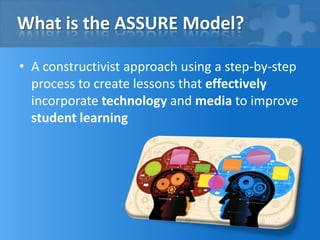
• A constructivist approach using a step-by-step
process to create lessons that effectively
incorporate technology and media to improve
student learning
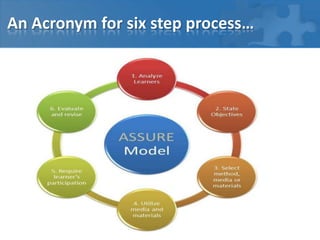
An Acronym for six step process…
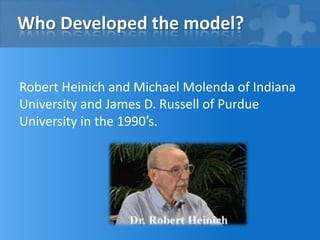
Who Developed the model?
Robert Heinich and Michael Molenda of Indiana
University and James D. Russell of Purdue
University in the 1990′s.
“Research has shown that well-designed
lessons begin with the arousal of
students’ interests…”

We need to know our students…
Analyze Learners…
Learning Styles:
Multiple intelligences, perceptual
preferences, motivation, processing habits, and
physiological factors

Entry Competencies:
Knowledge, skills and attitudes

General Characteristics:
Gender, Ethnicity, and Age
State Standards & Objectives…
Technology
Standards are
descriptions of
expected student
performance
established at the
school
district, state and
national level.

Objectives are
statements of
what each learner
will achieve, not
how the lesson is
taught and are
derived from the
curriculum and
technology

standards.
State Standards & Objectives…
Importance of Standards and
Objectives
• Help select
strategies, technology, and media
that will ensure learning
• Ensure assessment of student
learning
• Students are better prepared
when they know expected
outcomes
State Standards & Objectives…
Creating Well Stated Learning
Objectives
• Audience- specifies learner
• Behavior- should describe the new
capability of the learner/real world
skill
• Conditions- Materials and
environment of the learner
• Degree- includes time, accuracy
and qualitative standards
Select…
Questions to consider while selecting
strategies, technology, media, and
materials:
• Should this lesson be student or
teacher led?
• What strategy will engage and
motivate my students?
• What device of technology or media
will be best for all of my students?
• Should I create my own materials, use
or modify existing materials?
Utilize Technology, Media &
Materials..
Follow the 5 “Ps”
1. Preview your selection in relation to
learning objectives.
2. Prepare devices, media, and materials.
3. Prepare the environment- think of where
learning will take place.
4. Prepare the learners- use proper “warmups”
5. Provide the learning experience.
Require Learner Participation…
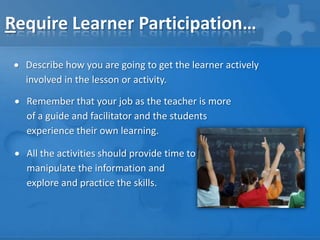
Describe how you are going to get the learner actively
involved in the lesson or activity.

Remember that your job as the teacher is more
of a guide and facilitator and the students
experience their own learning.
All the activities should provide time to
manipulate the information and
explore and practice the skills.
Evaluate & Revise…
This is where you reflect and decide if you
can make anything better for future
lessons.
You evaluate student performance and
decide whether they can do better during
the next time.
You should also evaluate the media
components and how effective they were.
Evaluate instructor performance by selfexamining how you did as an instructor or
facilitator.
Why Use ASSURE?
• Customized
• Students will learn by actively participating
• Tried and True
Sources
• http://www.utm.edu/staff/grakes/750/750assuremo
del.html
• http://ed205.net/assure_model.html
• Smaldino, Sharon, Deborah Lowther, and James
Russell.Instructional Technology and Media for
Learning. 10th. Boston, MA: Pearson
Education, 2012. 36-63. Print.

Chapter 3 Assure

  • 1.
    Chapter 3 The AS S U R E Model Frostburg State University Fall 2013 Presented by: Nicole Whiteman, Tara Fair, Amanda Deal, and Jacob Twigg
  • 2.
    What is theASSURE Model? • A constructivist approach using a step-by-step process to create lessons that effectively incorporate technology and media to improve student learning
  • 3.
    An Acronym forsix step process…
  • 4.
    Who Developed themodel? Robert Heinich and Michael Molenda of Indiana University and James D. Russell of Purdue University in the 1990′s.
  • 5.
    “Research has shownthat well-designed lessons begin with the arousal of students’ interests…” We need to know our students…
  • 6.
    Analyze Learners… Learning Styles: Multipleintelligences, perceptual preferences, motivation, processing habits, and physiological factors Entry Competencies: Knowledge, skills and attitudes General Characteristics: Gender, Ethnicity, and Age
  • 7.
    State Standards &Objectives… Technology Standards are descriptions of expected student performance established at the school district, state and national level. Objectives are statements of what each learner will achieve, not how the lesson is taught and are derived from the curriculum and technology standards.
  • 8.
    State Standards &Objectives… Importance of Standards and Objectives • Help select strategies, technology, and media that will ensure learning • Ensure assessment of student learning • Students are better prepared when they know expected outcomes
  • 9.
    State Standards &Objectives… Creating Well Stated Learning Objectives • Audience- specifies learner • Behavior- should describe the new capability of the learner/real world skill • Conditions- Materials and environment of the learner • Degree- includes time, accuracy and qualitative standards
  • 10.
    Select… Questions to considerwhile selecting strategies, technology, media, and materials: • Should this lesson be student or teacher led? • What strategy will engage and motivate my students? • What device of technology or media will be best for all of my students? • Should I create my own materials, use or modify existing materials?
  • 11.
    Utilize Technology, Media& Materials.. Follow the 5 “Ps” 1. Preview your selection in relation to learning objectives. 2. Prepare devices, media, and materials. 3. Prepare the environment- think of where learning will take place. 4. Prepare the learners- use proper “warmups” 5. Provide the learning experience.
  • 12.
    Require Learner Participation… Describehow you are going to get the learner actively involved in the lesson or activity. Remember that your job as the teacher is more of a guide and facilitator and the students experience their own learning. All the activities should provide time to manipulate the information and explore and practice the skills.
  • 13.
    Evaluate & Revise… Thisis where you reflect and decide if you can make anything better for future lessons. You evaluate student performance and decide whether they can do better during the next time. You should also evaluate the media components and how effective they were. Evaluate instructor performance by selfexamining how you did as an instructor or facilitator.
  • 14.
    Why Use ASSURE? •Customized • Students will learn by actively participating • Tried and True
  • 15.
    Sources • http://www.utm.edu/staff/grakes/750/750assuremo del.html • http://ed205.net/assure_model.html •Smaldino, Sharon, Deborah Lowther, and James Russell.Instructional Technology and Media for Learning. 10th. Boston, MA: Pearson Education, 2012. 36-63. Print.