1
Chapter 2: Commercial Discount
1- Definition
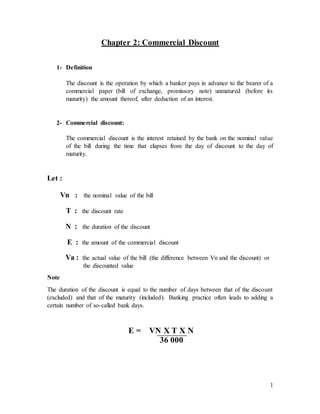
The discount is the operation by which a banker pays in advance to the bearer of a
commercial paper (bill of exchange, promissory note) unmatured (before its
maturity) the amount thereof, after deduction of an interest.
2- Commercial discount:
The commercial discount is the interest retained by the bank on the nominal value
of the bill during the time that elapses from the day of discount to the day of
maturity.
Let :
Vn : the nominal value of the bill
T : the discount rate
N : the duration of the discount
E : the amount of the commercial discount
Va : the actual value of the bill (the difference between Vn and the discount) or
the discounted value
Note
The duration of the discount is equal to the number of days between that of the discount
(excluded) and that of the maturity (included). Banking practice often leads to adding a
certain number of so-called bank days.
E = VN X T X N
36 000
2
Example
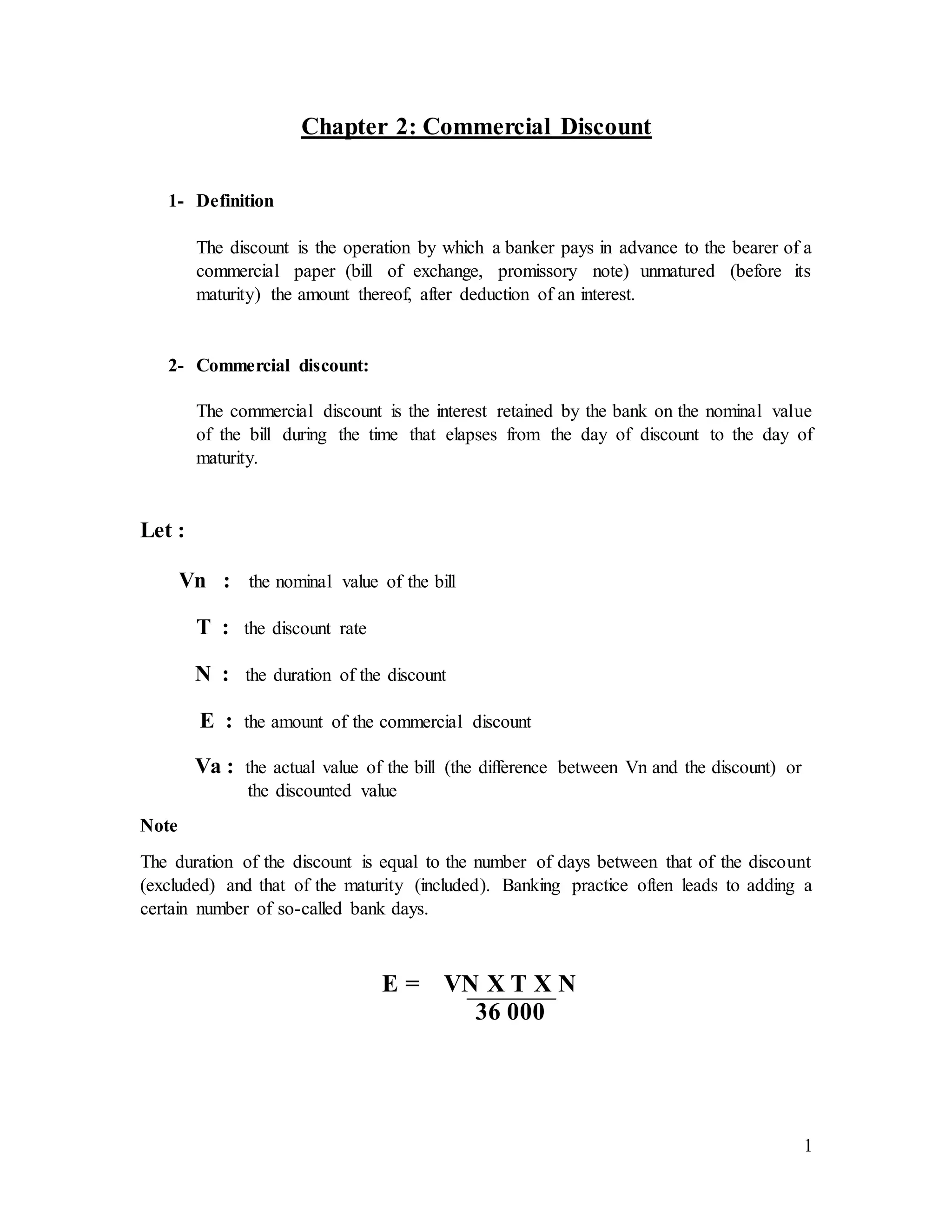
A trader negotiates a bill of $8,850, payable in 40 days. Discount rate: 12%.
Negotiation date Maturity
Rate 12%
40 d
E = Vn x t x n
36 000
E = 8850 X 12 X 40 = $118
36 000
Va = Vn – E
Va = 8850 -118 = 8,732
Application
A supplier negotiates on May 9 a bill of $15,000 whose maturity is August 15 of the same
year. The bank discounted the draft at a rate of 12%.
What is the amount of the discount?
Solution
Negotiation date maturity date
May 9 August 15
98 d
E = Vn x Tx n = 15,000 x 98 x 12 = $490
36000 36000
Va = 15,000 - 490 = $14,510
3
3- Discount practice
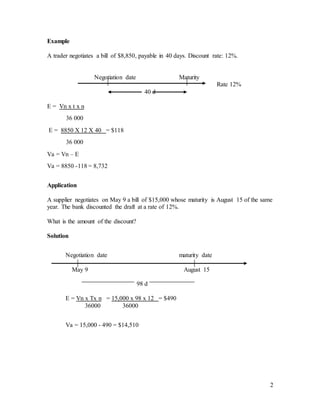
In practice, discounting an item involves financial costs, in addition to the actual
discount.
The fees include several commissions (Example: acceptance and mail
commission).
All of the discount and commissions are called "agio"
In general, the agio consists of:
 The discount
 Various commissions
 VAT (value added tax rate)
 VAT is applied directly on the whole of the agio (excluding tax)
Example:
Given a commercial bill of $25,000, due on June 24, 1997 and discounted on April 15 of
the same year under the following conditions:
Discount rate 13%
handling fees/bill $2
VAT at 7%
Take into account a bank day
Number of days: 70 + 1 = 71 days
25 000 x 13 x 71
Discount = = $640,97
36 000
Handling fees = $2
Total excluding tax = $642,97
VAT = $45
Agio (including tax) = $687,97
Actual value (V.a ) = 25 000 – 687,97 = $24 312,03
4
4- Equivalence of capitals using simple interest
Two bills are equivalent on a given date, when, discounted at the same rate, they
have the same present value on a determined date known as the equivalence date.
Example
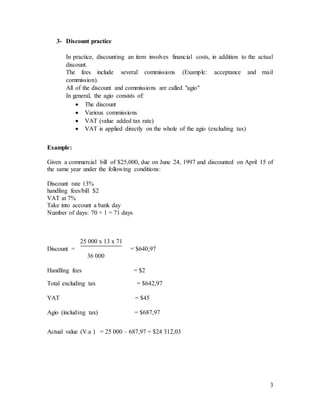
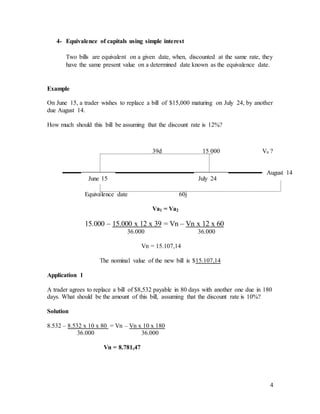
On June 15, a trader wishes to replace a bill of $15,000 maturing on July 24, by another
due August 14.
How much should this bill be assuming that the discount rate is 12%?
39d 15 000 Vn ?
Equivalence date 60j
Va1 = Va2
15.000 – 15.000 x 12 x 39 = Vn – Vn x 12 x 60
36.000 36.000
Vn = 15.107,14
The nominal value of the new bill is $15.107,14
Application 1
A trader agrees to replace a bill of $8,532 payable in 80 days with another one due in 180
days. What should be the amount of this bill, assuming that the discount rate is 10%?
Solution
8.532 – 8.532 x 10 x 80 = Vn – Vn x 10 x 180
36.000 36.000
Vn = 8.781,47
June 15 July 24
August 14
5
Application 2
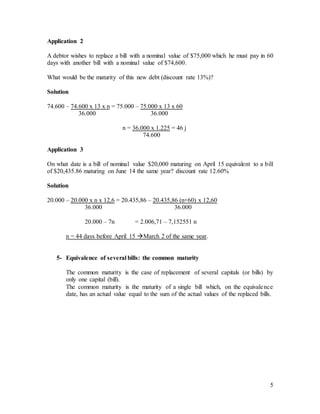
A debtor wishes to replace a bill with a nominal value of $75,000 which he must pay in 60
days with another bill with a nominal value of $74,600.
What would be the maturity of this new debt (discount rate 13%)?
Solution
74.600 – 74.600 x 13 x n = 75.000 – 75.000 x 13 x 60
36.000 36.000
n = 36.000 x 1.225 = 46 j
74.600
Application 3
On what date is a bill of nominal value $20,000 maturing on April 15 equivalent to a bill
of $20,435.86 maturing on June 14 the same year? discount rate 12.60%
Solution
20.000 – 20.000 x n x 12,6 = 20.435,86 – 20.435,86 (n+60) x 12,60
36.000 36.000
20.000 – 7n = 2.006,71 – 7,152551 n
n = 44 days before April 15 March 2 of the same year.
5- Equivalence of several bills: the common maturity
The common maturity is the case of replacement of several capitals (or bills) by
only one capital (bill).
The common maturity is the maturity of a single bill which, on the equivalence
date, has an actual value equal to the sum of the actual values of the replaced bills.
6
Example
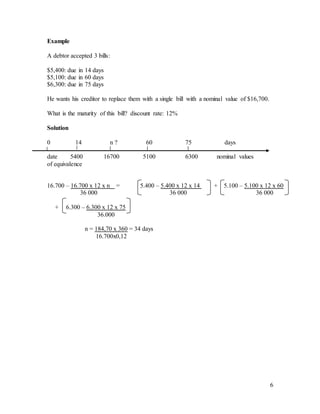
A debtor accepted 3 bills:
$5,400: due in 14 days
$5,100: due in 60 days
$6,300: due in 75 days
He wants his creditor to replace them with a single bill with a nominal value of $16,700.
What is the maturity of this bill? discount rate: 12%
Solution
0 14 n ? 60 75 days
date 5400 16700 5100 6300 nominal values
of equivalence
16.700 – 16.700 x 12 x n = 5.400 – 5.400 x 12 x 14 + 5.100 – 5.100 x 12 x 60
36 000 36 000 36 000
+ 6.300 – 6.300 x 12 x 75
36.000
n = 184,70 x 360 = 34 days
16.700x0,12

Chapter 2.docx

  • 1.
    1 Chapter 2: CommercialDiscount 1- Definition The discount is the operation by which a banker pays in advance to the bearer of a commercial paper (bill of exchange, promissory note) unmatured (before its maturity) the amount thereof, after deduction of an interest. 2- Commercial discount: The commercial discount is the interest retained by the bank on the nominal value of the bill during the time that elapses from the day of discount to the day of maturity. Let : Vn : the nominal value of the bill T : the discount rate N : the duration of the discount E : the amount of the commercial discount Va : the actual value of the bill (the difference between Vn and the discount) or the discounted value Note The duration of the discount is equal to the number of days between that of the discount (excluded) and that of the maturity (included). Banking practice often leads to adding a certain number of so-called bank days. E = VN X T X N 36 000
  • 2.
    2 Example A trader negotiatesa bill of $8,850, payable in 40 days. Discount rate: 12%. Negotiation date Maturity Rate 12% 40 d E = Vn x t x n 36 000 E = 8850 X 12 X 40 = $118 36 000 Va = Vn – E Va = 8850 -118 = 8,732 Application A supplier negotiates on May 9 a bill of $15,000 whose maturity is August 15 of the same year. The bank discounted the draft at a rate of 12%. What is the amount of the discount? Solution Negotiation date maturity date May 9 August 15 98 d E = Vn x Tx n = 15,000 x 98 x 12 = $490 36000 36000 Va = 15,000 - 490 = $14,510
  • 3.
    3 3- Discount practice Inpractice, discounting an item involves financial costs, in addition to the actual discount. The fees include several commissions (Example: acceptance and mail commission). All of the discount and commissions are called "agio" In general, the agio consists of:  The discount  Various commissions  VAT (value added tax rate)  VAT is applied directly on the whole of the agio (excluding tax) Example: Given a commercial bill of $25,000, due on June 24, 1997 and discounted on April 15 of the same year under the following conditions: Discount rate 13% handling fees/bill $2 VAT at 7% Take into account a bank day Number of days: 70 + 1 = 71 days 25 000 x 13 x 71 Discount = = $640,97 36 000 Handling fees = $2 Total excluding tax = $642,97 VAT = $45 Agio (including tax) = $687,97 Actual value (V.a ) = 25 000 – 687,97 = $24 312,03
  • 4.
    4 4- Equivalence ofcapitals using simple interest Two bills are equivalent on a given date, when, discounted at the same rate, they have the same present value on a determined date known as the equivalence date. Example On June 15, a trader wishes to replace a bill of $15,000 maturing on July 24, by another due August 14. How much should this bill be assuming that the discount rate is 12%? 39d 15 000 Vn ? Equivalence date 60j Va1 = Va2 15.000 – 15.000 x 12 x 39 = Vn – Vn x 12 x 60 36.000 36.000 Vn = 15.107,14 The nominal value of the new bill is $15.107,14 Application 1 A trader agrees to replace a bill of $8,532 payable in 80 days with another one due in 180 days. What should be the amount of this bill, assuming that the discount rate is 10%? Solution 8.532 – 8.532 x 10 x 80 = Vn – Vn x 10 x 180 36.000 36.000 Vn = 8.781,47 June 15 July 24 August 14
  • 5.
    5 Application 2 A debtorwishes to replace a bill with a nominal value of $75,000 which he must pay in 60 days with another bill with a nominal value of $74,600. What would be the maturity of this new debt (discount rate 13%)? Solution 74.600 – 74.600 x 13 x n = 75.000 – 75.000 x 13 x 60 36.000 36.000 n = 36.000 x 1.225 = 46 j 74.600 Application 3 On what date is a bill of nominal value $20,000 maturing on April 15 equivalent to a bill of $20,435.86 maturing on June 14 the same year? discount rate 12.60% Solution 20.000 – 20.000 x n x 12,6 = 20.435,86 – 20.435,86 (n+60) x 12,60 36.000 36.000 20.000 – 7n = 2.006,71 – 7,152551 n n = 44 days before April 15 March 2 of the same year. 5- Equivalence of several bills: the common maturity The common maturity is the case of replacement of several capitals (or bills) by only one capital (bill). The common maturity is the maturity of a single bill which, on the equivalence date, has an actual value equal to the sum of the actual values of the replaced bills.
  • 6.
    6 Example A debtor accepted3 bills: $5,400: due in 14 days $5,100: due in 60 days $6,300: due in 75 days He wants his creditor to replace them with a single bill with a nominal value of $16,700. What is the maturity of this bill? discount rate: 12% Solution 0 14 n ? 60 75 days date 5400 16700 5100 6300 nominal values of equivalence 16.700 – 16.700 x 12 x n = 5.400 – 5.400 x 12 x 14 + 5.100 – 5.100 x 12 x 60 36 000 36 000 36 000 + 6.300 – 6.300 x 12 x 75 36.000 n = 184,70 x 360 = 34 days 16.700x0,12