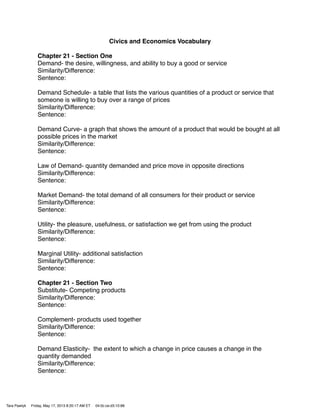
Civics and Economics Vocabulary
Chapter 21 - Section One
Demand- the desire, willingness, and ability to buy a good or service
Similarity/Difference:
Sentence:
Demand Schedule- a table that lists the various quantities of a product or service that
someone is willing to buy over a range of prices
Similarity/Difference:
Sentence:
Demand Curve- a graph that shows the amount of a product that would be bought at all
possible prices in the market
Similarity/Difference:
Sentence:
Law of Demand- quantity demanded and price move in opposite directions
Similarity/Difference:
Sentence:
Market Demand- the total demand of all consumers for their product or service
Similarity/Difference:
Sentence:
Utility- the pleasure, usefulness, or satisfaction we get from using the product
Similarity/Difference:
Sentence:
Marginal Utility- additional satisfaction
Similarity/Difference:
Sentence:
Chapter 21 - Section Two
Substitute- Competing products
Similarity/Difference:
Sentence:
Complement- products used together
Similarity/Difference:
Sentence:
Demand Elasticity- the extent to which a change in price causes a change in the
quantity demanded
Similarity/Difference:
Sentence:
Tara Pawlyk Friday, May 17, 2013 8:20:17 AM ET 04:0c:ce:d3:10:88
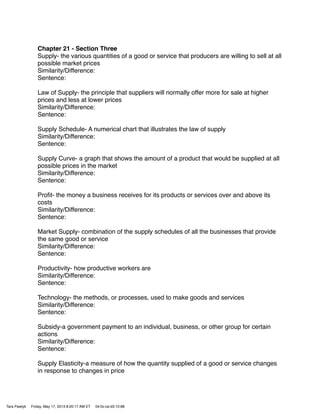
Chapter 21 - Section Three
Supply- the various quantities of a good or service that producers are willing to sell at all
possible market prices
Similarity/Difference:
Sentence:
Law of Supply- the principle that suppliers will normally offer more for sale at higher
prices and less at lower prices
Similarity/Difference:
Sentence:
Supply Schedule- A numerical chart that illustrates the law of supply
Similarity/Difference:
Sentence:
Supply Curve- a graph that shows the amount of a product that would be supplied at all
possible prices in the market
Similarity/Difference:
Sentence:
Profit- the money a business receives for its products or services over and above its
costs
Similarity/Difference:
Sentence:
Market Supply- combination of the supply schedules of all the businesses that provide
the same good or service
Similarity/Difference:
Sentence:
Productivity- how productive workers are
Similarity/Difference:
Sentence:
Technology- the methods, or processes, used to make goods and services
Similarity/Difference:
Sentence:
Subsidy-a government payment to an individual, business, or other group for certain
actions
Similarity/Difference:
Sentence:
Supply Elasticity-a measure of how the quantity supplied of a good or service changes
in response to changes in price
Tara Pawlyk Friday, May 17, 2013 8:20:17 AM ET 04:0c:ce:d3:10:88
Similarity/Difference:
Sentence:
Chapter 21 - Section Four
Surplus- amount by which the quantity supplied is higher than the quantity demanded
Similarity/Difference:
Sentence:
Shortage- the amount by which the quantity demanded is higher than the quantity
supplied
Similarity/Difference:
Sentence:
Equilibrium Price- neither a surplus nor a shortage
Similarity/Difference:
Sentence:
Price Ceiling- a maximum price set by the government that can be charged for goods
and services
Similarity/Difference:
Sentence:
Price Floor- a government minimum price that can be charged for goods and services
Similarity/Difference:
Sentence:
Minimum Wage- lowest legal wage that can be paid to most workers
Similarity/Difference:
Sentence:
Tara Pawlyk Friday, May 17, 2013 8:20:17 AM ET 04:0c:ce:d3:10:88

Chapter 21

  • 1.
    Civics and EconomicsVocabulary Chapter 21 - Section One Demand- the desire, willingness, and ability to buy a good or service Similarity/Difference: Sentence: Demand Schedule- a table that lists the various quantities of a product or service that someone is willing to buy over a range of prices Similarity/Difference: Sentence: Demand Curve- a graph that shows the amount of a product that would be bought at all possible prices in the market Similarity/Difference: Sentence: Law of Demand- quantity demanded and price move in opposite directions Similarity/Difference: Sentence: Market Demand- the total demand of all consumers for their product or service Similarity/Difference: Sentence: Utility- the pleasure, usefulness, or satisfaction we get from using the product Similarity/Difference: Sentence: Marginal Utility- additional satisfaction Similarity/Difference: Sentence: Chapter 21 - Section Two Substitute- Competing products Similarity/Difference: Sentence: Complement- products used together Similarity/Difference: Sentence: Demand Elasticity- the extent to which a change in price causes a change in the quantity demanded Similarity/Difference: Sentence: Tara Pawlyk Friday, May 17, 2013 8:20:17 AM ET 04:0c:ce:d3:10:88
  • 2.
    Chapter 21 -Section Three Supply- the various quantities of a good or service that producers are willing to sell at all possible market prices Similarity/Difference: Sentence: Law of Supply- the principle that suppliers will normally offer more for sale at higher prices and less at lower prices Similarity/Difference: Sentence: Supply Schedule- A numerical chart that illustrates the law of supply Similarity/Difference: Sentence: Supply Curve- a graph that shows the amount of a product that would be supplied at all possible prices in the market Similarity/Difference: Sentence: Profit- the money a business receives for its products or services over and above its costs Similarity/Difference: Sentence: Market Supply- combination of the supply schedules of all the businesses that provide the same good or service Similarity/Difference: Sentence: Productivity- how productive workers are Similarity/Difference: Sentence: Technology- the methods, or processes, used to make goods and services Similarity/Difference: Sentence: Subsidy-a government payment to an individual, business, or other group for certain actions Similarity/Difference: Sentence: Supply Elasticity-a measure of how the quantity supplied of a good or service changes in response to changes in price Tara Pawlyk Friday, May 17, 2013 8:20:17 AM ET 04:0c:ce:d3:10:88
  • 3.
    Similarity/Difference: Sentence: Chapter 21 -Section Four Surplus- amount by which the quantity supplied is higher than the quantity demanded Similarity/Difference: Sentence: Shortage- the amount by which the quantity demanded is higher than the quantity supplied Similarity/Difference: Sentence: Equilibrium Price- neither a surplus nor a shortage Similarity/Difference: Sentence: Price Ceiling- a maximum price set by the government that can be charged for goods and services Similarity/Difference: Sentence: Price Floor- a government minimum price that can be charged for goods and services Similarity/Difference: Sentence: Minimum Wage- lowest legal wage that can be paid to most workers Similarity/Difference: Sentence: Tara Pawlyk Friday, May 17, 2013 8:20:17 AM ET 04:0c:ce:d3:10:88