Chapter 2
CMC, Diffusion & Social
Theories
By: Nicole Katz, Hector Reyes, Jamie Albert,
Glenne De Gonzague
Identity
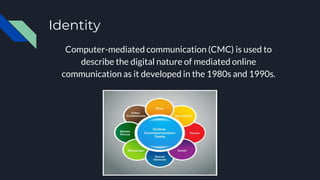
Computer-mediated communication (CMC) is used to
describe the digital nature of mediated online
communication as it developed in the 1980s and 1990s.
Identity
CMC:
● Examines how Identities and interactions create online
communities
● Offers a voice to groups seeking social changes, cultural changes,
and political power.
● Started out as a bulletin board system (BBS) or email and later,
developed into the World Wide Web (WWW) in the 1990s.
● Human-computer interaction (HCI): early research into how humans
engaged with computer hardware and software.
○ The social process of human-internet interaction is found
within social media communication.
Internet History
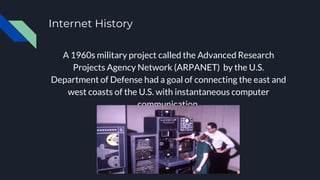
A 1960s military project called the Advanced Research
Projects Agency Network (ARPANET) by the U.S.
Department of Defense had a goal of connecting the east and
west coasts of the U.S. with instantaneous computer
communication.
Internet History (Cont.)
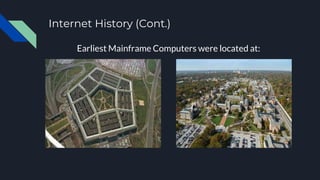
Earliest Mainframe Computers were located at:
Internet History (Cont.)
● Packeting switch: the method of moving internet data in packet
chunks and re-assembling content upon arrival.
● Examples of public systems during 1980s and 1990s
○ CompuServe
○ Prodigy
○ America Online
○ The WELL
○ Telephone dial up chat rooms
○ Information services
○ Online games
Internet History (Cont.)
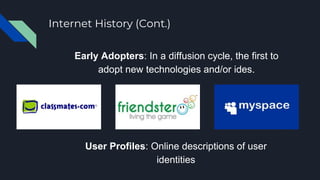
Early Adopters: In a diffusion cycle, the first to
adopt new technologies and/or ides.
User Profiles: Online descriptions of user
identities
Social Networking Happens with a
Cyber Cultural Context
● Frequently involve existing interpersonal
friendships that move into somewhat fluid
online spaces.
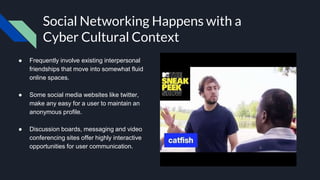
● Some social media websites like twitter,
make any easy for a user to maintain an
anonymous profile.
● Discussion boards, messaging and video
conferencing sites offer highly interactive
opportunities for user communication.
Social Networking Site Definitions
In order to have computer mediated communication (CMC) we use
social networking sites (SNS)
Often times we try to avoid using the word “networking” because it
may bring forth the awkwardness of having to meet strangers.
So instead the internet uses pre existing profiles that connect us to
identifiable users. Similar to the strategy of “cookies”
Example: Many sites or apps recommend people for us to follow
based on the content we’ve liked (via Instagram) or people for us to
connect based on similar career interest or Universities (via LinkedIn)
Media Sites and Functions
We have relationships like “friends” “followers” “fans” “contacts” “subscribers” etc.
There is a cyber cultural context that we involve ourselves in. The global community
gives us room to hide behind our screens and to an extent alter our identity. As well as
forcing us to keep a form of “impression management” and “self presentation”
Some sites require more interaction that others. (i.e. online users enter virtual spaces
while playing games)
Vlogs
Video bloggers use video posts instead of text.
Vlogs are regular commentary in video
medium.
Communication / Interaction / Community
The foundation of social media is really our desire to use the online network to connect
with others and broaden our networks.
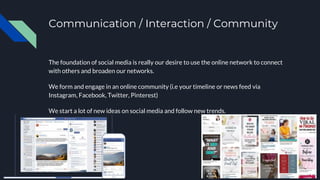
We form and engage in an online community (i.e your timeline or news feed via
Instagram, Facebook, Twitter, Pinterest)
We start a lot of new ideas on social media and follow new trends.
Diffusion of New Ideas
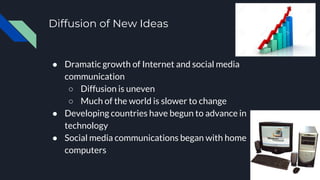
● Dramatic growth of Internet and social media
communication
○ Diffusion is uneven
○ Much of the world is slower to change
● Developing countries have begun to advance in
technology
● Social media communications began with home
computers
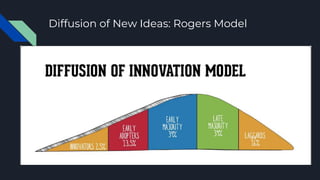
Diffusion of New Ideas: Rogers Model
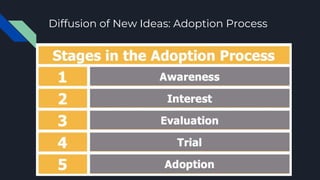
Diffusion of New Ideas: Adoption Process
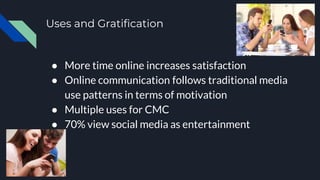
Uses and Gratification
● More time online increases satisfaction
● Online communication follows traditional media
use patterns in terms of motivation
● Multiple uses for CMC
● 70% view social media as entertainment
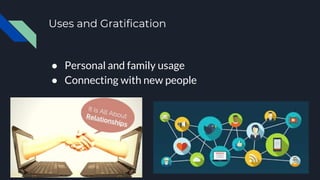
Uses and Gratification
● Personal and family usage
● Connecting with new people
Online Culture & Power
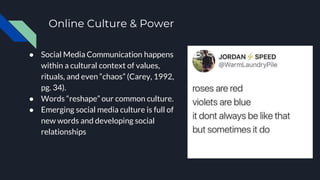
● Social Media Communication happens
within a cultural context of values,
rituals, and even “chaos” (Carey, 1992,
pg. 34).
● Words “reshape” our common culture.
● Emerging social media culture is full of
new words and developing social
relationships
Online Culture & Power (continued)
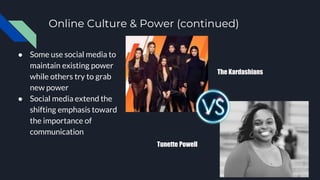
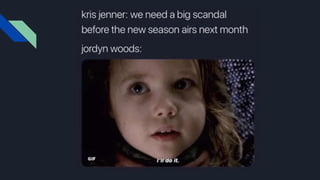
● Some use social media to
maintain existing power
while others try to grab
new power
● Social media extend the
shifting emphasis toward
the importance of
communication
The Kardashians
Tunette Powell
Online Culture & Power (continued)
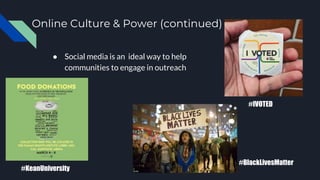
● Social media is an ideal way to help
communities to engage in outreach
#KeanUniversity
#IVOTED
#BlackLivesMatter
Online Culture & Power (continued)
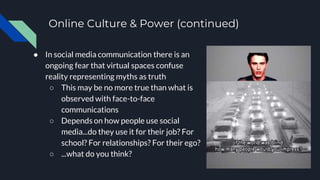
● In social media communication there is an
ongoing fear that virtual spaces confuse
reality representing myths as truth
○ This may be no more true than what is
observed with face-to-face
communications
○ Depends on how people use social
media...do they use it for their job? For
school? For relationships? For their ego?
○ ...what do you think?
CMC and Social Media
● CMC = Computer Mediated
Communications
○ Began with discussion boards and
emails
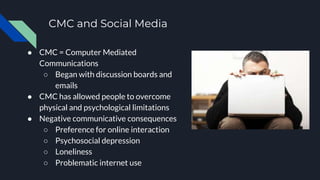
● CMC has allowed people to overcome
physical and psychological limitations
● Negative communicative consequences
○ Preference for online interaction
○ Psychosocial depression
○ Loneliness
○ Problematic internet use
CMC and Social Media (continued)
● Preference for online socialization is a key contributor to the
development of problematic Internet use
● When CMC is prefered over F2F, then there is a problem.
● Significant relationship found between psychosocial health and
preference for online socialization
● CMC is a TOOL
● This tool may lead people with problems to take these into online
environments rather than the negative effects being CAUSED by
online usage.
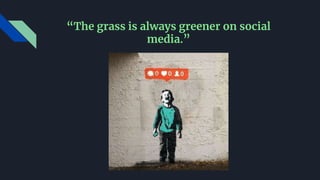
“The grass is always greener on social
media.”
CMC and Social Media (continued)
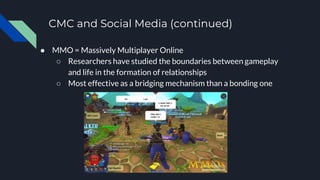
● MMO = Massively Multiplayer Online
○ Researchers have studied the boundaries between gameplay
and life in the formation of relationships
○ Most effective as a bridging mechanism than a bonding one
CMC and Social Media (continued)
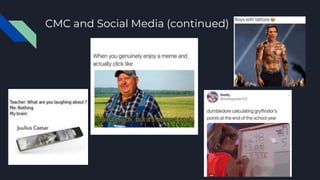
● Internet Memes: the propagation of content items such as jokes,
rumors, videos, or websites from one person to others
○ Cultural information that passes along from person to
person and gradually becomes a social phenomenon
○ Reproduce by various means of imitation
○ Interesting because of their diffusion through competition
and selection
● Online users have freedom but cultural boundaries exist
CMC and Social Media (continued)
● Paradox in social media
○ May have a tendency to trigger silence on controversial issues but some
users feel liberated to express their opinions
○ access the climate of opinion before responding
● Pew Research Center: study of #BlackLivesMatter
○ Black users were twice as likely as white users to see racial content on
social media sites
○ From Jan. 2015-March 2016: 995 million tweets about race
○ Viewed this form of social movement as a social media revolution that
functions through activists in content sharing designed to expose
corruption, exploitation and criminal behavior
CMC and Social Media (continued)
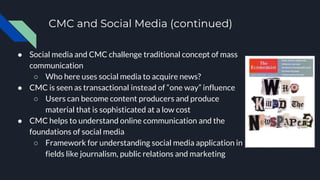
● Social media and CMC challenge traditional concept of mass
communication
○ Who here uses social media to acquire news?
● CMC is seen as transactional instead of “one way” influence
○ Users can become content producers and produce
material that is sophisticated at a low cost
● CMC helps to understand online communication and the
foundations of social media
○ Framework for understanding social media application in
fields like journalism, public relations and marketing
Discussion Questions:
1. How has CMC influenced the way we form relationships? How
may in blur the lines between reality and fantasy?
2. How would a visualization of your social networks depict
communication patterns and relationships? How could this be
used to influence future online behavior?
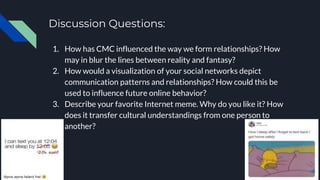
3. Describe your favorite Internet meme. Why do you like it? How
does it transfer cultural understandings from one person to
another?
Activity!
1. Get in your groups!
2. You have 3 minutes to make a list
of words (or phrases) that have
reshaped our culture through
social media. The group with the
longest list wins.
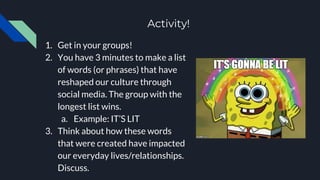
a. Example: IT’S LIT
3. Think about how these words
that were created have impacted
our everyday lives/relationships.
Discuss.

Chapter 2

  • 1.
    Chapter 2 CMC, Diffusion& Social Theories By: Nicole Katz, Hector Reyes, Jamie Albert, Glenne De Gonzague
  • 2.
    Identity Computer-mediated communication (CMC)is used to describe the digital nature of mediated online communication as it developed in the 1980s and 1990s.
  • 3.
    Identity CMC: ● Examines howIdentities and interactions create online communities ● Offers a voice to groups seeking social changes, cultural changes, and political power. ● Started out as a bulletin board system (BBS) or email and later, developed into the World Wide Web (WWW) in the 1990s. ● Human-computer interaction (HCI): early research into how humans engaged with computer hardware and software. ○ The social process of human-internet interaction is found within social media communication.
  • 4.
    Internet History A 1960smilitary project called the Advanced Research Projects Agency Network (ARPANET) by the U.S. Department of Defense had a goal of connecting the east and west coasts of the U.S. with instantaneous computer communication.
  • 5.
    Internet History (Cont.) EarliestMainframe Computers were located at:
  • 6.
    Internet History (Cont.) ●Packeting switch: the method of moving internet data in packet chunks and re-assembling content upon arrival. ● Examples of public systems during 1980s and 1990s ○ CompuServe ○ Prodigy ○ America Online ○ The WELL ○ Telephone dial up chat rooms ○ Information services ○ Online games
  • 7.
    Internet History (Cont.) EarlyAdopters: In a diffusion cycle, the first to adopt new technologies and/or ides. User Profiles: Online descriptions of user identities
  • 8.
    Social Networking Happenswith a Cyber Cultural Context ● Frequently involve existing interpersonal friendships that move into somewhat fluid online spaces. ● Some social media websites like twitter, make any easy for a user to maintain an anonymous profile. ● Discussion boards, messaging and video conferencing sites offer highly interactive opportunities for user communication.
  • 9.
    Social Networking SiteDefinitions In order to have computer mediated communication (CMC) we use social networking sites (SNS) Often times we try to avoid using the word “networking” because it may bring forth the awkwardness of having to meet strangers. So instead the internet uses pre existing profiles that connect us to identifiable users. Similar to the strategy of “cookies” Example: Many sites or apps recommend people for us to follow based on the content we’ve liked (via Instagram) or people for us to connect based on similar career interest or Universities (via LinkedIn)
  • 10.
    Media Sites andFunctions We have relationships like “friends” “followers” “fans” “contacts” “subscribers” etc. There is a cyber cultural context that we involve ourselves in. The global community gives us room to hide behind our screens and to an extent alter our identity. As well as forcing us to keep a form of “impression management” and “self presentation” Some sites require more interaction that others. (i.e. online users enter virtual spaces while playing games)
  • 11.
    Vlogs Video bloggers usevideo posts instead of text. Vlogs are regular commentary in video medium.
  • 12.
    Communication / Interaction/ Community The foundation of social media is really our desire to use the online network to connect with others and broaden our networks. We form and engage in an online community (i.e your timeline or news feed via Instagram, Facebook, Twitter, Pinterest) We start a lot of new ideas on social media and follow new trends.
  • 13.
    Diffusion of NewIdeas ● Dramatic growth of Internet and social media communication ○ Diffusion is uneven ○ Much of the world is slower to change ● Developing countries have begun to advance in technology ● Social media communications began with home computers
  • 14.
    Diffusion of NewIdeas: Rogers Model
  • 15.
    Diffusion of NewIdeas: Adoption Process
  • 16.
    Uses and Gratification ●More time online increases satisfaction ● Online communication follows traditional media use patterns in terms of motivation ● Multiple uses for CMC ● 70% view social media as entertainment
  • 17.
    Uses and Gratification ●Personal and family usage ● Connecting with new people
  • 18.
    Online Culture &Power ● Social Media Communication happens within a cultural context of values, rituals, and even “chaos” (Carey, 1992, pg. 34). ● Words “reshape” our common culture. ● Emerging social media culture is full of new words and developing social relationships
  • 19.
    Online Culture &Power (continued) ● Some use social media to maintain existing power while others try to grab new power ● Social media extend the shifting emphasis toward the importance of communication The Kardashians Tunette Powell
  • 21.
    Online Culture &Power (continued) ● Social media is an ideal way to help communities to engage in outreach #KeanUniversity #IVOTED #BlackLivesMatter
  • 22.
    Online Culture &Power (continued) ● In social media communication there is an ongoing fear that virtual spaces confuse reality representing myths as truth ○ This may be no more true than what is observed with face-to-face communications ○ Depends on how people use social media...do they use it for their job? For school? For relationships? For their ego? ○ ...what do you think?
  • 23.
    CMC and SocialMedia ● CMC = Computer Mediated Communications ○ Began with discussion boards and emails ● CMC has allowed people to overcome physical and psychological limitations ● Negative communicative consequences ○ Preference for online interaction ○ Psychosocial depression ○ Loneliness ○ Problematic internet use
  • 24.
    CMC and SocialMedia (continued) ● Preference for online socialization is a key contributor to the development of problematic Internet use ● When CMC is prefered over F2F, then there is a problem. ● Significant relationship found between psychosocial health and preference for online socialization ● CMC is a TOOL ● This tool may lead people with problems to take these into online environments rather than the negative effects being CAUSED by online usage.
  • 25.
    “The grass isalways greener on social media.”
  • 26.
    CMC and SocialMedia (continued) ● MMO = Massively Multiplayer Online ○ Researchers have studied the boundaries between gameplay and life in the formation of relationships ○ Most effective as a bridging mechanism than a bonding one
  • 27.
    CMC and SocialMedia (continued) ● Internet Memes: the propagation of content items such as jokes, rumors, videos, or websites from one person to others ○ Cultural information that passes along from person to person and gradually becomes a social phenomenon ○ Reproduce by various means of imitation ○ Interesting because of their diffusion through competition and selection ● Online users have freedom but cultural boundaries exist
  • 28.
    CMC and SocialMedia (continued)
  • 29.
    CMC and SocialMedia (continued) ● Paradox in social media ○ May have a tendency to trigger silence on controversial issues but some users feel liberated to express their opinions ○ access the climate of opinion before responding ● Pew Research Center: study of #BlackLivesMatter ○ Black users were twice as likely as white users to see racial content on social media sites ○ From Jan. 2015-March 2016: 995 million tweets about race ○ Viewed this form of social movement as a social media revolution that functions through activists in content sharing designed to expose corruption, exploitation and criminal behavior
  • 30.
    CMC and SocialMedia (continued) ● Social media and CMC challenge traditional concept of mass communication ○ Who here uses social media to acquire news? ● CMC is seen as transactional instead of “one way” influence ○ Users can become content producers and produce material that is sophisticated at a low cost ● CMC helps to understand online communication and the foundations of social media ○ Framework for understanding social media application in fields like journalism, public relations and marketing
  • 31.
    Discussion Questions: 1. Howhas CMC influenced the way we form relationships? How may in blur the lines between reality and fantasy? 2. How would a visualization of your social networks depict communication patterns and relationships? How could this be used to influence future online behavior? 3. Describe your favorite Internet meme. Why do you like it? How does it transfer cultural understandings from one person to another?
  • 32.
    Activity! 1. Get inyour groups! 2. You have 3 minutes to make a list of words (or phrases) that have reshaped our culture through social media. The group with the longest list wins. a. Example: IT’S LIT 3. Think about how these words that were created have impacted our everyday lives/relationships. Discuss.

Editor's Notes

  • #20 -came from a lower class family, husband was in military. Moved to nebraska. -since social media was free, she began to utilize it and reach out to her community. -she started blogs, eventually got paid to be a blogger and published her own books. -moved to LA where she used to social media to reach out to her community and get appointed to the neighbhorhood council. -rags to riches
  • #23 Think about instagram models. What if there wasnt instagram? When is that power being abused?
  • #24 Physically unable to get out and meet people face to face. Or if you’re anxious and prefer to stay in the house, can ease the feeling of isolation However, there are consequences.
  • #27 Again, brings up the topic of illusion and reality. Some people tend to get lost in fantasy.
  • #30 For instance, some people just like to scroll through instagram and not comment/post. Or we all know the people that just watch your SnapChat stories but don’t respond. Twitter and other Social Media platforms are used to mobilize social movements in the face of the government power & control.
  • #31 For instance, newspapers are failing. Ex: My cousin got laid off from the Asbury Park Press because dying form of media. Many people don’t have cable TV anymore. Many people admit to getting their news from Social Media sites.
  • #33 Clout Swerve Throwing shade I’ll dub you Deadass Lit