VCE ACCOUNTING 
UNIT 3 – RECORDING AND REPORTING FOR A TRADING BUSINESS 
CHAPTER 2 – BALANCE SHEETS 
 
Page | 1  
 
Student50 
Chapter 2 – Task B 
 
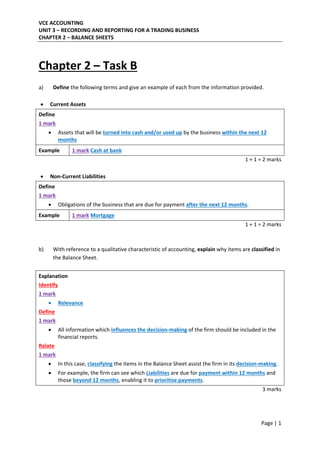
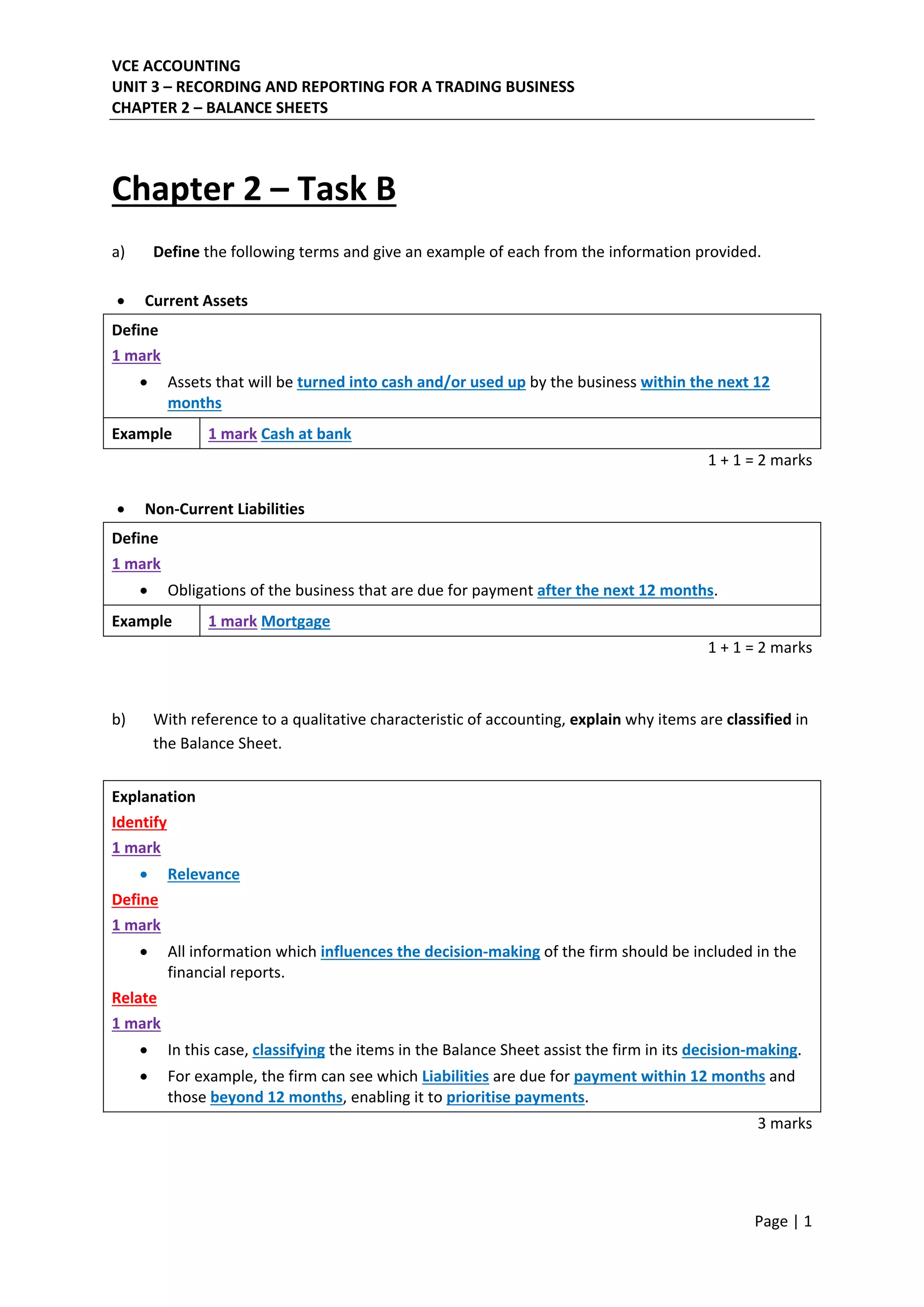
a)   Define the following terms and give an example of each from the information provided.   
 
 Current Assets 
Define 
1 mark 
 Assets that will be turned into cash and/or used up by the business within the next 12 
months 
Example  1 mark Cash at bank 
1 + 1 = 2 marks 
 
 Non‐Current Liabilities 
Define 
1 mark 
 Obligations of the business that are due for payment after the next 12 months. 
Example  1 mark Mortgage 
1 + 1 = 2 marks 
 
 
b)   With reference to a qualitative characteristic of accounting, explain why items are classified in 
the Balance Sheet.  
 
Explanation 
Identify  
1 mark 
 Relevance 
Define 
1 mark 
 All information which influences the decision‐making of the firm should be included in the 
financial reports. 
Relate 
1 mark 
 In this case, classifying the items in the Balance Sheet assist the firm in its decision‐making. 
 For example, the firm can see which Liabilities are due for payment within 12 months and 
those beyond 12 months, enabling it to prioritise payments. 
3 marks 
 
VCE ACCOUNTING 
UNIT 3 – RECORDING AND REPORTING FOR A TRADING BUSINESS 
CHAPTER 2 – BALANCE SHEETS 
 
Page | 2  
 
 
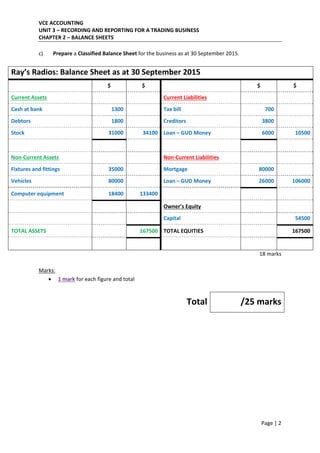
c)   Prepare a Classified Balance Sheet for the business as at 30 September 2015.  
 
Ray’s Radios: Balance Sheet as at 30 September 2015
  $  $    $  $ 
Current Assets    Current Liabilities 
Cash at bank  1300  Tax bill  700
Debtors  1800  Creditors  3800
Stock  31000  34100 Loan – GUD Money  6000 10500
     
Non‐Current Assets    Non‐Current Liabilities 
Fixtures and fittings  35000  Mortgage  80000
Vehicles  80000  Loan – GUD Money  26000 106000
Computer equipment  18400  133400  
    Owner’s Equity 
    Capital  54500
TOTAL ASSETS    167500 TOTAL EQUITIES  167500
     
18 marks 
 
Marks: 
 1 mark for each figure and total 
 
Total /25 marks
 

Chapter 2 - Balance Sheets Task B Solutions