VCE ACCOUNTING
UNIT 4 – CONTROL AND ANALYSIS OF BUSINESS PERFORMANCE
OUTCOME 1B – INVENTORY VALUATION AND BALANCE-DAY ADJUSTMENTS FOR REVENUE
Version 1a Page | 1
Name
Instructions
Complete ALL questions. The marks for each question are listed. There are 60 marks in total.
Time
75 minutes.
OUTCOME 1B
Question 1 – Sporting Life
Jackie Jones owns and operates a small business, Sporting Life, which specialises in the sale of sports
clothing and sports equipment. The business uses the double-entry accounting system based on the
accrual method of accounting. Sporting Life uses a 12-month reporting period ending on 31
December every year.
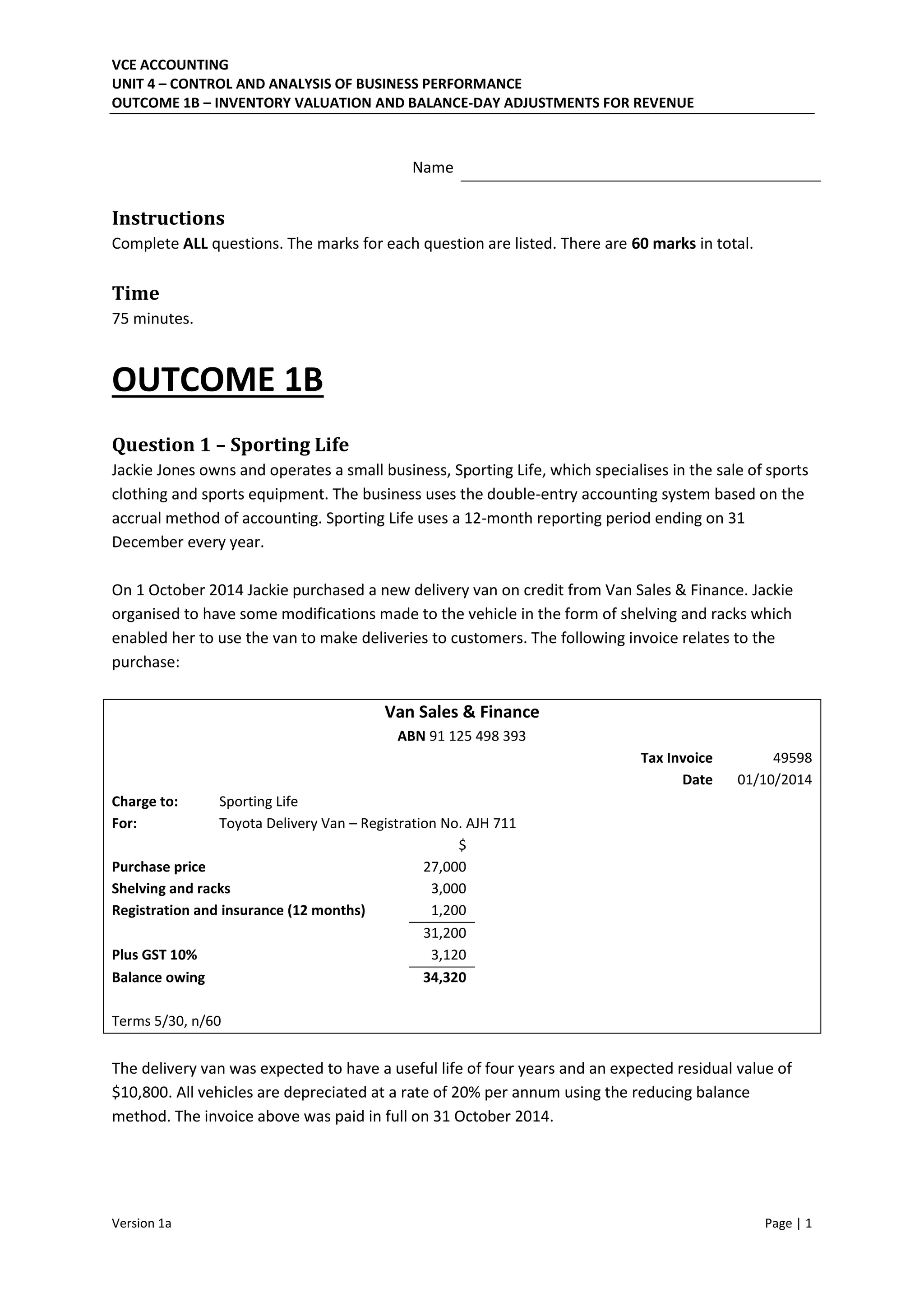
On 1 October 2014 Jackie purchased a new delivery van on credit from Van Sales & Finance. Jackie
organised to have some modifications made to the vehicle in the form of shelving and racks which
enabled her to use the van to make deliveries to customers. The following invoice relates to the
purchase:
Van Sales & Finance
ABN 91 125 498 393
Tax Invoice 49598
Date 01/10/2014
Charge to: Sporting Life
For: Toyota Delivery Van – Registration No. AJH 711
$
Purchase price 27,000
Shelving and racks 3,000
Registration and insurance (12 months) 1,200
31,200
Plus GST 10% 3,120
Balance owing 34,320
Terms 5/30, n/60
The delivery van was expected to have a useful life of four years and an expected residual value of
$10,800. All vehicles are depreciated at a rate of 20% per annum using the reducing balance
method. The invoice above was paid in full on 31 October 2014.
VCE ACCOUNTING
UNIT 4 – CONTROL AND ANALYSIS OF BUSINESS PERFORMANCE
OUTCOME 1B – INVENTORY VALUATION AND BALANCE-DAY ADJUSTMENTS FOR REVENUE
Version 1a Page | 2
Required
a) Prepare the General Journal entry to record the purchase of the delivery van on 1 October 2014.
(A narration is not required.)
1 mark
On 28 February 2016, Jackie decided to trade-in the delivery van for a new model from Van Sales &
Finance bought on 60 day credit terms. Details of the trade-in and purchase are as follows:
New van $33,000
Plus GST (10%) $3,300
$36,300
Less agreed trade-in value $22,000
Balance owing $14,300
Required
b) Calculate the accumulated depreciation on the old delivery van when it is disposed of on 28
February 2016.
3 marks
c) Prepare all entries required to record the disposal of the vehicle in the Disposal of Delivery Van
account in the General Ledger on 28 February 2016.
5 marks
Question 2 – Greenfinger Nursery
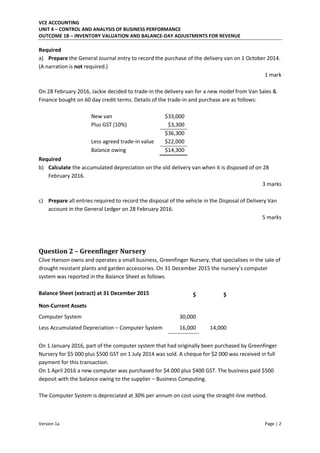
Clive Hanson owns and operates a small business, Greenfinger Nursery, that specialises in the sale of
drought resistant plants and garden accessories. O De e er 5 the ursery’s o puter
system was reported in the Balance Sheet as follows.
Balance Sheet (extract) at 31 December 2015 $ $
Non-Current Assets
Computer System 30,000
Less Accumulated Depreciation – Computer System 16,000 14,000
On 1 January 2016, part of the computer system that had originally been purchased by Greenfinger
Nursery for $5 000 plus $500 GST on 1 July 2014 was sold. A cheque for $2 000 was received in full
payment for this transaction.
On 1 April 2016 a new computer was purchased for $4 000 plus $400 GST. The business paid $500
deposit with the balance owing to the supplier – Business Computing.
The Computer System is depreciated at 30% per annum on cost using the straight-line method.
VCE ACCOUNTING
UNIT 4 – CONTROL AND ANALYSIS OF BUSINESS PERFORMANCE
OUTCOME 1B – INVENTORY VALUATION AND BALANCE-DAY ADJUSTMENTS FOR REVENUE
Version 1a Page | 3
Required
a) Calculate the Accumulated Depreciation on the part of the Computer System sold on 1 January
2016.
2 marks
b) Calculate the Depreciation Expense for the Computer System for the year ended 31 December
2016.
2 marks
c) Show how the following accounts will appear in the General Ledger after all entries have been
posted at the end of 2016. (You are required to balance the accounts.)
• Computer System
• Disposal of Computer System
3 + 4 = 7 marks
Question 3 – Findlay Builders
Tom Findlay owns and operates Findlay Builders. On 31 December 2014, the business purchased
new equipment for $42,000, not including GST. In addition, an optional 12-month warranty of
$1,200 (plus $120 GST) was paid for and the supplier charged $3,300 (including GST) for installation
of the equipment. The estimated residual value of the equipment is $8,000 and Findlay Builders
expected to use the equipment for five years.
Required
a) Using the reducing balance method of depreciation (at a rate of 30%), calculate the depreciation
expense on the equipment for the years ended:
 30 June 2015
 30 June 2016
1 + 1 = 2 marks
The owner of the business is unsure whether to use the straight-line or reducing balance method of
depreciation for this asset.
Required
b) If the reducing balance method was used rather than the straight-line method, explain how this
would effect Net Profit:
i. For the year ended 30 June 2016
ii. Over the life of the asset.
3 + 3 = 6 marks
VCE ACCOUNTING
UNIT 4 – CONTROL AND ANALYSIS OF BUSINESS PERFORMANCE
OUTCOME 1B – INVENTORY VALUATION AND BALANCE-DAY ADJUSTMENTS FOR REVENUE
Version 1a Page | 4
The firm also owns a vehicle that is used to make deliveries to customers. The vehicle was purchased
three years ago and has been depreciated using the straight-line method, with an estimated useful
life of six years. The owner is debating whether to change to the reducing-balance method of
depreciation for the remaining years of the vehicle.
c) Discuss whether the own should change depreciation methods in relation to the vehicle.
4 marks
Question 4 – Denise’s Quilts
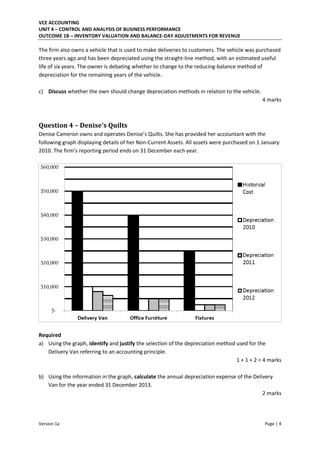
Denise Cameron owns and operates Denise’s Quilts. She has pro ided her a ou ta t ith the
following graph displaying details of her Non-Current Assets. All assets were purchased on 1 January
. The fir ’s reporti g period e ds o De e er ea h year.
Required
a) Using the graph, identify and justify the selection of the depreciation method used for the
Delivery Van referring to an accounting principle.
1 + 1 + 2 = 4 marks
b) Using the information in the graph, calculate the annual depreciation expense of the Delivery
Van for the year ended 31 December 2013.
2 marks
VCE ACCOUNTING
UNIT 4 – CONTROL AND ANALYSIS OF BUSINESS PERFORMANCE
OUTCOME 1B – INVENTORY VALUATION AND BALANCE-DAY ADJUSTMENTS FOR REVENUE
Version 1a Page | 5
c) The Office Furniture has been depreciated using straight-line depreciation. Given a residual
value of $10,000, calculate the estimated useful life of the asset.
2 marks
Question 5 – Gym World
John Easton owns a small business, Gym World, selling sporting equipment to gyms and fitness clubs.
The firm maintains an accrual accounting system when determining its profit annually at 30 June
each year.
On 3 June 2015 a customer (Golden Gyms) placed an order for 20 Fujo treadmills (selling price:
$5,000 plus $500 GST). Each treadmill has a cost price of $1,250 (plus $125 GST). On 5 June 2015 the
customer paid a deposit of $15,000. The deposit was correctly recorded in the Cash Receipts Journal
as Prepaid Revenue (Receipt 48).
Required
a) Explain why the deposit received on 5 June 2015 should be recorded as a liability.
3 marks
b) Record the deposit received on 5 June 2015 in the Cash Receipts Journal.
1 mark
On 16 June 2015 the firm delivered 10 of the treadmills to Golden Gyms and invoice 45 was issued to
the customer.
c) Prepare the entries required in the Sales Journal and General Journal on 16 June 2015 to record
this transaction. Narrations are not required.
3 + 1 = 4 marks
d) Show how the Prepaid Sales Revenue account would appear in the General Ledger after all
adjusting and closing entries have been made at 30 June 2015.
3 marks
On 1 April 2015 Gym World had invested $20,000 in a 12-month fixed-term deposit account. The
interest rate was 9% per annum and the interest is to be received twice per year – on 30 September
2015 and 31 March 2016.
Required
e) In the journals provided, record the following:
 The balance-day adjustment required on 30 June 2015 (Memo 4)
 The receipt of the interest on 30 September 2015 (Receipt 15)
 The receipt of the fixed-term deposit and interest on 31 March 2016 (Receipt 107).
Narrations are not required.
2 + 2 + 2 = 6 marks
VCE ACCOUNTING
UNIT 4 – CONTROL AND ANALYSIS OF BUSINESS PERFORMANCE
OUTCOME 1B – INVENTORY VALUATION AND BALANCE-DAY ADJUSTMENTS FOR REVENUE
Version 1a Page | 6
f) Explain the impact on the Balance Sheet of the business if the balance-day adjustment in the
previous question was not recorded.
3 marks
**** END OF OUTCOME ****

Unit 4 Outcome 1B - Questions v1a

  • 1.
    VCE ACCOUNTING UNIT 4– CONTROL AND ANALYSIS OF BUSINESS PERFORMANCE OUTCOME 1B – INVENTORY VALUATION AND BALANCE-DAY ADJUSTMENTS FOR REVENUE Version 1a Page | 1 Name Instructions Complete ALL questions. The marks for each question are listed. There are 60 marks in total. Time 75 minutes. OUTCOME 1B Question 1 – Sporting Life Jackie Jones owns and operates a small business, Sporting Life, which specialises in the sale of sports clothing and sports equipment. The business uses the double-entry accounting system based on the accrual method of accounting. Sporting Life uses a 12-month reporting period ending on 31 December every year. On 1 October 2014 Jackie purchased a new delivery van on credit from Van Sales & Finance. Jackie organised to have some modifications made to the vehicle in the form of shelving and racks which enabled her to use the van to make deliveries to customers. The following invoice relates to the purchase: Van Sales & Finance ABN 91 125 498 393 Tax Invoice 49598 Date 01/10/2014 Charge to: Sporting Life For: Toyota Delivery Van – Registration No. AJH 711 $ Purchase price 27,000 Shelving and racks 3,000 Registration and insurance (12 months) 1,200 31,200 Plus GST 10% 3,120 Balance owing 34,320 Terms 5/30, n/60 The delivery van was expected to have a useful life of four years and an expected residual value of $10,800. All vehicles are depreciated at a rate of 20% per annum using the reducing balance method. The invoice above was paid in full on 31 October 2014.
  • 2.
    VCE ACCOUNTING UNIT 4– CONTROL AND ANALYSIS OF BUSINESS PERFORMANCE OUTCOME 1B – INVENTORY VALUATION AND BALANCE-DAY ADJUSTMENTS FOR REVENUE Version 1a Page | 2 Required a) Prepare the General Journal entry to record the purchase of the delivery van on 1 October 2014. (A narration is not required.) 1 mark On 28 February 2016, Jackie decided to trade-in the delivery van for a new model from Van Sales & Finance bought on 60 day credit terms. Details of the trade-in and purchase are as follows: New van $33,000 Plus GST (10%) $3,300 $36,300 Less agreed trade-in value $22,000 Balance owing $14,300 Required b) Calculate the accumulated depreciation on the old delivery van when it is disposed of on 28 February 2016. 3 marks c) Prepare all entries required to record the disposal of the vehicle in the Disposal of Delivery Van account in the General Ledger on 28 February 2016. 5 marks Question 2 – Greenfinger Nursery Clive Hanson owns and operates a small business, Greenfinger Nursery, that specialises in the sale of drought resistant plants and garden accessories. O De e er 5 the ursery’s o puter system was reported in the Balance Sheet as follows. Balance Sheet (extract) at 31 December 2015 $ $ Non-Current Assets Computer System 30,000 Less Accumulated Depreciation – Computer System 16,000 14,000 On 1 January 2016, part of the computer system that had originally been purchased by Greenfinger Nursery for $5 000 plus $500 GST on 1 July 2014 was sold. A cheque for $2 000 was received in full payment for this transaction. On 1 April 2016 a new computer was purchased for $4 000 plus $400 GST. The business paid $500 deposit with the balance owing to the supplier – Business Computing. The Computer System is depreciated at 30% per annum on cost using the straight-line method.
  • 3.
    VCE ACCOUNTING UNIT 4– CONTROL AND ANALYSIS OF BUSINESS PERFORMANCE OUTCOME 1B – INVENTORY VALUATION AND BALANCE-DAY ADJUSTMENTS FOR REVENUE Version 1a Page | 3 Required a) Calculate the Accumulated Depreciation on the part of the Computer System sold on 1 January 2016. 2 marks b) Calculate the Depreciation Expense for the Computer System for the year ended 31 December 2016. 2 marks c) Show how the following accounts will appear in the General Ledger after all entries have been posted at the end of 2016. (You are required to balance the accounts.) • Computer System • Disposal of Computer System 3 + 4 = 7 marks Question 3 – Findlay Builders Tom Findlay owns and operates Findlay Builders. On 31 December 2014, the business purchased new equipment for $42,000, not including GST. In addition, an optional 12-month warranty of $1,200 (plus $120 GST) was paid for and the supplier charged $3,300 (including GST) for installation of the equipment. The estimated residual value of the equipment is $8,000 and Findlay Builders expected to use the equipment for five years. Required a) Using the reducing balance method of depreciation (at a rate of 30%), calculate the depreciation expense on the equipment for the years ended:  30 June 2015  30 June 2016 1 + 1 = 2 marks The owner of the business is unsure whether to use the straight-line or reducing balance method of depreciation for this asset. Required b) If the reducing balance method was used rather than the straight-line method, explain how this would effect Net Profit: i. For the year ended 30 June 2016 ii. Over the life of the asset. 3 + 3 = 6 marks
  • 4.
    VCE ACCOUNTING UNIT 4– CONTROL AND ANALYSIS OF BUSINESS PERFORMANCE OUTCOME 1B – INVENTORY VALUATION AND BALANCE-DAY ADJUSTMENTS FOR REVENUE Version 1a Page | 4 The firm also owns a vehicle that is used to make deliveries to customers. The vehicle was purchased three years ago and has been depreciated using the straight-line method, with an estimated useful life of six years. The owner is debating whether to change to the reducing-balance method of depreciation for the remaining years of the vehicle. c) Discuss whether the own should change depreciation methods in relation to the vehicle. 4 marks Question 4 – Denise’s Quilts Denise Cameron owns and operates Denise’s Quilts. She has pro ided her a ou ta t ith the following graph displaying details of her Non-Current Assets. All assets were purchased on 1 January . The fir ’s reporti g period e ds o De e er ea h year. Required a) Using the graph, identify and justify the selection of the depreciation method used for the Delivery Van referring to an accounting principle. 1 + 1 + 2 = 4 marks b) Using the information in the graph, calculate the annual depreciation expense of the Delivery Van for the year ended 31 December 2013. 2 marks
  • 5.
    VCE ACCOUNTING UNIT 4– CONTROL AND ANALYSIS OF BUSINESS PERFORMANCE OUTCOME 1B – INVENTORY VALUATION AND BALANCE-DAY ADJUSTMENTS FOR REVENUE Version 1a Page | 5 c) The Office Furniture has been depreciated using straight-line depreciation. Given a residual value of $10,000, calculate the estimated useful life of the asset. 2 marks Question 5 – Gym World John Easton owns a small business, Gym World, selling sporting equipment to gyms and fitness clubs. The firm maintains an accrual accounting system when determining its profit annually at 30 June each year. On 3 June 2015 a customer (Golden Gyms) placed an order for 20 Fujo treadmills (selling price: $5,000 plus $500 GST). Each treadmill has a cost price of $1,250 (plus $125 GST). On 5 June 2015 the customer paid a deposit of $15,000. The deposit was correctly recorded in the Cash Receipts Journal as Prepaid Revenue (Receipt 48). Required a) Explain why the deposit received on 5 June 2015 should be recorded as a liability. 3 marks b) Record the deposit received on 5 June 2015 in the Cash Receipts Journal. 1 mark On 16 June 2015 the firm delivered 10 of the treadmills to Golden Gyms and invoice 45 was issued to the customer. c) Prepare the entries required in the Sales Journal and General Journal on 16 June 2015 to record this transaction. Narrations are not required. 3 + 1 = 4 marks d) Show how the Prepaid Sales Revenue account would appear in the General Ledger after all adjusting and closing entries have been made at 30 June 2015. 3 marks On 1 April 2015 Gym World had invested $20,000 in a 12-month fixed-term deposit account. The interest rate was 9% per annum and the interest is to be received twice per year – on 30 September 2015 and 31 March 2016. Required e) In the journals provided, record the following:  The balance-day adjustment required on 30 June 2015 (Memo 4)  The receipt of the interest on 30 September 2015 (Receipt 15)  The receipt of the fixed-term deposit and interest on 31 March 2016 (Receipt 107). Narrations are not required. 2 + 2 + 2 = 6 marks
  • 6.
    VCE ACCOUNTING UNIT 4– CONTROL AND ANALYSIS OF BUSINESS PERFORMANCE OUTCOME 1B – INVENTORY VALUATION AND BALANCE-DAY ADJUSTMENTS FOR REVENUE Version 1a Page | 6 f) Explain the impact on the Balance Sheet of the business if the balance-day adjustment in the previous question was not recorded. 3 marks **** END OF OUTCOME ****