Welcome to Pharmacology     张岫美 山东大学医学院 药理学研究所 Welcome to Pharmacology
药 理 学   PHARMACOLOGY   张岫美 山东大学医学院 药理学研究所 [email_address]
CHAPTER  16 ANTIPARKINSONISM  DRUGS  AND DRUG THERAPY IN  ALZHEIMER’S  DISEASE
Parkinson’s disease Parkinson’s disease (PD) Features( paralysis agitants ) Tremor, rigidity, akinesia and  bradykinesia(ataxia) Parkinson’s syndrome
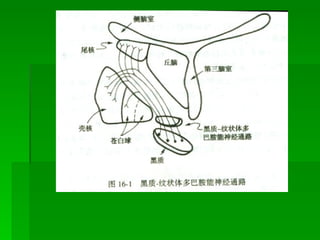
Pathogenesis(dopamine theory) Nigro-striatal(caudate nucleus,  putamen and pallidum) DA neuronal degeneration Dopaminergic neuron activity↓ Cholinergic neuron activity↑ Oxidative stress theory
 
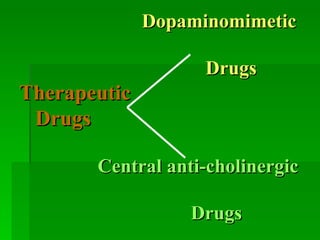
Dopaminomimetic    Drugs Therapeutic    Drugs       Central anti-cholinergic    Drugs
Section 1    Dopaminomimetic Drugs   Levodopa ( L-dopa,  左旋多巴) Levodopa could penetrates into the brain, where it is decarboxylated to dopamine.
Pharmacokinetics Absorption Ready from small intestine, t max  0.5- 2 hrs, affected by gastric emptying, gastric acid and amino acids
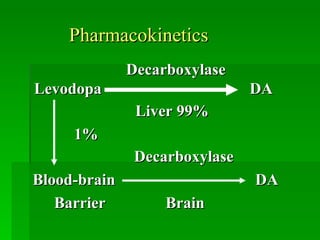
Pharmacokinetics 2. Distribution and metabolism about 1% through blood brain barrier by dopa decarboxylase to dopamine. 99% peripheral transfore to dopamine. a little to melonnin, most metabolized by COMT and MAO 3. Elimination kidney, t 1/2  1-3 hrs.
Pharmacokinetics Decarboxylase   Levodopa  DA Liver 99%   1%  Decarboxylase   Blood-brain  DA  Barrier  Brain
Pharmacological Actions and Uses 1.  Parkinson’s disease  Levodopa  is  widely  used  for treatment  of  all  type  of Parkinsonism  except  that associated  with  antipsychotic drug  therapy.
Properties   (1)Most effective for mild and  younger patients (2)More effective for rigidity and akinesia, less effective for tremor
Properties (3)Onset slow, 2-3 wks to effect, 1-6 months to E max (4)No effective for Parkinson’s syndrome caused by phenothiazines.
Actions and Uses 2. Hepatic coma Levodopa metabolized to noradrenaline to replace octopamine( false neurotransmitter theory)
Adverse Reactions 1. Gastrointestinal  Effects  2. Cardiovascular  Effects  3. Abnormal involuntary movement “on-off” phenomena  4. Psychic disorders and epilepsy
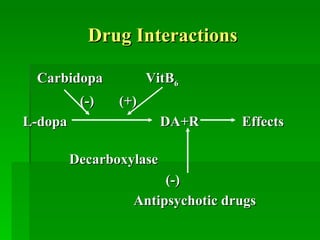
Drug Interactions   Carbidopa  VitB 6 (-)  (+) L-dopa  DA+R  Effects  Decarboxylase  (-)  Antipsychotic drugs
Other dopaminomimetics Decarboxylase  inhibitors Carbidopa (卡比多巴) Benserazide (苄丝肼) Compound Preparations Sinemet (息宁   ) Levodopa : Carbidopa (10 : 1) Madopar (美多巴) Levodopa : Benserazide (4 : 1)
Amantadine ( 金刚烷胺 ) Mechanism of Action 1.↑release DA from dopaminergic  terminals. 2.↓reuptake of DA. 3. dopamine receptor agonism
Amantadine Clinical Uses Parkinson’s disease, less effective than levodopa, and more effective than anticholinergic agents. Effective for Parkinson’s syndrome caused by phenothiazines, synergized by l-dopa. Onset rapidly, 2 wks; Last short about  4-8 wks.
Adverse Reactions Livedo reticularis Psychotic disorders
Bromocriptine ( 溴隐亭 )   Pergolide ( 培高利特 ) Large dose stimulate D 2  receptor in  substantia nigro-striatal Small dose stimulate D 2  receptor in tubero-infundibular, reduce PRL and GH release Used  to  treat  PD  and hyperprolactinemia
Selegiline   MAO-B inhibitor and antioxidants
Section  2 Central Anticholinergic  Drugs
Actions   Blocking the M-R ,↓cholinergic neurons  in the basal ganglia. Benzatropine ( 苯扎托品 ) Trihexyphenidyl ( 苯海索 ) Improve the tremor and rigidity of PD, little effect on bradykinesia .
Drug Therapy in Alzheimer’s Disease Alzheimer’s disease ( AD )  3/4 Vascular dementia ( VD )  1/4
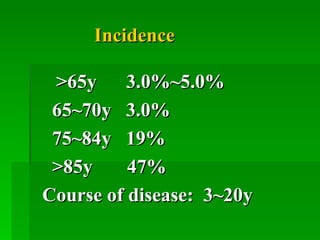
Incidence >65y  3.0%~5.0%  65~70y  3.0% 75~84y  19%  >85y  47% Course of disease:  3~20y
International  Symposium for Alzheimer’s Disease 2000  “If the effective methods for AD treatment is not found, the AD patients will be 22 000 000 in 2025; 45 000 000 in 2050 in whole world.”
Clinical Features Dementia, cognition dysufficiency, behavioral disorder  Pathological Features Senile plaque (SP,  老年斑 ) was found in brain , Neurofibrillary tangles (NFT,  神经元纤维缠结 ) and selective death of neuron.
Pathogenesis Neuron toxication of   amyloidβ-protein(Aβ,β- 淀粉样蛋白 )  。 Aβ 可能是胆碱能神经系统高强度、高选择性的负性调节物 ,  AChE 对 Aβ 的神经毒性起重要的加强和易化作用。
Therapy for AD 1.Potentiate cholinergic function  AChEI 、 M-R agonists 2.Potentiator of neuronal nutrition factor and neuron cell growth factor 3.Activator brain metabolism  吡拉西坦 4.Drugs improving microcirculation  麦角类衍生物、都可喜等 5.Calcium antagonists
SEE You !
Thank You !

chapter 16

  • 1.
    Welcome to Pharmacology   张岫美 山东大学医学院 药理学研究所 Welcome to Pharmacology
  • 2.
    药 理 学 PHARMACOLOGY   张岫美 山东大学医学院 药理学研究所 [email_address]
  • 3.
    CHAPTER 16ANTIPARKINSONISM DRUGS AND DRUG THERAPY IN ALZHEIMER’S DISEASE
  • 4.
    Parkinson’s disease Parkinson’sdisease (PD) Features( paralysis agitants ) Tremor, rigidity, akinesia and bradykinesia(ataxia) Parkinson’s syndrome
  • 5.
    Pathogenesis(dopamine theory) Nigro-striatal(caudatenucleus, putamen and pallidum) DA neuronal degeneration Dopaminergic neuron activity↓ Cholinergic neuron activity↑ Oxidative stress theory
  • 6.
  • 7.
    Dopaminomimetic Drugs Therapeutic Drugs Central anti-cholinergic Drugs
  • 8.
    Section 1 Dopaminomimetic Drugs Levodopa ( L-dopa, 左旋多巴) Levodopa could penetrates into the brain, where it is decarboxylated to dopamine.
  • 9.
    Pharmacokinetics Absorption Readyfrom small intestine, t max 0.5- 2 hrs, affected by gastric emptying, gastric acid and amino acids
  • 10.
    Pharmacokinetics 2. Distributionand metabolism about 1% through blood brain barrier by dopa decarboxylase to dopamine. 99% peripheral transfore to dopamine. a little to melonnin, most metabolized by COMT and MAO 3. Elimination kidney, t 1/2 1-3 hrs.
  • 11.
    Pharmacokinetics Decarboxylase Levodopa DA Liver 99% 1% Decarboxylase Blood-brain DA Barrier Brain
  • 12.
    Pharmacological Actions andUses 1. Parkinson’s disease Levodopa is widely used for treatment of all type of Parkinsonism except that associated with antipsychotic drug therapy.
  • 13.
    Properties (1)Most effective for mild and younger patients (2)More effective for rigidity and akinesia, less effective for tremor
  • 14.
    Properties (3)Onset slow,2-3 wks to effect, 1-6 months to E max (4)No effective for Parkinson’s syndrome caused by phenothiazines.
  • 15.
    Actions and Uses2. Hepatic coma Levodopa metabolized to noradrenaline to replace octopamine( false neurotransmitter theory)
  • 16.
    Adverse Reactions 1.Gastrointestinal Effects 2. Cardiovascular Effects 3. Abnormal involuntary movement “on-off” phenomena 4. Psychic disorders and epilepsy
  • 17.
    Drug Interactions Carbidopa VitB 6 (-) (+) L-dopa DA+R Effects Decarboxylase (-) Antipsychotic drugs
  • 18.
    Other dopaminomimetics Decarboxylase inhibitors Carbidopa (卡比多巴) Benserazide (苄丝肼) Compound Preparations Sinemet (息宁 ) Levodopa : Carbidopa (10 : 1) Madopar (美多巴) Levodopa : Benserazide (4 : 1)
  • 19.
    Amantadine ( 金刚烷胺) Mechanism of Action 1.↑release DA from dopaminergic terminals. 2.↓reuptake of DA. 3. dopamine receptor agonism
  • 20.
    Amantadine Clinical UsesParkinson’s disease, less effective than levodopa, and more effective than anticholinergic agents. Effective for Parkinson’s syndrome caused by phenothiazines, synergized by l-dopa. Onset rapidly, 2 wks; Last short about 4-8 wks.
  • 21.
    Adverse Reactions Livedoreticularis Psychotic disorders
  • 22.
    Bromocriptine ( 溴隐亭) Pergolide ( 培高利特 ) Large dose stimulate D 2 receptor in substantia nigro-striatal Small dose stimulate D 2 receptor in tubero-infundibular, reduce PRL and GH release Used to treat PD and hyperprolactinemia
  • 23.
    Selegiline MAO-B inhibitor and antioxidants
  • 24.
    Section 2Central Anticholinergic Drugs
  • 25.
    Actions Blocking the M-R ,↓cholinergic neurons in the basal ganglia. Benzatropine ( 苯扎托品 ) Trihexyphenidyl ( 苯海索 ) Improve the tremor and rigidity of PD, little effect on bradykinesia .
  • 26.
    Drug Therapy inAlzheimer’s Disease Alzheimer’s disease ( AD ) 3/4 Vascular dementia ( VD ) 1/4
  • 27.
    Incidence >65y 3.0%~5.0% 65~70y 3.0% 75~84y 19% >85y 47% Course of disease: 3~20y
  • 28.
    International Symposiumfor Alzheimer’s Disease 2000 “If the effective methods for AD treatment is not found, the AD patients will be 22 000 000 in 2025; 45 000 000 in 2050 in whole world.”
  • 29.
    Clinical Features Dementia,cognition dysufficiency, behavioral disorder Pathological Features Senile plaque (SP, 老年斑 ) was found in brain , Neurofibrillary tangles (NFT, 神经元纤维缠结 ) and selective death of neuron.
  • 30.
    Pathogenesis Neuron toxicationof amyloidβ-protein(Aβ,β- 淀粉样蛋白 ) 。 Aβ 可能是胆碱能神经系统高强度、高选择性的负性调节物 , AChE 对 Aβ 的神经毒性起重要的加强和易化作用。
  • 31.
    Therapy for AD1.Potentiate cholinergic function AChEI 、 M-R agonists 2.Potentiator of neuronal nutrition factor and neuron cell growth factor 3.Activator brain metabolism 吡拉西坦 4.Drugs improving microcirculation 麦角类衍生物、都可喜等 5.Calcium antagonists
  • 32.
  • 33.