#2 Notes and teaching tips: 6, 8, 9, 14, 15, and 29.
To view a full-screen figure during a class, click the expand button.
To return to the previous slide, click the shrink button.
To advance to the next slide, click anywhere on the full screen figure.
Applying the principles of economics to interpret and understand the news is a major goal of the principles course. You can encourage your students in this activity by using the two features: Economics in the News and Economics in Action.
(1) Before each class, scan the news and select two or three headlines that are relevant to your session today. There is always something that works. Read the headline and ask for comments, interpretation, discussion. Pose questions arising from it that motivate today’s class. At the end of the class, return to the questions and answer them with the tools you’ve been explaining.
(2) Once or twice a semester, set an assignment, for credit, with the following instructions:
(a) Find a news article about an economic topic that you find interesting.
(b) Make a short bullet-list summary of the article.
(c) Write and illustrate with appropriate graphs an economic analysis of the key points in the article.
Use the Economics in the News features in your textbook as models.
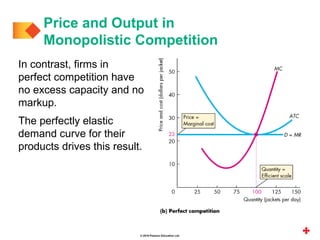
#6 Product differentiation—the heart of the space between monopoly and competition An old “ice cream on the beach” analogy really nails down the idea of product differentiation and explains how monopolistic competition fills the space between monopoly and perfect competition. Draw a line on the blackboard and label the two ends A and B. Tell the students that the line represents a beach (a long beach) along which beachgoers are uniformly spaced. An ice-cream vendor decides to set up shop on the beach—the only one. Where will she locate? The students will quickly see that the center—midway between A and B is the spot that will get the most customers because the cost of an ice cream is the market price plus the walking time to get it (remind them that the beach is very long!) Now a second ice-cream vendor opens up. Where does he locate? With a bit of help, the students will see that the best spot is right next to the first one. With one producer, there is monopoly and no variety—no product differentiation. With two producers, there is still no differentiation—technically, there is minimum differentiation. Now suppose a third and fourth ice-cream vendor come along. Where do they locate? At the ends of the beach at A and B. They differentiate as much as possible from each other and from the first two. Further entry has new ice-cream vendors locating in the middle of the gaps between the existing ones, always going into the widest gap. If the market could stand the competition, eventually, there would be ice-cream vendors so close to each other all along the beach that the members of any adjacent group were indistinguishable to a customer. Product differentiation would have been pushed to the point that there is no “space” for additional variety and the market would look like perfect competition.
Real products are like the beach example Talk about sports shoes, breakfast cereals, and any other goods that interest you and for which there are good locally observable examples and encourage the students to see that they are like the beach example. The variety of products fill the available variety “space.”
#8 Classroom activity
Check out Economics in Action: Monopolistic Competition Today
#9 The demand for a firm’s differentiated product in monopolistic competition
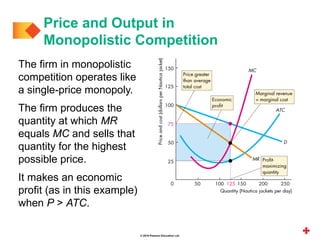
Remind the students about the ceteris paribus condition that defines a demand curve. Along the demand curve for Nike tennis shoes, the prices of Adidas, Fila, Head, K Swiss, Prince, Reebok, and Wilson tennis shoes are constant. Some people prefer Nike to the other brands and will pay a bit more for Nike. Other people prefer some other brand and will buy Nike only if its price is low enough. Buyers have brand preferences, but they will switch brands if price differences are large enough. So the higher the price of a Nike shoe, the prices of the other brands remaining the same, the smaller is the quantity of Nike shoes demanded.
#14 Classroom activity
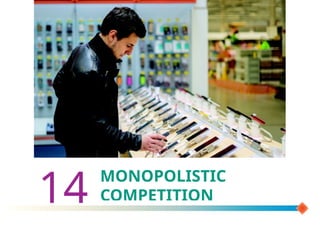
Check out Economics in the News: Product Differentiation in Smartphones
#15 Entry and exit shift the demand curve for a firm’s product
Students seem to have a bit of trouble appreciating that entry and exit change the demand for a firm’s product. Explain this effect by sticking with the tennis shoes example. Explain that the demand for Nike tennis shoes changes and the demand curve for Nike tennis shoes shifts if other firms enter or exit. If Tommy Hilfiger and the Gap started to make tennis shoes, some of Nike’s former customers would switch to these two new brands, and the demand for Nike shoes would decrease. The demand curve for Nike shoes would shift leftward. If Adidas, Fila, and Reebok stopped making tennis shoes, some of their former customers would switch to Nike, and the demand for Nike shoes would increase. The demand curve for Nike shoes would shift rightward.
#29 Classroom activity
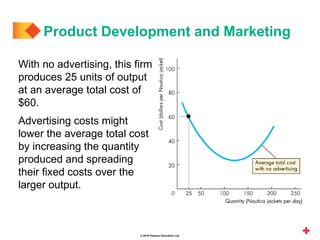
Check out Economics in Action: The Cost of Selling a Pair of Shoes