13

UK Renewable Energy Policy
since Privatization
Michael G. Pollitt


T    his chapter reviews the progress with increas-
     ing renewable energy supply in the United
Kingdom since 1990, with a particular focus on
                                                        nisms for resolving social conflict than with eco-
                                                        nomic incentive arrangements. Radical changes
                                                        to current policy are required, but policymakers
recent developments. This country is regarded as        must be careful that they are institutionally appro-
one where the considerable potential for renew-         priate to the United Kingdom. Calls to “just do
able energy,1 relative to other major European          it” with respect to delivery of larger quantities of
countries, has failed to be realized. It is also fre-   renewables are economically irresponsible and
quently suggested that the United Kingdom               highly likely to backfire in terms of achievement
needs to change its policies to renewables to look      of ultimate policy goals such as decarbonization
more like those in Germany or Spain (e.g.,              and energy security.
Mitchell 2007).                                              UK renewable energy policy exists in a wider
    The aim of this chapter is to look at the           energy policy context. The country’s stated
United Kingdom’s renewable energy policy in the         energy policy can be summed up as aiming to
context of its overall decarbonization (i.e. carbon     achieve “secure, affordable and low-carbon
emissions reduction) and energy policies. The           energy” (see DECC n.d.b). It therefore has three
chapter explores the precise nature of the failure      identifiable priorities: addressing climate change,
of UK renewables policy and suggests policy             providing energy security, and keeping energy
changes that might be appropriate in light of the       bills down. These policy objectives are naturally in
country’s institutional and resource endowments.        tension. The first two are expensive, whereas tack-
The focus is on the electricity sector in terms of      ling the third entails keeping prices down, if not
both renewable generation and, to a lesser extent,      for everyone, then for a significant minority of
the facilitating role of electricity distribution and   poor consumers. Between 1990 and 2003, resi-
transmission networks. The interactions among           dential electricity prices fell significantly in real
the UK’s electricity, heat, and transport sectors       terms in the United Kingdom, by around 30% per
within the overall decarbonization policy context       unit, but have risen by around 40% from 2003 to
are also examined.                                      2008 (QEP 2009). The number of households
    The discussion suggests that the precise nature     defined as being in energy (or fuel) poverty,
of the failure of UK policy is rather more to do        spending 10% or more of total expenditure on
with societal preferences and the available mecha-      heating and power, has risen from a low of 2 mil-
254      Michael G. Pollitt


lion in 2003 to 3.5 million in 2006 (BIS 2008),       duty to introduce policies that support achieve-
out of a total of around 25 million households        ment of the targets. The committee’s first report
(ONS 2007). This has put a strain on the ability of   (CCC 2008) was published in December 2008.
richer consumers to simultaneously finance poor       This gave indicative budgets for the periods 2008–
consumers, via bill payments to company support       2012, 2013–2017 and 2018–2022. The budget for
schemes (see Ofgem 2009b),2 and expensive poli-       any period beyond this must be set at least 12
cies arising from climate change and energy secu-     years ahead.
rity objectives. European Union (EU) directives            The report was then followed up by a signifi-
have also provided significant shape to UK energy     cant discussion in the HM Treasury budget for
policy, providing the basis for targets to 2020 for   2009 of policy measures aimed at supporting the
CO2 reduction and renewable electricity genera-       achievement of the decarbonization targets in the
tion share.                                           light of the report (see HM Treasury 2009).4 The
     The chapter begins by reviewing the United       announced measures included support for green
Kingdom’s overall decarbonization policy and          manufacturing, improvements to the renewable
potential for renewables, then its policy toward      support for offshore wind, increased funding for
renewables since 1990, with a particular focus on     combined heat and power, and a support mecha-
recent developments. This is followed by an           nism for up to four carbon capture and storage
examination of the evidence on the performance        (CCS) plants. The intention of the legislation is
of UK policy compared with that of other coun-        that if the government were to fail to enact appro-
tries. Next, a new institutional economics per-       priate policies to keep the United Kingdom on
spective is used to discuss what sorts of policies    track to achieve its targets, this could result in legal
might be right for the United Kingdom in the          action against ministers by third parties, though it
light of the evidence. Finally, the chapter exam-     remains to be seen on what grounds any action
ines the issue of overall policy toward decarbon-     would be likely to be successful, given the less
ization and the place of renewables within this.      than direct link between specific government
                                                      policy and impact on a national GHG target.
                                                           For reference, in 2008, UK GHG emissions
                                                      were 623.8 metric tons of CO2e (CO2 equivalent
Decarbonization Policy and the                        units), which is 20% below the 1990 baseline of
                                                      779.9 tons (Defra 2008). This means the United
Potential for Renewable Energy                        Kingdom is the only major European country to
in the United Kingdom                                 have already met and exceeded its 2012 Kyoto
                                                      target for emissions reduction target, which was
An important context for the United Kingdom’s         12.5% (see EEA 2006, Table 1). It is, however,
renewable energy policy is its overall decarboniza-   worth pointing out that the UK target is the result
tion policy. The country has one of the most          of negotiations within the EU to share out the
ambitious decarbonization policies in the world,      Kyoto-negotiated EU-wide target, and that the
as embodied in the 2008 Climate Change Act            baseline date of 1990 is very favorable to the
(OPSI 2008a).3 This policy consists of a commit-      United Kingdom. This is because it coincides
ment to reducing net greenhouse gas (GHG)             with the privatization of the UK power industry,
emissions by 80% by 2050 (from 1990 levels),          leading to a “dash for gas,” which resulted in an
with an intermediate target reduction of 26% by       unintended environmental windfall as dirtier
2020. This target is supported by five-year carbon    coal-fired plants were displaced from the system
budgets, the first period being 2008–2012 inclu-      (see Newbery and Pollitt 1997). This favorable
sive. These budgets are formulated in the Office of   starting place in which the United Kingdom finds
Climate Change and supported by a report from         itself is certainly a major factor in its relative
the independent Committee on Climate Change           enthusiasm for decarbonization.5 The 2009 EU
(CCC). Government ministers have a statutory          Renewables Directive further commits the
UK Renewable Energy Policy since Privatization         255


United Kingdom to a 15% target for renewables                    Given the ambitious targets for decarboniza-
contribution to total final energy consumption in            tion and renewable energy in the United King-
2020 as part of the EU’s overall 20% renewables              dom, it seems highly likely that nationally these
by 2020 target. This further target is acknowl-              targets will be missed, certainly on renewables. In
edged and accepted in the CCC report. The                    these circumstances, serious consideration will be
United Kingdom also has a specific annual target             given to meeting the targets via net purchases of
for the percentage of electricity from renewables            CO2 or green energy certificates from abroad
out to 2015 as part of its Renewables Obligation             (e.g., funding CCS in China). Indeed, if
Certificate scheme, discussed later in this chapter.         additionality could be clearly established, this
     The report suggests that by 2020, the share of          would seem to be a very sensible option given that
renewables could be as much as 30% in total elec-            at the margin, such purchases would be much
tricity generation (CCC 2008, 208). It also dis-             cheaper than domestic alternatives.
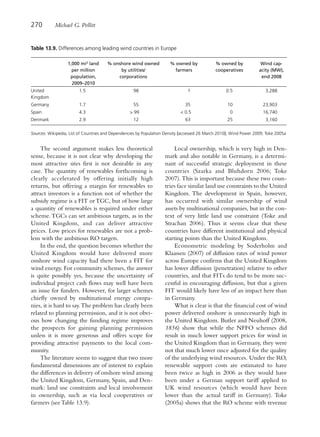
cusses the potential for the direct reduction of                 A defining feature of the United Kingdom is
emissions from buildings rather than via large-              the considerable potential it has for renewable
scale grid-connected electricity. This involves a            energy relative to its demand. The country has
combination of renewable heat and micro-                     some of the best wind, tidal, and wave resources
generation. For residential buildings, it identifies a       in Europe, as well as affording opportunities for
potential contribution of 14% reduction in heat              biomass and solar. The technical potential of each
emissions via a combination of biomass, solar hot            of these resources is very great, but the estimated
water, heat pumps, and biogas by 2020. In addi-              economic potentials are given in Table 13.1. UK
tion, small contributions may be made by PV and              electricity supplied in 2008 was 380 terawatt-
other sources for microgeneration of electricity.            hours (TWh) (DECC 2009b, Table 5.5).
     Recently, the newly created responsible gov-                In addition, it is worth mentioning that the
ernment ministry, the Department for Energy and              United Kingdom has up to 1,000 years’ worth of
Climate Change published its UK Renewable                    storage capacity of CO2 in the North Sea and
Energy Strategy (DECC 2009f). In line with the               currently generates around 13% of its electricity
CCC report, this suggested that more than 30% of             Table 13.1. Estimates of the likely economic
electricity should be generated from renewables              potentials for different renewable technologies in the
by 2020, as well as 12% of heat and 10% of trans-            United Kingdom
port energy, in order to meet EU targets.
     The United Kingdom’s commitment to                      Technology           Technology        Annual
decarbonization is likely to lead to a relatively            category             detail            potential
tight domestic policy with strong pressure for               Wind power           Onshore             50 TWh
purchasing of renewable electricity and CO2 per-                                  Offshore          100 TWh
mits from abroad. In 2007, the country was a net             Bioenergy            Biomass             41 TWh
purchaser of CO2 permits to the tune of 26 tons,             Geothermal           Ground source       8 TWh
or 3% of its 1990 GHG level (Defra 2009). It also                                 heat pumps
purchased energy via the interconnector with                 Hydro                Large scale         5 TWh
France (3% of total electricity delivered), which                                 Small scale         10 TWh
may have displaced higher-carbon energy in the               PV                   Retrofitted and    > 1 TWh
United Kingdom, and was one of the largest net                                    building inte-
importers of internationally traded bioenergy,                                    grated
mainly for cofiring in coal-fired power plants and           Marine               Wave energy         33 TWh
for blending in gasoline (DECC 2009b; Junginger                                   Tidal barrage       50 TWh
et al. 2008; Perry and Rosillo-Calle 2008). All of                                Tidal stream        18 TWh
these have some scope for expansion in terms of              Total                                  ~316 TWh
achieving the net decarbonization of the UK
economy.                                                     Source: Jamasb et al. 2008b, 81–82
256       Michael G. Pollitt


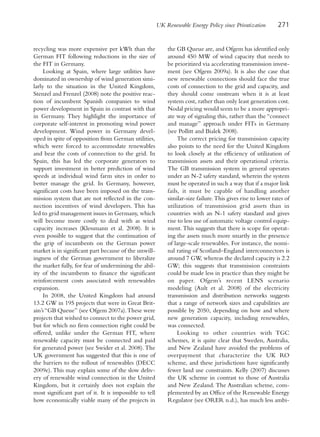
from nuclear power (DECC 2009b). The United             Table 13.2. Examples of estimated costs of
Kingdom has endowments of coal, oil, and gas            technologies for the United Kingdom in 2005
(though all three are depleting). Thus carbon cap-
ture and storage and nuclear power are likely to        Technology             Technology             p/kWh
compete with renewables to play a part in decar-                               detail

bonization of the electricity sector. The country is    Nuclear                Generation III         3.04–4.37

already committed to an auction for one demon-          Gas                    CCGTa with CCS         3.65–6.78

stration CCS plant and is reviewing designs for a       Coal                   IGCCb with CCS         3.5–5.67

new generation of nuclear power plants, with an         Wind                   Onshore                4.68–8.89

announcement in November 2009 on its pre-                                      Offshore               5.62–13.3

ferred sites for new building (see DECC 2009c).
                                                        Source: Jamasb 2008b, 75.
Electricity demand growth is increasing slowly, at      Notes: The spread of estimates reflects ranges in the discount
around 1% a year, and energy efficiency                 rate, capital cost, fuel and carbon prices, and other sensitivities;
                                                        p/kWh = pence per kilowatt-hour, given in 2005 values; 1 pence
measures—such as the elimination of filament            = 1.5 cents (U.S.) as of this writing.
lightbulbs starting in 2011 (DECC 2009e) and the        a
                                                          CCGT = combined cycle gas turbine
                                                        b
                                                          IGCC = integrated gasification combined cycle
introduction of smart metering for all electricity
customers by 2020—seem likely to moderate
demand growth.
     MacKay (2008, 109) predicts the likely con-        Among the renewable technologies in the United
tribution of renewables to UK decarbonization in        Kingdom, onshore wind, biomass, and offshore
the context of delivering the current level of          wind are lowest-cost at scale to 2020. Table 13.2
energy consumption of 125 kilowatt-hours per            shows some cost sensitivities for 2005.
day per person. He suggests that renewables con-            The table illustrates large uncertainty in the
tribution is likely to be only 18.3 kWh/day/            costs of building new plants, even with established
person, made up of the following: hydro, 0.3;           technologies. For wind, this reflects the impor-
tidal, 3; offshore wind, 4; biomass, 4; solar PV, 2     tance of exact location, which determines both
(+ 2 from solar hot water); and onshore wind, 3.        building costs and the available wind.The range of
Thus renewable energy would contribute around           costs illustrates substantial overlap under favorable
15% toward total decarbonization. MacKay’s              versus unfavorable circumstances for any pair of
analysis is helpful in that it illustrates that a big   technologies. However, it is important to point
contribution toward current electricity provision       out that this uncertainty over actual costs for cur-
comes in the context of electricity being the           rent new building does call into question projec-
source of only about one-third of current emis-         tions of costs to 2020. For instance, Dale et al.
sions of GHGs.                                          (2004) assume onshore and offshore new building
     The exact mix of different renewable tech-         costs of £650 and £1,000 ($975 and $1,500) per
nologies, CCS fitted to coal- or gas-fired plants,      kW, respectively, in scenarios with 25% energy
nuclear, and demand reduction in the UK energy          from wind. The most recent (albeit prerecession)
mix will depend on the relative costs of the differ-    wind parks are currently costing nearer to £1,000
ent technologies. Kannan (2009) shows the               and £2,500 ($1,500 and $3,750) per kW (see
impacts of different assumptions on the signifi-        Blanco 2009; and Snyder and Kaiser 2009). This is
cance of CCS in UK decarbonization and hence            somewhat concerning, given a return to
the implications for other sources of decarboniza-      macroeconomic growth, for the likely projected
tion. Demand reduction technologies are the             costs of renewable scenarios to 2020, especially
cheapest GHG abatement technology at the                given that the costs of electricity (which will
moment (see CCC 2008, 221), though demand               include cumulative subsidy commitments to
reduction measures suffer from well-known insti-        renewables) in 2020 will still likely reflect, to
tutional barriers to adoption (Grubb and Wilde          some extent, the cumulative cost of all wind
2008). Nuclear is probably the next cheapest.           capacity installed since 2005.
UK Renewable Energy Policy since Privatization          257


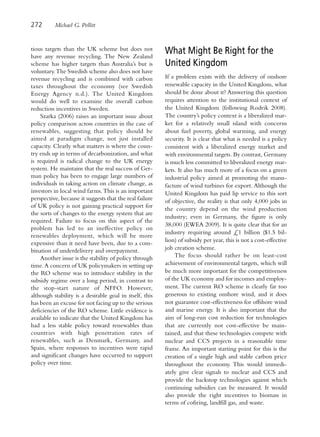
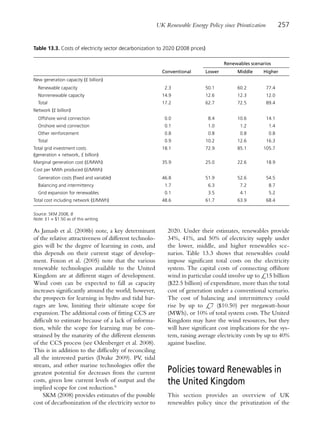
Table 13.3. Costs of electricity sector decarbonization to 2020 (2008 prices)

                                                                                       Renewables scenarios
                                                          Conventional      Lower           Middle     Higher
New generation capacity (£ billion)
  Renewable capacity                                       2.3              50.1            60.2         77.4
  Nonrenewable capacity                                   14.9              12.6            12.3         12.0
  Total                                                   17.2              62.7            72.5         89.4
Network (£ billion)
  Offshore wind connection                                 0.0                   8.4        10.6         14.1
  Onshore wind connection                                  0.1                   1.0         1.2          1.4
  Other reinforcement                                      0.8                   0.8         0.8          0.8
  Total                                                    0.9                  10.2        12.6         16.3
Total grid investment costs                               18.1                  72.9        85.1       105.7
(generation + network, £ billion)
Marginal generation cost (£/MWh)                          35.9                  25.0        22.6         18.9
Cost per MWh produced (£/MWh)
  Generation costs (fixed and variable)                   46.8                  51.9        52.6         54.5
  Balancing and intermittency                              1.7                   6.3         7.2          8.7
  Grid expansion for renewables                            0.1                   3.5         4.1          5.2
Total cost including network (£/MWh)                      48.6                  61.7        63.9         68.4

Source: SKM 2008, 8
Note: £1 = $1.50 as of this writing

As Jamasb et al. (2008b) note, a key determinant            2020. Under their estimates, renewables provide
of the relative attractiveness of different technolo-       34%, 41%, and 50% of electricity supply under
gies will be the degree of learning in costs, and           the lower, middle, and higher renewables sce-
this depends on their current stage of develop-             narios. Table 13.3 shows that renewables could
ment. Foxon et al. (2005) note that the various             impose significant total costs on the electricity
renewable technologies available to the United              system. The capital costs of connecting offshore
Kingdom are at different stages of development.             wind in particular could involve up to £15 billion
Wind costs can be expected to fall as capacity              ($22.5 billion) of expenditure, more than the total
increases significantly around the world; however,          cost of generation under a conventional scenario.
the prospects for learning in hydro and tidal bar-          The cost of balancing and intermittency could
rages are low, limiting their ultimate scope for            rise by up to £7 ($10.50) per megawatt-hour
expansion. The additional costs of fitting CCS are          (MWh), or 10% of total system costs. The United
difficult to estimate because of a lack of informa-         Kingdom may have the wind resources, but they
tion, while the scope for learning may be con-              will have significant cost implications for the sys-
strained by the maturity of the different elements          tem, raising average electricity costs by up to 40%
of the CCS process (see Odenberger et al. 2008).            against baseline.
This is in addition to the difficulty of reconciling
all the interested parties (Drake 2009). PV, tidal
stream, and other marine technologies offer the
greatest potential for decreases from the current           Policies toward Renewables in
costs, given low current levels of output and the           the United Kingdom
implied scope for cost reduction.6
     SKM (2008) provides estimates of the possible          This section provides an overview of UK
cost of decarbonization of the electricity sector to        renewables policy since the privatization of the
258       Michael G. Pollitt


country’s electricity supply industry beginning in       ing Agency (NFPA).8 In order to avoid this being
1990. Summarizing UK policy is not a straight-           seen as a discriminatory subsidy to the nuclear
forward task because of the large range of govern-       industry, it was recast as a way of supporting non-
ment initiatives toward renewable energy and the         fossil-fuel generation more generally, and a por-
great number of policy changes that have been            tion was allocated to support renewable energy
announced in recent years, some of which have            (Mitchell and Connor 2004). The portion was
yet to be implemented fully.7 Discovering the            small, but it provided a relatively significant
exact cost of renewable energy support is not easy,      amount of money to the industry at a time when
as evidenced by the fact that the best sources of        government expenditure on new technologies
information are answers to parliamentary ques-           was falling to a very low level, and the then
tions rather than published annual statistics. This is   Department of Energy was closing. The money
particularly true of the expenditure on individual       was allocated to new renewable projects via a
technologies. The heroic efforts of Mitchell and         series of bidding rounds whereby renewable
Connor (2004), who reviewed UK renewables                energy projects bid for an (inflation-indexed) per-
policy from 1990 to 2003, provided the inspira-          kilowatt-hour price for initially 8 and later 15
tion for some of the presentation here.                  years. Winning bids were selected by cost within
    In broad outline, there have been two main           each technology category.
support mechanisms for renewable electricity and              The result was a significant number of bids in
heat generation since privatization in the United        each of the auction rounds and falling bid costs in
Kingdom: the Non-Fossil Fuel Obligation                  each successive round.9 Connor (2003, 76)
(NFFO), which ran from 1990 to 2002, and the             reports that in the five rounds of NFFO in Eng-
Renewables Obligation (RO) scheme, which                 land and Wales, onshore wind costs fell from 10
began in 2002. During their period of operation,         pence (15.0 cents) per kWh in 1990 to 2.88 pence
these have been the most significant forms of            (4.3 cents) per kWh in 1998, with substantial falls
renewable energy support in the United Kingdom           for the other technology bands. Although NFFO
and were designed to work in parallel with liber-        was successful in soliciting a large number of
alized electricity and gas markets.                      competitive bids and in ensuring that any funded
    The assessment of renewable support policies         projects were cost-effective for electricity custom-
is complicated because there are two obvious             ers, it failed rather spectacularly in one key
metrics of success: the amount of renewables real-       respect: delivery of actual investment by the win-
ized relative to potential (quantity); and the total     ning bidders.
cost of renewable energy support policy relative to           Across the United Kingdom, between 1990
the amount of generation actually supported              and 1999, out of 302 awarded wind projects cov-
(suitably discounted). These two trade off, mean-        ering 2,659 MW, only 75 projects were built,
ing that success in one is likely to be associated       rated at 391 MW (Wong 2005). Spectacularly, not
with less success in the other.                          one of the 33 large wind projects awarded in the
                                                         fifth round of NFFO in England and Wales was
The Non-Fossil Fuel Obligation                           ever contracted. By contrast, out of 308 landfill
                                                         gas projects awarded, 208 were operational in
The Non-Fossil Fuel Obligation (NFFO) was                2008, with 458 MW of capacity out of 660 MW
originally designed as a way of financing the extra      contracted. For all the rounds of NFFO, out of
costs of nuclear power that became clear in the          933 awarded contracts, 477 were built, represent-
run-up to privatization. A non-fossil-fuel levy was      ing 1,202 out of 3,639 MW (DECC 2009b, Table
introduced on final electricity prices to pay for        7.1.2). The primary cause for the failure was that
nuclear decommissioning liabilities, and electri-        bidders were overoptimistic in their estimates of
city suppliers were forced to buy nuclear power at       the actual delivery costs of the projects, often
higher-than-market prices in auctions for non-           because the nature of the least-cost auction—with
fossil-fuel power run by the Non-Fossil Purchas-         no assessment of likelihood of delivery—
UK Renewable Energy Policy since Privatization      259


incentivized minimization of expenditure on pre-           development.” Institutional barriers emerged
paring realistic bids (Mitchell and Connor 2004).          early on as a critical factor in successful project
     In reviewing the failure of the NFFO policy,          implementation (McGowan 1991).
it is important to remember the context in which                In particular, it became clear that projects had
it operated. Renewables were then a very low               a problem with gaining the necessary consents
priority for UK government policy, and it was a            required to start building, known as “planning
period of a rapid switch from coal- to gas-fired           permission” in the United Kingdom, and that a
power. Prices and pollution, in terms of quantities        lack of attention was given to proper environmen-
of CO2, SOx, and NOx, fell substantially. The              tal impact assessments (Coles and Taylor 1993).
focus on market-driven investments was good for            Hull (1995) noted that in the early years, less than
energy and carbon-efficient combined heat and              half of all councils, the local government bodies
power (CHP) investment in the industrial and               responsible for consents, had planning guidance
commercial sectors (Bonilla 2006; Harvey 1994;             for renewable energy projects, and more impor-
Marshall 1993), which had struggled prior to pri-          tant, there was a lack of learning among councils.
vatization (Jarvis 1986). UK privatization was a           Calls came for clearer guidelines for the planning
significant policy success in economic terms,              process to facilitate wind power (Roberts and
especially when the benefits to the environment            Weightman 1994). Early industry views of the
are considered (Newbery and Pollitt 1997).                 scheme were positive, recognizing that it did con-
     The privatization and market liberalization           stitute a significant increase in expenditure over
policies ensured that the United Kingdom would             previous levels (Porter and Steen 1996). However,
easily meet its Kyoto targets for 2012 without any         the successive rounds of auctions were thought
further action, which was not the case for other           not to provide assurance of continuity of support
leading European countries. The mood at the                for renewables generally (Elliott 1994; Mitchell
time was nicely summarized by a government                 1995), and some worried that although they sup-
minister for energy in 1988, Michael Spicer, who           ported near-market technologies, declines in
wrote that “privatisation of the electricity supply        R&D expenditure were bad for less advanced
industry should boost the commercial prospects             technologies such as marine (Elliott 1994).
for these [green] technologies as a free market is              The final years of NFFO, 1999–2001, coin-
established” (Elliott 1992, 266). Indeed, Friends          cided with a sharp decline in wholesale electricity
of the Earth was optimistic that the opening up of         prices as significant amounts of new gas-fired
the residential energy market to competition in            capacity came into the market and competition
1998–1999 would give rise to demand for green              increased within the initially duopolistic genera-
tariffs and stimulate the production of green              tion sector (Evans and Green 2003). NFFO gen-
energy (Stanford 1998). It was only as the EU              erators had made overoptimistic bids, and their
moved toward substantial targets for renewables            situation was exacerbated by the end of the com-
that it became clear that the United Kingdom               pulsory wholesale power pool, which had guaran-
needed a policy that delivered large quantities of         teed the pool price to all generators, in March
renewables.10 Nevertheless, significant lessons can        2001. It was replaced with a contract market and a
be learned from the NFFO experience.                       balancing market. Imbalance between supply and
     Somewhat surprisingly, little quantitative            demand for an individual generator was now
analysis has been done on the bids that were suc-          more likely to result in a financial penalty. Inter-
cessful under NFFO and the factors in their suc-           mittent renewable generators were more likely to
cess and failure. Elliott (1992, 267) criticized the       need to participate in the balancing market to bal-
NFFO scheme as a “somewhat half-hearted                    ance their physical and contractual positions;
hybrid market/interventionist system” that                 because of the exogenous effects of weather, wind
“would still leave short-term price and market             generators have less capacity to match supply and
factors to shape important long term strategic             demand than fossil-fuel generators, who can
choice concerning patterns of technological                adjust their spinning reserve. This is not necessar-
260         Michael G. Pollitt


ily inefficient, however, as generators should be                       excluded). This share is steadily increasing from
incentivized to solve the imbalance problem. The                        2002 to 2015 (see Table 13.4). Under the RO
impact of this effect seems to have subsided after                      scheme, electricity suppliers must acquire these
one year of operation of the new arrangements,                          certificates in the prescribed target share of
partly as a result of the arrival of a more generous                    renewable generation for each annual period.
subsidy regime when Ofgem (the independent                              They can do this by buying or earning ROCs,
UK agency responsible for electricity and gas                           which are created when renewable generators
regulation) found little evidence of negative                           generate electricity. This essentially splits the mar-
impact from the change to the trading system on                         ket into two parts, renewable and nonrenewable,
renewable generators (see Ofgem 2002).                                  with renewable generators getting a price for the
                                                                        ROCs they create plus the wholesale price of
The Renewables Obligation Scheme                                        power.11
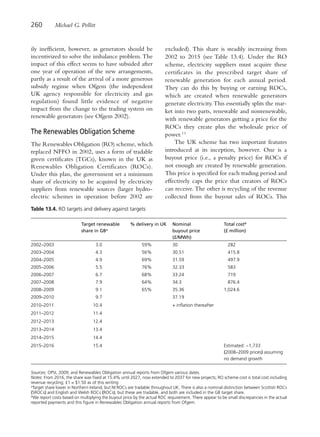
The Renewables Obligation (RO) scheme, which                                The UK scheme has two important features
replaced NFFO in 2002, uses a form of tradable                          introduced at its inception, however. One is a
green certificates (TGCs), known in the UK as                           buyout price (i.e., a penalty price) for ROCs if
Renewables Obligation Certificates (ROCs).                              not enough are created by renewable generation.
Under this plan, the government set a minimum                           This price is specified for each trading period and
share of electricity to be acquired by electricity                      effectively caps the price that creators of ROCs
suppliers from renewable sources (larger hydro-                         can receive. The other is recycling of the revenue
electric schemes in operation before 2002 are                           collected from the buyout sales of ROCs. This
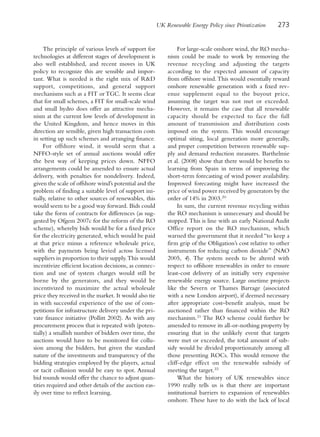
Table 13.4. RO targets and delivery against targets

                           Target renewable          % delivery in UK       Nominal                     Total costb
                           share in GBa                                     buyout price                (£ million)
                                                                            (£/MWh)
2002–2003                          3.0                      59%             30                            282
2003–2004                          4.3                      56%             30.51                         415.8
2004–2005                          4.9                      69%             31.59                         497.9
2005–2006                          5.5                      76%             32.33                         583
2006–2007                          6.7                      68%             33.24                         719
2007–2008                          7.9                      64%             34.3                          876.4
2008–2009                          9.1                      65%             35.36                       1,024.6
2009–2010                          9.7                                      37.19
2010–2011                        10.4                                       + inflation thereafter
2011–2012                        11.4
2012–2013                        12.4
2013–2014                        13.4
2014–2015                        14.4
2015–2016                        15.4                                                                   Estimated: ~1,733
                                                                                                        (2008–2009 prices) assuming
                                                                                                        no demand growth

Sources: OPSI, 2009; and Renewables Obligation annual reports from Ofgem various dates.
Notes: From 2016, the share was fixed at 15.4% until 2027, now extended to 2037 for new projects; RO scheme cost is total cost including
revenue recycling; £1 = $1.50 as of this writing
a
  Target share lower in Northern Ireland, but NI ROCs are tradable throughout UK. There is also a nominal distinction between Scottish ROCs
(SROCs) and English and Welsh ROCs (ROCs), but these are tradable, and both are included in the GB target share.
b
  We report costs based on multiplying the buyout price by the actual ROC requirement. There appear to be small discrepancies in the actual
reported payments and this figure in Renewables Obligation annual reports from Ofgem.
UK Renewable Energy Policy since Privatization       261


takes the form of allocating the revenue back to                  The scheme is further complicated by the
the creators of ROCs in proportion to the                     introduction of “banding” starting on April 1,
number they created.                                          2009 (see Table 13.5). This changes the exchange
     The renewable energy industry was very posi-             rate to ROCs of some renewable generation:
tive about the new incentive mechanism (Hill and              established technologies will get less than 1 ROC
Hay 2004). So they should have been, because the              per MWh, newer more. This change breaks the
scheme is very generous. Thus for example in                  link between the total number of ROCs and the
2007–2008, the buyout (penalty) price was                     share of renewable energy generation and will
£34.30 ($51.45) per MWh, and only 64% of the                  presumably result in a reduced amount of elec-
required ROCs were created by generators,                     tricity being produced from renewables if the
meaning the buyout price was binding in the cer-              scheme is fully successful (if the share of high-
                                                              exchange-rate technologies were to take off, as it
tificate market. The total payment by suppliers
                                                              might with offshore wind). The Carbon Trust
was the target quantity of renewables multiplied
by £34.30 ($51.45) per MWh. This meant that                   Table 13.5. Banding of ROCs from April 1, 2009
36% of the total ROC payment made by suppliers
was available to be recycled and was divided pro-             Generation type                 ROCs per MWh
portionally among the generators who created                  Landfill gas                         0.25
actual ROCs. Accordingly, for each ROC actually               Sewage gas
presented, the renewable generators received                                                       0.5
                                                              Cofiring of biomass
£34.30 plus £18.65 ($27.98) (i.e., an additional              Onshore wind
36/64 times £34.30 less costs of the scheme) This             Hydro
sum is in addition to the wholesale cost of power.            Cofiring of energy crops
As the total cost to suppliers of the ROC scheme              Energy from waste with CHP
was £876 million ($1,314 million), this implies               Cofiring of biomass with             1.0
that consumers overpaid, relative to what was                   CHP
necessary to secure the renewable generation                  Geopressure

actually supplied, by at least the value of the               Standard gasification

buyout revenue of around £315 million (36% of                 Standard pyrolysis
                                                              Offshore wind
£876 million [$1,314 million], or 1% of the total
                                                              Biomass
electricity expenditure of £30.7 billion [$46 bil-                                                 1.5
                                                              Cofiring of energy crops
lion] in 2008) (DUKES 2009).12 Interestingly, the
                                                                with CHP
government collects the associated ROC pay-
                                                              Wave
ments on the generation contracted under NFFO                 Tidal stream
via the NFFO fund, which creates a surplus above              Advanced gasification
the payments to generators under that program;                Advanced pyrolysis
this surplus is estimated to be around £200 mil-              Anaerobic digestion
lion ($300 million) per year (Tickell 2008).                  Energy crops
     The RO scheme is curious for two reasons.                Biomass with CHP
First, it relies on underdelivery to trigger the                                                   2.0
                                                              Energy crops with CHP
maximum subsidy amount. If the target number                  Solar photovoltaic
of ROCs (or more) were presented, then the                    Geothermal
price would drop to zero. Second, in the case of              Tidal impoundment—tidal
underdelivery, the maximum amount of subsidy is                 barrage
paid to those actually creating ROCs. Thus the                Tidal impoundment—tidal
scheme assumes failure to meet the target and                   lagoon
ensures that a fixed total subsidy is paid, given this,
regardless of how few ROCs are created.                       Source: DECC 2009d
262      Michael G. Pollitt


(2006) recommended the move to banding to             Table 13.6. Financial support (£ million) for
recognize the different stages of development that    renewables in the United Kingdom (nominal)
the technologies had reached, and hence the
higher learning benefits associated with increased                       R&D              RO             NFFO
funding to earlier-stage technologies. Oxera          1990–1991           14.7                             6.1
(2005) points out the cost implications of allowing   1991–1992           17.1                            11.7
NFFO plants to earn ROCs once their NFFO              1992–1993           16.1                            28.9
contracts expired (around £620 million [$930          1993–1994           15.2                            68.1
million]), giving those projects unexpected addi-     1994–1995            9.1                            96.4
tional subsidy. Oxera calculated that as much as      1995–1996            9.1                            94.5
half the payment via ROCs was in excess of that       1996–1997            6.2                           112.8
required to ensure that the funded projects went
                                                      1997–1998            4.3                           126.5
ahead, and that existing landfill gas projects did
                                                      1998–1999            3.3                             127
not require any ROCs to be economically viable.
                                                      1999–2000            4.6                            56.4
    The scheme, as shown in the table, implies
that the subsidy to offshore wind could be            2000–2001            4.4                            64.9

increased by £26.47 ($39.71) per MWh (50% of          2001–2002            6.1                            54.7
the 2007–2008 ROC revenue) and to tidal by            2002–2003           10.5          282.0                 -
£52.95 ($79.43) per MWh (100% of the 2007–            2003–2004           11.6          415.8                 -
2008 ROC revenue). In the 2009 budget, off-           2004–2005           19.7          497.9                 -
shore wind was subject to an emergency                2005–2007           36.6          583.0                 -
rebanding provision, which saw the offshore wind      2006–2007           49.5          719.0                 -
ROC band go to 2 for 2009–2010 and 1.75 for           2007–2008           41.6          876.4                 -
2010–2011, now increased back to 2 from 2010–
                                                      Sources: UK government renewable R&D budget data from IEA
2014.                                                 2009; Mitchell and Connor 2004, 1943


Policy Costs and Delivery                             port is up 47% in real terms from the figure esti-
under NFFO and RO                                     mated by Wordsworth and Grubb (2003) of £1.3
                                                      billion ($1.95 million) in 2002–2003.13
Table 13.6 summarizes the financial commitments            As the above discussion of the progress with
made under the NFFO and RO schemes, as well           the RO scheme has made clear, the development
as a reference amount for the amount of public        of electricity from renewables has been disap-
R&D expenditure reported to the International         pointing in terms of overall cost relative to deliv-
Energy Agency (IEA). The increased significance       ery, given the United Kingdom’s resource poten-
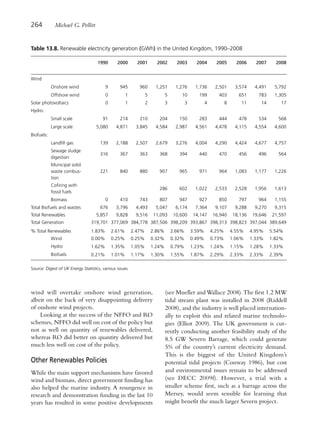
of the RO scheme is evident.                          tial and ambitious targets. Table 13.8 gives the fig-
     While the RO scheme is the most significant      ures in terms of total electricity generation. A
element of the United Kingdom’s expenditure on        number of features stand out. First of all, electri-
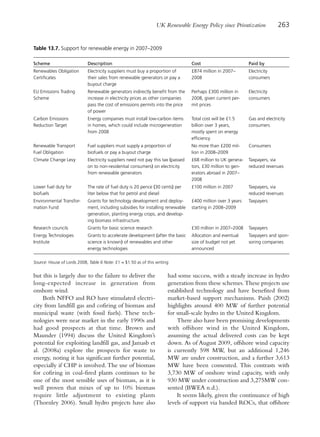
renewables, it is not the only element. Table 13.7    city from biomass in 2008 is larger than that from
is a summary offered in a ministerial answer to a     wind. Hydro remains significant within the UK
parliamentary select committee question. It is        renewable portfolio. Connor (2003) reported esti-
noteworthy that significant additional amounts are    mates from 2002 that suggested the United King-
still being spent by the taxpayer on supporting       dom would meet only two-thirds of its target level
earlier-stage technologies outside the CO2 price      by 2010. This still seems likely. However, the
and RO support mechanisms. However, the order         striking thing about the 2002 estimates is that for
of magnitude of energy customer support for           biomass, offshore wind, and hydro, they seem
renewables is of the order of £1.8 billion ($2.7      likely to be met or exceeded, though not by
billion) in 2008, in addition to £400 million         onshore wind. The United Kingdom is failing to
($600 million) by the taxpayer. This level of sup-    meet its projections for renewables as predicted,
UK Renewable Energy Policy since Privatization              263


Table 13.7. Support for renewable energy in 2007–2009

Scheme                      Description                                           Cost                        Paid by
Renewables Obligation       Electricity suppliers must buy a proportion of        £874 million in 2007–       Electricity
Certificates                their sales from renewable generators or pay a        2008                        consumers
                            buyout charge
EU Emissions Trading        Renewable generators indirectly benefit from the      Perhaps £300 million in     Electricity
Scheme                      increase in electricity prices as other companies     2008, given current per-    consumers
                            pass the cost of emissions permits into the price     mit prices
                            of power
Carbon Emissions            Energy companies must install low-carbon items        Total cost will be £1.5     Gas and electricity
Reduction Target            in homes, which could include microgeneration         billion over 3 years,       consumers
                            from 2008                                             mostly spent on energy
                                                                                  efficiency
Renewable Transport         Fuel suppliers must supply a proportion of            No more than £200 mil-      Consumers
Fuel Obligation             biofuels or pay a buyout charge                       lion in 2008–2009
Climate Change Levy         Electricity suppliers need not pay this tax (passed   £68 million to UK genera-   Taxpayers, via
                            on to non-residential consumers) on electricity       tors, £30 million to gen-   reduced revenues
                            from renewable generators                             erators abroad in 2007–
                                                                                  2008
Lower fuel duty for         The rate of fuel duty is 20 pence (30 cents) per      £100 million in 2007        Taxpayers, via
biofuels                    liter below that for petrol and diesel                                            reduced revenues
Environmental Transfor-     Grants for technology development and deploy-         £400 million over 3 years   Taxpayers
mation Fund                 ment, including subsidies for installing renewable    starting in 2008–2009
                            generation, planting energy crops, and develop-
                            ing biomass infrastructure.
Research councils           Grants for basic science research                     £30 million in 2007–2008    Taxpayers
Energy Technologies         Grants to accelerate development (after the basic     Allocation and eventual     Taxpayers and spon-
Institute                   science is known) of renewables and other             size of budget not yet      soring companies
                            energy technologies                                   announced

Source: House of Lords 2008, Table 6 Note: £1 = $1.50 as of this writing


but this is largely due to the failure to deliver the                  had some success, with a steady increase in hydro
long-expected increase in generation from                              generation from these schemes. These projects use
onshore wind.                                                          established technology and have benefited from
    Both NFFO and RO have stimulated electri-                          market-based support mechanisms. Paish (2002)
city from landfill gas and cofiring of biomass and                     highlights around 400 MW of further potential
municipal waste (with fossil fuels). These tech-                       for small-scale hydro in the United Kingdom.
nologies were near market in the early 1990s and                           There also have been promising developments
had good prospects at that time. Brown and                             with offshore wind in the United Kingdom,
Maunder (1994) discuss the United Kingdom’s                            assuming the actual delivered costs can be kept
potential for exploiting landfill gas, and Jamasb et                   down. As of August 2009, offshore wind capacity
al. (2008a) explore the prospects for waste to                         is currently 598 MW, but an additional 1,246
energy, noting it has significant further potential,                   MW are under construction, and a further 3,613
especially if CHP is involved. The use of biomass                      MW have been consented. This contrasts with
for cofiring in coal-fired plants continues to be                      3,730 MW of onshore wind capacity, with only
one of the most sensible uses of biomass, as it is                     930 MW under construction and 3,275MW con-
well proven that mixes of up to 10% biomass                            sented (BWEA n.d.).
require little adjustment to existing plants                               It seems likely, given the continuance of high
(Thornley 2006). Small hydro projects have also                        levels of support via banded ROCs, that offshore
264           Michael G. Pollitt


Table 13.8. Renewable electricity generation (GWh) in the United Kingdom, 1990–2008

                                     1990       2000       2001        2002        2003        2004        2005        2006     2007     2008


Wind
            Onshore wind                 9       945        960       1,251       1,276       1,736       2,501       3,574    4,491    5,792
            Offshore wind                0           1           5           5       10         199         403         651      783    1,305
Solar photovoltaics                      0           1           2           3           3           4           8       11       14       17
Hydro:
            Small scale                 91       214        210         204         150         283         444         478      534      568
            Large scale             5,080      4,871      3,845       4,584       2,987       4,561       4,478       4,115    4,554    4,600
Biofuels:
            Landfill gas              139      2,188      2,507       2,679       3,276       4,004       4,290       4,424    4,677    4,757
            Sewage sludge
                                      316        367        363         368         394         440         470         456      496      564
            digestion
            Municipal solid
            waste combus-             221        840        880         907         965         971         964       1,083    1,177    1,226
            tion
            Cofiring with
                                                                        286         602       1,022       2,533       2,528    1,956    1,613
            fossil fuels
            Biomass                      0       410        743         807         947         927         850         797      964    1,155
Total Biofuels and wastes             676      3,796      4,493       5,047       6,174       7,364       9,107       9,288    9,270    9,315
Total Renewables                    5,857      9,828      9,516      11,093      10,600      14,147      16,940      18,136   19,646   21,597
Total Generation                 319,701 377,069 384,778 387,506 398,209 393,867 398,313 398,823 397,044 389,649
% Total Renewables               1.83%       2.61%       2.47%       2.86%       2.66%       3.59%       4.25%       4.55%    4.95%    5.54%
            Wind                 0.00%       0.25%       0.25%       0.32%       0.32%       0.49%       0.73%       1.06%    1.33%    1.82%
            Hydro                1.62%       1.35%       1.05%       1.24%       0.79%       1.23%       1.24%       1.15%    1.28%    1.33%
            Biofuels             0.21%       1.01%       1.17%       1.30%       1.55%       1.87%       2.29%       2.33%    2.33%    2.39%

Source: Digest of UK Energy Statistics, various issues


wind will overtake onshore wind generation,                                  (see Mueller and Wallace 2008). The first 1.2 MW
albeit on the back of very disappointing delivery                            tidal stream plant was installed in 2008 (Riddell
of onshore wind projects.                                                    2008), and the industry is well placed internation-
    Looking at the success of the NFFO and RO                                ally to exploit this and related marine technolo-
schemes, NFFO did well on cost of the policy but                             gies (Elliot 2009). The UK government is cur-
not as well on quantity of renewables delivered,                             rently conducting another feasibility study of the
whereas RO did better on quantity delivered but                              8.5 GW Severn Barrage, which could generate
much less well on cost of the policy.                                        5% of the country’s current electricity demand.
                                                                             This is the biggest of the United Kingdom’s
Other Renewables Policies                                                    potential tidal projects (Conway 1986), but cost
While the main support mechanisms have favored                               and environmental issues remain to be addressed
wind and biomass, direct government funding has                              (see DECC 2009f). However, a trial with a
also helped the marine industry. A resurgence in                             smaller scheme first, such as a barrage across the
research and demonstration funding in the last 10                            Mersey, would seem sensible for learning that
years has resulted in some positive developments                             might benefit the much larger Severn project.
UK Renewable Energy Policy since Privatization      265


     PV has relied on direct government support
for installation programs that have involved only a
                                                              An Assessment of Renewables
small number of installations, mainly funded via              Policies
the government’s Industry Department (DTI,
then BERR) under the Low Carbon Buildings                     A 20-year view of UK renewables policy suggests
Fund. This funding has installed only a few hun-              a failure to translate the country’s early resource-
dred PV systems. The degree of satisfaction with              based promise into actual delivery of renewable
the technology among the recipients of funding                energy. It would be wrong to suggest widespread
has been positive (Faiers and Neame 2006), but a              policy failure, however. The United Kingdom is
lack of significant sums of money and proper                  making progress on decarbonization and has
assessment of the learning from the policy has                strong and increasingly comprehensive policies in
been noted (Keirstead 2007). This is in spite of a            place, covering electricity, heat, and transport (via
well-regarded R&D plan for solar being put in                 policies toward electric vehicles and biofuels).
place in the 1990s (Stainforth et al. 1996) and                    Two points are worth making at this stage.
work showing that significant community instal-               First, renewable energy policy remains an expen-
lations of solar would not pose any local grid                sive gamble for all countries. Second, it is unclear
problems (Thomson and Infield 2007). The gov-                 what part particular renewable technologies
ernment has made two very recent changes to its               should play in decarbonization to 2050.
renewables policy, which are relevant to any                       As Helm (2002) has pointed out, a sensibly
assessment of the need for reform of the current              high and stable price of carbon is the starting
arrangements (allowed for in primary legislation              point for all economically feasible decarboniza-
(OPSI 2008b)).                                                tion policies. In the absence of this, it is virtually
     First, a feed-in tariff (FIT) for small-scale low-       impossible to establish proper signals for mature
carbon generation commences in April 2010 (see                technologies and near-market technologies,
www.fitariffs.co.uk/). This will be for renewable             whose response to the proper price signal deter-
electricity generation up to 5 MW and fossil-fuel             mines how fast the country needs to accelerate
CHP up to 50 kW. Meant to encourage PV,                       less developed technologies. This is particularly
small-scale wind (including microwind),                       true for nuclear, CCS, and demand reduction
microhydro, and micro-CHP, this policy responds               investments, many of which are being delayed by
to industry concerns about the lack of ambition in            low, volatile, and uncertain prices for carbon. The
microgeneration policy (Lupton 2008).                         United Kingdom, with its diversified energy sys-
     The second policy is a Renewable Heat                    tem, exposure to world energy markets, and
Incentive (RHI) (see www.rhincentive.co.uk).                  openness to both nuclear and CCS, has keenly felt
This has the potential to be a significant policy             the lack of a proper carbon price signal.
covering all scales of production: household,                      As Nelson (2008) discusses, the failure to set a
community, and industrial. It is intended to drive            sufficiently tight cap on CO2 at the EU level
the share of renewable heat to 14% (though this is            makes UK renewables policy meaningless as a
not a firm target) up from 0.6%. It could cover air           policy for decarbonization. More renewable elec-
source heat pumps, anaerobic digestion to pro-                tricity generation within the EU Emissions Trad-
duce biogas for heat production, biomass heat                 ing System (ETS) simply causes fuel switching in
generation and CHP, ground source heat pumps,                 the fossil plants from gas to coal, not to mention
liquid biofuels (but only when replacing oil-fired            delaying nonrenewable low-carbon investments
heating systems) and solar thermal heat and hot               in CCS and nuclear. In this context, UK
water.                                                        renewables policy has been somewhat conserva-
     The scheme is not finalized at the time of               tive with respect to funding levels under NFFO
writing and is due to commence in April 2011.                 and to renewable energy targets under the RO
                                                              and, until recently, unwilling to pick winners. As
                                                              Eikeland and Sæverud (2007) point out, however,
266       Michael G. Pollitt


the ending of the United Kingdom’s status as an        an impact assessment to the relevant local govern-
energy exporter in 2003 and the associated rapid       ment authority. The application is initially assessed
decline in oil and gas reserves have led to a          by a local planning officer, who makes recom-
reawakening of energy security concern as a            mendations on the plans to the relevant group of
major driver of UK energy policy. This is likely to    elected local councilors for the area, who in turn
explain substantially increased interest in deliver-   vote on the proposal. Plans would be available for
ing more domestic renewable capacity.                  public consultation, and objections could be
     Failure to deliver large quantities of            raised during the review period. Planning applica-
renewables so far is not a particular issue, in that   tions can be granted subject to conditions and
delay will probably mean lower costs of exploita-      obligations. This process might result in a number
tion (resulting from learning by doing elsewhere       of iterations in the plans. Should permission be
and learning by research) when they are finally        refused, the applicant can appeal the decision, in
exploited. The unfortunate aspect of the RO sys-       which case a costly public inquiry would ensue.
tem is its failure to deliver cost-effectively the     The relevant central government department also
renewables that it has delivered. This has been a      has the right to disallow a locally approved plan-
serious design flaw, and the inability of the UK       ning application so objectors can appeal to the
government to learn and correct the flaw does not      relevant government minister. At the national
bode well for any other long-term mechanism put        level, plans need to be submitted to the relevant
in place to support renewables. Nevertheless,          government department for referral to the secre-
given the targets for delivery that exist within the   tary of state for final decision. Objections can be
scheme, it is clearly important to consider why        raised to these plans according to the planning
the scheme has not delivered the quantity of           guidelines. This national-level process is being
renewables intended. The failure of the scheme to      streamlined, as below.15
deliver overall lies squarely with one particular           The average time for local and national plan-
technology: the failure to deliver sufficient quan-    ning decisions on onshore wind in 2007 was 24
tities of onshore wind.                                months, with approval rates of 62% (Chamberlain
                                                       2008, 21). For large projects, the Ministry of
Onshore Wind and the Planning Problem                  Defence, National Air Traffic Control, and civil
                                                       airports were major objectors. Attempts have been
The standard reason given for the delivery failure     made since 2007 to obligate local councils to set
is difficulties in getting new wind farms through      target levels of energy from renewables for new
local planning processes. Whereas conventional         developments. The 2008 Planning Act (see OPSI
power plants can easily be built on existing sites     2008c) allows for setting up an Infrastructure
and require national-level planning consents,          Planning Commission to decide on large onshore
wind farms are often small in terms of MW              wind farms (greater than 50 MW) as well as large
capacity and require local planning permission if      offshore projects (greater than 100 MW) (see
less than 50 MW, which covers most onshore             NAO 2008, 40–41, for a discussion).
installations.14 Evidence has consistently shown            The literature has dug more deeply into the
that gaining planning permission is a serious          planning problem. Hedger (1995) highlights that
obstacle to the development of wind farms or,          wind power development involves a clash of plan-
more precisely, that the costs of obtaining permis-    ning cultures: land use versus energy supply. The
sion are often prohibitive in terms of imposed         first is fundamentally local, participatory, and con-
delays, negotiation costs, and planning restrictions   cerned with preserving rural landscapes; the sec-
on the precise nature of the final investment.         ond is fundamentally national, top-down, and
    In the United Kingdom, local planning deci-        concerned with delivering technological solutions
sions typically involve an applicant, such as a wind   to national energy supply requirements. These
project developer, making a planning application.      cultures were bound to clash in onshore wind
This includes the submission of detailed plans and     power development.
UK Renewable Energy Policy since Privatization       267


     Mitchell and Connor (2004) stress that the             many people’s fears not being realized. It is also
emphasis on cost minimization, combined with                true that in general, majority support exists for
the tying of subsidies to particular locations and          new wind farms, but there are a significant
plans, meant that many successful NFFO bids                 number of both local and nonlocal objectors to
failed to get through the planning process. This            given schemes (Warren et al. 2005). This suggests
was because the bidders were not able to invest in          a social gap or democratic deficit at the local level
local engagement or respond to the outcome of               that needs to be overcome (Bell et al. 2005) in
the engagement process by modifying their pro-              order to connect national policy delivery with
posals. Indeed, the competitive nature of NFFO              legitimate local concerns.
meant that often the bidders had to keep prospec-                Rather surprisingly, little systematic study has
tive locations secret and did not engage in local           been done of success rates in individual local
consultations prior to bidding. Toke (2005b)                authority areas or by individual developers or
found that for the projects he examined from the            ownership type. Only Toke (2005b) has attempted
third through fifth NFFO rounds in England and              a regression analysis, looking at planning permis-
Wales, 47 were granted planning permission, 47              sion acceptance and refusal for wind projects
refused planning permission, and 96 did not make            based on a sample of 51 proposals. Among his
or complete an application.16                               findings is that if the local planning officers (who
     The main reasons given for planning objec-             process applications and make recommendations
tions were visual amenity impairment and worries            to the local councilors who vote on the applica-
about noise (Eltham et al. 2008). These gave rise           tion) object, then projects are almost always
to concerns about economic effects on house                 refused, whereas if they accept a project, it is likely
prices and tourism. The United Kingdom is a                 to go through on appeal. Toke also finds that if the
densely populated island, with many areas of                Campaign to Protect Rural England, which cam-
lower population and high ground located in                 paigns “for the beauty, tranquillity and diversity of
national parks or other places that attract tourists.       the countryside” (CPRE n.d.), objects to a
Increasing numbers of residents or second-home              project, it is likely to be opposed by the local
buyers have been moving to such areas for their             parish council. One developer, Wind Prospect
visual amenities rather than employment reasons             (2008), which has a joint venture with EDF, a
(see Strachan and Lal 2004 for a discussion of the          major energy company, to develop onshore wind
debate around tourism). The decline of employ-              farms in the United Kingdom, has invested heav-
ment in farming and rural industries has reduced            ily in local consultation and seems to have been
the scope for arguments based on the small                  more successful in gaining planning permission
number of permanent jobs that might be created              (see Toke 2005b). Active community involvement
in the energy sector, because increasing percent-           has led to successful development in some cases,
ages of people living in the countryside work in            particularly when the community owns shares in
nearby conurbations and are not looking for                 the wind farm, but these are small in capacity
employment in local industries.                             terms.17 However, under both NFFO and RO,
     Rural environmental protection and local               there has been an unwillingness to actively involve
community action groups thus had strong incen-              communities in co-ownership of onshore wind
tives to organize opposition to individual wind             developments, possibly because of the dominance
farm projects, although in some cases tourism               of large power companies within the UK wind
actually increased after wind turbines were                 power sector and the high transaction costs of
installed, and the noise from a modern turbine              such engagement.
that is 500 meters away is no more than in a quiet               Overall, it is difficult to tell whether the full
bedroom (Strachan and Lal 2004). A number of                cost of developing wind power onshore is actually
studies (e.g., Eltham et al. 2008; Warren et al.            much higher than it would appear, given the
2005) have shown that attitudes to wind farms               social value of the UK countryside, or whether a
consistently improve after construction, with               feasible redistribution of the current benefits
268       Michael G. Pollitt


toward potential local objectors would be enough           anti-wind lobbies. The wind developers were
to solve the planning problem. Bergmann et al.             unhappy that many proposed schemes lay outside
(2008) use willingness-to-pay modeling of a sam-           the designated areas, and anti-wind groups were
ple of rural and urban dwellers in Scotland. While         unhappy with where some of the boundaries of
both groups value reduced environmental impact             the acceptable areas were drawn.
from power generation highly, the authors find
that urban dwellers are willing to pay more for an
offshore wind farm than for an equivalent large
onshore wind farm and value the rural employ-              Biomass
ment opportunities less than do rural people. The          Biomass is likely to be the second-largest renew-
actual construction costs of wind farms in the             able energy source out to 2020 in the United
United Kingdom are difficult to come by, but the           Kingdom. Biomass is frequently cited as a signifi-
information that is available suggests that                cant, albeit finite contribution to UK decarbon-
simulations of the likely penetration of new               ization (of the order of up to 5%) (see Taylor 2008
projects are still based on optimistic assumptions         for a review). Biomass policy toward waste has
that wind costs will be much cheaper than they             been largely successful because of the near-market
currently are.18 High actual costs may therefore be        nature of the technology and its responsiveness to
a factor delaying investment. The achieved load            both NFFO and RO subsidies. The direct burn-
factors for the whole UK wind portfolio in 2008            ing of biocrops has also been successful, given the
were 27% for onshore and 30.4% for offshore                emerging global market in tradable biomass from
(DECC, 2009b, 206) in contrast to higher                   countries such as Brazil, Canada, and the United
assumptions in some calculations (e.g., Dale et al.        States (Junginger et al. 2008).
2004, who assume 35% for both onshore and off-                  Government support for local biocrop plants
shore wind).                                               has proved problematic, however, given the tech-
    No doubt smaller, more local developments              nological, planning, and economic constraints. A
would facilitate reduced planning objections, but          high-profile project involving local biomass and
they would come with their own higher costs.               new technology failed as a result of financing con-
The move to FITs for such smaller developments             cerns (Piterou et al. 2008), and it is difficult to
should help increase the number of such projects.          justify the use of local biocrops for anything other
However, in examining scenario rankings from               than direct burning in existing coal-fired power
different wind actors in northwest England,                stations in direct competition with internationally
Mander (2008) finds that expansion of offshore             traded biomass, which is usually produced more
wind was the only part of a wind strategy that             efficiently abroad. Nevertheless, some focus
both pro-wind and pro-countryside lobbies could            group studies have suggested that there is public
agree on, even if onshore wind became more                 support for the use of local biomass in small CHP
community-driven. Attempts to streamline the               plants and skepticism about the overall GHG
planning process have been made, with significant          impact of the use of internationally traded
reforms to the appeals process in 2003 (Toke               biomass (see Upham et al. 2007).
2003), giving more power at the national level;                 It is not environmentally sensible to use local
nevertheless, there is clearly still an issue of getting   biocrops to produce biofuel in the United King-
permission. Attempts in 2005 to streamline the             dom. Local biocrops produce more GHG impact
planning process in Wales (under a devolved                when directly burned to produce power and heat
administration) have had mixed success (Cowell             (Hammond et al. 2008). Indeed, in the longer
2007). The Welsh Assembly designated “strategic            run, the current use of biofuels to blend with
search areas,” which were assessed to be more              petrol and diesel may be phased out as the vehicle
suitable for large wind farm developments and              fleet is electrified (for current use, see Bomb et al.
hence more likely to be approved on appeal.                2007). The difficulty of making a sensible indus-
These proved controversial, with both pro- and             trial policy argument for a local crop-dedicated
UK Renewable Energy Policy since Privatization      269


biomass power plant within a viable long-run                 tem.19 This excess cost is significant and rising.
decarbonization strategy is helpfully discussed by           Nevertheless, it remains small compared with the
van der Horst (2005). Indeed, Slade et al. (2009)            high cost of the renewable deployment strategies
criticize UK bioenergy policy as being character-            of some other countries, such as Germany and
ized by lots of initiatives but with a lack of clarity       Spain, which have not allowed them to meet their
as to precise objectives to be delivered. If the             GHG reduction targets.
country were to rely on internationally traded                    It is fashionable to suggest that the root cause
biomass as its key input, this would require better          of the problem of underdelivery of onshore wind
certification as to the source of the biomass (van           is the use of a tradable green certificate (TGC)
Dam et al. 2008).                                            scheme rather than a FIT, as used in Germany and
     Bioenergy, with its complicated supply chain,           Spain (see, e.g., Butler and Neuhoff 2008;
displacement impacts, and total production cycle
                                                             Jacobsson et al. 2009; Lipp 2007; Meyer 2003;
sustainability impacts, requires proper pricing of
                                                             Toke 2005a; Toke and Lauber 2007). A more bal-
all its environmental effects, including GHGs and
                                                             anced assessment by the International Energy
local pollutants, in order to calculate whether it is
                                                             Agency (IEA 2006) of the UK renewable energy
worthwhile (Elghali et al. 2007). The life cycle
GHG impact of biocrops (i.e., the impact on the              policy points out that TGCs have worked well (at
amount of carbon stored in the stock of growing              least to the date of the IEA’s assessment) in a
crops) is further complicated by the carbon stor-            number of jurisdictions, such as Texas, Sweden,
age impacts of increasing the area set aside for             Australia, and New Zealand. It is only in the
growing them (Cannell 2003).                                 United Kingdom where they seem to have mani-
                                                             festly failed to deliver the intended capacity.
                                                                  Two common theoretical arguments have
                                                             been made for the superiority of FITs over TGCs.
UK Performance versus That of                                One is that by offering a fixed price per kWh to
                                                             developers, this allows new renewables to be
Other Countries                                              financed more easily. The other is that FITs attract
The discussion so far indicates that comparative             large quantities of renewables because these are
assessment of UK policy on renewable energy                  not limited to the most attractive sites.
would not be straightforward. It is clear that the                The first argument is well put by Mitchell et
United Kingdom has pursued a successful decar-               al. (2006), who maintain that the UK RO scheme
bonization strategy to date and that relative suc-           exposes renewables to price, volume, and balan-
cess has been achieved in several areas, both in             cing risks, rather than just volume risks as under a
responding to price signals and in developing new            FIT. Although this clearly does impose costs, it is
technologies for deployment in the country. The              not clear that it is suboptimal or that it explains
one area of failure is in deployment of onshore              nondelivery against the United Kingdom’s
wind at least cost. The net environmental impact             renewables targets. Higher risk is relevant to non-
of this failure is currently zero, given that the            delivery where development is small-scale and the
United Kingdom is on course to meet its GHG                  developers have little or no credit history; here
reduction targets. Still, this environmental per-            there may well be a significant market failure in
formance could have been delivered at lower cost.            the market for external finance. However, it is
The excess costs of the current set of policies are          rather a weak argument when the ultimate devel-
hard to estimate, given the diversity of support             opers are mostly large multinational companies
instruments. However, a lower-end estimate                   making portfolio investments, and when most
would be the amount of revenue recycling within              ROC credits are bought by the six multinational
the RO mechanism, as this overpayment seems                  supply companies who dominate the UK market,
largely unnecessary to deliver the observed quan-            each with generation interests and the option to
tity of renewables connected to the electricity sys-         invest directly in renewable capacity.
270         Michael G. Pollitt


Table 13.9. Differences among leading wind countries in Europe

                  1,000 mi2 land      % onshore wind owned            % owned by              % owned by             Wind cap-
                    per million            by utilities/                farmers               cooperatives          acity (MW),
                   population,            corporations                                                               end 2008
                    2009–2010
United                  1.5                         98                         1                   0.5                 3,288
Kingdom
Germany                 1.7                         55                        35                    10                23,903
Spain                   4.3                       > 99                      < 0.5                    0                16,740
Denmark                 2.9                         12                        63                    25                 3,160

Sources: Wikipedia, List of Countries and Dependencies by Population Density (accessed 26 March 2010); Wind Power 2009; Toke 2005a


    The second argument makes less theoretical                           Local ownership, which is very high in Den-
sense, because it is not clear why developing the                   mark and also notable in Germany, is a determi-
most attractive sites first is not desirable in any                 nant of successful strategic deployment in these
case. The quantity of renewables forthcoming is                     countries (Szarka and Bluhdorn 2006; Toke
clearly accelerated by offering initially high                      2007). This is important because these two coun-
returns, but offering a margin for renewables to                    tries face similar land use constraints to the United
attract investors is a function not of whether the                  Kingdom. The development in Spain, however,
subsidy regime is a FIT or TGC, but of how large                    has occurred with similar ownership of wind
a quantity of renewables is required under either                   assets by multinational companies, but in the con-
scheme. TGCs can set ambitious targets, as in the                   text of very little land use constraint (Toke and
United Kingdom, and can deliver attractive                          Strachan 2006). Thus it seems clear that these
prices. Low prices for renewables are not a prob-                   countries have different institutional and physical
lem with the ambitious RO targets.                                  starting points than the United Kingdom.
    In the end, the question becomes whether the                         Econometric modeling by Soderholm and
United Kingdom would have delivered more                            Klaassen (2007) of diffusion rates of wind power
onshore wind capacity had there been a FIT for                      across Europe confirms that the United Kingdom
wind energy. For community schemes, the answer                      has lower diffusion (penetration) relative to other
is quite possibly yes, because the uncertainty of                   countries, and that FITs do tend to be more suc-
individual project cash flows may well have been                    cessful in encouraging diffusion, but that a given
an issue for funders. However, for larger schemes                   FIT would likely have less of an impact here than
chiefly owned by multinational energy compa-                        in Germany.
nies, it is hard to say. The problem has clearly been                    What is clear is that the financial cost of wind
related to planning permission, and it is not obvi-                 power delivered onshore is unnecessarily high in
ous how changing the funding regime improves                        the United Kingdom. Butler and Neuhoff (2008,
the prospects for gaining planning permission                       1856) show that while the NFFO schemes did
unless it is more generous and offers scope for                     result in much lower support prices for wind in
providing attractive payments to the local com-                     the United Kingdom than in Germany, they were
munity.                                                             not that much lower once adjusted for the quality
    The literature seems to suggest that two more                   of the underlying wind resources. Under the RO,
fundamental dimensions are of interest to explain                   renewable support costs are estimated to have
the differences in delivery of onshore wind among                   been twice as high in 2006 as they would have
the United Kingdom, Germany, Spain, and Den-                        been under a German support tariff applied to
mark: land use constraints and local involvement                    UK wind resources (which would have been
in ownership, such as via local cooperatives or                     lower than the actual tariff in Germany). Toke
farmers (see Table 13.9).                                           (2005a) shows that the RO scheme with revenue
UK Renewable Energy Policy since Privatization       271


recycling was more expensive per kWh than the               the GB Queue are, and Ofgem has identified only
German FIT following reductions in the size of              around 450 MW of wind capacity that needs to
the FIT in Germany.                                         be prioritized via accelerating transmission invest-
     Looking at Spain, where large utilities have           ment (see Ofgem 2009a). It is also the case that
dominated in ownership of wind generation simi-             new renewable connections should face the true
larly to the situation in the United Kingdom,               costs of connection to the grid and capacity, and
Stenzel and Frenzel (2008) note the positive reac-          they should come onstream when it is at least
tion of incumbent Spanish companies to wind                 system cost, rather than only least generation cost.
power development in Spain in contrast with that            Nodal pricing would seem to be a more appropri-
in Germany. They highlight the importance of                ate way of signaling this, rather than the “connect
corporate self-interest in promoting wind power             and manage” approach under FITs in Germany
development. Wind power in Germany devel-                   (see Pollitt and Bialek 2008).
oped in spite of opposition from German utilities,               The correct pricing for transmission capacity
which were forced to accommodate renewables                 also points to the need for the United Kingdom
and bear the costs of connection to the grid. In            to look closely at the efficiency of utilization of
Spain, this has led the corporate generators to             transmission assets and their operational criteria.
support investment in better prediction of wind             The GB transmission system in general operates
speeds at individual wind farm sites in order to            under an N-2 safety standard, wherein the system
better manage the grid. In Germany, however,                must be operated in such a way that if a major link
significant costs have been imposed on the trans-           fails, it must be capable of handling another
mission system that are not reflected in the con-           similar-size failure. This gives rise to lower rates of
nection incentives of wind developers. This has             utilization of transmission grid assets than in
led to grid management issues in Germany, which             countries with an N-1 safety standard and gives
will become more costly to deal with as wind                rise to less use of automatic voltage control equip-
capacity increases (Klessmann et al. 2008). It is           ment. This suggests that there is scope for operat-
even possible to suggest that the continuation of           ing the assets much more smartly in the presence
the grip of incumbents on the German power                  of large-scale renewables. For instance, the nomi-
market is in significant part because of the unwill-        nal rating of Scotland–England interconnectors is
ingness of the German government to liberalize              around 7 GW, whereas the declared capacity is 2.2
the market fully, for fear of undermining the abil-         GW; this suggests that transmission constraints
ity of the incumbents to finance the significant            could be made less in practice than they might be
reinforcement costs associated with renewables              on paper. Ofgem’s recent LENS scenario
expansion.                                                  modeling (Ault et al. 2008) of the electricity
     In 2008, the United Kingdom had around                 transmission and distribution networks suggests
13.2 GW in 195 projects that were in Great Brit-            that a range of network sizes and capabilities are
ain’s “GB Queue” (see Ofgem 2007a). These were              possible by 2050, depending on how and where
projects that wished to connect to the power grid,          new generation capacity, including renewables,
but for which no firm connection right could be             was connected.
offered, unlike under the German FIT, where                      Looking to other countries with TGC
renewable capacity must be connected and paid               schemes, it is quite clear that Sweden, Australia,
for generated power (see Swider et al. 2008). The           and New Zealand have avoided the problems of
UK government has suggested that this is one of             overpayment that characterize the UK RO
the barriers to the rollout of renewables (DECC             scheme, and these jurisdictions have significantly
2009e). This may explain some of the slow deliv-            fewer land use constraints. Kelly (2007) discusses
ery of renewable wind connection in the United              the UK scheme in contrast to those of Australia
Kingdom, but it certainly does not explain the              and New Zealand. The Australian scheme, com-
most significant part of it. It is impossible to tell       plemented by an Office of the Renewable Energy
how economically viable many of the projects in             Regulator (see ORER n.d.), has much less ambi-
272       Michael G. Pollitt


tious targets than the UK scheme but does not
have any revenue recycling. The New Zealand
                                                         What Might Be Right for the
scheme has higher targets than Australia’s but is        United Kingdom
voluntary. The Swedish scheme also does not have
revenue recycling and is combined with carbon            If a problem exists with the delivery of onshore
taxes throughout the economy (see Swedish                renewable capacity in the United Kingdom, what
Energy Agency n.d.). The United Kingdom                  should be done about it? Answering this question
would do well to examine the overall carbon              requires attention to the institutional context of
reduction incentives in Sweden.                          the United Kingdom (following Rodrik 2008).
    Szarka (2006) raises an important issue about        The country’s policy context is a liberalized mar-
policy comparison across countries in the case of        ket for a relatively small island with concerns
renewables, suggesting that policy should be             about fuel poverty, global warming, and energy
aimed at paradigm change, not just installed             security. It is clear that what is needed is a policy
capacity. Clearly what matters is where the coun-        consistent with a liberalized energy market and
try ends up in terms of decarbonization, and what        with environmental targets. By contrast, Germany
is required is radical change to the UK energy           is much less committed to liberalized energy mar-
system. He maintains that the real success of Ger-       kets. It also has much more of a focus on a green
man policy has been to engage large numbers of           industrial policy aimed at promoting the manu-
individuals in taking action on climate change, as       facture of wind turbines for export. Although the
investors in local wind farms. This is an important      United Kingdom has paid lip service to this sort
perspective, because it suggests that the real failure   of objective, the reality is that only 4,000 jobs in
of UK policy is not gaining practical support for        the country depend on the wind production
the sorts of changes to the energy system that are
                                                         industry; even in Germany, the figure is only
required. Failure to focus on this aspect of the
                                                         38,000 (EWEA 2009). It is quite clear that for an
problem has led to an ineffective policy on
                                                         industry requiring around £1 billion ($1.5 bil-
renewables deployment, which will be more
                                                         lion) of subsidy per year, this is not a cost-effective
expensive than it need have been, due to a com-
bination of underdelivery and overpayment.               job creation scheme.
    Another issue is the stability of policy through         The focus should rather be on least-cost
time. A concern of UK policymakers in setting up         achievement of environmental targets, which will
the RO scheme was to introduce stability in the          be much more important for the competitiveness
subsidy regime over a long period, in contrast to        of the UK economy and for incomes and employ-
the stop-start nature of NFFO. However,                  ment. The current RO scheme is clearly far too
although stability is a desirable goal in itself, this   generous to existing onshore wind, and it does
has been an excuse for not facing up to the serious      not guarantee cost-effectiveness for offshore wind
deficiencies of the RO scheme. Little evidence is        and marine energy. It is also important that the
available to indicate that the United Kingdom has        aim of long-run cost reduction for technologies
had a less stable policy toward renewables than          that are currently not cost-effective be main-
countries with high penetration rates of                 tained, and that these technologies compete with
renewables, such as Denmark, Germany, and                nuclear and CCS projects in a reasonable time
Spain, where responses to incentives were rapid          frame. An important starting point for this is the
and significant changes have occurred to support         creation of a single high and stable carbon price
policy over time.                                        throughout the economy. This would immedi-
                                                         ately give clear signals to nuclear and CCS and
                                                         provide the backstop technologies against which
                                                         continuing subsidies can be measured. It would
                                                         also provide the right incentives to biomass in
                                                         terms of cofiring, landfill gas, and waste.
UK Renewable Energy Policy since Privatization     273


     The principle of various levels of support for              For large-scale onshore wind, the RO mecha-
technologies at different stages of development is          nism could be made to work by removing the
also well established, and recent moves in UK               revenue recycling and adjusting the targets
policy to recognize this are sensible and impor-            according to the expected amount of capacity
tant. What is needed is the right mix of R&D                from offshore wind. This would essentially reward
support, competitions, and general support                  onshore renewable generation with a fixed rev-
mechanisms such as a FIT or TGC. It seems clear             enue supplement equal to the buyout price,
that for small schemes, a FIT for small-scale wind          assuming the target was not met or exceeded.
and small hydro does offer an attractive mecha-             However, it remains the case that all renewable
nism at the current low levels of development in            capacity should be expected to face the full
the United Kingdom, and hence moves in this                 amount of transmission and distribution costs
direction are sensible, given high transaction costs        imposed on the system. This would encourage
in setting up such schemes and arranging finance.           optimal siting, local generation more generally,
     For offshore wind, it would seem that a                and proper competition between renewable sup-
NFFO-style set of annual auctions would offer               ply and demand reduction measures. Barthelmie
the best way of keeping prices down. NFFO                   et al. (2008) show that there would be benefits to
arrangements could be amended to ensure actual              learning from Spain in terms of improving the
delivery, with penalties for nondelivery. Indeed,           short-term forecasting of wind power availability.
given the scale of offshore wind’s potential and the        Improved forecasting might have increased the
problem of finding a suitable level of support ini-         price of wind power received by generators by the
tially, relative to other sources of renewables, this       order of 14% in 2003.20
would seem to be a good way forward. Bids could                  In sum, the current revenue recycling within
take the form of contracts for differences (as sug-         the RO mechanism is unnecessary and should be
gested by Ofgem 2007c for the reform of the RO              stopped. This is line with an early National Audit
scheme), whereby bids would be for a fixed price            Office report on the RO mechanism, which
for the electricity generated, which would be paid          warned the government that it needed “to keep a
at that price minus a reference wholesale price,            firm grip of the Obligation’s cost relative to other
with the payments being levied across licensed              instruments for reducing carbon dioxide” (NAO
suppliers in proportion to their supply. This would         2005, 4). The system needs to be altered with
incentivize efficient location decisions, as connec-        respect to offshore renewables in order to ensure
tion and use of system charges would still be               least-cost delivery of an initially very expensive
borne by the generators, and they would be                  renewable energy source. Large onetime projects
incentivized to maximize the actual wholesale               like the Severn or Thames Barrage (associated
price they received in the market. It would also tie        with a new London airport), if deemed necessary
in with successful experience of the use of com-            after appropriate cost–benefit analysis, must be
petitions for infrastructure delivery under the pri-        auctioned rather than financed within the RO
vate finance initiative (Pollitt 2002). As with any         mechanism.21 The RO scheme could further be
procurement process that is repeated with (poten-           amended to remove its all-or-nothing property by
tially) a smallish number of bidders over time, the         ensuring that in the unlikely event that targets
auctions would have to be monitored for collu-              were met or exceeded, the total amount of sub-
sion among the bidders, but given the standard              sidy would be divided proportionately among all
nature of the investments and transparency of the           those presenting ROCs. This would remove the
bidding strategies employed by the players, actual          cliff-edge effect on the renewable subsidy of
or tacit collusion would be easy to spot. Annual            meeting the target.22
bid rounds would offer the chance to adjust quan-                What the history of UK renewables since
tities required and other details of the auction eas-       1990 really tells us is that there are important
ily over time to reflect learning.                          institutional barriers to expansion of renewables
                                                            onshore. These have to do with the lack of local
274       Michael G. Pollitt


benefit from renewable projects that employ a           the large amount of relatively cheap unexploited
small number of people and have a significant per-      wind resources in the United Kingdom, in the
ceived amenity impact. The key learning from            face of overpayment to existing renewable gen-
Denmark and Germany is that local populations           erators.
must perceive such projects as being of positive
benefit to them rather than simply satisfying some
distant national policy objective, which they may
otherwise support. The United Kingdom must              Conclusions
develop local energy companies that are owned by        The United Kingdom is struggling to develop a
local investors or local customers or councils if the   coherent set of policies for decarbonization fol-
potential exploitation of local energy resources—       lowing its successful experience in liberalizing
wind, biomass, hydro, and other technologies—is         energy markets. Various authors have suggested
to be realized. This is because virtually all renew-    that the decarbonization policy is so ambitious
able electricity and heat technologies involve sig-     that it demands radical institutional changes
nificant local impacts in terms of siting of indus-     (Mitchell 2007; Pollitt 2008). However, little con-
trial facilities close to residential areas.            sensus has been reached on what form those insti-
     For offshore renewables, getting costs down        tutional changes should take.
will be the challenge. Costs need to decrease sig-           What is clear is that solutions must target
nificantly in order for energy customers to be          least-cost, or else the whole policy is likely to fail
willing to support large quantities of offshore         as a result of the actual cost becoming prohibitive.
renewables. The current combination of capital          On the path to this sort of ultimate policy failure,
grants and arbitrary ROC banding is not a satis-        large amounts of resources are likely to be wasted,
factory or sustainable way forward. Auctions for        to little overall effect and for no benefit to the UK
new capacity would be institutionally compatible        economy or the global climate. The United King-
with the United Kingdom’s liberalized electricity       dom has had a long history of failed government
market and offer the prospects of falling prices        intervention in the energy market and in indus-
over time. They would also tie in with the auc-         trial policy in general (Pollitt 2008). It must not
tions to build, own, and operate offshore trans-        continue this sort of tradition. It has, however,
mission lines to the new wind farms that Ofgem is       had good experience with the role of markets,
currently implementing (see Ofgem 2007b).               undertaking basic R&D, and the use of market
Under Ofgem’s offshore transmission auction             mechanisms to deliver public goods. The country
scheme, once an offshore wind farm has a firm           has also particular concerns about fuel poverty,
contract for connection to the onshore transmis-        which argues for a focus on keeping the costs of
sion grid, an auction is triggered to build the         renewables policy down.
interconnection between the shore and the wind               The United Kingdom agreed to an ambitious
farm.                                                   renewable generation target that was unnecessar-
     In the end, success in UK policy toward            ily tough—in terms of the required speed of
renewable deployment, relative to other coun-           increase in the share—in the face of its EU CO2
tries, must be measured in terms of the net present     targets, which could have been met in a much
value of the amount of renewable electricity gen-       more straightforward way by a combination of
erated scaled by the amount of subsidy. Although        demand reduction and a switch from coal- to gas-
this success metric will be difficult to measure at     fired generation (see Grubb et al. 2008). Why the
any point along the pathway, in the interim, suc-       country got itself into this position is not appar-
cess should be measured in terms of the extent to       ent, but it clearly hoped that the EU ETS would
which the maximum amount of renewable gen-              be much more effective than it has been in sup-
eration (adjusted for technological maturity) is        porting decarbonization. Because of this, the EU
being supported for the current level of subsidy.       Renewables Directive has become more signifi-
UK policy clearly is not being successful, given        cant for the country than it needed to be.
UK Renewable Energy Policy since Privatization       275


    The United Kingdom also must resist calls to               The United Kingdom also needs to signifi-
see national renewables policy as anything other           cantly improve the quality of the information on
than a policy for delivering learning benefits on          which policy decisions are being made. There is a
the path to cost parity with established technolo-         severe lack of analysis of the drivers of past policy
gies. An industrial policy based around the                outcomes, partly as a result of the lack of informa-
employment or export potential of renewables is            tion on the financial characteristics of individual
not a sensible use of national economic resources.         projects that have received subsidies. No study has
No doubt some benefit will accrue to the United            been done on the actual performance of renew-
Kingdom from exploiting its domestic renewables            able projects in the United Kingdom. Foxon and
potential, but this will arise naturally and should        Pearson (2007) highlight the need for improve-
not be an objective of policy. The British Wind            ments to the process of energy policymaking,
Energy Association (BWEA) reports that the                 whereby analysis is properly used to evaluate
United Kingdom is a net exporter of small-scale            policy, and policy is revised in the light of analysis.
wind turbines, the part of the market least affected       One particular area for improvement is in the
by government subsidy (see BWEA 2009). The                 consistency of energy policy among heat, power,
country needs to move to a more competitive                and transport fuel in terms of value of subsidies for
energy market wherein smaller firms compete                carbon reduction, entry barrier reduction, and
with large incumbents to supply power and                  promoting learning.
deliver national targets and the capacity to rapidly           The information available to potential, often
adopt new lower-cost innovations exists. This is           small-scale, developers could also be improved
essential if incumbent costs are to be kept down           with significantly more use of geographical infor-
and oligopoly pricing and excessive subsidy                mation system (GIS) mapping of potential renew-
regimes are to be avoided. The 40 years from 2010          able energy sites and guidance on acceptable
to 2050 are very likely to see huge technological          designs and siting rules. This would focus devel-
and lifestyle changes that will substantially change       oper efforts on sites much more likely to secure
the potential picture of the power, heat, and trans-       local public support and obtain planning permis-
port sectors (see Ault et al. 2008). The United            sion. This sort of proactive approach to preparing
Kingdom must have institutional arrangements to            the ground for projects would seem to address
incentivize potentially drastic innovation within          some of the calls for more united government
the renewables sector.                                     approaches (e.g., Keirstead 2007) toward energy
    The country must incorporate the learning              policy in the United Kingdom. It also likely
from both its NFFO and its RO experiences into             would aid in resolving resource conflicts among
future subsidy regimes. The evidence suggests that         local community, leisure, defense, air traffic, and
a reformed NFFO-type auction could be a sensi-             energy interests.
ble way to deliver large offshore wind parks                   Finally, a focus on renewables must not detract
mostly built by big multinational utility compa-           from the overriding policy aim of decarbonization
nies. Onshore, it is clear that there are legitimate       of the economy. This requires sensible carbon
land use issues with renewables, which can be              prices and the workings of the price mechanism
addressed only by smaller-scale projects for local         with regards to transmission and distribution
public benefit. This policy is in line with some of        costs. In the end, it is only when locational costs
the more decentralized scenarios of the future             and environmental externalities are properly
development of electricity networks, and it would          priced that any given renewables project, with its
have the added co-benefits of substantially re-            particular characteristics, can be evaluated among
inforcing the need for paradigm change at the              the myriad alternatives. Although the UK policies
individual level and aiding behavioral changes that        toward renewables may currently be failing to
would support the optimal use of technologies              deliver new capacity in sufficient quantity to hit
that promote energy efficiency.                            long-term renewables targets, it is by no means
276       Michael G. Pollitt


clear that those countries that are doing better in               nuclear power ended. It was phased out in April
this regard are any nearer to achieving long-term                 2002, having been 0.3%. The levy rate in Scot-
decarbonization.                                                  land, which was not used to fund nuclear liabili-
                                                                  ties, began at 0.5% in 1996 and reached a maxi-
                                                                  mum of 1.2% (Wikipedia, s.v. “Fossil Fuel Levy”).
                                                            9.    England and Wales had five rounds of NFFO:
Acknowledgments                                                   NFFO-1, start date 1990, followed by NFFO-2,
                                                                  -3, -4, and -5 in 1992, 1995, 1997, and 1998.
The author acknowledges the ongoing intellec-                     Scotland had three rounds: SRO-1, -2 and -3 in
tual support of the ESRC Electricity Policy                       1995, 1997, and 1999. Northern Ireland had two
                                                                  rounds: NI-NFFO-1 and -2 in 1994 and 1995.
Research Group. Bin Feng provided excellent
                                                                  See Wong (2005, 131). The last NFFO contract is
research assistance. The comments of Boaz                         due to expire in 2018.
Moselle, David Newbery, Jorge Padilla, Dick                 10.   Under the 2001 EU Renewables Directive, the
Schmalensee, Steve Smith, and Jon Stern are                       United Kingdom signed up to a 10% target for
acknowledged.                                                     renewable electricity generation, which is embod-
                                                                  ied in the successor scheme to NFFO (European
                                                                  Commission 2001).
                                                            11.   Continuing NFFO contracts are funded via the
Notes                                                             revenue from the auction of ROCs (by the NFPA)
                                                                  associated with the contracts (see Ofgem 2004).
1.   The definition of renewables used in this chapter is   12.   Assuming here that no one has invested in a
     that in the EU Renewables Directive                          renewable generation project that would be
     (2009/28/EC): “ ‘energy from renewable sources’              unprofitable without the “recycled” revenues. The
     means energy from renewable non-fossil sources,              actual reported figure for recycled revenue is
     namely wind, solar, aerothermal, geothermal,                 £307m (Ofgem, Renewables Obligation Annual
     hydrothermal and ocean energy, hydropower,                   Report 2007–2008, 1).
     biomass, landfill gas, sewage treatment plant gas      13.   UK inflation between September 2002 and Sep-
     and biogases” (European Commission 2009, Arti-               tember 2008 was 15% (ONS 2009). The National
     cle 2(a)).                                                   Audit Office reported a figure of only £700 mil-
2.   This indicates that in August 2009, 8% of a typical          lion ($1.05 billion) per annum for annual costs
     electricity bill and 3% of a typical gas bill was            2003–2006 (NAO 2005, 35).
     being charged to support environmental schemes,        14.   In May 2009, only eight operational schemes
     of which the most expensive were targeted toward             existed with a capacity of 50 MW or more
     lower-income consumers.                                      onshore (DECC 2009b, 145–51).
3.   UK carbon targets are net of trading, and hence        15.   For more details on the planning process in Eng-
     can include carbon credits purchased from abroad.            land, see DECC (2009 n.d.b).
4.   HM Treasury (Her Majesty’s Treasury) is the UK         16.   In this vein, Upreti and van der Horst (2004) have
     Ministry of Finance.                                         an enlightening discussion of one NFFO biomass
5.   It is worth noting that Germany also likes the               project that, because it could not be modified as
     1990 baseline date, as this coincides with the col-          suggested by the local consultation process, even-
     lapse of the Berlin Wall and the rapid decarboniza-          tually had to be abandoned.
     tion of the former East Germany as a result of         17.   One of the few examples of significant capital rais-
     industrial decline and improved environmental                ing from the local community was the Baywind
     standards.                                                   project in Cumbria, which first raised £1.2 mil-
6.   See, e.g., DECC (2009a, 92), which shows pro-                lion ($1.8 million) to form a cooperative to
     jected cost decreases for PV of 70% to 2050,                 develop wind power (see www.baywind.co.uk).
     against only 22% for coal-fired CCS.                   18.   Compare actual costs in Snyder and Kaiser (2009)
7.   NAO (2008, 17) reports 20 government policies,               and Blanco (2009) with cost simulation assump-
     strategies, and reviews on energy between 1997               tions in Dale et al. (2004) and Strbac et al. (2007).
     and 2009, with 16 of those from 2003 onward.           19.   This is because the recycled revenue component is
8.   Initially the levy was 10.6% in England and Wales,           highly uncertain and unlikely to be a key part of
     but it fell to 0.9% in 1998 when payments for                the business case for a new renewables project.
UK Renewable Energy Policy since Privatization          277


20. It might be considered odd that UK wind genera-               Butler, L., and K. Neuhoff (2008). Comparison of
    tors have not done this already, given the financial            Feed-In Tariff, Quota and Auction Mechanisms to
    incentive to do so, but this may be due to the                  Support Wind Power Development. Renewable
    currently low level of wind capacity, relative to               Energy 33 (8): 1854–1867.
    some of the fixed costs in setting up such a system.          BWEA (British Wind Energy Association). 2009. Small
21. See SDC (2007) on potential tidal projects in the               Wind Systems UK Market Report 2009.
    United Kingdom.                                                 www.bwea.com/pdf/small/
22. The government has considered this issue but has                BWEA%20SWS%20UK%20Market%20Report%
    decided not to do anything about it at the                      202009.pdf (accessed August 27, 2009).
    moment, given the gap between delivery and                    ———. No date. www.bwea.com/ukwed/index.asp
    actual (or future) targets (DECC 2008).                         (accessed August 20, 2009).
                                                                  Cannell, M. G. R. 2003. Carbon Sequestration and
                                                                    Biomass Energy Offset: Theoretical, Potential and
                                                                    Achievable Capacities Globally, in Europe and the
References                                                          UK. Biomass and Bioenergy 24 (2): 97–116.
                                                                  Carbon Trust. 2006. Policy Frameworks for Renewables.
Ault, G., D. Frame, N. Hughes, and N. Strachan. 2008.               London: Carbon Trust.
   Electricity Network Scenarios in Great Britain for 2050,       CCC (Committee on Climate Change). 2008. Building
   Final Report for Ofgem’s LENS Project. Ref. No.                  a Low Carbon Economy:The UK’s Contribution to Tack-
   157a/08. London: Ofgem.                                          ling Climate Change. London: TSO.
Barthelmie, R. J., F. Murray, and S. C. Pryor. 2008. The          Chamberlain, Phil. 2008. Still Much to Be Done on
   Economic Benefit of Short-Term Forecasting for                   Planning. Real Power 12 (April–June): 19–24.
   Wind Energy in the UK Electricity Market. Energy                 www.bwea.com/pdf/realpower/realpower_12.pdf
   Policy 36 (5): 1687–1696.                                        (accessed February 22, 2010).
Bell, D., T. Gray, and C. Haggett. 2005. The “Social
                                                                  Coles, R. W., and J. Taylor. 1993. Wind Power and
   Gap” in Wind Farm Siting Decisions: Explanations
                                                                    Planning: The Environmental Impact of Windfarms
   and Policy Responses. Environmental Politics 14 (4):
                                                                    in the UK. Land Use Policy 10 (3): 205–226.
   460–477.
                                                                  Connor, P. M. 2003. UK Renewable Energy Policy: A
Bergmann, A., S. Colombo, and N. Hanley. 2008.
                                                                    Review. Renewable and Sustainable Energy Reviews 7
   Rural versus Urban Preferences for Renewable
                                                                    (1): 65–82.
   Energy Developments. Ecological Economics 65 (3):
                                                                  Conway, A. 1986. Tidal Power: A Matter of Faith,
   616–625.
                                                                    Hope and Policy. Energy Policy 14 (6): 574–577.
BIS (Department for Business, Innovation and Skills).
   2008. Fuel Poverty Statistics: Background Indicators,          Cowell, R. 2007. Wind Power and “the Planning Prob-
   2008: Annex to Fuel Poverty Strategy Report, 2008.               lem”: The Experience of Wales. European Environ-
   www.berr.gov.uk/files/file48037.pdf (accessed Feb-               ment 17 (5): 291–306.
   ruary 22, 2010).                                               CPRE (Campaign to Protect Rural England). No date.
Blanco, M. I. 2009. The Economics of Wind Energy.                   CPRE home page. www.cpre.org.uk (accessed Feb-
   Renewable and Sustainable Energy Reviews 13 (6–7):               ruary 22, 2010).
   1372–1382.                                                     Dale, L., D. Milborrow, R. Slark, and G. Strbac. 2004.
Bomb, C., K. McCormick, E. Deurwaarder, and                         Total Cost Estimates for Large-Scale Wind Scenarios
   T. Kåberger. 2007. Biofuels for Transport in Europe:             in UK. Energy Policy 32 (17): 1949–1956.
   Lessons from Germany and the UK. Energy Policy 35              DECC (Department of Energy and Climate Change).
   (4): 2256–2267.                                                  2008. Reform of the Renewables Obligation: Government
Bonilla, D. 2006. Energy Prices, Production and the                 Response to the Statutory Consultation on the Renewables
   Adoption of Cogeneration in the UK and the Neth-                 Obligation Order 2009. London: DECC.
   erlands. Cambridge Working Papers in Economics:                ———. 2009a. Analytical Annex: The UK Low Carbon
   27–27. Cambridge, UK: University of Cambridge,                   Transition Plan. London: DECC.
   Faculty of Economics (formerly DAE)                            ———. 2009b. Digest of UK Energy Statistics 2009 Edi-
Brown, K. A., and D. H. Maunder. 1994. Using                        tion. London: DECC.
   Landfill Gas: A UK perspective. Renewable Energy 5             ———. 2009c. Draft National Policy Statement for
   (5–8): 774–781.                                                  Nuclear Power Generation (EN-6).
278       Michael G. Pollitt


   http://data.energynpsconsultation.decc.gov.uk/          ———. 1994. UK Renewable Energy Strategy: The
   documents/npss/EN-6.pdf (accessed February 22,             Need for Longer-Term Support. Energy Policy 22
   2010).                                                     (12): 1067–1074.
———. 2009d. Offshore Renewables Financial Boost            ———. 2009. Marine Renewables: A New Innovation
   Kicks In. www.decc.gov.uk/en/content/cms/news/             Frontier. Technology Analysis and Strategic Management
   pn037/pn037.aspx (accessed August 25, 2009).               21 (2): 267–275.
———. 2009e. The UK Low Carbon Transition Plan.             Eltham, D. C., G. P. Harrison, and S. J. Allen. 2008.
   London: DECC.                                              Change in Public Attitudes Towards a Cornish Wind
———. 2009f. The UK Renewable Energy Strategy. Lon-            Farm: Implications for Planning. Energy Policy 36 (1):
   don: DECC.                                                 23–33.
———. No date, a. Energy Statistics: Prices.                European Commission. 2001. Directive 2001/77/EC of
   www.decc.gov.uk/en/content/cms/statistics/                 the European Parliament and Council of 27 September
   source/prices/prices.aspx (accessed August 25,             2001 on the Promotion of Electricity Produced from
   2009).                                                     Renewable Energy Sources in the Internal Electricity.
———. No date, b. Planning Process in England.                 Brussels: European Commission.
   www.decc.gov.uk/en/content/cms/what_we_do/              ———. 2009. Directive 2009/28/EC of the European
   uk_supply/energy_mix/renewable/planning/                   Parliament and of the Council of 23 April 2009 on
   plan_policy/england/england.aspx.                          the promotion of the use of energy from renewable
Defra (Department for Environment, Food and Rural             sources and amending and subsequently repealing
   Affairs). 2008. Greenhouse Emissions Statistics.           Directives 2001/77/EC and 2003/30/EC. Brussels:
   www.defra.gov.uk/environment/statistics/                   European Commission.
   globatmos/download/ghg_ns_20090326.pdf                  Evans, J., and R. Green. 2003. Why Did British Electri-
                                                              city Prices Fall after 1998? CMI Electricity Project
   (accessed August 27, 2009).
                                                              working paper No. 26. Cambridge, UK: University
———. 2009. UK Climate Change Sustainable Devel-
                                                              of Cambridge.
   opment Indicator: 2007 Greenhouse Gas Emissions,
                                                           EWEA (European Wind Energy Association). 2009.
   Final Figures, www.defra.gov.uk/evidence/
                                                              Wind Energy: The Facts. Chapter 7: Employment in
   statistics/environment/globatmos/download/                 the Wind Energy Sector. www.wind-energy-the-
   ghg_ns_20090203.pdf (accessed August 27, 2009).            facts.org/en/part-3-economics-of-wind-power/
Drake, F. 2009. Black Gold to Green Gold: Regional            chapter-7-employment/ (accessed August 27, 2009).
   Energy Policy and the Rehabilitation of Coal in         Faiers, A., and C. Neame. 2006. Consumer Attitudes
   Response to Climate Change. Area 41 (1): 43–54.            Towards Domestic Solar Power Systems. Energy
DUKES (Digest of UK Energy Statistics). 2009.                 Policy 34 (14): 1797–1806.
   Expenditure on Energy by Final User to 2008             Foxon, T. J., R. Gross, A. Chase, J. Howes, A. Arnall,
   (DUKES 1.1.6). Available at DECC n.d.a.                    and D. Anderson. 2005. UK Innovation Systems for
EEA (European Environment Agency). 2006. EU                   New and Renewable Energy Technologies: Drivers,
   Greenhouse Gas Emissions Increase for Second Year          Barriers and Systems Failures. Energy Policy 33 (16):
   in a Row. www.eea.europa.eu/pressroom/                     2123–2137.
   newsreleases/GHG2006-en (accessed February 22,          Foxon, T. J., and P. J. G. Pearson. 2007. Towards
   2010).                                                     Improved Policy Processes for Promoting Innovation
Eikeland, P. O., and I. A. Sæverud. 2007. Market Diffu-       in Renewable Electricity Technologies in the UK.
   sion of New Renewable Energy in Europe: Explain-           Energy Policy 35 (3): 1539–1550.
   ing Front-Runner and Laggard Positions. Energy &        Grubb, M., T. Jamasb, and M. Pollitt. 2008. A Low-
   Environment 18 (1): 13–36.                                 Carbon Electricity Sector for the UK: What Can Be
Elghali, L., R. Clift, P. Sinclair, C. Panoutsou, and A.      Done and How Much Will It Cost? In Delivering a
   Bauen. 2007. Developing a Sustainability Frame-            Low Carbon Electricity System, edited by M. Grubb, T.
   work for the Assessment of Bioenergy Systems.              Jamasb, and M. Pollitt. Cambridge, UK: Cambridge
   Energy Policy 35 (12): 6075–6083.                          University Press, 462–497.
Elliott, D. 1992. Renewables and the Privatization of      Grubb, M., and J. Wilde. 2008. Enhancing the Efficient
   the UK ESI: A Case Study. Energy Policy 20 (3):            Use of Electricity in the Business and Public Sectors.
   257–268.                                                   Delivering a Low Carbon Electricity System, edited by
UK Renewable Energy Policy since Privatization        279


   M. Grubb, T. Jamasb, and M. Pollitt. Cambridge,              Junginger, M., T. Bolkesjo, D. Bradley, P. Dolzan, A.
   UK: Cambridge University Press, 229–256.                        Faaij, J. Heinimö, B. Hektor, Ø. Leistad, E. Ling, M.
Hammond, G. P., S. Kallu, and M.C. McManus. 2008.                  Perry, E. Piacente, F. Rosillo-Calle, Y. Ryckmans,
   Development of Biofuels for the UK Automotive                   P-P. Schouwenberg, B. Solberg, E. Trømborg, A. da
   Market. Applied Energy 85 (6): 506–515.                         Silva Walter, and M. de Wit. 2008. Developments in
                                                                   International Bioenergy Trade. Biomass and Bioenergy
Harvey, K. 1994. The Development of Combined Heat
                                                                   32 (8): 717–729.
   and Power in the UK. Energy Policy 22 (2): 179–181.
                                                                Kannan, R. 2009. Uncertainties in Key Low Carbon
Hedger, M. M. 1995. Wind Power: Challenges to Plan-
                                                                   Power Generation Technologies: Implication for UK
   ning Policy in the UK. Land Use Policy 12 (1):                  Decarbonisation Targets. Applied Energy 86 (10):
   17–28.                                                          1873–1886.
Helm, D. 2002. A Critique of Renewables Policy in the           Keirstead, J. 2007. The UK Domestic Photovoltaics
   UK. Energy Policy 30 (3): 185–188.                              Industry and the Role of Central Government.
Hill, A., and M. Hay. 2004. UK Renewables: Harness-                Energy Policy 35 (4): 2268–2280.
   ing Wind, Wave and Tide. Refocus 5 (2): 20–21.               Kelly, G. 2007. Renewable Energy Strategies in Eng-
HM Treasury. 2009. Budget 2009 Building Britain’s                  land, Australia and New Zealand. Geoforum 38 (2):
   Future. Economic and Fiscal Strategy Report and Finan-          326–338.
   cial Statement and Budget Report. London: Stationery         Klessmann, C., C. Nabe, and K. Burges. 2008. Pros and
   Office.                                                         Cons of Exposing Renewables to Electricity Market
House of Lords. 2008. Economic Affairs—Fourth                      Risks: A Comparison of the Market Integration
   Report. Chapter 6: Policy on Renewable Energy.                  Approaches in Germany, Spain, and the UK. Energy
   www.publications.parliament.uk/pa/ld200708/                     Policy 36 (10): 3646–3661.
   ldselect/ldeconaf/195/19509.htm#a53 (accessed                Lipp, J. 2007. Lessons for Effective Renewable Electri-
   February 22, 2010).                                             city Policy from Denmark, Germany and the United
Hull, A. 1995. Local Strategies for Renewable Energy:              Kingdom. Energy Policy 35 (11): 5481–5495.
   Policy Approaches in England and Wales. Land Use             Lupton, M. 2008. Chasing the Dream [Micro-
   Policy 12 (1): 7–16.                                            generation Strategy]. Engineering & Technology
IEA (International Energy Agency). 2006. Energy Poli-              (17509637) 3 (12): 54–57.
   cies of IEA Countries: The United Kingdom: 2006              MacKay, D. 2008. Sustainable Energy—without the Hot
   Review. Paris: OECD Publishing.                                 Air. Cambridge: UIT.
———. 2009. Energy Technology RD&D Database.                     Mander, S. 2008. The Role of Discourse Coalitions in
   wds.iea.org/WDS/ReportFolders/                                  Planning for Renewable Energy: A Case Study of
   ReportFolders.aspx (accessed August 28, 2009).                  Wind-Energy Deployment. Environment and Plan-
Jacobsson, S., A. Bergek, D. Finon, V. Lauber, C.                  ning C: Government and Policy 26 (3): 583–600.
   Mitchell, D. Toke, and A. Verbruggen. 2009. EU               Marshall, E. 1993. CHP and Deregulation: The Regu-
   Renewable Energy Support Policy: Faith or Facts?                lator’s Viewpoint. Energy Policy 21 (1): 73–78.
   Energy Policy 37 (6): 2143–2146.                             McGowan, F. 1991. Controlling the Greenhouse
Jamasb, T., H. Kiamil, and R. Nepal. 2008a. Hot Issue              Effect:The Role of Renewables. Energy Policy 19 (2):
   and Burning Options in Waste Management: A                      110–118.
   Social Cost Benefit Analysis of Waste-to-Energy in           Meyer, N. I. 2003. European Schemes for Promoting
   the UK. Cambridge Working Papers in Economics:                  Renewables in Liberalised Markets. Energy Policy 31
   24–24. Cambridge, UK: University of Cambridge,                  (7): 665–676.
   Faculty of Economics.                                        Mitchell, C. 1995. Renewable Energy in the UK: Finan-
Jamasb, T., W. Nuttall, M. Pollitt, and A. Maratou.                cing Options for the Future. London: Campaign for the
   2008b. Technologies for a Low Carbon Electricity                Protection of Rural England.
   System: An Assessment of the UK’s Issues and                 ———. 2007. The Political Economy of Sustainable
   Options. Delivering a Low Carbon Electricity System,            Energy. Basingstoke, UK: Palgrave.
   edited by M. Grubb, T. Jamasb, and M. Pollitt. Cam-          Mitchell, C., D. Bauknecht, and P. M. Connor. 2006.
   bridge, UK: Cambridge University Press, 64–99.                  Effectiveness through Risk Reduction: A Compari-
Jarvis, I. 1986. Can a successful city-wide CHP scheme             son of the Renewable Obligation in England and
   be launched in the UK?’, Energy Policy, 14 (2), 160–            Wales and the Feed-In System in Germany. Energy
   163.                                                            Policy 34 (3): 297–305.
280        Michael G. Pollitt


Mitchell, C., and P. Connor. 2004. Renewable Energy         ONS (Office for National Statistics). 2007. House-
  Policy in the UK 1990–2003. Energy Policy 32 (17):           holds: Rise in Non-family Households.
  1935–1947.                                                   www.statistics.gov.uk/cci/nugget.asp?id=1866
Mueller, M., and R. Wallace. 2008. Enabling Science            (accessed August 25, 2009).
  and Technology for Marine Renewable Energy.               ———. 2009. CPI series. www.ons.gov.uk (accessed
  Energy Policy 36 (12): 4376–4382.                            August 27, 2009).
NAO (National Audit Office). 2005. Department ofTrade       OPSI (Office of Public Sector Information). 2008a.
  and Industry Renewable Energy. 11 February 2005.             Climate Change Act. www.opsi.gov.uk/acts/
  London: NAO.                                                 acts2008/ukpga_20080027_en_1 (accessed August
———. 2008. Renewable Energy: Options for Scrutiny.             28, 2009).
  London: NAO.                                              ———. 2008b. Energy Act. www.opsi.gov.uk/acts/
Nelson, H. T. 2008. Planning Implications from the             acts2008/ukpga_20080032_ en_1 (accessed August
  Interactions between Renewable Energy Programs               28, 2009).
  and Carbon Regulation. Journal of Environmental           ———. 2008c. Planning Act. www.opsi.gov.uk/acts/
  Planning and Management 51 (4): 581–596.                     acts2008/ukpga_20080029_en_1 (accessed August
Newbery, D. M., and M. G. Pollitt. 1997. The Restruc-          28, 2009).
  turing and Privatisation of Britain’s CEGB: Was It        ———. 2009. 2009 No. 785 Electricity, England and
  Worth It? Journal of Industrial Economics 45 (3): 269–       Wales The Renewables Obligation Order 2009.
  303.                                                         www.opsi.gov.uk/si/si2009/pdf/
Odenberger, M., J. Kjärstad, and F. Johnsson. 2008.            uksi_20090785_en.pdf (accessed March 26, 2010).
  Ramp-Up of CO2 Capture and Storage within                 ORER (Office of the Renewable Energy Regulator).
  Europe. International Journal of Greenhouse Gas Control      No date. ORER home page. www.orer.gov.au
  2 (4): 417–438.                                              (accessed February 22, 2010).
Ofgem. 2002. The Review of the First Year of NETA: A        Oxera. 2005. Economic Analysis of the Design, Cost and
  Review Document, Vol. 1, July. London: Ofgem.                Performance of the UK Renewables Obligation and Capi-
———. 2004. The Renewables Obligation: Ofgem’s First            tal Grants Scheme. Report prepared for the National
  Annual Report. London: Ofgem.                                Audit Office. London: National Audit Office.
———. 2007a. The GB Queue: Problems and Possible             Paish, O. 2002. Small Hydro Power: Technology and
  Solutions. www.ofgem.gov.uk/Networks/Trans/                  Current Status. Renewable and Sustainable Energy
  PriceControls/TPCR4/ConsultantsReports/                      Reviews 6 (6): 537–556.
  Documents1/16962-The%20GB%20Queue%20-                     Perry, M., and F. Rosillo-Calle. 2008. Recent Trends
  %20%20Reasons%20and%20remedies.ppt (accessed                 and Future Opportunities in UK Bioenergy: Max-
  August 28, 2009).                                            imising Biomass Penetration in a Centralised Energy
———. 2007b. Offshore Transmission.                             System. Biomass and Bioenergy 32 (8): 688–701.
  www.ofgem.gov.uk/Networks/offtrans/Pages/                 Piterou, A., S. Shackley, and P. Upham. 2008. Project
  Offshoretransmission.aspx (accessed August 28,               ARBRE: Lessons for Bio-energy Developers and
  2009).                                                       Policy-makers. Energy Policy 36 (6): 2044–50.
———. 2007c). Reform of the Renewables Obligation            Pollitt, M. 2002. Declining Role of the State in Infra-
  2006: Ofgem’s Response. London: Ofgem.                       structure Investments in the UK. In Private Initiatives
———. 2009a. Derogations to Facilitate Earlier Con-             in Infrastructure: Priorities, Incentives, and Performance,
  nection of Generation—Decision on Interim                    edited by M. Tsuji, S. Berg, and M. Politt. Chelten-
  Approach. www.ofgem.gov.uk/Networks/Trans/                   ham, UK: Edward Elgar, 67–100.
  ElecTransPolicy/tar/Documents1/20090508%                  ———. 2008. The Future of Electricity (and Gas)
  20derogations%20interim.pdf (accessed February               Regulation in Low-Carbon Policy World. Energy
  22, 2010).                                                   Journal, Special Issue in Honor of David Newbery,
———. 2009b. Updated Household Energy Bills                     63–94.
  Explained. www.ofgem.gov.uk/Media/FactSheets/             Pollitt, M., and J. Bialek. 2008. Electricity Network
  Documents1/updatedhouseholdbills09.pdf (accessed             Investment and Regulation for a Low Carbon
  October 20, 2009).                                           Future. In Delivering a Low Carbon Electricity System,
———. Various dates. Renewables Obligation annual               edited by M. Grubb, T. Jamasb, and M. Pollitt. Cam-
  reports.                                                     bridge, UK: Cambridge University Press.
UK Renewable Energy Policy since Privatization        281


Porter, D., and N. Steen. 1996. Renewable Energy in a            Operation and Development of the UK Electricity
   Competitive Electricity Market. Renewable Energy 9            Systems. Electric Power Systems Research 77: 1214–
   (1–4): 1120–1123.                                             1227.
QEP (Quarterly Energy Prices). 2009. Average Annual           Swedish Energy Agency. No date. Swedish Energy
   Domestic Electricity Bills by Home and Non-home               Agency home page. www.swedishenergyagency.se
   Supplier (QEP 2.2.1). Available at DECC n.d.a.                (accessed February 22, 2010).
Riddell, R. 2008. Turning Tides [Tidal Power Technol-         Swider, D. J., L. Beurskens, S. Davidson, J. Twidell, J.
   ogy]. Engineering & Technology (17509637) 3 (16):             Pyrko, W. Pruggler, H. Auer, K. Vertin, and R.
   46–49.
                                                                 Skema. 2008. Conditions and Costs for Renewables
Roberts, S., and F. Weightman. 1994. Cleaning Up the
                                                                 Electricity Grid Connection: Examples in Europe.
   World with Renewable Energy: From Possibilities to
                                                                 Renewable Energy 8: 1832–1842.
   Practicalities. Renewable Energy 5 (5–8): 1314–1321.
                                                              Szarka, J. 2006. Wind Power, Policy Learning and Para-
Rodrik, D. 2008. Second Best Institutions. American
                                                                 digm Change. Energy Policy 34 (17): 3041–3048.
   Economic Review 98 (2): 100–104.
                                                              Szarka, J., and I. Bluhdorn. 2006. Wind Power in Britain
SDC (Sustainable Development Commission). 2007.
                                                                 and Germany: Explaining Contrasting Development
   Turning the Tide: Tidal Power in the UK. London:
                                                                 Paths. London: Anglo-German Foundation for the
   SDC.
                                                                 Study of Industry.
SKM (Sinclair Knight Merz). 2008. Growth Scenarios for
                                                              Taylor, G. 2008. Bioenergy for Heat and Electricity in
   UK Renewables Generation and Implications for Future
                                                                 the UK: A Research Atlas and Roadmap. Energy
   Developments and Operation of Electricity Networks.
                                                                 Policy 36 (12): 4383–4389.
   London: BERR.
Slade, R., C. Panoutsou, and A. Bauen. 2009. Recon-           Thomson, M., and D. G. Infield. 2007. Impact of
   ciling Bio-energy Policy and Delivery in the UK:              Widespread Photovoltaics Generation on Distribu-
   Will UK Policy Initiatives Lead to Increased                  tion Systems. IET Renewable Power Generation 1 (1):
   Deployment? Biomass and Bioenergy 33 (4): 679–688.            33–40.
Snyder, B., and M. J. Kaiser. 2009. A Comparison of           Thornley, P. 2006. Increasing Biomass Based Power
   Offshore Wind Power Development in Europe and                 Generation in the UK. Energy Policy 34 (15): 2087–
   the U.S.: Patterns and Drivers of Development.                2099.
   Applied Energy 86 (10): 1845–1856.                         Tickell, Oliver. 2008. Robbing Us of Renewables.
Soderholm, P., and G. Klaassen. 2007. Wind Power in              Guardian, September 6.
   Europe: A Simultaneous Innovation-Diffusion                Toke, D. 2003. Wind Power in the UK: How Planning
   Model. Environmental and Resource Economics 36 (2):           Conditions and Financial Arrangements Affect Out-
   163–190.                                                      comes. International Journal of Sustainable Energy 23
Stainforth, D., A. Cole, P. Dolley, H. Edwards, J.               (4): 207–216.
   Wilczek, and M. Wood. 1996. An Overview of the             ———. 2005a. Are Green Electricity Certificates the
   UK Department of Trade and Industry’s (DTI’s) Pro-            Way Forward for Renewable Energy? An Evaluation
   gramme in Solar Energy. Solar Energy 58 (1–3): 111–           of the United Kingdom’s Renewables Obligation in
   119.                                                          the Context of International Comparisons. Environ-
Stanford, A. 1998. Liberalisation of the UK Energy               ment and Planning C: Government and Policy 23 (3):
   Market: An Opportunity for Green Energy. Renew-               361–374.
   able Energy 15 (1–4): 215–217.                             ———. 2005b. Explaining Wind Planning Outcomes.
Stenzel, T., and A. Frenzel. 2008. Regulating Techno-            Some findings from a study in England and Wales.
   logical Change: The Strategic Reactions of Utility            Energy Policy 33 (12): 1527–1539.
   Companies towards Subsidy Policies in the German,          ———. 2007. Renewable Financial Support Systems
   Spanish and UK Electricity Markets. Energy Policy 36          and Cost-Effectiveness. Journal of Cleaner Production
   (7): 2645–2657.                                               15 (3): 280–287.
Strachan, P. A., and D. Lal. 2004. Wind Energy Policy,        Toke, D., and V. Lauber. 2007. Anglo-Saxon and Ger-
   Planning and Management Practice in the UK: Hot               man Approaches to Neoliberalism and Environmen-
   Air or a Gathering Storm? Regional Studies 38 (5):            tal Policy: The Case of Financing Renewable
   549–569.                                                      Energy. Geoforum 38 (4): 677–687.
Strbac, G., A. Shakoor, M. Black, D. Pudjianto, and T.        Toke, D., and P. A. Strachan. 2006. Ecological Mod-
   Bopp. 2007. Impact of Wind Generation on the                  ernization and Wind Power in the UK. European
282       Michael G. Pollitt


   Environment: The Journal of European Environmental       of Wind Power in Scotland and Ireland. Journal of
   Policy (Wiley) 16 (3): 155–166.                          Environmental Planning and Management 48 (6): 853–
Upham, P., S. Shackley, and H. Waterman. 2007. Public       875.
   and Stakeholder Perceptions of 2030 Bioenergy Sce-      Wind Power (The Wind Power Wind Turbines and
   narios for theYorkshire and Humber Region. Energy
                                                            Windfarms Database). 2009. Wind Power Produc-
   Policy 35 (9): 4403–4412.
                                                            tion for Main Countries. www.thewindpower.net/
Upreti, B. R., and D. van der Horst. 2004. National
   Renewable Energy Policy and Local Opposition in          23-countries-capacities.php (accessed February 22,
   the UK: The Failed Development of a Biomass Elec-        2010).
   tricity Plant. Biomass and Bioenergy 26 (1): 61–69.     Wind Prospect. 2008. Wind Prospect Group home
van Dam, J., M. Junginger, A.Faaij, I. Jurgens, G. Best,    page. www.windprospect.com (accessed February
   and U. Fritsche. 2008. Overview of Recent Devel-         22, 2010).
   opments in Sustainable Biomass Certification.           Wong, S.-F. 2005. Obliging Institutions and Industry
   Biomass and Bioenergy 32 (8): 749–780.                   Evolution: A Comparative Study of the German and
van der Horst, D. 2005. UK Biomass Energy since             UK Wind Energy Industries. Industry and Innovation
   1990: The Mismatch between Project Types and             12 (1): 117–145.
   Policy Objectives. Energy Policy 33 (5): 705–716.       Wordsworth, A., and M. Grubb. 2003. Quantifying the
Warren, C. R., C. Lumsden, S. O’Dowd, and R.V.              UK’s Incentives for Low Carbon Investment. Climate
   Birnie. 2005. ‘Green on Green’: Public Perceptions       Policy (Elsevier) 3 (1): 77.

Chapter 13: UK Renewable Energy Policy since Privatization

  • 1.
    13 UK Renewable EnergyPolicy since Privatization Michael G. Pollitt T his chapter reviews the progress with increas- ing renewable energy supply in the United Kingdom since 1990, with a particular focus on nisms for resolving social conflict than with eco- nomic incentive arrangements. Radical changes to current policy are required, but policymakers recent developments. This country is regarded as must be careful that they are institutionally appro- one where the considerable potential for renew- priate to the United Kingdom. Calls to “just do able energy,1 relative to other major European it” with respect to delivery of larger quantities of countries, has failed to be realized. It is also fre- renewables are economically irresponsible and quently suggested that the United Kingdom highly likely to backfire in terms of achievement needs to change its policies to renewables to look of ultimate policy goals such as decarbonization more like those in Germany or Spain (e.g., and energy security. Mitchell 2007). UK renewable energy policy exists in a wider The aim of this chapter is to look at the energy policy context. The country’s stated United Kingdom’s renewable energy policy in the energy policy can be summed up as aiming to context of its overall decarbonization (i.e. carbon achieve “secure, affordable and low-carbon emissions reduction) and energy policies. The energy” (see DECC n.d.b). It therefore has three chapter explores the precise nature of the failure identifiable priorities: addressing climate change, of UK renewables policy and suggests policy providing energy security, and keeping energy changes that might be appropriate in light of the bills down. These policy objectives are naturally in country’s institutional and resource endowments. tension. The first two are expensive, whereas tack- The focus is on the electricity sector in terms of ling the third entails keeping prices down, if not both renewable generation and, to a lesser extent, for everyone, then for a significant minority of the facilitating role of electricity distribution and poor consumers. Between 1990 and 2003, resi- transmission networks. The interactions among dential electricity prices fell significantly in real the UK’s electricity, heat, and transport sectors terms in the United Kingdom, by around 30% per within the overall decarbonization policy context unit, but have risen by around 40% from 2003 to are also examined. 2008 (QEP 2009). The number of households The discussion suggests that the precise nature defined as being in energy (or fuel) poverty, of the failure of UK policy is rather more to do spending 10% or more of total expenditure on with societal preferences and the available mecha- heating and power, has risen from a low of 2 mil-
  • 2.
    254 Michael G. Pollitt lion in 2003 to 3.5 million in 2006 (BIS 2008), duty to introduce policies that support achieve- out of a total of around 25 million households ment of the targets. The committee’s first report (ONS 2007). This has put a strain on the ability of (CCC 2008) was published in December 2008. richer consumers to simultaneously finance poor This gave indicative budgets for the periods 2008– consumers, via bill payments to company support 2012, 2013–2017 and 2018–2022. The budget for schemes (see Ofgem 2009b),2 and expensive poli- any period beyond this must be set at least 12 cies arising from climate change and energy secu- years ahead. rity objectives. European Union (EU) directives The report was then followed up by a signifi- have also provided significant shape to UK energy cant discussion in the HM Treasury budget for policy, providing the basis for targets to 2020 for 2009 of policy measures aimed at supporting the CO2 reduction and renewable electricity genera- achievement of the decarbonization targets in the tion share. light of the report (see HM Treasury 2009).4 The The chapter begins by reviewing the United announced measures included support for green Kingdom’s overall decarbonization policy and manufacturing, improvements to the renewable potential for renewables, then its policy toward support for offshore wind, increased funding for renewables since 1990, with a particular focus on combined heat and power, and a support mecha- recent developments. This is followed by an nism for up to four carbon capture and storage examination of the evidence on the performance (CCS) plants. The intention of the legislation is of UK policy compared with that of other coun- that if the government were to fail to enact appro- tries. Next, a new institutional economics per- priate policies to keep the United Kingdom on spective is used to discuss what sorts of policies track to achieve its targets, this could result in legal might be right for the United Kingdom in the action against ministers by third parties, though it light of the evidence. Finally, the chapter exam- remains to be seen on what grounds any action ines the issue of overall policy toward decarbon- would be likely to be successful, given the less ization and the place of renewables within this. than direct link between specific government policy and impact on a national GHG target. For reference, in 2008, UK GHG emissions were 623.8 metric tons of CO2e (CO2 equivalent Decarbonization Policy and the units), which is 20% below the 1990 baseline of 779.9 tons (Defra 2008). This means the United Potential for Renewable Energy Kingdom is the only major European country to in the United Kingdom have already met and exceeded its 2012 Kyoto target for emissions reduction target, which was An important context for the United Kingdom’s 12.5% (see EEA 2006, Table 1). It is, however, renewable energy policy is its overall decarboniza- worth pointing out that the UK target is the result tion policy. The country has one of the most of negotiations within the EU to share out the ambitious decarbonization policies in the world, Kyoto-negotiated EU-wide target, and that the as embodied in the 2008 Climate Change Act baseline date of 1990 is very favorable to the (OPSI 2008a).3 This policy consists of a commit- United Kingdom. This is because it coincides ment to reducing net greenhouse gas (GHG) with the privatization of the UK power industry, emissions by 80% by 2050 (from 1990 levels), leading to a “dash for gas,” which resulted in an with an intermediate target reduction of 26% by unintended environmental windfall as dirtier 2020. This target is supported by five-year carbon coal-fired plants were displaced from the system budgets, the first period being 2008–2012 inclu- (see Newbery and Pollitt 1997). This favorable sive. These budgets are formulated in the Office of starting place in which the United Kingdom finds Climate Change and supported by a report from itself is certainly a major factor in its relative the independent Committee on Climate Change enthusiasm for decarbonization.5 The 2009 EU (CCC). Government ministers have a statutory Renewables Directive further commits the
  • 3.
    UK Renewable EnergyPolicy since Privatization 255 United Kingdom to a 15% target for renewables Given the ambitious targets for decarboniza- contribution to total final energy consumption in tion and renewable energy in the United King- 2020 as part of the EU’s overall 20% renewables dom, it seems highly likely that nationally these by 2020 target. This further target is acknowl- targets will be missed, certainly on renewables. In edged and accepted in the CCC report. The these circumstances, serious consideration will be United Kingdom also has a specific annual target given to meeting the targets via net purchases of for the percentage of electricity from renewables CO2 or green energy certificates from abroad out to 2015 as part of its Renewables Obligation (e.g., funding CCS in China). Indeed, if Certificate scheme, discussed later in this chapter. additionality could be clearly established, this The report suggests that by 2020, the share of would seem to be a very sensible option given that renewables could be as much as 30% in total elec- at the margin, such purchases would be much tricity generation (CCC 2008, 208). It also dis- cheaper than domestic alternatives. cusses the potential for the direct reduction of A defining feature of the United Kingdom is emissions from buildings rather than via large- the considerable potential it has for renewable scale grid-connected electricity. This involves a energy relative to its demand. The country has combination of renewable heat and micro- some of the best wind, tidal, and wave resources generation. For residential buildings, it identifies a in Europe, as well as affording opportunities for potential contribution of 14% reduction in heat biomass and solar. The technical potential of each emissions via a combination of biomass, solar hot of these resources is very great, but the estimated water, heat pumps, and biogas by 2020. In addi- economic potentials are given in Table 13.1. UK tion, small contributions may be made by PV and electricity supplied in 2008 was 380 terawatt- other sources for microgeneration of electricity. hours (TWh) (DECC 2009b, Table 5.5). Recently, the newly created responsible gov- In addition, it is worth mentioning that the ernment ministry, the Department for Energy and United Kingdom has up to 1,000 years’ worth of Climate Change published its UK Renewable storage capacity of CO2 in the North Sea and Energy Strategy (DECC 2009f). In line with the currently generates around 13% of its electricity CCC report, this suggested that more than 30% of Table 13.1. Estimates of the likely economic electricity should be generated from renewables potentials for different renewable technologies in the by 2020, as well as 12% of heat and 10% of trans- United Kingdom port energy, in order to meet EU targets. The United Kingdom’s commitment to Technology Technology Annual decarbonization is likely to lead to a relatively category detail potential tight domestic policy with strong pressure for Wind power Onshore 50 TWh purchasing of renewable electricity and CO2 per- Offshore 100 TWh mits from abroad. In 2007, the country was a net Bioenergy Biomass 41 TWh purchaser of CO2 permits to the tune of 26 tons, Geothermal Ground source 8 TWh or 3% of its 1990 GHG level (Defra 2009). It also heat pumps purchased energy via the interconnector with Hydro Large scale 5 TWh France (3% of total electricity delivered), which Small scale 10 TWh may have displaced higher-carbon energy in the PV Retrofitted and > 1 TWh United Kingdom, and was one of the largest net building inte- importers of internationally traded bioenergy, grated mainly for cofiring in coal-fired power plants and Marine Wave energy 33 TWh for blending in gasoline (DECC 2009b; Junginger Tidal barrage 50 TWh et al. 2008; Perry and Rosillo-Calle 2008). All of Tidal stream 18 TWh these have some scope for expansion in terms of Total ~316 TWh achieving the net decarbonization of the UK economy. Source: Jamasb et al. 2008b, 81–82
  • 4.
    256 Michael G. Pollitt from nuclear power (DECC 2009b). The United Table 13.2. Examples of estimated costs of Kingdom has endowments of coal, oil, and gas technologies for the United Kingdom in 2005 (though all three are depleting). Thus carbon cap- ture and storage and nuclear power are likely to Technology Technology p/kWh compete with renewables to play a part in decar- detail bonization of the electricity sector. The country is Nuclear Generation III 3.04–4.37 already committed to an auction for one demon- Gas CCGTa with CCS 3.65–6.78 stration CCS plant and is reviewing designs for a Coal IGCCb with CCS 3.5–5.67 new generation of nuclear power plants, with an Wind Onshore 4.68–8.89 announcement in November 2009 on its pre- Offshore 5.62–13.3 ferred sites for new building (see DECC 2009c). Source: Jamasb 2008b, 75. Electricity demand growth is increasing slowly, at Notes: The spread of estimates reflects ranges in the discount around 1% a year, and energy efficiency rate, capital cost, fuel and carbon prices, and other sensitivities; p/kWh = pence per kilowatt-hour, given in 2005 values; 1 pence measures—such as the elimination of filament = 1.5 cents (U.S.) as of this writing. lightbulbs starting in 2011 (DECC 2009e) and the a CCGT = combined cycle gas turbine b IGCC = integrated gasification combined cycle introduction of smart metering for all electricity customers by 2020—seem likely to moderate demand growth. MacKay (2008, 109) predicts the likely con- Among the renewable technologies in the United tribution of renewables to UK decarbonization in Kingdom, onshore wind, biomass, and offshore the context of delivering the current level of wind are lowest-cost at scale to 2020. Table 13.2 energy consumption of 125 kilowatt-hours per shows some cost sensitivities for 2005. day per person. He suggests that renewables con- The table illustrates large uncertainty in the tribution is likely to be only 18.3 kWh/day/ costs of building new plants, even with established person, made up of the following: hydro, 0.3; technologies. For wind, this reflects the impor- tidal, 3; offshore wind, 4; biomass, 4; solar PV, 2 tance of exact location, which determines both (+ 2 from solar hot water); and onshore wind, 3. building costs and the available wind.The range of Thus renewable energy would contribute around costs illustrates substantial overlap under favorable 15% toward total decarbonization. MacKay’s versus unfavorable circumstances for any pair of analysis is helpful in that it illustrates that a big technologies. However, it is important to point contribution toward current electricity provision out that this uncertainty over actual costs for cur- comes in the context of electricity being the rent new building does call into question projec- source of only about one-third of current emis- tions of costs to 2020. For instance, Dale et al. sions of GHGs. (2004) assume onshore and offshore new building The exact mix of different renewable tech- costs of £650 and £1,000 ($975 and $1,500) per nologies, CCS fitted to coal- or gas-fired plants, kW, respectively, in scenarios with 25% energy nuclear, and demand reduction in the UK energy from wind. The most recent (albeit prerecession) mix will depend on the relative costs of the differ- wind parks are currently costing nearer to £1,000 ent technologies. Kannan (2009) shows the and £2,500 ($1,500 and $3,750) per kW (see impacts of different assumptions on the signifi- Blanco 2009; and Snyder and Kaiser 2009). This is cance of CCS in UK decarbonization and hence somewhat concerning, given a return to the implications for other sources of decarboniza- macroeconomic growth, for the likely projected tion. Demand reduction technologies are the costs of renewable scenarios to 2020, especially cheapest GHG abatement technology at the given that the costs of electricity (which will moment (see CCC 2008, 221), though demand include cumulative subsidy commitments to reduction measures suffer from well-known insti- renewables) in 2020 will still likely reflect, to tutional barriers to adoption (Grubb and Wilde some extent, the cumulative cost of all wind 2008). Nuclear is probably the next cheapest. capacity installed since 2005.
  • 5.
    UK Renewable EnergyPolicy since Privatization 257 Table 13.3. Costs of electricity sector decarbonization to 2020 (2008 prices) Renewables scenarios Conventional Lower Middle Higher New generation capacity (£ billion) Renewable capacity 2.3 50.1 60.2 77.4 Nonrenewable capacity 14.9 12.6 12.3 12.0 Total 17.2 62.7 72.5 89.4 Network (£ billion) Offshore wind connection 0.0 8.4 10.6 14.1 Onshore wind connection 0.1 1.0 1.2 1.4 Other reinforcement 0.8 0.8 0.8 0.8 Total 0.9 10.2 12.6 16.3 Total grid investment costs 18.1 72.9 85.1 105.7 (generation + network, £ billion) Marginal generation cost (£/MWh) 35.9 25.0 22.6 18.9 Cost per MWh produced (£/MWh) Generation costs (fixed and variable) 46.8 51.9 52.6 54.5 Balancing and intermittency 1.7 6.3 7.2 8.7 Grid expansion for renewables 0.1 3.5 4.1 5.2 Total cost including network (£/MWh) 48.6 61.7 63.9 68.4 Source: SKM 2008, 8 Note: £1 = $1.50 as of this writing As Jamasb et al. (2008b) note, a key determinant 2020. Under their estimates, renewables provide of the relative attractiveness of different technolo- 34%, 41%, and 50% of electricity supply under gies will be the degree of learning in costs, and the lower, middle, and higher renewables sce- this depends on their current stage of develop- narios. Table 13.3 shows that renewables could ment. Foxon et al. (2005) note that the various impose significant total costs on the electricity renewable technologies available to the United system. The capital costs of connecting offshore Kingdom are at different stages of development. wind in particular could involve up to £15 billion Wind costs can be expected to fall as capacity ($22.5 billion) of expenditure, more than the total increases significantly around the world; however, cost of generation under a conventional scenario. the prospects for learning in hydro and tidal bar- The cost of balancing and intermittency could rages are low, limiting their ultimate scope for rise by up to £7 ($10.50) per megawatt-hour expansion. The additional costs of fitting CCS are (MWh), or 10% of total system costs. The United difficult to estimate because of a lack of informa- Kingdom may have the wind resources, but they tion, while the scope for learning may be con- will have significant cost implications for the sys- strained by the maturity of the different elements tem, raising average electricity costs by up to 40% of the CCS process (see Odenberger et al. 2008). against baseline. This is in addition to the difficulty of reconciling all the interested parties (Drake 2009). PV, tidal stream, and other marine technologies offer the greatest potential for decreases from the current Policies toward Renewables in costs, given low current levels of output and the the United Kingdom implied scope for cost reduction.6 SKM (2008) provides estimates of the possible This section provides an overview of UK cost of decarbonization of the electricity sector to renewables policy since the privatization of the
  • 6.
    258 Michael G. Pollitt country’s electricity supply industry beginning in ing Agency (NFPA).8 In order to avoid this being 1990. Summarizing UK policy is not a straight- seen as a discriminatory subsidy to the nuclear forward task because of the large range of govern- industry, it was recast as a way of supporting non- ment initiatives toward renewable energy and the fossil-fuel generation more generally, and a por- great number of policy changes that have been tion was allocated to support renewable energy announced in recent years, some of which have (Mitchell and Connor 2004). The portion was yet to be implemented fully.7 Discovering the small, but it provided a relatively significant exact cost of renewable energy support is not easy, amount of money to the industry at a time when as evidenced by the fact that the best sources of government expenditure on new technologies information are answers to parliamentary ques- was falling to a very low level, and the then tions rather than published annual statistics. This is Department of Energy was closing. The money particularly true of the expenditure on individual was allocated to new renewable projects via a technologies. The heroic efforts of Mitchell and series of bidding rounds whereby renewable Connor (2004), who reviewed UK renewables energy projects bid for an (inflation-indexed) per- policy from 1990 to 2003, provided the inspira- kilowatt-hour price for initially 8 and later 15 tion for some of the presentation here. years. Winning bids were selected by cost within In broad outline, there have been two main each technology category. support mechanisms for renewable electricity and The result was a significant number of bids in heat generation since privatization in the United each of the auction rounds and falling bid costs in Kingdom: the Non-Fossil Fuel Obligation each successive round.9 Connor (2003, 76) (NFFO), which ran from 1990 to 2002, and the reports that in the five rounds of NFFO in Eng- Renewables Obligation (RO) scheme, which land and Wales, onshore wind costs fell from 10 began in 2002. During their period of operation, pence (15.0 cents) per kWh in 1990 to 2.88 pence these have been the most significant forms of (4.3 cents) per kWh in 1998, with substantial falls renewable energy support in the United Kingdom for the other technology bands. Although NFFO and were designed to work in parallel with liber- was successful in soliciting a large number of alized electricity and gas markets. competitive bids and in ensuring that any funded The assessment of renewable support policies projects were cost-effective for electricity custom- is complicated because there are two obvious ers, it failed rather spectacularly in one key metrics of success: the amount of renewables real- respect: delivery of actual investment by the win- ized relative to potential (quantity); and the total ning bidders. cost of renewable energy support policy relative to Across the United Kingdom, between 1990 the amount of generation actually supported and 1999, out of 302 awarded wind projects cov- (suitably discounted). These two trade off, mean- ering 2,659 MW, only 75 projects were built, ing that success in one is likely to be associated rated at 391 MW (Wong 2005). Spectacularly, not with less success in the other. one of the 33 large wind projects awarded in the fifth round of NFFO in England and Wales was The Non-Fossil Fuel Obligation ever contracted. By contrast, out of 308 landfill gas projects awarded, 208 were operational in The Non-Fossil Fuel Obligation (NFFO) was 2008, with 458 MW of capacity out of 660 MW originally designed as a way of financing the extra contracted. For all the rounds of NFFO, out of costs of nuclear power that became clear in the 933 awarded contracts, 477 were built, represent- run-up to privatization. A non-fossil-fuel levy was ing 1,202 out of 3,639 MW (DECC 2009b, Table introduced on final electricity prices to pay for 7.1.2). The primary cause for the failure was that nuclear decommissioning liabilities, and electri- bidders were overoptimistic in their estimates of city suppliers were forced to buy nuclear power at the actual delivery costs of the projects, often higher-than-market prices in auctions for non- because the nature of the least-cost auction—with fossil-fuel power run by the Non-Fossil Purchas- no assessment of likelihood of delivery—
  • 7.
    UK Renewable EnergyPolicy since Privatization 259 incentivized minimization of expenditure on pre- development.” Institutional barriers emerged paring realistic bids (Mitchell and Connor 2004). early on as a critical factor in successful project In reviewing the failure of the NFFO policy, implementation (McGowan 1991). it is important to remember the context in which In particular, it became clear that projects had it operated. Renewables were then a very low a problem with gaining the necessary consents priority for UK government policy, and it was a required to start building, known as “planning period of a rapid switch from coal- to gas-fired permission” in the United Kingdom, and that a power. Prices and pollution, in terms of quantities lack of attention was given to proper environmen- of CO2, SOx, and NOx, fell substantially. The tal impact assessments (Coles and Taylor 1993). focus on market-driven investments was good for Hull (1995) noted that in the early years, less than energy and carbon-efficient combined heat and half of all councils, the local government bodies power (CHP) investment in the industrial and responsible for consents, had planning guidance commercial sectors (Bonilla 2006; Harvey 1994; for renewable energy projects, and more impor- Marshall 1993), which had struggled prior to pri- tant, there was a lack of learning among councils. vatization (Jarvis 1986). UK privatization was a Calls came for clearer guidelines for the planning significant policy success in economic terms, process to facilitate wind power (Roberts and especially when the benefits to the environment Weightman 1994). Early industry views of the are considered (Newbery and Pollitt 1997). scheme were positive, recognizing that it did con- The privatization and market liberalization stitute a significant increase in expenditure over policies ensured that the United Kingdom would previous levels (Porter and Steen 1996). However, easily meet its Kyoto targets for 2012 without any the successive rounds of auctions were thought further action, which was not the case for other not to provide assurance of continuity of support leading European countries. The mood at the for renewables generally (Elliott 1994; Mitchell time was nicely summarized by a government 1995), and some worried that although they sup- minister for energy in 1988, Michael Spicer, who ported near-market technologies, declines in wrote that “privatisation of the electricity supply R&D expenditure were bad for less advanced industry should boost the commercial prospects technologies such as marine (Elliott 1994). for these [green] technologies as a free market is The final years of NFFO, 1999–2001, coin- established” (Elliott 1992, 266). Indeed, Friends cided with a sharp decline in wholesale electricity of the Earth was optimistic that the opening up of prices as significant amounts of new gas-fired the residential energy market to competition in capacity came into the market and competition 1998–1999 would give rise to demand for green increased within the initially duopolistic genera- tariffs and stimulate the production of green tion sector (Evans and Green 2003). NFFO gen- energy (Stanford 1998). It was only as the EU erators had made overoptimistic bids, and their moved toward substantial targets for renewables situation was exacerbated by the end of the com- that it became clear that the United Kingdom pulsory wholesale power pool, which had guaran- needed a policy that delivered large quantities of teed the pool price to all generators, in March renewables.10 Nevertheless, significant lessons can 2001. It was replaced with a contract market and a be learned from the NFFO experience. balancing market. Imbalance between supply and Somewhat surprisingly, little quantitative demand for an individual generator was now analysis has been done on the bids that were suc- more likely to result in a financial penalty. Inter- cessful under NFFO and the factors in their suc- mittent renewable generators were more likely to cess and failure. Elliott (1992, 267) criticized the need to participate in the balancing market to bal- NFFO scheme as a “somewhat half-hearted ance their physical and contractual positions; hybrid market/interventionist system” that because of the exogenous effects of weather, wind “would still leave short-term price and market generators have less capacity to match supply and factors to shape important long term strategic demand than fossil-fuel generators, who can choice concerning patterns of technological adjust their spinning reserve. This is not necessar-
  • 8.
    260 Michael G. Pollitt ily inefficient, however, as generators should be excluded). This share is steadily increasing from incentivized to solve the imbalance problem. The 2002 to 2015 (see Table 13.4). Under the RO impact of this effect seems to have subsided after scheme, electricity suppliers must acquire these one year of operation of the new arrangements, certificates in the prescribed target share of partly as a result of the arrival of a more generous renewable generation for each annual period. subsidy regime when Ofgem (the independent They can do this by buying or earning ROCs, UK agency responsible for electricity and gas which are created when renewable generators regulation) found little evidence of negative generate electricity. This essentially splits the mar- impact from the change to the trading system on ket into two parts, renewable and nonrenewable, renewable generators (see Ofgem 2002). with renewable generators getting a price for the ROCs they create plus the wholesale price of The Renewables Obligation Scheme power.11 The Renewables Obligation (RO) scheme, which The UK scheme has two important features replaced NFFO in 2002, uses a form of tradable introduced at its inception, however. One is a green certificates (TGCs), known in the UK as buyout price (i.e., a penalty price) for ROCs if Renewables Obligation Certificates (ROCs). not enough are created by renewable generation. Under this plan, the government set a minimum This price is specified for each trading period and share of electricity to be acquired by electricity effectively caps the price that creators of ROCs suppliers from renewable sources (larger hydro- can receive. The other is recycling of the revenue electric schemes in operation before 2002 are collected from the buyout sales of ROCs. This Table 13.4. RO targets and delivery against targets Target renewable % delivery in UK Nominal Total costb share in GBa buyout price (£ million) (£/MWh) 2002–2003 3.0 59% 30 282 2003–2004 4.3 56% 30.51 415.8 2004–2005 4.9 69% 31.59 497.9 2005–2006 5.5 76% 32.33 583 2006–2007 6.7 68% 33.24 719 2007–2008 7.9 64% 34.3 876.4 2008–2009 9.1 65% 35.36 1,024.6 2009–2010 9.7 37.19 2010–2011 10.4 + inflation thereafter 2011–2012 11.4 2012–2013 12.4 2013–2014 13.4 2014–2015 14.4 2015–2016 15.4 Estimated: ~1,733 (2008–2009 prices) assuming no demand growth Sources: OPSI, 2009; and Renewables Obligation annual reports from Ofgem various dates. Notes: From 2016, the share was fixed at 15.4% until 2027, now extended to 2037 for new projects; RO scheme cost is total cost including revenue recycling; £1 = $1.50 as of this writing a Target share lower in Northern Ireland, but NI ROCs are tradable throughout UK. There is also a nominal distinction between Scottish ROCs (SROCs) and English and Welsh ROCs (ROCs), but these are tradable, and both are included in the GB target share. b We report costs based on multiplying the buyout price by the actual ROC requirement. There appear to be small discrepancies in the actual reported payments and this figure in Renewables Obligation annual reports from Ofgem.
  • 9.
    UK Renewable EnergyPolicy since Privatization 261 takes the form of allocating the revenue back to The scheme is further complicated by the the creators of ROCs in proportion to the introduction of “banding” starting on April 1, number they created. 2009 (see Table 13.5). This changes the exchange The renewable energy industry was very posi- rate to ROCs of some renewable generation: tive about the new incentive mechanism (Hill and established technologies will get less than 1 ROC Hay 2004). So they should have been, because the per MWh, newer more. This change breaks the scheme is very generous. Thus for example in link between the total number of ROCs and the 2007–2008, the buyout (penalty) price was share of renewable energy generation and will £34.30 ($51.45) per MWh, and only 64% of the presumably result in a reduced amount of elec- required ROCs were created by generators, tricity being produced from renewables if the meaning the buyout price was binding in the cer- scheme is fully successful (if the share of high- exchange-rate technologies were to take off, as it tificate market. The total payment by suppliers might with offshore wind). The Carbon Trust was the target quantity of renewables multiplied by £34.30 ($51.45) per MWh. This meant that Table 13.5. Banding of ROCs from April 1, 2009 36% of the total ROC payment made by suppliers was available to be recycled and was divided pro- Generation type ROCs per MWh portionally among the generators who created Landfill gas 0.25 actual ROCs. Accordingly, for each ROC actually Sewage gas presented, the renewable generators received 0.5 Cofiring of biomass £34.30 plus £18.65 ($27.98) (i.e., an additional Onshore wind 36/64 times £34.30 less costs of the scheme) This Hydro sum is in addition to the wholesale cost of power. Cofiring of energy crops As the total cost to suppliers of the ROC scheme Energy from waste with CHP was £876 million ($1,314 million), this implies Cofiring of biomass with 1.0 that consumers overpaid, relative to what was CHP necessary to secure the renewable generation Geopressure actually supplied, by at least the value of the Standard gasification buyout revenue of around £315 million (36% of Standard pyrolysis Offshore wind £876 million [$1,314 million], or 1% of the total Biomass electricity expenditure of £30.7 billion [$46 bil- 1.5 Cofiring of energy crops lion] in 2008) (DUKES 2009).12 Interestingly, the with CHP government collects the associated ROC pay- Wave ments on the generation contracted under NFFO Tidal stream via the NFFO fund, which creates a surplus above Advanced gasification the payments to generators under that program; Advanced pyrolysis this surplus is estimated to be around £200 mil- Anaerobic digestion lion ($300 million) per year (Tickell 2008). Energy crops The RO scheme is curious for two reasons. Biomass with CHP First, it relies on underdelivery to trigger the 2.0 Energy crops with CHP maximum subsidy amount. If the target number Solar photovoltaic of ROCs (or more) were presented, then the Geothermal price would drop to zero. Second, in the case of Tidal impoundment—tidal underdelivery, the maximum amount of subsidy is barrage paid to those actually creating ROCs. Thus the Tidal impoundment—tidal scheme assumes failure to meet the target and lagoon ensures that a fixed total subsidy is paid, given this, regardless of how few ROCs are created. Source: DECC 2009d
  • 10.
    262 Michael G. Pollitt (2006) recommended the move to banding to Table 13.6. Financial support (£ million) for recognize the different stages of development that renewables in the United Kingdom (nominal) the technologies had reached, and hence the higher learning benefits associated with increased R&D RO NFFO funding to earlier-stage technologies. Oxera 1990–1991 14.7 6.1 (2005) points out the cost implications of allowing 1991–1992 17.1 11.7 NFFO plants to earn ROCs once their NFFO 1992–1993 16.1 28.9 contracts expired (around £620 million [$930 1993–1994 15.2 68.1 million]), giving those projects unexpected addi- 1994–1995 9.1 96.4 tional subsidy. Oxera calculated that as much as 1995–1996 9.1 94.5 half the payment via ROCs was in excess of that 1996–1997 6.2 112.8 required to ensure that the funded projects went 1997–1998 4.3 126.5 ahead, and that existing landfill gas projects did 1998–1999 3.3 127 not require any ROCs to be economically viable. 1999–2000 4.6 56.4 The scheme, as shown in the table, implies that the subsidy to offshore wind could be 2000–2001 4.4 64.9 increased by £26.47 ($39.71) per MWh (50% of 2001–2002 6.1 54.7 the 2007–2008 ROC revenue) and to tidal by 2002–2003 10.5 282.0 - £52.95 ($79.43) per MWh (100% of the 2007– 2003–2004 11.6 415.8 - 2008 ROC revenue). In the 2009 budget, off- 2004–2005 19.7 497.9 - shore wind was subject to an emergency 2005–2007 36.6 583.0 - rebanding provision, which saw the offshore wind 2006–2007 49.5 719.0 - ROC band go to 2 for 2009–2010 and 1.75 for 2007–2008 41.6 876.4 - 2010–2011, now increased back to 2 from 2010– Sources: UK government renewable R&D budget data from IEA 2014. 2009; Mitchell and Connor 2004, 1943 Policy Costs and Delivery port is up 47% in real terms from the figure esti- under NFFO and RO mated by Wordsworth and Grubb (2003) of £1.3 billion ($1.95 million) in 2002–2003.13 Table 13.6 summarizes the financial commitments As the above discussion of the progress with made under the NFFO and RO schemes, as well the RO scheme has made clear, the development as a reference amount for the amount of public of electricity from renewables has been disap- R&D expenditure reported to the International pointing in terms of overall cost relative to deliv- Energy Agency (IEA). The increased significance ery, given the United Kingdom’s resource poten- of the RO scheme is evident. tial and ambitious targets. Table 13.8 gives the fig- While the RO scheme is the most significant ures in terms of total electricity generation. A element of the United Kingdom’s expenditure on number of features stand out. First of all, electri- renewables, it is not the only element. Table 13.7 city from biomass in 2008 is larger than that from is a summary offered in a ministerial answer to a wind. Hydro remains significant within the UK parliamentary select committee question. It is renewable portfolio. Connor (2003) reported esti- noteworthy that significant additional amounts are mates from 2002 that suggested the United King- still being spent by the taxpayer on supporting dom would meet only two-thirds of its target level earlier-stage technologies outside the CO2 price by 2010. This still seems likely. However, the and RO support mechanisms. However, the order striking thing about the 2002 estimates is that for of magnitude of energy customer support for biomass, offshore wind, and hydro, they seem renewables is of the order of £1.8 billion ($2.7 likely to be met or exceeded, though not by billion) in 2008, in addition to £400 million onshore wind. The United Kingdom is failing to ($600 million) by the taxpayer. This level of sup- meet its projections for renewables as predicted,
  • 11.
    UK Renewable EnergyPolicy since Privatization 263 Table 13.7. Support for renewable energy in 2007–2009 Scheme Description Cost Paid by Renewables Obligation Electricity suppliers must buy a proportion of £874 million in 2007– Electricity Certificates their sales from renewable generators or pay a 2008 consumers buyout charge EU Emissions Trading Renewable generators indirectly benefit from the Perhaps £300 million in Electricity Scheme increase in electricity prices as other companies 2008, given current per- consumers pass the cost of emissions permits into the price mit prices of power Carbon Emissions Energy companies must install low-carbon items Total cost will be £1.5 Gas and electricity Reduction Target in homes, which could include microgeneration billion over 3 years, consumers from 2008 mostly spent on energy efficiency Renewable Transport Fuel suppliers must supply a proportion of No more than £200 mil- Consumers Fuel Obligation biofuels or pay a buyout charge lion in 2008–2009 Climate Change Levy Electricity suppliers need not pay this tax (passed £68 million to UK genera- Taxpayers, via on to non-residential consumers) on electricity tors, £30 million to gen- reduced revenues from renewable generators erators abroad in 2007– 2008 Lower fuel duty for The rate of fuel duty is 20 pence (30 cents) per £100 million in 2007 Taxpayers, via biofuels liter below that for petrol and diesel reduced revenues Environmental Transfor- Grants for technology development and deploy- £400 million over 3 years Taxpayers mation Fund ment, including subsidies for installing renewable starting in 2008–2009 generation, planting energy crops, and develop- ing biomass infrastructure. Research councils Grants for basic science research £30 million in 2007–2008 Taxpayers Energy Technologies Grants to accelerate development (after the basic Allocation and eventual Taxpayers and spon- Institute science is known) of renewables and other size of budget not yet soring companies energy technologies announced Source: House of Lords 2008, Table 6 Note: £1 = $1.50 as of this writing but this is largely due to the failure to deliver the had some success, with a steady increase in hydro long-expected increase in generation from generation from these schemes. These projects use onshore wind. established technology and have benefited from Both NFFO and RO have stimulated electri- market-based support mechanisms. Paish (2002) city from landfill gas and cofiring of biomass and highlights around 400 MW of further potential municipal waste (with fossil fuels). These tech- for small-scale hydro in the United Kingdom. nologies were near market in the early 1990s and There also have been promising developments had good prospects at that time. Brown and with offshore wind in the United Kingdom, Maunder (1994) discuss the United Kingdom’s assuming the actual delivered costs can be kept potential for exploiting landfill gas, and Jamasb et down. As of August 2009, offshore wind capacity al. (2008a) explore the prospects for waste to is currently 598 MW, but an additional 1,246 energy, noting it has significant further potential, MW are under construction, and a further 3,613 especially if CHP is involved. The use of biomass MW have been consented. This contrasts with for cofiring in coal-fired plants continues to be 3,730 MW of onshore wind capacity, with only one of the most sensible uses of biomass, as it is 930 MW under construction and 3,275MW con- well proven that mixes of up to 10% biomass sented (BWEA n.d.). require little adjustment to existing plants It seems likely, given the continuance of high (Thornley 2006). Small hydro projects have also levels of support via banded ROCs, that offshore
  • 12.
    264 Michael G. Pollitt Table 13.8. Renewable electricity generation (GWh) in the United Kingdom, 1990–2008 1990 2000 2001 2002 2003 2004 2005 2006 2007 2008 Wind Onshore wind 9 945 960 1,251 1,276 1,736 2,501 3,574 4,491 5,792 Offshore wind 0 1 5 5 10 199 403 651 783 1,305 Solar photovoltaics 0 1 2 3 3 4 8 11 14 17 Hydro: Small scale 91 214 210 204 150 283 444 478 534 568 Large scale 5,080 4,871 3,845 4,584 2,987 4,561 4,478 4,115 4,554 4,600 Biofuels: Landfill gas 139 2,188 2,507 2,679 3,276 4,004 4,290 4,424 4,677 4,757 Sewage sludge 316 367 363 368 394 440 470 456 496 564 digestion Municipal solid waste combus- 221 840 880 907 965 971 964 1,083 1,177 1,226 tion Cofiring with 286 602 1,022 2,533 2,528 1,956 1,613 fossil fuels Biomass 0 410 743 807 947 927 850 797 964 1,155 Total Biofuels and wastes 676 3,796 4,493 5,047 6,174 7,364 9,107 9,288 9,270 9,315 Total Renewables 5,857 9,828 9,516 11,093 10,600 14,147 16,940 18,136 19,646 21,597 Total Generation 319,701 377,069 384,778 387,506 398,209 393,867 398,313 398,823 397,044 389,649 % Total Renewables 1.83% 2.61% 2.47% 2.86% 2.66% 3.59% 4.25% 4.55% 4.95% 5.54% Wind 0.00% 0.25% 0.25% 0.32% 0.32% 0.49% 0.73% 1.06% 1.33% 1.82% Hydro 1.62% 1.35% 1.05% 1.24% 0.79% 1.23% 1.24% 1.15% 1.28% 1.33% Biofuels 0.21% 1.01% 1.17% 1.30% 1.55% 1.87% 2.29% 2.33% 2.33% 2.39% Source: Digest of UK Energy Statistics, various issues wind will overtake onshore wind generation, (see Mueller and Wallace 2008). The first 1.2 MW albeit on the back of very disappointing delivery tidal stream plant was installed in 2008 (Riddell of onshore wind projects. 2008), and the industry is well placed internation- Looking at the success of the NFFO and RO ally to exploit this and related marine technolo- schemes, NFFO did well on cost of the policy but gies (Elliot 2009). The UK government is cur- not as well on quantity of renewables delivered, rently conducting another feasibility study of the whereas RO did better on quantity delivered but 8.5 GW Severn Barrage, which could generate much less well on cost of the policy. 5% of the country’s current electricity demand. This is the biggest of the United Kingdom’s Other Renewables Policies potential tidal projects (Conway 1986), but cost While the main support mechanisms have favored and environmental issues remain to be addressed wind and biomass, direct government funding has (see DECC 2009f). However, a trial with a also helped the marine industry. A resurgence in smaller scheme first, such as a barrage across the research and demonstration funding in the last 10 Mersey, would seem sensible for learning that years has resulted in some positive developments might benefit the much larger Severn project.
  • 13.
    UK Renewable EnergyPolicy since Privatization 265 PV has relied on direct government support for installation programs that have involved only a An Assessment of Renewables small number of installations, mainly funded via Policies the government’s Industry Department (DTI, then BERR) under the Low Carbon Buildings A 20-year view of UK renewables policy suggests Fund. This funding has installed only a few hun- a failure to translate the country’s early resource- dred PV systems. The degree of satisfaction with based promise into actual delivery of renewable the technology among the recipients of funding energy. It would be wrong to suggest widespread has been positive (Faiers and Neame 2006), but a policy failure, however. The United Kingdom is lack of significant sums of money and proper making progress on decarbonization and has assessment of the learning from the policy has strong and increasingly comprehensive policies in been noted (Keirstead 2007). This is in spite of a place, covering electricity, heat, and transport (via well-regarded R&D plan for solar being put in policies toward electric vehicles and biofuels). place in the 1990s (Stainforth et al. 1996) and Two points are worth making at this stage. work showing that significant community instal- First, renewable energy policy remains an expen- lations of solar would not pose any local grid sive gamble for all countries. Second, it is unclear problems (Thomson and Infield 2007). The gov- what part particular renewable technologies ernment has made two very recent changes to its should play in decarbonization to 2050. renewables policy, which are relevant to any As Helm (2002) has pointed out, a sensibly assessment of the need for reform of the current high and stable price of carbon is the starting arrangements (allowed for in primary legislation point for all economically feasible decarboniza- (OPSI 2008b)). tion policies. In the absence of this, it is virtually First, a feed-in tariff (FIT) for small-scale low- impossible to establish proper signals for mature carbon generation commences in April 2010 (see technologies and near-market technologies, www.fitariffs.co.uk/). This will be for renewable whose response to the proper price signal deter- electricity generation up to 5 MW and fossil-fuel mines how fast the country needs to accelerate CHP up to 50 kW. Meant to encourage PV, less developed technologies. This is particularly small-scale wind (including microwind), true for nuclear, CCS, and demand reduction microhydro, and micro-CHP, this policy responds investments, many of which are being delayed by to industry concerns about the lack of ambition in low, volatile, and uncertain prices for carbon. The microgeneration policy (Lupton 2008). United Kingdom, with its diversified energy sys- The second policy is a Renewable Heat tem, exposure to world energy markets, and Incentive (RHI) (see www.rhincentive.co.uk). openness to both nuclear and CCS, has keenly felt This has the potential to be a significant policy the lack of a proper carbon price signal. covering all scales of production: household, As Nelson (2008) discusses, the failure to set a community, and industrial. It is intended to drive sufficiently tight cap on CO2 at the EU level the share of renewable heat to 14% (though this is makes UK renewables policy meaningless as a not a firm target) up from 0.6%. It could cover air policy for decarbonization. More renewable elec- source heat pumps, anaerobic digestion to pro- tricity generation within the EU Emissions Trad- duce biogas for heat production, biomass heat ing System (ETS) simply causes fuel switching in generation and CHP, ground source heat pumps, the fossil plants from gas to coal, not to mention liquid biofuels (but only when replacing oil-fired delaying nonrenewable low-carbon investments heating systems) and solar thermal heat and hot in CCS and nuclear. In this context, UK water. renewables policy has been somewhat conserva- The scheme is not finalized at the time of tive with respect to funding levels under NFFO writing and is due to commence in April 2011. and to renewable energy targets under the RO and, until recently, unwilling to pick winners. As Eikeland and Sæverud (2007) point out, however,
  • 14.
    266 Michael G. Pollitt the ending of the United Kingdom’s status as an an impact assessment to the relevant local govern- energy exporter in 2003 and the associated rapid ment authority. The application is initially assessed decline in oil and gas reserves have led to a by a local planning officer, who makes recom- reawakening of energy security concern as a mendations on the plans to the relevant group of major driver of UK energy policy. This is likely to elected local councilors for the area, who in turn explain substantially increased interest in deliver- vote on the proposal. Plans would be available for ing more domestic renewable capacity. public consultation, and objections could be Failure to deliver large quantities of raised during the review period. Planning applica- renewables so far is not a particular issue, in that tions can be granted subject to conditions and delay will probably mean lower costs of exploita- obligations. This process might result in a number tion (resulting from learning by doing elsewhere of iterations in the plans. Should permission be and learning by research) when they are finally refused, the applicant can appeal the decision, in exploited. The unfortunate aspect of the RO sys- which case a costly public inquiry would ensue. tem is its failure to deliver cost-effectively the The relevant central government department also renewables that it has delivered. This has been a has the right to disallow a locally approved plan- serious design flaw, and the inability of the UK ning application so objectors can appeal to the government to learn and correct the flaw does not relevant government minister. At the national bode well for any other long-term mechanism put level, plans need to be submitted to the relevant in place to support renewables. Nevertheless, government department for referral to the secre- given the targets for delivery that exist within the tary of state for final decision. Objections can be scheme, it is clearly important to consider why raised to these plans according to the planning the scheme has not delivered the quantity of guidelines. This national-level process is being renewables intended. The failure of the scheme to streamlined, as below.15 deliver overall lies squarely with one particular The average time for local and national plan- technology: the failure to deliver sufficient quan- ning decisions on onshore wind in 2007 was 24 tities of onshore wind. months, with approval rates of 62% (Chamberlain 2008, 21). For large projects, the Ministry of Onshore Wind and the Planning Problem Defence, National Air Traffic Control, and civil airports were major objectors. Attempts have been The standard reason given for the delivery failure made since 2007 to obligate local councils to set is difficulties in getting new wind farms through target levels of energy from renewables for new local planning processes. Whereas conventional developments. The 2008 Planning Act (see OPSI power plants can easily be built on existing sites 2008c) allows for setting up an Infrastructure and require national-level planning consents, Planning Commission to decide on large onshore wind farms are often small in terms of MW wind farms (greater than 50 MW) as well as large capacity and require local planning permission if offshore projects (greater than 100 MW) (see less than 50 MW, which covers most onshore NAO 2008, 40–41, for a discussion). installations.14 Evidence has consistently shown The literature has dug more deeply into the that gaining planning permission is a serious planning problem. Hedger (1995) highlights that obstacle to the development of wind farms or, wind power development involves a clash of plan- more precisely, that the costs of obtaining permis- ning cultures: land use versus energy supply. The sion are often prohibitive in terms of imposed first is fundamentally local, participatory, and con- delays, negotiation costs, and planning restrictions cerned with preserving rural landscapes; the sec- on the precise nature of the final investment. ond is fundamentally national, top-down, and In the United Kingdom, local planning deci- concerned with delivering technological solutions sions typically involve an applicant, such as a wind to national energy supply requirements. These project developer, making a planning application. cultures were bound to clash in onshore wind This includes the submission of detailed plans and power development.
  • 15.
    UK Renewable EnergyPolicy since Privatization 267 Mitchell and Connor (2004) stress that the many people’s fears not being realized. It is also emphasis on cost minimization, combined with true that in general, majority support exists for the tying of subsidies to particular locations and new wind farms, but there are a significant plans, meant that many successful NFFO bids number of both local and nonlocal objectors to failed to get through the planning process. This given schemes (Warren et al. 2005). This suggests was because the bidders were not able to invest in a social gap or democratic deficit at the local level local engagement or respond to the outcome of that needs to be overcome (Bell et al. 2005) in the engagement process by modifying their pro- order to connect national policy delivery with posals. Indeed, the competitive nature of NFFO legitimate local concerns. meant that often the bidders had to keep prospec- Rather surprisingly, little systematic study has tive locations secret and did not engage in local been done of success rates in individual local consultations prior to bidding. Toke (2005b) authority areas or by individual developers or found that for the projects he examined from the ownership type. Only Toke (2005b) has attempted third through fifth NFFO rounds in England and a regression analysis, looking at planning permis- Wales, 47 were granted planning permission, 47 sion acceptance and refusal for wind projects refused planning permission, and 96 did not make based on a sample of 51 proposals. Among his or complete an application.16 findings is that if the local planning officers (who The main reasons given for planning objec- process applications and make recommendations tions were visual amenity impairment and worries to the local councilors who vote on the applica- about noise (Eltham et al. 2008). These gave rise tion) object, then projects are almost always to concerns about economic effects on house refused, whereas if they accept a project, it is likely prices and tourism. The United Kingdom is a to go through on appeal. Toke also finds that if the densely populated island, with many areas of Campaign to Protect Rural England, which cam- lower population and high ground located in paigns “for the beauty, tranquillity and diversity of national parks or other places that attract tourists. the countryside” (CPRE n.d.), objects to a Increasing numbers of residents or second-home project, it is likely to be opposed by the local buyers have been moving to such areas for their parish council. One developer, Wind Prospect visual amenities rather than employment reasons (2008), which has a joint venture with EDF, a (see Strachan and Lal 2004 for a discussion of the major energy company, to develop onshore wind debate around tourism). The decline of employ- farms in the United Kingdom, has invested heav- ment in farming and rural industries has reduced ily in local consultation and seems to have been the scope for arguments based on the small more successful in gaining planning permission number of permanent jobs that might be created (see Toke 2005b). Active community involvement in the energy sector, because increasing percent- has led to successful development in some cases, ages of people living in the countryside work in particularly when the community owns shares in nearby conurbations and are not looking for the wind farm, but these are small in capacity employment in local industries. terms.17 However, under both NFFO and RO, Rural environmental protection and local there has been an unwillingness to actively involve community action groups thus had strong incen- communities in co-ownership of onshore wind tives to organize opposition to individual wind developments, possibly because of the dominance farm projects, although in some cases tourism of large power companies within the UK wind actually increased after wind turbines were power sector and the high transaction costs of installed, and the noise from a modern turbine such engagement. that is 500 meters away is no more than in a quiet Overall, it is difficult to tell whether the full bedroom (Strachan and Lal 2004). A number of cost of developing wind power onshore is actually studies (e.g., Eltham et al. 2008; Warren et al. much higher than it would appear, given the 2005) have shown that attitudes to wind farms social value of the UK countryside, or whether a consistently improve after construction, with feasible redistribution of the current benefits
  • 16.
    268 Michael G. Pollitt toward potential local objectors would be enough anti-wind lobbies. The wind developers were to solve the planning problem. Bergmann et al. unhappy that many proposed schemes lay outside (2008) use willingness-to-pay modeling of a sam- the designated areas, and anti-wind groups were ple of rural and urban dwellers in Scotland. While unhappy with where some of the boundaries of both groups value reduced environmental impact the acceptable areas were drawn. from power generation highly, the authors find that urban dwellers are willing to pay more for an offshore wind farm than for an equivalent large onshore wind farm and value the rural employ- Biomass ment opportunities less than do rural people. The Biomass is likely to be the second-largest renew- actual construction costs of wind farms in the able energy source out to 2020 in the United United Kingdom are difficult to come by, but the Kingdom. Biomass is frequently cited as a signifi- information that is available suggests that cant, albeit finite contribution to UK decarbon- simulations of the likely penetration of new ization (of the order of up to 5%) (see Taylor 2008 projects are still based on optimistic assumptions for a review). Biomass policy toward waste has that wind costs will be much cheaper than they been largely successful because of the near-market currently are.18 High actual costs may therefore be nature of the technology and its responsiveness to a factor delaying investment. The achieved load both NFFO and RO subsidies. The direct burn- factors for the whole UK wind portfolio in 2008 ing of biocrops has also been successful, given the were 27% for onshore and 30.4% for offshore emerging global market in tradable biomass from (DECC, 2009b, 206) in contrast to higher countries such as Brazil, Canada, and the United assumptions in some calculations (e.g., Dale et al. States (Junginger et al. 2008). 2004, who assume 35% for both onshore and off- Government support for local biocrop plants shore wind). has proved problematic, however, given the tech- No doubt smaller, more local developments nological, planning, and economic constraints. A would facilitate reduced planning objections, but high-profile project involving local biomass and they would come with their own higher costs. new technology failed as a result of financing con- The move to FITs for such smaller developments cerns (Piterou et al. 2008), and it is difficult to should help increase the number of such projects. justify the use of local biocrops for anything other However, in examining scenario rankings from than direct burning in existing coal-fired power different wind actors in northwest England, stations in direct competition with internationally Mander (2008) finds that expansion of offshore traded biomass, which is usually produced more wind was the only part of a wind strategy that efficiently abroad. Nevertheless, some focus both pro-wind and pro-countryside lobbies could group studies have suggested that there is public agree on, even if onshore wind became more support for the use of local biomass in small CHP community-driven. Attempts to streamline the plants and skepticism about the overall GHG planning process have been made, with significant impact of the use of internationally traded reforms to the appeals process in 2003 (Toke biomass (see Upham et al. 2007). 2003), giving more power at the national level; It is not environmentally sensible to use local nevertheless, there is clearly still an issue of getting biocrops to produce biofuel in the United King- permission. Attempts in 2005 to streamline the dom. Local biocrops produce more GHG impact planning process in Wales (under a devolved when directly burned to produce power and heat administration) have had mixed success (Cowell (Hammond et al. 2008). Indeed, in the longer 2007). The Welsh Assembly designated “strategic run, the current use of biofuels to blend with search areas,” which were assessed to be more petrol and diesel may be phased out as the vehicle suitable for large wind farm developments and fleet is electrified (for current use, see Bomb et al. hence more likely to be approved on appeal. 2007). The difficulty of making a sensible indus- These proved controversial, with both pro- and trial policy argument for a local crop-dedicated
  • 17.
    UK Renewable EnergyPolicy since Privatization 269 biomass power plant within a viable long-run tem.19 This excess cost is significant and rising. decarbonization strategy is helpfully discussed by Nevertheless, it remains small compared with the van der Horst (2005). Indeed, Slade et al. (2009) high cost of the renewable deployment strategies criticize UK bioenergy policy as being character- of some other countries, such as Germany and ized by lots of initiatives but with a lack of clarity Spain, which have not allowed them to meet their as to precise objectives to be delivered. If the GHG reduction targets. country were to rely on internationally traded It is fashionable to suggest that the root cause biomass as its key input, this would require better of the problem of underdelivery of onshore wind certification as to the source of the biomass (van is the use of a tradable green certificate (TGC) Dam et al. 2008). scheme rather than a FIT, as used in Germany and Bioenergy, with its complicated supply chain, Spain (see, e.g., Butler and Neuhoff 2008; displacement impacts, and total production cycle Jacobsson et al. 2009; Lipp 2007; Meyer 2003; sustainability impacts, requires proper pricing of Toke 2005a; Toke and Lauber 2007). A more bal- all its environmental effects, including GHGs and anced assessment by the International Energy local pollutants, in order to calculate whether it is Agency (IEA 2006) of the UK renewable energy worthwhile (Elghali et al. 2007). The life cycle GHG impact of biocrops (i.e., the impact on the policy points out that TGCs have worked well (at amount of carbon stored in the stock of growing least to the date of the IEA’s assessment) in a crops) is further complicated by the carbon stor- number of jurisdictions, such as Texas, Sweden, age impacts of increasing the area set aside for Australia, and New Zealand. It is only in the growing them (Cannell 2003). United Kingdom where they seem to have mani- festly failed to deliver the intended capacity. Two common theoretical arguments have been made for the superiority of FITs over TGCs. UK Performance versus That of One is that by offering a fixed price per kWh to developers, this allows new renewables to be Other Countries financed more easily. The other is that FITs attract The discussion so far indicates that comparative large quantities of renewables because these are assessment of UK policy on renewable energy not limited to the most attractive sites. would not be straightforward. It is clear that the The first argument is well put by Mitchell et United Kingdom has pursued a successful decar- al. (2006), who maintain that the UK RO scheme bonization strategy to date and that relative suc- exposes renewables to price, volume, and balan- cess has been achieved in several areas, both in cing risks, rather than just volume risks as under a responding to price signals and in developing new FIT. Although this clearly does impose costs, it is technologies for deployment in the country. The not clear that it is suboptimal or that it explains one area of failure is in deployment of onshore nondelivery against the United Kingdom’s wind at least cost. The net environmental impact renewables targets. Higher risk is relevant to non- of this failure is currently zero, given that the delivery where development is small-scale and the United Kingdom is on course to meet its GHG developers have little or no credit history; here reduction targets. Still, this environmental per- there may well be a significant market failure in formance could have been delivered at lower cost. the market for external finance. However, it is The excess costs of the current set of policies are rather a weak argument when the ultimate devel- hard to estimate, given the diversity of support opers are mostly large multinational companies instruments. However, a lower-end estimate making portfolio investments, and when most would be the amount of revenue recycling within ROC credits are bought by the six multinational the RO mechanism, as this overpayment seems supply companies who dominate the UK market, largely unnecessary to deliver the observed quan- each with generation interests and the option to tity of renewables connected to the electricity sys- invest directly in renewable capacity.
  • 18.
    270 Michael G. Pollitt Table 13.9. Differences among leading wind countries in Europe 1,000 mi2 land % onshore wind owned % owned by % owned by Wind cap- per million by utilities/ farmers cooperatives acity (MW), population, corporations end 2008 2009–2010 United 1.5 98 1 0.5 3,288 Kingdom Germany 1.7 55 35 10 23,903 Spain 4.3 > 99 < 0.5 0 16,740 Denmark 2.9 12 63 25 3,160 Sources: Wikipedia, List of Countries and Dependencies by Population Density (accessed 26 March 2010); Wind Power 2009; Toke 2005a The second argument makes less theoretical Local ownership, which is very high in Den- sense, because it is not clear why developing the mark and also notable in Germany, is a determi- most attractive sites first is not desirable in any nant of successful strategic deployment in these case. The quantity of renewables forthcoming is countries (Szarka and Bluhdorn 2006; Toke clearly accelerated by offering initially high 2007). This is important because these two coun- returns, but offering a margin for renewables to tries face similar land use constraints to the United attract investors is a function not of whether the Kingdom. The development in Spain, however, subsidy regime is a FIT or TGC, but of how large has occurred with similar ownership of wind a quantity of renewables is required under either assets by multinational companies, but in the con- scheme. TGCs can set ambitious targets, as in the text of very little land use constraint (Toke and United Kingdom, and can deliver attractive Strachan 2006). Thus it seems clear that these prices. Low prices for renewables are not a prob- countries have different institutional and physical lem with the ambitious RO targets. starting points than the United Kingdom. In the end, the question becomes whether the Econometric modeling by Soderholm and United Kingdom would have delivered more Klaassen (2007) of diffusion rates of wind power onshore wind capacity had there been a FIT for across Europe confirms that the United Kingdom wind energy. For community schemes, the answer has lower diffusion (penetration) relative to other is quite possibly yes, because the uncertainty of countries, and that FITs do tend to be more suc- individual project cash flows may well have been cessful in encouraging diffusion, but that a given an issue for funders. However, for larger schemes FIT would likely have less of an impact here than chiefly owned by multinational energy compa- in Germany. nies, it is hard to say. The problem has clearly been What is clear is that the financial cost of wind related to planning permission, and it is not obvi- power delivered onshore is unnecessarily high in ous how changing the funding regime improves the United Kingdom. Butler and Neuhoff (2008, the prospects for gaining planning permission 1856) show that while the NFFO schemes did unless it is more generous and offers scope for result in much lower support prices for wind in providing attractive payments to the local com- the United Kingdom than in Germany, they were munity. not that much lower once adjusted for the quality The literature seems to suggest that two more of the underlying wind resources. Under the RO, fundamental dimensions are of interest to explain renewable support costs are estimated to have the differences in delivery of onshore wind among been twice as high in 2006 as they would have the United Kingdom, Germany, Spain, and Den- been under a German support tariff applied to mark: land use constraints and local involvement UK wind resources (which would have been in ownership, such as via local cooperatives or lower than the actual tariff in Germany). Toke farmers (see Table 13.9). (2005a) shows that the RO scheme with revenue
  • 19.
    UK Renewable EnergyPolicy since Privatization 271 recycling was more expensive per kWh than the the GB Queue are, and Ofgem has identified only German FIT following reductions in the size of around 450 MW of wind capacity that needs to the FIT in Germany. be prioritized via accelerating transmission invest- Looking at Spain, where large utilities have ment (see Ofgem 2009a). It is also the case that dominated in ownership of wind generation simi- new renewable connections should face the true larly to the situation in the United Kingdom, costs of connection to the grid and capacity, and Stenzel and Frenzel (2008) note the positive reac- they should come onstream when it is at least tion of incumbent Spanish companies to wind system cost, rather than only least generation cost. power development in Spain in contrast with that Nodal pricing would seem to be a more appropri- in Germany. They highlight the importance of ate way of signaling this, rather than the “connect corporate self-interest in promoting wind power and manage” approach under FITs in Germany development. Wind power in Germany devel- (see Pollitt and Bialek 2008). oped in spite of opposition from German utilities, The correct pricing for transmission capacity which were forced to accommodate renewables also points to the need for the United Kingdom and bear the costs of connection to the grid. In to look closely at the efficiency of utilization of Spain, this has led the corporate generators to transmission assets and their operational criteria. support investment in better prediction of wind The GB transmission system in general operates speeds at individual wind farm sites in order to under an N-2 safety standard, wherein the system better manage the grid. In Germany, however, must be operated in such a way that if a major link significant costs have been imposed on the trans- fails, it must be capable of handling another mission system that are not reflected in the con- similar-size failure. This gives rise to lower rates of nection incentives of wind developers. This has utilization of transmission grid assets than in led to grid management issues in Germany, which countries with an N-1 safety standard and gives will become more costly to deal with as wind rise to less use of automatic voltage control equip- capacity increases (Klessmann et al. 2008). It is ment. This suggests that there is scope for operat- even possible to suggest that the continuation of ing the assets much more smartly in the presence the grip of incumbents on the German power of large-scale renewables. For instance, the nomi- market is in significant part because of the unwill- nal rating of Scotland–England interconnectors is ingness of the German government to liberalize around 7 GW, whereas the declared capacity is 2.2 the market fully, for fear of undermining the abil- GW; this suggests that transmission constraints ity of the incumbents to finance the significant could be made less in practice than they might be reinforcement costs associated with renewables on paper. Ofgem’s recent LENS scenario expansion. modeling (Ault et al. 2008) of the electricity In 2008, the United Kingdom had around transmission and distribution networks suggests 13.2 GW in 195 projects that were in Great Brit- that a range of network sizes and capabilities are ain’s “GB Queue” (see Ofgem 2007a). These were possible by 2050, depending on how and where projects that wished to connect to the power grid, new generation capacity, including renewables, but for which no firm connection right could be was connected. offered, unlike under the German FIT, where Looking to other countries with TGC renewable capacity must be connected and paid schemes, it is quite clear that Sweden, Australia, for generated power (see Swider et al. 2008). The and New Zealand have avoided the problems of UK government has suggested that this is one of overpayment that characterize the UK RO the barriers to the rollout of renewables (DECC scheme, and these jurisdictions have significantly 2009e). This may explain some of the slow deliv- fewer land use constraints. Kelly (2007) discusses ery of renewable wind connection in the United the UK scheme in contrast to those of Australia Kingdom, but it certainly does not explain the and New Zealand. The Australian scheme, com- most significant part of it. It is impossible to tell plemented by an Office of the Renewable Energy how economically viable many of the projects in Regulator (see ORER n.d.), has much less ambi-
  • 20.
    272 Michael G. Pollitt tious targets than the UK scheme but does not have any revenue recycling. The New Zealand What Might Be Right for the scheme has higher targets than Australia’s but is United Kingdom voluntary. The Swedish scheme also does not have revenue recycling and is combined with carbon If a problem exists with the delivery of onshore taxes throughout the economy (see Swedish renewable capacity in the United Kingdom, what Energy Agency n.d.). The United Kingdom should be done about it? Answering this question would do well to examine the overall carbon requires attention to the institutional context of reduction incentives in Sweden. the United Kingdom (following Rodrik 2008). Szarka (2006) raises an important issue about The country’s policy context is a liberalized mar- policy comparison across countries in the case of ket for a relatively small island with concerns renewables, suggesting that policy should be about fuel poverty, global warming, and energy aimed at paradigm change, not just installed security. It is clear that what is needed is a policy capacity. Clearly what matters is where the coun- consistent with a liberalized energy market and try ends up in terms of decarbonization, and what with environmental targets. By contrast, Germany is required is radical change to the UK energy is much less committed to liberalized energy mar- system. He maintains that the real success of Ger- kets. It also has much more of a focus on a green man policy has been to engage large numbers of industrial policy aimed at promoting the manu- individuals in taking action on climate change, as facture of wind turbines for export. Although the investors in local wind farms. This is an important United Kingdom has paid lip service to this sort perspective, because it suggests that the real failure of objective, the reality is that only 4,000 jobs in of UK policy is not gaining practical support for the country depend on the wind production the sorts of changes to the energy system that are industry; even in Germany, the figure is only required. Failure to focus on this aspect of the 38,000 (EWEA 2009). It is quite clear that for an problem has led to an ineffective policy on industry requiring around £1 billion ($1.5 bil- renewables deployment, which will be more lion) of subsidy per year, this is not a cost-effective expensive than it need have been, due to a com- bination of underdelivery and overpayment. job creation scheme. Another issue is the stability of policy through The focus should rather be on least-cost time. A concern of UK policymakers in setting up achievement of environmental targets, which will the RO scheme was to introduce stability in the be much more important for the competitiveness subsidy regime over a long period, in contrast to of the UK economy and for incomes and employ- the stop-start nature of NFFO. However, ment. The current RO scheme is clearly far too although stability is a desirable goal in itself, this generous to existing onshore wind, and it does has been an excuse for not facing up to the serious not guarantee cost-effectiveness for offshore wind deficiencies of the RO scheme. Little evidence is and marine energy. It is also important that the available to indicate that the United Kingdom has aim of long-run cost reduction for technologies had a less stable policy toward renewables than that are currently not cost-effective be main- countries with high penetration rates of tained, and that these technologies compete with renewables, such as Denmark, Germany, and nuclear and CCS projects in a reasonable time Spain, where responses to incentives were rapid frame. An important starting point for this is the and significant changes have occurred to support creation of a single high and stable carbon price policy over time. throughout the economy. This would immedi- ately give clear signals to nuclear and CCS and provide the backstop technologies against which continuing subsidies can be measured. It would also provide the right incentives to biomass in terms of cofiring, landfill gas, and waste.
  • 21.
    UK Renewable EnergyPolicy since Privatization 273 The principle of various levels of support for For large-scale onshore wind, the RO mecha- technologies at different stages of development is nism could be made to work by removing the also well established, and recent moves in UK revenue recycling and adjusting the targets policy to recognize this are sensible and impor- according to the expected amount of capacity tant. What is needed is the right mix of R&D from offshore wind. This would essentially reward support, competitions, and general support onshore renewable generation with a fixed rev- mechanisms such as a FIT or TGC. It seems clear enue supplement equal to the buyout price, that for small schemes, a FIT for small-scale wind assuming the target was not met or exceeded. and small hydro does offer an attractive mecha- However, it remains the case that all renewable nism at the current low levels of development in capacity should be expected to face the full the United Kingdom, and hence moves in this amount of transmission and distribution costs direction are sensible, given high transaction costs imposed on the system. This would encourage in setting up such schemes and arranging finance. optimal siting, local generation more generally, For offshore wind, it would seem that a and proper competition between renewable sup- NFFO-style set of annual auctions would offer ply and demand reduction measures. Barthelmie the best way of keeping prices down. NFFO et al. (2008) show that there would be benefits to arrangements could be amended to ensure actual learning from Spain in terms of improving the delivery, with penalties for nondelivery. Indeed, short-term forecasting of wind power availability. given the scale of offshore wind’s potential and the Improved forecasting might have increased the problem of finding a suitable level of support ini- price of wind power received by generators by the tially, relative to other sources of renewables, this order of 14% in 2003.20 would seem to be a good way forward. Bids could In sum, the current revenue recycling within take the form of contracts for differences (as sug- the RO mechanism is unnecessary and should be gested by Ofgem 2007c for the reform of the RO stopped. This is line with an early National Audit scheme), whereby bids would be for a fixed price Office report on the RO mechanism, which for the electricity generated, which would be paid warned the government that it needed “to keep a at that price minus a reference wholesale price, firm grip of the Obligation’s cost relative to other with the payments being levied across licensed instruments for reducing carbon dioxide” (NAO suppliers in proportion to their supply. This would 2005, 4). The system needs to be altered with incentivize efficient location decisions, as connec- respect to offshore renewables in order to ensure tion and use of system charges would still be least-cost delivery of an initially very expensive borne by the generators, and they would be renewable energy source. Large onetime projects incentivized to maximize the actual wholesale like the Severn or Thames Barrage (associated price they received in the market. It would also tie with a new London airport), if deemed necessary in with successful experience of the use of com- after appropriate cost–benefit analysis, must be petitions for infrastructure delivery under the pri- auctioned rather than financed within the RO vate finance initiative (Pollitt 2002). As with any mechanism.21 The RO scheme could further be procurement process that is repeated with (poten- amended to remove its all-or-nothing property by tially) a smallish number of bidders over time, the ensuring that in the unlikely event that targets auctions would have to be monitored for collu- were met or exceeded, the total amount of sub- sion among the bidders, but given the standard sidy would be divided proportionately among all nature of the investments and transparency of the those presenting ROCs. This would remove the bidding strategies employed by the players, actual cliff-edge effect on the renewable subsidy of or tacit collusion would be easy to spot. Annual meeting the target.22 bid rounds would offer the chance to adjust quan- What the history of UK renewables since tities required and other details of the auction eas- 1990 really tells us is that there are important ily over time to reflect learning. institutional barriers to expansion of renewables onshore. These have to do with the lack of local
  • 22.
    274 Michael G. Pollitt benefit from renewable projects that employ a the large amount of relatively cheap unexploited small number of people and have a significant per- wind resources in the United Kingdom, in the ceived amenity impact. The key learning from face of overpayment to existing renewable gen- Denmark and Germany is that local populations erators. must perceive such projects as being of positive benefit to them rather than simply satisfying some distant national policy objective, which they may otherwise support. The United Kingdom must Conclusions develop local energy companies that are owned by The United Kingdom is struggling to develop a local investors or local customers or councils if the coherent set of policies for decarbonization fol- potential exploitation of local energy resources— lowing its successful experience in liberalizing wind, biomass, hydro, and other technologies—is energy markets. Various authors have suggested to be realized. This is because virtually all renew- that the decarbonization policy is so ambitious able electricity and heat technologies involve sig- that it demands radical institutional changes nificant local impacts in terms of siting of indus- (Mitchell 2007; Pollitt 2008). However, little con- trial facilities close to residential areas. sensus has been reached on what form those insti- For offshore renewables, getting costs down tutional changes should take. will be the challenge. Costs need to decrease sig- What is clear is that solutions must target nificantly in order for energy customers to be least-cost, or else the whole policy is likely to fail willing to support large quantities of offshore as a result of the actual cost becoming prohibitive. renewables. The current combination of capital On the path to this sort of ultimate policy failure, grants and arbitrary ROC banding is not a satis- large amounts of resources are likely to be wasted, factory or sustainable way forward. Auctions for to little overall effect and for no benefit to the UK new capacity would be institutionally compatible economy or the global climate. The United King- with the United Kingdom’s liberalized electricity dom has had a long history of failed government market and offer the prospects of falling prices intervention in the energy market and in indus- over time. They would also tie in with the auc- trial policy in general (Pollitt 2008). It must not tions to build, own, and operate offshore trans- continue this sort of tradition. It has, however, mission lines to the new wind farms that Ofgem is had good experience with the role of markets, currently implementing (see Ofgem 2007b). undertaking basic R&D, and the use of market Under Ofgem’s offshore transmission auction mechanisms to deliver public goods. The country scheme, once an offshore wind farm has a firm has also particular concerns about fuel poverty, contract for connection to the onshore transmis- which argues for a focus on keeping the costs of sion grid, an auction is triggered to build the renewables policy down. interconnection between the shore and the wind The United Kingdom agreed to an ambitious farm. renewable generation target that was unnecessar- In the end, success in UK policy toward ily tough—in terms of the required speed of renewable deployment, relative to other coun- increase in the share—in the face of its EU CO2 tries, must be measured in terms of the net present targets, which could have been met in a much value of the amount of renewable electricity gen- more straightforward way by a combination of erated scaled by the amount of subsidy. Although demand reduction and a switch from coal- to gas- this success metric will be difficult to measure at fired generation (see Grubb et al. 2008). Why the any point along the pathway, in the interim, suc- country got itself into this position is not appar- cess should be measured in terms of the extent to ent, but it clearly hoped that the EU ETS would which the maximum amount of renewable gen- be much more effective than it has been in sup- eration (adjusted for technological maturity) is porting decarbonization. Because of this, the EU being supported for the current level of subsidy. Renewables Directive has become more signifi- UK policy clearly is not being successful, given cant for the country than it needed to be.
  • 23.
    UK Renewable EnergyPolicy since Privatization 275 The United Kingdom also must resist calls to The United Kingdom also needs to signifi- see national renewables policy as anything other cantly improve the quality of the information on than a policy for delivering learning benefits on which policy decisions are being made. There is a the path to cost parity with established technolo- severe lack of analysis of the drivers of past policy gies. An industrial policy based around the outcomes, partly as a result of the lack of informa- employment or export potential of renewables is tion on the financial characteristics of individual not a sensible use of national economic resources. projects that have received subsidies. No study has No doubt some benefit will accrue to the United been done on the actual performance of renew- Kingdom from exploiting its domestic renewables able projects in the United Kingdom. Foxon and potential, but this will arise naturally and should Pearson (2007) highlight the need for improve- not be an objective of policy. The British Wind ments to the process of energy policymaking, Energy Association (BWEA) reports that the whereby analysis is properly used to evaluate United Kingdom is a net exporter of small-scale policy, and policy is revised in the light of analysis. wind turbines, the part of the market least affected One particular area for improvement is in the by government subsidy (see BWEA 2009). The consistency of energy policy among heat, power, country needs to move to a more competitive and transport fuel in terms of value of subsidies for energy market wherein smaller firms compete carbon reduction, entry barrier reduction, and with large incumbents to supply power and promoting learning. deliver national targets and the capacity to rapidly The information available to potential, often adopt new lower-cost innovations exists. This is small-scale, developers could also be improved essential if incumbent costs are to be kept down with significantly more use of geographical infor- and oligopoly pricing and excessive subsidy mation system (GIS) mapping of potential renew- regimes are to be avoided. The 40 years from 2010 able energy sites and guidance on acceptable to 2050 are very likely to see huge technological designs and siting rules. This would focus devel- and lifestyle changes that will substantially change oper efforts on sites much more likely to secure the potential picture of the power, heat, and trans- local public support and obtain planning permis- port sectors (see Ault et al. 2008). The United sion. This sort of proactive approach to preparing Kingdom must have institutional arrangements to the ground for projects would seem to address incentivize potentially drastic innovation within some of the calls for more united government the renewables sector. approaches (e.g., Keirstead 2007) toward energy The country must incorporate the learning policy in the United Kingdom. It also likely from both its NFFO and its RO experiences into would aid in resolving resource conflicts among future subsidy regimes. The evidence suggests that local community, leisure, defense, air traffic, and a reformed NFFO-type auction could be a sensi- energy interests. ble way to deliver large offshore wind parks Finally, a focus on renewables must not detract mostly built by big multinational utility compa- from the overriding policy aim of decarbonization nies. Onshore, it is clear that there are legitimate of the economy. This requires sensible carbon land use issues with renewables, which can be prices and the workings of the price mechanism addressed only by smaller-scale projects for local with regards to transmission and distribution public benefit. This policy is in line with some of costs. In the end, it is only when locational costs the more decentralized scenarios of the future and environmental externalities are properly development of electricity networks, and it would priced that any given renewables project, with its have the added co-benefits of substantially re- particular characteristics, can be evaluated among inforcing the need for paradigm change at the the myriad alternatives. Although the UK policies individual level and aiding behavioral changes that toward renewables may currently be failing to would support the optimal use of technologies deliver new capacity in sufficient quantity to hit that promote energy efficiency. long-term renewables targets, it is by no means
  • 24.
    276 Michael G. Pollitt clear that those countries that are doing better in nuclear power ended. It was phased out in April this regard are any nearer to achieving long-term 2002, having been 0.3%. The levy rate in Scot- decarbonization. land, which was not used to fund nuclear liabili- ties, began at 0.5% in 1996 and reached a maxi- mum of 1.2% (Wikipedia, s.v. “Fossil Fuel Levy”). 9. England and Wales had five rounds of NFFO: Acknowledgments NFFO-1, start date 1990, followed by NFFO-2, -3, -4, and -5 in 1992, 1995, 1997, and 1998. The author acknowledges the ongoing intellec- Scotland had three rounds: SRO-1, -2 and -3 in tual support of the ESRC Electricity Policy 1995, 1997, and 1999. Northern Ireland had two rounds: NI-NFFO-1 and -2 in 1994 and 1995. Research Group. Bin Feng provided excellent See Wong (2005, 131). The last NFFO contract is research assistance. The comments of Boaz due to expire in 2018. Moselle, David Newbery, Jorge Padilla, Dick 10. Under the 2001 EU Renewables Directive, the Schmalensee, Steve Smith, and Jon Stern are United Kingdom signed up to a 10% target for acknowledged. renewable electricity generation, which is embod- ied in the successor scheme to NFFO (European Commission 2001). 11. Continuing NFFO contracts are funded via the Notes revenue from the auction of ROCs (by the NFPA) associated with the contracts (see Ofgem 2004). 1. The definition of renewables used in this chapter is 12. Assuming here that no one has invested in a that in the EU Renewables Directive renewable generation project that would be (2009/28/EC): “ ‘energy from renewable sources’ unprofitable without the “recycled” revenues. The means energy from renewable non-fossil sources, actual reported figure for recycled revenue is namely wind, solar, aerothermal, geothermal, £307m (Ofgem, Renewables Obligation Annual hydrothermal and ocean energy, hydropower, Report 2007–2008, 1). biomass, landfill gas, sewage treatment plant gas 13. UK inflation between September 2002 and Sep- and biogases” (European Commission 2009, Arti- tember 2008 was 15% (ONS 2009). The National cle 2(a)). Audit Office reported a figure of only £700 mil- 2. This indicates that in August 2009, 8% of a typical lion ($1.05 billion) per annum for annual costs electricity bill and 3% of a typical gas bill was 2003–2006 (NAO 2005, 35). being charged to support environmental schemes, 14. In May 2009, only eight operational schemes of which the most expensive were targeted toward existed with a capacity of 50 MW or more lower-income consumers. onshore (DECC 2009b, 145–51). 3. UK carbon targets are net of trading, and hence 15. For more details on the planning process in Eng- can include carbon credits purchased from abroad. land, see DECC (2009 n.d.b). 4. HM Treasury (Her Majesty’s Treasury) is the UK 16. In this vein, Upreti and van der Horst (2004) have Ministry of Finance. an enlightening discussion of one NFFO biomass 5. It is worth noting that Germany also likes the project that, because it could not be modified as 1990 baseline date, as this coincides with the col- suggested by the local consultation process, even- lapse of the Berlin Wall and the rapid decarboniza- tually had to be abandoned. tion of the former East Germany as a result of 17. One of the few examples of significant capital rais- industrial decline and improved environmental ing from the local community was the Baywind standards. project in Cumbria, which first raised £1.2 mil- 6. See, e.g., DECC (2009a, 92), which shows pro- lion ($1.8 million) to form a cooperative to jected cost decreases for PV of 70% to 2050, develop wind power (see www.baywind.co.uk). against only 22% for coal-fired CCS. 18. Compare actual costs in Snyder and Kaiser (2009) 7. NAO (2008, 17) reports 20 government policies, and Blanco (2009) with cost simulation assump- strategies, and reviews on energy between 1997 tions in Dale et al. (2004) and Strbac et al. (2007). and 2009, with 16 of those from 2003 onward. 19. This is because the recycled revenue component is 8. Initially the levy was 10.6% in England and Wales, highly uncertain and unlikely to be a key part of but it fell to 0.9% in 1998 when payments for the business case for a new renewables project.
  • 25.
    UK Renewable EnergyPolicy since Privatization 277 20. It might be considered odd that UK wind genera- Butler, L., and K. Neuhoff (2008). Comparison of tors have not done this already, given the financial Feed-In Tariff, Quota and Auction Mechanisms to incentive to do so, but this may be due to the Support Wind Power Development. Renewable currently low level of wind capacity, relative to Energy 33 (8): 1854–1867. some of the fixed costs in setting up such a system. BWEA (British Wind Energy Association). 2009. Small 21. See SDC (2007) on potential tidal projects in the Wind Systems UK Market Report 2009. United Kingdom. www.bwea.com/pdf/small/ 22. The government has considered this issue but has BWEA%20SWS%20UK%20Market%20Report% decided not to do anything about it at the 202009.pdf (accessed August 27, 2009). moment, given the gap between delivery and ———. No date. www.bwea.com/ukwed/index.asp actual (or future) targets (DECC 2008). (accessed August 20, 2009). Cannell, M. G. R. 2003. Carbon Sequestration and Biomass Energy Offset: Theoretical, Potential and Achievable Capacities Globally, in Europe and the References UK. Biomass and Bioenergy 24 (2): 97–116. Carbon Trust. 2006. Policy Frameworks for Renewables. Ault, G., D. Frame, N. Hughes, and N. Strachan. 2008. London: Carbon Trust. Electricity Network Scenarios in Great Britain for 2050, CCC (Committee on Climate Change). 2008. Building Final Report for Ofgem’s LENS Project. Ref. No. a Low Carbon Economy:The UK’s Contribution to Tack- 157a/08. London: Ofgem. ling Climate Change. London: TSO. Barthelmie, R. J., F. Murray, and S. C. Pryor. 2008. The Chamberlain, Phil. 2008. Still Much to Be Done on Economic Benefit of Short-Term Forecasting for Planning. Real Power 12 (April–June): 19–24. Wind Energy in the UK Electricity Market. Energy www.bwea.com/pdf/realpower/realpower_12.pdf Policy 36 (5): 1687–1696. (accessed February 22, 2010). Bell, D., T. Gray, and C. Haggett. 2005. The “Social Coles, R. W., and J. Taylor. 1993. Wind Power and Gap” in Wind Farm Siting Decisions: Explanations Planning: The Environmental Impact of Windfarms and Policy Responses. Environmental Politics 14 (4): in the UK. Land Use Policy 10 (3): 205–226. 460–477. Connor, P. M. 2003. UK Renewable Energy Policy: A Bergmann, A., S. Colombo, and N. Hanley. 2008. Review. Renewable and Sustainable Energy Reviews 7 Rural versus Urban Preferences for Renewable (1): 65–82. Energy Developments. Ecological Economics 65 (3): Conway, A. 1986. Tidal Power: A Matter of Faith, 616–625. Hope and Policy. Energy Policy 14 (6): 574–577. BIS (Department for Business, Innovation and Skills). 2008. Fuel Poverty Statistics: Background Indicators, Cowell, R. 2007. Wind Power and “the Planning Prob- 2008: Annex to Fuel Poverty Strategy Report, 2008. lem”: The Experience of Wales. European Environ- www.berr.gov.uk/files/file48037.pdf (accessed Feb- ment 17 (5): 291–306. ruary 22, 2010). CPRE (Campaign to Protect Rural England). No date. Blanco, M. I. 2009. The Economics of Wind Energy. CPRE home page. www.cpre.org.uk (accessed Feb- Renewable and Sustainable Energy Reviews 13 (6–7): ruary 22, 2010). 1372–1382. Dale, L., D. Milborrow, R. Slark, and G. Strbac. 2004. Bomb, C., K. McCormick, E. Deurwaarder, and Total Cost Estimates for Large-Scale Wind Scenarios T. Kåberger. 2007. Biofuels for Transport in Europe: in UK. Energy Policy 32 (17): 1949–1956. Lessons from Germany and the UK. Energy Policy 35 DECC (Department of Energy and Climate Change). (4): 2256–2267. 2008. Reform of the Renewables Obligation: Government Bonilla, D. 2006. Energy Prices, Production and the Response to the Statutory Consultation on the Renewables Adoption of Cogeneration in the UK and the Neth- Obligation Order 2009. London: DECC. erlands. Cambridge Working Papers in Economics: ———. 2009a. Analytical Annex: The UK Low Carbon 27–27. Cambridge, UK: University of Cambridge, Transition Plan. London: DECC. Faculty of Economics (formerly DAE) ———. 2009b. Digest of UK Energy Statistics 2009 Edi- Brown, K. A., and D. H. Maunder. 1994. Using tion. London: DECC. Landfill Gas: A UK perspective. Renewable Energy 5 ———. 2009c. Draft National Policy Statement for (5–8): 774–781. Nuclear Power Generation (EN-6).
  • 26.
    278 Michael G. Pollitt http://data.energynpsconsultation.decc.gov.uk/ ———. 1994. UK Renewable Energy Strategy: The documents/npss/EN-6.pdf (accessed February 22, Need for Longer-Term Support. Energy Policy 22 2010). (12): 1067–1074. ———. 2009d. Offshore Renewables Financial Boost ———. 2009. Marine Renewables: A New Innovation Kicks In. www.decc.gov.uk/en/content/cms/news/ Frontier. Technology Analysis and Strategic Management pn037/pn037.aspx (accessed August 25, 2009). 21 (2): 267–275. ———. 2009e. The UK Low Carbon Transition Plan. Eltham, D. C., G. P. Harrison, and S. J. Allen. 2008. London: DECC. Change in Public Attitudes Towards a Cornish Wind ———. 2009f. The UK Renewable Energy Strategy. Lon- Farm: Implications for Planning. Energy Policy 36 (1): don: DECC. 23–33. ———. No date, a. Energy Statistics: Prices. European Commission. 2001. Directive 2001/77/EC of www.decc.gov.uk/en/content/cms/statistics/ the European Parliament and Council of 27 September source/prices/prices.aspx (accessed August 25, 2001 on the Promotion of Electricity Produced from 2009). Renewable Energy Sources in the Internal Electricity. ———. No date, b. Planning Process in England. Brussels: European Commission. www.decc.gov.uk/en/content/cms/what_we_do/ ———. 2009. Directive 2009/28/EC of the European uk_supply/energy_mix/renewable/planning/ Parliament and of the Council of 23 April 2009 on plan_policy/england/england.aspx. the promotion of the use of energy from renewable Defra (Department for Environment, Food and Rural sources and amending and subsequently repealing Affairs). 2008. Greenhouse Emissions Statistics. Directives 2001/77/EC and 2003/30/EC. Brussels: www.defra.gov.uk/environment/statistics/ European Commission. globatmos/download/ghg_ns_20090326.pdf Evans, J., and R. Green. 2003. Why Did British Electri- city Prices Fall after 1998? CMI Electricity Project (accessed August 27, 2009). working paper No. 26. Cambridge, UK: University ———. 2009. UK Climate Change Sustainable Devel- of Cambridge. opment Indicator: 2007 Greenhouse Gas Emissions, EWEA (European Wind Energy Association). 2009. Final Figures, www.defra.gov.uk/evidence/ Wind Energy: The Facts. Chapter 7: Employment in statistics/environment/globatmos/download/ the Wind Energy Sector. www.wind-energy-the- ghg_ns_20090203.pdf (accessed August 27, 2009). facts.org/en/part-3-economics-of-wind-power/ Drake, F. 2009. Black Gold to Green Gold: Regional chapter-7-employment/ (accessed August 27, 2009). Energy Policy and the Rehabilitation of Coal in Faiers, A., and C. Neame. 2006. Consumer Attitudes Response to Climate Change. Area 41 (1): 43–54. Towards Domestic Solar Power Systems. Energy DUKES (Digest of UK Energy Statistics). 2009. Policy 34 (14): 1797–1806. Expenditure on Energy by Final User to 2008 Foxon, T. J., R. Gross, A. Chase, J. Howes, A. Arnall, (DUKES 1.1.6). Available at DECC n.d.a. and D. Anderson. 2005. UK Innovation Systems for EEA (European Environment Agency). 2006. EU New and Renewable Energy Technologies: Drivers, Greenhouse Gas Emissions Increase for Second Year Barriers and Systems Failures. Energy Policy 33 (16): in a Row. www.eea.europa.eu/pressroom/ 2123–2137. newsreleases/GHG2006-en (accessed February 22, Foxon, T. J., and P. J. G. Pearson. 2007. Towards 2010). Improved Policy Processes for Promoting Innovation Eikeland, P. O., and I. A. Sæverud. 2007. Market Diffu- in Renewable Electricity Technologies in the UK. sion of New Renewable Energy in Europe: Explain- Energy Policy 35 (3): 1539–1550. ing Front-Runner and Laggard Positions. Energy & Grubb, M., T. Jamasb, and M. Pollitt. 2008. A Low- Environment 18 (1): 13–36. Carbon Electricity Sector for the UK: What Can Be Elghali, L., R. Clift, P. Sinclair, C. Panoutsou, and A. Done and How Much Will It Cost? In Delivering a Bauen. 2007. Developing a Sustainability Frame- Low Carbon Electricity System, edited by M. Grubb, T. work for the Assessment of Bioenergy Systems. Jamasb, and M. Pollitt. Cambridge, UK: Cambridge Energy Policy 35 (12): 6075–6083. University Press, 462–497. Elliott, D. 1992. Renewables and the Privatization of Grubb, M., and J. Wilde. 2008. Enhancing the Efficient the UK ESI: A Case Study. Energy Policy 20 (3): Use of Electricity in the Business and Public Sectors. 257–268. Delivering a Low Carbon Electricity System, edited by
  • 27.
    UK Renewable EnergyPolicy since Privatization 279 M. Grubb, T. Jamasb, and M. Pollitt. Cambridge, Junginger, M., T. Bolkesjo, D. Bradley, P. Dolzan, A. UK: Cambridge University Press, 229–256. Faaij, J. Heinimö, B. Hektor, Ø. Leistad, E. Ling, M. Hammond, G. P., S. Kallu, and M.C. McManus. 2008. Perry, E. Piacente, F. Rosillo-Calle, Y. Ryckmans, Development of Biofuels for the UK Automotive P-P. Schouwenberg, B. Solberg, E. Trømborg, A. da Market. Applied Energy 85 (6): 506–515. Silva Walter, and M. de Wit. 2008. Developments in International Bioenergy Trade. Biomass and Bioenergy Harvey, K. 1994. The Development of Combined Heat 32 (8): 717–729. and Power in the UK. Energy Policy 22 (2): 179–181. Kannan, R. 2009. Uncertainties in Key Low Carbon Hedger, M. M. 1995. Wind Power: Challenges to Plan- Power Generation Technologies: Implication for UK ning Policy in the UK. Land Use Policy 12 (1): Decarbonisation Targets. Applied Energy 86 (10): 17–28. 1873–1886. Helm, D. 2002. A Critique of Renewables Policy in the Keirstead, J. 2007. The UK Domestic Photovoltaics UK. Energy Policy 30 (3): 185–188. Industry and the Role of Central Government. Hill, A., and M. Hay. 2004. UK Renewables: Harness- Energy Policy 35 (4): 2268–2280. ing Wind, Wave and Tide. Refocus 5 (2): 20–21. Kelly, G. 2007. Renewable Energy Strategies in Eng- HM Treasury. 2009. Budget 2009 Building Britain’s land, Australia and New Zealand. Geoforum 38 (2): Future. Economic and Fiscal Strategy Report and Finan- 326–338. cial Statement and Budget Report. London: Stationery Klessmann, C., C. Nabe, and K. Burges. 2008. Pros and Office. Cons of Exposing Renewables to Electricity Market House of Lords. 2008. Economic Affairs—Fourth Risks: A Comparison of the Market Integration Report. Chapter 6: Policy on Renewable Energy. Approaches in Germany, Spain, and the UK. Energy www.publications.parliament.uk/pa/ld200708/ Policy 36 (10): 3646–3661. ldselect/ldeconaf/195/19509.htm#a53 (accessed Lipp, J. 2007. Lessons for Effective Renewable Electri- February 22, 2010). city Policy from Denmark, Germany and the United Hull, A. 1995. Local Strategies for Renewable Energy: Kingdom. Energy Policy 35 (11): 5481–5495. Policy Approaches in England and Wales. Land Use Lupton, M. 2008. Chasing the Dream [Micro- Policy 12 (1): 7–16. generation Strategy]. Engineering & Technology IEA (International Energy Agency). 2006. Energy Poli- (17509637) 3 (12): 54–57. cies of IEA Countries: The United Kingdom: 2006 MacKay, D. 2008. Sustainable Energy—without the Hot Review. Paris: OECD Publishing. Air. Cambridge: UIT. ———. 2009. Energy Technology RD&D Database. Mander, S. 2008. The Role of Discourse Coalitions in wds.iea.org/WDS/ReportFolders/ Planning for Renewable Energy: A Case Study of ReportFolders.aspx (accessed August 28, 2009). Wind-Energy Deployment. Environment and Plan- Jacobsson, S., A. Bergek, D. Finon, V. Lauber, C. ning C: Government and Policy 26 (3): 583–600. Mitchell, D. Toke, and A. Verbruggen. 2009. EU Marshall, E. 1993. CHP and Deregulation: The Regu- Renewable Energy Support Policy: Faith or Facts? lator’s Viewpoint. Energy Policy 21 (1): 73–78. Energy Policy 37 (6): 2143–2146. McGowan, F. 1991. Controlling the Greenhouse Jamasb, T., H. Kiamil, and R. Nepal. 2008a. Hot Issue Effect:The Role of Renewables. Energy Policy 19 (2): and Burning Options in Waste Management: A 110–118. Social Cost Benefit Analysis of Waste-to-Energy in Meyer, N. I. 2003. European Schemes for Promoting the UK. Cambridge Working Papers in Economics: Renewables in Liberalised Markets. Energy Policy 31 24–24. Cambridge, UK: University of Cambridge, (7): 665–676. Faculty of Economics. Mitchell, C. 1995. Renewable Energy in the UK: Finan- Jamasb, T., W. Nuttall, M. Pollitt, and A. Maratou. cing Options for the Future. London: Campaign for the 2008b. Technologies for a Low Carbon Electricity Protection of Rural England. System: An Assessment of the UK’s Issues and ———. 2007. The Political Economy of Sustainable Options. Delivering a Low Carbon Electricity System, Energy. Basingstoke, UK: Palgrave. edited by M. Grubb, T. Jamasb, and M. Pollitt. Cam- Mitchell, C., D. Bauknecht, and P. M. Connor. 2006. bridge, UK: Cambridge University Press, 64–99. Effectiveness through Risk Reduction: A Compari- Jarvis, I. 1986. Can a successful city-wide CHP scheme son of the Renewable Obligation in England and be launched in the UK?’, Energy Policy, 14 (2), 160– Wales and the Feed-In System in Germany. Energy 163. Policy 34 (3): 297–305.
  • 28.
    280 Michael G. Pollitt Mitchell, C., and P. Connor. 2004. Renewable Energy ONS (Office for National Statistics). 2007. House- Policy in the UK 1990–2003. Energy Policy 32 (17): holds: Rise in Non-family Households. 1935–1947. www.statistics.gov.uk/cci/nugget.asp?id=1866 Mueller, M., and R. Wallace. 2008. Enabling Science (accessed August 25, 2009). and Technology for Marine Renewable Energy. ———. 2009. CPI series. www.ons.gov.uk (accessed Energy Policy 36 (12): 4376–4382. August 27, 2009). NAO (National Audit Office). 2005. Department ofTrade OPSI (Office of Public Sector Information). 2008a. and Industry Renewable Energy. 11 February 2005. Climate Change Act. www.opsi.gov.uk/acts/ London: NAO. acts2008/ukpga_20080027_en_1 (accessed August ———. 2008. Renewable Energy: Options for Scrutiny. 28, 2009). London: NAO. ———. 2008b. Energy Act. www.opsi.gov.uk/acts/ Nelson, H. T. 2008. Planning Implications from the acts2008/ukpga_20080032_ en_1 (accessed August Interactions between Renewable Energy Programs 28, 2009). and Carbon Regulation. Journal of Environmental ———. 2008c. Planning Act. www.opsi.gov.uk/acts/ Planning and Management 51 (4): 581–596. acts2008/ukpga_20080029_en_1 (accessed August Newbery, D. M., and M. G. Pollitt. 1997. The Restruc- 28, 2009). turing and Privatisation of Britain’s CEGB: Was It ———. 2009. 2009 No. 785 Electricity, England and Worth It? Journal of Industrial Economics 45 (3): 269– Wales The Renewables Obligation Order 2009. 303. www.opsi.gov.uk/si/si2009/pdf/ Odenberger, M., J. Kjärstad, and F. Johnsson. 2008. uksi_20090785_en.pdf (accessed March 26, 2010). Ramp-Up of CO2 Capture and Storage within ORER (Office of the Renewable Energy Regulator). Europe. International Journal of Greenhouse Gas Control No date. ORER home page. www.orer.gov.au 2 (4): 417–438. (accessed February 22, 2010). Ofgem. 2002. The Review of the First Year of NETA: A Oxera. 2005. Economic Analysis of the Design, Cost and Review Document, Vol. 1, July. London: Ofgem. Performance of the UK Renewables Obligation and Capi- ———. 2004. The Renewables Obligation: Ofgem’s First tal Grants Scheme. Report prepared for the National Annual Report. London: Ofgem. Audit Office. London: National Audit Office. ———. 2007a. The GB Queue: Problems and Possible Paish, O. 2002. Small Hydro Power: Technology and Solutions. www.ofgem.gov.uk/Networks/Trans/ Current Status. Renewable and Sustainable Energy PriceControls/TPCR4/ConsultantsReports/ Reviews 6 (6): 537–556. Documents1/16962-The%20GB%20Queue%20- Perry, M., and F. Rosillo-Calle. 2008. Recent Trends %20%20Reasons%20and%20remedies.ppt (accessed and Future Opportunities in UK Bioenergy: Max- August 28, 2009). imising Biomass Penetration in a Centralised Energy ———. 2007b. Offshore Transmission. System. Biomass and Bioenergy 32 (8): 688–701. www.ofgem.gov.uk/Networks/offtrans/Pages/ Piterou, A., S. Shackley, and P. Upham. 2008. Project Offshoretransmission.aspx (accessed August 28, ARBRE: Lessons for Bio-energy Developers and 2009). Policy-makers. Energy Policy 36 (6): 2044–50. ———. 2007c). Reform of the Renewables Obligation Pollitt, M. 2002. Declining Role of the State in Infra- 2006: Ofgem’s Response. London: Ofgem. structure Investments in the UK. In Private Initiatives ———. 2009a. Derogations to Facilitate Earlier Con- in Infrastructure: Priorities, Incentives, and Performance, nection of Generation—Decision on Interim edited by M. Tsuji, S. Berg, and M. Politt. Chelten- Approach. www.ofgem.gov.uk/Networks/Trans/ ham, UK: Edward Elgar, 67–100. ElecTransPolicy/tar/Documents1/20090508% ———. 2008. The Future of Electricity (and Gas) 20derogations%20interim.pdf (accessed February Regulation in Low-Carbon Policy World. Energy 22, 2010). Journal, Special Issue in Honor of David Newbery, ———. 2009b. Updated Household Energy Bills 63–94. Explained. www.ofgem.gov.uk/Media/FactSheets/ Pollitt, M., and J. Bialek. 2008. Electricity Network Documents1/updatedhouseholdbills09.pdf (accessed Investment and Regulation for a Low Carbon October 20, 2009). Future. In Delivering a Low Carbon Electricity System, ———. Various dates. Renewables Obligation annual edited by M. Grubb, T. Jamasb, and M. Pollitt. Cam- reports. bridge, UK: Cambridge University Press.
  • 29.
    UK Renewable EnergyPolicy since Privatization 281 Porter, D., and N. Steen. 1996. Renewable Energy in a Operation and Development of the UK Electricity Competitive Electricity Market. Renewable Energy 9 Systems. Electric Power Systems Research 77: 1214– (1–4): 1120–1123. 1227. QEP (Quarterly Energy Prices). 2009. Average Annual Swedish Energy Agency. No date. Swedish Energy Domestic Electricity Bills by Home and Non-home Agency home page. www.swedishenergyagency.se Supplier (QEP 2.2.1). Available at DECC n.d.a. (accessed February 22, 2010). Riddell, R. 2008. Turning Tides [Tidal Power Technol- Swider, D. J., L. Beurskens, S. Davidson, J. Twidell, J. ogy]. Engineering & Technology (17509637) 3 (16): Pyrko, W. Pruggler, H. Auer, K. Vertin, and R. 46–49. Skema. 2008. Conditions and Costs for Renewables Roberts, S., and F. Weightman. 1994. Cleaning Up the Electricity Grid Connection: Examples in Europe. World with Renewable Energy: From Possibilities to Renewable Energy 8: 1832–1842. Practicalities. Renewable Energy 5 (5–8): 1314–1321. Szarka, J. 2006. Wind Power, Policy Learning and Para- Rodrik, D. 2008. Second Best Institutions. American digm Change. Energy Policy 34 (17): 3041–3048. Economic Review 98 (2): 100–104. Szarka, J., and I. Bluhdorn. 2006. Wind Power in Britain SDC (Sustainable Development Commission). 2007. and Germany: Explaining Contrasting Development Turning the Tide: Tidal Power in the UK. London: Paths. London: Anglo-German Foundation for the SDC. Study of Industry. SKM (Sinclair Knight Merz). 2008. Growth Scenarios for Taylor, G. 2008. Bioenergy for Heat and Electricity in UK Renewables Generation and Implications for Future the UK: A Research Atlas and Roadmap. Energy Developments and Operation of Electricity Networks. Policy 36 (12): 4383–4389. London: BERR. Slade, R., C. Panoutsou, and A. Bauen. 2009. Recon- Thomson, M., and D. G. Infield. 2007. Impact of ciling Bio-energy Policy and Delivery in the UK: Widespread Photovoltaics Generation on Distribu- Will UK Policy Initiatives Lead to Increased tion Systems. IET Renewable Power Generation 1 (1): Deployment? Biomass and Bioenergy 33 (4): 679–688. 33–40. Snyder, B., and M. J. Kaiser. 2009. A Comparison of Thornley, P. 2006. Increasing Biomass Based Power Offshore Wind Power Development in Europe and Generation in the UK. Energy Policy 34 (15): 2087– the U.S.: Patterns and Drivers of Development. 2099. Applied Energy 86 (10): 1845–1856. Tickell, Oliver. 2008. Robbing Us of Renewables. Soderholm, P., and G. Klaassen. 2007. Wind Power in Guardian, September 6. Europe: A Simultaneous Innovation-Diffusion Toke, D. 2003. Wind Power in the UK: How Planning Model. Environmental and Resource Economics 36 (2): Conditions and Financial Arrangements Affect Out- 163–190. comes. International Journal of Sustainable Energy 23 Stainforth, D., A. Cole, P. Dolley, H. Edwards, J. (4): 207–216. Wilczek, and M. Wood. 1996. An Overview of the ———. 2005a. Are Green Electricity Certificates the UK Department of Trade and Industry’s (DTI’s) Pro- Way Forward for Renewable Energy? An Evaluation gramme in Solar Energy. Solar Energy 58 (1–3): 111– of the United Kingdom’s Renewables Obligation in 119. the Context of International Comparisons. Environ- Stanford, A. 1998. Liberalisation of the UK Energy ment and Planning C: Government and Policy 23 (3): Market: An Opportunity for Green Energy. Renew- 361–374. able Energy 15 (1–4): 215–217. ———. 2005b. Explaining Wind Planning Outcomes. Stenzel, T., and A. Frenzel. 2008. Regulating Techno- Some findings from a study in England and Wales. logical Change: The Strategic Reactions of Utility Energy Policy 33 (12): 1527–1539. Companies towards Subsidy Policies in the German, ———. 2007. Renewable Financial Support Systems Spanish and UK Electricity Markets. Energy Policy 36 and Cost-Effectiveness. Journal of Cleaner Production (7): 2645–2657. 15 (3): 280–287. Strachan, P. A., and D. Lal. 2004. Wind Energy Policy, Toke, D., and V. Lauber. 2007. Anglo-Saxon and Ger- Planning and Management Practice in the UK: Hot man Approaches to Neoliberalism and Environmen- Air or a Gathering Storm? Regional Studies 38 (5): tal Policy: The Case of Financing Renewable 549–569. Energy. Geoforum 38 (4): 677–687. Strbac, G., A. Shakoor, M. Black, D. Pudjianto, and T. Toke, D., and P. A. Strachan. 2006. Ecological Mod- Bopp. 2007. Impact of Wind Generation on the ernization and Wind Power in the UK. European
  • 30.
    282 Michael G. Pollitt Environment: The Journal of European Environmental of Wind Power in Scotland and Ireland. Journal of Policy (Wiley) 16 (3): 155–166. Environmental Planning and Management 48 (6): 853– Upham, P., S. Shackley, and H. Waterman. 2007. Public 875. and Stakeholder Perceptions of 2030 Bioenergy Sce- Wind Power (The Wind Power Wind Turbines and narios for theYorkshire and Humber Region. Energy Windfarms Database). 2009. Wind Power Produc- Policy 35 (9): 4403–4412. tion for Main Countries. www.thewindpower.net/ Upreti, B. R., and D. van der Horst. 2004. National Renewable Energy Policy and Local Opposition in 23-countries-capacities.php (accessed February 22, the UK: The Failed Development of a Biomass Elec- 2010). tricity Plant. Biomass and Bioenergy 26 (1): 61–69. Wind Prospect. 2008. Wind Prospect Group home van Dam, J., M. Junginger, A.Faaij, I. Jurgens, G. Best, page. www.windprospect.com (accessed February and U. Fritsche. 2008. Overview of Recent Devel- 22, 2010). opments in Sustainable Biomass Certification. Wong, S.-F. 2005. Obliging Institutions and Industry Biomass and Bioenergy 32 (8): 749–780. Evolution: A Comparative Study of the German and van der Horst, D. 2005. UK Biomass Energy since UK Wind Energy Industries. Industry and Innovation 1990: The Mismatch between Project Types and 12 (1): 117–145. Policy Objectives. Energy Policy 33 (5): 705–716. Wordsworth, A., and M. Grubb. 2003. Quantifying the Warren, C. R., C. Lumsden, S. O’Dowd, and R.V. UK’s Incentives for Low Carbon Investment. Climate Birnie. 2005. ‘Green on Green’: Public Perceptions Policy (Elsevier) 3 (1): 77.