1
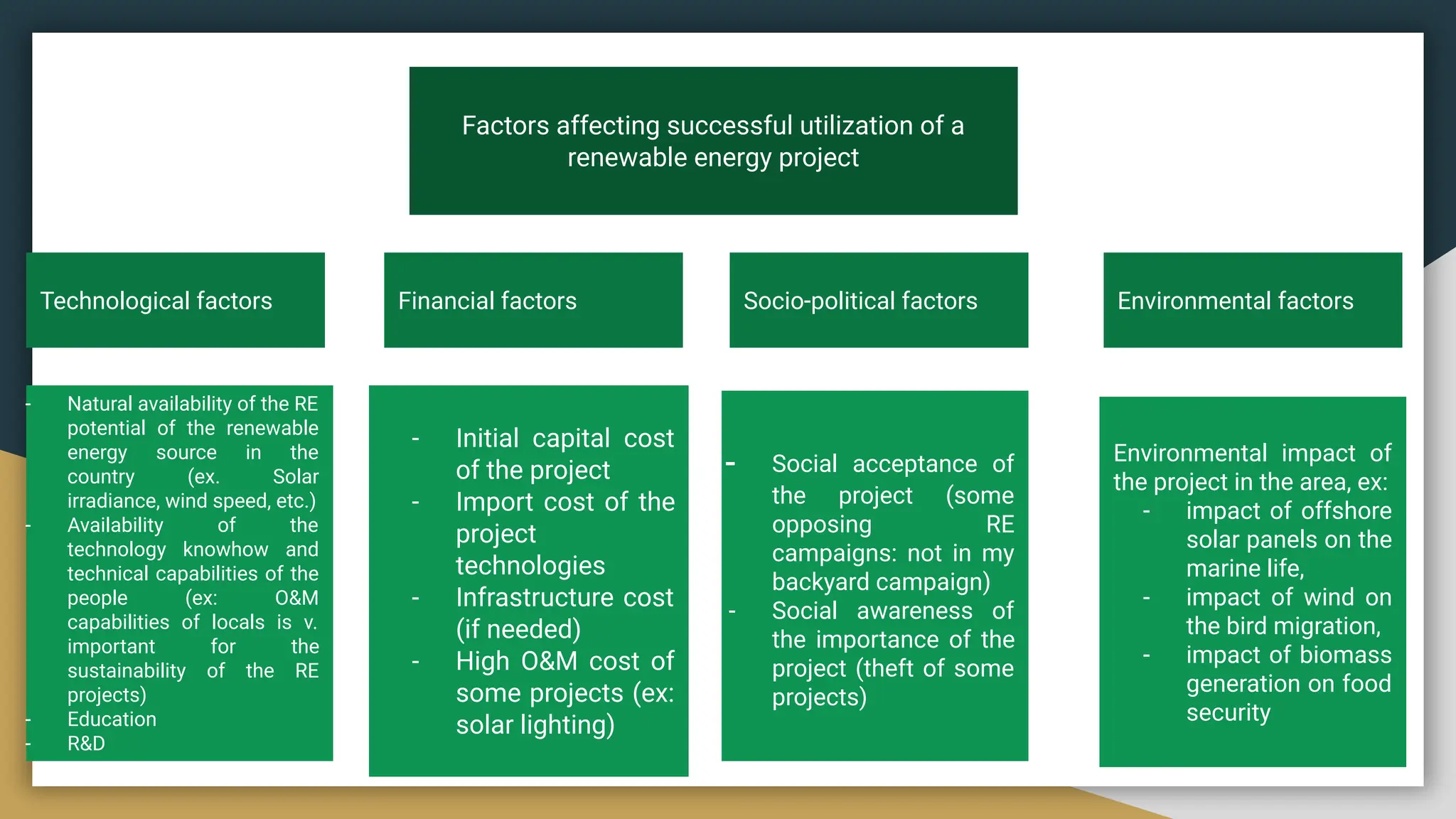
Factors affecting successful utilization of a
renewable energy project
Technological factors Financial factors
- Social acceptance of
the project (some
opposing RE
campaigns: not in my
backyard campaign)
- Social awareness of
the importance of the
project (theft of some
projects)
- Initial capital cost
of the project
- Import cost of the
project
technologies
- Infrastructure cost
(if needed)
- High O&M cost of
some projects (ex:
solar lighting)
- Natural availability of the RE
potential of the renewable
energy source in the
country (ex. Solar
irradiance, wind speed, etc.)
- Availability of the
technology knowhow and
technical capabilities of the
people (ex: O&M
capabilities of locals is v.
important for the
sustainability of the RE
projects)
- Education
- R&D
Socio-political factors Environmental factors
Environmental impact of
the project in the area, ex:
- impact of offshore
solar panels on the
marine life,
- impact of wind on
the bird migration,
- impact of biomass
generation on food
security
Renewable Energy Potential in UK
REMENA MSc program
Course: Renewable Energy Potential
Instructors: Dr. Adel Khalil
By:
Safwa Abuelazayem
21.Jan. 2023
2
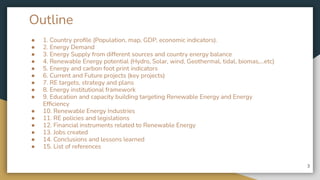
Outline

● 1. Country profile (Population, map, GDP, economic indicators).
● 2. Energy Demand
● 3. Energy Supply from different sources and country energy balance
● 4. Renewable Energy potential (Hydro, Solar, wind, Geothermal, tidal, biomas,...etc)
● 5. Energy and carbon foot print indicators
● 6. Current and Future projects (key projects)
● 7. RE targets, strategy and plans
● 8. Energy institutional framework
● 9. Education and capacity building targeting Renewable Energy and Energy
Efficiency
● 10. Renewable Energy Industries
● 11. RE policies and legislations
● 12. Financial instruments related to Renewable Energy
● 13. Jobs created
● 14. Conclusions and lessons learned
● 15. List of references
3
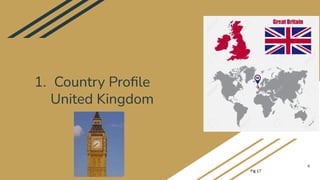
1. Country Profile
United Kingdom
4
Fig 17
Country Profile
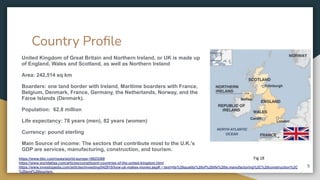
United Kingdom of Great Britain and Northern Ireland, or UK is made up
of England, Wales and Scotland, as well as Northern Ireland
Area: 242,514 sq km
Boarders: one land border with Ireland, Maritime boarders with France,
Belgium, Denmark, France, Germany, the Netherlands, Norway, and the
Faroe Islands (Denmark).
Population: 62.8 million
Life expectancy: 78 years (men), 82 years (women)
Currency: pound sterling
Main Source of income: The sectors that contribute most to the U.K.'s
GDP are services, manufacturing, construction, and tourism.
https://www.bbc.com/news/world-europe-18023389
https://www.worldatlas.com/articles/constituent-countries-of-the-united-kingdom.html
https://www.investopedia.com/articles/investing/042915/how-uk-makes-money.asp#:~:text=Its%20quality%20of%20life%20is,manufacturing%2C%20construction%2C
%20and%20tourism.
5
Fig 18
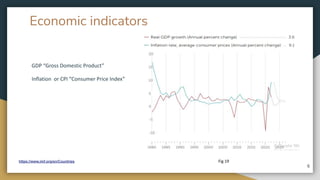
GDP “Gross Domestic Product”
Inflation or CPI “Consumer Price Index”
Economic indicators
6
Fig 19
https://www.imf.org/en/Countries
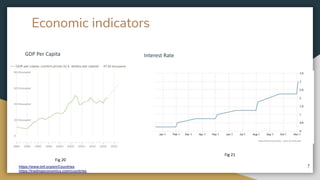
Interest Rate
Economic indicators
GDP Per Capita
7
Fig 20
Fig 21
https://www.imf.org/en/Countries
https://tradingeconomics.com/countries
Economic indicators
8
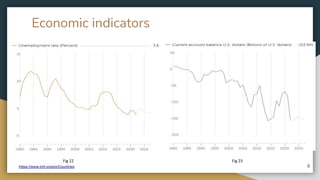
Fig 22 Fig 23
https://www.imf.org/en/Countries
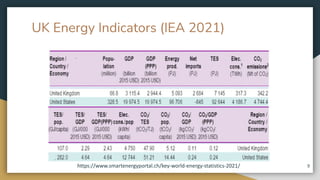
UK Energy Indicators (IEA 2021)
https://www.smartenergyportal.ch/key-world-energy-statistics-2021/ 9
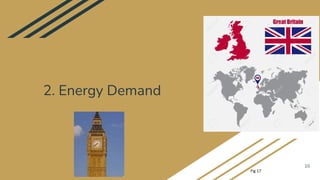
2. Energy Demand
10
Fig 17
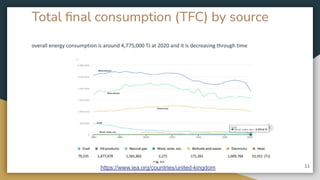
Total final consumption (TFC) by source
overall energy consumption is around 4,775,000 TJ at 2020 and it is decreasing through time
11
Fig 33
https://www.iea.org/countries/united-kingdom
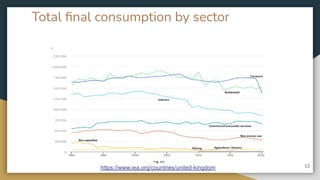
Total final consumption by sector
12
Fig 33
https://www.iea.org/countries/united-kingdom
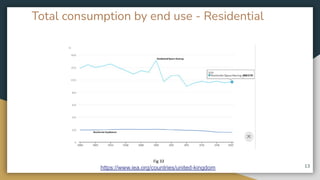
Total consumption by end use - Residential
13
Fig 33
https://www.iea.org/countries/united-kingdom
3. Energy Supply
14
Fig 17
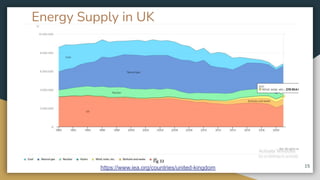
Energy Supply in UK
15
Fig 33
https://www.iea.org/countries/united-kingdom
Energy Supply in UK
Energy Sankey diagram- Error! Hyperlink reference not valid. (23.885 million ton of oil equivalent equals 1 TJ)
16
Fig 33
https://www.iea.org/countries/united-kingdom
4. RENEWABLE ENERGY
POTENTIAL
17
Fig 17
RENEWABLE ENERGY POTENTIAL
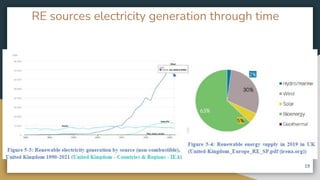
2021 electricity forms around 11% of the primary energy sources (or Total Energy Supply-TES) and around
15% of the Total Final Consumption (TFC). Renewables (Hydro, wind and solar) form around 45% of the
electricity sources hence around 4.5% of the primary energy sources (TES) and around 6.8% of the TFC. Also
considering all renewable energy sources by adding renewable electricity generation and biofuels energy
makes around 12% of the TFC.
18
RE sources electricity generation through time
19
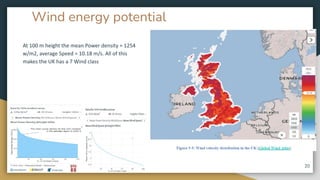
Wind energy potential
At 100 m height the mean Power density = 1254
w/m2, average Speed = 10.18 m/s. All of this
makes the UK has a 7 Wind class
20
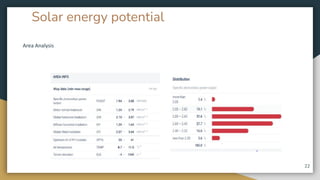
Solar energy potential
The mean Power density = 2.6 kWh/kWp/day= 949 kWh/kWp/year.
21
Solar energy potential
Area Analysis
22
Solar energy potential
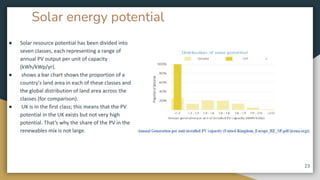
● Solar resource potential has been divided into
seven classes, each representing a range of
annual PV output per unit of capacity
(kWh/kWp/yr).
● shows a bar chart shows the proportion of a
country's land area in each of these classes and
the global distribution of land area across the
classes (for comparison).
● UK is in the first class; this means that the PV
potential in the UK exists but not very high
potential. That’s why the share of the PV in the
renewables mix is not large.
23
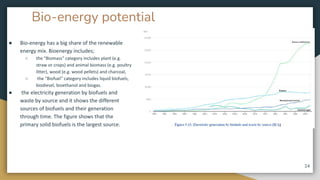
Bio-energy potential
● Bio-energy has a big share of the renewable
energy mix. Bioenergy includes;
○ the "Biomass" category includes plant (e.g.
straw or crops) and animal biomass (e.g. poultry
litter), wood (e.g. wood pellets) and charcoal,
○ the "Biofuel" category includes liquid biofuels,
biodiesel, bioethanol and biogas.
● the electricity generation by biofuels and
waste by source and it shows the different
sources of biofuels and their generation
through time. The figure shows that the
primary solid biofuels is the largest source.
24
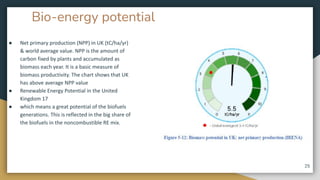
Bio-energy potential
● Net primary production (NPP) in UK (tC/ha/yr)
& world average value. NPP is the amount of
carbon fixed by plants and accumulated as
biomass each year. It is a basic measure of
biomass productivity. The chart shows that UK
has above average NPP value
● Renewable Energy Potential in the United
Kingdom 17
● which means a great potential of the biofuels
generations. This is reflected in the big share of
the biofuels in the noncombustible RE mix.
25
5. ENERGY AND CARBON
FOOTPRINT INDICATORS
26
Fig 17
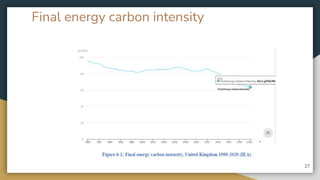
Final energy carbon intensity
27
CO2 emissions by energy source
28
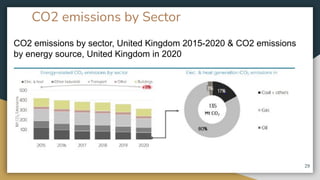
CO2 emissions by Sector
29
CO2 emissions by sector, United Kingdom 2015-2020 & CO2 emissions
by energy source, United Kingdom in 2020
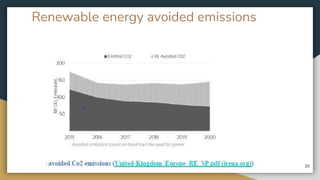
Renewable energy avoided emissions
30
Carbon Emissions Statistics (IEA 2021)
https://www.smartenergyportal.ch/key-world-energy-statistics-2021/ 31
6. Current & Future projects
32
Fig 17
Current Projects
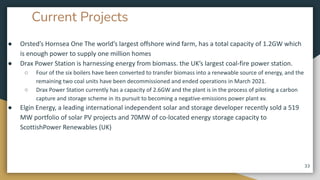
● Orsted’s Hornsea One The world’s largest offshore wind farm, has a total capacity of 1.2GW which
is enough power to supply one million homes
● Drax Power Station is harnessing energy from biomass. the UK’s largest coal-fire power station.
○ Four of the six boilers have been converted to transfer biomass into a renewable source of energy, and the
remaining two coal units have been decommissioned and ended operations in March 2021.
○ Drax Power Station currently has a capacity of 2.6GW and the plant is in the process of piloting a carbon
capture and storage scheme in its pursuit to becoming a negative-emissions power plant xv.
● Elgin Energy, a leading international independent solar and storage developer recently sold a 519
MW portfolio of solar PV projects and 70MW of co-located energy storage capacity to
ScottishPower Renewables (UK)
33
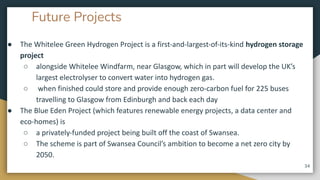
Future Projects
● The Whitelee Green Hydrogen Project is a first-and-largest-of-its-kind hydrogen storage
project
○ alongside Whitelee Windfarm, near Glasgow, which in part will develop the UK’s
largest electrolyser to convert water into hydrogen gas.
○ when finished could store and provide enough zero-carbon fuel for 225 buses
travelling to Glasgow from Edinburgh and back each day
● The Blue Eden Project (which features renewable energy projects, a data center and
eco-homes) is
○ a privately-funded project being built off the coast of Swansea.
○ The scheme is part of Swansea Council’s ambition to become a net zero city by
2050.
34
7. RE TARGETS, STRATEGY
AND PLANS
35
Fig 17
UK RE Energy Strategy
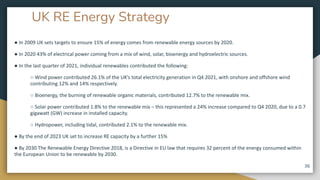
● In 2009 UK sets targets to ensure 15% of energy comes from renewable energy sources by 2020.
● In 2020 43% of electrical power coming from a mix of wind, solar, bioenergy and hydroelectric sources.
● In the last quarter of 2021, individual renewables contributed the following:
○ Wind power contributed 26.1% of the UK’s total electricity generation in Q4 2021, with onshore and offshore wind
contributing 12% and 14% respectively.
○ Bioenergy, the burning of renewable organic materials, contributed 12.7% to the renewable mix.
○ Solar power contributed 1.8% to the renewable mix – this represented a 24% increase compared to Q4 2020, due to a 0.7
gigawatt (GW) increase in installed capacity.
○ Hydropower, including tidal, contributed 2.1% to the renewable mix.
● By the end of 2023 UK set to increase RE capacity by a further 15%
● By 2030 The Renewable Energy Directive 2018, is a Directive in EU law that requires 32 percent of the energy consumed within
the European Union to be renewable by 2030.
36
White paper 2020
This White Paper outlined the Ten Point Plan for a Green Industrial Revolution which are:
● Advancing offshore wind
● Driving the Growth of Low Carbon Hydrogen
● Delivering New and Advanced Nuclear Power
● Accelerating the Shift to Zero Emission Vehicles
● Green Public Transport, Cycling and Walking
● Jet Zero and Green Ships
● Greener Buildings
● Investing in Carbon Capture, Usage and Storage
● Protecting Our Natural Environment
● Green Finance and Innovation
37
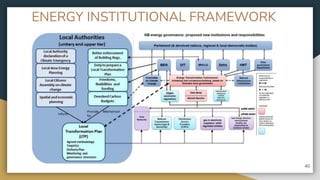
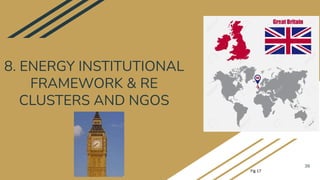
8. ENERGY INSTITUTIONAL
FRAMEWORK & RE
CLUSTERS AND NGOS
38
Fig 17
ENERGY INSTITUTIONAL FRAMEWORK
39
ENERGY INSTITUTIONAL FRAMEWORK
40
9. EDUCATION AND CAPACITY
BUILDING TARGETING
RENEWABLE ENERGY AND
ENERGY EFFICIENCY
41
Fig 17
EDUCATION AND CAPACITY BUILDING TARGETING
RENEWABLE ENERGY AND ENERGY EFFICIENCY
42
● There’re many educational
programs related to renewable
energy. Also, there’s a lot of
masters in renewable energy
programs in the UK
● Thus, the R&D in the RE field is
very reach and many patents
are created in the UK
10. RENEWABLE ENERGY
INDUSTRIES
43
Fig 17
RENEWABLE ENERGY INDUSTRIES
44
● The UK renewables sectors is currently home to major global players as well as an
emerging cleantech industry fuelled by smaller start-up companies who are looking to
slow climate change with innovative renewable energy technology.
● UK market has been identified as a key target for its renewable generation capacity
growth.
● The companies holding the largest market share in the Renewable Electricity
Generation in the UK industry include:
○ Orsted Power (UK) Ltd: Wind energy
○ Scottish Power UK plc: Green electricity producer
○ SSE plc: RE (onshore wind, offshore wind and hydro) generator and one of
the largest electricity network companies in the UK
○ RWE AG: Wind & solar energy, the world's number two in offshore wind
power and Europe's third largest company in renewable energy
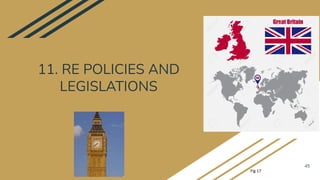
11. RE POLICIES AND
LEGISLATIONS
45
Fig 17
Important legalization schemes
Renewables Obligation (RO)
● Current laws of PV support for renewable electricity projects in the UK.
● Came into effect in 2002 in England and Wales, and Scotland, followed by Northern Ireland in
2005. It places an obligation on UK electricity suppliers to source an increasing proportion of
the electricity they supply from renewable sources.
46
https://www.iea.org/policies/4182-renewables-obligation-ro
Important legalization schemes
● Renewables Obligation Certificates (ROCs) are green certificates issued to operators of
accredited renewable generating stations for the eligible renewable electricity they
generate.
○ Operators can trade ROCs with other parties. ROCs are ultimately used by suppliers to
demonstrate that they have met their obligation.
○ Entities unable to present required are obligated to pay the fine.
○
47
https://www.iea.org/policies/4182-renewables-obligation-ro
Important legalization schemes
Contracts for Difference (CfD)
● introduced by Part 2 (Electricity Market Reform) of the Energy Act 2013, which is the central plank of the legislative framework
created for delivering secure, affordable and low carbon energy.
● designed to replace the Renewables Obligation and incentivise investment in large-scale low carbon electricity generation. CfDs
operate as private law contracts between low carbon electricity generators and the Low Carbon Contracts Company (LCCC), which
manages CfD contracts.
● The CfD provides price security and thereby bankability for a renewable generator by setting a “strike price” for the electricity
generated.
48
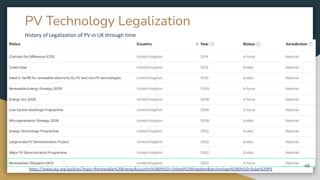
PV Technology Legalization
History of Legalization of PV in UK through time
https://www.iea.org/policies?topic=Renewable%20Energy&country%5B0%5D=United%20Kingdom&technology%5B0%5D=Solar%20PV
49
Wind Technology Legalization
Source IEA
50
Government Support
● The Energy Price Guarantee: is a temporary additional measure to protect consumers from the
recent significant increases in wholesale gas prices. The guarantee was put in place on 1 October
2022 and will last until April 2024. It means that consumers will pay less for their energy than they
would under the price cap
○ It reduces (compared to the undiscounted price of energy) the amount you can be charged
per unit of gas or electricity, to an annual equivalent of around £2,500 for a typical household
in Great Britain.
51
Government Support
Also UK Government offers support on the energy bills through:
● Energy Bills Support Scheme discount: provides a £400 non-repayable discount to
eligible households to help with their energy bills over winter 2022 to 2023
● Energy Bill Relief Scheme: help for businesses and other non-domestic customers
● The Energy Price Guarantee: is a temporary additional measure to protect consumers
from the recent significant increases in wholesale gas prices.
○ The guarantee was put in place on 1 October 2022 and will last until April 2024
○ It reduces (compared to the undiscounted price of energy) the amount you can
be charged per unit of gas or electricity, to an annual equivalent of around
£2,500 for a typical household in Great Britain.
52
Energy Tariff Structure in UK
● The average unit price for dual fuel customers on standard variable tariffs subject to Ofgam’s
price cap which is:
34.0p/kWh (pence per kilowatt hour) for electricity and 10.3p/kWh for gas, inclusive of VAT,
from 1 October 2022 through to March 2023
● The energy price cap is determined by Ofgam company (Great Britain’s independent energy
regulator)
● The price is update the level every three months to reflect inflation and changes in
underlying costs.
● The energy price differs from region to another
53
54
https://www.nimblefins.co.uk/average-cost-electricity-kwh-uk
Energy Tarrif_Geographically
The broken down regional electricity prices per kWh as geographical distribution at 2021
Energy Tariff Structure in UK
● What are the factors that are taken into considerations while putting the energy price cap
○ Wholesale energy costs. This is the amount suppliers pay for the energy they supply to
consumers.
○ Network costs. These relate to building and maintaining the energy networks that carry energy
to consumers' homes.
○ Policy costs. These relate to government schemes to save energy, reduce emissions and
promote renewable energy.
○ Supplier operating costs
○ VAT: 5% tax is added to the level of the tariff.
55
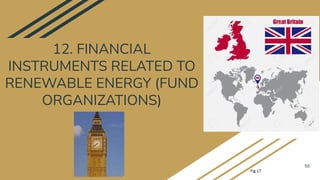
12. FINANCIAL
INSTRUMENTS RELATED TO
RENEWABLE ENERGY (FUND
ORGANIZATIONS)
56
Fig 17
FINANCIAL INSTRUMENTS RELATED TO
RENEWABLE ENERGY (FUND ORGANIZATIONS)
● There’re big number of organizations in the RE field in the UK. Around 1,035 with 934
for-profit companies, 23 non-profit companies and 2% public organizations.
● The top investor types are:
○ venture capital,
○ private equity firm,
○ accelerator and
○ governmental office.
● The top Funding Types are;
○ Venture,
○ Grant,
○ Seed,
○ Debt Financing,
○ Private Equity
57
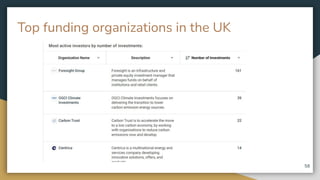
Top funding organizations in the UK
58
13. JOBS CREATED
59
Fig 17
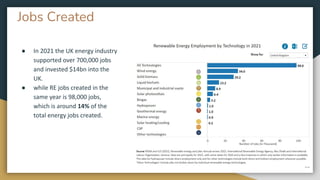
Jobs Created
● In 2021 the UK energy industry
supported over 700,000 jobs
and invested $14bn into the
UK.
● while RE jobs created in the
same year is 98,000 jobs,
which is around 14% of the
total energy jobs created.
60
14. Conclusion
61
Fig 17
Conclusion
● Considering all the report inputs, it can be concluded that improving the energy
consumption situation in the UK could be achieved from:
○ decreasing the energy in the domestic and transport sectors (The government have already
worked on decreasing the domestic sector consumption in many ways such as “it all adds
up” campaign, the white paper policy )
○ working on the R&D to develop new technologies to reduce the conversion losses.
○ increasing its share of RE. Although UK have great conventional energy profile, they could
not depend only on the conventional fuels, so UK have to make the best use of the RE
resources potential because of; the CO2 emission reduction targets, the fear of natural
conventional energy resources depletion, and import reduction threats.
62
Conclusion
● There’re key issues facing the renewables industry across solar, hydropower, wind, and biomass.
○ Solar power is not reliable in nature and so grid modernization is key to helping solar energy
grow in the UK.
○ Biomass energy production include environmental issues, such as the combustion of certain
biofuels, which may affect the UK’s commitments to Air Quality, as well as the expectation of
short-term growth as more biowaste is used to produce fuel, whilst also potential long-term
supply reductions due to collective conscience efforts to reduce waste.
○ Wind energy is the most promising technology
● UK should periodically revise their legalization scheme and check whether it needs modification or
update.
● To achieve UKK strategy, UK should make the best out of the policies and motivate more people to
use renewables.
63
References
● https://www.safalta.com/blog/top-10-most-powerful-countries-in-the-world
● https://www.smartenergyportal.ch/key-world-energy-statistics-2021/
● United Kingdom - Countries & Regions - IEA
● https://oeuk.org.uk/uk-gas-production-will-fall-75-by-2030-without-new-investment-warns-industry-body/
● https://assets.publishing.service.gov.uk/government/uploads/system/uploads/attachment_data/file/877047/Press_Notice_March_2020.pdf
● https://heycar.co.uk/blog/electric-cars-statistics-and-projections
● United Kingdom - Countries & Regions - IEA
● Energy flow chart 2021 - GOV.UK (www.gov.uk)
● https://www.gov.uk/government/news/small-changes-mean-energy-advice-campaign-adds-up-to-big-savings
● United-Kingdom_Europe_RE_SP.pdf (irena.org)
● https://www.iea.org/policies/4891-renewable-energy-strategy-2009
● globalwindatlas.info/en
● United-Kingdom_Europe_RE_SP.pdf (irena.org)
● Global Solar Atlas
● Energy Trends December 2022 (publishing.service.gov.uk)
● Government unveils eight major new renewables projects, supporting 8,500 green jobs - GOV.UK (www.gov.uk)
64
References
● United Kingdom: Renewable Energy – Country Comparative Guides (legal500.com)
● Climate change and energy - GOV.UK (www.gov.uk)
● United Kingdom: Renewable Energy – Country Comparative Guides (legal500.com)
● IGov | New Thinking: The IGov institutional framework for energy governance (exeter.ac.uk)
● Best Masters in Renewable Energy in England United Kingdom 2023 (masterstudies.com)
● http://orsted.co.uk/
● https://www.scottishpower.co.uk/about-us/commitments
● https://www.sse.com/what-we-do/sse-renewables/
● https://www.rwe.com/en
● United Kingdom: Renewable Energy – Country Comparative Guides (legal500.com)
● https://www.iea.org/policies/4182-renewables-obligation-ro
● https://www.iea.org/policies/4910-feed-in-tariffs-for-renewable-electricity-for-pv-and-non-pv-technologies
● United Kingdom: Renewable Energy – Country Comparative Guides (legal500.com)
● Policy database – Data & Statistics - IEA
● List of top United Kingdom Renewable Energy Companies - Crunchbase Hub Profile
65
Thank You
66

Renewable Energy Potential in UK_SAzayem

  • 1.
    1 Factors affecting successfulutilization of a renewable energy project Technological factors Financial factors - Social acceptance of the project (some opposing RE campaigns: not in my backyard campaign) - Social awareness of the importance of the project (theft of some projects) - Initial capital cost of the project - Import cost of the project technologies - Infrastructure cost (if needed) - High O&M cost of some projects (ex: solar lighting) - Natural availability of the RE potential of the renewable energy source in the country (ex. Solar irradiance, wind speed, etc.) - Availability of the technology knowhow and technical capabilities of the people (ex: O&M capabilities of locals is v. important for the sustainability of the RE projects) - Education - R&D Socio-political factors Environmental factors Environmental impact of the project in the area, ex: - impact of offshore solar panels on the marine life, - impact of wind on the bird migration, - impact of biomass generation on food security
  • 2.
    Renewable Energy Potentialin UK REMENA MSc program Course: Renewable Energy Potential Instructors: Dr. Adel Khalil By: Safwa Abuelazayem 21.Jan. 2023 2
  • 3.
    Outline ● 1. Countryprofile (Population, map, GDP, economic indicators). ● 2. Energy Demand ● 3. Energy Supply from different sources and country energy balance ● 4. Renewable Energy potential (Hydro, Solar, wind, Geothermal, tidal, biomas,...etc) ● 5. Energy and carbon foot print indicators ● 6. Current and Future projects (key projects) ● 7. RE targets, strategy and plans ● 8. Energy institutional framework ● 9. Education and capacity building targeting Renewable Energy and Energy Efficiency ● 10. Renewable Energy Industries ● 11. RE policies and legislations ● 12. Financial instruments related to Renewable Energy ● 13. Jobs created ● 14. Conclusions and lessons learned ● 15. List of references 3
  • 4.
  • 5.
    Country Profile United Kingdomof Great Britain and Northern Ireland, or UK is made up of England, Wales and Scotland, as well as Northern Ireland Area: 242,514 sq km Boarders: one land border with Ireland, Maritime boarders with France, Belgium, Denmark, France, Germany, the Netherlands, Norway, and the Faroe Islands (Denmark). Population: 62.8 million Life expectancy: 78 years (men), 82 years (women) Currency: pound sterling Main Source of income: The sectors that contribute most to the U.K.'s GDP are services, manufacturing, construction, and tourism. https://www.bbc.com/news/world-europe-18023389 https://www.worldatlas.com/articles/constituent-countries-of-the-united-kingdom.html https://www.investopedia.com/articles/investing/042915/how-uk-makes-money.asp#:~:text=Its%20quality%20of%20life%20is,manufacturing%2C%20construction%2C %20and%20tourism. 5 Fig 18
  • 6.
    GDP “Gross DomesticProduct” Inflation or CPI “Consumer Price Index” Economic indicators 6 Fig 19 https://www.imf.org/en/Countries
  • 7.
    Interest Rate Economic indicators GDPPer Capita 7 Fig 20 Fig 21 https://www.imf.org/en/Countries https://tradingeconomics.com/countries
  • 8.
    Economic indicators 8 Fig 22Fig 23 https://www.imf.org/en/Countries
  • 9.
    UK Energy Indicators(IEA 2021) https://www.smartenergyportal.ch/key-world-energy-statistics-2021/ 9
  • 10.
  • 11.
    Total final consumption(TFC) by source overall energy consumption is around 4,775,000 TJ at 2020 and it is decreasing through time 11 Fig 33 https://www.iea.org/countries/united-kingdom
  • 12.
    Total final consumptionby sector 12 Fig 33 https://www.iea.org/countries/united-kingdom
  • 13.
    Total consumption byend use - Residential 13 Fig 33 https://www.iea.org/countries/united-kingdom
  • 14.
  • 15.
    Energy Supply inUK 15 Fig 33 https://www.iea.org/countries/united-kingdom
  • 16.
    Energy Supply inUK Energy Sankey diagram- Error! Hyperlink reference not valid. (23.885 million ton of oil equivalent equals 1 TJ) 16 Fig 33 https://www.iea.org/countries/united-kingdom
  • 17.
  • 18.
    RENEWABLE ENERGY POTENTIAL 2021electricity forms around 11% of the primary energy sources (or Total Energy Supply-TES) and around 15% of the Total Final Consumption (TFC). Renewables (Hydro, wind and solar) form around 45% of the electricity sources hence around 4.5% of the primary energy sources (TES) and around 6.8% of the TFC. Also considering all renewable energy sources by adding renewable electricity generation and biofuels energy makes around 12% of the TFC. 18
  • 19.
    RE sources electricitygeneration through time 19
  • 20.
    Wind energy potential At100 m height the mean Power density = 1254 w/m2, average Speed = 10.18 m/s. All of this makes the UK has a 7 Wind class 20
  • 21.
    Solar energy potential Themean Power density = 2.6 kWh/kWp/day= 949 kWh/kWp/year. 21
  • 22.
  • 23.
    Solar energy potential ●Solar resource potential has been divided into seven classes, each representing a range of annual PV output per unit of capacity (kWh/kWp/yr). ● shows a bar chart shows the proportion of a country's land area in each of these classes and the global distribution of land area across the classes (for comparison). ● UK is in the first class; this means that the PV potential in the UK exists but not very high potential. That’s why the share of the PV in the renewables mix is not large. 23
  • 24.
    Bio-energy potential ● Bio-energyhas a big share of the renewable energy mix. Bioenergy includes; ○ the "Biomass" category includes plant (e.g. straw or crops) and animal biomass (e.g. poultry litter), wood (e.g. wood pellets) and charcoal, ○ the "Biofuel" category includes liquid biofuels, biodiesel, bioethanol and biogas. ● the electricity generation by biofuels and waste by source and it shows the different sources of biofuels and their generation through time. The figure shows that the primary solid biofuels is the largest source. 24
  • 25.
    Bio-energy potential ● Netprimary production (NPP) in UK (tC/ha/yr) & world average value. NPP is the amount of carbon fixed by plants and accumulated as biomass each year. It is a basic measure of biomass productivity. The chart shows that UK has above average NPP value ● Renewable Energy Potential in the United Kingdom 17 ● which means a great potential of the biofuels generations. This is reflected in the big share of the biofuels in the noncombustible RE mix. 25
  • 26.
    5. ENERGY ANDCARBON FOOTPRINT INDICATORS 26 Fig 17
  • 27.
    Final energy carbonintensity 27
  • 28.
    CO2 emissions byenergy source 28
  • 29.
    CO2 emissions bySector 29 CO2 emissions by sector, United Kingdom 2015-2020 & CO2 emissions by energy source, United Kingdom in 2020
  • 30.
  • 31.
    Carbon Emissions Statistics(IEA 2021) https://www.smartenergyportal.ch/key-world-energy-statistics-2021/ 31
  • 32.
    6. Current &Future projects 32 Fig 17
  • 33.
    Current Projects ● Orsted’sHornsea One The world’s largest offshore wind farm, has a total capacity of 1.2GW which is enough power to supply one million homes ● Drax Power Station is harnessing energy from biomass. the UK’s largest coal-fire power station. ○ Four of the six boilers have been converted to transfer biomass into a renewable source of energy, and the remaining two coal units have been decommissioned and ended operations in March 2021. ○ Drax Power Station currently has a capacity of 2.6GW and the plant is in the process of piloting a carbon capture and storage scheme in its pursuit to becoming a negative-emissions power plant xv. ● Elgin Energy, a leading international independent solar and storage developer recently sold a 519 MW portfolio of solar PV projects and 70MW of co-located energy storage capacity to ScottishPower Renewables (UK) 33
  • 34.
    Future Projects ● TheWhitelee Green Hydrogen Project is a first-and-largest-of-its-kind hydrogen storage project ○ alongside Whitelee Windfarm, near Glasgow, which in part will develop the UK’s largest electrolyser to convert water into hydrogen gas. ○ when finished could store and provide enough zero-carbon fuel for 225 buses travelling to Glasgow from Edinburgh and back each day ● The Blue Eden Project (which features renewable energy projects, a data center and eco-homes) is ○ a privately-funded project being built off the coast of Swansea. ○ The scheme is part of Swansea Council’s ambition to become a net zero city by 2050. 34
  • 35.
    7. RE TARGETS,STRATEGY AND PLANS 35 Fig 17
  • 36.
    UK RE EnergyStrategy ● In 2009 UK sets targets to ensure 15% of energy comes from renewable energy sources by 2020. ● In 2020 43% of electrical power coming from a mix of wind, solar, bioenergy and hydroelectric sources. ● In the last quarter of 2021, individual renewables contributed the following: ○ Wind power contributed 26.1% of the UK’s total electricity generation in Q4 2021, with onshore and offshore wind contributing 12% and 14% respectively. ○ Bioenergy, the burning of renewable organic materials, contributed 12.7% to the renewable mix. ○ Solar power contributed 1.8% to the renewable mix – this represented a 24% increase compared to Q4 2020, due to a 0.7 gigawatt (GW) increase in installed capacity. ○ Hydropower, including tidal, contributed 2.1% to the renewable mix. ● By the end of 2023 UK set to increase RE capacity by a further 15% ● By 2030 The Renewable Energy Directive 2018, is a Directive in EU law that requires 32 percent of the energy consumed within the European Union to be renewable by 2030. 36
  • 37.
    White paper 2020 ThisWhite Paper outlined the Ten Point Plan for a Green Industrial Revolution which are: ● Advancing offshore wind ● Driving the Growth of Low Carbon Hydrogen ● Delivering New and Advanced Nuclear Power ● Accelerating the Shift to Zero Emission Vehicles ● Green Public Transport, Cycling and Walking ● Jet Zero and Green Ships ● Greener Buildings ● Investing in Carbon Capture, Usage and Storage ● Protecting Our Natural Environment ● Green Finance and Innovation 37
  • 38.
    8. ENERGY INSTITUTIONAL FRAMEWORK& RE CLUSTERS AND NGOS 38 Fig 17
  • 39.
  • 40.
  • 41.
    9. EDUCATION ANDCAPACITY BUILDING TARGETING RENEWABLE ENERGY AND ENERGY EFFICIENCY 41 Fig 17
  • 42.
    EDUCATION AND CAPACITYBUILDING TARGETING RENEWABLE ENERGY AND ENERGY EFFICIENCY 42 ● There’re many educational programs related to renewable energy. Also, there’s a lot of masters in renewable energy programs in the UK ● Thus, the R&D in the RE field is very reach and many patents are created in the UK
  • 43.
  • 44.
    RENEWABLE ENERGY INDUSTRIES 44 ●The UK renewables sectors is currently home to major global players as well as an emerging cleantech industry fuelled by smaller start-up companies who are looking to slow climate change with innovative renewable energy technology. ● UK market has been identified as a key target for its renewable generation capacity growth. ● The companies holding the largest market share in the Renewable Electricity Generation in the UK industry include: ○ Orsted Power (UK) Ltd: Wind energy ○ Scottish Power UK plc: Green electricity producer ○ SSE plc: RE (onshore wind, offshore wind and hydro) generator and one of the largest electricity network companies in the UK ○ RWE AG: Wind & solar energy, the world's number two in offshore wind power and Europe's third largest company in renewable energy
  • 45.
    11. RE POLICIESAND LEGISLATIONS 45 Fig 17
  • 46.
    Important legalization schemes RenewablesObligation (RO) ● Current laws of PV support for renewable electricity projects in the UK. ● Came into effect in 2002 in England and Wales, and Scotland, followed by Northern Ireland in 2005. It places an obligation on UK electricity suppliers to source an increasing proportion of the electricity they supply from renewable sources. 46 https://www.iea.org/policies/4182-renewables-obligation-ro
  • 47.
    Important legalization schemes ●Renewables Obligation Certificates (ROCs) are green certificates issued to operators of accredited renewable generating stations for the eligible renewable electricity they generate. ○ Operators can trade ROCs with other parties. ROCs are ultimately used by suppliers to demonstrate that they have met their obligation. ○ Entities unable to present required are obligated to pay the fine. ○ 47 https://www.iea.org/policies/4182-renewables-obligation-ro
  • 48.
    Important legalization schemes Contractsfor Difference (CfD) ● introduced by Part 2 (Electricity Market Reform) of the Energy Act 2013, which is the central plank of the legislative framework created for delivering secure, affordable and low carbon energy. ● designed to replace the Renewables Obligation and incentivise investment in large-scale low carbon electricity generation. CfDs operate as private law contracts between low carbon electricity generators and the Low Carbon Contracts Company (LCCC), which manages CfD contracts. ● The CfD provides price security and thereby bankability for a renewable generator by setting a “strike price” for the electricity generated. 48
  • 49.
    PV Technology Legalization Historyof Legalization of PV in UK through time https://www.iea.org/policies?topic=Renewable%20Energy&country%5B0%5D=United%20Kingdom&technology%5B0%5D=Solar%20PV 49
  • 50.
  • 51.
    Government Support ● TheEnergy Price Guarantee: is a temporary additional measure to protect consumers from the recent significant increases in wholesale gas prices. The guarantee was put in place on 1 October 2022 and will last until April 2024. It means that consumers will pay less for their energy than they would under the price cap ○ It reduces (compared to the undiscounted price of energy) the amount you can be charged per unit of gas or electricity, to an annual equivalent of around £2,500 for a typical household in Great Britain. 51
  • 52.
    Government Support Also UKGovernment offers support on the energy bills through: ● Energy Bills Support Scheme discount: provides a £400 non-repayable discount to eligible households to help with their energy bills over winter 2022 to 2023 ● Energy Bill Relief Scheme: help for businesses and other non-domestic customers ● The Energy Price Guarantee: is a temporary additional measure to protect consumers from the recent significant increases in wholesale gas prices. ○ The guarantee was put in place on 1 October 2022 and will last until April 2024 ○ It reduces (compared to the undiscounted price of energy) the amount you can be charged per unit of gas or electricity, to an annual equivalent of around £2,500 for a typical household in Great Britain. 52
  • 53.
    Energy Tariff Structurein UK ● The average unit price for dual fuel customers on standard variable tariffs subject to Ofgam’s price cap which is: 34.0p/kWh (pence per kilowatt hour) for electricity and 10.3p/kWh for gas, inclusive of VAT, from 1 October 2022 through to March 2023 ● The energy price cap is determined by Ofgam company (Great Britain’s independent energy regulator) ● The price is update the level every three months to reflect inflation and changes in underlying costs. ● The energy price differs from region to another 53
  • 54.
    54 https://www.nimblefins.co.uk/average-cost-electricity-kwh-uk Energy Tarrif_Geographically The brokendown regional electricity prices per kWh as geographical distribution at 2021
  • 55.
    Energy Tariff Structurein UK ● What are the factors that are taken into considerations while putting the energy price cap ○ Wholesale energy costs. This is the amount suppliers pay for the energy they supply to consumers. ○ Network costs. These relate to building and maintaining the energy networks that carry energy to consumers' homes. ○ Policy costs. These relate to government schemes to save energy, reduce emissions and promote renewable energy. ○ Supplier operating costs ○ VAT: 5% tax is added to the level of the tariff. 55
  • 56.
    12. FINANCIAL INSTRUMENTS RELATEDTO RENEWABLE ENERGY (FUND ORGANIZATIONS) 56 Fig 17
  • 57.
    FINANCIAL INSTRUMENTS RELATEDTO RENEWABLE ENERGY (FUND ORGANIZATIONS) ● There’re big number of organizations in the RE field in the UK. Around 1,035 with 934 for-profit companies, 23 non-profit companies and 2% public organizations. ● The top investor types are: ○ venture capital, ○ private equity firm, ○ accelerator and ○ governmental office. ● The top Funding Types are; ○ Venture, ○ Grant, ○ Seed, ○ Debt Financing, ○ Private Equity 57
  • 58.
  • 59.
  • 60.
    Jobs Created ● In2021 the UK energy industry supported over 700,000 jobs and invested $14bn into the UK. ● while RE jobs created in the same year is 98,000 jobs, which is around 14% of the total energy jobs created. 60
  • 61.
  • 62.
    Conclusion ● Considering allthe report inputs, it can be concluded that improving the energy consumption situation in the UK could be achieved from: ○ decreasing the energy in the domestic and transport sectors (The government have already worked on decreasing the domestic sector consumption in many ways such as “it all adds up” campaign, the white paper policy ) ○ working on the R&D to develop new technologies to reduce the conversion losses. ○ increasing its share of RE. Although UK have great conventional energy profile, they could not depend only on the conventional fuels, so UK have to make the best use of the RE resources potential because of; the CO2 emission reduction targets, the fear of natural conventional energy resources depletion, and import reduction threats. 62
  • 63.
    Conclusion ● There’re keyissues facing the renewables industry across solar, hydropower, wind, and biomass. ○ Solar power is not reliable in nature and so grid modernization is key to helping solar energy grow in the UK. ○ Biomass energy production include environmental issues, such as the combustion of certain biofuels, which may affect the UK’s commitments to Air Quality, as well as the expectation of short-term growth as more biowaste is used to produce fuel, whilst also potential long-term supply reductions due to collective conscience efforts to reduce waste. ○ Wind energy is the most promising technology ● UK should periodically revise their legalization scheme and check whether it needs modification or update. ● To achieve UKK strategy, UK should make the best out of the policies and motivate more people to use renewables. 63
  • 64.
    References ● https://www.safalta.com/blog/top-10-most-powerful-countries-in-the-world ● https://www.smartenergyportal.ch/key-world-energy-statistics-2021/ ●United Kingdom - Countries & Regions - IEA ● https://oeuk.org.uk/uk-gas-production-will-fall-75-by-2030-without-new-investment-warns-industry-body/ ● https://assets.publishing.service.gov.uk/government/uploads/system/uploads/attachment_data/file/877047/Press_Notice_March_2020.pdf ● https://heycar.co.uk/blog/electric-cars-statistics-and-projections ● United Kingdom - Countries & Regions - IEA ● Energy flow chart 2021 - GOV.UK (www.gov.uk) ● https://www.gov.uk/government/news/small-changes-mean-energy-advice-campaign-adds-up-to-big-savings ● United-Kingdom_Europe_RE_SP.pdf (irena.org) ● https://www.iea.org/policies/4891-renewable-energy-strategy-2009 ● globalwindatlas.info/en ● United-Kingdom_Europe_RE_SP.pdf (irena.org) ● Global Solar Atlas ● Energy Trends December 2022 (publishing.service.gov.uk) ● Energy Trends December 2022 (publishing.service.gov.uk) ● Energy Trends December 2022 (publishing.service.gov.uk) ● Government unveils eight major new renewables projects, supporting 8,500 green jobs - GOV.UK (www.gov.uk) 64
  • 65.
    References ● United Kingdom:Renewable Energy – Country Comparative Guides (legal500.com) ● Climate change and energy - GOV.UK (www.gov.uk) ● United Kingdom: Renewable Energy – Country Comparative Guides (legal500.com) ● IGov | New Thinking: The IGov institutional framework for energy governance (exeter.ac.uk) ● Best Masters in Renewable Energy in England United Kingdom 2023 (masterstudies.com) ● http://orsted.co.uk/ ● https://www.scottishpower.co.uk/about-us/commitments ● https://www.sse.com/what-we-do/sse-renewables/ ● https://www.rwe.com/en ● United Kingdom: Renewable Energy – Country Comparative Guides (legal500.com) ● United Kingdom: Renewable Energy – Country Comparative Guides (legal500.com) ● United Kingdom: Renewable Energy – Country Comparative Guides (legal500.com) ● https://www.iea.org/policies/4182-renewables-obligation-ro ● https://www.iea.org/policies/4910-feed-in-tariffs-for-renewable-electricity-for-pv-and-non-pv-technologies ● United Kingdom: Renewable Energy – Country Comparative Guides (legal500.com) ● Policy database – Data & Statistics - IEA ● List of top United Kingdom Renewable Energy Companies - Crunchbase Hub Profile 65
  • 66.