Chapter 13:
Contributing to the
Profession
Planning and Administering Early Childhood Programs
Tenth Edition
Nancy Freeman
Celia A. Decker
John R. Decker
Prepared by:
Nancy K. Freeman
Tere Holmes
Kris Curtis
13-
Freeman/Decker/Decker, Planning and Administering Early Childhood Programs, 10e
© 2012, 2008, 2005, 2001, 1995 by Pearson Education, Inc. All Rights Reserved
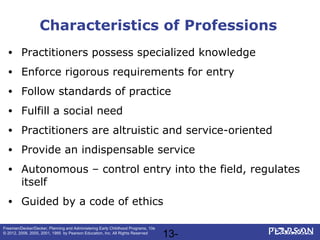
Characteristics of Professions
• Practitioners possess specialized knowledge
• Enforce rigorous requirements for entry
• Follow standards of practice
• Fulfill a social need
• Practitioners are altruistic and service-oriented
• Provide an indispensable service
• Autonomous – control entry into the field, regulates
itself
• Guided by a code of ethics
13-
Freeman/Decker/Decker, Planning and Administering Early Childhood Programs, 10e
© 2012, 2008, 2005, 2001, 1995 by Pearson Education, Inc. All Rights Reserved
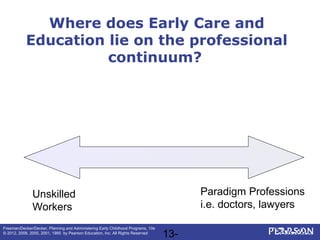
Where does Early Care and
Education lie on the professional
continuum?
Paradigm Professions
i.e. doctors, lawyers
Unskilled
Workers
13-
Freeman/Decker/Decker, Planning and Administering Early Childhood Programs, 10e
© 2012, 2008, 2005, 2001, 1995 by Pearson Education, Inc. All Rights Reserved
NAEYC Code of Professional Ethics
• 1st
adopted in 1989
• Revised in 1992, 1997, and 2005
• Reaffirmed and Updated, 2011
• Supplements extend the Code
– Adult Educators (2004)
– Program Administrators (2006)
○ Reaffirmed and Updated, 2011
NAEYC resources help
practitioners apply the Code.
13-
Freeman/Decker/Decker, Planning and Administering Early Childhood Programs, 10e
© 2012, 2008, 2005, 2001, 1995 by Pearson Education, Inc. All Rights Reserved
Becoming an advocate
• Individual advocacy
–Advocacy for specific children or families
–Sharing your informed views with individuals or
groups
• Collective advocacy
–Public policy advocacy
–Private-sector advocacy
13-
Freeman/Decker/Decker, Planning and Administering Early Childhood Programs, 10e
© 2012, 2008, 2005, 2001, 1995 by Pearson Education, Inc. All Rights Reserved
What are the contents of an
advocate’s toolbox?
• Position statements of professional organizations
• Briefing papers
• Talking points
• Key facts handouts
• Concrete examples to demonstrate the importance
of your issue/ recommendation
• Action alerts
13-
Freeman/Decker/Decker, Planning and Administering Early Childhood Programs, 10e
© 2012, 2008, 2005, 2001, 1995 by Pearson Education, Inc. All Rights Reserved
Important Reminder!
• Some agencies or organizations do not permit their
employees to take a public stand on controversial
issues.
• Be certain you are following your employer’s policies
related to advocacy activities.
• If you can’t speak out publically you might share
information with friends and family – they might
become inspired advocates.
13-
Freeman/Decker/Decker, Planning and Administering Early Childhood Programs, 10e
© 2012, 2008, 2005, 2001, 1995 by Pearson Education, Inc. All Rights Reserved
Helping others enter the profession
• Be a resource for potential early childhood
professionals
• Welcome student teachers, interns, etc.
• Mentor novices
• Encourage emerging leaders
13-
Freeman/Decker/Decker, Planning and Administering Early Childhood Programs, 10e
© 2012, 2008, 2005, 2001, 1995 by Pearson Education, Inc. All Rights Reserved
Contribute to the profession by
welcoming research
• Be certain research has been approved by an
appropriate Institutional Review Board (IRB).
• Review procedures to obtain consent and ensure
privacy of participants.
• Encourage classroom-based action research to
improve practice.
13-
Freeman/Decker/Decker, Planning and Administering Early Childhood Programs, 10e
© 2012, 2008, 2005, 2001, 1995 by Pearson Education, Inc. All Rights Reserved
Contribute to the profession by
welcoming research
• Be certain research has been approved by an
appropriate Institutional Review Board (IRB).
• Review procedures to obtain consent and ensure
privacy of participants.
• Encourage classroom-based action research to
improve practice.

Chapter 13 Slides

  • 1.
    Chapter 13: Contributing tothe Profession Planning and Administering Early Childhood Programs Tenth Edition Nancy Freeman Celia A. Decker John R. Decker Prepared by: Nancy K. Freeman Tere Holmes Kris Curtis
  • 2.
    13- Freeman/Decker/Decker, Planning andAdministering Early Childhood Programs, 10e © 2012, 2008, 2005, 2001, 1995 by Pearson Education, Inc. All Rights Reserved Characteristics of Professions • Practitioners possess specialized knowledge • Enforce rigorous requirements for entry • Follow standards of practice • Fulfill a social need • Practitioners are altruistic and service-oriented • Provide an indispensable service • Autonomous – control entry into the field, regulates itself • Guided by a code of ethics
  • 3.
    13- Freeman/Decker/Decker, Planning andAdministering Early Childhood Programs, 10e © 2012, 2008, 2005, 2001, 1995 by Pearson Education, Inc. All Rights Reserved Where does Early Care and Education lie on the professional continuum? Paradigm Professions i.e. doctors, lawyers Unskilled Workers
  • 4.
    13- Freeman/Decker/Decker, Planning andAdministering Early Childhood Programs, 10e © 2012, 2008, 2005, 2001, 1995 by Pearson Education, Inc. All Rights Reserved NAEYC Code of Professional Ethics • 1st adopted in 1989 • Revised in 1992, 1997, and 2005 • Reaffirmed and Updated, 2011 • Supplements extend the Code – Adult Educators (2004) – Program Administrators (2006) ○ Reaffirmed and Updated, 2011 NAEYC resources help practitioners apply the Code.
  • 5.
    13- Freeman/Decker/Decker, Planning andAdministering Early Childhood Programs, 10e © 2012, 2008, 2005, 2001, 1995 by Pearson Education, Inc. All Rights Reserved Becoming an advocate • Individual advocacy –Advocacy for specific children or families –Sharing your informed views with individuals or groups • Collective advocacy –Public policy advocacy –Private-sector advocacy
  • 6.
    13- Freeman/Decker/Decker, Planning andAdministering Early Childhood Programs, 10e © 2012, 2008, 2005, 2001, 1995 by Pearson Education, Inc. All Rights Reserved What are the contents of an advocate’s toolbox? • Position statements of professional organizations • Briefing papers • Talking points • Key facts handouts • Concrete examples to demonstrate the importance of your issue/ recommendation • Action alerts
  • 7.
    13- Freeman/Decker/Decker, Planning andAdministering Early Childhood Programs, 10e © 2012, 2008, 2005, 2001, 1995 by Pearson Education, Inc. All Rights Reserved Important Reminder! • Some agencies or organizations do not permit their employees to take a public stand on controversial issues. • Be certain you are following your employer’s policies related to advocacy activities. • If you can’t speak out publically you might share information with friends and family – they might become inspired advocates.
  • 8.
    13- Freeman/Decker/Decker, Planning andAdministering Early Childhood Programs, 10e © 2012, 2008, 2005, 2001, 1995 by Pearson Education, Inc. All Rights Reserved Helping others enter the profession • Be a resource for potential early childhood professionals • Welcome student teachers, interns, etc. • Mentor novices • Encourage emerging leaders
  • 9.
    13- Freeman/Decker/Decker, Planning andAdministering Early Childhood Programs, 10e © 2012, 2008, 2005, 2001, 1995 by Pearson Education, Inc. All Rights Reserved Contribute to the profession by welcoming research • Be certain research has been approved by an appropriate Institutional Review Board (IRB). • Review procedures to obtain consent and ensure privacy of participants. • Encourage classroom-based action research to improve practice.
  • 10.
    13- Freeman/Decker/Decker, Planning andAdministering Early Childhood Programs, 10e © 2012, 2008, 2005, 2001, 1995 by Pearson Education, Inc. All Rights Reserved Contribute to the profession by welcoming research • Be certain research has been approved by an appropriate Institutional Review Board (IRB). • Review procedures to obtain consent and ensure privacy of participants. • Encourage classroom-based action research to improve practice.