1-1
International Business
Environments and Operations, 13/e
Global Edition
Part One
Background For International Business
Copyright © 2011 Pearson Education
1-2
International Business
International business consists of all
commercial transactions—including
sales, investments, and
transportation—that take place
between two or more countries
Increasingly foreign countries are a
source of both production and sales for
domestic companies
Copyright © 2011 Pearson Education
1-3
1-3
Studying International Business is
Important
• Most companies are either international or
compete with international companies
• Modes of operations may differ from those used
domestically
• The best way of conducting business may differ
by country
• An understanding helps you make better career
decisions
• An understanding helps you decide what
government policies to support
Copyright © 2011 Pearson Education
1-4
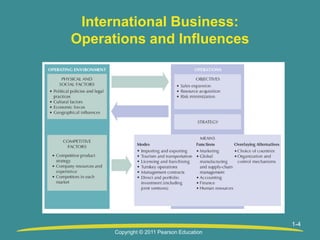
International Business:
Operations and Influences
Copyright © 2011 Pearson Education
1-5
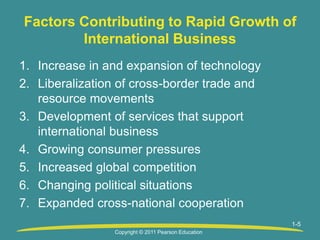
Factors Contributing to Rapid Growth of
International Business
1. Increase in and expansion of technology
2. Liberalization of cross-border trade and
resource movements
3. Development of services that support
international business
4. Growing consumer pressures
5. Increased global competition
6. Changing political situations
7. Expanded cross-national cooperation
Copyright © 2011 Pearson Education
1-6
1
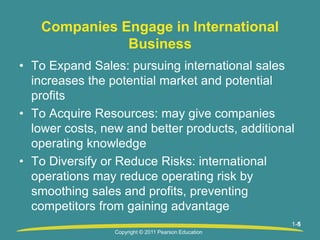
Companies Engage in International
Business
• To Expand Sales: pursuing international sales
increases the potential market and potential
profits
• To Acquire Resources: may give companies
lower costs, new and better products, additional
operating knowledge
• To Diversify or Reduce Risks: international
operations may reduce operating risk by
smoothing sales and profits, preventing
competitors from gaining advantage
Copyright © 2011 Pearson Education
1-7
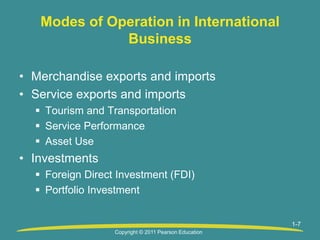
Modes of Operation in International
Business
• Merchandise exports and imports
• Service exports and imports
 Tourism and Transportation
 Service Performance
 Asset Use
• Investments
 Foreign Direct Investment (FDI)
 Portfolio Investment
Copyright © 2011 Pearson Education
1-8
Multinational Enterprises
Multinational Enterprises (MNEs) take a
global approach to markets and
production. Sometimes they are referred
to as multinational corporations or
companies (MNCs) or transnational
companies (TNCs).
Copyright © 2011 Pearson Education
1-9
Difference Between International and
Domestic Operations
When operating abroad companies may
have to adjust their usual methods of
carrying out business.
Foreign conditions often dictate a more
suitable method, and the operating modes
used for international business differ from
those used on a domestic level.
Copyright © 2011 Pearson Education
1-10
Physical and Social Factors Affecting
International Business Operations
To operate within a company’s external
environment, its managers must have
knowledge of business operations and a
working knowledge of social sciences,
and how they affect all functional
business fields.
Copyright © 2011 Pearson Education
1-11
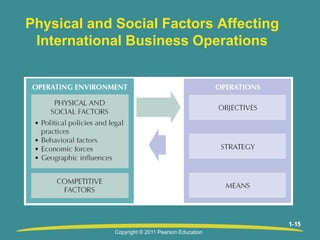
1-15
Physical and Social Factors Affecting
International Business Operations
Copyright © 2011 Pearson Education
1-12
Competitive Factors Affecting
International Business
• A company’s competitive strategy
influences how and where it can best
operate.
• A company’s competitive situation may
differ in terms of its relative strength and
which competitors it faces.
Copyright © 2011 Pearson Education
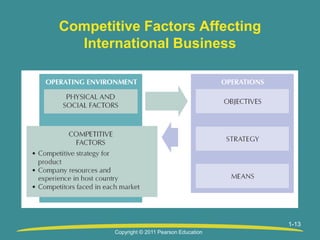
1-13
Competitive Factors Affecting
International Business
Copyright © 2011 Pearson Education
1-14
Future of International Business and
Globalization
• Further globalization is inevitable.
• International business will grow primarily along
regional rather than global lines.
• Forces working against further globalization and
international business will slow down both
trends.
Copyright © 2011 Pearson Education
1-15
All rights reserved. No part of this publication may
be reproduced, stored in a retrieval system, or
transmitted, in any form or by any means,
electronic, mechanical, photocopying, recording,
or otherwise, without the prior written permission
of the publisher. Printed in the United States of
America.
Copyright © 2011 Pearson Education

chapter 1 new.ppt

  • 1.
    1-1 International Business Environments andOperations, 13/e Global Edition Part One Background For International Business Copyright © 2011 Pearson Education
  • 2.
    1-2 International Business International businessconsists of all commercial transactions—including sales, investments, and transportation—that take place between two or more countries Increasingly foreign countries are a source of both production and sales for domestic companies Copyright © 2011 Pearson Education
  • 3.
    1-3 1-3 Studying International Businessis Important • Most companies are either international or compete with international companies • Modes of operations may differ from those used domestically • The best way of conducting business may differ by country • An understanding helps you make better career decisions • An understanding helps you decide what government policies to support Copyright © 2011 Pearson Education
  • 4.
    1-4 International Business: Operations andInfluences Copyright © 2011 Pearson Education
  • 5.
    1-5 Factors Contributing toRapid Growth of International Business 1. Increase in and expansion of technology 2. Liberalization of cross-border trade and resource movements 3. Development of services that support international business 4. Growing consumer pressures 5. Increased global competition 6. Changing political situations 7. Expanded cross-national cooperation Copyright © 2011 Pearson Education
  • 6.
    1-6 1 Companies Engage inInternational Business • To Expand Sales: pursuing international sales increases the potential market and potential profits • To Acquire Resources: may give companies lower costs, new and better products, additional operating knowledge • To Diversify or Reduce Risks: international operations may reduce operating risk by smoothing sales and profits, preventing competitors from gaining advantage Copyright © 2011 Pearson Education
  • 7.
    1-7 Modes of Operationin International Business • Merchandise exports and imports • Service exports and imports  Tourism and Transportation  Service Performance  Asset Use • Investments  Foreign Direct Investment (FDI)  Portfolio Investment Copyright © 2011 Pearson Education
  • 8.
    1-8 Multinational Enterprises Multinational Enterprises(MNEs) take a global approach to markets and production. Sometimes they are referred to as multinational corporations or companies (MNCs) or transnational companies (TNCs). Copyright © 2011 Pearson Education
  • 9.
    1-9 Difference Between Internationaland Domestic Operations When operating abroad companies may have to adjust their usual methods of carrying out business. Foreign conditions often dictate a more suitable method, and the operating modes used for international business differ from those used on a domestic level. Copyright © 2011 Pearson Education
  • 10.
    1-10 Physical and SocialFactors Affecting International Business Operations To operate within a company’s external environment, its managers must have knowledge of business operations and a working knowledge of social sciences, and how they affect all functional business fields. Copyright © 2011 Pearson Education
  • 11.
    1-11 1-15 Physical and SocialFactors Affecting International Business Operations Copyright © 2011 Pearson Education
  • 12.
    1-12 Competitive Factors Affecting InternationalBusiness • A company’s competitive strategy influences how and where it can best operate. • A company’s competitive situation may differ in terms of its relative strength and which competitors it faces. Copyright © 2011 Pearson Education
  • 13.
    1-13 Competitive Factors Affecting InternationalBusiness Copyright © 2011 Pearson Education
  • 14.
    1-14 Future of InternationalBusiness and Globalization • Further globalization is inevitable. • International business will grow primarily along regional rather than global lines. • Forces working against further globalization and international business will slow down both trends. Copyright © 2011 Pearson Education
  • 15.
    1-15 All rights reserved.No part of this publication may be reproduced, stored in a retrieval system, or transmitted, in any form or by any means, electronic, mechanical, photocopying, recording, or otherwise, without the prior written permission of the publisher. Printed in the United States of America. Copyright © 2011 Pearson Education