BIO460
Biological Diversity
CHAPTER 1 : NATIONAL
POLICIES
Learning objectives:
Towards the end of this chapter, students should be able
to:
• Define biological diversity
• Describe National policy on biological diversity
• Describe the rich diversity of Malaysian flora and fauna
• Explain biodiversity crisis
• Explain the conservation efforts
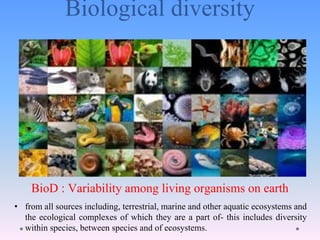
Biological diversity
• from all sources including, terrestrial, marine and other aquatic ecosystems and
the ecological complexes of which they are a part of- this includes diversity
within species, between species and of ecosystems.
BioD : Variability among living organisms on earth
RICH DIVERSITY OF MALAYSIAN
FLORA AND FAUNA
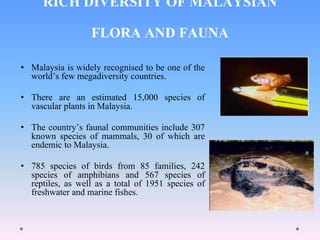
• Malaysia is widely recognised to be one of the
world’s few megadiversity countries.
• There are an estimated 15,000 species of
vascular plants in Malaysia.
• The country’s faunal communities include 307
known species of mammals, 30 of which are
endemic to Malaysia.
• 785 species of birds from 85 families, 242
species of amphibians and 567 species of
reptiles, as well as a total of 1951 species of
freshwater and marine fishes.
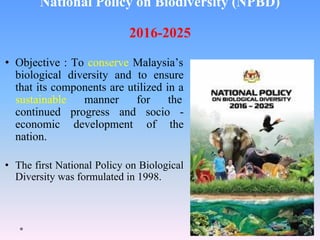
National Policy on Biodiversity (NPBD)
2016-2025
• Objective : To conserve Malaysia’s
biological diversity and to ensure
that its components are utilized in a
sustainable manner for the
continued progress and socio -
economic development of the
nation.
• The first National Policy on Biological
Diversity was formulated in 1998.
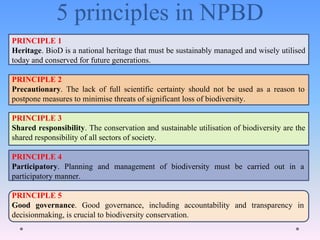
5 principles in NPBD
PRINCIPLE 1
Heritage. BioD is a national heritage that must be sustainably managed and wisely utilised
today and conserved for future generations.
PRINCIPLE 2
Precautionary. The lack of full scientific certainty should not be used as a reason to
postpone measures to minimise threats of significant loss of biodiversity.
PRINCIPLE 3
Shared responsibility. The conservation and sustainable utilisation of biodiversity are the
shared responsibility of all sectors of society.
PRINCIPLE 4
Participatory. Planning and management of biodiversity must be carried out in a
participatory manner.
PRINCIPLE 5
Good governance. Good governance, including accountability and transparency in
decisionmaking, is crucial to biodiversity conservation.
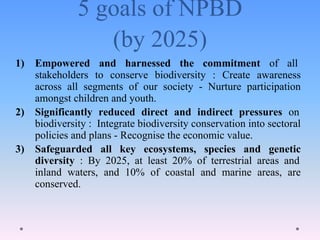
5 goals of NPBD
(by 2025)
1) Empowered and harnessed the commitment of all
stakeholders to conserve biodiversity : Create awareness
across all segments of our society - Nurture participation
amongst children and youth.
2) Significantly reduced direct and indirect pressures on
biodiversity : Integrate biodiversity conservation into sectoral
policies and plans - Recognise the economic value.
3) Safeguarded all key ecosystems, species and genetic
diversity : By 2025, at least 20% of terrestrial areas and
inland waters, and 10% of coastal and marine areas, are
conserved.
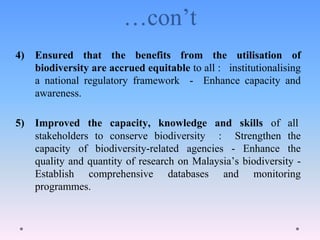
…con’t
4) Ensured that the benefits from the utilisation of
biodiversity are accrued equitable to all : institutionalising
a national regulatory framework - Enhance capacity and
awareness.
5) Improved the capacity, knowledge and skills of all
stakeholders to conserve biodiversity : Strengthen the
capacity of biodiversity-related agencies - Enhance the
quality and quantity of research on Malaysia’s biodiversity -
Establish comprehensive databases and monitoring
programmes.
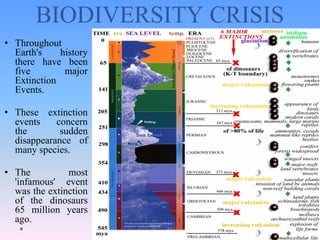
BIODIVERSITY CRISIS
• Throughout
Earth's history
there have been
five major
Extinction
Events.
• These extinction
events concern
the sudden
disappearance of
many species.
• The most
'infamous' event
was the extinction
of the dinosaurs
65 million years
ago.
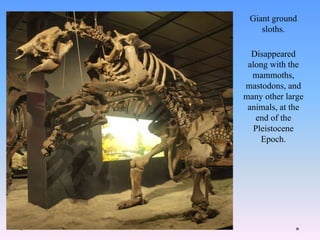
Giant ground
sloths.
Disappeared
along with the
mammoths,
mastodons, and
many other large
animals, at the
end of the
Pleistocene
Epoch.
…con’t
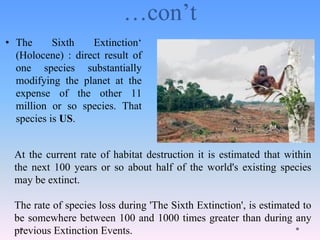
• The Sixth Extinction‘
(Holocene) : direct result of
one species substantially
modifying the planet at the
expense of the other 11
million or so species. That
species is US.
At the current rate of habitat destruction it is estimated that within
the next 100 years or so about half of the world's existing species
may be extinct.
The rate of species loss during 'The Sixth Extinction', is estimated to
be somewhere between 100 and 1000 times greater than during any
previous Extinction Events.
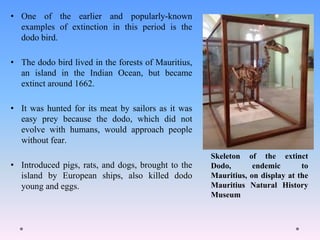
• One of the earlier and popularly-known
examples of extinction in this period is the
dodo bird.
• The dodo bird lived in the forests of Mauritius,
an island in the Indian Ocean, but became
extinct around 1662.
• It was hunted for its meat by sailors as it was
easy prey because the dodo, which did not
evolve with humans, would approach people
without fear.
• Introduced pigs, rats, and dogs, brought to the
island by European ships, also killed dodo
young and eggs.
Skeleton of the extinct
Dodo, endemic to
Mauritius, on display at the
Mauritius Natural History
Museum
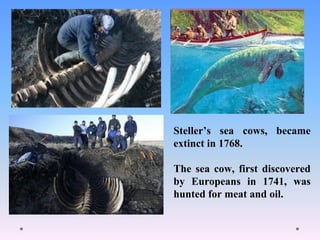
Steller’s sea cows, became
extinct in 1768.
The sea cow, first discovered
by Europeans in 1741, was
hunted for meat and oil.
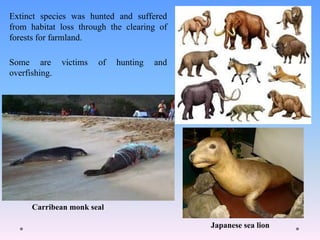
Extinct species was hunted and suffered
from habitat loss through the clearing of
forests for farmland.
Some are victims of hunting and
overfishing.
Japanese sea lion
Carribean monk seal
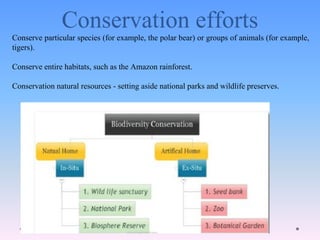
Conservation efforts
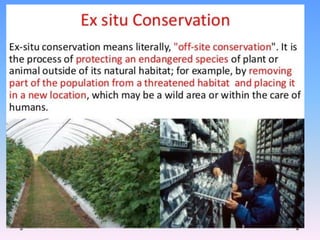
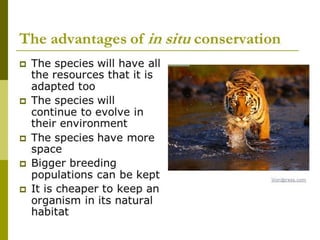
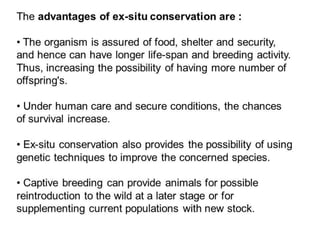
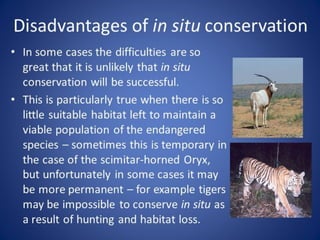
Conserve particular species (for example, the polar bear) or groups of animals (for example,
tigers).
Conserve entire habitats, such as the Amazon rainforest.
Conservation natural resources - setting aside national parks and wildlife preserves.
chapter 1 bio460 biological diversity uitm

chapter 1 bio460 biological diversity uitm

  • 1.
  • 2.
    Learning objectives: Towards theend of this chapter, students should be able to: • Define biological diversity • Describe National policy on biological diversity • Describe the rich diversity of Malaysian flora and fauna • Explain biodiversity crisis • Explain the conservation efforts
  • 3.
    Biological diversity • fromall sources including, terrestrial, marine and other aquatic ecosystems and the ecological complexes of which they are a part of- this includes diversity within species, between species and of ecosystems. BioD : Variability among living organisms on earth
  • 4.
    RICH DIVERSITY OFMALAYSIAN FLORA AND FAUNA • Malaysia is widely recognised to be one of the world’s few megadiversity countries. • There are an estimated 15,000 species of vascular plants in Malaysia. • The country’s faunal communities include 307 known species of mammals, 30 of which are endemic to Malaysia. • 785 species of birds from 85 families, 242 species of amphibians and 567 species of reptiles, as well as a total of 1951 species of freshwater and marine fishes.
  • 5.
    National Policy onBiodiversity (NPBD) 2016-2025 • Objective : To conserve Malaysia’s biological diversity and to ensure that its components are utilized in a sustainable manner for the continued progress and socio - economic development of the nation. • The first National Policy on Biological Diversity was formulated in 1998.
  • 6.
    5 principles inNPBD PRINCIPLE 1 Heritage. BioD is a national heritage that must be sustainably managed and wisely utilised today and conserved for future generations. PRINCIPLE 2 Precautionary. The lack of full scientific certainty should not be used as a reason to postpone measures to minimise threats of significant loss of biodiversity. PRINCIPLE 3 Shared responsibility. The conservation and sustainable utilisation of biodiversity are the shared responsibility of all sectors of society. PRINCIPLE 4 Participatory. Planning and management of biodiversity must be carried out in a participatory manner. PRINCIPLE 5 Good governance. Good governance, including accountability and transparency in decisionmaking, is crucial to biodiversity conservation.
  • 7.
    5 goals ofNPBD (by 2025) 1) Empowered and harnessed the commitment of all stakeholders to conserve biodiversity : Create awareness across all segments of our society - Nurture participation amongst children and youth. 2) Significantly reduced direct and indirect pressures on biodiversity : Integrate biodiversity conservation into sectoral policies and plans - Recognise the economic value. 3) Safeguarded all key ecosystems, species and genetic diversity : By 2025, at least 20% of terrestrial areas and inland waters, and 10% of coastal and marine areas, are conserved.
  • 8.
    …con’t 4) Ensured thatthe benefits from the utilisation of biodiversity are accrued equitable to all : institutionalising a national regulatory framework - Enhance capacity and awareness. 5) Improved the capacity, knowledge and skills of all stakeholders to conserve biodiversity : Strengthen the capacity of biodiversity-related agencies - Enhance the quality and quantity of research on Malaysia’s biodiversity - Establish comprehensive databases and monitoring programmes.
  • 9.
    BIODIVERSITY CRISIS • Throughout Earth'shistory there have been five major Extinction Events. • These extinction events concern the sudden disappearance of many species. • The most 'infamous' event was the extinction of the dinosaurs 65 million years ago.
  • 10.
    Giant ground sloths. Disappeared along withthe mammoths, mastodons, and many other large animals, at the end of the Pleistocene Epoch.
  • 11.
    …con’t • The SixthExtinction‘ (Holocene) : direct result of one species substantially modifying the planet at the expense of the other 11 million or so species. That species is US. At the current rate of habitat destruction it is estimated that within the next 100 years or so about half of the world's existing species may be extinct. The rate of species loss during 'The Sixth Extinction', is estimated to be somewhere between 100 and 1000 times greater than during any previous Extinction Events.
  • 12.
    • One ofthe earlier and popularly-known examples of extinction in this period is the dodo bird. • The dodo bird lived in the forests of Mauritius, an island in the Indian Ocean, but became extinct around 1662. • It was hunted for its meat by sailors as it was easy prey because the dodo, which did not evolve with humans, would approach people without fear. • Introduced pigs, rats, and dogs, brought to the island by European ships, also killed dodo young and eggs. Skeleton of the extinct Dodo, endemic to Mauritius, on display at the Mauritius Natural History Museum
  • 13.
    Steller’s sea cows,became extinct in 1768. The sea cow, first discovered by Europeans in 1741, was hunted for meat and oil.
  • 14.
    Extinct species washunted and suffered from habitat loss through the clearing of forests for farmland. Some are victims of hunting and overfishing. Japanese sea lion Carribean monk seal
  • 15.
    Conservation efforts Conserve particularspecies (for example, the polar bear) or groups of animals (for example, tigers). Conserve entire habitats, such as the Amazon rainforest. Conservation natural resources - setting aside national parks and wildlife preserves.