1- 1
Copyright © 2012 Pearson Education, Inc.
Publishing as Prentice Hall
i t ’s good and
good for you
Chapter 1
Marketing:
Creating and Capturing Customer Value
1- 2
Copyright © 2012 Pearson Education, Inc.
Publishing as Prentice Hall
Creating and Capturing Customer
Value
• What Is Marketing?
• Understand the Marketplace and Customer Needs
• Designing a Customer-Driven Marketing Strategy
• Preparing an Integrated Marketing Plan and Program
• Building Customer Relationships
• Capturing Value from Customers
• The Changing Marketing Landscape
Topic Outline
1- 3
Copyright © 2012 Pearson Education, Inc.
Publishing as Prentice Hall
• A simple definition of marketing is
managing profitable customer
relationships.
• Marketing must both attract new
customers and grow the current customers.
• Every organization must perform marketing
functions, not just for-profit companies.
• Nonprofits (colleges, hospitals, churches,
etc.) also must perform marketing.
WHAT IS MARKETING?
1- 4
Copyright © 2012 Pearson Education, Inc.
Publishing as Prentice Hall
• Most people think of marketing as selling
and advertising—“telling and selling.”
• Marketing must focus on satisfying
customer needs.
1- 5
Copyright © 2012 Pearson Education, Inc.
Publishing as Prentice Hall
What Is Marketing?
Marketing is a process by which
companies create value for customers and
build strong customer relationships to
capture value from customers in return
1- 6
Copyright © 2012 Pearson Education, Inc.
Publishing as Prentice Hall
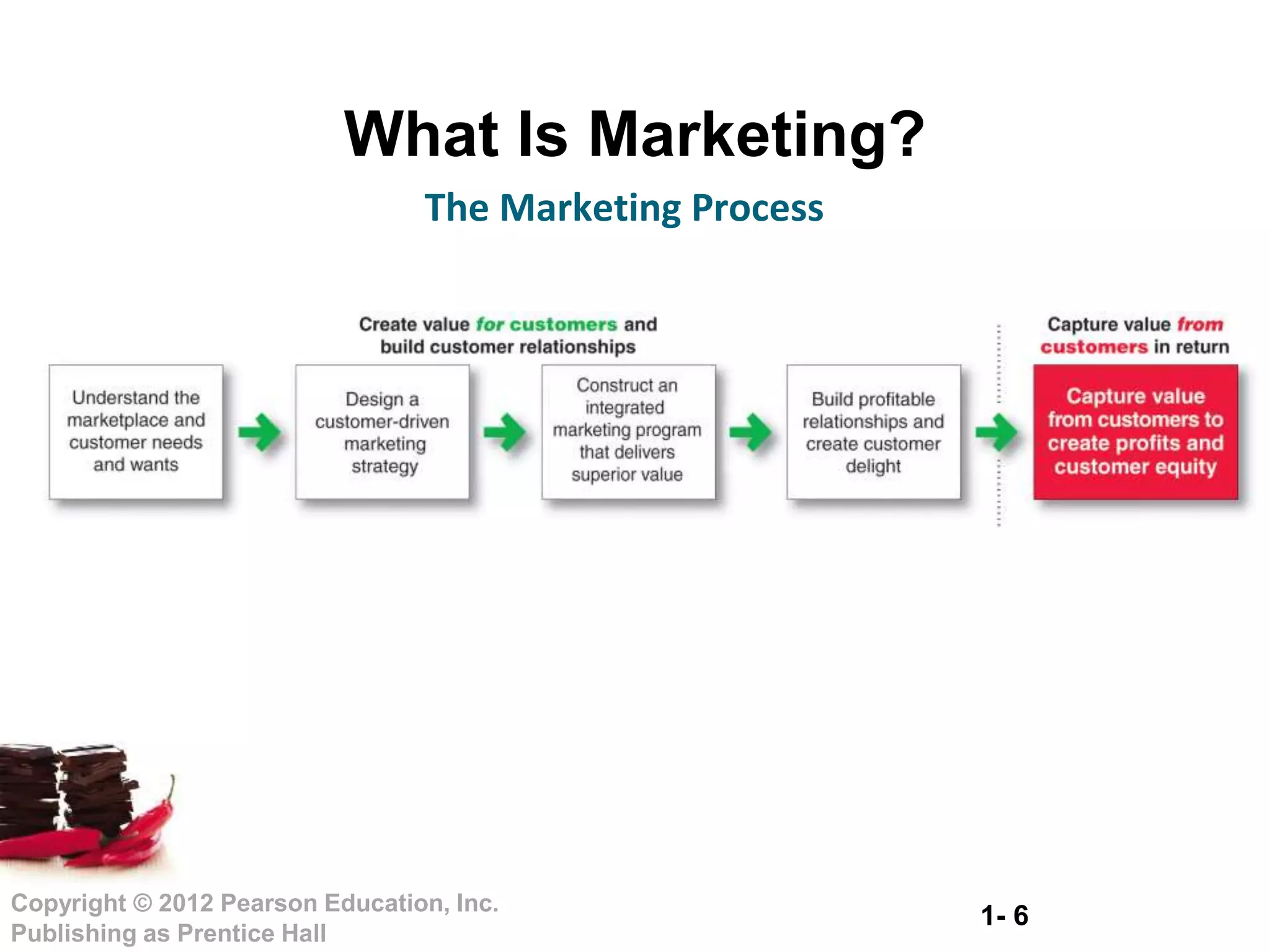
What Is Marketing?
The Marketing Process
1- 7
Copyright © 2012 Pearson Education, Inc.
Publishing as Prentice Hall
• In the first four steps, companies work to
understand consumers, create customer
value, and build strong customer
relationships.
• In the final step, companies reap the
rewards of creating superior customer
value. By creating value for consumers,
they in turn capture value from consumers
in the form of sales, profits, and long-term
customer equity.
1- 8
Copyright © 2012 Pearson Education, Inc.
Publishing as Prentice Hall
Understanding the Marketplace
and Customer Needs
• States of deprivation
• Physical—food, clothing, warmth, safety
• Social—belonging and affection
• Individual—knowledge and self-expression
Needs
• Form that needs take as they are shaped by culture
and individual personality
Wants
• Wants backed by buying power
Demands
Customer Needs, Wants, and Demands
1- 9
Copyright © 2012 Pearson Education, Inc.
Publishing as Prentice Hall
• Five core customer and marketplace
concepts are critical: (1) needs, wants, and
demands; (2) marketing offers (products,
services, and experiences); (3) value and
satisfaction; (4) exchanges and
relationships; and (5) markets.
1- 10
Copyright © 2012 Pearson Education, Inc.
Publishing as Prentice Hall
Customer Needs, Wants, and Demands
• The most basic concept underlying
marketing is that of human needs.
• Human needs are states of felt deprivation.
They include physical, social, and individual
needs. These needs were not created by
marketers; they are a basic part of the
human makeup.
1- 11
Copyright © 2012 Pearson Education, Inc.
Publishing as Prentice Hall
• Wants are the form human needs take as
they are shaped by culture and individual
personality. An American needs food but
wants a Big Mac.
• When backed by buying power, wants
become demands.
• The best marketing companies go to great
lengths to learn and understand their
customers’ needs, wants, and demands
1- 12
Copyright © 2012 Pearson Education, Inc.
Publishing as Prentice Hall
Understanding the Marketplace
and Customer Needs
• Market offerings are some
combination of products,
services, information, or
experiences offered to a
market to satisfy a need or
want
• Marketing myopia is
focusing only on existing
wants and losing sight of
underlying consumer
needs
1- 13
Copyright © 2012 Pearson Education, Inc.
Publishing as Prentice Hall
• Needs and wants are fulfilled through market
offerings—some combination of products,
services, information, or experiences offered to a
market to satisfy a need or want.
• Market offerings include products and services—
activities or benefits offered for sale that are
essentially intangible and do not result in the
ownership of anything.
• Marketing myopia occurs when a company
becomes so taken with their own products that
they lose sight of underlying customer needs.
1- 14
Copyright © 2012 Pearson Education, Inc.
Publishing as Prentice Hall
Understanding the Marketplace
and Customer Needs
Customer Value and Satisfaction
Expectations
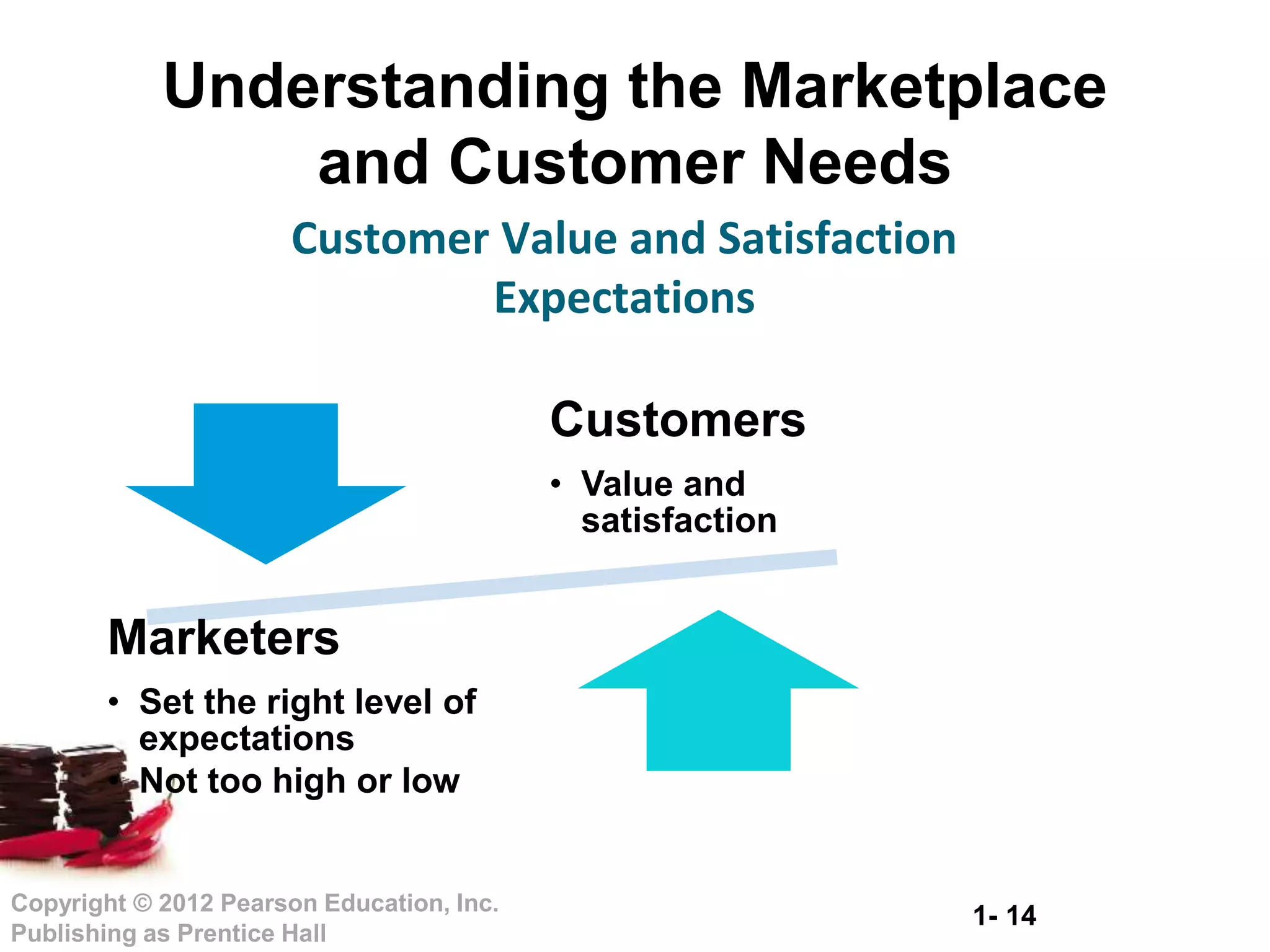
Customers
• Value and
satisfaction
Marketers
• Set the right level of
expectations
• Not too high or low
1- 15
Copyright © 2012 Pearson Education, Inc.
Publishing as Prentice Hall
Customer Value and Satisfaction
• Customers form expectations about the value and
satisfaction that various market offerings will
deliver and buy accordingly.
• Satisfied customers buy again and tell others
about their good experiences.
• Dissatisfied customers switch to competitors and
disparage the product to others.
• Customer value and customer satisfaction are key
building blocks for developing and managing
customer relationships.
1- 16
Copyright © 2012 Pearson Education, Inc.
Publishing as Prentice Hall
Exchange is the act of obtaining a desired
object from someone by offering
something in return
•Marketing consists of actions taken to
build and maintain desirable exchange
relationships with target audiences.
Understanding the Marketplace
and Customer Needs
1- 17
Copyright © 2012 Pearson Education, Inc.
Publishing as Prentice Hall
Understanding the Marketplace
and Customer Needs
Markets are the set of actual and
potential buyers of a product
1- 18
Copyright © 2012 Pearson Education, Inc.
Publishing as Prentice Hall
• Marketing means managing markets to
bring about profitable customer
relationships.
• Figure 1.2 shows the main elements in a
modern marketing system.
1- 19
Copyright © 2012 Pearson Education, Inc.
Publishing as Prentice Hall
Designing a Customer-Driven
Marketing Strategy
Marketing management is the art and
science of choosing target markets and
building profitable relationships with them
– What customers will we serve?
– How can we best serve these customers?
1- 20
Copyright © 2012 Pearson Education, Inc.
Publishing as Prentice Hall
• The marketing manager must answer two
important questions:
• What customers will we serve (what’s our
target market)?
• How can we serve these customers best
(what’s our value proposition)?
1- 21
Copyright © 2012 Pearson Education, Inc.
Publishing as Prentice Hall
Designing a Customer-Driven
Marketing Strategy
Market segmentation refers to dividing the
markets into segments of customers
Target marketing refers to which segments
to go after
Selecting Customers to Serve
1- 22
Copyright © 2012 Pearson Education, Inc.
Publishing as Prentice Hall
Selecting Customers to Serve
• A company must decide whom it will serve.
• It does this by dividing the market into segments of
customers (market segmentation) and selecting which
segments it will go after (target marketing).
• Marketing managers know they cannot serve all
customers. By trying to do so, they end up not serving any
well.
• Marketing managers must decide which customers they
want to target and on which level, timing, and nature of
their demand.
• Marketing management is customer management and
demand management.
1- 23
Copyright © 2012 Pearson Education, Inc.
Publishing as Prentice Hall
Designing a Customer-Driven
Marketing Strategy
Choosing a Value Proposition
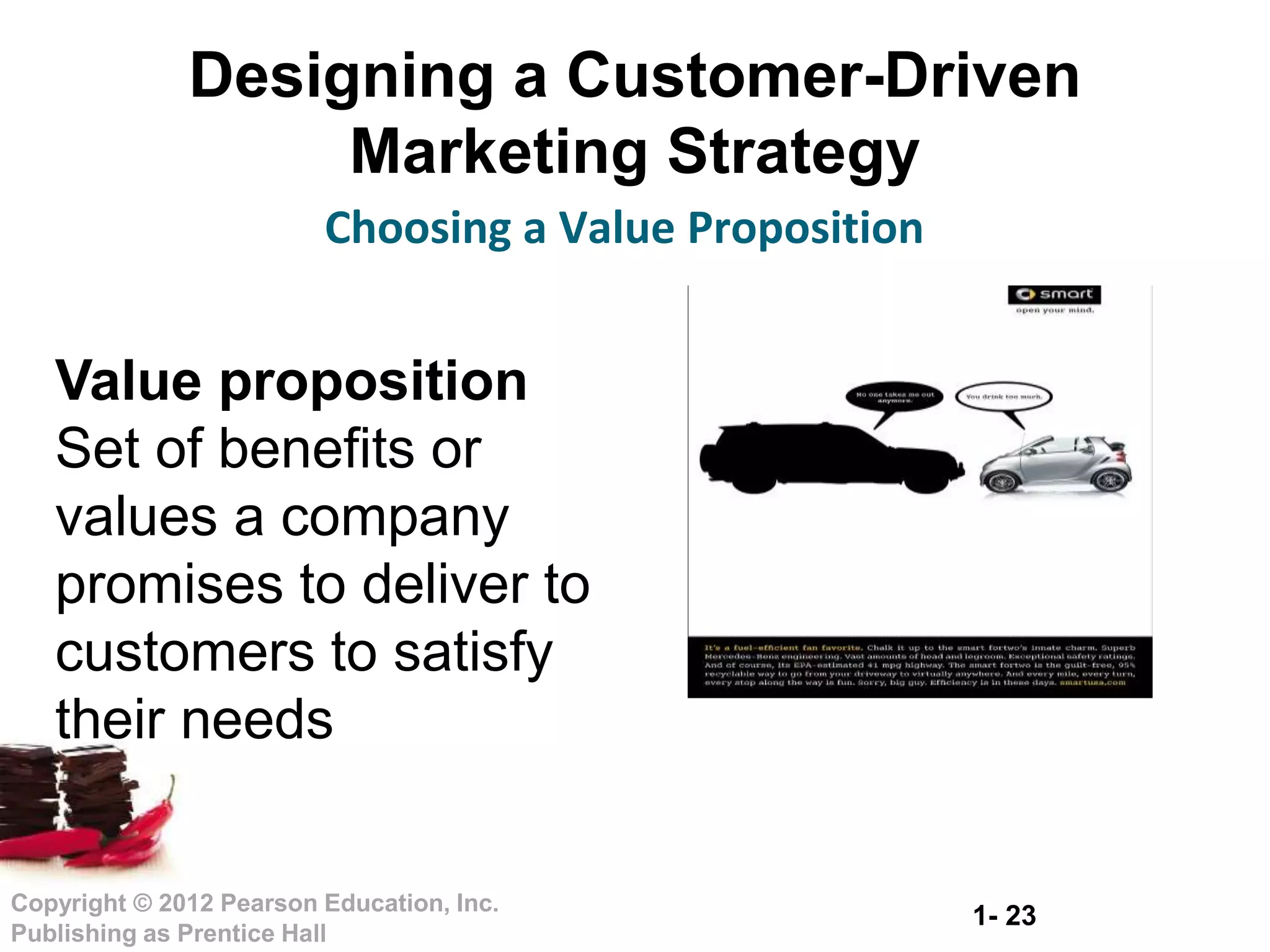
Value proposition
Set of benefits or
values a company
promises to deliver to
customers to satisfy
their needs
1- 24
Copyright © 2012 Pearson Education, Inc.
Publishing as Prentice Hall
• (BMW promises “the ultimate driving
machine.”)
• Such value propositions differentiate one
brand from another.
1- 25
Copyright © 2012 Pearson Education, Inc.
Publishing as Prentice Hall
Designing a Customer-Driven
Marketing Strategy
Production
concept
Product
concept
Selling
concept
Marketing
concept
Societal
concept
Marketing Management Orientations
1- 26
Copyright © 2012 Pearson Education, Inc.
Publishing as Prentice Hall
• Marketing management wants to design
strategies that will build profitable
relationships with target consumers. But
what philosophy should guide these
marketing strategies?
• There are five alternative concepts under
which organizations design and carry out
their marketing strategies:
1- 27
Copyright © 2012 Pearson Education, Inc.
Publishing as Prentice Hall
Designing a Customer-Driven
Marketing Strategy
Production concept is the idea that
consumers will favor products that are
available or highly affordable
• Management should focus on improving
production and distribution efficiency
Marketing Management Orientations
1- 28
Copyright © 2012 Pearson Education, Inc.
Publishing as Prentice Hall
Designing a Customer-Driven
Marketing Strategy
Product concept is the idea that consumers
will favor products that offer the most
quality, performance, and features.
Organization should therefore devote its
energy to making continuous product
improvements.
Marketing Management Orientations
1- 29
Copyright © 2012 Pearson Education, Inc.
Publishing as Prentice Hall
Designing a Customer-Driven
Marketing Strategy
Selling concept is the idea that consumers
will not buy enough of the firm’s products
unless it undertakes a large scale selling
and promotion effort
Marketing Management Orientations
1- 30
Copyright © 2012 Pearson Education, Inc.
Publishing as Prentice Hall
• The concept is typically practiced with
unsought goods—those that buyers do not
normally think of buying, such as insurance
or blood donations.
• These industries must be good at tracking
down prospects and selling them on
product benefits.
1- 31
Copyright © 2012 Pearson Education, Inc.
Publishing as Prentice Hall
Designing a Customer-Driven
Marketing Strategy
Marketing Management Orientations
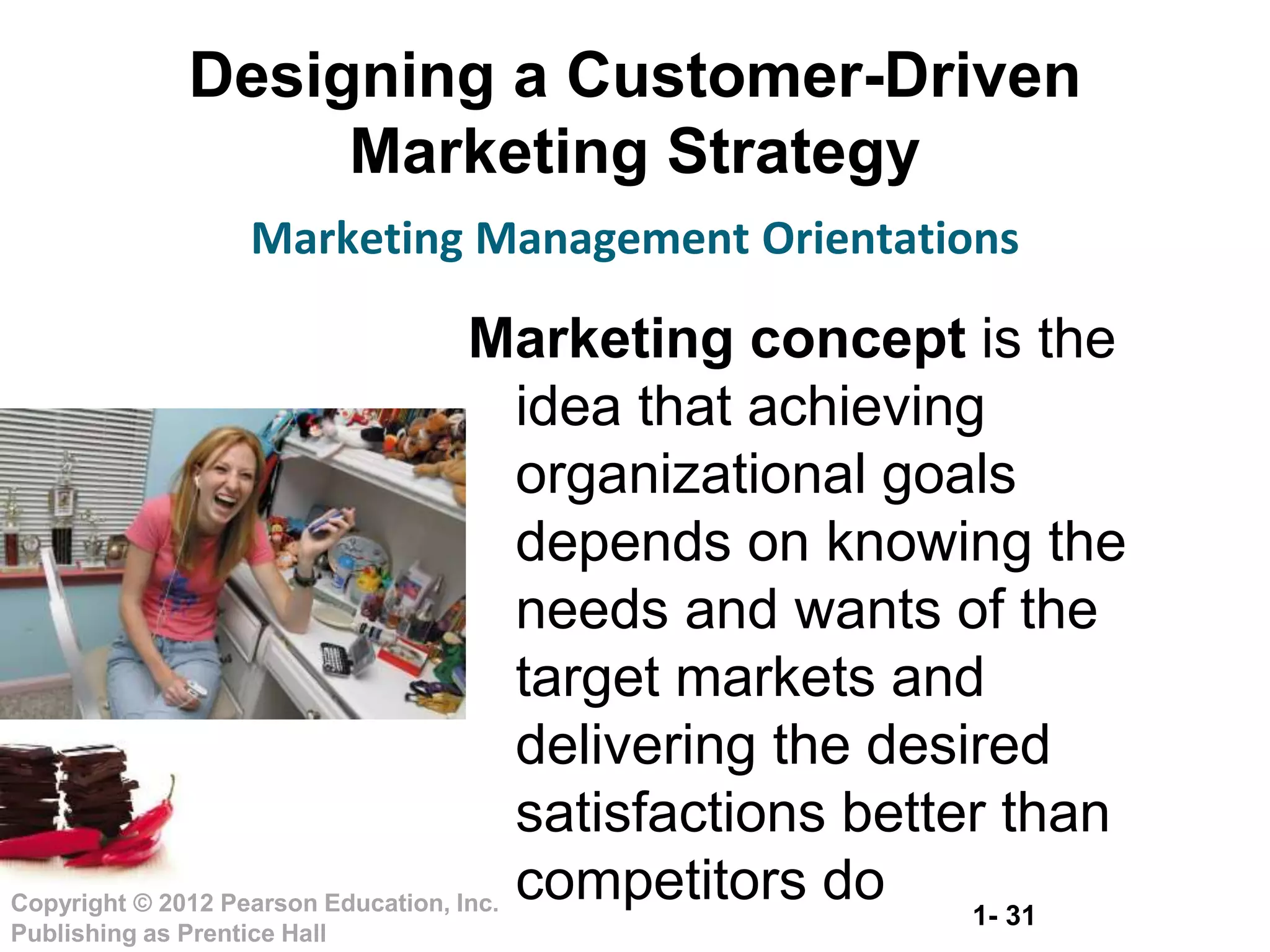
Marketing concept is the
idea that achieving
organizational goals
depends on knowing the
needs and wants of the
target markets and
delivering the desired
satisfactions better than
competitors do
1- 32
Copyright © 2012 Pearson Education, Inc.
Publishing as Prentice Hall
• Under the marketing concept, customer focus and value
are the paths to sales and profits.
• Rather than a “make and sell” philosophy, it is a
customer-centered “sense and respond” philosophy.
• The job is not to find the right customers for your product
but to find the right products for your customers.
• Customer-driven companies research current customers
deeply to learn about their desires, gather new product
and service ideas, and test proposed product
improvements.
• Customer-driven marketing is understanding customer
needs even better than customers themselves do and
creating products and services that meet existing and
latent needs.
1- 33
Copyright © 2012 Pearson Education, Inc.
Publishing as Prentice Hall
Designing a Customer-Driven
Marketing Strategy
Marketing Management Orientations
Societal marketing concept
is the idea that a company
should make good marketing
decisions by considering
consumers’ wants, the
company’s requirements,
consumers’ long-term
interests, and society’s long-
run interests
1- 34
Copyright © 2012 Pearson Education, Inc.
Publishing as Prentice Hall
• The societal marketing concept questions
whether the pure marketing concept
overlooks possible conflicts between
consumer short-run wants and consumer
long-run welfare.
• The societal marketing concept holds that
marketing strategy should deliver value to
customers in a way that maintains or
improves both the consumer’s and
society’s well-being.
1- 35
Copyright © 2012 Pearson Education, Inc.
Publishing as Prentice Hall
Designing a Customer-Driven
Marketing Strategy
1- 36
Copyright © 2012 Pearson Education, Inc.
Publishing as Prentice Hall
The marketing mix: set of tools (four Ps) the
firm uses to implement its marketing
strategy. It includes product, price,
promotion, and place.
Integrated marketing program:
comprehensive plan that communicates
and delivers the intended value to chosen
customers.
Preparing an Integrated Marketing
Plan and Program
1- 37
Copyright © 2012 Pearson Education, Inc.
Publishing as Prentice Hall
• The company’s marketing strategy outlines
which customers the company will serve
and how it will create value for these
customers.
• Next, the marketer develops an integrated
marketing program that will actually deliver
the intended value to target customers.
• The marketing program consists of the
firm’s marketing mix, the set of marketing
tools the firm uses to implement its
marketing strategy.
1- 38
Copyright © 2012 Pearson Education, Inc.
Publishing as Prentice Hall
• The marketing mix tools are classified into
the four Ps of marketing: product, price,
place, and promotion.
• The firm blends all of these marketing mix
tools into a comprehensive integrated
marketing program that communicates and
delivers the intended value to chosen
customers.
1- 39
Copyright © 2012 Pearson Education, Inc.
Publishing as Prentice Hall
Building Customer Relationships
• The overall process of
building and maintaining
profitable customer
relationships by delivering
superior customer value
and satisfaction
Customer Relationship Management (CRM)
1- 40
Copyright © 2012 Pearson Education, Inc.
Publishing as Prentice Hall
• Customer relationship management is the
most important concept of modern
marketing.
• Customer relationship management is the
overall process of building and maintaining
profitable customer relationships by
delivering superior customer value and
satisfaction.
• It deals with all aspects of acquiring,
keeping, and growing customers.
1- 41
Copyright © 2012 Pearson Education, Inc.
Publishing as Prentice Hall
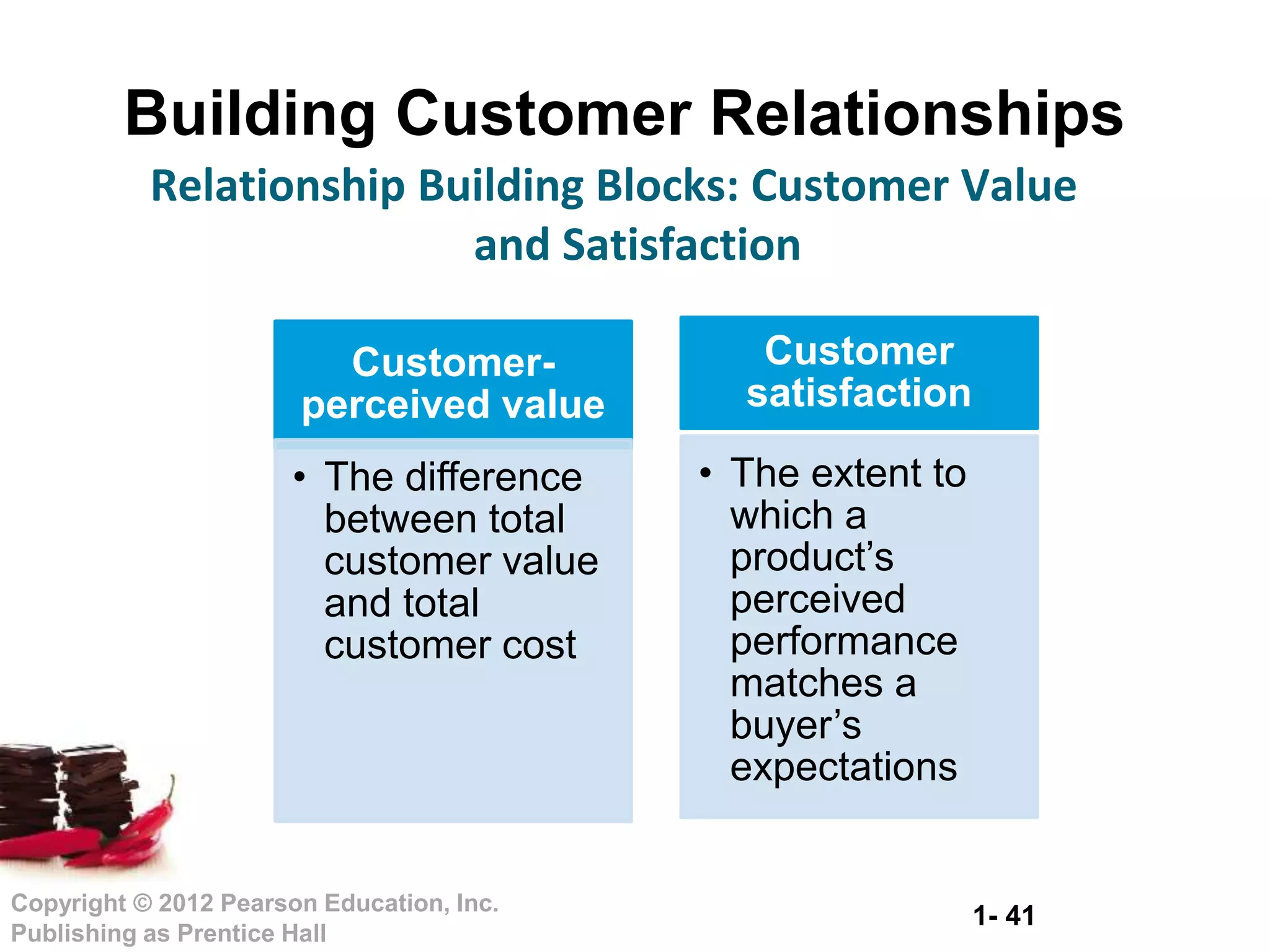
Building Customer Relationships
Relationship Building Blocks: Customer Value
and Satisfaction
Customer-
perceived value
• The difference
between total
customer value
and total
customer cost
Customer
satisfaction
• The extent to
which a
product’s
perceived
performance
matches a
buyer’s
expectations
1- 42
Copyright © 2012 Pearson Education, Inc.
Publishing as Prentice Hall
• The key to building lasting customer relationships
is to create superior customer value and
satisfaction.
Customer Value
• Customer-perceived value is the customer’s
evaluation of the difference between all the
benefits and all the costs of a market offering
relative to those of competing offers.
• Customers often do not judge values and costs
“accurately” or “objectively.”
• Instead, customers act on perceived value.
1- 43
Copyright © 2012 Pearson Education, Inc.
Publishing as Prentice Hall
• Customer Satisfaction
• Customer satisfaction depends on the
product’s perceived performance relative
to a buyer’s expectations.
• If the product’s performance falls short of
expectations, the customer is dissatisfied. If
performance matches expectations, the
customer is satisfied. If performance
exceeds expectations, the customer is
highly satisfied or delighted.
1- 44
Copyright © 2012 Pearson Education, Inc.
Publishing as Prentice Hall
• Although the customer-centered firm seeks
to deliver high customer satisfaction
relative to competitors, it does not attempt
to maximize customer satisfaction.
• A company can always increase customer
satisfaction by lowering its price or
increasing its services. But this may result
in lower profits.
• The purpose of marketing is to generate
customer value profitably.
1- 45
Copyright © 2012 Pearson Education, Inc.
Publishing as Prentice Hall
• The first four steps in the marketing
process involve building customer
relationships. The final step involves
capturing value in return.
• By creating superior customer value, the
firm creates highly satisfied customers who
stay loyal and buy more.
CAPTURING VALUE FROM
CUSTOMERS
1- 46
Copyright © 2012 Pearson Education, Inc.
Publishing as Prentice Hall
Capturing Value from Customers
• Customer lifetime value is the value of the
entire stream of purchases that the
customer would
make over a
lifetime of
patronage
Creating Customer Loyalty and Retention
1- 47
Copyright © 2012 Pearson Education, Inc.
Publishing as Prentice Hall
Creating Customer Loyalty and Retention
• The aim of customer relationship management
(CRM) is to create not just customer satisfaction,
but customer delight.
• This means that companies must aim high in
building customer relationships.
• Customer delight creates an emotional
relationship with a product or service, not just a
rational preference.
• Companies are realizing that losing a customer
means losing more than a single sale. It means
losing customer lifetime value.
1- 48
Copyright © 2012 Pearson Education, Inc.
Publishing as Prentice Hall
Capturing Value from Customers
Share of customer is the portion of the
customer’s purchasing that a company gets
in its product categories
Growing Share of Customer
1- 49
Copyright © 2012 Pearson Education, Inc.
Publishing as Prentice Hall
Capturing Value from
Customers
Customer equity is
the total combined
customer lifetime
values of all of the
company’s
customers
1- 50
Copyright © 2012 Pearson Education, Inc.
Publishing as Prentice Hall
Building Customer Equity
• Companies want not only to create profitable customers,
but to “own” them for life, capture their customer lifetime
value, and earn a greater share of their purchases.
What Is Customer Equity?
• Customer equity is the total combined customer lifetime
values of all of the company’s current and potential
customers.
• Clearly, the more loyal the firm’s profitable customers,
the higher the firm’s customer equity.
• Customer equity may be a better measure of a firm’s
performance than current sales or market share.
1- 51
Copyright © 2012 Pearson Education, Inc.
Publishing as Prentice Hall
Capturing Value from Customers
• Right relationships with the right customers
involves treating customers as assets that
need to be managed and maximized
• Different types of customers require
different relationship management
strategies
Building Customer Equity
1- 52
Copyright © 2012 Pearson Education, Inc.
Publishing as Prentice Hall
So, What Is Marketing?
Pulling It All Together
1- 53
Copyright © 2012 Pearson Education, Inc.
Publishing as Prentice Hall
• Marketing is the process of building profitable
customer relationships by creating value for
customers and capturing value in return.
• The first four steps in the marketing process
create value for customers.
• The final step in the process allows the company
to capture value from customers.
• When building customer and partner
relationships, companies must harness marketing
technology, take advantage of global
opportunities, and act in an ethical and socially
responsible way.
• Figure 1.6 provides a road map to future chapters
of this text.
1- 54
Copyright © 2012 Pearson Education, Inc.
Publishing as Prentice Hall
All rights reserved. No part of this publication may be reproduced, stored in a
retrieval system, or transmitted, in any form or by any means, electronic,
mechanical, photocopying, recording, or otherwise, without the prior written
permission of the publisher. Printed in the United States of America.
Copyright © 2012 Pearson Education, Inc.
Publishing as Prentice Hall

Chapter 1.ppt

  • 1.
    1- 1 Copyright ©2012 Pearson Education, Inc. Publishing as Prentice Hall i t ’s good and good for you Chapter 1 Marketing: Creating and Capturing Customer Value
  • 2.
    1- 2 Copyright ©2012 Pearson Education, Inc. Publishing as Prentice Hall Creating and Capturing Customer Value • What Is Marketing? • Understand the Marketplace and Customer Needs • Designing a Customer-Driven Marketing Strategy • Preparing an Integrated Marketing Plan and Program • Building Customer Relationships • Capturing Value from Customers • The Changing Marketing Landscape Topic Outline
  • 3.
    1- 3 Copyright ©2012 Pearson Education, Inc. Publishing as Prentice Hall • A simple definition of marketing is managing profitable customer relationships. • Marketing must both attract new customers and grow the current customers. • Every organization must perform marketing functions, not just for-profit companies. • Nonprofits (colleges, hospitals, churches, etc.) also must perform marketing. WHAT IS MARKETING?
  • 4.
    1- 4 Copyright ©2012 Pearson Education, Inc. Publishing as Prentice Hall • Most people think of marketing as selling and advertising—“telling and selling.” • Marketing must focus on satisfying customer needs.
  • 5.
    1- 5 Copyright ©2012 Pearson Education, Inc. Publishing as Prentice Hall What Is Marketing? Marketing is a process by which companies create value for customers and build strong customer relationships to capture value from customers in return
  • 6.
    1- 6 Copyright ©2012 Pearson Education, Inc. Publishing as Prentice Hall What Is Marketing? The Marketing Process
  • 7.
    1- 7 Copyright ©2012 Pearson Education, Inc. Publishing as Prentice Hall • In the first four steps, companies work to understand consumers, create customer value, and build strong customer relationships. • In the final step, companies reap the rewards of creating superior customer value. By creating value for consumers, they in turn capture value from consumers in the form of sales, profits, and long-term customer equity.
  • 8.
    1- 8 Copyright ©2012 Pearson Education, Inc. Publishing as Prentice Hall Understanding the Marketplace and Customer Needs • States of deprivation • Physical—food, clothing, warmth, safety • Social—belonging and affection • Individual—knowledge and self-expression Needs • Form that needs take as they are shaped by culture and individual personality Wants • Wants backed by buying power Demands Customer Needs, Wants, and Demands
  • 9.
    1- 9 Copyright ©2012 Pearson Education, Inc. Publishing as Prentice Hall • Five core customer and marketplace concepts are critical: (1) needs, wants, and demands; (2) marketing offers (products, services, and experiences); (3) value and satisfaction; (4) exchanges and relationships; and (5) markets.
  • 10.
    1- 10 Copyright ©2012 Pearson Education, Inc. Publishing as Prentice Hall Customer Needs, Wants, and Demands • The most basic concept underlying marketing is that of human needs. • Human needs are states of felt deprivation. They include physical, social, and individual needs. These needs were not created by marketers; they are a basic part of the human makeup.
  • 11.
    1- 11 Copyright ©2012 Pearson Education, Inc. Publishing as Prentice Hall • Wants are the form human needs take as they are shaped by culture and individual personality. An American needs food but wants a Big Mac. • When backed by buying power, wants become demands. • The best marketing companies go to great lengths to learn and understand their customers’ needs, wants, and demands
  • 12.
    1- 12 Copyright ©2012 Pearson Education, Inc. Publishing as Prentice Hall Understanding the Marketplace and Customer Needs • Market offerings are some combination of products, services, information, or experiences offered to a market to satisfy a need or want • Marketing myopia is focusing only on existing wants and losing sight of underlying consumer needs
  • 13.
    1- 13 Copyright ©2012 Pearson Education, Inc. Publishing as Prentice Hall • Needs and wants are fulfilled through market offerings—some combination of products, services, information, or experiences offered to a market to satisfy a need or want. • Market offerings include products and services— activities or benefits offered for sale that are essentially intangible and do not result in the ownership of anything. • Marketing myopia occurs when a company becomes so taken with their own products that they lose sight of underlying customer needs.
  • 14.
    1- 14 Copyright ©2012 Pearson Education, Inc. Publishing as Prentice Hall Understanding the Marketplace and Customer Needs Customer Value and Satisfaction Expectations Customers • Value and satisfaction Marketers • Set the right level of expectations • Not too high or low
  • 15.
    1- 15 Copyright ©2012 Pearson Education, Inc. Publishing as Prentice Hall Customer Value and Satisfaction • Customers form expectations about the value and satisfaction that various market offerings will deliver and buy accordingly. • Satisfied customers buy again and tell others about their good experiences. • Dissatisfied customers switch to competitors and disparage the product to others. • Customer value and customer satisfaction are key building blocks for developing and managing customer relationships.
  • 16.
    1- 16 Copyright ©2012 Pearson Education, Inc. Publishing as Prentice Hall Exchange is the act of obtaining a desired object from someone by offering something in return •Marketing consists of actions taken to build and maintain desirable exchange relationships with target audiences. Understanding the Marketplace and Customer Needs
  • 17.
    1- 17 Copyright ©2012 Pearson Education, Inc. Publishing as Prentice Hall Understanding the Marketplace and Customer Needs Markets are the set of actual and potential buyers of a product
  • 18.
    1- 18 Copyright ©2012 Pearson Education, Inc. Publishing as Prentice Hall • Marketing means managing markets to bring about profitable customer relationships. • Figure 1.2 shows the main elements in a modern marketing system.
  • 19.
    1- 19 Copyright ©2012 Pearson Education, Inc. Publishing as Prentice Hall Designing a Customer-Driven Marketing Strategy Marketing management is the art and science of choosing target markets and building profitable relationships with them – What customers will we serve? – How can we best serve these customers?
  • 20.
    1- 20 Copyright ©2012 Pearson Education, Inc. Publishing as Prentice Hall • The marketing manager must answer two important questions: • What customers will we serve (what’s our target market)? • How can we serve these customers best (what’s our value proposition)?
  • 21.
    1- 21 Copyright ©2012 Pearson Education, Inc. Publishing as Prentice Hall Designing a Customer-Driven Marketing Strategy Market segmentation refers to dividing the markets into segments of customers Target marketing refers to which segments to go after Selecting Customers to Serve
  • 22.
    1- 22 Copyright ©2012 Pearson Education, Inc. Publishing as Prentice Hall Selecting Customers to Serve • A company must decide whom it will serve. • It does this by dividing the market into segments of customers (market segmentation) and selecting which segments it will go after (target marketing). • Marketing managers know they cannot serve all customers. By trying to do so, they end up not serving any well. • Marketing managers must decide which customers they want to target and on which level, timing, and nature of their demand. • Marketing management is customer management and demand management.
  • 23.
    1- 23 Copyright ©2012 Pearson Education, Inc. Publishing as Prentice Hall Designing a Customer-Driven Marketing Strategy Choosing a Value Proposition Value proposition Set of benefits or values a company promises to deliver to customers to satisfy their needs
  • 24.
    1- 24 Copyright ©2012 Pearson Education, Inc. Publishing as Prentice Hall • (BMW promises “the ultimate driving machine.”) • Such value propositions differentiate one brand from another.
  • 25.
    1- 25 Copyright ©2012 Pearson Education, Inc. Publishing as Prentice Hall Designing a Customer-Driven Marketing Strategy Production concept Product concept Selling concept Marketing concept Societal concept Marketing Management Orientations
  • 26.
    1- 26 Copyright ©2012 Pearson Education, Inc. Publishing as Prentice Hall • Marketing management wants to design strategies that will build profitable relationships with target consumers. But what philosophy should guide these marketing strategies? • There are five alternative concepts under which organizations design and carry out their marketing strategies:
  • 27.
    1- 27 Copyright ©2012 Pearson Education, Inc. Publishing as Prentice Hall Designing a Customer-Driven Marketing Strategy Production concept is the idea that consumers will favor products that are available or highly affordable • Management should focus on improving production and distribution efficiency Marketing Management Orientations
  • 28.
    1- 28 Copyright ©2012 Pearson Education, Inc. Publishing as Prentice Hall Designing a Customer-Driven Marketing Strategy Product concept is the idea that consumers will favor products that offer the most quality, performance, and features. Organization should therefore devote its energy to making continuous product improvements. Marketing Management Orientations
  • 29.
    1- 29 Copyright ©2012 Pearson Education, Inc. Publishing as Prentice Hall Designing a Customer-Driven Marketing Strategy Selling concept is the idea that consumers will not buy enough of the firm’s products unless it undertakes a large scale selling and promotion effort Marketing Management Orientations
  • 30.
    1- 30 Copyright ©2012 Pearson Education, Inc. Publishing as Prentice Hall • The concept is typically practiced with unsought goods—those that buyers do not normally think of buying, such as insurance or blood donations. • These industries must be good at tracking down prospects and selling them on product benefits.
  • 31.
    1- 31 Copyright ©2012 Pearson Education, Inc. Publishing as Prentice Hall Designing a Customer-Driven Marketing Strategy Marketing Management Orientations Marketing concept is the idea that achieving organizational goals depends on knowing the needs and wants of the target markets and delivering the desired satisfactions better than competitors do
  • 32.
    1- 32 Copyright ©2012 Pearson Education, Inc. Publishing as Prentice Hall • Under the marketing concept, customer focus and value are the paths to sales and profits. • Rather than a “make and sell” philosophy, it is a customer-centered “sense and respond” philosophy. • The job is not to find the right customers for your product but to find the right products for your customers. • Customer-driven companies research current customers deeply to learn about their desires, gather new product and service ideas, and test proposed product improvements. • Customer-driven marketing is understanding customer needs even better than customers themselves do and creating products and services that meet existing and latent needs.
  • 33.
    1- 33 Copyright ©2012 Pearson Education, Inc. Publishing as Prentice Hall Designing a Customer-Driven Marketing Strategy Marketing Management Orientations Societal marketing concept is the idea that a company should make good marketing decisions by considering consumers’ wants, the company’s requirements, consumers’ long-term interests, and society’s long- run interests
  • 34.
    1- 34 Copyright ©2012 Pearson Education, Inc. Publishing as Prentice Hall • The societal marketing concept questions whether the pure marketing concept overlooks possible conflicts between consumer short-run wants and consumer long-run welfare. • The societal marketing concept holds that marketing strategy should deliver value to customers in a way that maintains or improves both the consumer’s and society’s well-being.
  • 35.
    1- 35 Copyright ©2012 Pearson Education, Inc. Publishing as Prentice Hall Designing a Customer-Driven Marketing Strategy
  • 36.
    1- 36 Copyright ©2012 Pearson Education, Inc. Publishing as Prentice Hall The marketing mix: set of tools (four Ps) the firm uses to implement its marketing strategy. It includes product, price, promotion, and place. Integrated marketing program: comprehensive plan that communicates and delivers the intended value to chosen customers. Preparing an Integrated Marketing Plan and Program
  • 37.
    1- 37 Copyright ©2012 Pearson Education, Inc. Publishing as Prentice Hall • The company’s marketing strategy outlines which customers the company will serve and how it will create value for these customers. • Next, the marketer develops an integrated marketing program that will actually deliver the intended value to target customers. • The marketing program consists of the firm’s marketing mix, the set of marketing tools the firm uses to implement its marketing strategy.
  • 38.
    1- 38 Copyright ©2012 Pearson Education, Inc. Publishing as Prentice Hall • The marketing mix tools are classified into the four Ps of marketing: product, price, place, and promotion. • The firm blends all of these marketing mix tools into a comprehensive integrated marketing program that communicates and delivers the intended value to chosen customers.
  • 39.
    1- 39 Copyright ©2012 Pearson Education, Inc. Publishing as Prentice Hall Building Customer Relationships • The overall process of building and maintaining profitable customer relationships by delivering superior customer value and satisfaction Customer Relationship Management (CRM)
  • 40.
    1- 40 Copyright ©2012 Pearson Education, Inc. Publishing as Prentice Hall • Customer relationship management is the most important concept of modern marketing. • Customer relationship management is the overall process of building and maintaining profitable customer relationships by delivering superior customer value and satisfaction. • It deals with all aspects of acquiring, keeping, and growing customers.
  • 41.
    1- 41 Copyright ©2012 Pearson Education, Inc. Publishing as Prentice Hall Building Customer Relationships Relationship Building Blocks: Customer Value and Satisfaction Customer- perceived value • The difference between total customer value and total customer cost Customer satisfaction • The extent to which a product’s perceived performance matches a buyer’s expectations
  • 42.
    1- 42 Copyright ©2012 Pearson Education, Inc. Publishing as Prentice Hall • The key to building lasting customer relationships is to create superior customer value and satisfaction. Customer Value • Customer-perceived value is the customer’s evaluation of the difference between all the benefits and all the costs of a market offering relative to those of competing offers. • Customers often do not judge values and costs “accurately” or “objectively.” • Instead, customers act on perceived value.
  • 43.
    1- 43 Copyright ©2012 Pearson Education, Inc. Publishing as Prentice Hall • Customer Satisfaction • Customer satisfaction depends on the product’s perceived performance relative to a buyer’s expectations. • If the product’s performance falls short of expectations, the customer is dissatisfied. If performance matches expectations, the customer is satisfied. If performance exceeds expectations, the customer is highly satisfied or delighted.
  • 44.
    1- 44 Copyright ©2012 Pearson Education, Inc. Publishing as Prentice Hall • Although the customer-centered firm seeks to deliver high customer satisfaction relative to competitors, it does not attempt to maximize customer satisfaction. • A company can always increase customer satisfaction by lowering its price or increasing its services. But this may result in lower profits. • The purpose of marketing is to generate customer value profitably.
  • 45.
    1- 45 Copyright ©2012 Pearson Education, Inc. Publishing as Prentice Hall • The first four steps in the marketing process involve building customer relationships. The final step involves capturing value in return. • By creating superior customer value, the firm creates highly satisfied customers who stay loyal and buy more. CAPTURING VALUE FROM CUSTOMERS
  • 46.
    1- 46 Copyright ©2012 Pearson Education, Inc. Publishing as Prentice Hall Capturing Value from Customers • Customer lifetime value is the value of the entire stream of purchases that the customer would make over a lifetime of patronage Creating Customer Loyalty and Retention
  • 47.
    1- 47 Copyright ©2012 Pearson Education, Inc. Publishing as Prentice Hall Creating Customer Loyalty and Retention • The aim of customer relationship management (CRM) is to create not just customer satisfaction, but customer delight. • This means that companies must aim high in building customer relationships. • Customer delight creates an emotional relationship with a product or service, not just a rational preference. • Companies are realizing that losing a customer means losing more than a single sale. It means losing customer lifetime value.
  • 48.
    1- 48 Copyright ©2012 Pearson Education, Inc. Publishing as Prentice Hall Capturing Value from Customers Share of customer is the portion of the customer’s purchasing that a company gets in its product categories Growing Share of Customer
  • 49.
    1- 49 Copyright ©2012 Pearson Education, Inc. Publishing as Prentice Hall Capturing Value from Customers Customer equity is the total combined customer lifetime values of all of the company’s customers
  • 50.
    1- 50 Copyright ©2012 Pearson Education, Inc. Publishing as Prentice Hall Building Customer Equity • Companies want not only to create profitable customers, but to “own” them for life, capture their customer lifetime value, and earn a greater share of their purchases. What Is Customer Equity? • Customer equity is the total combined customer lifetime values of all of the company’s current and potential customers. • Clearly, the more loyal the firm’s profitable customers, the higher the firm’s customer equity. • Customer equity may be a better measure of a firm’s performance than current sales or market share.
  • 51.
    1- 51 Copyright ©2012 Pearson Education, Inc. Publishing as Prentice Hall Capturing Value from Customers • Right relationships with the right customers involves treating customers as assets that need to be managed and maximized • Different types of customers require different relationship management strategies Building Customer Equity
  • 52.
    1- 52 Copyright ©2012 Pearson Education, Inc. Publishing as Prentice Hall So, What Is Marketing? Pulling It All Together
  • 53.
    1- 53 Copyright ©2012 Pearson Education, Inc. Publishing as Prentice Hall • Marketing is the process of building profitable customer relationships by creating value for customers and capturing value in return. • The first four steps in the marketing process create value for customers. • The final step in the process allows the company to capture value from customers. • When building customer and partner relationships, companies must harness marketing technology, take advantage of global opportunities, and act in an ethical and socially responsible way. • Figure 1.6 provides a road map to future chapters of this text.
  • 54.
    1- 54 Copyright ©2012 Pearson Education, Inc. Publishing as Prentice Hall All rights reserved. No part of this publication may be reproduced, stored in a retrieval system, or transmitted, in any form or by any means, electronic, mechanical, photocopying, recording, or otherwise, without the prior written permission of the publisher. Printed in the United States of America. Copyright © 2012 Pearson Education, Inc. Publishing as Prentice Hall