A College Degree: Closer Than You Think
How to Earn College Credit for Self-directed and Workplace Learning

Jack M. Kenner
Senior Partner
Adult Continuing Education & Career Advancement Resource Network
Phone: 443-364-9134
jackkenner@acecarnetwork.org
You Will Learn:
   Why A College Degree: What’s In It For Me?

   About the many ways you can earn college credit

   To use flexible credit recognition opportunities to help you
    more quickly complete a degree

   How to use your earned credit to help you get a legitimate, accredited
    academic degree

   What is Regional and National Accreditation?

   About resources and tools that will help you take next steps to completing
    your degree in a cost-effective and efficient manner.


A College Degree: What’s In It For Me?
                         College graduates earn an
                          average of 98% more income
                         Those with an advanced
                          degree earn 177% more, and
                          the gap is widening
                         Optimizes your employability
                          value
                          Increases your career
                          advancement opportunities
                         “Completes” YOU
Education pays in higher earnings and lower unemployment rates
 http://www.bls.gov/emp/ep_chart_001.htm
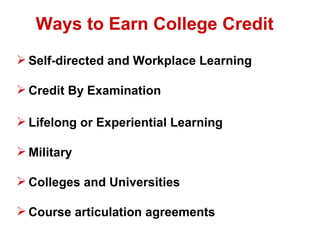
Ways to Earn College Credit
 Self-directed and Workplace Learning

 Credit By Examination

 Lifelong or Experiential Learning

 Military

 Colleges and Universities

 Course articulation agreements
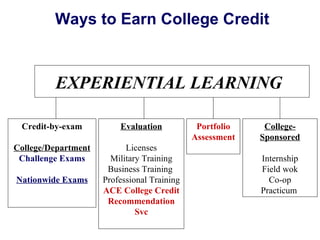
Ways to Earn College Credit


         EXPERIENTIAL LEARNING

 Credit-by-exam          Evaluation           Portfolio    College-
                                             Assessment   Sponsored
College/Department         Licenses
 Challenge Exams       Military Training                  Internship
                      Business Training                   Field wok
Nationwide Exams     Professional Training                  Co-op
                     ACE College Credit                   Practicum
                      Recommendation
                              Svc
American Council on Education

The American Council on Education's
College Credit Recommendation Service
(CREDIT) connects self-directed and
workplace learning with colleges and
universities by helping adults gain access to
academic credit for formal courses and
examinations taken outside the traditional
classroom.
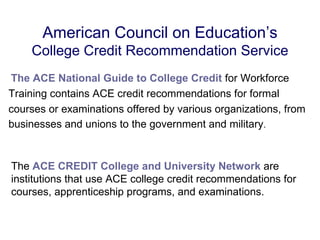
American Council on Education’s
    College Credit Recommendation Service
The ACE National Guide to College Credit for Workforce
Training contains ACE credit recommendations for formal
courses or examinations offered by various organizations, from
businesses and unions to the government and military.


The ACE CREDIT College and University Network are
institutions that use ACE college credit recommendations for
courses, apprenticeship programs, and examinations.
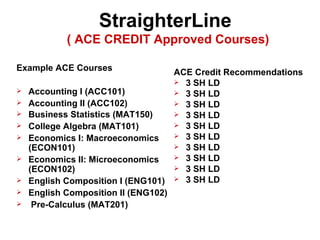
StraighterLine
            ( ACE CREDIT Approved Courses)

Example ACE Courses                   ACE Credit Recommendations
                                       3 SH LD
   Accounting I (ACC101)              3 SH LD
   Accounting II (ACC102)             3 SH LD
   Business Statistics (MAT150)       3 SH LD
   College Algebra (MAT101)           3 SH LD
   Economics I: Macroeconomics        3 SH LD
    (ECON101)                          3 SH LD
   Economics II: Microeconomics       3 SH LD
    (ECON102)                          3 SH LD
   English Composition I (ENG101)     3 SH LD
   English Composition II (ENG102)
    Pre-Calculus (MAT201)
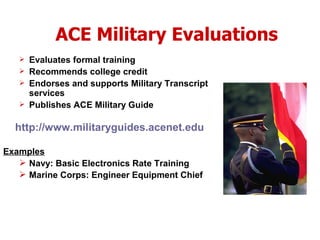
ACE Military Evaluations
      Evaluates formal training
      Recommends college credit
      Endorses and supports Military Transcript
       services
      Publishes ACE Military Guide

  http://www.militaryguides.acenet.edu

Examples
    Navy: Basic Electronics Rate Training
    Marine Corps: Engineer Equipment Chief
Types of Colleges and
Universities
             Two- and four-year
              accredited institutions
             Adult-centered institutions
               Distance learning
               External degrees
               Weekend colleges
Generally Accepted Accreditation Principles
               (GAAP) Criteria
ïź For schools based in the U.S.:
  accreditation by an accrediting agency
  recognized either by the U.S. Dept of
  Education (www.ed.gov) and/or by the
  Council on Higher Education
  Accreditation (www.CHEA.ORG)
ïź http://www.chea.org/heta
The agencies that recognize accrediting agencies.
Credit by Examination
   Nationally Standardized Examinations
       Offered for a variety of subjects
       Minimum scores can result in 3-6 credits
       Saves the adult learner time and money
       Saves the agency money

   Course or Department Challenge Exams
       Take the final examination in lieu of the course
       Saves the adult learner time and money
       Saves the agency money
Some Widely Recognized Exams
   College-Level Examination Program
    (CLEP) http://www.collegeboard.org

   Chauncey Group International - DSST
    http://www.getcollegecredit.com

   Excelsior College Examinations
    http://www.excelsior.edu
Questions? Advice? Contact 


  Jack M. Kenner, Senior Partner
         ACECAR Network
       4920 Water Grove Lane
       Ellicott City, MD 21043
  jackkenner@acecarnetwork.org
         1-443-364-9134

A College Degree Closer Than You Think

  • 1.
    A College Degree:Closer Than You Think How to Earn College Credit for Self-directed and Workplace Learning Jack M. Kenner Senior Partner Adult Continuing Education & Career Advancement Resource Network Phone: 443-364-9134 jackkenner@acecarnetwork.org
  • 2.
    You Will Learn:  Why A College Degree: What’s In It For Me?  About the many ways you can earn college credit  To use flexible credit recognition opportunities to help you more quickly complete a degree  How to use your earned credit to help you get a legitimate, accredited academic degree  What is Regional and National Accreditation?  About resources and tools that will help you take next steps to completing your degree in a cost-effective and efficient manner.    
  • 3.
    A College Degree:What’s In It For Me?  College graduates earn an average of 98% more income  Those with an advanced degree earn 177% more, and the gap is widening  Optimizes your employability value  Increases your career advancement opportunities  “Completes” YOU Education pays in higher earnings and lower unemployment rates http://www.bls.gov/emp/ep_chart_001.htm
  • 4.
    Ways to EarnCollege Credit  Self-directed and Workplace Learning  Credit By Examination  Lifelong or Experiential Learning  Military  Colleges and Universities  Course articulation agreements
  • 5.
    Ways to EarnCollege Credit EXPERIENTIAL LEARNING Credit-by-exam Evaluation Portfolio College- Assessment Sponsored College/Department Licenses Challenge Exams Military Training Internship Business Training Field wok Nationwide Exams Professional Training Co-op ACE College Credit Practicum Recommendation Svc
  • 6.
    American Council onEducation The American Council on Education's College Credit Recommendation Service (CREDIT) connects self-directed and workplace learning with colleges and universities by helping adults gain access to academic credit for formal courses and examinations taken outside the traditional classroom.
  • 7.
    American Council onEducation’s College Credit Recommendation Service The ACE National Guide to College Credit for Workforce Training contains ACE credit recommendations for formal courses or examinations offered by various organizations, from businesses and unions to the government and military. The ACE CREDIT College and University Network are institutions that use ACE college credit recommendations for courses, apprenticeship programs, and examinations.
  • 8.
    StraighterLine ( ACE CREDIT Approved Courses) Example ACE Courses ACE Credit Recommendations  3 SH LD  Accounting I (ACC101)  3 SH LD  Accounting II (ACC102)  3 SH LD  Business Statistics (MAT150)  3 SH LD  College Algebra (MAT101)  3 SH LD  Economics I: Macroeconomics  3 SH LD (ECON101)  3 SH LD  Economics II: Microeconomics  3 SH LD (ECON102)  3 SH LD  English Composition I (ENG101)  3 SH LD  English Composition II (ENG102)  Pre-Calculus (MAT201)
  • 9.
    ACE Military Evaluations  Evaluates formal training  Recommends college credit  Endorses and supports Military Transcript services  Publishes ACE Military Guide http://www.militaryguides.acenet.edu Examples  Navy: Basic Electronics Rate Training  Marine Corps: Engineer Equipment Chief
  • 10.
    Types of Collegesand Universities  Two- and four-year accredited institutions  Adult-centered institutions  Distance learning  External degrees  Weekend colleges
  • 11.
    Generally Accepted AccreditationPrinciples (GAAP) Criteria ïź For schools based in the U.S.: accreditation by an accrediting agency recognized either by the U.S. Dept of Education (www.ed.gov) and/or by the Council on Higher Education Accreditation (www.CHEA.ORG) ïź http://www.chea.org/heta The agencies that recognize accrediting agencies.
  • 12.
    Credit by Examination  Nationally Standardized Examinations  Offered for a variety of subjects  Minimum scores can result in 3-6 credits  Saves the adult learner time and money  Saves the agency money  Course or Department Challenge Exams  Take the final examination in lieu of the course  Saves the adult learner time and money  Saves the agency money
  • 13.
    Some Widely RecognizedExams  College-Level Examination Program (CLEP) http://www.collegeboard.org  Chauncey Group International - DSST http://www.getcollegecredit.com  Excelsior College Examinations http://www.excelsior.edu
  • 14.
    Questions? Advice? Contact
 Jack M. Kenner, Senior Partner ACECAR Network 4920 Water Grove Lane Ellicott City, MD 21043 jackkenner@acecarnetwork.org 1-443-364-9134