

Developing the Value Offeringchapter 09SEGMENTATION, TARGET MARKETING, AND POSITIONINGchapter 10THE PRODUCT EXPERIENCE: PRODUCT STRATEGYchapter 11THE PRODUCT EXPERIENCE: BUILDING THE BRANDchapter 12THE PRODUCT EXPERIENCE: NEW PRODUCT DEVELOPMENTchapter 13SERVICE AS THE CORE OFFERINGchapter 14MANAGING PRICING DECISIONSpart THREECopyright © 2010 by The McGraw-Hill Companies, Inc. All rights reservedMcGraw-Hill/Irwin
09Segmentation, Target Marketing, and Positioning9-2
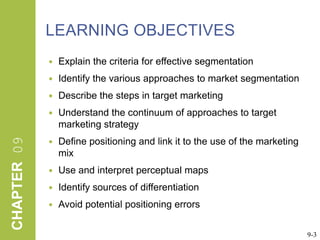
LEARNING OBJECTIVESExplain the criteria for effective segmentationIdentify the various approaches to market segmentationDescribe the steps in target marketingUnderstand the continuum of approaches to target marketing strategyDefine positioning and link it to the use of the marketing mixUse and interpret perceptual mapsIdentify sources of differentiationAvoid potential positioning errors9-3
FULFILLING CONSUMER NEEDS AND WANTSMarket SegmentationTarget MarketingPositioning9-4
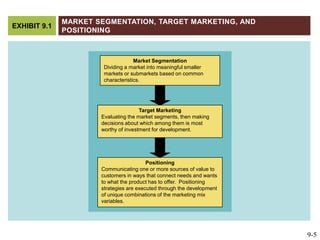
Market Segmentation, Target Marketing, and PositioningEXHIBIT 9.1Market SegmentationDividing a market into meaningful smaller markets or submarkets based on common characteristics.Target MarketingEvaluating the market segments, then making decisions about which among them is most worthy of investment for development.PositioningCommunicating one or more sources of value to customers in ways that connect needs and wants to what the product has to offer.  Positioning strategies are executed through the development of unique combinations of the marketing mix variables. 9-5
WHAT IS SEGMENTATION?Segmentation seeks to find one or more factors about members of a heterogeneous market that allow for dividing of the market into smaller, more homogeneous subgroups The purpose would be to develop different marketing strategies to best meet the segments’ distinct needs and wants.9-6
Criteria for Effective SegmentationIs the segment of sufficient size?  Is the segment readily identifiable and can it be measured? Is the segment clearly differentiated on one or more important dimensions? Can the segment be reached in order to deliver the value of the product?9-7
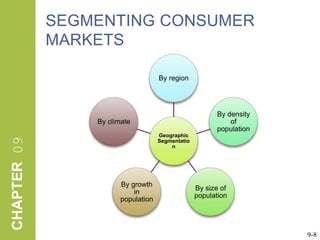
SEGMENTING CONSUMER MARKETS9-8
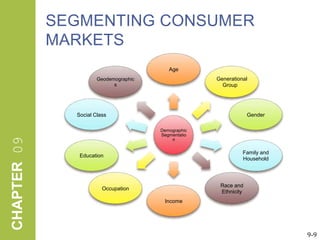
SEGMENTING CONSUMER MARKETS9-9
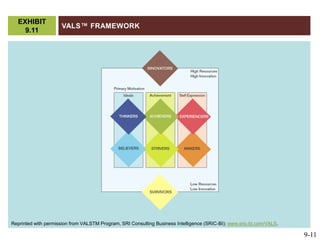
SEGMENTING CONSUMER MARKETSPsychographic SegmentationVALS™ (Values and Lifestyles)9-10
VALS™ FrameworkEXHIBIT 9.11Reprinted with permission from VALSTM Program, SRI Consulting Business Intelligence (SRIC-BI); www.sric-bi.com/VALS.9-11
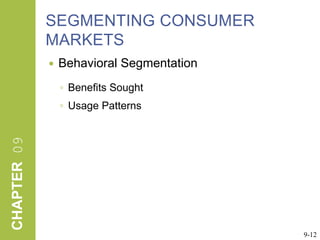
SEGMENTING CONSUMER MARKETSBehavioral SegmentationBenefits SoughtUsage Patterns9-12
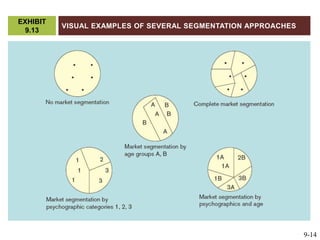
SEGMENTING CONSUMER MARKETSFirms use Multiple Segmentation Approaches SimultaneouslyFirms develop a profile of a segment that might include aspects of any or all of the segmentation approaches we have learned. 9-13
Visual Examples of Several Segmentation ApproachesEXHIBIT 9.139-14
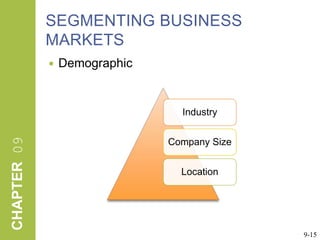
SEGMENTING BUSINESS MARKETSDemographic9-15
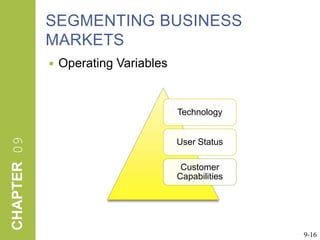
SEGMENTING BUSINESS MARKETSOperating Variables9-16
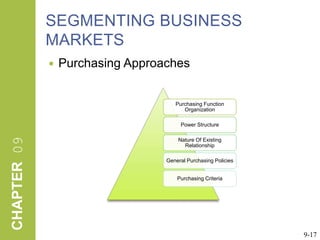
SEGMENTING BUSINESS MARKETSPurchasing Approaches9-17
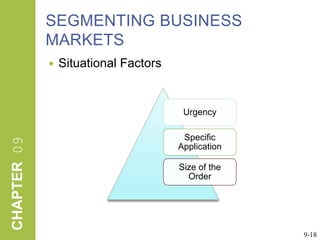
SEGMENTING BUSINESS MARKETSSituational Factors9-18
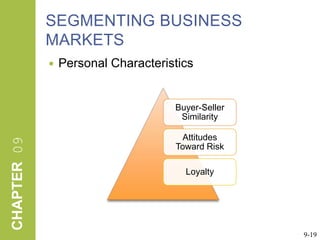
SEGMENTING BUSINESS MARKETSPersonal Characteristics9-19
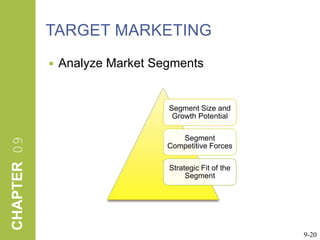
TARGET MARKETINGAnalyze Market Segments9-20
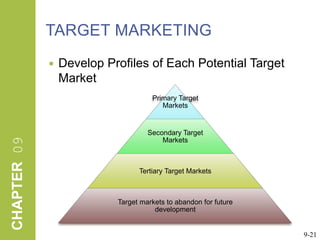
TARGET MARKETINGDevelop Profiles of Each Potential Target Market9-21
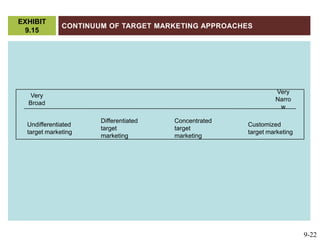
Continuum of Target Marketing ApproachesEXHIBIT 9.15VeryBroadVeryNarrowUndifferentiatedtarget marketingDifferentiatedtarget marketingConcentratedtarget marketingCustomizedtarget marketing9-22
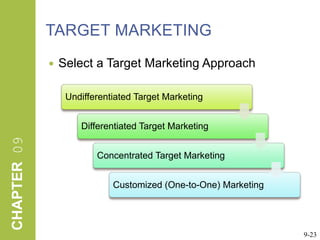
TARGET MARKETINGSelect a Target Marketing Approach9-23
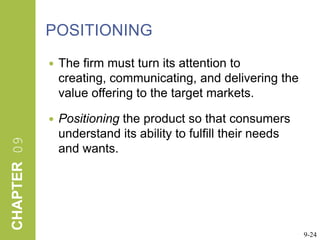
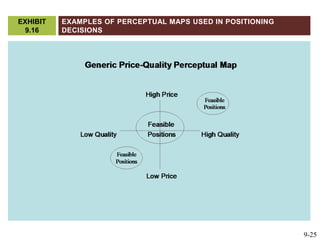
POSITIONINGThe firm must turn its attention to creating, communicating, and delivering the value offering to the target markets.  Positioning the product so that consumers understand its ability to fulfill their needs and wants. 9-24
Examples of Perceptual Maps Used in Positioning DecisionsEXHIBIT 9.169-25
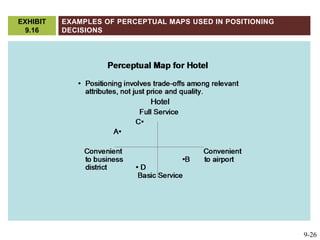
Examples of Perceptual Maps Used in Positioning DecisionsEXHIBIT 9.169-26
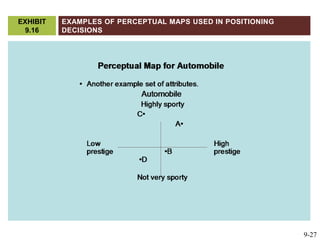
Examples of Perceptual Maps Used in Positioning DecisionsEXHIBIT 9.169-27
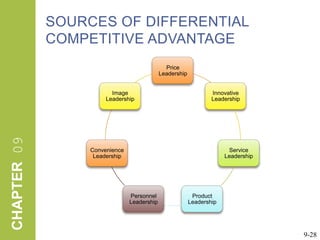
Sources of Differential Competitive Advantage9-28
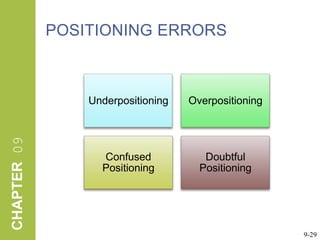
Positioning Errors9-29
30Thank You, Please Visit Us At :http://wanbk.page.tl

Chap009