CHAPTER THREE
DESIGN OF THE
OPERATION SYSTEM
9/6/2022
9/6/2022 2
Chapter objectives
 Product and service Design
 Process Selection
 Strategic Capacity planning
 Facility Location and Layout
 Job Design and Work Measurement
© 2007 Wiley
Product Design
• Product design – the process of defining all of the
companies product characteristics
– Product design must support product manufacturability (the ease
with which a product can be made)
– Product design defines a product’s characteristics of;
• appearance,
• materials,
• dimensions,
• tolerances, and
• performance standards
Service Design
 Specifies what the customer is to
experience
 Benefits to the human senses
 Psychological
benefits
An Effective Design Process
 Matches product/service characteristics
with customer needs
 Meets customer requirements in simplest,
most cost-effective manner
 Reduces time to market
 Minimizes revisions
Degree of Design Newness
1.Modification of an existing
product/service
2.Expansion of an existing product/service
3.Clone of a competitor’s product/service
4.New product/service
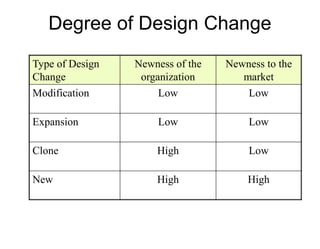
Degree of Design Change
Type of Design
Change
Newness of the
organization
Newness to the
market
Modification Low Low
Expansion Low Low
Clone High Low
New High High
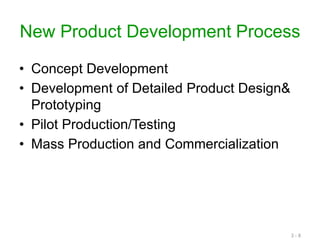
New Product Development Process
• Concept Development
• Development of Detailed Product Design&
Prototyping
• Pilot Production/Testing
• Mass Production and Commercialization
3 - 8
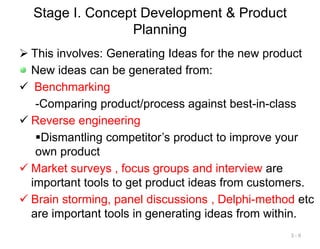
Stage I. Concept Development & Product
Planning
 This involves: Generating Ideas for the new product
New ideas can be generated from:
 Benchmarking
-Comparing product/process against best-in-class
 Reverse engineering
Dismantling competitor’s product to improve your
own product
 Market surveys , focus groups and interview are
important tools to get product ideas from customers.
 Brain storming, panel discussions , Delphi-method etc
are important tools in generating ideas from within.
3 - 9
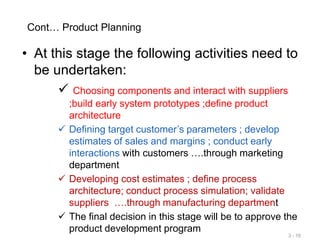
Cont… Product Planning
• At this stage the following activities need to
be undertaken:
 Choosing components and interact with suppliers
;build early system prototypes ;define product
architecture
 Defining target customer’s parameters ; develop
estimates of sales and margins ; conduct early
interactions with customers ….through marketing
department
 Developing cost estimates ; define process
architecture; conduct process simulation; validate
suppliers ….through manufacturing department
 The final decision in this stage will be to approve the
product development program
3 - 10
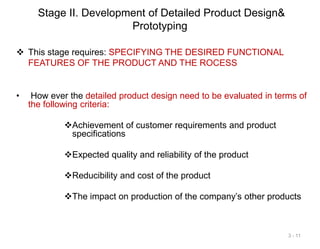
Stage II. Development of Detailed Product Design&
Prototyping
 This stage requires: SPECIFYING THE DESIRED FUNCTIONAL
FEATURES OF THE PRODUCT AND THE ROCESS
• How ever the detailed product design need to be evaluated in terms of
the following criteria:
Achievement of customer requirements and product
specifications
Expected quality and reliability of the product
Reducibility and cost of the product
The impact on production of the company’s other products
3 - 11
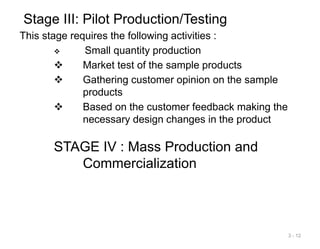
Stage III: Pilot Production/Testing
This stage requires the following activities :
 Small quantity production
 Market test of the sample products
 Gathering customer opinion on the sample
products
 Based on the customer feedback making the
necessary design changes in the product
STAGE IV : Mass Production and
Commercialization
3 - 12
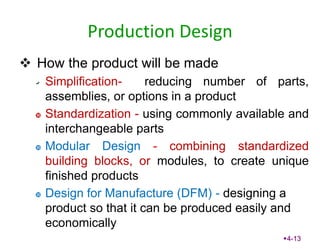
Production Design
 How the product will be made
Simplification- reducing number of parts,
assemblies, or options in a product
 Standardization - using commonly available and
interchangeable parts
 Modular Design - combining standardized
building blocks, or modules, to create unique
finished products
 Design for Manufacture (DFM) - designing a
product so that it can be produced easily and
economically
4-13
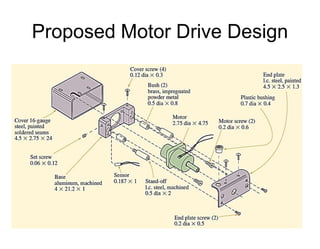
Proposed Motor Drive Design
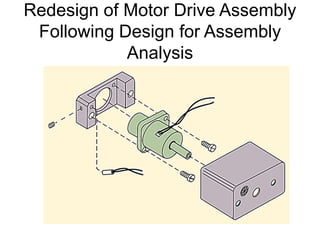
Redesign of Motor Drive Assembly
Following Design for Assembly
Analysis
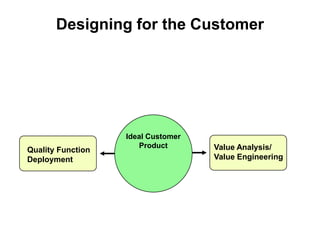
Designing for the Customer
Quality Function
Deployment
Value Analysis/
Value Engineering
Ideal Customer
Product
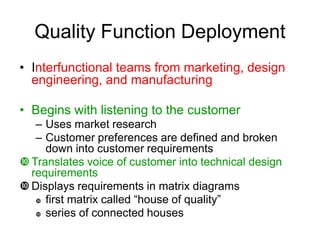
Quality Function Deployment
• Interfunctional teams from marketing, design
engineering, and manufacturing
• Begins with listening to the customer
– Uses market research
– Customer preferences are defined and broken
down into customer requirements
 Translates voice of customer into technical design
requirements
 Displays requirements in matrix diagrams
 first matrix called “house of quality”
 series of connected houses
3 - 18
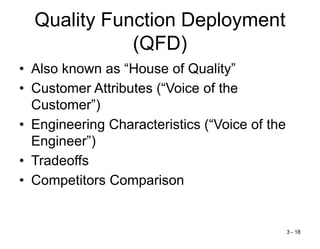
Quality Function Deployment
(QFD)
• Also known as “House of Quality”
• Customer Attributes (“Voice of the
Customer”)
• Engineering Characteristics (“Voice of the
Engineer”)
• Tradeoffs
• Competitors Comparison
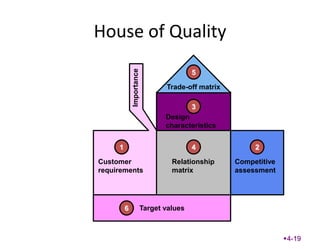
House of Quality
4-19
Trade-off matrix
Design
characteristics
Customer
requirements
Target values
Relationship
matrix
Competitive
assessment
Importance
1 2
3
4
5
6
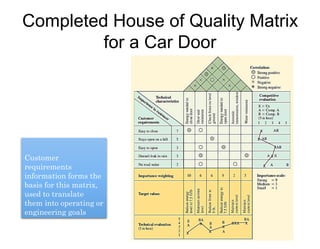
Completed House of Quality Matrix
for a Car Door
Customer
requirements
information forms the
basis for this matrix,
used to translate
them into operating or
engineering goals
Benefits of QFD
Promotes better understanding of customer
demands
Promotes better understanding of design
interactions
Involves manufacturing in design process
Provides documentation of design process
4-21
9/6/2022 22
Value Analysis/Value Engineering
 Achieve equivalent or better performance at a lower
cost while maintaining all functional requirements
defined by the customer
 Does the item have any design features that are
not necessary?
 Can two or more parts be combined into one?
 How can we cut down the weight?
 Are there nonstandard parts that can be
eliminated?
Value Analysis/Value Engineering
(VA/VE)
• Purpose is to simplify products and processes
• Objective is to achieve better performance at a
lower cost while maintaining all functional
requirements defined by the customer
Design Team
• Traditional approach
– “We design it, you build it” or “over the
wall”
• Concurrent engineering
– “Let’s work together simultaneously”
– A new approach to design that involves
simultaneous design of products and
processes by design teams
•© 2007 Wiley
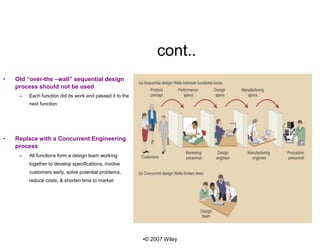
cont..
• Old “over-the –wall” sequential design
process should not be used
– Each function did its work and passed it to the
next function
• Replace with a Concurrent Engineering
process
– All functions form a design team working
together to develop specifications, involve
customers early, solve potential problems,
reduce costs, & shorten time to market
© 2007 Wiley
Design of Services
• Service design is unique in that the service and
entire service concept are being designed
– must define both the service and concept
- Physical elements, aesthetic & psychological
benefits
e.g. promptness, friendliness, ambiance
– Product and service design must match the needs and
preferences of the targeted customer group
Characteristics of a Well-Designed
Service System
1. Each element of the service system is consistent with
the operating focus of the firm.
2. It is user-friendly.
3. It is robust.
4. It is structured so that consistent performance by its people and
systems is easily maintained.
3 - 27
Characteristics of a Well-Designed
Service System (Continued)
5. It provides effective links between the
back office and the front office so that
nothing falls between the cracks.
6. It manages the evidence of service quality
in such a way that customers see the
value of the service provided.
7. It is cost-effective.
3 - 28
Major Elements in Designing a Service
Organization
1.Identification of the target market-Who is the customer?
2.Defining the service concept –How do we differentiate our
service in the market?
3.Defining the service strategy-What is our service package
and the operating focus of our service?
4.Defining the service delivery system-What are the actual
processes , staff and facilities by which the service is
created?

chap 3-1.PPT

  • 1.
    CHAPTER THREE DESIGN OFTHE OPERATION SYSTEM 9/6/2022
  • 2.
    9/6/2022 2 Chapter objectives Product and service Design  Process Selection  Strategic Capacity planning  Facility Location and Layout  Job Design and Work Measurement
  • 3.
    © 2007 Wiley ProductDesign • Product design – the process of defining all of the companies product characteristics – Product design must support product manufacturability (the ease with which a product can be made) – Product design defines a product’s characteristics of; • appearance, • materials, • dimensions, • tolerances, and • performance standards
  • 4.
    Service Design  Specifieswhat the customer is to experience  Benefits to the human senses  Psychological benefits
  • 5.
    An Effective DesignProcess  Matches product/service characteristics with customer needs  Meets customer requirements in simplest, most cost-effective manner  Reduces time to market  Minimizes revisions
  • 6.
    Degree of DesignNewness 1.Modification of an existing product/service 2.Expansion of an existing product/service 3.Clone of a competitor’s product/service 4.New product/service
  • 7.
    Degree of DesignChange Type of Design Change Newness of the organization Newness to the market Modification Low Low Expansion Low Low Clone High Low New High High
  • 8.
    New Product DevelopmentProcess • Concept Development • Development of Detailed Product Design& Prototyping • Pilot Production/Testing • Mass Production and Commercialization 3 - 8
  • 9.
    Stage I. ConceptDevelopment & Product Planning  This involves: Generating Ideas for the new product New ideas can be generated from:  Benchmarking -Comparing product/process against best-in-class  Reverse engineering Dismantling competitor’s product to improve your own product  Market surveys , focus groups and interview are important tools to get product ideas from customers.  Brain storming, panel discussions , Delphi-method etc are important tools in generating ideas from within. 3 - 9
  • 10.
    Cont… Product Planning •At this stage the following activities need to be undertaken:  Choosing components and interact with suppliers ;build early system prototypes ;define product architecture  Defining target customer’s parameters ; develop estimates of sales and margins ; conduct early interactions with customers ….through marketing department  Developing cost estimates ; define process architecture; conduct process simulation; validate suppliers ….through manufacturing department  The final decision in this stage will be to approve the product development program 3 - 10
  • 11.
    Stage II. Developmentof Detailed Product Design& Prototyping  This stage requires: SPECIFYING THE DESIRED FUNCTIONAL FEATURES OF THE PRODUCT AND THE ROCESS • How ever the detailed product design need to be evaluated in terms of the following criteria: Achievement of customer requirements and product specifications Expected quality and reliability of the product Reducibility and cost of the product The impact on production of the company’s other products 3 - 11
  • 12.
    Stage III: PilotProduction/Testing This stage requires the following activities :  Small quantity production  Market test of the sample products  Gathering customer opinion on the sample products  Based on the customer feedback making the necessary design changes in the product STAGE IV : Mass Production and Commercialization 3 - 12
  • 13.
    Production Design  Howthe product will be made Simplification- reducing number of parts, assemblies, or options in a product  Standardization - using commonly available and interchangeable parts  Modular Design - combining standardized building blocks, or modules, to create unique finished products  Design for Manufacture (DFM) - designing a product so that it can be produced easily and economically 4-13
  • 14.
  • 15.
    Redesign of MotorDrive Assembly Following Design for Assembly Analysis
  • 16.
    Designing for theCustomer Quality Function Deployment Value Analysis/ Value Engineering Ideal Customer Product
  • 17.
    Quality Function Deployment •Interfunctional teams from marketing, design engineering, and manufacturing • Begins with listening to the customer – Uses market research – Customer preferences are defined and broken down into customer requirements  Translates voice of customer into technical design requirements  Displays requirements in matrix diagrams  first matrix called “house of quality”  series of connected houses
  • 18.
    3 - 18 QualityFunction Deployment (QFD) • Also known as “House of Quality” • Customer Attributes (“Voice of the Customer”) • Engineering Characteristics (“Voice of the Engineer”) • Tradeoffs • Competitors Comparison
  • 19.
    House of Quality 4-19 Trade-offmatrix Design characteristics Customer requirements Target values Relationship matrix Competitive assessment Importance 1 2 3 4 5 6
  • 20.
    Completed House ofQuality Matrix for a Car Door Customer requirements information forms the basis for this matrix, used to translate them into operating or engineering goals
  • 21.
    Benefits of QFD Promotesbetter understanding of customer demands Promotes better understanding of design interactions Involves manufacturing in design process Provides documentation of design process 4-21
  • 22.
    9/6/2022 22 Value Analysis/ValueEngineering  Achieve equivalent or better performance at a lower cost while maintaining all functional requirements defined by the customer  Does the item have any design features that are not necessary?  Can two or more parts be combined into one?  How can we cut down the weight?  Are there nonstandard parts that can be eliminated?
  • 23.
    Value Analysis/Value Engineering (VA/VE) •Purpose is to simplify products and processes • Objective is to achieve better performance at a lower cost while maintaining all functional requirements defined by the customer
  • 24.
    Design Team • Traditionalapproach – “We design it, you build it” or “over the wall” • Concurrent engineering – “Let’s work together simultaneously” – A new approach to design that involves simultaneous design of products and processes by design teams
  • 25.
    •© 2007 Wiley cont.. •Old “over-the –wall” sequential design process should not be used – Each function did its work and passed it to the next function • Replace with a Concurrent Engineering process – All functions form a design team working together to develop specifications, involve customers early, solve potential problems, reduce costs, & shorten time to market
  • 26.
    © 2007 Wiley Designof Services • Service design is unique in that the service and entire service concept are being designed – must define both the service and concept - Physical elements, aesthetic & psychological benefits e.g. promptness, friendliness, ambiance – Product and service design must match the needs and preferences of the targeted customer group
  • 27.
    Characteristics of aWell-Designed Service System 1. Each element of the service system is consistent with the operating focus of the firm. 2. It is user-friendly. 3. It is robust. 4. It is structured so that consistent performance by its people and systems is easily maintained. 3 - 27
  • 28.
    Characteristics of aWell-Designed Service System (Continued) 5. It provides effective links between the back office and the front office so that nothing falls between the cracks. 6. It manages the evidence of service quality in such a way that customers see the value of the service provided. 7. It is cost-effective. 3 - 28
  • 29.
    Major Elements inDesigning a Service Organization 1.Identification of the target market-Who is the customer? 2.Defining the service concept –How do we differentiate our service in the market? 3.Defining the service strategy-What is our service package and the operating focus of our service? 4.Defining the service delivery system-What are the actual processes , staff and facilities by which the service is created?

Editor's Notes