Company, Division & Product Naming Plus… Logo (Identity) Guidelines
Process Review Naming Guidelines - options Concur on our approach Product positioning – brand promise Compare current product name to guidelines Existing equity, brand transition strategy, constraints (code name change, collateral) Review competition Create or brainstorm for candidates – no critique Evaluate candidates against guidelines, brand promise, marketability Create short list Positioning statements (positions, clarifies) Research US & Foreign trademark, product, business, URL, user group (consumer) Finalize name based on availability or recycle through approach Register name, URL Logo & Identity (Review Logo Guidelines)
Naming Guidelines Review guidelines first Level sets the entire team Creates baseline rules that we agree on Reduces personal opinion and setting up camps--unless based on accepted rules Opinions are good, but if they don’t follow agreed upon rules, then they are subjective, not empirical and may not represent what market prefers. Likewise, my opinion, outside of the rules, counts for “1” (although interesting, not statistically significant) Should not discredit examples since they are not always market relevant, since they are concept relevant
Group Concurrence We should agree to go through  process  – before solidifying opinions Examples: HRW 100 years of tradition Strong camps Empirical evidence - 3% recognition in their logo Result – 100% concurrence we needed to change it Everything not finalized –  discussion  PowerPoint
Branding Considerations Institutional brand identity Acid test – Microsoft “Where do you want to go today?” Actual: “A Safe Bet” Positive and negative experience/baggage Metrowerks – Codewarrior Motorola – kept company name, transition Now Freescale – across the board (building new) Product brand identity P&G approach – product branding Attachmate / DCA – institutional branding vs product Microsoft approach - combined Recommendations – depends on association Don’t eat our own dog food. External perceptions critical.
Company/Division Naming Two conventions Call after primary product Goldmine, WordPerfect, Coca-Cola Metrowerks discussion Standalone Founder. Dell, Ford, Mercedes (after person), Covey Suggestive. Firestone, Thrifty, Dollar Combination. Micro/Soft Acronyms. IBM. Initials – engineering loves them, hard (expensive) to brand Tangible objects. Apple, Red Hat (easier to remember)
Corporate Tag Lines Identity (what they make) known Microsoft – tag line Sun – tag line Descriptive (answers, “who are you”) Positioning (#1, most, leader) Rules of thumb – 7-9 words (billboard) Association Tied to corporation Tivoli – An IBM Company Metrowerks – A Motorola Company Acid test… worth more with, or without associate w/holding co. Acquisition – watch out, don’t loose existing brand equity in the transition
Product Positioning The  apex  of all strategy How it is positioned within the field of competitors? What is the unique differentor? Examples: Crossfax – a hook was built in Codewarrior for Windows – no hook, made one Name reflects positioning – if possible. If not, tagline reflects it.
Branding Purpose: Prevent price erosion (better brands can demand higher prices, more credibility) What do prospects expect from a company like yours? What promises can you deliver? Brand promise (implied, expressed). Examples? Forget about what you are known for, capture and become what the market wants (not a person, a company/product) Overarching positioning 3-4 positioning statements that validate the positioning
Product Naming #1 preference: Call it what it is or what it does. Microsoft Mouse, Microsoft Project, Microsoft Word, WinFax, PhotoShop, Corel Draw Not sexy, but immediate, inexpensive to brand, owns category Acid test Call prospect (or buyer if a reseller). Give name of the product. Ask, “What is it?” If they can’t identify the product, or at least the category – start over (too hard to brand)
Tag Lines If your name needs “clarification” then describe it with a tag line 3D Website Builder (category) Everything you need to create 3D VRML Worlds On The Internet Describes, positions, (11 words) beyond 7-9 word rule Difficult names Ascend, HP Newwave, Eudora Ami Pro 7-9 word rule
Bad   Examples Nike (fine, if you have millions to create equity) IBM (initial – fine, after billions in equity) International Business Machines You can brand anything…  with enough money . Unless you have hundreds of millions to spend, then choose a “cheaper” brand name No subliminal – initials, codes (AmiPro)
Approaches (good or bad) Suggestive - Klenex Acronym - IBM Obvious – Microsoft Mouse Clipping – FedEx Product – Coca Cola Resource – Toys R Us Abstract – Samna Benefit – Trusted Data
Compare Current Name Name: Positioning: Tag Line: Classification Existing equity Brand transition strategy Constraints (cost (code name, collateral))
Example Product Name Positioning #1 best-selling Highest ranked Description (what does it do) Benefit (How does it help) #1 Best-selling Software To Do What?
Competition Competitors May want to consider their naming conventions May or may not be critical Home spun alternatives
Brainstorming All is fair – no critique Software to help ($110 NameExpress.com) Nameboy.com (free engine to come up with a site name, but works for all names)
Evaluate Candidates Cross off obvious Review remaining against guidelines, promise, marketability Consider Easy to remember 3 syllables Balanced Power Consonants Marketability (CodeWarrior, Facility Commander) Determine short list
Research US Trademark Foreign Trademark Products and Business Names Field of use – watch out URL availability
Finalize Finalize or re-cycle through process Register name, URL Logo Creation
Logo Guidelines Priority for effective, less expensive, quick recognition You can brand anything with enough money – key is  immediate recognition ,  minimal cost How will it look in black and white? Vertical or horizontal Horizontal is easier to work with for most treatments
Logo Guidelines Priority for best logos Make the company logo the name Name integrated with unique graphic A “mark” that can stand on its own A mark that cannot stand on its own
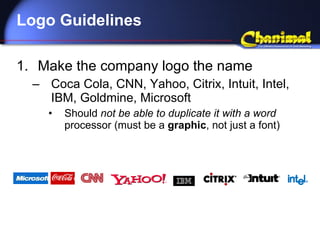
Logo Guidelines Make the company logo the name Coca Cola, CNN, Yahoo, Citrix, Intuit, Intel, IBM, Goldmine, Microsoft Should  not be able to duplicate it with a word  processor (must be a  graphic , not just a font)
Logo Guidelines 2. Name integrated with unique graphic K-mart (mart inside the K) GoodYear (winged foot between Good and Year) McDonalds (text intersecting arches) AOL
Logo Guidelines 3. A “mark” that can stand on its own Tangible object you can visualize Unique Large enough to differentiate at distance Fewest impressions to make connection Apple (bite out of apple) Red Hat (physical felt red hat)
Logo Guidelines 4. Worst: A mark that cannot stand on its own Must have a text name next to it to equate it to anything Nike swoosh (swoosh did not mean anything. Fine if you have hundreds of millions (brand anything)) Goldmine newer logo (means absolutely nothing on its own) HRW (Owl hidden in bushes, same size line points, invisible at a distance of 2 feet) Also, the text next to it was not unique, it was inconsistent (sometimes sans, or serif, initials or spelled out) Only 3% of respondents could identify the standalone logo as ours (after 100 years of use (or misuse)). A travesty. Acid test. Take away the name and ask, “Who is this?” You’ll recognize those that have spent a fortune branding, but not those that have not.
Logo Selection Select from the first option whenever possible Use the name as the logo Easier to establish equity Cheaper Not the same rules for a mass consumer product (but doesn’t apply to us)
 

Chanimal Naming Logo Guidelines

  • 1.
    Company, Division &Product Naming Plus… Logo (Identity) Guidelines
  • 2.
    Process Review NamingGuidelines - options Concur on our approach Product positioning – brand promise Compare current product name to guidelines Existing equity, brand transition strategy, constraints (code name change, collateral) Review competition Create or brainstorm for candidates – no critique Evaluate candidates against guidelines, brand promise, marketability Create short list Positioning statements (positions, clarifies) Research US & Foreign trademark, product, business, URL, user group (consumer) Finalize name based on availability or recycle through approach Register name, URL Logo & Identity (Review Logo Guidelines)
  • 3.
    Naming Guidelines Reviewguidelines first Level sets the entire team Creates baseline rules that we agree on Reduces personal opinion and setting up camps--unless based on accepted rules Opinions are good, but if they don’t follow agreed upon rules, then they are subjective, not empirical and may not represent what market prefers. Likewise, my opinion, outside of the rules, counts for “1” (although interesting, not statistically significant) Should not discredit examples since they are not always market relevant, since they are concept relevant
  • 4.
    Group Concurrence Weshould agree to go through process – before solidifying opinions Examples: HRW 100 years of tradition Strong camps Empirical evidence - 3% recognition in their logo Result – 100% concurrence we needed to change it Everything not finalized – discussion PowerPoint
  • 5.
    Branding Considerations Institutionalbrand identity Acid test – Microsoft “Where do you want to go today?” Actual: “A Safe Bet” Positive and negative experience/baggage Metrowerks – Codewarrior Motorola – kept company name, transition Now Freescale – across the board (building new) Product brand identity P&G approach – product branding Attachmate / DCA – institutional branding vs product Microsoft approach - combined Recommendations – depends on association Don’t eat our own dog food. External perceptions critical.
  • 6.
    Company/Division Naming Twoconventions Call after primary product Goldmine, WordPerfect, Coca-Cola Metrowerks discussion Standalone Founder. Dell, Ford, Mercedes (after person), Covey Suggestive. Firestone, Thrifty, Dollar Combination. Micro/Soft Acronyms. IBM. Initials – engineering loves them, hard (expensive) to brand Tangible objects. Apple, Red Hat (easier to remember)
  • 7.
    Corporate Tag LinesIdentity (what they make) known Microsoft – tag line Sun – tag line Descriptive (answers, “who are you”) Positioning (#1, most, leader) Rules of thumb – 7-9 words (billboard) Association Tied to corporation Tivoli – An IBM Company Metrowerks – A Motorola Company Acid test… worth more with, or without associate w/holding co. Acquisition – watch out, don’t loose existing brand equity in the transition
  • 8.
    Product Positioning The apex of all strategy How it is positioned within the field of competitors? What is the unique differentor? Examples: Crossfax – a hook was built in Codewarrior for Windows – no hook, made one Name reflects positioning – if possible. If not, tagline reflects it.
  • 9.
    Branding Purpose: Preventprice erosion (better brands can demand higher prices, more credibility) What do prospects expect from a company like yours? What promises can you deliver? Brand promise (implied, expressed). Examples? Forget about what you are known for, capture and become what the market wants (not a person, a company/product) Overarching positioning 3-4 positioning statements that validate the positioning
  • 10.
    Product Naming #1preference: Call it what it is or what it does. Microsoft Mouse, Microsoft Project, Microsoft Word, WinFax, PhotoShop, Corel Draw Not sexy, but immediate, inexpensive to brand, owns category Acid test Call prospect (or buyer if a reseller). Give name of the product. Ask, “What is it?” If they can’t identify the product, or at least the category – start over (too hard to brand)
  • 11.
    Tag Lines Ifyour name needs “clarification” then describe it with a tag line 3D Website Builder (category) Everything you need to create 3D VRML Worlds On The Internet Describes, positions, (11 words) beyond 7-9 word rule Difficult names Ascend, HP Newwave, Eudora Ami Pro 7-9 word rule
  • 12.
    Bad Examples Nike (fine, if you have millions to create equity) IBM (initial – fine, after billions in equity) International Business Machines You can brand anything… with enough money . Unless you have hundreds of millions to spend, then choose a “cheaper” brand name No subliminal – initials, codes (AmiPro)
  • 13.
    Approaches (good orbad) Suggestive - Klenex Acronym - IBM Obvious – Microsoft Mouse Clipping – FedEx Product – Coca Cola Resource – Toys R Us Abstract – Samna Benefit – Trusted Data
  • 14.
    Compare Current NameName: Positioning: Tag Line: Classification Existing equity Brand transition strategy Constraints (cost (code name, collateral))
  • 15.
    Example Product NamePositioning #1 best-selling Highest ranked Description (what does it do) Benefit (How does it help) #1 Best-selling Software To Do What?
  • 16.
    Competition Competitors Maywant to consider their naming conventions May or may not be critical Home spun alternatives
  • 17.
    Brainstorming All isfair – no critique Software to help ($110 NameExpress.com) Nameboy.com (free engine to come up with a site name, but works for all names)
  • 18.
    Evaluate Candidates Crossoff obvious Review remaining against guidelines, promise, marketability Consider Easy to remember 3 syllables Balanced Power Consonants Marketability (CodeWarrior, Facility Commander) Determine short list
  • 19.
    Research US TrademarkForeign Trademark Products and Business Names Field of use – watch out URL availability
  • 20.
    Finalize Finalize orre-cycle through process Register name, URL Logo Creation
  • 21.
    Logo Guidelines Priorityfor effective, less expensive, quick recognition You can brand anything with enough money – key is immediate recognition , minimal cost How will it look in black and white? Vertical or horizontal Horizontal is easier to work with for most treatments
  • 22.
    Logo Guidelines Priorityfor best logos Make the company logo the name Name integrated with unique graphic A “mark” that can stand on its own A mark that cannot stand on its own
  • 23.
    Logo Guidelines Makethe company logo the name Coca Cola, CNN, Yahoo, Citrix, Intuit, Intel, IBM, Goldmine, Microsoft Should not be able to duplicate it with a word processor (must be a graphic , not just a font)
  • 24.
    Logo Guidelines 2.Name integrated with unique graphic K-mart (mart inside the K) GoodYear (winged foot between Good and Year) McDonalds (text intersecting arches) AOL
  • 25.
    Logo Guidelines 3.A “mark” that can stand on its own Tangible object you can visualize Unique Large enough to differentiate at distance Fewest impressions to make connection Apple (bite out of apple) Red Hat (physical felt red hat)
  • 26.
    Logo Guidelines 4.Worst: A mark that cannot stand on its own Must have a text name next to it to equate it to anything Nike swoosh (swoosh did not mean anything. Fine if you have hundreds of millions (brand anything)) Goldmine newer logo (means absolutely nothing on its own) HRW (Owl hidden in bushes, same size line points, invisible at a distance of 2 feet) Also, the text next to it was not unique, it was inconsistent (sometimes sans, or serif, initials or spelled out) Only 3% of respondents could identify the standalone logo as ours (after 100 years of use (or misuse)). A travesty. Acid test. Take away the name and ask, “Who is this?” You’ll recognize those that have spent a fortune branding, but not those that have not.
  • 27.
    Logo Selection Selectfrom the first option whenever possible Use the name as the logo Easier to establish equity Cheaper Not the same rules for a mass consumer product (but doesn’t apply to us)
  • 28.