Lesson 1:
Learning Objectives:
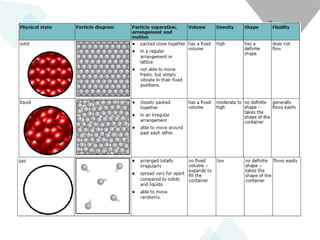
•State the distinguishing properties of solids,liquids and gases.
•Describe the structure of solids, liquids and gases in terms of
particle separation, arrangement and motion.
•Describe changes of state in terms of melting, boiling,
evaporating, freezing and condensing
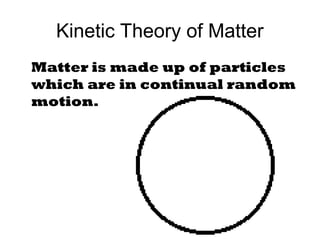
Kinetic Theory of Matter
Matter is made up of particles
which are in continual random
motion.
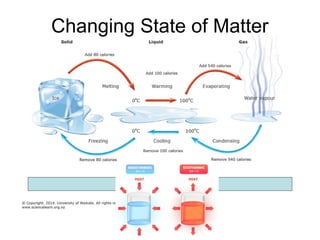
Changing State of Matter
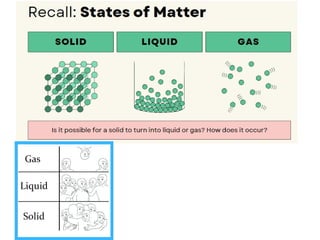
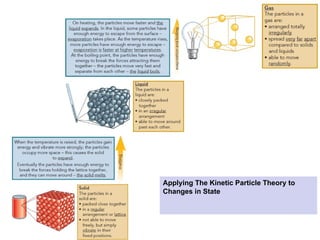
Applying The Kinetic Particle Theory to
Changes in State
Changing State of Matter
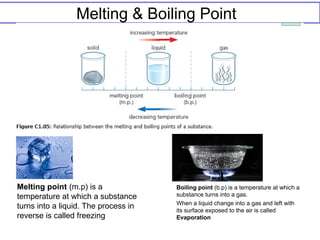
Melting & Boiling Point
Boiling point (b.p) is a temperature at which a
substance turns into a gas.
When a liquid change into a gas and left with
its surface exposed to the air is called
Evaporation
Melting point (m.p) is a
temperature at which a substance
turns into a liquid. The process in
reverse is called freezing
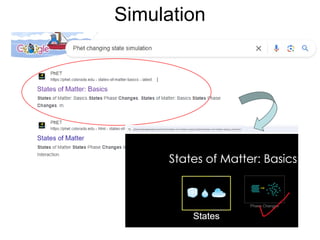
Simulation
Lesson 2:
Learning Objectives:
•Describe the effects of temperature and pressure on the volume of a gas.
•Explain, in terms of kinetic particle theory, the effects of temperature and
pressure on the volume of a gas.
•Explain changes of state in terms of kinetic particle theory, including the
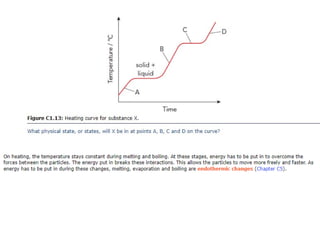
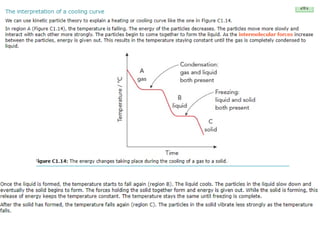
interpretation ofheating and cooling curves
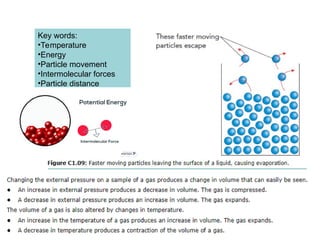
Key words:
•Temperature
•Energy
•Particle movement
•Intermolecular forces
•Particle distance
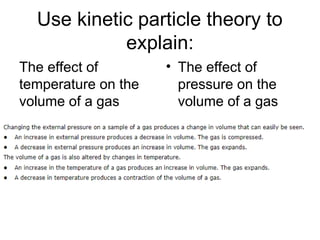
Use kinetic particle theory to
explain:
The effect of
temperature on the
volume of a gas
• The effect of
pressure on the
volume of a gas
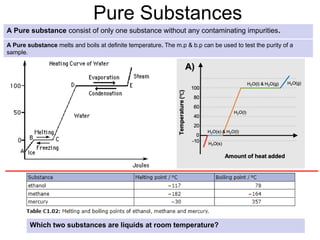
Pure Substances
A Pure substance consist of only one substance without any contaminating impurities.
A Pure substance melts and boils at definite temperature. The m.p & b.p can be used to test the purity of a
sample.
Which two substances are liquids at room temperature?
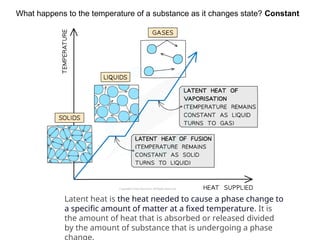
Latent heat is the heat needed to cause a phase change to
a specific amount of matter at a fixed temperature. It is
the amount of heat that is absorbed or released divided
by the amount of substance that is undergoing a phase
What happens to the temperature of a substance as it changes state? Constant
Lesson 3:
Learning Objectives:
•Describe and explain diffusion in terms of kinetic particle theory.
•Describe and explain the effect of relative molecular mass on the rate of
diffusion of gases
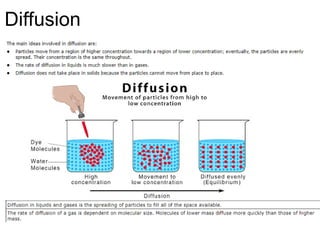
Diffusion
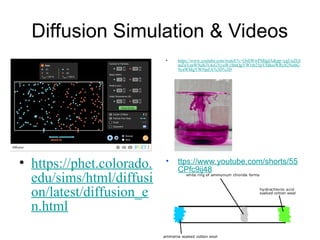
Diffusion Simulation & Videos
• https://phet.colorado.
edu/sims/html/diffusi
on/latest/diffusion_e
n.html
• https://www.youtube.com/watch?v=OxhWwPMlgdA&pp=ygUuZGl
mZnVzaW9uIGV4cGVyaW1lbnQgYW1tb25pYSBoeWRyb2NobG
9yaWMgYWNpZA%3D%3D
• ttps://www.youtube.com/shorts/55
CPfc9ij48
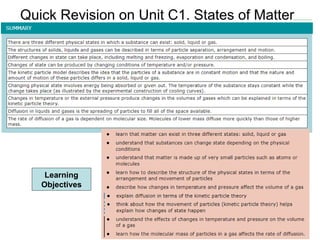
Quick Revision on Unit C1. States of Matter
Learning
Objectives
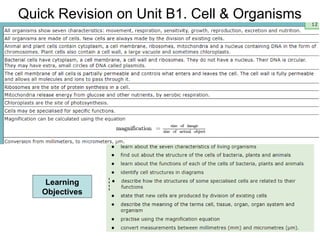
Quick Revision on Unit B1. Cell & Organisms
Learning
Objectives

Changing_State_&_The_Kinetic_Theory_of_Matter.ppt

  • 1.
    Lesson 1: Learning Objectives: •Statethe distinguishing properties of solids,liquids and gases. •Describe the structure of solids, liquids and gases in terms of particle separation, arrangement and motion. •Describe changes of state in terms of melting, boiling, evaporating, freezing and condensing
  • 2.
    Kinetic Theory ofMatter Matter is made up of particles which are in continual random motion.
  • 5.
  • 6.
    Applying The KineticParticle Theory to Changes in State
  • 7.
  • 8.
    Melting & BoilingPoint Boiling point (b.p) is a temperature at which a substance turns into a gas. When a liquid change into a gas and left with its surface exposed to the air is called Evaporation Melting point (m.p) is a temperature at which a substance turns into a liquid. The process in reverse is called freezing
  • 9.
  • 10.
    Lesson 2: Learning Objectives: •Describethe effects of temperature and pressure on the volume of a gas. •Explain, in terms of kinetic particle theory, the effects of temperature and pressure on the volume of a gas. •Explain changes of state in terms of kinetic particle theory, including the interpretation ofheating and cooling curves
  • 11.
  • 12.
    Use kinetic particletheory to explain: The effect of temperature on the volume of a gas • The effect of pressure on the volume of a gas
  • 13.
    Pure Substances A Puresubstance consist of only one substance without any contaminating impurities. A Pure substance melts and boils at definite temperature. The m.p & b.p can be used to test the purity of a sample. Which two substances are liquids at room temperature?
  • 14.
    Latent heat isthe heat needed to cause a phase change to a specific amount of matter at a fixed temperature. It is the amount of heat that is absorbed or released divided by the amount of substance that is undergoing a phase What happens to the temperature of a substance as it changes state? Constant
  • 17.
    Lesson 3: Learning Objectives: •Describeand explain diffusion in terms of kinetic particle theory. •Describe and explain the effect of relative molecular mass on the rate of diffusion of gases
  • 18.
  • 19.
    Diffusion Simulation &Videos • https://phet.colorado. edu/sims/html/diffusi on/latest/diffusion_e n.html • https://www.youtube.com/watch?v=OxhWwPMlgdA&pp=ygUuZGl mZnVzaW9uIGV4cGVyaW1lbnQgYW1tb25pYSBoeWRyb2NobG 9yaWMgYWNpZA%3D%3D • ttps://www.youtube.com/shorts/55 CPfc9ij48
  • 21.
    Quick Revision onUnit C1. States of Matter Learning Objectives
  • 22.
    Quick Revision onUnit B1. Cell & Organisms Learning Objectives