Change Management
Enjoy the video
 ‘change’
◦ work schedules
◦ departmentalisation
◦ machinery
◦ organisational design
◦ people
Forces of Change
Political
Technological
Competitors
Organization
Economic
Forces of Change
Organization
Managerial position
Employee
Strategy
Structure
Procedure/processes
Sociocultural
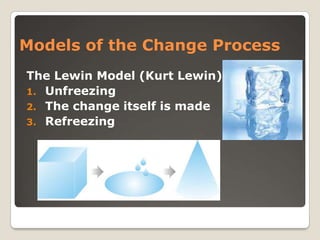
Models of the Change Process
The Lewin Model (Kurt Lewin)
1. Unfreezing
2. The change itself is made
3. Refreezing
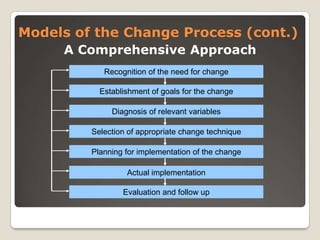
Models of the Change Process (cont.)
A Comprehensive Approach
Recognition of the need for change
Establishment of goals for the change
Diagnosis of relevant variables
Selection of appropriate change technique
Planning for implementation of the change
Actual implementation
Evaluation and follow up
Resistance to Change
 Uncertainty
 Threatened self-interest
 Peer pressure
 Bureaucratic : comfortable with present
ways of doing thing
Managing Resistance to Change
 Participation
 Education and communication
 Facilitation
 Negotiation and Agreement
 Manipulation
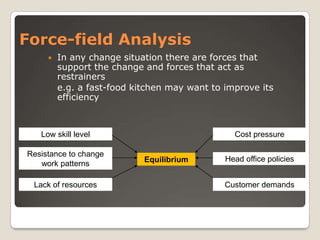
Force-field Analysis
 In any change situation there are forces that
support the change and forces that act as
restrainers
e.g. a fast-food kitchen may want to improve its
efficiency
Low skill level
Resistance to change
work patterns
Lack of resources
Cost pressure
Head office policies
Customer demands
Equilibrium
Types of change
 Developmental Change
 Transitional Change
 Transformational Change
occurs when a company makes an
improvement to their current business
Developmental Change
Transitional Change
replaces existing processes or procedures with
something that is completely new to the
company
Transformational Change
occurs after the transition period

Change management

Editor's Notes

  • #12 It can be developmental change, transitional and transformational change.
  • #13 If a company decided to improve their processes, methods and performance have to be change and this is the developmental change. Companies are forced to use the developmental change if they want to continue to stay competitive . If the enterprise chooses not to challenge fundamental ideas or prefers to perfect a system already in place, then the goal is developmental or incremental change. so after the developmental change new knowledge enter in the company and it’s help the company to improve in company capabilities, skill sets and whole of the systems.For example tow years ago Bridgestone branch in Iran decided to improve the skills of the employees so they send some of them to Japan for training after they came bake their skills improved. So this improvement helped the company to produce tire with best quality.
  • #14 The period that we can not use the old process and the new process is being implemented is called the transitional change. Transitional change seeks the new skill and ability that is different from existing one. Transitional change may not require an important shift in culture or behavior but it is more challenging to implement than developmental change. a company, re-organization, use new technology and creating new produces or services are example of that. In effect the enterprise moves from its “old” state to its “new” state.
  • #15 Transformational change may involve both developmental change and transitional change. it is a kind tuning that usually follows a radical development in technology. Transformational change is along process. Many times taking seven to ten years. For example, when computers be introduced in the market, all the companies have to adopt them because they had no other choice.