CEB Sales Leadership Council®
Challenger Selling
Driving Growth Through the Insight-Led Sale
A Framework for Member Conversations
The mission of The Corporate Executive Board Company and its affiliates (CEB) is to unlock the potential of organizations and leaders by advancing the science and practice of
management. When we bring leaders together, it is crucial that our discussions neither restrict competition nor improperly share inside information. All other conversations are welcomed
and encouraged.
Confidentiality and Intellectual Property
These materials have been prepared by CEB for the exclusive and individual use of our member companies. These materials contain valuable confidential and proprietary information
belonging to CEB and they may not be shared with any third party (including independent contractors and consultants) without the prior approval of CEB. CEB retains any and all
intellectual property rights in these materials and requires retention of the copyright mark on all pages reproduced.
Legal Caveat
CEB is not able to guarantee the accuracy of the information or analysis contained in these materials. Furthermore, CEB is not engaged in rendering legal, accounting, or any other
professional services. CEB specifically disclaims liability for any damages, claims or losses that may arise from a) any errors or omissions in these materials, whether caused by CEB or
its sources, or b) reliance upon any recommendation made by CEB.
© 2013 The Corporate Executive Board Company.
All Rights Reserved. SEC5230513SYN
 3
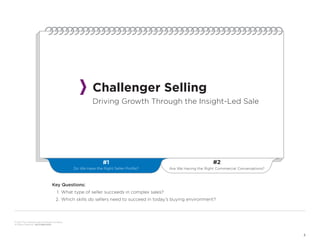
Key Questions:
1.	What type of seller succeeds in complex sales?
2.	Which skills do sellers need to succeed in today’s buying environment?
Are We Having the Right Commercial Conversations?
#2
Do We Have the Right Seller Profile?
#1
Challenger Selling
Driving Growth Through the Insight-Led Sale
 4
© 2013 The Corporate Executive Board Company.
All Rights Reserved. SEC5230513SYN
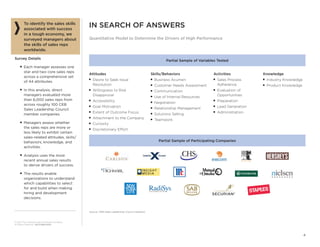
in search of answers
Quantitative model to determine the drivers of high performance
partial sample of variables Tested
partial sample of participating companies
attitudes
■ Desire to Seek Issue
Resolution
■ Willingness to Risk
Disapproval
■ Accessibility
■ Goal Motivation
■ Extent of Outcome Focus
■ Attachment to the Company
■ Curiosity
■ Discretionary Effort
skills/behaviors
■ Business Acumen
■ Customer Needs Assessment
■ Communication
■ Use of Internal Resources
■ Negotiation
■ Relationship Management
■ Solutions Selling
■ Teamwork
activities
■ Sales Process
Adherence
■ Evaluation of
Opportunities
■ Preparation
■ Lead Generation
■ Administration
Knowledge
■ Industry Knowledge
■ Product Knowledge
To identify the sales skills
associated with success
in a tough economy, we
surveyed managers about
the skills of sales reps
worldwide.
survey details
■ Each manager assesses one
star and two core sales reps
across a comprehensive set
of 44 attributes.
■ In this analysis, direct
managers evaluated more
than 6,000 sales reps from
across roughly 100 CEB
Sales Leadership Council
member companies.
■ Managers assess whether
the sales reps are more or
less likely to exhibit certain
sales-related attitudes, skills/
behaviors, knowledge, and
activities.
■ Analysis uses the most
recent annual sales results
to derive drivers of success.
■ The results enable
organizations to understand
which capabilities to select
for and build when making
hiring and development
decisions.
Source: CEB Sales Leadership Council research.
 5
© 2013 The Corporate Executive Board Company.
All Rights Reserved. SEC5230513SYN
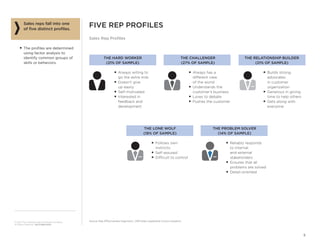
The problem solver
(14% of sample)
■■ Reliably responds
to internal
and external
stakeholders
■■ Ensures that all
problems are solved
■■ Detail-oriented
The relationship builder
(21% of sample)
■■ Builds strong
advocates
in customer
organization
■■ Generous in giving
time to help others
■■ Gets along with
everyone
The lone wolf
(18% of sample)
■■ Follows own
instincts
■■ Self-assured
■■ Difficult to control
The challenger
(27% of sample)
■■ Always has a
different view
of the world
■■ Understands the
customer’s business
■■ Loves to debate
■■ Pushes the customer
The hard worker
(21% of sample)
■■ Always willing to
go the extra mile
■■ Doesn’t give
up easily
■■ Self-motivated
■■ Interested in
feedback and
development
Source:	Rep Effectiveness Diagnostic; CEB Sales Leadership Council research.
Sales reps fall into one
of five distinct profiles.
■■ The profiles are determined
using factor analysis to
identify common groups of
skills or behaviors.
Five Rep Profiles
Sales Rep Profiles
 6
© 2013 The Corporate Executive Board Company.
All Rights Reserved. SEC5230513SYN
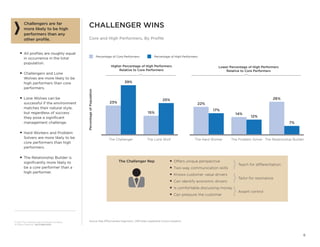
Challenger Wins
Core and High Performers, By Profile
The Challenger The Lone Wolf The Hard Worker The Problem Solver The Relationship Builder
23%
39%
15%
25%
22%
17%
14%
12%
26%
7%
The Challenger The Lone Wolf The Hard Worker The Problem Solver The Relationship Builder
23%
39%
15%
25%
22%
17%
14%
12%
26%
7%
Higher Percentage of High Performers
Relative to Core Performers
Lower Percentage of High Performers
Relative to Core Performers
PercentageofPopulation
Percentage of Core Performers Percentage of High Performers
The Challenger Rep ■■ Offers unique perspective
■■ Two-way communication skills
■■ Knows customer value drivers
■■ Can identify economic drivers
■■ Is comfortable discussing money
■■ Can pressure the customer
Challengers are far
more likely to be high
performers than any
other profile.
■■ All profiles are roughly equal
in occurrence in the total
population.
■■ Challengers and Lone
Wolves are more likely to be
high performers than core
performers.
■■ Lone Wolves can be
successful if the environment
matches their natural style,
but regardless of success
they pose a significant
management challenge.
■■ Hard Workers and Problem
Solvers are more likely to be
core performers than high
performers.
■■ The Relationship Builder is
significantly more likely to
be a core performer than a
high performer.
Teach for differentiation
Tailor for resonance
Assert control
Source:	Rep Effectiveness Diagnostic; CEB Sales Leadership Council research.
 7
© 2013 The Corporate Executive Board Company.
All Rights Reserved. SEC5230513SYN
Low Complexity High Complexity
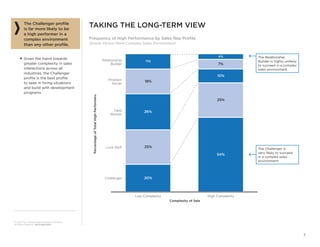
20%
25%
26%
18%
11%
54%
25%
10%
7%
4%
The Challenger profile
is far more likely to be
a high performer in a
complex environment
than any other profile.
■■ Given the trend towards
greater complexity in sales
interactions across all
industries, the Challenger
profile is the best profile
to seek in hiring situations
and build with development
programs.
Taking the long-term view
Frequency of High Performance by Sales Rep Profile
Simple Versus More Complex Sales Environment
Complexity of Sale
PercentageofTotalHighPerformers
Challenger
Lone Wolf
Hard
Worker
Problem
Solver
Relationship
Builder
The Relationship
Builder is highly unlikely
to succeed in a complex
sales environment.
The Challenger is
very likely to succeed
in a complex sales
environment.
© 2013 The Corporate Executive Board Company.
All Rights Reserved. SEC5230513SYN
 8
Key Questions:
1.	What do customers most value from a commercial relationship?
2.	How do the highest performing sales people create customer loyalty?
Are We Having the Right Commercial Conversations?
#2
Do We Have the Right Seller Profile?
#1
Challenger Selling
Driving Growth Through the Insight-Led Sale
 9
© 2013 The Corporate Executive Board Company.
All Rights Reserved. SEC5230513SYN
Source:	Customer Experience Diagnostic; CEB Sales Leadership Council research.
Company and
Brand Impact
Product and
Service Delivery
Value-to-
Price Ratio
Sales
Experience
19% 19%
19%
19%
19%
9%
19%
19%
9%
53%
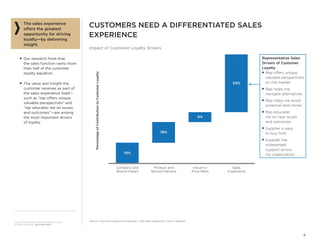
The sales experience
offers the greatest
opportunity for driving
loyalty—by delivering
insight.
■■ Our research finds that
the sales function owns more
than half of the customer
loyalty equation.
■■ The value and insight the
customer receives as part of
the sales experience itself—
such as “rep offers unique,
valuable perspectives” and
“rep educates me on issues
and outcomes”—are among
the most important drivers
of loyalty.
Customers Need a Differentiated Sales
Experience
Impact of Customer Loyalty Drivers
Representative Sales
Drivers of Customer
Loyalty
■■ Rep offers unique,
valuable perspectives
on the market
■■ Rep helps me
navigate alternatives
■■ Rep helps me avoid
potential land mines
■■ Rep educates
me on new issues
and outcomes
■■ Supplier is easy
to buy from
■■ Supplier has
widespread
support across
my organization
PercentageofContributiontoCustomerLoyalty
 10
© 2013 The Corporate Executive Board Company.
All Rights Reserved. SEC5230513SYN
1. Lead to Your Unique Strengths
Why?
Teaching that is equally relevant to other suppliers
does not further customer appreciation for your
unique strengths and therefore does little more
than create goodwill.
2. Challenge Customers’ Assumptions
Why?
Sharing information that is simply new or
voyeuristically interesting fails to grab mind share
and “stick” with customers.
3. Catalyze Action
Why?
Without sufficient pathing toward a solution for
customers’ problems and a prescription for action,
teaching fails to further the sales cycle.
4. Scale Across Customers
Why?
The costs of developing and delivering one-off
teaching content are a burden on the organization
and not economically viable.
Commercial Teaching has to…
Commercial Teaching
Definition: Reframing the way the customer assigns value to the areas where you outperform your competitors.
Not An Individual Skill
Commercial Teaching Attributes
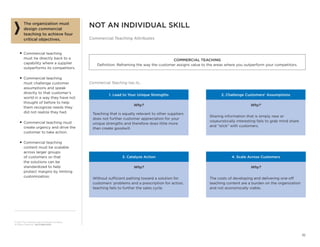
The organization must
design commercial
teaching to achieve four
critical objectives.
■■ Commercial teaching
must tie directly back to a
capability where a supplier
outperforms its competitors.
■■ Commercial teaching
must challenge customer
assumptions and speak
directly to that customer’s
world in a way they have not
thought of before to help
them recognize needs they
did not realize they had.
■■ Commercial teaching must
create urgency and drive the
customer to take action.
■■ Commercial teaching
content must be scalable
across larger groups
of customers so that
the solutions can be
standardized to help
protect margins by limiting
customization.
 11
© 2013 The Corporate Executive Board Company.
All Rights Reserved. SEC5230513SYN
Lead to, Not Lead With
Deconstruction of a Commercial Teaching Pitch
“Emotometer”:LevelofCustomerExcitement
Customer State
1. “Warmer”
Building credibility
by reading
their mind,
demonstrating
empathy
2. “Reframe”
First reframe of
unrecognized
problem, need, or
assumption
3. “Rational
Drowning”
Gradual
intensification of
the problem, both
in degree and
closeness to the
customer
4. “Emotional
Impact”
Psychological
features of the
problem, or
presence in
the individual’s
workflow,
humanizing the
problem
5. “Value
Proposition—
A New Way”
A new framework
for addressing the
problem—implicitly
tied to the supplier
value proposition
6. “Our
Solution and
Implementation
Map”
Map of supplier
services or
solutions linked
back to key
teaching points;
highlighted path to
implementation
Intrigued Drowning Involved Relieved
Positive
Neutral
Negative
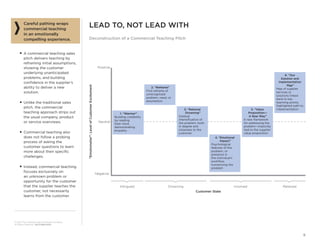
Careful pathing wraps
commercial teaching
in an emotionally
compelling experience.
■■ A commercial teaching sales
pitch delivers teaching by
reframing initial assumptions,
showing the customer
underlying unanticipated
problems, and building
confidence in the supplier’s
ability to deliver a new
solution.
■■ Unlike the traditional sales
pitch, the commercial
teaching approach strips out
the usual company, product
or service overviews.
■■ Commercial teaching also
does not follow a probing
process of asking the
customer questions to learn
more about their specific
challenges.
■■ Instead, commercial teaching
focuses exclusively on
an unknown problem or
opportunity for the customer
that the supplier teaches the
customer, not necessarily
learns from the customer.

Challenger-Data

  • 1.
    CEB Sales LeadershipCouncil® Challenger Selling Driving Growth Through the Insight-Led Sale
  • 2.
    A Framework forMember Conversations The mission of The Corporate Executive Board Company and its affiliates (CEB) is to unlock the potential of organizations and leaders by advancing the science and practice of management. When we bring leaders together, it is crucial that our discussions neither restrict competition nor improperly share inside information. All other conversations are welcomed and encouraged. Confidentiality and Intellectual Property These materials have been prepared by CEB for the exclusive and individual use of our member companies. These materials contain valuable confidential and proprietary information belonging to CEB and they may not be shared with any third party (including independent contractors and consultants) without the prior approval of CEB. CEB retains any and all intellectual property rights in these materials and requires retention of the copyright mark on all pages reproduced. Legal Caveat CEB is not able to guarantee the accuracy of the information or analysis contained in these materials. Furthermore, CEB is not engaged in rendering legal, accounting, or any other professional services. CEB specifically disclaims liability for any damages, claims or losses that may arise from a) any errors or omissions in these materials, whether caused by CEB or its sources, or b) reliance upon any recommendation made by CEB.
  • 3.
    © 2013 TheCorporate Executive Board Company. All Rights Reserved. SEC5230513SYN  3 Key Questions: 1. What type of seller succeeds in complex sales? 2. Which skills do sellers need to succeed in today’s buying environment? Are We Having the Right Commercial Conversations? #2 Do We Have the Right Seller Profile? #1 Challenger Selling Driving Growth Through the Insight-Led Sale
  • 4.
     4 © 2013 TheCorporate Executive Board Company. All Rights Reserved. SEC5230513SYN in search of answers Quantitative model to determine the drivers of high performance partial sample of variables Tested partial sample of participating companies attitudes ■ Desire to Seek Issue Resolution ■ Willingness to Risk Disapproval ■ Accessibility ■ Goal Motivation ■ Extent of Outcome Focus ■ Attachment to the Company ■ Curiosity ■ Discretionary Effort skills/behaviors ■ Business Acumen ■ Customer Needs Assessment ■ Communication ■ Use of Internal Resources ■ Negotiation ■ Relationship Management ■ Solutions Selling ■ Teamwork activities ■ Sales Process Adherence ■ Evaluation of Opportunities ■ Preparation ■ Lead Generation ■ Administration Knowledge ■ Industry Knowledge ■ Product Knowledge To identify the sales skills associated with success in a tough economy, we surveyed managers about the skills of sales reps worldwide. survey details ■ Each manager assesses one star and two core sales reps across a comprehensive set of 44 attributes. ■ In this analysis, direct managers evaluated more than 6,000 sales reps from across roughly 100 CEB Sales Leadership Council member companies. ■ Managers assess whether the sales reps are more or less likely to exhibit certain sales-related attitudes, skills/ behaviors, knowledge, and activities. ■ Analysis uses the most recent annual sales results to derive drivers of success. ■ The results enable organizations to understand which capabilities to select for and build when making hiring and development decisions. Source: CEB Sales Leadership Council research.
  • 5.
     5 © 2013 TheCorporate Executive Board Company. All Rights Reserved. SEC5230513SYN The problem solver (14% of sample) ■■ Reliably responds to internal and external stakeholders ■■ Ensures that all problems are solved ■■ Detail-oriented The relationship builder (21% of sample) ■■ Builds strong advocates in customer organization ■■ Generous in giving time to help others ■■ Gets along with everyone The lone wolf (18% of sample) ■■ Follows own instincts ■■ Self-assured ■■ Difficult to control The challenger (27% of sample) ■■ Always has a different view of the world ■■ Understands the customer’s business ■■ Loves to debate ■■ Pushes the customer The hard worker (21% of sample) ■■ Always willing to go the extra mile ■■ Doesn’t give up easily ■■ Self-motivated ■■ Interested in feedback and development Source: Rep Effectiveness Diagnostic; CEB Sales Leadership Council research. Sales reps fall into one of five distinct profiles. ■■ The profiles are determined using factor analysis to identify common groups of skills or behaviors. Five Rep Profiles Sales Rep Profiles
  • 6.
     6 © 2013 TheCorporate Executive Board Company. All Rights Reserved. SEC5230513SYN Challenger Wins Core and High Performers, By Profile The Challenger The Lone Wolf The Hard Worker The Problem Solver The Relationship Builder 23% 39% 15% 25% 22% 17% 14% 12% 26% 7% The Challenger The Lone Wolf The Hard Worker The Problem Solver The Relationship Builder 23% 39% 15% 25% 22% 17% 14% 12% 26% 7% Higher Percentage of High Performers Relative to Core Performers Lower Percentage of High Performers Relative to Core Performers PercentageofPopulation Percentage of Core Performers Percentage of High Performers The Challenger Rep ■■ Offers unique perspective ■■ Two-way communication skills ■■ Knows customer value drivers ■■ Can identify economic drivers ■■ Is comfortable discussing money ■■ Can pressure the customer Challengers are far more likely to be high performers than any other profile. ■■ All profiles are roughly equal in occurrence in the total population. ■■ Challengers and Lone Wolves are more likely to be high performers than core performers. ■■ Lone Wolves can be successful if the environment matches their natural style, but regardless of success they pose a significant management challenge. ■■ Hard Workers and Problem Solvers are more likely to be core performers than high performers. ■■ The Relationship Builder is significantly more likely to be a core performer than a high performer. Teach for differentiation Tailor for resonance Assert control Source: Rep Effectiveness Diagnostic; CEB Sales Leadership Council research.
  • 7.
     7 © 2013 TheCorporate Executive Board Company. All Rights Reserved. SEC5230513SYN Low Complexity High Complexity 20% 25% 26% 18% 11% 54% 25% 10% 7% 4% The Challenger profile is far more likely to be a high performer in a complex environment than any other profile. ■■ Given the trend towards greater complexity in sales interactions across all industries, the Challenger profile is the best profile to seek in hiring situations and build with development programs. Taking the long-term view Frequency of High Performance by Sales Rep Profile Simple Versus More Complex Sales Environment Complexity of Sale PercentageofTotalHighPerformers Challenger Lone Wolf Hard Worker Problem Solver Relationship Builder The Relationship Builder is highly unlikely to succeed in a complex sales environment. The Challenger is very likely to succeed in a complex sales environment.
  • 8.
    © 2013 TheCorporate Executive Board Company. All Rights Reserved. SEC5230513SYN  8 Key Questions: 1. What do customers most value from a commercial relationship? 2. How do the highest performing sales people create customer loyalty? Are We Having the Right Commercial Conversations? #2 Do We Have the Right Seller Profile? #1 Challenger Selling Driving Growth Through the Insight-Led Sale
  • 9.
     9 © 2013 TheCorporate Executive Board Company. All Rights Reserved. SEC5230513SYN Source: Customer Experience Diagnostic; CEB Sales Leadership Council research. Company and Brand Impact Product and Service Delivery Value-to- Price Ratio Sales Experience 19% 19% 19% 19% 19% 9% 19% 19% 9% 53% The sales experience offers the greatest opportunity for driving loyalty—by delivering insight. ■■ Our research finds that the sales function owns more than half of the customer loyalty equation. ■■ The value and insight the customer receives as part of the sales experience itself— such as “rep offers unique, valuable perspectives” and “rep educates me on issues and outcomes”—are among the most important drivers of loyalty. Customers Need a Differentiated Sales Experience Impact of Customer Loyalty Drivers Representative Sales Drivers of Customer Loyalty ■■ Rep offers unique, valuable perspectives on the market ■■ Rep helps me navigate alternatives ■■ Rep helps me avoid potential land mines ■■ Rep educates me on new issues and outcomes ■■ Supplier is easy to buy from ■■ Supplier has widespread support across my organization PercentageofContributiontoCustomerLoyalty
  • 10.
     10 © 2013 TheCorporate Executive Board Company. All Rights Reserved. SEC5230513SYN 1. Lead to Your Unique Strengths Why? Teaching that is equally relevant to other suppliers does not further customer appreciation for your unique strengths and therefore does little more than create goodwill. 2. Challenge Customers’ Assumptions Why? Sharing information that is simply new or voyeuristically interesting fails to grab mind share and “stick” with customers. 3. Catalyze Action Why? Without sufficient pathing toward a solution for customers’ problems and a prescription for action, teaching fails to further the sales cycle. 4. Scale Across Customers Why? The costs of developing and delivering one-off teaching content are a burden on the organization and not economically viable. Commercial Teaching has to… Commercial Teaching Definition: Reframing the way the customer assigns value to the areas where you outperform your competitors. Not An Individual Skill Commercial Teaching Attributes The organization must design commercial teaching to achieve four critical objectives. ■■ Commercial teaching must tie directly back to a capability where a supplier outperforms its competitors. ■■ Commercial teaching must challenge customer assumptions and speak directly to that customer’s world in a way they have not thought of before to help them recognize needs they did not realize they had. ■■ Commercial teaching must create urgency and drive the customer to take action. ■■ Commercial teaching content must be scalable across larger groups of customers so that the solutions can be standardized to help protect margins by limiting customization.
  • 11.
     11 © 2013 TheCorporate Executive Board Company. All Rights Reserved. SEC5230513SYN Lead to, Not Lead With Deconstruction of a Commercial Teaching Pitch “Emotometer”:LevelofCustomerExcitement Customer State 1. “Warmer” Building credibility by reading their mind, demonstrating empathy 2. “Reframe” First reframe of unrecognized problem, need, or assumption 3. “Rational Drowning” Gradual intensification of the problem, both in degree and closeness to the customer 4. “Emotional Impact” Psychological features of the problem, or presence in the individual’s workflow, humanizing the problem 5. “Value Proposition— A New Way” A new framework for addressing the problem—implicitly tied to the supplier value proposition 6. “Our Solution and Implementation Map” Map of supplier services or solutions linked back to key teaching points; highlighted path to implementation Intrigued Drowning Involved Relieved Positive Neutral Negative Careful pathing wraps commercial teaching in an emotionally compelling experience. ■■ A commercial teaching sales pitch delivers teaching by reframing initial assumptions, showing the customer underlying unanticipated problems, and building confidence in the supplier’s ability to deliver a new solution. ■■ Unlike the traditional sales pitch, the commercial teaching approach strips out the usual company, product or service overviews. ■■ Commercial teaching also does not follow a probing process of asking the customer questions to learn more about their specific challenges. ■■ Instead, commercial teaching focuses exclusively on an unknown problem or opportunity for the customer that the supplier teaches the customer, not necessarily learns from the customer.