Challenge Fund Empowered Committee MeetingChallenge Fund Empowered Committee Meeting
A Demo onA Demo on
““Innovative Policing through Police ITInnovative Policing through Police IT””
Introduction
Overview of Police IT
Presentation Structure
Overview of Legacy Systems
Legacy Systems and Police IT Integration
Conclusion
Introduction
Large number of easily comprehensible inputs, readily
available would lead to informed decision making and
meticulous planning.
Evolve systems responsive to changing requirementEvolve systems responsive to changing requirement
and technologies.
Software systems are critical assets and incorporate
key knowledge acquired over the life of an
organization.
The lifetime of software systems is very variable though
many large systems remain in use for many years.
Introduction
Organizations are heavily dependent on the services
provided by these systems.
Legacy systems incorporate a large number of changesLegacy systems incorporate a large number of changes
continuously incorporated to reflect evolving business
practices.
A legacy system has to pass through many developers
evolving over decades to satisfy new requirements.
Introduction
A legacy system has following characteristics:
Legacy systems often run on obsolete (and usually
slow) hardware and software.
High maintenance costHigh maintenance cost
These systems are hard to maintain, improve, and
expand.
Integration with newer systems may also be difficult
because new software may use completely different
technologies.
Overview of POLICE IT
Police IT software application has 12 modules, 64
roles, 522 screens and 417 reports.
The core functions of Police IT have three modules
namely, Crime, Law & Order and Traffic.
The Administration side has another three modules
namely Administration, Finance and Stores.
Overview of POLICE IT
Armed Reserve, Motor Transport and Training provide
the ancillary support.
Technical modules are the Wireless and FSL.Technical modules are the Wireless and FSL.
The MIS (Management Information System) module
provides inputs for decision making to all senior
officers.
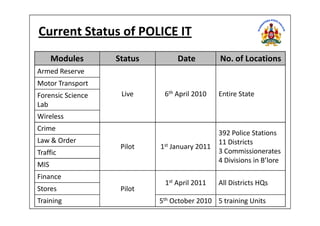
Current Status of POLICE IT
Modules Status Date No. of Locations
Armed Reserve
Live 6th April 2010 Entire State
Motor Transport
Forensic Science
Lab
WirelessWireless
Crime
Pilot 1st January 2011
392 Police Stations
11 Districts
3 Commissionerates
4 Divisions in B’lore
Law & Order
Traffic
MIS
Finance
Pilot
1st April 2011 All Districts HQs
Stores
Training 5th October 2010 5 training Units
Legacy Systems
The seven legacy systems proposed for
integration with Police IT ERP are
e-BEATe-BEAT
G-CARE
e-Khajane
e-Procurement
GPS based AVLS
Traffic Management Center
Blackberry
Benefits of Integration
Increase in usage because of easier access through a
single software.
It would lead to increase in critical functionalities ofIt would lead to increase in critical functionalities of
Police IT software.
Silos (legacy systems) cannot deliver the functionalities
of an integrated software.
Benefits of Integration (Contd...)
Merger of few of these systems will lead to better
maintenance and usability of that functionality.
Centralized server based approach reduces application
deployment and configuration costs.
Overview of Legacy Systems
Beat System
Intimate knowledge of the conditions prevailing in the
station jurisdiction and of the movements and doings
of criminals are conditions precedent to the successful
prevention of crime. To gain such knowledge, anprevention of crime. To gain such knowledge, an
efficient beat system is a primary necessity.
e-Beat
e-Beat is a beat management system for police
personnel designed to move the beat registration to
a RFID based automatic logging system.
Overview of Legacy Systems
e-BEAT
The system is based on Radio Frequency ID system.
Implementation of the e-Beat system started during
2003-2004 in three phases and presently it is running
across the state.
e-Beat Integration
e-Beat system works on stand-alone system in each
police station. It is used to enter data on disconnected
mode in the application.
Following are the issues with existing e-Beat systemFollowing are the issues with existing e-Beat system
1. Data is saved locally.
2. Data sharing between units are not possible.
3. Difficult to track beat activities by higher officers.
As the first step of integration e-Beat systems data will
be saved centrally in a single database server.
e-Beat Integration
In the new integrated system work process, beat entry
can be done through both systems.
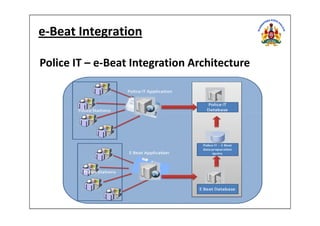
Police IT software will fetch the data from e-Beat
system using an intermediate DB script.system using an intermediate DB script.
Police IT software will generate reports from e-Beat
data.
e-Beat Integration
Police IT – e-Beat Integration Architecture
Overview of Legacy Systems
G-CARE
G-CARE is a desktop based Geographic Information
System (GIS) based Crime analysis and search engine
was developed by KSRSAC for Karnataka State Police.was developed by KSRSAC for Karnataka State Police.
The information stored in Crime and Criminal
Information system (CCIS) database can be viewed
with respect to the spatial background.
This software converts the data into information very
easily in presentable form.
Overview of Legacy Systems (Contd...)
G-CARE
Information can be analyzed, shown on maps and
printed.
G-CARE retrieves the information easily to analyze the
situation and helps easy and fast decision making by
Police Officers on the field.
Makes planning easier based on hotspot and other
analysis.
G-CARE Integration
Existing G-CARE system generates eight crime related
reports only at district level based on input from CCIS
database.
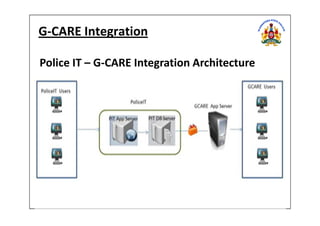
In the proposed system, G-CARE application will fetchIn the proposed system, G-CARE application will fetch
the data from Police IT database.
G-CARE application would generate twenty three
crime related reports at all levels of police
department.
This will add graphical reports for easier
comprehension and better analysis of the same data.
G-CARE Integration
Police IT – G-CARE Integration Architecture
Overview of Legacy Systems
e-Khajane
e-Khajane software computerizes the entire treasury
activities.
This system keeps track of activities from the time of
approval of the state budget to the point of rendering
accounts to the Government.
All the bill clearances are managed through this
system which facilitates strict budget monitoring.
e-Khajane Integration
In the existing system, all the reports and documents
generated by Police IT are manually entered into e-
Khajane system.
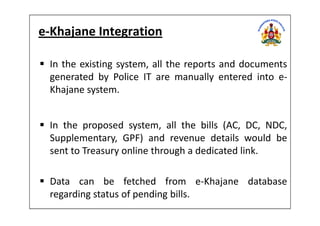
In the proposed system, all the bills (AC, DC, NDC,
Supplementary, GPF) and revenue details would be
sent to Treasury online through a dedicated link.
Data can be fetched from e-Khajane database
regarding status of pending bills.
e-Khajane Integration (Contd...)
Post integration, there will be no reconciliation issues
which takes large amount of time and energy of both
the departments.
e-Khajane Integration
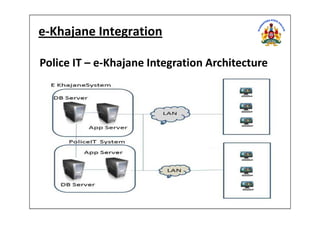
Police IT – e-Khajane Integration Architecture
Overview of Legacy Systems
e-Procurement
It is a single unitary end-to-end procurement solution
in the State.
It has three main components of catalogue
management, e-Tendering and contract management.
Ensures transparency, accountability to citizens and
incorporates all the benefits of transacting on the
Internet.
Overview of Legacy Systems (Contd...)
e-Procurement
No need for physical technical and commercial bid
meetings – huge saving on productive time.
Vendors registration helps in eliminating dubious
bidders.
Caters to vendors across the country.
e-Procurement Integration
e-Procurement is managed through the e-Proc portal
and is accessed through the internet.
In the proposed system, there are two phases ofIn the proposed system, there are two phases of
integration
1. Procurement Process
2. Inventory Management
Procurement Process will work under “Single sign in”
concept, in which user can access the e-Proc portal
through Police IT application.
e-Procurement Integration
The procured item details will be fetched by an
intermediate Database process. Police IT will provide
an option to access the e-Procurement application
through Police IT and fetch all information related tothrough Police IT and fetch all information related to
the procurement process and at a later stage the
contract management.
Inventory creation: It would also help in the creation of
inventory which happens through the e-Proc process.
e-Procurement Integration
Inventory Management phase, the procured item
details will be fetched by an intermediate Database
process Police IT will provide an option to access the
e-Procurement application through Police IT and fetch
all information related to the procurement process
and at a later stage the contract management.and at a later stage the contract management.
It would also help in the creation of inventory which
happens through the e-Proc process.
It would help the users to generate integrated reports
from both e-Proc and Police IT.
Overview of Legacy Systems
GPS based AVLS
Automated Vehicle Location System is a online, real-
time GPS-GPRS based police vehicle monitoring
system.system.
The system works through an integrated GPS-GPRS
based device installed in each vehicle which monitors
location, fuel, mileage and speed.
It is based on GIS mapping and is real-time.
GPS based AVLS Integration
The proposed system provides an option to access the
GPS Based AVLS system through Police IT.
The proposed system is divided in to three stagesThe proposed system is divided in to three stages
1. Access to GPS based AVLS system
2. Automatic generation of vehicle log reports
3. Mapping of different utilities of Police IT on G-
CARE generated hot spot maps.
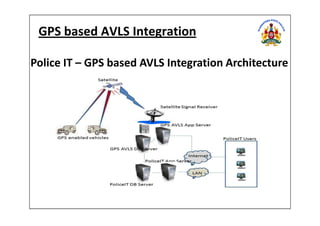
GPS based AVLS Integration
Police IT – GPS based AVLS Integration Architecture
Overview of Legacy Systems
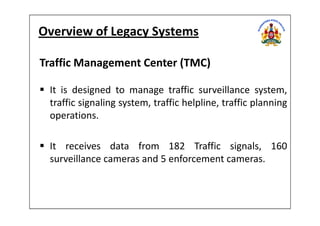
Traffic Management Center (TMC)
It is designed to manage traffic surveillance system,
traffic signaling system, traffic helpline, traffic planning
operations.operations.
It receives data from 182 Traffic signals, 160
surveillance cameras and 5 enforcement cameras.
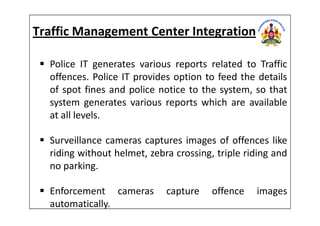
Traffic Management Center Integration
Police IT generates various reports related to Traffic
offences. Police IT provides option to feed the details
of spot fines and police notice to the system, so that
system generates various reports which are available
at all levels.at all levels.
Surveillance cameras captures images of offences like
riding without helmet, zebra crossing, triple riding and
no parking.
Enforcement cameras capture offence images
automatically.
TMC Integration (Contd...)
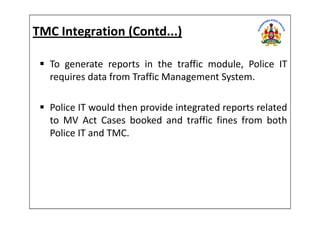
To generate reports in the traffic module, Police IT
requires data from Traffic Management System.
Police IT would then provide integrated reports relatedPolice IT would then provide integrated reports related
to MV Act Cases booked and traffic fines from both
Police IT and TMC.
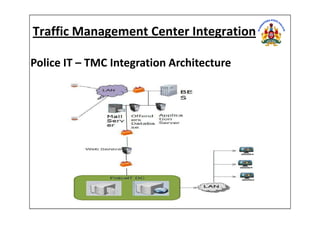
Traffic Management Center Integration
Police IT – TMC Integration Architecture
Overview of Legacy Systems
Blackberry
It enables traffic field personnel to have mobile
access to the vehicle database, through a mobile
handheld device connected to Bluetooth enabled
printers.printers.
Blackberry is used to enforce traffic rules and
regulations and fine offenders.
Online booking of violations ensures tracking of
habitual traffic offenders.
Data consolidation is an issue at the state level.
Blackberry Integration
Spot fine can be fed either through blackberry or
through Police IT. To avoid this redundant data entry,
integration of Police IT with Blackberry is necessary.
The data would automatically flow from Blackberry toThe data would automatically flow from Blackberry to
Police IT application.
Police IT application would generate the consolidated
fine collection receipt report out of data provided by
Blackberry and Police IT database.
Blackberry Integration
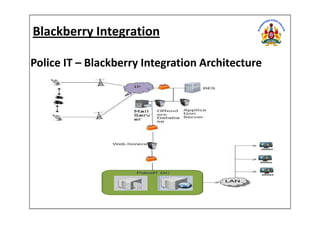
Police IT – Blackberry Integration Architecture
Legacy System Integration is one of the most critical tasks
in transforming the Police IT ERP into an e-Business suite.
The goal of the integration is to address a wide range of
management and technical issues with the evolving
Conclusion
management and technical issues with the evolving
software system. The objective is to plan and manage the
legacy system integration in a professional manner to
yield the desired results.
THANK YOU

Challenge Fund Empowered Committee Meeting

  • 1.
    Challenge Fund EmpoweredCommittee MeetingChallenge Fund Empowered Committee Meeting A Demo onA Demo on ““Innovative Policing through Police ITInnovative Policing through Police IT””
  • 2.
    Introduction Overview of PoliceIT Presentation Structure Overview of Legacy Systems Legacy Systems and Police IT Integration Conclusion
  • 3.
    Introduction Large number ofeasily comprehensible inputs, readily available would lead to informed decision making and meticulous planning. Evolve systems responsive to changing requirementEvolve systems responsive to changing requirement and technologies. Software systems are critical assets and incorporate key knowledge acquired over the life of an organization. The lifetime of software systems is very variable though many large systems remain in use for many years.
  • 4.
    Introduction Organizations are heavilydependent on the services provided by these systems. Legacy systems incorporate a large number of changesLegacy systems incorporate a large number of changes continuously incorporated to reflect evolving business practices. A legacy system has to pass through many developers evolving over decades to satisfy new requirements.
  • 5.
    Introduction A legacy systemhas following characteristics: Legacy systems often run on obsolete (and usually slow) hardware and software. High maintenance costHigh maintenance cost These systems are hard to maintain, improve, and expand. Integration with newer systems may also be difficult because new software may use completely different technologies.
  • 6.
    Overview of POLICEIT Police IT software application has 12 modules, 64 roles, 522 screens and 417 reports. The core functions of Police IT have three modules namely, Crime, Law & Order and Traffic. The Administration side has another three modules namely Administration, Finance and Stores.
  • 7.
    Overview of POLICEIT Armed Reserve, Motor Transport and Training provide the ancillary support. Technical modules are the Wireless and FSL.Technical modules are the Wireless and FSL. The MIS (Management Information System) module provides inputs for decision making to all senior officers.
  • 8.
    Current Status ofPOLICE IT Modules Status Date No. of Locations Armed Reserve Live 6th April 2010 Entire State Motor Transport Forensic Science Lab WirelessWireless Crime Pilot 1st January 2011 392 Police Stations 11 Districts 3 Commissionerates 4 Divisions in B’lore Law & Order Traffic MIS Finance Pilot 1st April 2011 All Districts HQs Stores Training 5th October 2010 5 training Units
  • 9.
    Legacy Systems The sevenlegacy systems proposed for integration with Police IT ERP are e-BEATe-BEAT G-CARE e-Khajane e-Procurement GPS based AVLS Traffic Management Center Blackberry
  • 10.
    Benefits of Integration Increasein usage because of easier access through a single software. It would lead to increase in critical functionalities ofIt would lead to increase in critical functionalities of Police IT software. Silos (legacy systems) cannot deliver the functionalities of an integrated software.
  • 11.
    Benefits of Integration(Contd...) Merger of few of these systems will lead to better maintenance and usability of that functionality. Centralized server based approach reduces application deployment and configuration costs.
  • 12.
    Overview of LegacySystems Beat System Intimate knowledge of the conditions prevailing in the station jurisdiction and of the movements and doings of criminals are conditions precedent to the successful prevention of crime. To gain such knowledge, anprevention of crime. To gain such knowledge, an efficient beat system is a primary necessity. e-Beat e-Beat is a beat management system for police personnel designed to move the beat registration to a RFID based automatic logging system.
  • 13.
    Overview of LegacySystems e-BEAT The system is based on Radio Frequency ID system. Implementation of the e-Beat system started during 2003-2004 in three phases and presently it is running across the state.
  • 14.
    e-Beat Integration e-Beat systemworks on stand-alone system in each police station. It is used to enter data on disconnected mode in the application. Following are the issues with existing e-Beat systemFollowing are the issues with existing e-Beat system 1. Data is saved locally. 2. Data sharing between units are not possible. 3. Difficult to track beat activities by higher officers. As the first step of integration e-Beat systems data will be saved centrally in a single database server.
  • 15.
    e-Beat Integration In thenew integrated system work process, beat entry can be done through both systems. Police IT software will fetch the data from e-Beat system using an intermediate DB script.system using an intermediate DB script. Police IT software will generate reports from e-Beat data.
  • 16.
    e-Beat Integration Police IT– e-Beat Integration Architecture
  • 17.
    Overview of LegacySystems G-CARE G-CARE is a desktop based Geographic Information System (GIS) based Crime analysis and search engine was developed by KSRSAC for Karnataka State Police.was developed by KSRSAC for Karnataka State Police. The information stored in Crime and Criminal Information system (CCIS) database can be viewed with respect to the spatial background. This software converts the data into information very easily in presentable form.
  • 18.
    Overview of LegacySystems (Contd...) G-CARE Information can be analyzed, shown on maps and printed. G-CARE retrieves the information easily to analyze the situation and helps easy and fast decision making by Police Officers on the field. Makes planning easier based on hotspot and other analysis.
  • 19.
    G-CARE Integration Existing G-CAREsystem generates eight crime related reports only at district level based on input from CCIS database. In the proposed system, G-CARE application will fetchIn the proposed system, G-CARE application will fetch the data from Police IT database. G-CARE application would generate twenty three crime related reports at all levels of police department. This will add graphical reports for easier comprehension and better analysis of the same data.
  • 20.
    G-CARE Integration Police IT– G-CARE Integration Architecture
  • 21.
    Overview of LegacySystems e-Khajane e-Khajane software computerizes the entire treasury activities. This system keeps track of activities from the time of approval of the state budget to the point of rendering accounts to the Government. All the bill clearances are managed through this system which facilitates strict budget monitoring.
  • 22.
    e-Khajane Integration In theexisting system, all the reports and documents generated by Police IT are manually entered into e- Khajane system. In the proposed system, all the bills (AC, DC, NDC, Supplementary, GPF) and revenue details would be sent to Treasury online through a dedicated link. Data can be fetched from e-Khajane database regarding status of pending bills.
  • 23.
    e-Khajane Integration (Contd...) Postintegration, there will be no reconciliation issues which takes large amount of time and energy of both the departments.
  • 24.
    e-Khajane Integration Police IT– e-Khajane Integration Architecture
  • 25.
    Overview of LegacySystems e-Procurement It is a single unitary end-to-end procurement solution in the State. It has three main components of catalogue management, e-Tendering and contract management. Ensures transparency, accountability to citizens and incorporates all the benefits of transacting on the Internet.
  • 26.
    Overview of LegacySystems (Contd...) e-Procurement No need for physical technical and commercial bid meetings – huge saving on productive time. Vendors registration helps in eliminating dubious bidders. Caters to vendors across the country.
  • 27.
    e-Procurement Integration e-Procurement ismanaged through the e-Proc portal and is accessed through the internet. In the proposed system, there are two phases ofIn the proposed system, there are two phases of integration 1. Procurement Process 2. Inventory Management Procurement Process will work under “Single sign in” concept, in which user can access the e-Proc portal through Police IT application.
  • 28.
    e-Procurement Integration The procureditem details will be fetched by an intermediate Database process. Police IT will provide an option to access the e-Procurement application through Police IT and fetch all information related tothrough Police IT and fetch all information related to the procurement process and at a later stage the contract management. Inventory creation: It would also help in the creation of inventory which happens through the e-Proc process.
  • 29.
    e-Procurement Integration Inventory Managementphase, the procured item details will be fetched by an intermediate Database process Police IT will provide an option to access the e-Procurement application through Police IT and fetch all information related to the procurement process and at a later stage the contract management.and at a later stage the contract management. It would also help in the creation of inventory which happens through the e-Proc process. It would help the users to generate integrated reports from both e-Proc and Police IT.
  • 30.
    Overview of LegacySystems GPS based AVLS Automated Vehicle Location System is a online, real- time GPS-GPRS based police vehicle monitoring system.system. The system works through an integrated GPS-GPRS based device installed in each vehicle which monitors location, fuel, mileage and speed. It is based on GIS mapping and is real-time.
  • 31.
    GPS based AVLSIntegration The proposed system provides an option to access the GPS Based AVLS system through Police IT. The proposed system is divided in to three stagesThe proposed system is divided in to three stages 1. Access to GPS based AVLS system 2. Automatic generation of vehicle log reports 3. Mapping of different utilities of Police IT on G- CARE generated hot spot maps.
  • 32.
    GPS based AVLSIntegration Police IT – GPS based AVLS Integration Architecture
  • 33.
    Overview of LegacySystems Traffic Management Center (TMC) It is designed to manage traffic surveillance system, traffic signaling system, traffic helpline, traffic planning operations.operations. It receives data from 182 Traffic signals, 160 surveillance cameras and 5 enforcement cameras.
  • 34.
    Traffic Management CenterIntegration Police IT generates various reports related to Traffic offences. Police IT provides option to feed the details of spot fines and police notice to the system, so that system generates various reports which are available at all levels.at all levels. Surveillance cameras captures images of offences like riding without helmet, zebra crossing, triple riding and no parking. Enforcement cameras capture offence images automatically.
  • 35.
    TMC Integration (Contd...) Togenerate reports in the traffic module, Police IT requires data from Traffic Management System. Police IT would then provide integrated reports relatedPolice IT would then provide integrated reports related to MV Act Cases booked and traffic fines from both Police IT and TMC.
  • 36.
    Traffic Management CenterIntegration Police IT – TMC Integration Architecture
  • 37.
    Overview of LegacySystems Blackberry It enables traffic field personnel to have mobile access to the vehicle database, through a mobile handheld device connected to Bluetooth enabled printers.printers. Blackberry is used to enforce traffic rules and regulations and fine offenders. Online booking of violations ensures tracking of habitual traffic offenders. Data consolidation is an issue at the state level.
  • 38.
    Blackberry Integration Spot finecan be fed either through blackberry or through Police IT. To avoid this redundant data entry, integration of Police IT with Blackberry is necessary. The data would automatically flow from Blackberry toThe data would automatically flow from Blackberry to Police IT application. Police IT application would generate the consolidated fine collection receipt report out of data provided by Blackberry and Police IT database.
  • 39.
    Blackberry Integration Police IT– Blackberry Integration Architecture
  • 40.
    Legacy System Integrationis one of the most critical tasks in transforming the Police IT ERP into an e-Business suite. The goal of the integration is to address a wide range of management and technical issues with the evolving Conclusion management and technical issues with the evolving software system. The objective is to plan and manage the legacy system integration in a professional manner to yield the desired results.
  • 41.