Chad Cirino
Introduction to Hospitality
March 19, 2015
Prof. Malan
Leaving With a Smile: Hotel Reputation Management
Reputation Management was originally a Public Relations term used to describe the way
in which a public relations specialist could control the public image of an individual, company,
or brand. With the proliferation of the internet, and social media, Reputation Management has
taken a new form. Reputation Management is a practice of engaging with customer reviews and
potentially damaging content on the internet so as to promote a better brand image, as well as
engaging with customer feedback to find solutions or address problems before they affect brand
image. (Milo) Managing the reputation of a brand is now a complex and difficult task that
includes interacting with and utilizing the resources of review sites, social media, and search
results (known as SEO optimization). (Lieb)
A decade ago, when social media was a relatively new phenomenon, Reputation
Management took on both ethical and unethical forms in business. Unethical Reputation
Management is considered to include practices such as influencing search results online through
something called SEO Gaming (creating websites, blogs, or content that includes tags related to a
brand or product so it will post higher in search engine results), posting fake positive reviews on
review sites to garner a higher rating, or censoring negative customer feedback. Most of these
issues have been addressed by more sophisticated analytical tools such as Google's search engine
analytics, (see figure 1) and review sites have in some instances begun to require users to
register, or prove they are a customer (in our case an actual guest of the hotel they are
reviewing). Ethical practices in Reputation Management include engaging with and responding
to customer problems and complaints, asking websites to correct inaccurate information, and
using customer feedback to influence brand development. (Hutton)
Statistics on Reputation Management in terms of a correlation to revenue are somewhat
shaky. Reputation is difficult to measure and therefore difficult to correlate. One analysis found,
"the more companies focused on "managing relationships with non-customer publics" or
reputation management" as their guiding communication philosophy, the more likely they were
to have a strong reputation." (Hutton) Reputation, as the paper explains, "Is something an
organization has with strangers, but a relationship is generally something an organization has
with its friends and associates." (Hutton) For a hotel this is an important distinction. Hotels want
to build relationships with their guests by providing an experiential stay as well as excellent
service because that relationship will create a return guest, but hotels also want to have a positive
reputation to potential guest who have never stayed at a particular property because that potential
guest will be more inclined to stay with a hotel he or she is aware has a good reputation. In this
way, reputation is about generating a positive awareness of brand or location so as to draw in
new customers.
Hotel brands and individual properties have already seen the value of engaging with
social media and the internet. You would be hard-pressed to find one that doesn't have a website,
Facebook page, Twitter account, and probably a few other forms of social media. (see figure 3)
This trend is something seen as a necessity in most businesses, but it is particularly important to
the hospitality industry because bookings and travel research is increasingly occurring online. By
having a proactive presence on the internet and social media hotels can, to a certain extent,
control their reputation by promoting themselves, interacting with potential guests, and engaging
with feedback from prior guests. Nevertheless, review sites and online travel agencies like
TripAdvisor (see figure 2) and Expedia are places where negative reviews can seemingly hurt a
hotels reputation. (Friedlander) A guest that posts about their negative experience at a particular
hotel on Facebook or Twitter has now potentially damaged a hotels reputation in the eyes of
many non-guests (e.g. potential guests). Furthermore, it is difficult to engage with guest feedback
on OTAs and social media because the hotel cannot directly interact with a guest complaint to
solve a problem and sometimes these complaints are unspecific, making it difficult to decide
where a hotel should focus its resources to improve.
There are several ways in which hotels have begun to approach reputation management.
First, hotels have begun to use Reputation Management Services—companies like ReviewPro—
which use software to monitor OTAs and social media and analyze reviews. ReviewPro claims
there are more than 140 OTA sources. (Friedlander) This technology links with a hotels property
management system and allows management and employees access to data they can actually use
to improve performance and increase guest satisfaction. Second, hotels can use guest surveys
upon check-out, either emailed to a guest or provided on an in-house iPad or tablet. (Friedlander)
These surveys are more comprehensive and specific and seek to motive the guest to ponder the
entire experience, explain the positive and negative aspects of their stay, and identify specific
areas of improvement. Surveys such as this can mitigate future reputation management issues by
addressing guest complaints on site and specifically as opposed to much later (after the guest has
left) and erroneously (such as an ambiguous review on an OTA that does not address any
specific issue that can be resolved).
There is still some question in the hospitality industry as to whether social media and
OTA reviews actually represent a clear image of customer satisfaction. Data from guests on
those sites seems to be somewhat unreliable because guests tend to be more likely to be
motivated to make a negative review and less likely to make a positive one (skewing reviews
toward the negatives). (Barsky) Guests that write and review hotels online also tend to be of a
younger demographic. Market Metrix found that younger people were more likely to make
reviews because they were more likely to use social media, and make travel plans using OTAs.
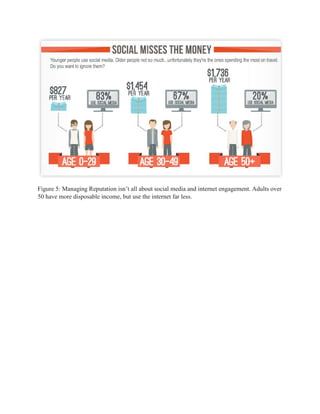
Only 20% of adults over 50 use social media and are under-represented when it comes to making
online reviews, but they represent twice the spending in hospitality compared to the under 30
demographic. (Barsky)(see figure 5) Finally, Market Metrix found that 15% of reviews were
being paid-for in 2014 and suggest that as many as 40% of reviews online are fake (coming from
people who never stayed at the hotel). (Barsky) This analysis shows a potential for distortion in
terms of how a hotel can efficiently manage its reputation online and engage with legitimate
customer complaints, while not sacrificing precious revenue on areas that do not need to be
addressed.
A hotels reputation is really based on guest experience and satisfaction. One of the major
problems in the past was that hotels misrepresented their guest-rooms or facilities on their
websites or on OTAs. If a hotel claims that all its rooms have spectacular views of the beach, or
presents pictures of a room with a view of the ocean, and a guest books the room associated with
that image online—the room had better live up to the expectations of that image when the guest
arrives. Typically, such misrepresentations can lead to negative reviews and low guest
satisfaction. One way to address this problem is by using "reality marketing". (Drewnicki) (see
figure 4) This approach posts accurate picture of rooms and gives accurate descriptions—even if
they don't have the best view or the most amenities. Guests want to know what they are getting
when they book and they may still be likely to choose to stay with a hotel because it is less
expensive, or in a more practical location (Library Hotel Collection in New York uses this
technique in marketing their rooms). By eliminating discrepancies between the online
representation and the actual hotel, guests are less likely to respond negatively and in this way
the hotel maintains its positive reputation. (Drewnicki)
Reputation Management is ultimately a bit of a misnomer if you think of it as a way to
control or manipulate guest's opinions after the fact. Reputation is decided by guests and the
general public based on their experience with the hotel. A hotel can promote a positive image,
and advertise their experience, but after check-out it will be the guest who decides if the hotel
lived up to these expectations. It is, therefore, important for hotels to provide accurate
descriptions and images of the experience they are offering, and obviously to provide excellent
service at all times. If the hotel lives up to the expectations of its guests it will maintain a good
reputation. Engaging with guests on site or online allows a hotel to address specific areas of
improvement and customer complaints in some cases, but this practice, is not so much
Reputation Management as it is scrambling to put out a fire. Once a guest has left the hotel it is
nearly impossible to remedy their complaints to gain their repeat business and ensure their
satisfaction. Good Reputation Management starts with marketing accurate representations,
continues with providing excellent service, and ends when the guest checks-out with a smile.
(see figure 6)
Figure 1: A search for “best hotels in New Orleans” yields these top-results. Notice the first
result is a list of the top 30 hotels according to TripAdvisor. If you have a hotel in New Orleans
you probably want to be on this list. I’m searching for a particular hotel: The Hyatt on Bourbon
Street because I’ve stayed there before, I loved the location, and the rooms were spacious and
newly renovated.
Figure 2: Sure enough the Hyatt French Quarter is ranked number 11 out of 30. Not bad,
especially for the price. My friends and I wanted to be close enough to the bars on Bourdon
Street that we wouldn’t have to get a cab, and we could walk to and from our hotel easily. Notice
how the guest quotes mention the location. Now that I’ve found the hotel I want I’m going to
click on it and see if it’s really what I’m looking for.
Figure 3: This shows the importance a hotel must place on its web presence. In addition to
having a lot of favorable reviews on TripAdvisor, the Hyatt French Quarter also has its own
property website which you could access from the TripAdvisor site (the link is in the upper right
hand corner). But if you are already satisfied OTAs often prompt guests to enter the dates of their
trip so they can begin comparing prices. Once someone has entered the dates they are planning to
stay, the OTAs can begin to use its algorithms to offer similar hotels at better prices or get you
the best price on the hotel you want. In this case I want to stay loyal to this Hyatt because my
stay was so good the first time.
Figure 4: When I click on Hyatt French Quarter’s photo gallery on TripAdvisor it takes me to a
large catalog page of photos (this is just a small section). The photos are divided into sub-
catalogues based on room description and there are other sub catalogues for the pool and gym as
well as other parts of the hotel. By dividing the images into categories based on what type of
room it is Hyatt French Quarter is using ‘reality marketing’ because they are showing the guest
exactly what to expect when they book a particular room. In addition TripAdvisor also has a
section for guests to post their personal photos to in a separate gallery so potential customers can
see how much fun their experience might be if they stay with Hyatt French Quarter. By the way
these rooms really nice, I can tell you from experience they live up to the pictures.
Figure 5: Managing Reputation isn’t all about social media and internet engagement. Adults over
50 have more disposable income, but use the internet far less.
Figure 6: A guest posted this photo from their stay at the Hyatt French Quarter on TripAdvisor.
A marketing strategy doesn’t get much easier than when your guests do it for you. Time to hit
the street and have some fun!
Works Cited
Barsky Ph.D., Johnathan, Dr., and Mike Waite. For Hospitality, Social Media Is Too Little Too
Late. Rep. Market Metrix, 14 Nov. 2012. Web. 19 Mar. 2015.
<corp.marketmetrix/pdfs/MMx_Social_Media_Too_Little_Too_Late.pdf>.
Drewnicki, Natasha. "Is Reality Marketing the Future of Online Reputation Management?"
ReviewPro. Review Rank S.A., 19 Aug. 2014. Web. 19 Mar. 2015.
<www.reviewpro.com/is-reality-marketing-the-future-of-online-reputation-management-
32660>.
Friedlander, R. J. "Trends That Will Boost Your Hotel Marketing in 2015." ReviewPro. Review
Rank S.A., 9 Feb. 2015. Web. 19 Mar. 2015. <www.reviewpro.com/trends-boost-your-
hotel-marketing-2015-33541>.
Hutton, James G., Michael B. Goodman, Jill B. Alexander, and Christina M. Genest. "Reputation
Management: The New Face of Corporate Public Relations?" Public Relations Review
27.3 (2001): 247-61. Science Direct. Elsevier B.V., 21 Sept. 2001. Web. 19 Mar. 2015.
<www.sciencedirect.com/science/pii/S0363811101000856>.
Lieb, Rebecca. "How Your Content Strategy Is Critical For Reputation Management." Marketing
Land. Matt McGee, 10 July 2012. Web. 19 Mar. 2015. <marketingland.com/how-your-
content-strategy-is-critical-for-reputation-management-16073>.
Milo, Moryt. "Great Businesses Lean Forward, Respond Fast." Silicon Valley Business Journal.
American City Business Journals, 17 May 2013. Web. 19 Mar. 2015.
<www.bizjournals.com/sanjose/print-edition/2013/05/17/great-businesses-lean-forward-
respond.html>.

Chad Cirino_Int_Hos

  • 1.
    Chad Cirino Introduction toHospitality March 19, 2015 Prof. Malan Leaving With a Smile: Hotel Reputation Management Reputation Management was originally a Public Relations term used to describe the way in which a public relations specialist could control the public image of an individual, company, or brand. With the proliferation of the internet, and social media, Reputation Management has taken a new form. Reputation Management is a practice of engaging with customer reviews and potentially damaging content on the internet so as to promote a better brand image, as well as engaging with customer feedback to find solutions or address problems before they affect brand image. (Milo) Managing the reputation of a brand is now a complex and difficult task that includes interacting with and utilizing the resources of review sites, social media, and search results (known as SEO optimization). (Lieb) A decade ago, when social media was a relatively new phenomenon, Reputation Management took on both ethical and unethical forms in business. Unethical Reputation Management is considered to include practices such as influencing search results online through something called SEO Gaming (creating websites, blogs, or content that includes tags related to a brand or product so it will post higher in search engine results), posting fake positive reviews on review sites to garner a higher rating, or censoring negative customer feedback. Most of these issues have been addressed by more sophisticated analytical tools such as Google's search engine analytics, (see figure 1) and review sites have in some instances begun to require users to register, or prove they are a customer (in our case an actual guest of the hotel they are
  • 2.
    reviewing). Ethical practicesin Reputation Management include engaging with and responding to customer problems and complaints, asking websites to correct inaccurate information, and using customer feedback to influence brand development. (Hutton) Statistics on Reputation Management in terms of a correlation to revenue are somewhat shaky. Reputation is difficult to measure and therefore difficult to correlate. One analysis found, "the more companies focused on "managing relationships with non-customer publics" or reputation management" as their guiding communication philosophy, the more likely they were to have a strong reputation." (Hutton) Reputation, as the paper explains, "Is something an organization has with strangers, but a relationship is generally something an organization has with its friends and associates." (Hutton) For a hotel this is an important distinction. Hotels want to build relationships with their guests by providing an experiential stay as well as excellent service because that relationship will create a return guest, but hotels also want to have a positive reputation to potential guest who have never stayed at a particular property because that potential guest will be more inclined to stay with a hotel he or she is aware has a good reputation. In this way, reputation is about generating a positive awareness of brand or location so as to draw in new customers. Hotel brands and individual properties have already seen the value of engaging with social media and the internet. You would be hard-pressed to find one that doesn't have a website, Facebook page, Twitter account, and probably a few other forms of social media. (see figure 3) This trend is something seen as a necessity in most businesses, but it is particularly important to the hospitality industry because bookings and travel research is increasingly occurring online. By having a proactive presence on the internet and social media hotels can, to a certain extent, control their reputation by promoting themselves, interacting with potential guests, and engaging
  • 3.
    with feedback fromprior guests. Nevertheless, review sites and online travel agencies like TripAdvisor (see figure 2) and Expedia are places where negative reviews can seemingly hurt a hotels reputation. (Friedlander) A guest that posts about their negative experience at a particular hotel on Facebook or Twitter has now potentially damaged a hotels reputation in the eyes of many non-guests (e.g. potential guests). Furthermore, it is difficult to engage with guest feedback on OTAs and social media because the hotel cannot directly interact with a guest complaint to solve a problem and sometimes these complaints are unspecific, making it difficult to decide where a hotel should focus its resources to improve. There are several ways in which hotels have begun to approach reputation management. First, hotels have begun to use Reputation Management Services—companies like ReviewPro— which use software to monitor OTAs and social media and analyze reviews. ReviewPro claims there are more than 140 OTA sources. (Friedlander) This technology links with a hotels property management system and allows management and employees access to data they can actually use to improve performance and increase guest satisfaction. Second, hotels can use guest surveys upon check-out, either emailed to a guest or provided on an in-house iPad or tablet. (Friedlander) These surveys are more comprehensive and specific and seek to motive the guest to ponder the entire experience, explain the positive and negative aspects of their stay, and identify specific areas of improvement. Surveys such as this can mitigate future reputation management issues by addressing guest complaints on site and specifically as opposed to much later (after the guest has left) and erroneously (such as an ambiguous review on an OTA that does not address any specific issue that can be resolved). There is still some question in the hospitality industry as to whether social media and OTA reviews actually represent a clear image of customer satisfaction. Data from guests on
  • 4.
    those sites seemsto be somewhat unreliable because guests tend to be more likely to be motivated to make a negative review and less likely to make a positive one (skewing reviews toward the negatives). (Barsky) Guests that write and review hotels online also tend to be of a younger demographic. Market Metrix found that younger people were more likely to make reviews because they were more likely to use social media, and make travel plans using OTAs. Only 20% of adults over 50 use social media and are under-represented when it comes to making online reviews, but they represent twice the spending in hospitality compared to the under 30 demographic. (Barsky)(see figure 5) Finally, Market Metrix found that 15% of reviews were being paid-for in 2014 and suggest that as many as 40% of reviews online are fake (coming from people who never stayed at the hotel). (Barsky) This analysis shows a potential for distortion in terms of how a hotel can efficiently manage its reputation online and engage with legitimate customer complaints, while not sacrificing precious revenue on areas that do not need to be addressed. A hotels reputation is really based on guest experience and satisfaction. One of the major problems in the past was that hotels misrepresented their guest-rooms or facilities on their websites or on OTAs. If a hotel claims that all its rooms have spectacular views of the beach, or presents pictures of a room with a view of the ocean, and a guest books the room associated with that image online—the room had better live up to the expectations of that image when the guest arrives. Typically, such misrepresentations can lead to negative reviews and low guest satisfaction. One way to address this problem is by using "reality marketing". (Drewnicki) (see figure 4) This approach posts accurate picture of rooms and gives accurate descriptions—even if they don't have the best view or the most amenities. Guests want to know what they are getting when they book and they may still be likely to choose to stay with a hotel because it is less
  • 5.
    expensive, or ina more practical location (Library Hotel Collection in New York uses this technique in marketing their rooms). By eliminating discrepancies between the online representation and the actual hotel, guests are less likely to respond negatively and in this way the hotel maintains its positive reputation. (Drewnicki) Reputation Management is ultimately a bit of a misnomer if you think of it as a way to control or manipulate guest's opinions after the fact. Reputation is decided by guests and the general public based on their experience with the hotel. A hotel can promote a positive image, and advertise their experience, but after check-out it will be the guest who decides if the hotel lived up to these expectations. It is, therefore, important for hotels to provide accurate descriptions and images of the experience they are offering, and obviously to provide excellent service at all times. If the hotel lives up to the expectations of its guests it will maintain a good reputation. Engaging with guests on site or online allows a hotel to address specific areas of improvement and customer complaints in some cases, but this practice, is not so much Reputation Management as it is scrambling to put out a fire. Once a guest has left the hotel it is nearly impossible to remedy their complaints to gain their repeat business and ensure their satisfaction. Good Reputation Management starts with marketing accurate representations, continues with providing excellent service, and ends when the guest checks-out with a smile. (see figure 6)
  • 6.
    Figure 1: Asearch for “best hotels in New Orleans” yields these top-results. Notice the first result is a list of the top 30 hotels according to TripAdvisor. If you have a hotel in New Orleans you probably want to be on this list. I’m searching for a particular hotel: The Hyatt on Bourbon Street because I’ve stayed there before, I loved the location, and the rooms were spacious and newly renovated.
  • 7.
    Figure 2: Sureenough the Hyatt French Quarter is ranked number 11 out of 30. Not bad, especially for the price. My friends and I wanted to be close enough to the bars on Bourdon Street that we wouldn’t have to get a cab, and we could walk to and from our hotel easily. Notice how the guest quotes mention the location. Now that I’ve found the hotel I want I’m going to click on it and see if it’s really what I’m looking for.
  • 8.
    Figure 3: Thisshows the importance a hotel must place on its web presence. In addition to having a lot of favorable reviews on TripAdvisor, the Hyatt French Quarter also has its own property website which you could access from the TripAdvisor site (the link is in the upper right hand corner). But if you are already satisfied OTAs often prompt guests to enter the dates of their trip so they can begin comparing prices. Once someone has entered the dates they are planning to stay, the OTAs can begin to use its algorithms to offer similar hotels at better prices or get you the best price on the hotel you want. In this case I want to stay loyal to this Hyatt because my stay was so good the first time.
  • 9.
    Figure 4: WhenI click on Hyatt French Quarter’s photo gallery on TripAdvisor it takes me to a large catalog page of photos (this is just a small section). The photos are divided into sub- catalogues based on room description and there are other sub catalogues for the pool and gym as well as other parts of the hotel. By dividing the images into categories based on what type of room it is Hyatt French Quarter is using ‘reality marketing’ because they are showing the guest exactly what to expect when they book a particular room. In addition TripAdvisor also has a section for guests to post their personal photos to in a separate gallery so potential customers can see how much fun their experience might be if they stay with Hyatt French Quarter. By the way these rooms really nice, I can tell you from experience they live up to the pictures.
  • 10.
    Figure 5: ManagingReputation isn’t all about social media and internet engagement. Adults over 50 have more disposable income, but use the internet far less.
  • 11.
    Figure 6: Aguest posted this photo from their stay at the Hyatt French Quarter on TripAdvisor. A marketing strategy doesn’t get much easier than when your guests do it for you. Time to hit the street and have some fun!
  • 12.
    Works Cited Barsky Ph.D.,Johnathan, Dr., and Mike Waite. For Hospitality, Social Media Is Too Little Too Late. Rep. Market Metrix, 14 Nov. 2012. Web. 19 Mar. 2015. <corp.marketmetrix/pdfs/MMx_Social_Media_Too_Little_Too_Late.pdf>. Drewnicki, Natasha. "Is Reality Marketing the Future of Online Reputation Management?" ReviewPro. Review Rank S.A., 19 Aug. 2014. Web. 19 Mar. 2015. <www.reviewpro.com/is-reality-marketing-the-future-of-online-reputation-management- 32660>. Friedlander, R. J. "Trends That Will Boost Your Hotel Marketing in 2015." ReviewPro. Review Rank S.A., 9 Feb. 2015. Web. 19 Mar. 2015. <www.reviewpro.com/trends-boost-your- hotel-marketing-2015-33541>. Hutton, James G., Michael B. Goodman, Jill B. Alexander, and Christina M. Genest. "Reputation Management: The New Face of Corporate Public Relations?" Public Relations Review 27.3 (2001): 247-61. Science Direct. Elsevier B.V., 21 Sept. 2001. Web. 19 Mar. 2015. <www.sciencedirect.com/science/pii/S0363811101000856>. Lieb, Rebecca. "How Your Content Strategy Is Critical For Reputation Management." Marketing Land. Matt McGee, 10 July 2012. Web. 19 Mar. 2015. <marketingland.com/how-your- content-strategy-is-critical-for-reputation-management-16073>.
  • 13.
    Milo, Moryt. "GreatBusinesses Lean Forward, Respond Fast." Silicon Valley Business Journal. American City Business Journals, 17 May 2013. Web. 19 Mar. 2015. <www.bizjournals.com/sanjose/print-edition/2013/05/17/great-businesses-lean-forward- respond.html>.