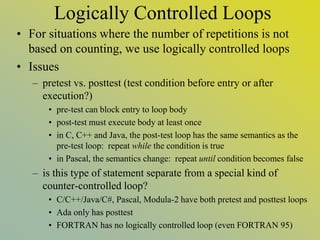
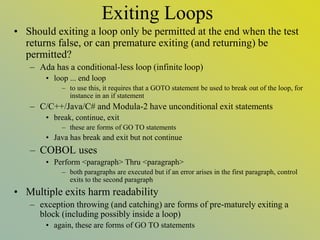
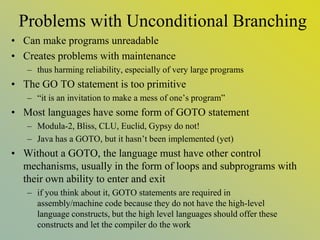
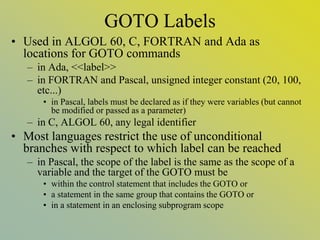
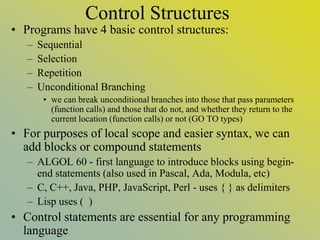
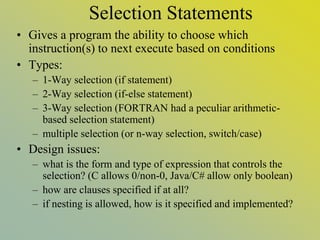
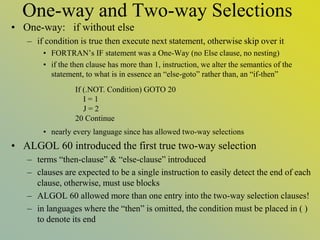
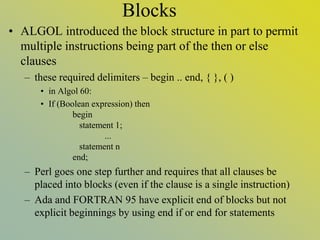
Control structures provide programming languages with the ability to alter the sequential execution of code. The key control structures are sequential execution, selection (if/else), repetition (loops), and unconditional branching (goto). Selection statements allow a program to choose which instructions to execute based on conditions, while repetition statements allow code to execute repeatedly. Early languages like FORTRAN had limited control structures, while ALGOL introduced more robust structures like blocks and flexible for loops. Modern languages continue to refine control structures for readability and reliability.
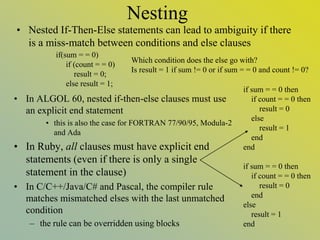
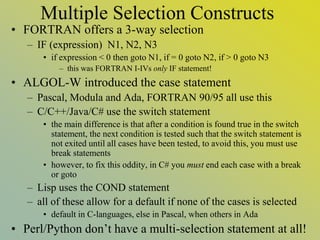
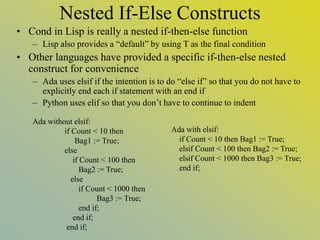
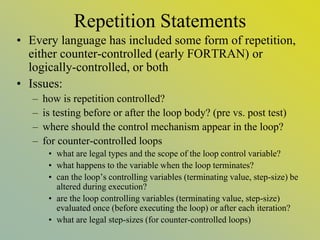
![FORTRAN’s DO statement
• DO label variable = initial, terminal [,step]
– example: Do 10 K = 1, 10
– FORTRAN I – IV: a posttest loop, stepsize defaults to 1
– label is a line number that indicates the last instruction in the loop body
– FORTRAN 77, 90 and 95: pretest loop
• Integers (literals or variables) only for initial, terminal, step
– these values are computed prior to loop execution so that, if a variable
changes values in the loop, it does not affect the number of loop iterations
DO 10 I = J, K * 10, L
K = K + 1
L = L + 2
10 CONTINUE
If J = 1, K = 5, L = 2, the loop would
iterate 25 times in spite of K and L
changing in the loop body
initvalue = J
terminalvalue = K * 10
stepvalue = L
iterationcount =
max(int((K*10 – J) / L), 1*)
* - in FORTRAN I-IV, this is a post-test
loop so it must iterate at least 1 time, in
later FORTRANs, this would become 0](https://image.slidesharecdn.com/ch8-221012154914-a0918a93/85/ch8-ppt-9-320.jpg)
![ALGOL For Loop
• ALGOL 60 introduced an extremely flexible for loop as
a reaction to FORTRAN’s primitive and restrictive Do
– the programmer controls the number of iterations by
• a counter controlled mechanism like FORTRAN’s DO but where the
step size and terminating value could change during iterations
• enumerating a list of values to iterate through
• using a logical statement to control termination
• or any combination thereof
• Basic form:
– for <var> := <list>{,<list>} | <list> <expr> | <expr> while
<boolean> | <expr> step <expr> until <expr> do <stmt>
– examples:
• for count :=1, 2, 3, 4, 5, 6, 7 do list[count]:=0
• for count:= 1 step 1 until 7 do list[count]:=0
• for count:=1, count+1 while (count <=7) do list[count]:=0
• for I := 1, 4, 13, step 5 until 23, 3*I while I < 300, 8, -4 do …
– the values for I iterate through: 1, 4, 13, 18, 23, 69, 207, 8, -4](https://image.slidesharecdn.com/ch8-221012154914-a0918a93/85/ch8-ppt-10-320.jpg)
![Other Languages For Loops
• COBOL:
– Perform <expr> Times <statements> End-Perform
– Perform Varying <var> From <expr> By <expr> Until <expr>
<statements> End-Perform
• PL/I:
– DO <var> = <start> TO <stop> {BY <stepsize>}; <statements> END;
– <start>, <stop> and <stepsize> can be int or float values
– like FORTRAN though, the values are only evaluated once before the
loop starts
– can have multiple lists of <start> TO <stop> values
• DO I = 1 TO 10, 20 to 30, 50 TO 100; …
• Pascal: for <var> := <init> (to | downto) <final> do
– <var>, <init>, <final> are any ordinal type but are evaluated prior to the
start of the loop, step size is fixed as 1 or -1 depending on whether you use
to or downto
• Ada: for <var> in [reverse] <range> loop ... end loop
– <range> is a subrange as in 1..10 (the values can be ints or enumerated
types)](https://image.slidesharecdn.com/ch8-221012154914-a0918a93/85/ch8-ppt-11-320.jpg)
![Iterator Loops
• A variation of the counting loop is a loop that iterates
once for each item in the list (or data structure) provided
– Algol’s for loop has the capability of iterating over a list, but
the list must be explicitly enumerated
– Python: for <var> in <range>:
• <range> will be a tuple or range(value [, value] [, value])
• note that Python’s for loop can also be a counting loop by using the
range function as in for x in range(0, 10, 2) which iterates over 0, 2, 4,
6, 8, 10
– C# has a foreach statement which can iterate across array
elements
– Java 5.0’s for loop has been enhanced to work on objects of
type Iterable
– Common Lisp has a dolist statement much like C#’s foreach](https://image.slidesharecdn.com/ch8-221012154914-a0918a93/85/ch8-ppt-13-320.jpg)