Advanced Web Applications
Course Introduction and Curriculum
Course Introduction
This course aims to introduce students to
advanced web application development
technologies and tools.
Students will learn how to design and develop
modern, interactive web applications using the
latest technologies.
The course covers both front-end and back-end
development aspects and their integration to
build complete web applications.
Students will gain practical skills through hands-
on projects that simulate real-world
development environments.
Course Objectives
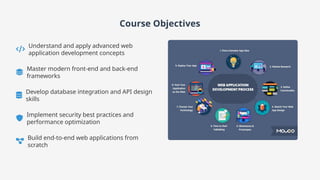
Understand and apply advanced web
application development concepts
Master modern front-end and back-end
frameworks
Develop database integration and API design
skills
Implement security best practices and
performance optimization
Build end-to-end web applications from
scratch
Modern Web Architectures
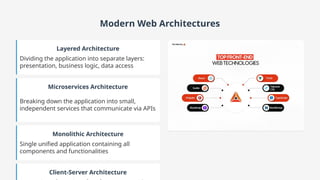
Layered Architecture
Dividing the application into separate layers:
presentation, business logic, data access
Microservices Architecture
Breaking down the application into small,
independent services that communicate via APIs
Monolithic Architecture
Single unified application containing all
components and functionalities
Client-Server Architecture
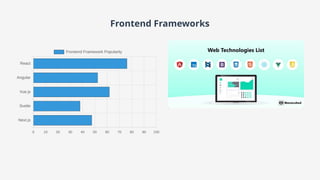
Frontend Frameworks
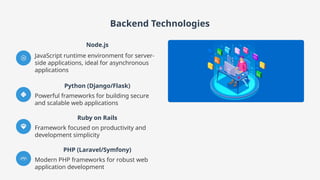
Backend Technologies
Node.js
JavaScript runtime environment for server-
side applications, ideal for asynchronous
applications
Python (Django/Flask)
Powerful frameworks for building secure
and scalable web applications
Ruby on Rails
Framework focused on productivity and
development simplicity
PHP (Laravel/Symfony)
Modern PHP frameworks for robust web
application development
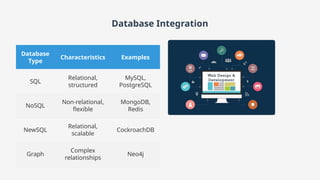
Database Integration
Database
Type
Characteristics Examples
SQL
Relational,
structured
MySQL,
PostgreSQL
NoSQL
Non-relational,
flexible
MongoDB,
Redis
NewSQL
Relational,
scalable
CockroachDB
Graph
Complex
relationships
Neo4j
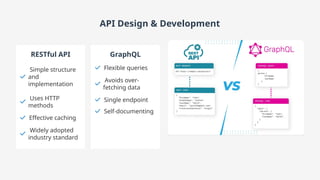
API Design & Development
RESTful API
Simple structure
and
implementation
Uses HTTP
methods
Effective caching
Widely adopted
industry standard
GraphQL
Flexible queries
Avoids over-
fetching data
Single endpoint
Self-documenting
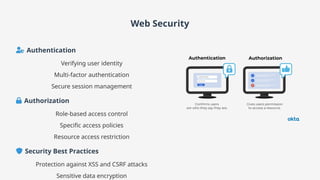
Web Security
Authentication
Verifying user identity
Multi-factor authentication
Secure session management
Authorization
Role-based access control
Specific access policies
Resource access restriction
Security Best Practices
Protection against XSS and CSRF attacks
Sensitive data encryption
Course Summary
User interface development using modern
frameworks
Backend services and API development
Database integration and data
management
Security best practices and performance
optimization
Integrated projects combining all acquired
skills

Advanced Web Applications lecture Note .pptx

  • 1.
    Advanced Web Applications CourseIntroduction and Curriculum
  • 2.
    Course Introduction This courseaims to introduce students to advanced web application development technologies and tools. Students will learn how to design and develop modern, interactive web applications using the latest technologies. The course covers both front-end and back-end development aspects and their integration to build complete web applications. Students will gain practical skills through hands- on projects that simulate real-world development environments.
  • 3.
    Course Objectives Understand andapply advanced web application development concepts Master modern front-end and back-end frameworks Develop database integration and API design skills Implement security best practices and performance optimization Build end-to-end web applications from scratch
  • 4.
    Modern Web Architectures LayeredArchitecture Dividing the application into separate layers: presentation, business logic, data access Microservices Architecture Breaking down the application into small, independent services that communicate via APIs Monolithic Architecture Single unified application containing all components and functionalities Client-Server Architecture
  • 5.
  • 6.
    Backend Technologies Node.js JavaScript runtimeenvironment for server- side applications, ideal for asynchronous applications Python (Django/Flask) Powerful frameworks for building secure and scalable web applications Ruby on Rails Framework focused on productivity and development simplicity PHP (Laravel/Symfony) Modern PHP frameworks for robust web application development
  • 7.
  • 8.
    API Design &Development RESTful API Simple structure and implementation Uses HTTP methods Effective caching Widely adopted industry standard GraphQL Flexible queries Avoids over- fetching data Single endpoint Self-documenting
  • 9.
    Web Security Authentication Verifying useridentity Multi-factor authentication Secure session management Authorization Role-based access control Specific access policies Resource access restriction Security Best Practices Protection against XSS and CSRF attacks Sensitive data encryption
  • 10.
    Course Summary User interfacedevelopment using modern frameworks Backend services and API development Database integration and data management Security best practices and performance optimization Integrated projects combining all acquired skills