Computer Evolution and
Performance
ENIAC - background
• Electronic Numerical Integrator And Computer
• Eckert and Mauchly
• University of Pennsylvania
• Trajectory tables for weapons
• Started 1943
• Finished 1946
– Too late for war effort
• Used until 1955
ENIAC - details
• Decimal (not binary)
• 20 accumulators of 10 digits
• Programmed manually by switches
• 18,000 vacuum tubes
• 30 tons
• 15,000 square feet
• 140 kW power consumption
• 5,000 additions per second
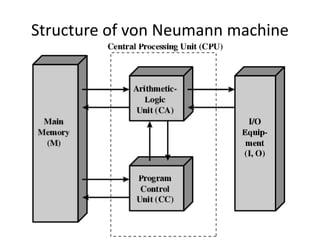
von Neumann/Turing
• Stored Program concept
• Main memory storing programs and data
• ALU operating on binary data
• Control unit interpreting instructions from
memory and executing
• Input and output equipment operated by control
unit
• Princeton Institute for Advanced Studies
– IAS
• Completed 1952
Structure of von Neumann machine
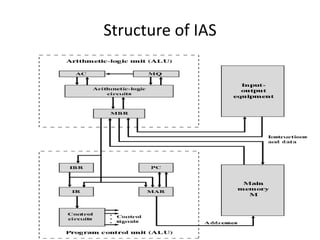
IAS - details
• 1000 x 40 bit words
– Binary number
– 2 x 20 bit instructions
• Set of registers (storage in CPU)
– Memory Buffer Register
– Memory Address Register
– Instruction Register
– Instruction Buffer Register
– Program Counter
– Accumulator
– Multiplier Quotient
Structure of IAS
Commercial Computers
• 1947 - Eckert-Mauchly Computer Corporation
• UNIVAC I (Universal Automatic Computer)
• US Bureau of Census 1950 calculations
• Became part of Sperry-Rand Corporation
• Late 1950s - UNIVAC II
– Faster
– More memory
IBM
• Punched-card processing equipment
• 1953 - the 701
– IBM’s first stored program computer
– Scientific calculations
• 1955 - the 702
– Business applications
• Lead to 700/7000 series
Transistors
• Replaced vacuum tubes
• Smaller
• Cheaper
• Less heat dissipation
• Solid State device
• Made from Silicon (Sand)
• Invented 1947 at Bell Labs
• William Shockley et al.
Transistor Based Computers
• Second generation machines
• NCR & RCA produced small transistor
machines
• IBM 7000
• DEC - 1957
– Produced PDP-1
Microelectronics
• Literally - “small electronics”
• A computer is made up of gates, memory cells
and interconnections
• These can be manufactured on a
semiconductor
• e.g. silicon wafer
Generations of Computer
• Vacuum tube - 1946-1957
• Transistor - 1958-1964
• Small scale integration - 1965 on
– Up to 100 devices on a chip
• Medium scale integration - to 1971
– 100-3,000 devices on a chip
• Large scale integration - 1971-1977
– 3,000 - 100,000 devices on a chip
• Very large scale integration - 1978 -1991
– 100,000 - 100,000,000 devices on a chip
Moore’s Law
• Increased density of components on chip
• Gordon Moore – co-founder of Intel
• Number of transistors on a chip will double every year
• Since 1970’s development has slowed a little
– Number of transistors doubles every 18 months
• Cost of a chip has remained almost unchanged
• Higher packing density means shorter electrical paths, giving
higher performance
• Smaller size gives increased flexibility
• Reduced power and cooling requirements
• Fewer interconnections increases reliability
x86 Evolution (1)
• 8080
– first general purpose microprocessor
– 8 bit data path
– Used in first personal computer – Altair
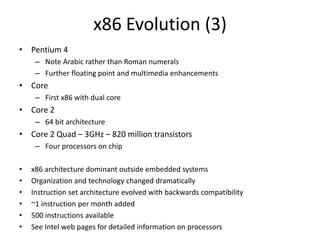
• 8086 – 5MHz – 29,000 transistors
– much more powerful
– 16 bit
– instruction cache, prefetch few instructions
– 8088 (8 bit external bus) used in first IBM PC
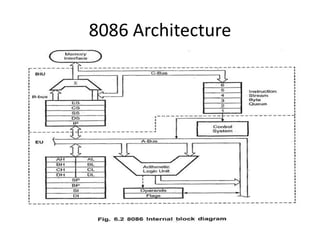
• 80286
– 16 Mbyte memory addressable
– up from 1Mb
• 80386
– 32 bit
– Support for multitasking
• 80486
– sophisticated powerful cache and instruction pipelining
– built in maths co-processor
x86 Evolution (2)
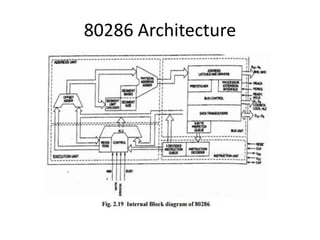
• Pentium
– Superscalar
– Multiple instructions executed in parallel
• Pentium Pro
– Increased superscalar organization
– Aggressive register renaming
– branch prediction
– data flow analysis
– speculative execution
• Pentium II
– MMX technology
– graphics, video & audio processing
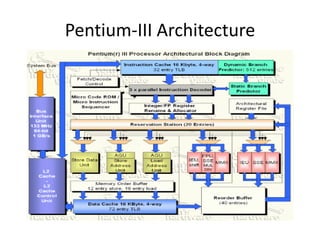
• Pentium III
– Additional floating point instructions for 3D graphics
x86 Evolution (3)
• Pentium 4
– Note Arabic rather than Roman numerals
– Further floating point and multimedia enhancements
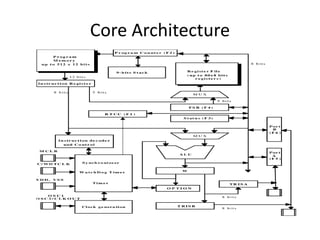
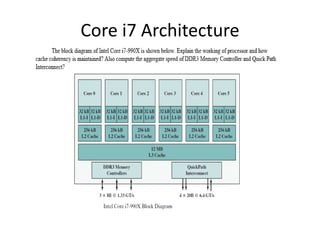
• Core
– First x86 with dual core
• Core 2
– 64 bit architecture
• Core 2 Quad – 3GHz – 820 million transistors
– Four processors on chip
• x86 architecture dominant outside embedded systems
• Organization and technology changed dramatically
• Instruction set architecture evolved with backwards compatibility
• ~1 instruction per month added
• 500 instructions available
• See Intel web pages for detailed information on processors
8086 Architecture
8086 Architecture
80286 Architecture
80386 Architecture
80486 Architecture
Pentium Architecture
Pentium-III Architecture
Pentium-IV Architecture
Core Architecture
Core i7 Architecture
Embedded Systems
ARM
• ARM evolved from RISC design
• Used mainly in embedded systems
– Used within product
– Not general purpose computer
– Dedicated function
– E.g. Anti-lock brakes in car
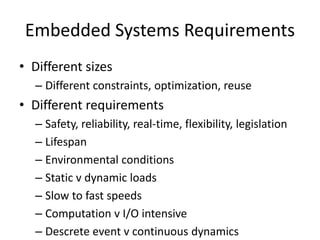
Embedded Systems Requirements
• Different sizes
– Different constraints, optimization, reuse
• Different requirements
– Safety, reliability, real-time, flexibility, legislation
– Lifespan
– Environmental conditions
– Static v dynamic loads
– Slow to fast speeds
– Computation v I/O intensive
– Descrete event v continuous dynamics
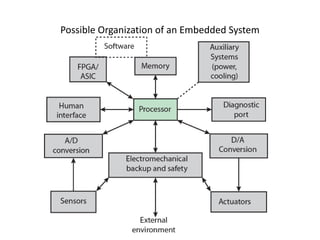
Possible Organization of an Embedded System
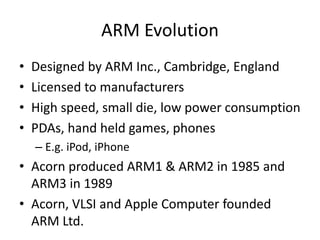
ARM Evolution
• Designed by ARM Inc., Cambridge, England
• Licensed to manufacturers
• High speed, small die, low power consumption
• PDAs, hand held games, phones
– E.g. iPod, iPhone
• Acorn produced ARM1 & ARM2 in 1985 and
ARM3 in 1989
• Acorn, VLSI and Apple Computer founded
ARM Ltd.
ARM Systems Categories
• Embedded real time
• Application platform
– Linux, Palm OS, Symbian OS, Windows mobile
• Secure applications

ch2 -A Computer Evolution and Performance updated.pdf

  • 1.
  • 2.
    ENIAC - background •Electronic Numerical Integrator And Computer • Eckert and Mauchly • University of Pennsylvania • Trajectory tables for weapons • Started 1943 • Finished 1946 – Too late for war effort • Used until 1955
  • 3.
    ENIAC - details •Decimal (not binary) • 20 accumulators of 10 digits • Programmed manually by switches • 18,000 vacuum tubes • 30 tons • 15,000 square feet • 140 kW power consumption • 5,000 additions per second
  • 4.
    von Neumann/Turing • StoredProgram concept • Main memory storing programs and data • ALU operating on binary data • Control unit interpreting instructions from memory and executing • Input and output equipment operated by control unit • Princeton Institute for Advanced Studies – IAS • Completed 1952
  • 5.
    Structure of vonNeumann machine
  • 6.
    IAS - details •1000 x 40 bit words – Binary number – 2 x 20 bit instructions • Set of registers (storage in CPU) – Memory Buffer Register – Memory Address Register – Instruction Register – Instruction Buffer Register – Program Counter – Accumulator – Multiplier Quotient
  • 7.
  • 8.
    Commercial Computers • 1947- Eckert-Mauchly Computer Corporation • UNIVAC I (Universal Automatic Computer) • US Bureau of Census 1950 calculations • Became part of Sperry-Rand Corporation • Late 1950s - UNIVAC II – Faster – More memory
  • 9.
    IBM • Punched-card processingequipment • 1953 - the 701 – IBM’s first stored program computer – Scientific calculations • 1955 - the 702 – Business applications • Lead to 700/7000 series
  • 10.
    Transistors • Replaced vacuumtubes • Smaller • Cheaper • Less heat dissipation • Solid State device • Made from Silicon (Sand) • Invented 1947 at Bell Labs • William Shockley et al.
  • 11.
    Transistor Based Computers •Second generation machines • NCR & RCA produced small transistor machines • IBM 7000 • DEC - 1957 – Produced PDP-1
  • 12.
    Microelectronics • Literally -“small electronics” • A computer is made up of gates, memory cells and interconnections • These can be manufactured on a semiconductor • e.g. silicon wafer
  • 13.
    Generations of Computer •Vacuum tube - 1946-1957 • Transistor - 1958-1964 • Small scale integration - 1965 on – Up to 100 devices on a chip • Medium scale integration - to 1971 – 100-3,000 devices on a chip • Large scale integration - 1971-1977 – 3,000 - 100,000 devices on a chip • Very large scale integration - 1978 -1991 – 100,000 - 100,000,000 devices on a chip
  • 14.
    Moore’s Law • Increaseddensity of components on chip • Gordon Moore – co-founder of Intel • Number of transistors on a chip will double every year • Since 1970’s development has slowed a little – Number of transistors doubles every 18 months • Cost of a chip has remained almost unchanged • Higher packing density means shorter electrical paths, giving higher performance • Smaller size gives increased flexibility • Reduced power and cooling requirements • Fewer interconnections increases reliability
  • 15.
    x86 Evolution (1) •8080 – first general purpose microprocessor – 8 bit data path – Used in first personal computer – Altair • 8086 – 5MHz – 29,000 transistors – much more powerful – 16 bit – instruction cache, prefetch few instructions – 8088 (8 bit external bus) used in first IBM PC • 80286 – 16 Mbyte memory addressable – up from 1Mb • 80386 – 32 bit – Support for multitasking • 80486 – sophisticated powerful cache and instruction pipelining – built in maths co-processor
  • 16.
    x86 Evolution (2) •Pentium – Superscalar – Multiple instructions executed in parallel • Pentium Pro – Increased superscalar organization – Aggressive register renaming – branch prediction – data flow analysis – speculative execution • Pentium II – MMX technology – graphics, video & audio processing • Pentium III – Additional floating point instructions for 3D graphics
  • 17.
    x86 Evolution (3) •Pentium 4 – Note Arabic rather than Roman numerals – Further floating point and multimedia enhancements • Core – First x86 with dual core • Core 2 – 64 bit architecture • Core 2 Quad – 3GHz – 820 million transistors – Four processors on chip • x86 architecture dominant outside embedded systems • Organization and technology changed dramatically • Instruction set architecture evolved with backwards compatibility • ~1 instruction per month added • 500 instructions available • See Intel web pages for detailed information on processors
  • 18.
  • 19.
  • 20.
  • 21.
  • 22.
  • 23.
  • 24.
  • 25.
  • 26.
  • 27.
  • 28.
    Embedded Systems ARM • ARMevolved from RISC design • Used mainly in embedded systems – Used within product – Not general purpose computer – Dedicated function – E.g. Anti-lock brakes in car
  • 29.
    Embedded Systems Requirements •Different sizes – Different constraints, optimization, reuse • Different requirements – Safety, reliability, real-time, flexibility, legislation – Lifespan – Environmental conditions – Static v dynamic loads – Slow to fast speeds – Computation v I/O intensive – Descrete event v continuous dynamics
  • 30.
    Possible Organization ofan Embedded System
  • 31.
    ARM Evolution • Designedby ARM Inc., Cambridge, England • Licensed to manufacturers • High speed, small die, low power consumption • PDAs, hand held games, phones – E.g. iPod, iPhone • Acorn produced ARM1 & ARM2 in 1985 and ARM3 in 1989 • Acorn, VLSI and Apple Computer founded ARM Ltd.
  • 32.
    ARM Systems Categories •Embedded real time • Application platform – Linux, Palm OS, Symbian OS, Windows mobile • Secure applications