CHAPTER 19
Lecture Slides
A History of
Western Music
TENTH EDITION
by
J. PETER BURKHOLDER
DONALD JAY GROUT
CLAUDE V. PALISCA
© 2019 W. W. Norton & Co., Inc.
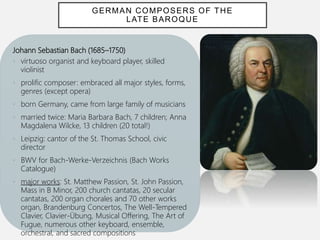
Johann Sebastian Bach (1685–1750)
• virtuoso organist and keyboard player, skilled
violinist
• prolific composer: embraced all major styles, forms,
genres (except opera)
• born Germany, came from large family of musicians
• married twice: Maria Barbara Bach, 7 children; Anna
Magdalena Wilcke, 13 children (20 total!)
• Leipzig: cantor of the St. Thomas School, civic
director
• BWV for Bach-Werke-Verzeichnis (Bach Works
Catalogue)
• major works: St. Matthew Passion, St. John Passion,
Mass in B Minor, 200 church cantatas, 20 secular
cantatas, 200 organ chorales and 70 other works
organ, Brandenburg Concertos, The Well-Tempered
Clavier, Clavier-Übung, Musical Offering, The Art of
Fugue, numerous other keyboard, ensemble,
orchestral, and sacred compositions
GERMAN COMPOSERS OF THE
LATE BAROQUE
Bach at work
• composed to fulfill needs of positions held
• Organ works, cantatas, solo or ensemble music for Court; some pedagogical
works for teaching, and concertos and chamber works for the collegium
musicum in Leipzig
• Leipzig – His position at St. Thomaskirche (St. Thomas Church –
Lutheran)
• Bach was the council’s third choice after Telemann and Christoph Graupner
• Bach’s position at St. Thomas’s School:
• teach Latin and music four hours a day
• compose, copy, and rehearse music for church services
• directed top choir, supervised other three
• trained best students on instruments; directed church instrumental ensemble
• composed one major work for church each week
• provided music for town ceremonies and at the university
• composed for weddings, funerals, other special occasions
GERMAN COMPOSERS OF THE
LATE BAROQUE
GERMAN COMPOSERS OF THE
LATE BAROQUE
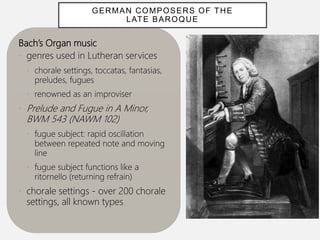
Bach’s Organ music
• genres used in Lutheran services
• chorale settings, toccatas, fantasias,
preludes, fugues
• renowned as an improviser
• Prelude and Fugue in A Minor,
BWM 543 (NAWM 102)
• fugue subject: rapid oscillation
between repeated note and moving
line
• fugue subject functions like a
ritornello (returning refrain)
• chorale settings - over 200 chorale
settings, all known types
GERMAN COMPOSERS OF THE
LATE BAROQUE
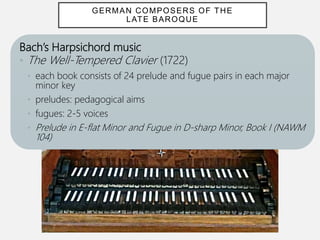
Bach’s Harpsichord music
• The Well-Tempered Clavier (1722)
• each book consists of 24 prelude and fugue pairs in each major
minor key
• preludes: pedagogical aims
• fugues: 2-5 voices
• Prelude in E-flat Minor and Fugue in D-sharp Minor, Book I (NAWM
104)
GERMAN COMPOSERS OF THE
LATE BAROQUE
Orchestral music
• Brandenburg Concertos, dedicated in 1721
to the Margrave of Brandenburg
• Ensemble suites
• dialogue between soloists and orchestra within
episodes
GERMAN COMPOSERS OF THE
LATE BAROQUE
Bach’s Cantatas
• new kind of sacred text, cantata –
traditions of the past: Lutheran chorale,
and elements of operatic recitative and
aria
• approximately 200 church cantatas
preserved
• Cantata Wachet Auf BWV 140 (1731,
Leipzig)
GERMAN COMPOSERS OF THE
LATE BAROQUE
Bach’s Passions: Performed at Vespers on Good Friday in
Leipzig
• Chorales, arias, recitatives
• St. John Passion (1724, later revised)
• St. Matthew Passion (1727, revised 1736)
• St. Matthew Passion (NAWM 106, excerpt)
• No. 37 “Wer hat dich so geschlagen“ (chorale about the judgment
of Jesus’s guilt)
• No. 38 “Petrus aber saß draußen im Palast“ (biblical narrative of
disciple Peter’s denials)
GERMAN COMPOSERS OF THE
LATE BAROQUE
George Frideric Handel [Georg Friederich Händel]
(1685–1759)
• Recognized since his time as one of the greatest
composers of the Baroque Era
• born in Germany
• education in organ, harpsichord, counterpoint,
current German and Italian idioms
• violinist in opera house orchestra, Hamburg opera
house
• traveled to Italy; gained recognition as a composer
• London: served aristocratic patrons, had the support
of British royal family
• Handel’s patrons determined his compositions:
aristocracy, Hanover Court, and British monarchs
major works: Messiah, Saul, Samson, Israel in Egypt,
about 20 other oratorios, Giulio Cesare and 40 other
Italian operas, about 100 Italian cantatas, 45 concertos,
20 trio sonatas, 20 solo sonatas, numerous keyboard
pieces, Water Music and Music for the Royal Fireworks
GER MAN C OMPOSERS OF TH E L ATE BAR OQUE
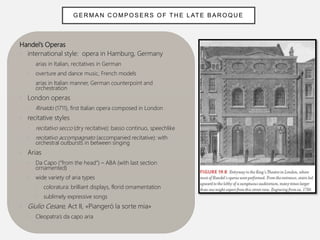
Handel’s Operas
• international style: opera in Hamburg, Germany
• arias in Italian, recitatives in German
• overture and dance music, French models
• arias in Italian manner, German counterpoint and
orchestration
• London operas
• Rinaldo (1711), first Italian opera composed in London
• recitative styles
• recitativo secco (dry recitative): basso continuo, speechlike
• recitativo accompagnato (accompanied recitative): with
orchestral outbursts in between singing
• Arias
• Da Capo (“from the head”) – ABA (with last section
ornamented)
• wide variety of aria types
• coloratura: brilliant displays, florid ornamentation
• sublimely expressive songs
• Giulio Cesare, Act II, «Piangeró la sorte mia»
• Cleopatra’s da capo aria
GER MAN C OMPOSERS OF TH E L ATE BAR OQUE
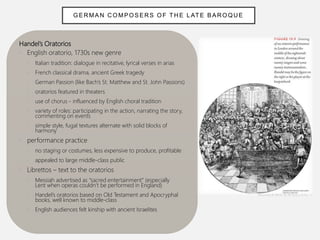
Handel’s Oratorios
• English oratorio, 1730s new genre
• Italian tradition: dialogue in recitative, lyrical verses in arias
• French classical drama, ancient Greek tragedy
• German Passion (like Bach’s St. Matthew and St. John Passions)
• oratorios featured in theaters
• use of chorus - influenced by English choral tradition
• variety of roles: participating in the action, narrating the story,
commenting on events
• simple style, fugal textures alternate with solid blocks of
harmony
• performance practice
• no staging or costumes, less expensive to produce, profitable
• appealed to large middle-class public
• Librettos – text to the oratorios
• Messiah advertised as “sacred entertainment” (especially
Lent when operas couldn’t be performed in England)
• Handel’s oratorios based on Old Testament and Apocryphal
books, well known to middle-class
• English audiences felt kinship with ancient Israelites
GER MAN C OMPOSERS OF TH E L ATE BAR OQUE
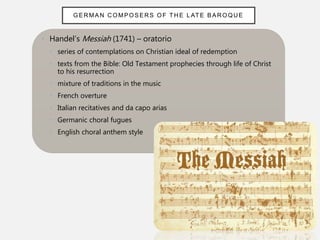
• Handel’s Messiah (1741) – oratorio
• series of contemplations on Christian ideal of redemption
• texts from the Bible: Old Testament prophecies through life of Christ
to his resurrection
• mixture of traditions in the music
• French overture
• Italian recitatives and da capo arias
• Germanic choral fugues
• English choral anthem style
GER MAN C OMPOSERS OF TH E L ATE BAR OQUE
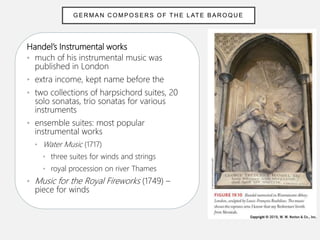
Handel’s Instrumental works
• much of his instrumental music was
published in London
• extra income, kept name before the
• two collections of harpsichord suites, 20
solo sonatas, trio sonatas for various
instruments
• ensemble suites: most popular
instrumental works
• Water Music (1717)
• three suites for winds and strings
• royal procession on river Thames
• Music for the Royal Fireworks (1749) –
piece for winds
GER MAN C OMPOSERS OF TH E L ATE BAR OQUE

Ch19 late baroque german composers

  • 1.
    CHAPTER 19 Lecture Slides AHistory of Western Music TENTH EDITION by J. PETER BURKHOLDER DONALD JAY GROUT CLAUDE V. PALISCA © 2019 W. W. Norton & Co., Inc.
  • 2.
    Johann Sebastian Bach(1685–1750) • virtuoso organist and keyboard player, skilled violinist • prolific composer: embraced all major styles, forms, genres (except opera) • born Germany, came from large family of musicians • married twice: Maria Barbara Bach, 7 children; Anna Magdalena Wilcke, 13 children (20 total!) • Leipzig: cantor of the St. Thomas School, civic director • BWV for Bach-Werke-Verzeichnis (Bach Works Catalogue) • major works: St. Matthew Passion, St. John Passion, Mass in B Minor, 200 church cantatas, 20 secular cantatas, 200 organ chorales and 70 other works organ, Brandenburg Concertos, The Well-Tempered Clavier, Clavier-Übung, Musical Offering, The Art of Fugue, numerous other keyboard, ensemble, orchestral, and sacred compositions GERMAN COMPOSERS OF THE LATE BAROQUE
  • 3.
    Bach at work •composed to fulfill needs of positions held • Organ works, cantatas, solo or ensemble music for Court; some pedagogical works for teaching, and concertos and chamber works for the collegium musicum in Leipzig • Leipzig – His position at St. Thomaskirche (St. Thomas Church – Lutheran) • Bach was the council’s third choice after Telemann and Christoph Graupner • Bach’s position at St. Thomas’s School: • teach Latin and music four hours a day • compose, copy, and rehearse music for church services • directed top choir, supervised other three • trained best students on instruments; directed church instrumental ensemble • composed one major work for church each week • provided music for town ceremonies and at the university • composed for weddings, funerals, other special occasions GERMAN COMPOSERS OF THE LATE BAROQUE
  • 4.
    GERMAN COMPOSERS OFTHE LATE BAROQUE
  • 5.
    Bach’s Organ music •genres used in Lutheran services • chorale settings, toccatas, fantasias, preludes, fugues • renowned as an improviser • Prelude and Fugue in A Minor, BWM 543 (NAWM 102) • fugue subject: rapid oscillation between repeated note and moving line • fugue subject functions like a ritornello (returning refrain) • chorale settings - over 200 chorale settings, all known types GERMAN COMPOSERS OF THE LATE BAROQUE
  • 6.
    Bach’s Harpsichord music •The Well-Tempered Clavier (1722) • each book consists of 24 prelude and fugue pairs in each major minor key • preludes: pedagogical aims • fugues: 2-5 voices • Prelude in E-flat Minor and Fugue in D-sharp Minor, Book I (NAWM 104) GERMAN COMPOSERS OF THE LATE BAROQUE
  • 7.
    Orchestral music • BrandenburgConcertos, dedicated in 1721 to the Margrave of Brandenburg • Ensemble suites • dialogue between soloists and orchestra within episodes GERMAN COMPOSERS OF THE LATE BAROQUE
  • 8.
    Bach’s Cantatas • newkind of sacred text, cantata – traditions of the past: Lutheran chorale, and elements of operatic recitative and aria • approximately 200 church cantatas preserved • Cantata Wachet Auf BWV 140 (1731, Leipzig) GERMAN COMPOSERS OF THE LATE BAROQUE
  • 9.
    Bach’s Passions: Performedat Vespers on Good Friday in Leipzig • Chorales, arias, recitatives • St. John Passion (1724, later revised) • St. Matthew Passion (1727, revised 1736) • St. Matthew Passion (NAWM 106, excerpt) • No. 37 “Wer hat dich so geschlagen“ (chorale about the judgment of Jesus’s guilt) • No. 38 “Petrus aber saß draußen im Palast“ (biblical narrative of disciple Peter’s denials) GERMAN COMPOSERS OF THE LATE BAROQUE
  • 10.
    George Frideric Handel[Georg Friederich Händel] (1685–1759) • Recognized since his time as one of the greatest composers of the Baroque Era • born in Germany • education in organ, harpsichord, counterpoint, current German and Italian idioms • violinist in opera house orchestra, Hamburg opera house • traveled to Italy; gained recognition as a composer • London: served aristocratic patrons, had the support of British royal family • Handel’s patrons determined his compositions: aristocracy, Hanover Court, and British monarchs major works: Messiah, Saul, Samson, Israel in Egypt, about 20 other oratorios, Giulio Cesare and 40 other Italian operas, about 100 Italian cantatas, 45 concertos, 20 trio sonatas, 20 solo sonatas, numerous keyboard pieces, Water Music and Music for the Royal Fireworks GER MAN C OMPOSERS OF TH E L ATE BAR OQUE
  • 11.
    Handel’s Operas • internationalstyle: opera in Hamburg, Germany • arias in Italian, recitatives in German • overture and dance music, French models • arias in Italian manner, German counterpoint and orchestration • London operas • Rinaldo (1711), first Italian opera composed in London • recitative styles • recitativo secco (dry recitative): basso continuo, speechlike • recitativo accompagnato (accompanied recitative): with orchestral outbursts in between singing • Arias • Da Capo (“from the head”) – ABA (with last section ornamented) • wide variety of aria types • coloratura: brilliant displays, florid ornamentation • sublimely expressive songs • Giulio Cesare, Act II, «Piangeró la sorte mia» • Cleopatra’s da capo aria GER MAN C OMPOSERS OF TH E L ATE BAR OQUE
  • 12.
    Handel’s Oratorios • Englishoratorio, 1730s new genre • Italian tradition: dialogue in recitative, lyrical verses in arias • French classical drama, ancient Greek tragedy • German Passion (like Bach’s St. Matthew and St. John Passions) • oratorios featured in theaters • use of chorus - influenced by English choral tradition • variety of roles: participating in the action, narrating the story, commenting on events • simple style, fugal textures alternate with solid blocks of harmony • performance practice • no staging or costumes, less expensive to produce, profitable • appealed to large middle-class public • Librettos – text to the oratorios • Messiah advertised as “sacred entertainment” (especially Lent when operas couldn’t be performed in England) • Handel’s oratorios based on Old Testament and Apocryphal books, well known to middle-class • English audiences felt kinship with ancient Israelites GER MAN C OMPOSERS OF TH E L ATE BAR OQUE
  • 13.
    • Handel’s Messiah(1741) – oratorio • series of contemplations on Christian ideal of redemption • texts from the Bible: Old Testament prophecies through life of Christ to his resurrection • mixture of traditions in the music • French overture • Italian recitatives and da capo arias • Germanic choral fugues • English choral anthem style GER MAN C OMPOSERS OF TH E L ATE BAR OQUE
  • 14.
    Handel’s Instrumental works •much of his instrumental music was published in London • extra income, kept name before the • two collections of harpsichord suites, 20 solo sonatas, trio sonatas for various instruments • ensemble suites: most popular instrumental works • Water Music (1717) • three suites for winds and strings • royal procession on river Thames • Music for the Royal Fireworks (1749) – piece for winds GER MAN C OMPOSERS OF TH E L ATE BAR OQUE