Cryptography and
Cryptography and
NetworkSecurity
Network Security
Chapter 10
Chapter 10
Fifth Edition
Fifth Edition
by William Stallings
by William Stallings
Lecture slides by Lawrie Brown
Lecture slides by Lawrie Brown
2.
Chapter 10 –
Chapter10 – Other Public Key
Other Public Key
Cryptosystems
Cryptosystems
Amongst the tribes of Central Australia every man, woman,
Amongst the tribes of Central Australia every man, woman,
and child has a secret or sacred name which is bestowed
and child has a secret or sacred name which is bestowed
by the older men upon him or her soon after birth, and
by the older men upon him or her soon after birth, and
which is known to none but the fully initiated members of
which is known to none but the fully initiated members of
the group. This secret name is never mentioned except
the group. This secret name is never mentioned except
upon the most solemn occasions; to utter it in the hearing of
upon the most solemn occasions; to utter it in the hearing of
men of another group would be a most serious breach of
men of another group would be a most serious breach of
tribal custom. When mentioned at all, the name is spoken
tribal custom. When mentioned at all, the name is spoken
only in a whisper, and not until the most elaborate
only in a whisper, and not until the most elaborate
precautions have been taken that it shall be heard by no
precautions have been taken that it shall be heard by no
one but members of the group. The native thinks that a
one but members of the group. The native thinks that a
stranger knowing his secret name would have special
stranger knowing his secret name would have special
power to work him ill by means of magic.
power to work him ill by means of magic.
—
—The Golden Bough,
The Golden Bough, Sir James George Frazer
Sir James George Frazer
3.
Diffie-Hellman Key Exchange
Diffie-HellmanKey Exchange
first public-key type scheme proposed
first public-key type scheme proposed
by Diffie & Hellman in 1976 along with the
by Diffie & Hellman in 1976 along with the
exposition of public key concepts
exposition of public key concepts
note: now know that
note: now know that Williamson
Williamson (UK CESG)
(UK CESG)
secretly proposed the concept in 1970
secretly proposed the concept in 1970
is a practical method for public exchange
is a practical method for public exchange
of a secret key
of a secret key
used in a number of commercial products
used in a number of commercial products
4.
Diffie-Hellman Key Exchange
Diffie-HellmanKey Exchange
a public-key distribution scheme
a public-key distribution scheme
cannot be used to exchange an arbitrary message
cannot be used to exchange an arbitrary message
rather it can establish a common key
rather it can establish a common key
known only to the two participants
known only to the two participants
value of key depends on the participants (and
value of key depends on the participants (and
their private and public key information)
their private and public key information)
based on exponentiation in a finite (Galois) field
based on exponentiation in a finite (Galois) field
(modulo a prime or a polynomial) - easy
(modulo a prime or a polynomial) - easy
security relies on the difficulty of computing
security relies on the difficulty of computing
discrete logarithms (similar to factoring) – hard
discrete logarithms (similar to factoring) – hard
5.
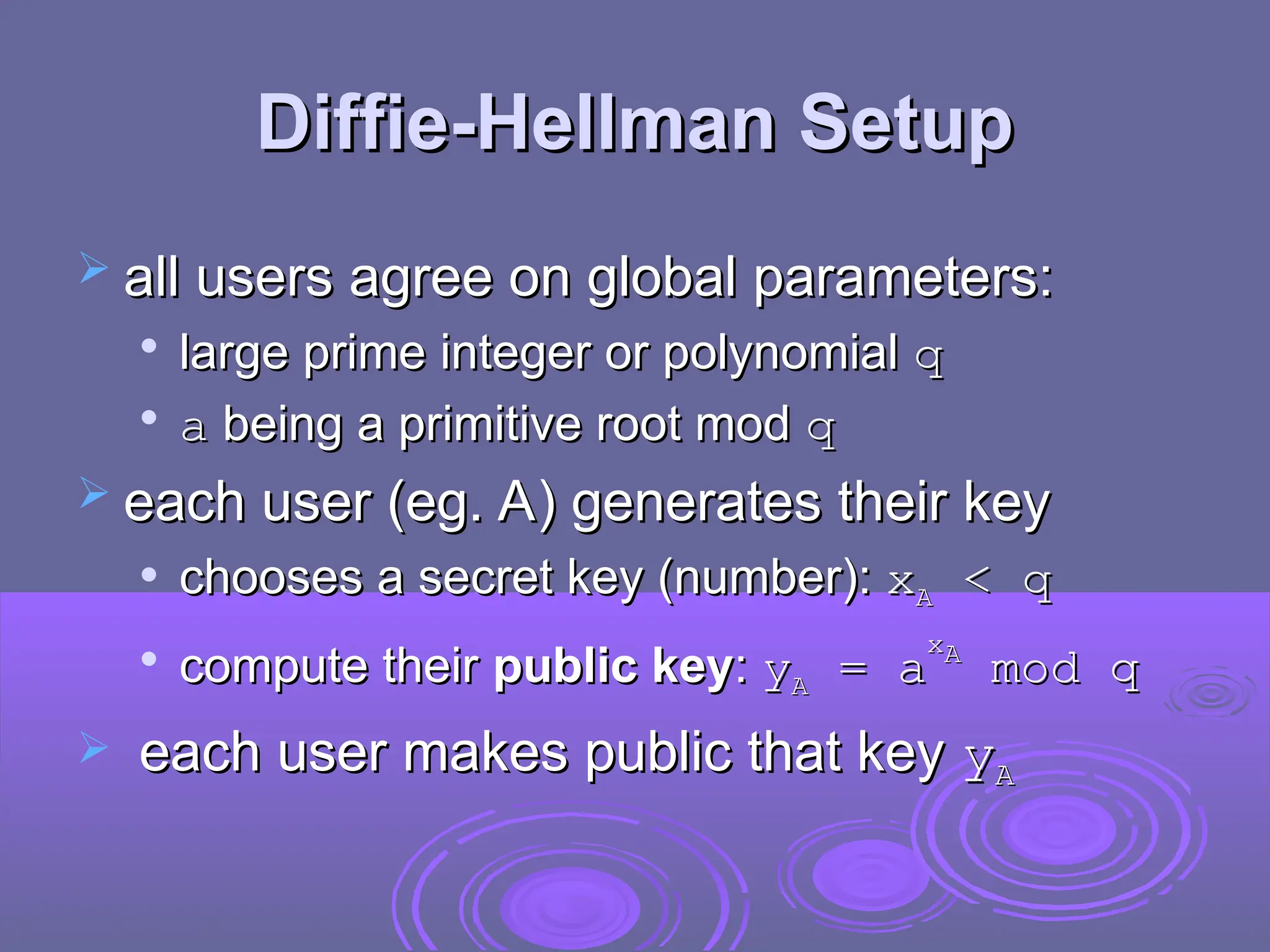
Diffie-Hellman Setup
Diffie-Hellman Setup
all users agree on global parameters:
all users agree on global parameters:
large prime integer or polynomial
large prime integer or polynomial q
q
a
a being a primitive root mod
being a primitive root mod q
q
each user (eg. A) generates their key
each user (eg. A) generates their key
chooses a secret key (number):
chooses a secret key (number): x
xA
A < q
< q
compute their
compute their public key
public key:
: y
yA
A =
= a
a
x
xA
A
mod q
mod q
each user makes public that key
each user makes public that key y
yA
A
6.
Diffie-Hellman Key Exchange
Diffie-HellmanKey Exchange
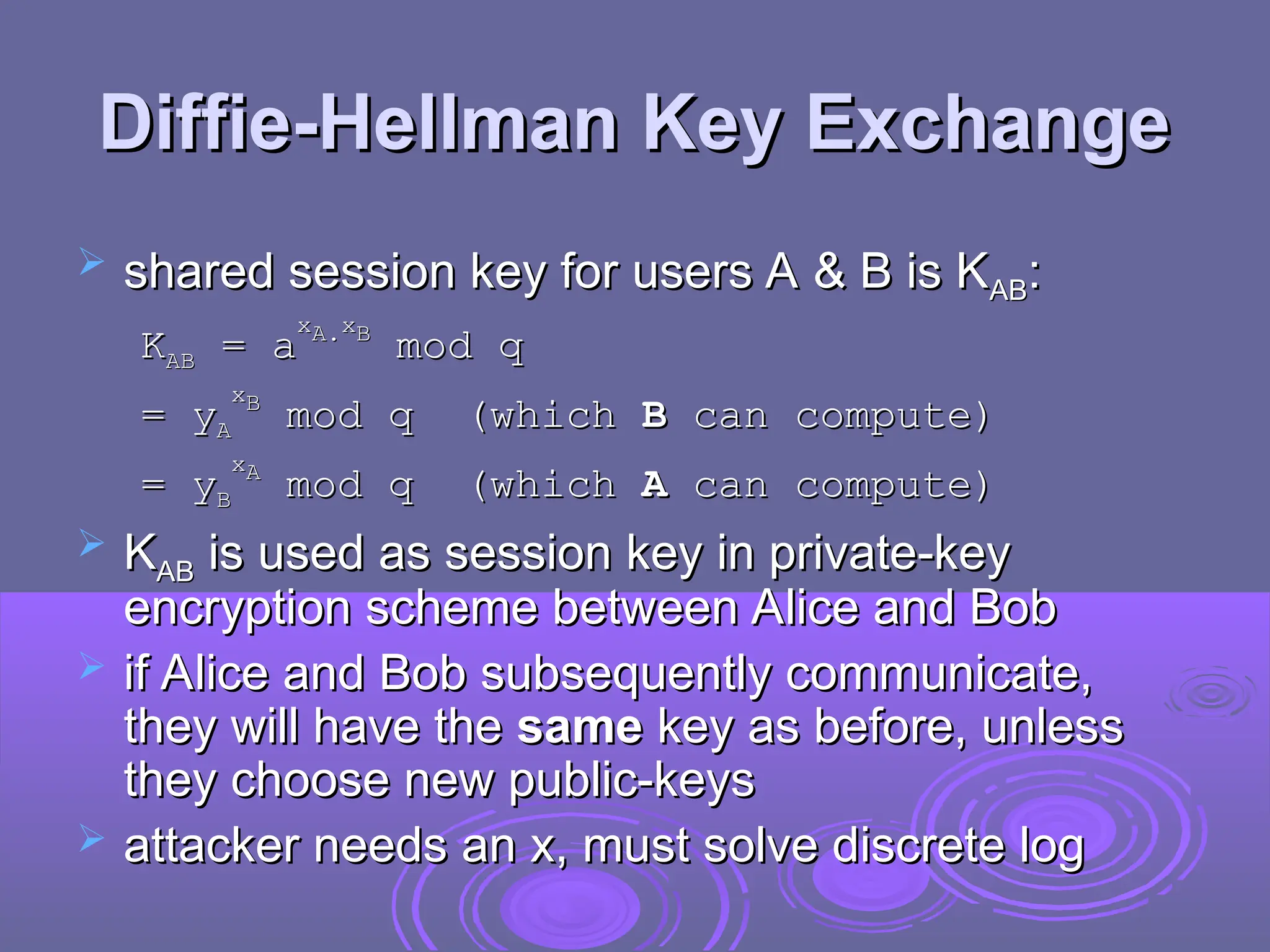
shared session key for users A & B is K
shared session key for users A & B is KAB
AB:
:
K
KAB
AB =
= a
a
x
xA.
A.x
xB
B
mod q
mod q
= y
= yA
A
x
xB
B
mod q (which
mod q (which B
B can compute)
can compute)
= y
= yB
B
x
xA
A
mod q (which
mod q (which A
A can compute)
can compute)
K
KAB
AB is used as session key in private-key
is used as session key in private-key
encryption scheme between Alice and Bob
encryption scheme between Alice and Bob
if Alice and Bob subsequently communicate,
if Alice and Bob subsequently communicate,
they will have the
they will have the same
same key as before, unless
key as before, unless
they choose new public-keys
they choose new public-keys
attacker needs an x, must solve discrete log
attacker needs an x, must solve discrete log
7.
Diffie-Hellman Example
Diffie-Hellman Example
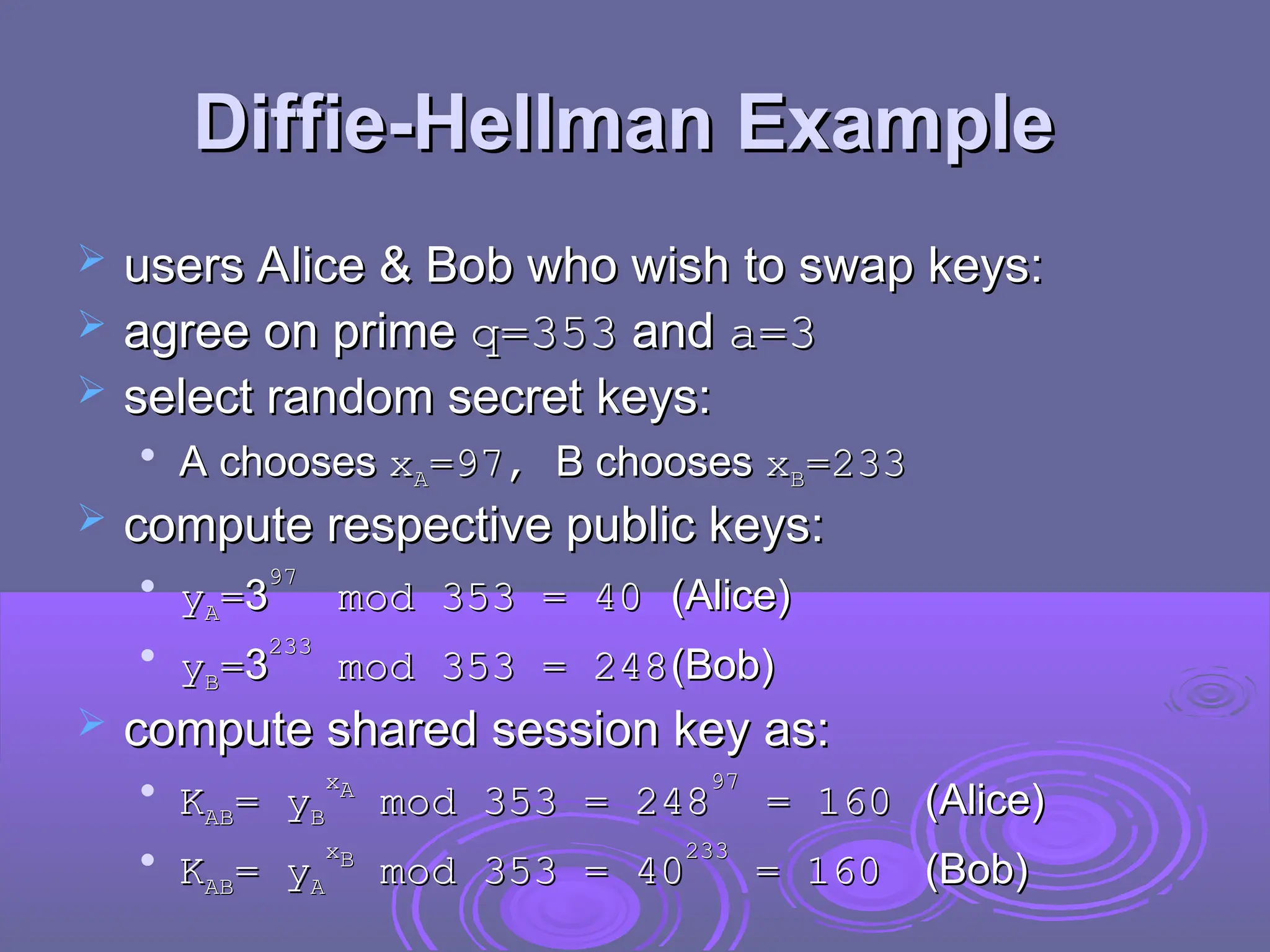
users Alice & Bob who wish to swap keys:
users Alice & Bob who wish to swap keys:
agree on prime
agree on prime q=353
q=353 and
and a
a=3
=3
select random secret keys:
select random secret keys:
A chooses
A chooses x
xA
A=97,
=97, B chooses
B chooses x
xB
B=233
=233
compute respective public keys:
compute respective public keys:
y
yA
A=
=3
3
97
97
mod 353 = 40
mod 353 = 40 (Alice)
(Alice)
y
yB
B=
=3
3
233
233
mod 353 = 248
mod 353 = 248(Bob)
(Bob)
compute shared session key as:
compute shared session key as:
K
KAB
AB= y
= yB
B
x
xA
A
mod 353 =
mod 353 = 248
248
97
97
= 160
= 160 (Alice)
(Alice)
K
KAB
AB= y
= yA
A
x
xB
B
mod 353 =
mod 353 = 40
40
233
233
= 160
= 160 (Bob)
(Bob)
8.
Key Exchange Protocols
KeyExchange Protocols
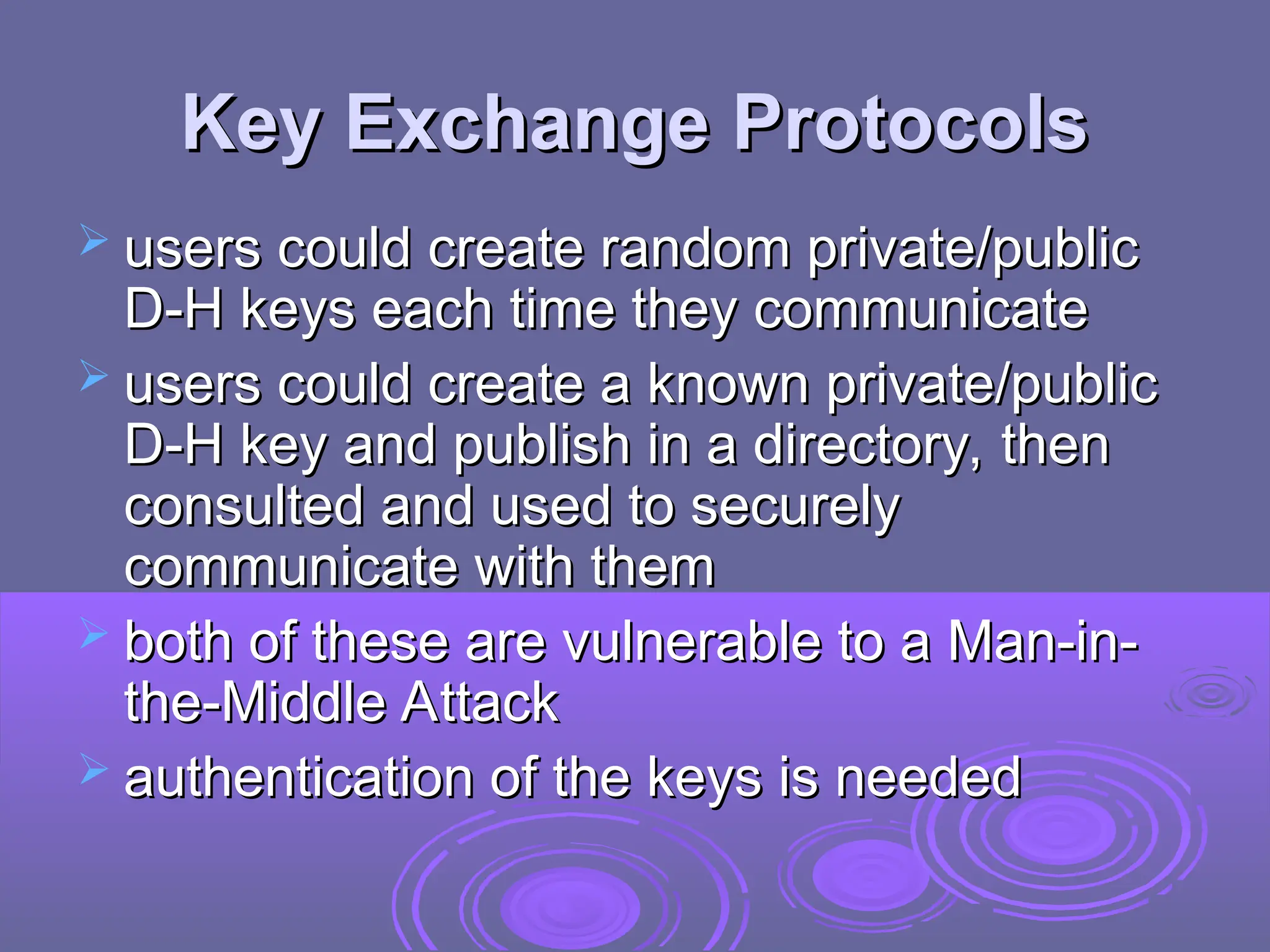
users could create random private/public
users could create random private/public
D-H keys each time they communicate
D-H keys each time they communicate
users could create a known private/public
users could create a known private/public
D-H key and publish in a directory, then
D-H key and publish in a directory, then
consulted and used to securely
consulted and used to securely
communicate with them
communicate with them
both of these are vulnerable to a Man-in-
both of these are vulnerable to a Man-in-
the-Middle Attack
the-Middle Attack
authentication of the keys is needed
authentication of the keys is needed
9.
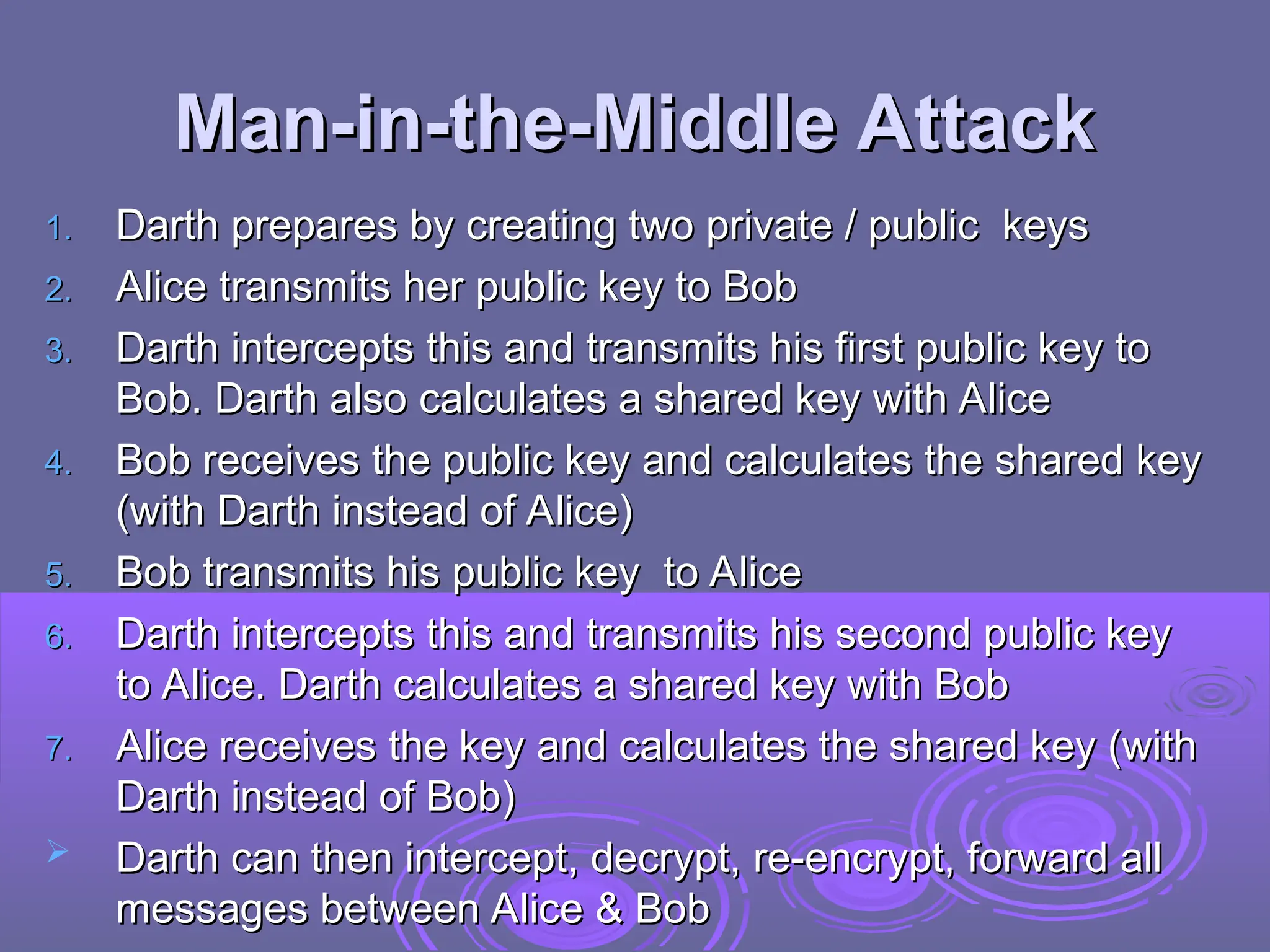
Man-in-the-Middle Attack
Man-in-the-Middle Attack
1.
1.Darth prepares by creating two private / public keys
Darth prepares by creating two private / public keys
2.
2. Alice transmits her public key to Bob
Alice transmits her public key to Bob
3.
3. Darth intercepts this and transmits his first public key to
Darth intercepts this and transmits his first public key to
Bob. Darth also calculates a shared key with Alice
Bob. Darth also calculates a shared key with Alice
4.
4. Bob receives the public key and calculates the shared key
Bob receives the public key and calculates the shared key
(with Darth instead of Alice)
(with Darth instead of Alice)
5.
5. Bob transmits his public key to Alice
Bob transmits his public key to Alice
6.
6. Darth intercepts this and transmits his second public key
Darth intercepts this and transmits his second public key
to Alice. Darth calculates a shared key with Bob
to Alice. Darth calculates a shared key with Bob
7.
7. Alice receives the key and calculates the shared key (with
Alice receives the key and calculates the shared key (with
Darth instead of Bob)
Darth instead of Bob)
Darth can then intercept, decrypt, re-encrypt, forward all
Darth can then intercept, decrypt, re-encrypt, forward all
messages between Alice & Bob
messages between Alice & Bob
10.
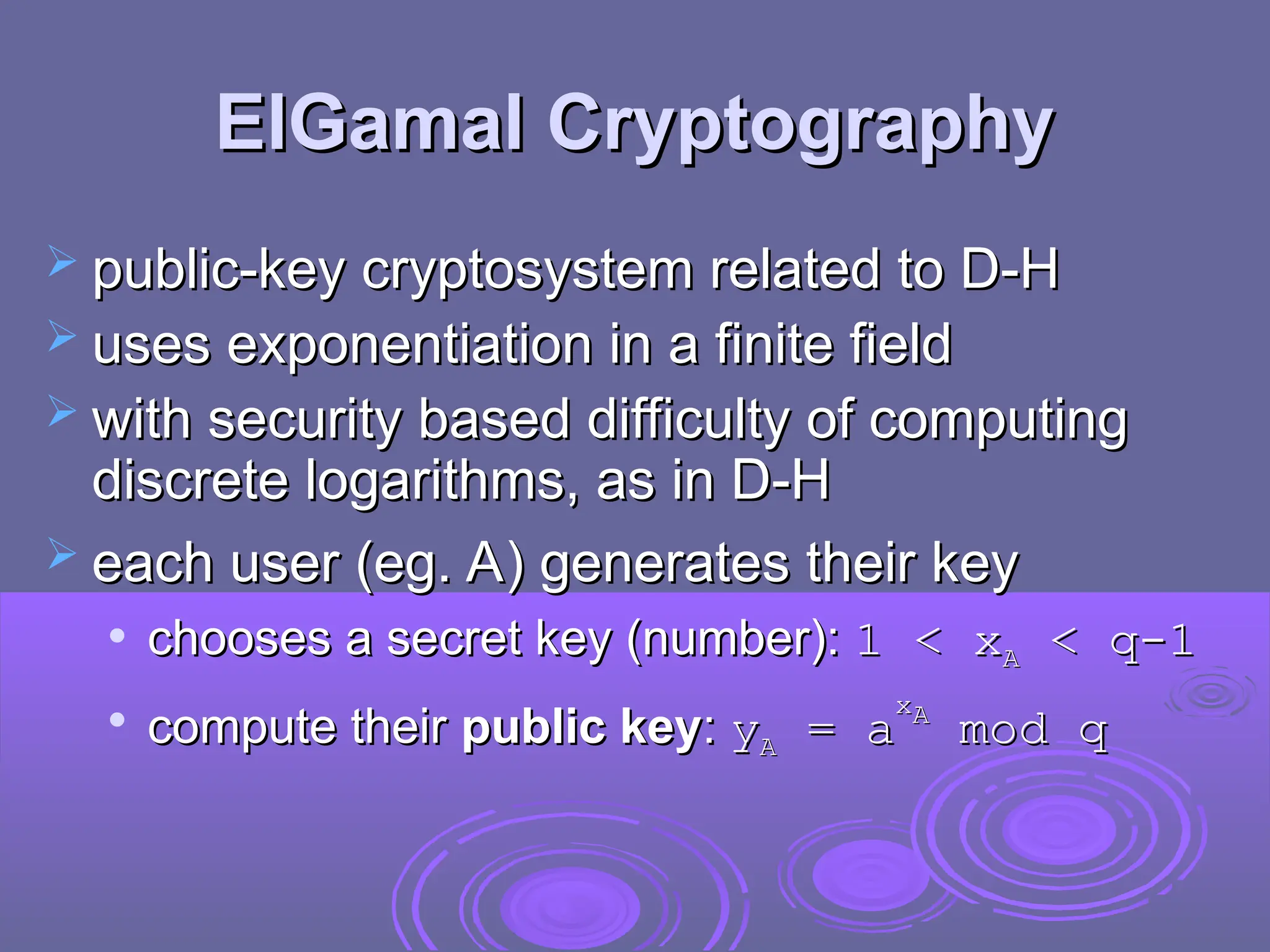
ElGamal Cryptography
ElGamal Cryptography
public-key cryptosystem related to D-H
public-key cryptosystem related to D-H
uses exponentiation in a finite field
uses exponentiation in a finite field
with security based difficulty of computing
with security based difficulty of computing
discrete logarithms, as in D-H
discrete logarithms, as in D-H
each user (eg. A) generates their key
each user (eg. A) generates their key
chooses a secret key (number):
chooses a secret key (number): 1 <
1 < x
xA
A < q-1
< q-1
compute their
compute their public key
public key:
: y
yA
A =
= a
a
x
xA
A
mod q
mod q
11.
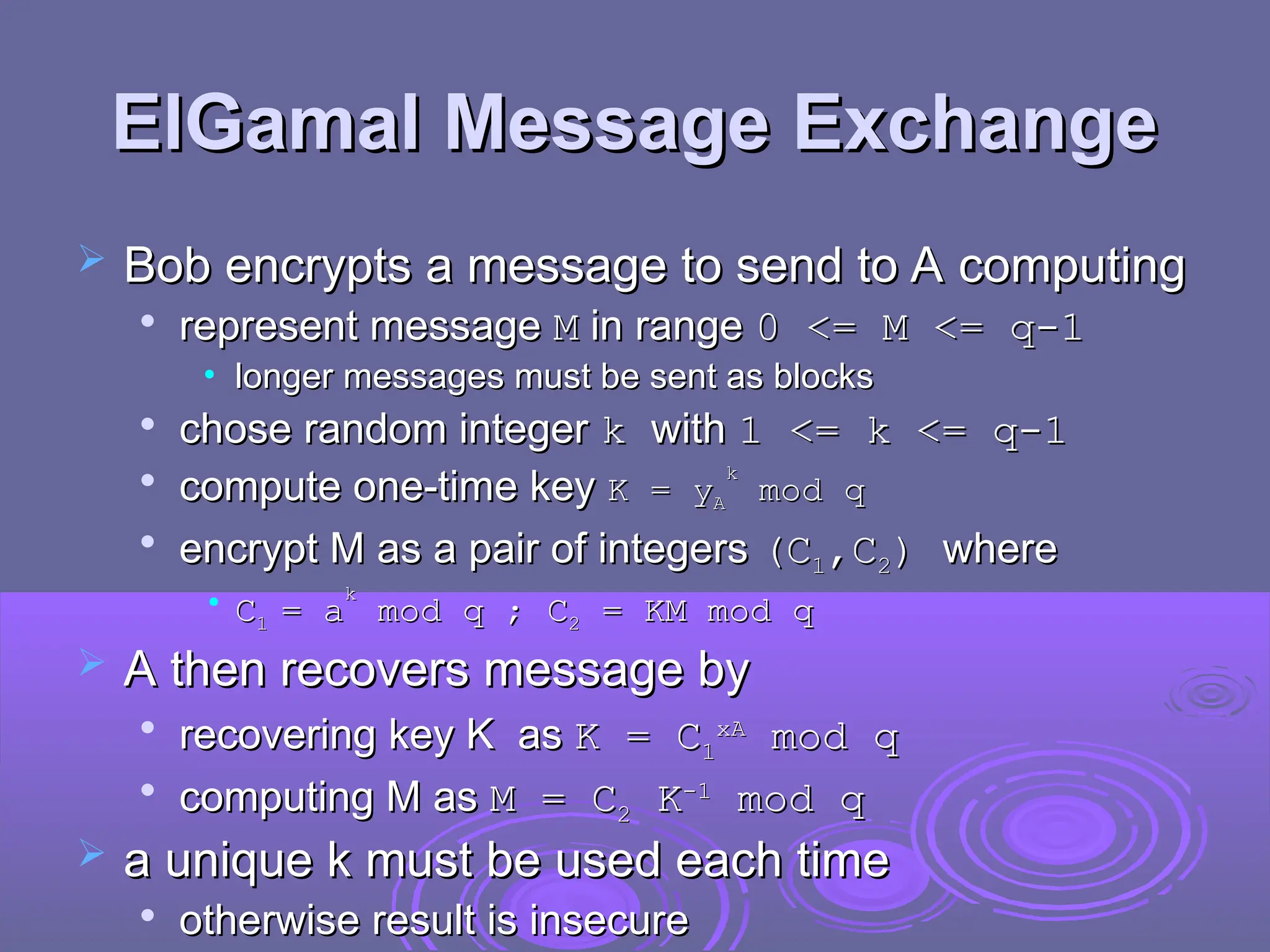
ElGamal Message Exchange
ElGamalMessage Exchange
Bob encrypts a message to send to A computing
Bob encrypts a message to send to A computing
represent message
represent message M
M in range
in range 0 <= M <= q-1
0 <= M <= q-1
• longer messages must be sent as blocks
longer messages must be sent as blocks
chose random integer
chose random integer k
k with
with 1 <= k <= q-1
1 <= k <= q-1
compute one-time key
compute one-time key K = y
K = yA
A
k
k
mod q
mod q
encrypt M as a pair of integers
encrypt M as a pair of integers (C
(C1
1,C
,C2
2)
) where
where
• C
C1
1 =
= a
a
k
k
mod q ;
mod q ; C
C2
2 = KM mod q
= KM mod q
A then recovers message by
A then recovers message by
recovering key K as
recovering key K as K =
K = C
C1
1
x
xA
A
mod q
mod q
computing M as
computing M as M = C
M = C2
2 K
K-1
-1
mod q
mod q
a unique k must be used each time
a unique k must be used each time
otherwise result is insecure
otherwise result is insecure
12.
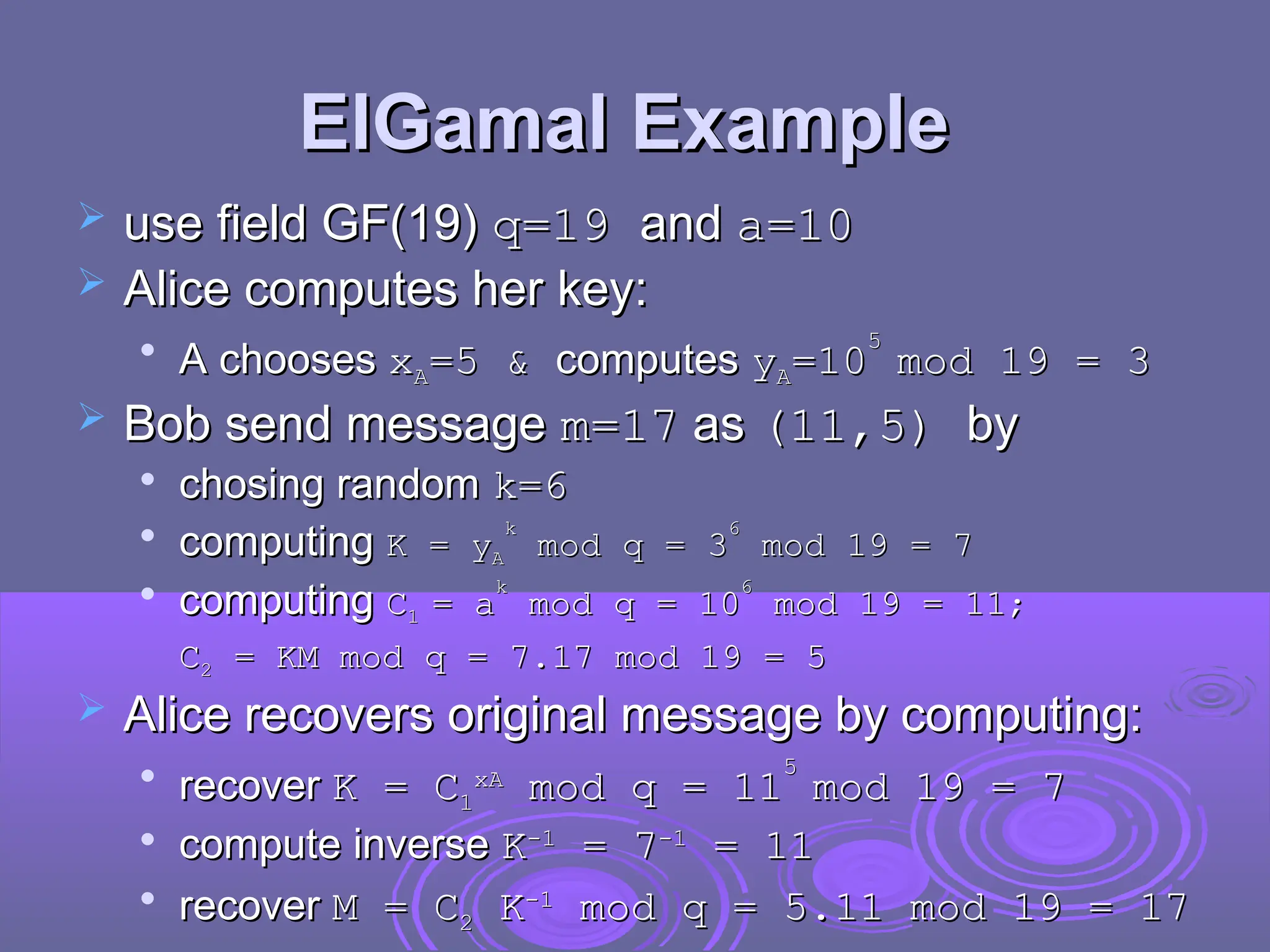
ElGamal Example
ElGamal Example
use field GF(19)
use field GF(19) q=19
q=19 and
and a
a=10
=10
Alice computes her key:
Alice computes her key:
A chooses
A chooses x
xA
A=5 &
=5 & computes
computes y
yA
A=
=10
10
5
5
mod 19 = 3
mod 19 = 3
Bob send message
Bob send message m=17
m=17 as
as (11,5)
(11,5) by
by
chosing random
chosing random k=6
k=6
computing
computing K = y
K = yA
A
k
k
mod q = 3
mod q = 3
6
6
mod 19 = 7
mod 19 = 7
computing
computing C
C1
1 =
= a
a
k
k
mod q = 10
mod q = 10
6
6
mod 19 = 11;
mod 19 = 11;
C
C2
2 = KM mod q = 7.17 mod 19 = 5
= KM mod q = 7.17 mod 19 = 5
Alice recovers original message by computing:
Alice recovers original message by computing:
recover
recover K =
K = C
C1
1
x
xA
A
mod q =
mod q = 11
11
5
5
mod 19 = 7
mod 19 = 7
compute inverse
compute inverse K
K-1
-1
= 7
= 7-1
-1
= 11
= 11
recover
recover M = C
M = C2
2 K
K-1
-1
mod q = 5.11 mod 19 = 17
mod q = 5.11 mod 19 = 17
13.
Elliptic Curve Cryptography
EllipticCurve Cryptography
majority of public-key crypto (RSA, D-H)
majority of public-key crypto (RSA, D-H)
use either integer or polynomial arithmetic
use either integer or polynomial arithmetic
with very large numbers/polynomials
with very large numbers/polynomials
imposes a significant load in storing and
imposes a significant load in storing and
processing keys and messages
processing keys and messages
an alternative is to use elliptic curves
an alternative is to use elliptic curves
offers same security with smaller bit sizes
offers same security with smaller bit sizes
newer, but not as well analysed
newer, but not as well analysed
14.
Real Elliptic Curves
RealElliptic Curves
an
an elliptic curve is defined by an
elliptic curve is defined by an
equation in two variables x & y, with
equation in two variables x & y, with
coefficients
coefficients
consider a cubic elliptic curve of form
consider a cubic elliptic curve of form
y
y2
2
=
= x
x3
3
+
+ ax
ax +
+ b
b
where x,y,a,b are all real numbers
where x,y,a,b are all real numbers
also define zero point O
also define zero point O
consider set of points E(a,b) that satisfy
consider set of points E(a,b) that satisfy
have addition operation for elliptic curve
have addition operation for elliptic curve
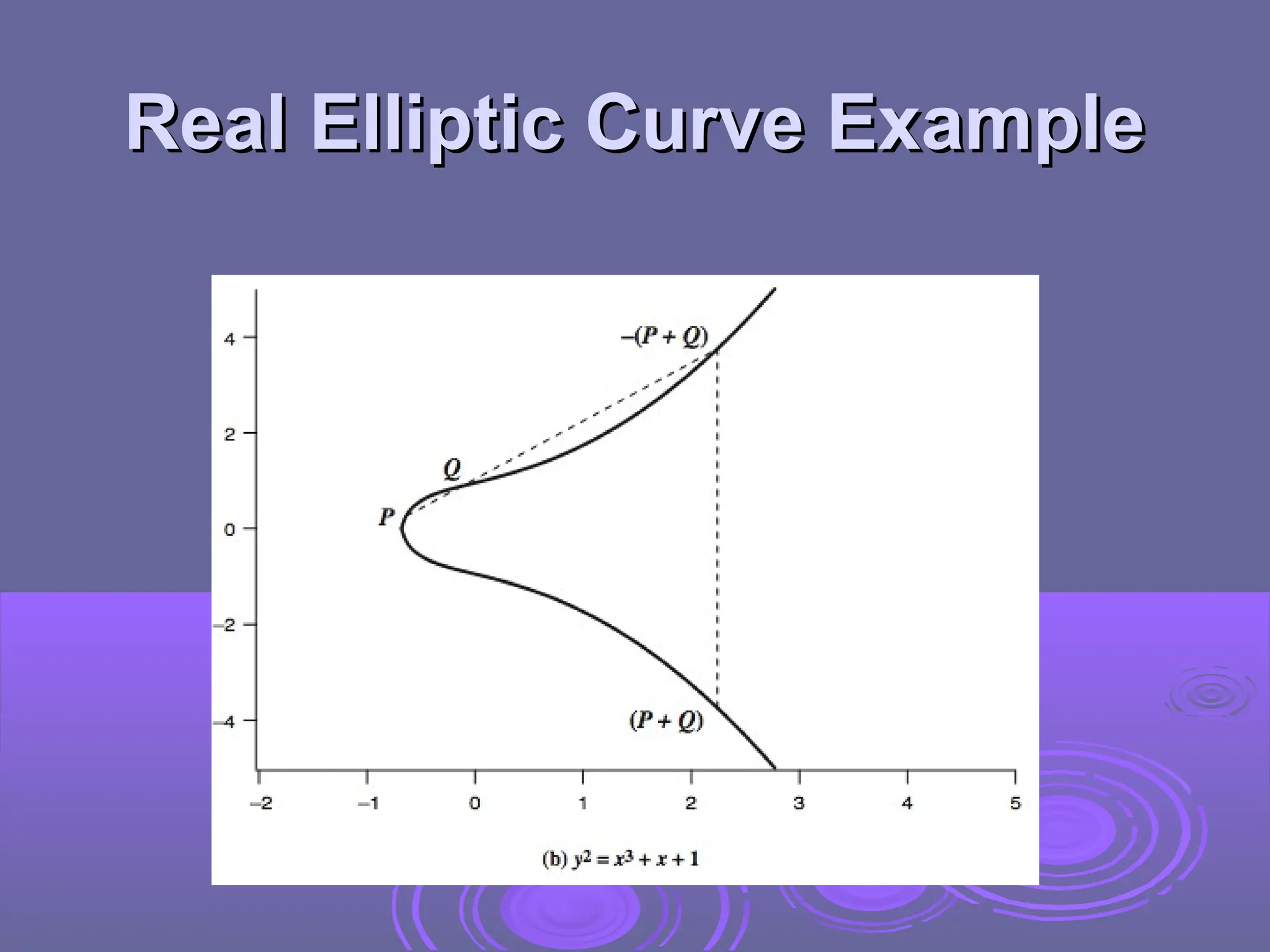
geometrically sum of P+Q is reflection of the
geometrically sum of P+Q is reflection of the
intersection R
intersection R
Finite Elliptic Curves
FiniteElliptic Curves
Elliptic curve cryptography uses curves
Elliptic curve cryptography uses curves
whose variables & coefficients are finite
whose variables & coefficients are finite
have two families commonly used:
have two families commonly used:
prime curves
prime curves E
Ep
p(a,b)
(a,b) defined over Z
defined over Zp
p
• use integers modulo a prime
use integers modulo a prime
• best in software
best in software
binary curves
binary curves E
E2
2m
m(a,b)
(a,b) defined over GF(2
defined over GF(2n
n
)
)
• use polynomials with binary coefficients
use polynomials with binary coefficients
• best in hardware
best in hardware
17.
Elliptic Curve Cryptography
EllipticCurve Cryptography
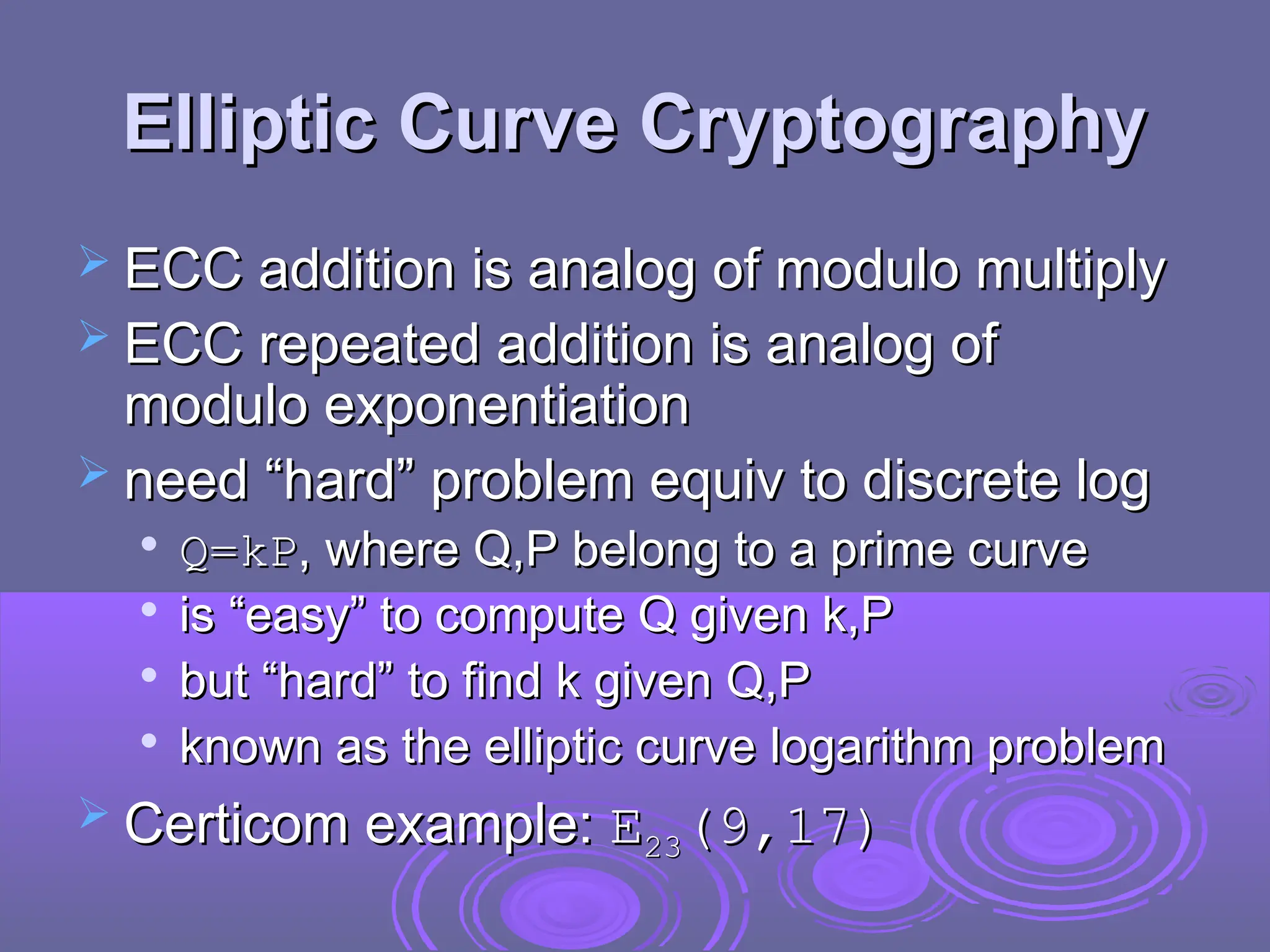
ECC addition is analog of modulo multiply
ECC addition is analog of modulo multiply
ECC repeated addition is analog of
ECC repeated addition is analog of
modulo exponentiation
modulo exponentiation
need “hard” problem equiv to discrete log
need “hard” problem equiv to discrete log
Q=kP
Q=kP, where Q,P belong to a prime curve
, where Q,P belong to a prime curve
is “easy” to compute Q given k,P
is “easy” to compute Q given k,P
but “hard” to find k given Q,P
but “hard” to find k given Q,P
known as the elliptic curve logarithm problem
known as the elliptic curve logarithm problem
Certicom example:
Certicom example: E
E23
23(9,17)
(9,17)
18.
ECC Diffie-Hellman
ECC Diffie-Hellman
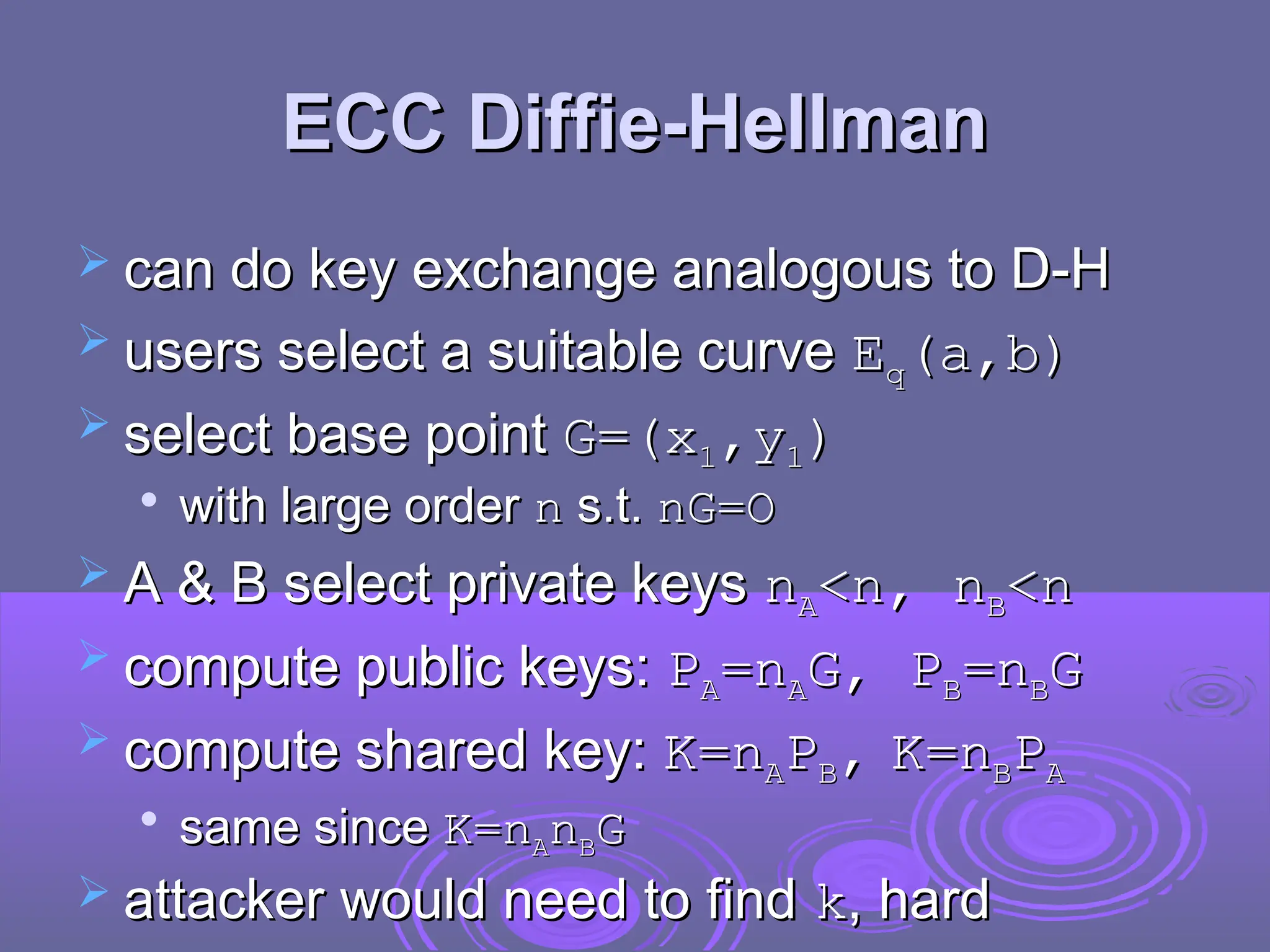
can do key exchange analogous to D-H
can do key exchange analogous to D-H
users select a suitable curve
users select a suitable curve E
Eq
q(a,b)
(a,b)
select base point
select base point G=(x
G=(x1
1,y
,y1
1)
)
with large order
with large order n
n s.t.
s.t. nG=O
nG=O
A & B select private keys
A & B select private keys n
nA
A<n, n
<n, nB
B<n
<n
compute public keys:
compute public keys: P
PA
A=n
=nA
AG,
G, P
PB
B=n
=nB
BG
G
compute shared key:
compute shared key: K
K=n
=nA
AP
PB
B,
, K
K=n
=nB
BP
PA
A
same since
same since K
K=n
=nA
An
nB
BG
G
attacker would need to find
attacker would need to find k
k, hard
, hard
19.
ECC Encryption/Decryption
ECC Encryption/Decryption
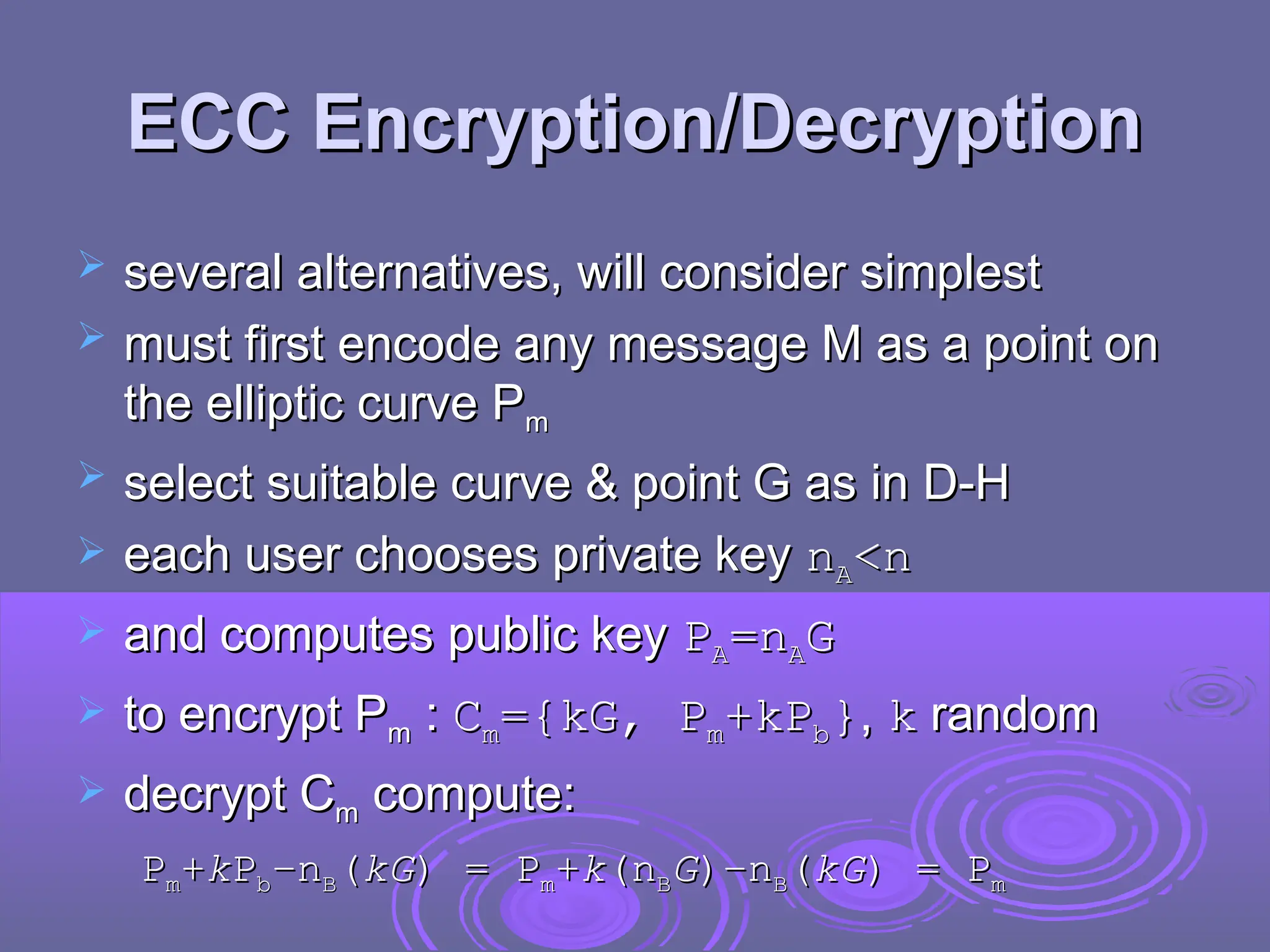
several alternatives, will consider simplest
several alternatives, will consider simplest
must first encode any message M as a point on
must first encode any message M as a point on
the elliptic curve P
the elliptic curve Pm
m
select suitable curve & point G as in D-H
select suitable curve & point G as in D-H
each user chooses private key
each user chooses private key n
nA
A<n
<n
and computes public key
and computes public key P
PA
A=n
=nA
AG
G
to encrypt P
to encrypt Pm
m :
: C
Cm
m={kG, P
={kG, Pm
m+kP
+kPb
b}
},
, k
k random
random
decrypt C
decrypt Cm
m compute:
compute:
P
Pm
m+
+k
kP
Pb
b–
–n
nB
B(
(kG
kG) =
) = P
Pm
m+
+k
k(
(n
nB
BG
G)–
)–n
nB
B(
(kG
kG) =
) = P
Pm
m
20.
ECC Security
ECC Security
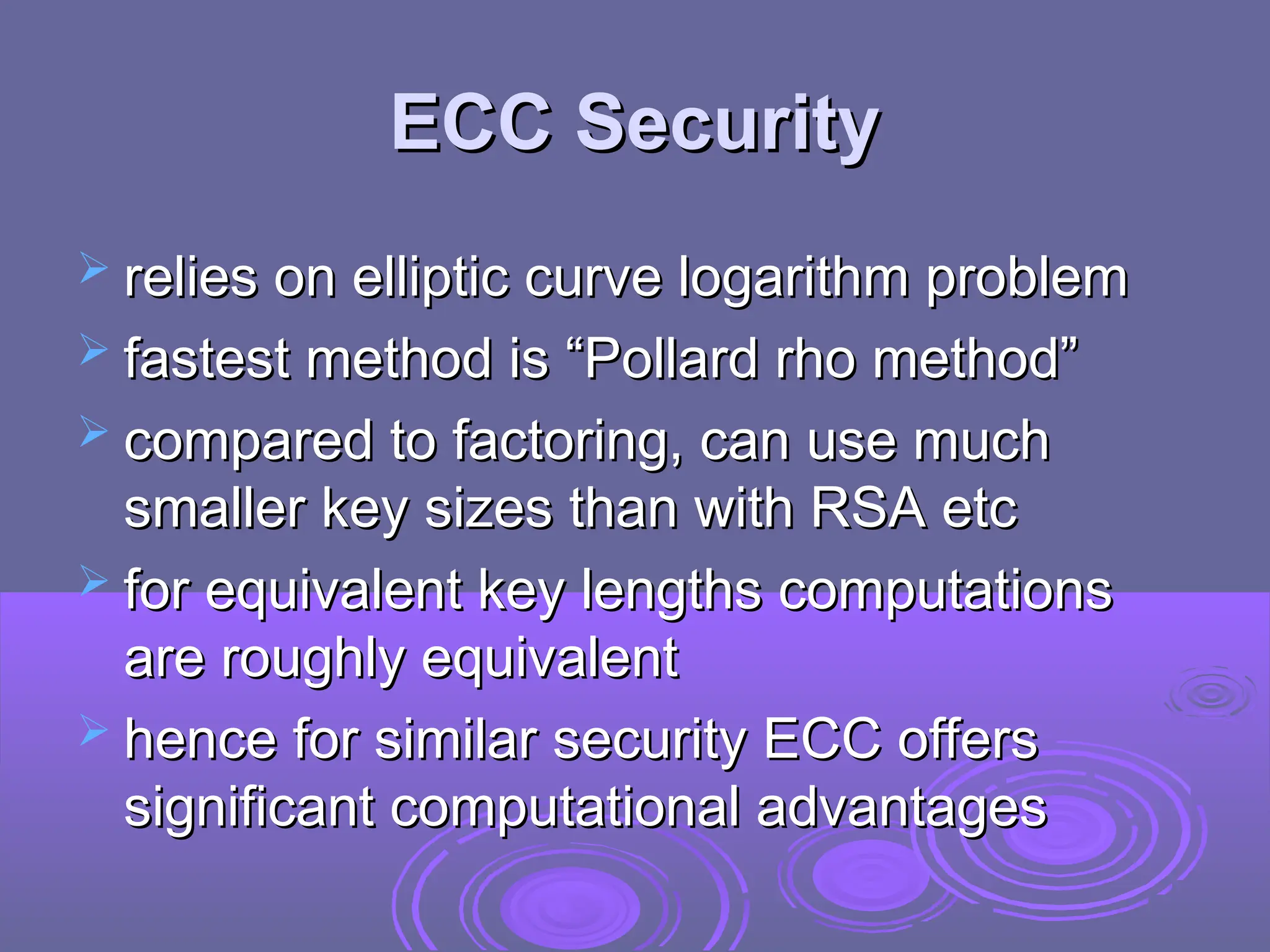
relies on elliptic curve logarithm problem
relies on elliptic curve logarithm problem
fastest method is “Pollard rho method”
fastest method is “Pollard rho method”
compared to factoring, can use much
compared to factoring, can use much
smaller key sizes than with RSA etc
smaller key sizes than with RSA etc
for equivalent key lengths computations
for equivalent key lengths computations
are roughly equivalent
are roughly equivalent
hence for similar security ECC offers
hence for similar security ECC offers
significant computational advantages
significant computational advantages
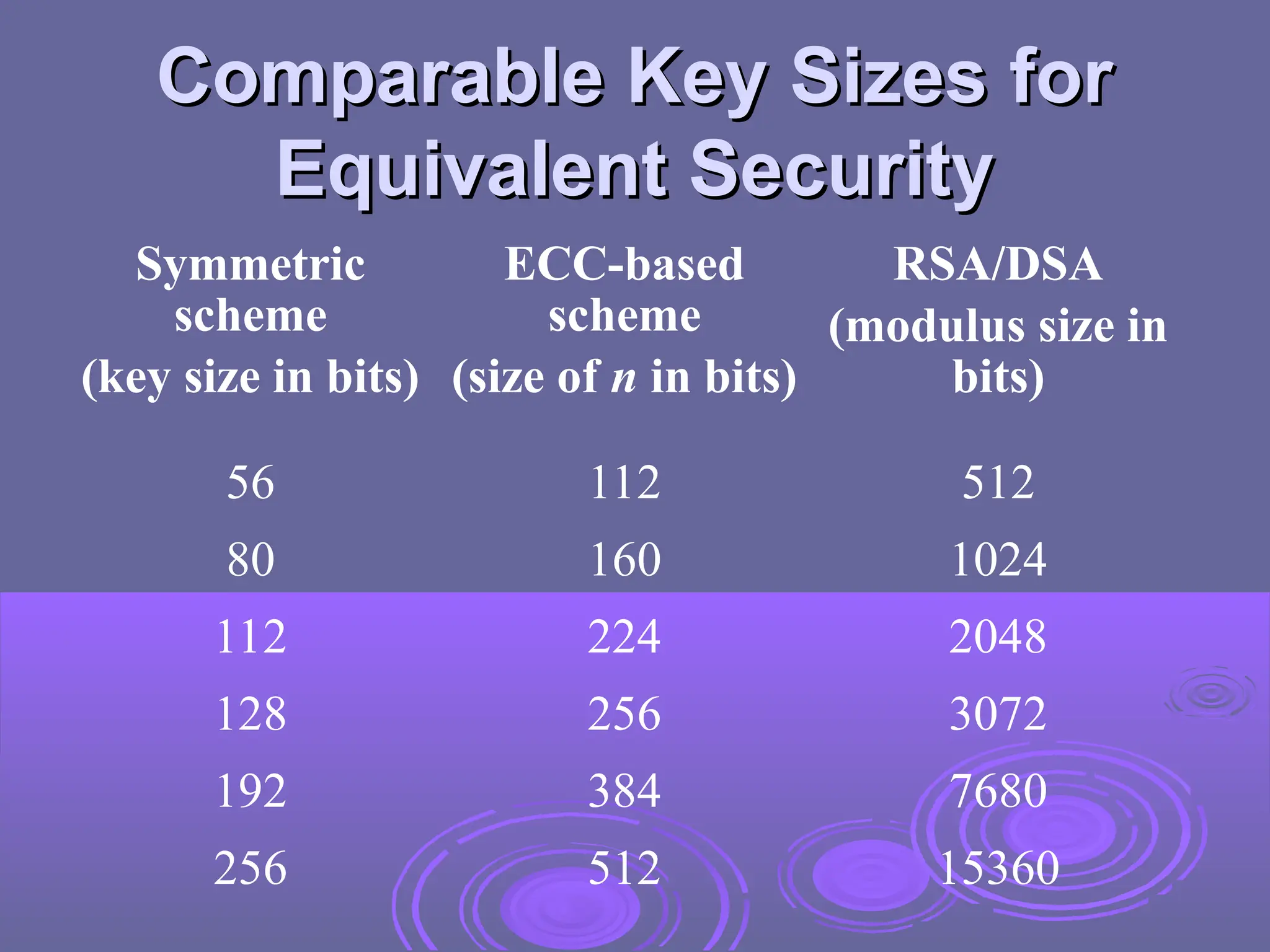
21.
Comparable Key Sizesfor
Comparable Key Sizes for
Equivalent Security
Equivalent Security
Symmetric
scheme
(key size in bits)
ECC-based
scheme
(size of n in bits)
RSA/DSA
(modulus size in
bits)
56 112 512
80 160 1024
112 224 2048
128 256 3072
192 384 7680
256 512 15360
22.
Pseudorandom Number
Pseudorandom Number
Generation(PRNG) based on
Generation (PRNG) based on
Asymmetric Ciphers
Asymmetric Ciphers
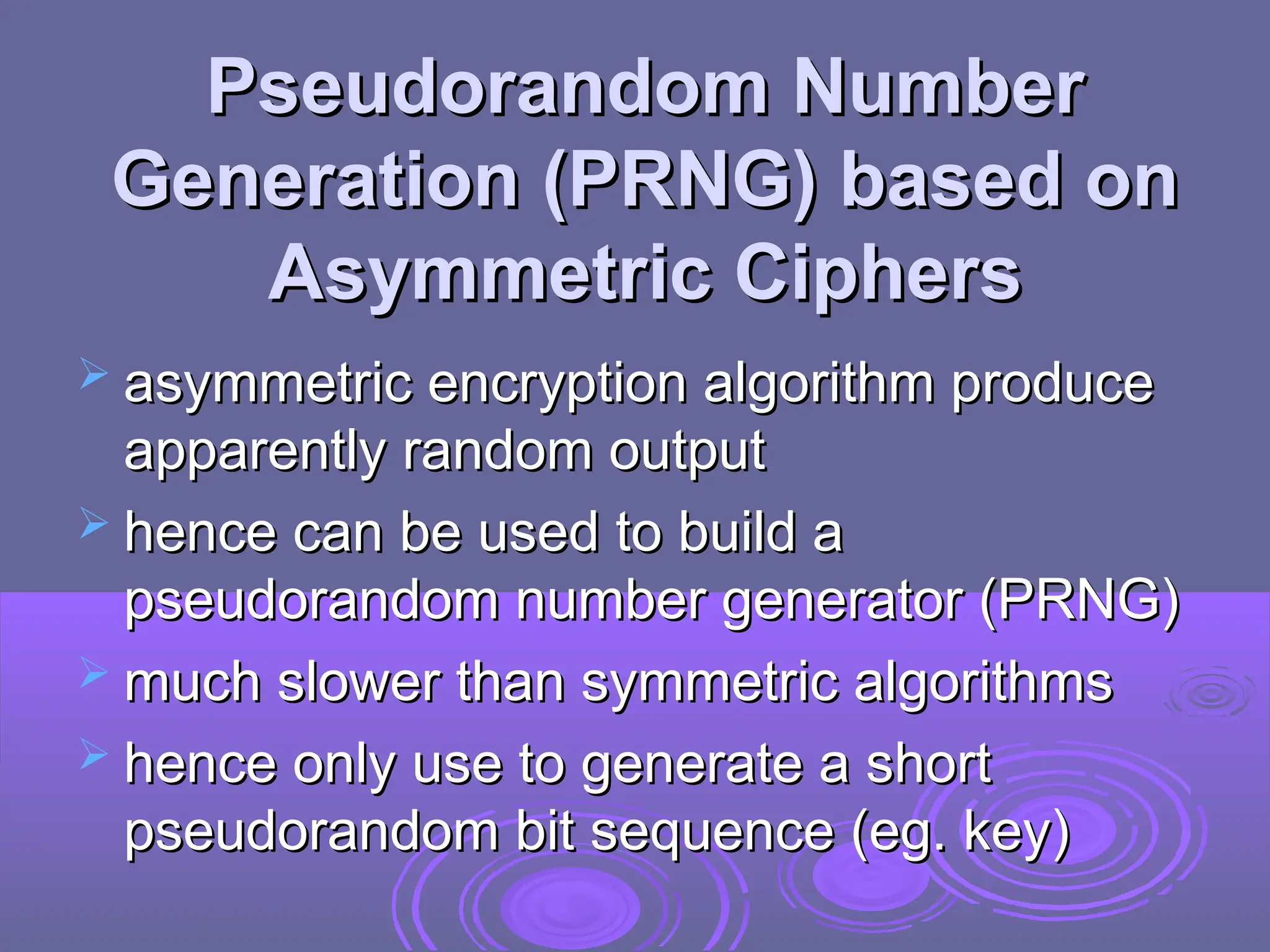
asymmetric encryption algorithm produce
asymmetric encryption algorithm produce
apparently random output
apparently random output
hence can be used to build a
hence can be used to build a
pseudorandom number generator (PRNG)
pseudorandom number generator (PRNG)
much slower than symmetric algorithms
much slower than symmetric algorithms
hence only use to generate a short
hence only use to generate a short
pseudorandom bit sequence (eg. key)
pseudorandom bit sequence (eg. key)
23.
PRNG based onRSA
PRNG based on RSA
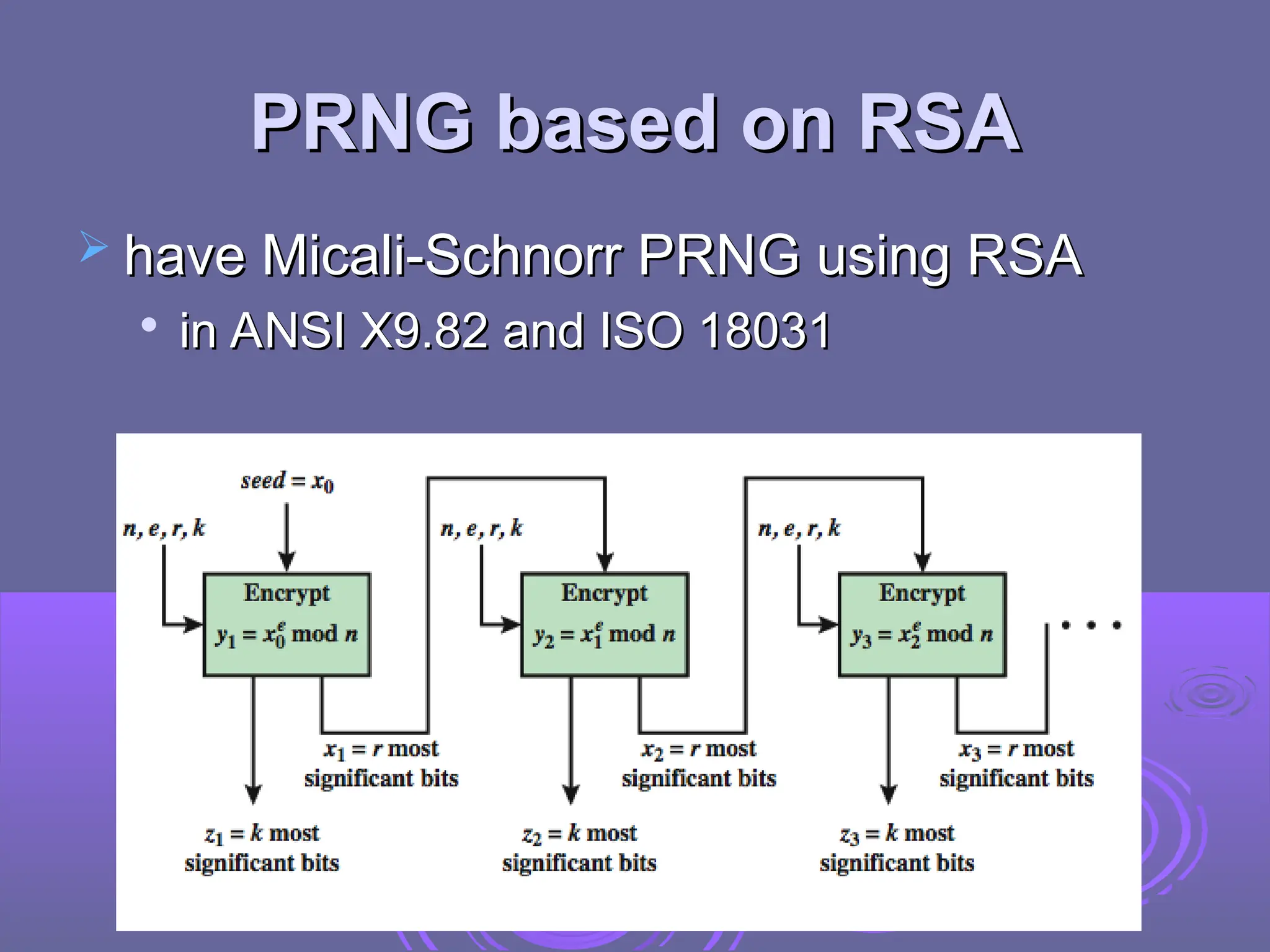
have Micali-Schnorr PRNG using RSA
have Micali-Schnorr PRNG using RSA
in ANSI X9.82 and ISO 18031
in ANSI X9.82 and ISO 18031
24.
Summary
Summary
have considered:
haveconsidered:
Diffie-Hellman key exchange
Diffie-Hellman key exchange
ElGamal cryptography
ElGamal cryptography
Elliptic Curve cryptography
Elliptic Curve cryptography
Pseudorandom Number Generation (PRNG)
Pseudorandom Number Generation (PRNG)
based on Asymmetric Ciphers (RSA & ECC)
based on Asymmetric Ciphers (RSA & ECC)
Editor's Notes
#1 Lecture slides by Lawrie Brown for “Cryptography and Network Security”, 5/e, by William Stallings, Chapter 10 – “Other Public Key Cryptosystems”.
#3 This chapter continues our overview of public-key cryptography systems (PKCSs), and begins with a description of one of the earliest and simplest PKCS, Diffie-Hellman key exchange. This first published public-key algorithm appeared in the seminal paper by Diffie and Hellman that defined public-key cryptography [DIFF76b] and is generally referred to as Diffie-Hellman key exchange. The concept had been previously described in a classified report in 1970 by Williamson (UK CESG) - and subsequently declassified in 1987, see [ELLI99]. The purpose of the algorithm is to enable two users to securely exchange a key that can then be used for subsequent encryption of messages. The algorithm itself is limited to the exchange of secret values. A number of commercial products employ this key exchange technique.
#4 The purpose of the algorithm is to enable two users to securely exchange a key that can then be used for subsequent encryption of messages. The algorithm itself is limited to the exchange of secret values, which depends on the value of the public/private keys of the participants. The Diffie-Hellman algorithm uses exponentiation in a finite (Galois) field (modulo a prime or a polynomial), and depends for its effectiveness on the difficulty of computing discrete logarithms.
#5 In the Diffie-Hellman key exchange algorithm, there are two publicly known numbers: a prime number q and an integer a that is a primitive root of q. The prime q and primitive root a can be common to all using some instance of the D-H scheme. Note that the primitive root a is a number whose powers successively generate all the elements mod q. Users Alice and Bob choose random secrets x's, and then "protect" them using exponentiation to create their public y's. For an attacker monitoring the exchange of the y's to recover either of the x's, they'd need to solve the discrete logarithm problem, which is hard.
#6 The actual key exchange for either party consists of raising the others "public key' to power of their private key. The resulting number (or as much of as is necessary) is used as the key for a block cipher or other private key scheme. For an attacker to obtain the same value they need at least one of the secret numbers, which means solving a discrete log, which is computationally infeasible given large enough numbers. Note that if Alice and Bob subsequently communicate, they will have the same key as before, unless they choose new public-keys.
#7 Here is an example of Diffie-Hellman from the text using prime q=353, showing how each computes its public key, and then how after they exchange public keys, each can compute the common secret key.I n this simple example, it would be possible by brute force to determine the secret key 160. In particular, an attacker E can determine the common key by discovering a solution to the equation 3a mod 353 = 40 or the equation 3b mod 353 = 248. The brute-force approach is to calculate powers of 3 modulo 353, stopping when the result equals either 40 or 248. The desired answer is reached with the exponent value of 97, which provides 397 mod 353 = 40. With larger numbers, the problem becomes impractical.
#8 Now consider a simple protocol that makes use of the Diffie-Hellman calculation. Suppose that user A wishes to set up a connection with user B and use a secret key to encrypt messages on that connection. User A can generate a one-time private key XA, calculate YA, and send that to user B. User B responds by generating a private value XB, calculating YB, and sending YB to user A. Both users can now calculate the key. The necessary public values q and a would need to be known ahead of time. Alternatively, user A could pick values for q and a and include those in the first message.
#9 Now consider a simple protocol that makes use of the Diffie-Hellman calculation. Suppose that user A wishes to set up a connection with user B and use a secret key to encrypt messages on that connection. User A can generate a one-time private key XA, calculate YA, and send that to user B. User B responds by generating a private value XB, calculating YB, and sending YB to user A. Both users can now calculate the key. The necessary public values q and a would need to be known ahead of time. Alternatively, user A could pick values for q and a and include those in the first message.
#10 The protocol described on the previous slide is insecure against a man-in-the-middle attack. Suppose Alice and Bob wish to exchange keys, and Darth is the adversary. The attack proceeds as follows:
Darth prepares for the attack by generating two random private keys XD1 and XD2 and then computing the corresponding public keys YD1 and YD2
Alice transmits YA to Bob.
Darth intercepts YA and transmits YD1 to Bob. Darth also calculates K2 = (YA )^ XD2 mod q
Bob receives YD1 and calculates K1=(YD1 )^ XB mod q
Bob transmits YB to Alice.
Darth intercepts YB and transmits YD2 to Alice. Darth calculates K1=(YB )^ XD1 mod q
Alice receives YD2 and calculates K2=(YD2 )^ XA mod q .
At this point, Bob and Alice think that they share a secret key, but instead Bob and Darth share secret key K1 and Alice and Darth share secret key K2. All future communication between Bob and Alice is compromised in the following way:
Alice sends an encrypted message M: E(K2, M).
Darth intercepts the encrypted message and decrypts it, to recover M.
Darth sends Bob E(K1, M) or E(K1, M'), where M' is any message. In the first case, Darth simply wants to eavesdrop on the communication without altering it. In the second case, Darth wants to modify the message going to Bob. The key exchange protocol is vulnerable to such an attack because it does not authenticate the participants. This vulnerability can be overcome with the use of digital signatures and public- key certificates.
#11 The protocol described on the previous slide is insecure against a man-in-the-middle attack. Suppose Alice and Bob wish to exchange keys, and Darth is the adversary. The attack proceeds as follows:
Darth prepares for the attack by generating two random private keys XD1 and XD2 and then computing the corresponding public keys YD1 and YD2
Alice transmits YA to Bob.
Darth intercepts YA and transmits YD1 to Bob. Darth also calculates K2 = (YA )^ XD2 mod q
Bob receives YD1 and calculates K1=(YD1 )^ XB mod q
Bob transmits YB to Alice.
Darth intercepts YB and transmits YD2 to Alice. Darth calculates K1=(YB )^ XD1 mod q
Alice receives YD2 and calculates K2=(YD2 )^ XA mod q .
At this point, Bob and Alice think that they share a secret key, but instead Bob and Darth share secret key K1 and Alice and Darth share secret key K2. All future communication between Bob and Alice is compromised in the following way:
Alice sends an encrypted message M: E(K2, M).
Darth intercepts the encrypted message and decrypts it, to recover M.
Darth sends Bob E(K1, M) or E(K1, M'), where M' is any message. In the first case, Darth simply wants to eavesdrop on the communication without altering it. In the second case, Darth wants to modify the message going to Bob. The key exchange protocol is vulnerable to such an attack because it does not authenticate the participants. This vulnerability can be overcome with the use of digital signatures and public- key certificates.
#12 In 1984, T. Elgamal announced a public-key scheme based on discrete logarithms, closely related to the Diffie-Hellman technique [ELGA84, ELGA85]. The ElGamal cryptosystem is used in some form in a number of standards including the digital signature standard (DSS) and the S/MIME email standard. As with Diffie-Hellman, the global elements of ElGamal are a prime number q and a, which is a primitive root of q. User A generates a private/public key pair as shown. The security of ElGamal is based on the difficulty of computing discrete logarithms, to recover either x given y, or k given K (next slide).
#13 Any user B that has access to A's public key can encrypt a message as shown. These steps correspond to Figure 9.1a in that Alice generates a public/private key pair; Bob encrypts using Alice's public key; and Alice decrypts using her private key. See text for details of why these steps result in M being recovered. Note that K functions as a one-time key, used to encrypt and decrypt the message. If a message must be broken up into blocks and sent as a sequence of encrypted blocks, a unique value of k should be used for each block. If k is used for more than one block, knowledge of one block m of the message enables the user to compute other blocks as shown in the text.
The basic idea with El Gamal encryption is to choose a random key, protect it, then use it to scramble the message by multiplying the message with it. Two bits of info have to be sent: the first to recover this temporary key, the second the actual scrambled message. See that El Gamal encryption involves 1 modulo exponentiation and a multiplication (vs 1 exponentiation for RSA).
#14 Here is an example of ElGamal from the text using the prime field GF(19); that is, q = 19. It has primitive roots {2, 3, 10, 13, 14, 15}, as shown in Table 8.3. We choose a = 10. Alice generates a key pair as shown. Suppose Bob wants to send the message with the value M = 17. Then he computes the ciphertext pair (11, 5) and sends this to Alice. Alice recovers the message by first recovering K, then computing its inverse (using the Extended Euclids Algorithm – see Ch 4), and finally recovering M.
#15 A major issue with the use of Public-Key Cryptography, is the size of numbers used, and hence keys being stored. Recently, an alternate approach has emerged, elliptic curve cryptography (ECC), which performs the computations using elliptic curve arithmetic instead of integer or polynomial arithmetic. Already, ECC is showing up in standardization efforts, including the IEEE P1363 Standard for Public-Key Cryptography. The principal attraction of ECC, compared to RSA, is that it appears to offer equal security for a far smaller key size, thereby reducing processing overhead. Although the theory of ECC has been around for some time, it is only recently that products have begun to appear and that there has been sustained cryptanalytic interest in probing for weaknesses. Accordingly, the confidence level in ECC is not yet as high as that in RSA.
#16 An elliptic curve is defined by an equation in two variables, with coefficients. For cryptography, the variables and coefficients are restricted to elements in a finite field, which results in the definition of a finite abelian group (see Ch 4 for details of an abelian group). Before looking at this, we first look at elliptic curves in which the variables and coefficients are real numbers. This case is perhaps easier to visualize. Elliptic curves are not ellipses. They are so named because they are described by cubic equations, similar to those used for calculating the circumference of an ellipse. For our purpose, we can consider cubic equations for elliptic curves of the form shown here. Also included in the definition of an elliptic curve is a single element denoted O and called the point at infinity or the zero point. Now, consider the set of points E(a, b) consisting of all of the points (x, y) that satisfy this equation together with the element O. Using a different value of the pair (a, b) results in a different set E(a, b). See text for detailed rules of addition and relation to zero point O. Can derive an algebraic interpretation of addition, based on computing gradient of tangent and then solving for intersection with curve. There is also an algebraic description of additions over elliptic curves, see text.
#17 Stallings Figure 10.4b “Example of Elliptic Curves”, illustrates the geometric interpretation of elliptic curve addition, as follows: If three points on an elliptic curve lie on a straight line, their sum is O. hence define addition as:
O serves as the additive identity. Thus O = –O; for any point P on the elliptic curve, P + O = P. In what follows, we assume P <> O and Q <> O.
The negative of a point P is the point with the same x coordinate but the negative of the y coordinate; that is, if P = (x, y), then –P = (x, –y). These two points can be joined by a vertical line & that P + (–P) = P – P = O.
To add two points P and Q with different x coordinates, draw a straight line between them and find the third point of intersection R. There is a unique point R that is the point of intersection (unless the line is tangent to the curve at either P or Q, in which case we take R = P or R = Q, respectively). To form a group structure, we need to define addition on these three points as follows: P + Q = –R. ie. P + Q to be the mirror image (with respect to the x axis) of the third point of intersection as shown on slide.
The geometric interpretation of the preceding item also applies to two points, P and –P, with the same x coordinate. The points are joined by a vertical line, which can be viewed as also intersecting the curve at the infinity point. We therefore have P + (–P) = O, consistent with item (2).
To double a point Q, draw the tangent line and find the other point of intersection S. Then Q + Q = 2Q = –S.
With the preceding list of rules, it can be shown that the set E(a, b) is an abelian group.
#18 Elliptic curve cryptography makes use of elliptic curves in which the variables and coefficients are all restricted to elements of a finite field. Two families of elliptic curves are used in cryptographic applications: prime curves over Zp (best for software use), and binary curves over GF(2m) (best for hardware use).
There is no obvious geometric interpretation of elliptic curve arithmetic over finite fields. The algebraic interpretation used for elliptic curve arithmetic over does readily carry over. See text for detailed discussion.
#19 Elliptic Curve Cryptography uses addition as an analog of modulo multiply, and repeated addition as an analog of modulo exponentiation. The “hard” problem is the elliptic curve logarithm problem. We give an example taken from the Certicom Web site (www.certicom.com). Consider the group E23(9, 17). This is the group defined by the equation y2 mod 23 = (x3 + 9x + 17) mod 23. What is the discrete logarithm k of Q = (4, 5) to the base P = (16, 5)? The brute-force method is to compute multiples of P until Q is found. Thus P = (16, 5); 2P = (20, 20); 3P = (14, 14); 4P = (19, 20); 5P = (13, 10); 6P = (7, 3); 7P = (8, 7); 8P = (12, 17) ; 9P = (4, 5). Because 9P = (4, 5) = Q, the discrete logarithm Q = (4, 5) to the base P = (16, 5) is k = 9. In a real application, k would be so large as to make the brute-force approach infeasible.
#20 Illustrate here the elliptic curve analog of Diffie-Hellman key exchange, which is a close analogy given elliptic curve multiplication equates to modulo exponentiation. Key exchange using elliptic curves can be done in the following manner. First pick a large integer q, which is either a prime number p or an integer of the form 2m and elliptic curve parameters a and b for Equation (10.5) or Equation (10.7). This defines the elliptic group of points Eq(a, b). Next, pick a base point G = (x1, y1) in Eq(a, b) whose order is a very large value n. The order n of a point G on an elliptic curve is the smallest positive integer n such that nG = O. So Eq(a, b) and G are parameters of the cryptosystem known to all participants. A key exchange between users A and B can then be accomplished as shown. To break this scheme, an attacker would need to be able to compute k given G and kG, which is assumed hard.
#21 Several approaches to encryption/decryption using elliptic curves have been analyzed in the literature. This one is an analog of the ElGamal public-key encryption algorithm. The sender must first encode any message M as a point on the elliptic curve Pm (there are relatively straightforward techniques for this). Note that the ciphertext is a pair of points on the elliptic curve. The sender masks the message using random k, but also sends along a “clue” allowing the receiver who know the private-key to recover k and hence the message. For an attacker to recover the message, the attacker would have to compute k given G and kG, which is assumed hard.
#22 The security of ECC depends on how difficult it is to determine k given kP and P. This is referred to as the elliptic curve logarithm problem. The fastest known technique for taking the elliptic curve logarithm is known as the Pollard rho method. Compared to factoring integers or polynomials, can use much smaller numbers for equivalent levels of security.
#23 Stallings Table 10.3 - “ Comparable Key Sizes in Terms of Computational Effort for Cryptanalysis” ompares various algorithms by showing comparable key sizes in terms of computational effort for cryptanalysis. As can be seen, a considerably smaller key size can be used for ECC compared to RSA. Furthermore, for equal key lengths, the computational effort required for ECC and RSA is comparable. Thus, there is a computational advantage to using ECC with a shorter key length than a comparably secure RSA.
#24 We noted in Chapter 7 that, because a symmetric block cipher produces an apparently random output, it can serve as the basis of a pseudorandom number generator (PRNG). Similarly, an asymmetric encryption algorithm produces apparently random output and can be used to build a PRNG. Because asymmetric algorithms are typically much slower than symmetric algorithms, asymmetric algorithms are not used to generate open-ended PRNG bit streams. Rather, the asymmetric approach is useful for creating a pseudorandom function (PRF) for generating a short pseudorandom bit sequence. In this section, we examine two PRNG designs based on pseudorandom functions.
#25 For a sufficient key length, the RSA algorithm is considered secure and is a good candidate to form the basis of a PRNG. Such a PRNG, known as the Micali-Schnorr PRNG is recommended in the ANSI standard X9.82 (Random Number Generation) and in the ISO standard 18031 (Random Bit Generation). The PRNG is illustrated in Stallings Figure 10.8. This PRNG has much the same structure as the output feedback (OFB) mode used as a PRNG but using RSA instead of a block cipher. We can define the PRNG as follows:
SETUP Select parameters per normal RSA key setup, with r + k =bitlength of n
SEED Select a random seed x of bitlength the same as n
GENERATE a pseudorandom sequence of length k x m using the loop:
for i from 1 to m do the following:
yi = xei-1 mod n
xi = r most significant bits of yi
zi = k least significant bits of yi
OUTPUT The output sequence is z1 || z2 || … || zm
The parameters n, r, e, and k are selected to satisfy the six conditions detailed in the text. There is clearly a tradeoff between r and k. Because RSA is computationally intensive, we would like to generate as many pseudorandom bits per iteration as possible, and therefore would like a large value of k. However, for cryptographic strength, we would like r to be as large as possible.
#26 In this subsection, we briefly summarize a technique developed by the U.S. National Security Agency known as dual elliptic curve PRNG (DEC PRNG). This technique is recommended in NIST SP 800-90, the ANSI standard X9.82 and in the ISO standard 18031. There has been some controversy regarding both the security and inefficiency of this algorithm compared to other alternatives. Can summarize the algorithm as follows: Let P and Q be two known points on a given elliptic curve. The seed of the DEC PRNG is a random integer s0 Let x denote a function that gives the x-coordinate of a point of the curve. Let lsb i(s) denote the i least significant bits of an integer s. The DEC PRNG transforms the seed into the pseudorandom sequence of length 240k, k > 0, as follows.
for i = 1 to k do
set si = x(si-1 P )
set ri = lsb240 (x(si Q))
end for
return r1 , . . . , rk
Given the security concerns expressed for this PRNG, the only motivation for its use would be that it is used in a system that already implements ECC but does not implement any other symmetric, asymmetric, or hash cryptographic algorithm that could be used to build a PRNG.


![Understanding Parkinson’s Disease: Causes, Symptoms, and Treatment [2025]](https://cdn.slidesharecdn.com/ss_thumbnails/understandingparkinson-251208102525-80ba3223-thumbnail.jpg?width=640&height=640&fit=bounds)


