Operating System Concepts Silberschatz and Galvin1999
10.1
Module 10: File-System Interface
• File Concept
• Access :Methods
• Directory Structure
• Protection
• Consistency Semantics
Operating System Concepts Silberschatz and Galvin1999
10.2
File Concept
• Contiguous logical address space
• Types:
– Data
 numeric
 character
 binary
– Program
Operating System Concepts Silberschatz and Galvin1999
10.3
File Structure
• None - sequence of words, bytes
• Simple record structure
– Lines
– Fixed length
– Variable length
• Complex Structures
– Formatted document
– Relocatable load file
• Can simulate last two with first method by inserting appropriate control
characters.
• Who decides:
– Operating system
– Program
Operating System Concepts Silberschatz and Galvin1999
10.4
File Attributes
• Name – only information kept in human-readable form.
• Type – needed for systems that support different types.
• Location – pointer to file location on device.
• Size – current file size.
• Protection – controls who can do reading, writing, executing.
• Time, date, and user identification – data for protection,
security, and usage monitoring.
• Information about files are kept in the directory structure, which is
maintained on the disk.
Operating System Concepts Silberschatz and Galvin1999
10.5
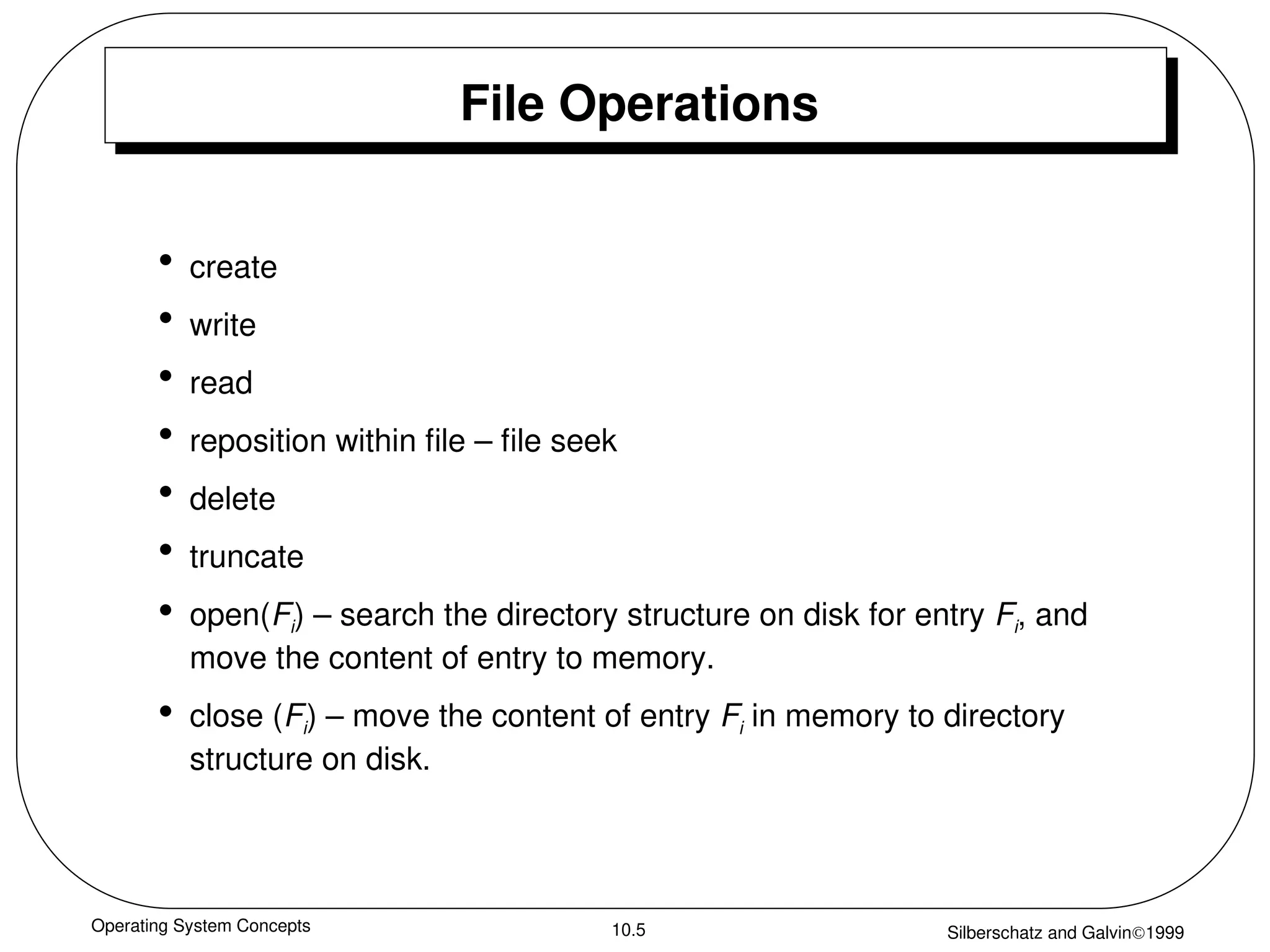
File Operations
• create
• write
• read
• reposition within file – file seek
• delete
• truncate
• open(Fi) – search the directory structure on disk for entry Fi, and
move the content of entry to memory.
• close (Fi) – move the content of entry Fi in memory to directory
structure on disk.
Operating System Concepts Silberschatz and Galvin1999
10.6
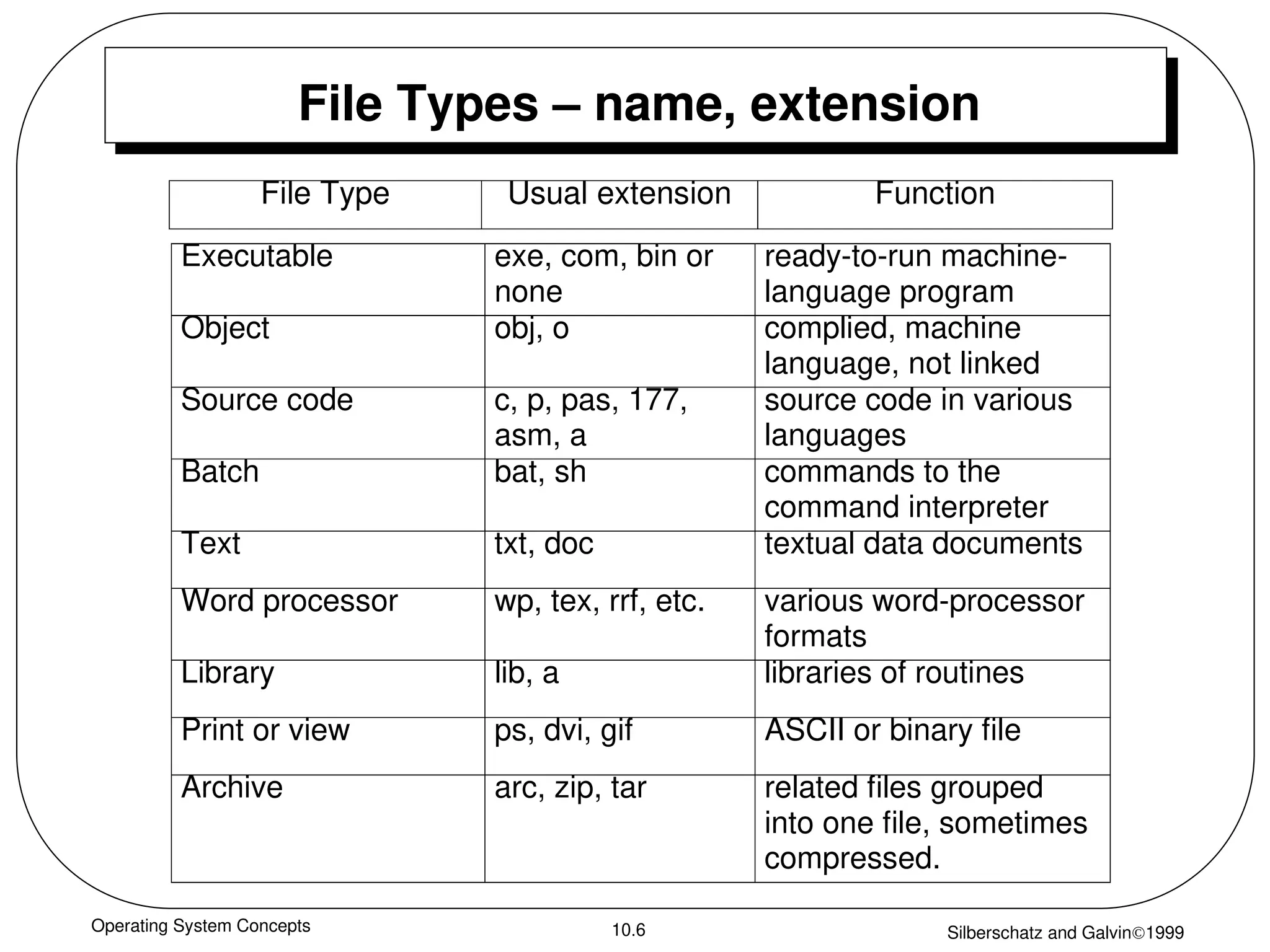
File Types – name, extension
Executable exe, com, bin or
none
ready-to-run machine-
language program
Object obj, o complied, machine
language, not linked
Source code c, p, pas, 177,
asm, a
source code in various
languages
Batch bat, sh commands to the
command interpreter
Text txt, doc textual data documents
Word processor wp, tex, rrf, etc. various word-processor
formats
Library lib, a libraries of routines
Print or view ps, dvi, gif ASCII or binary file
Archive arc, zip, tar related files grouped
into one file, sometimes
compressed.
File Type Usual extension Function
Operating System Concepts Silberschatz and Galvin1999
10.7
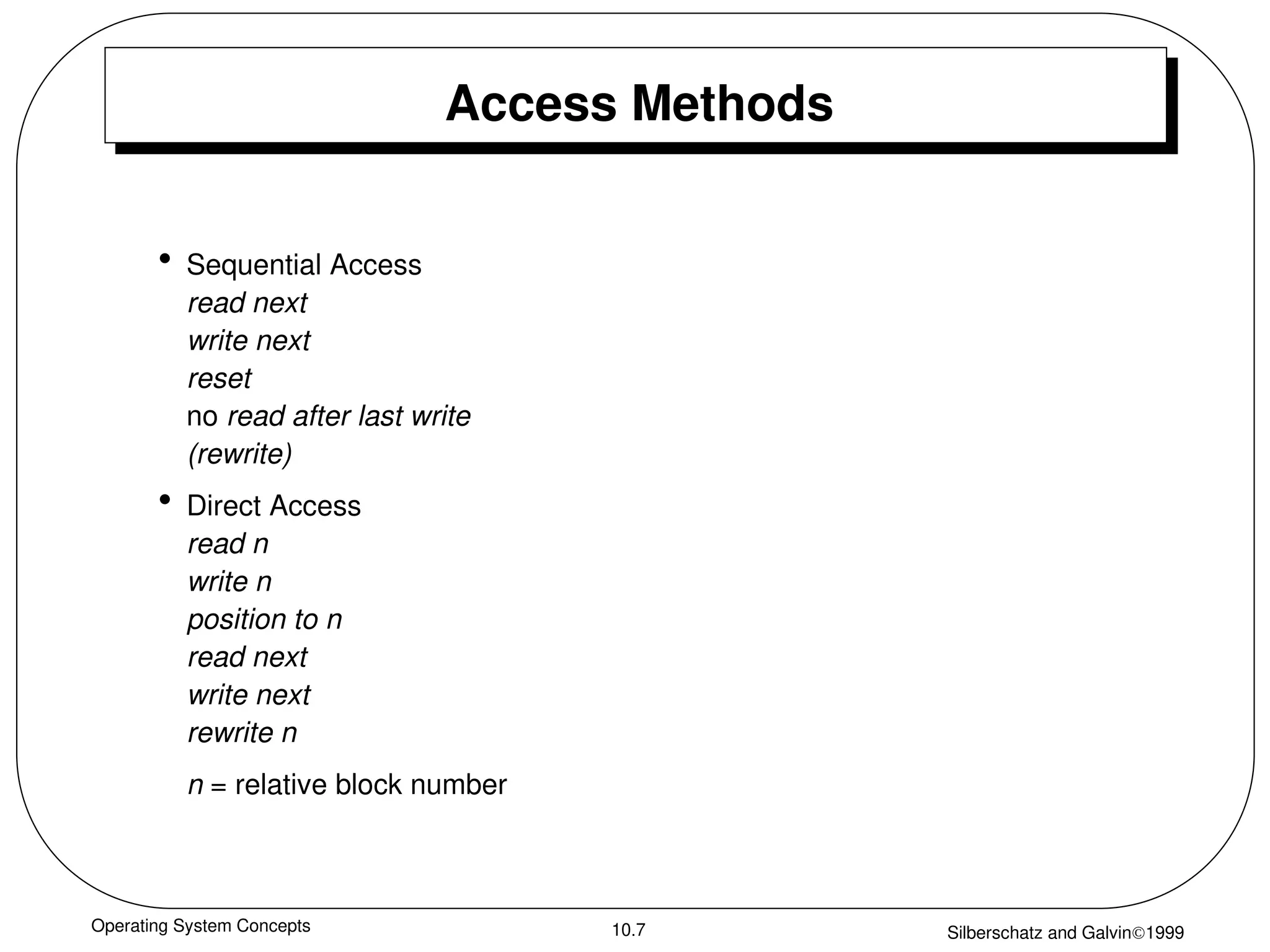
Access Methods
• Sequential Access
read next
write next
reset
no read after last write
(rewrite)
• Direct Access
read n
write n
position to n
read next
write next
rewrite n
n = relative block number
Operating System Concepts Silberschatz and Galvin1999
10.8
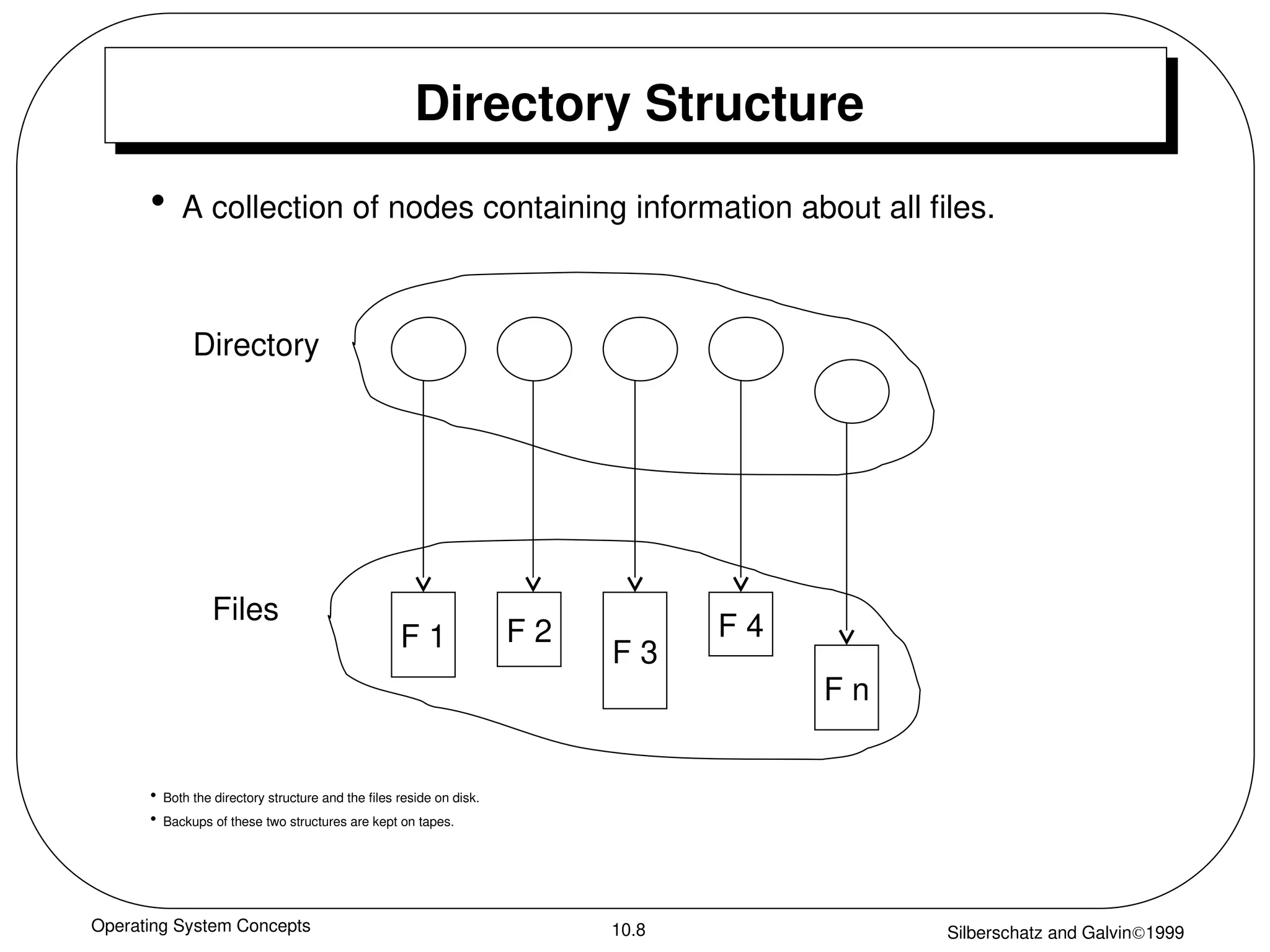
Directory Structure
• A collection of nodes containing information about all files.
F 1 F 2
F 3
F 4
F n
Directory
Files
• Both the directory structure and the files reside on disk.
• Backups of these two structures are kept on tapes.
Operating System Concepts Silberschatz and Galvin1999
10.9
Information in a Device Directory
• Name
• Type
• Address
• Current length
• Maximum length
• Date last accessed (for archival)
• Date last updated (for dump)
• Owner ID (who pays)
• Protection information (discuss later)
Operating System Concepts Silberschatz and Galvin1999
10.10
Operations Performed on Directory
• Search for a file
• Create a file
• Delete a file
• List a directory
• Rename a file
• Traverse the file system
Operating System Concepts Silberschatz and Galvin1999
10.11
Organize the Directory (Logically) to Obtain
• Efficiency – locating a file quickly.
• Naming – convenient to users.
– Two users can have same name for different files.
– The same file can have several different names.
• Grouping – logical grouping of files by properties, (e.g., all Pascal
programs, all games, …)
Operating System Concepts Silberschatz and Galvin1999
10.12
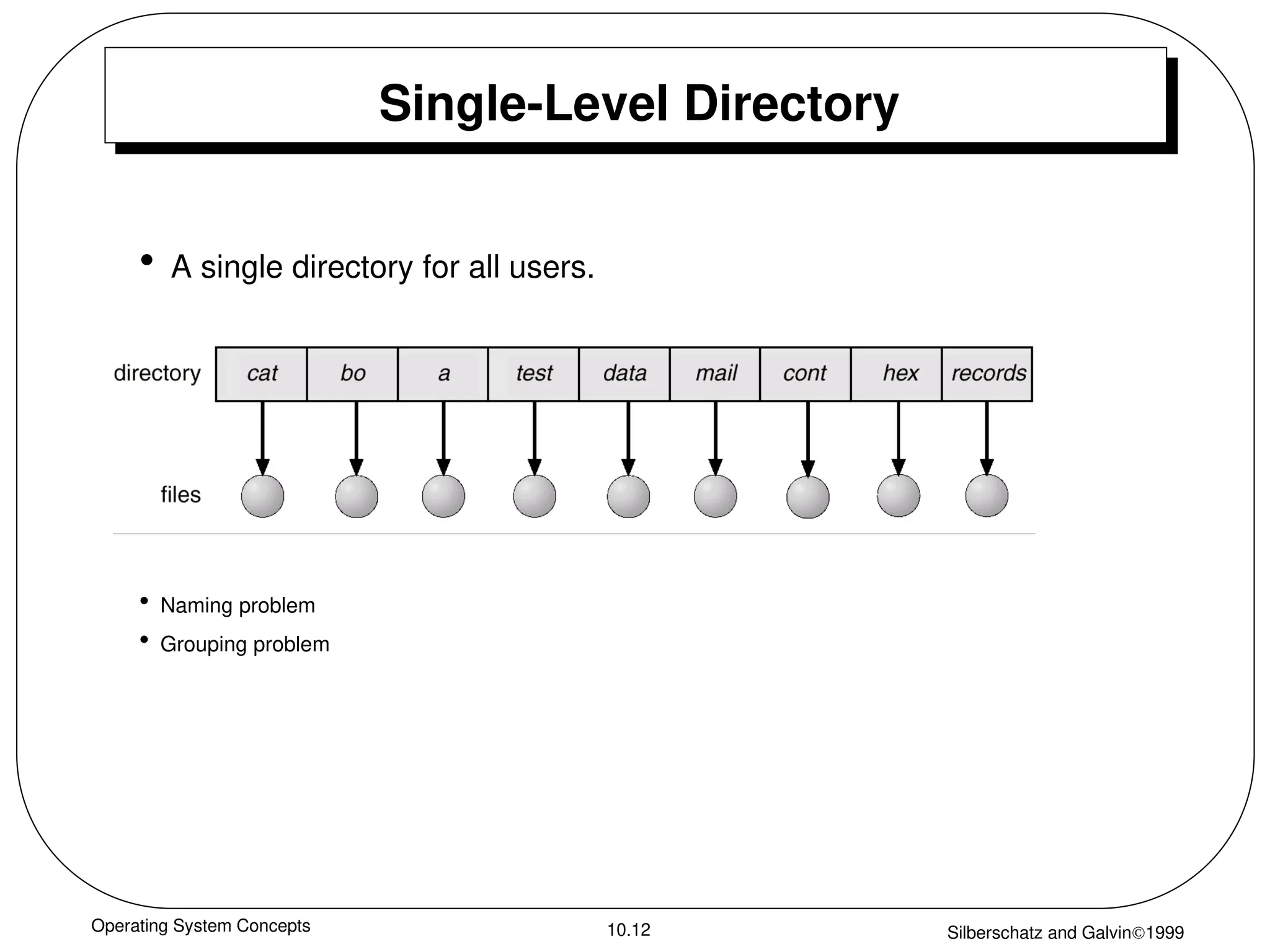
Single-Level Directory
• A single directory for all users.
• Naming problem
• Grouping problem
Operating System Concepts Silberschatz and Galvin1999
10.13
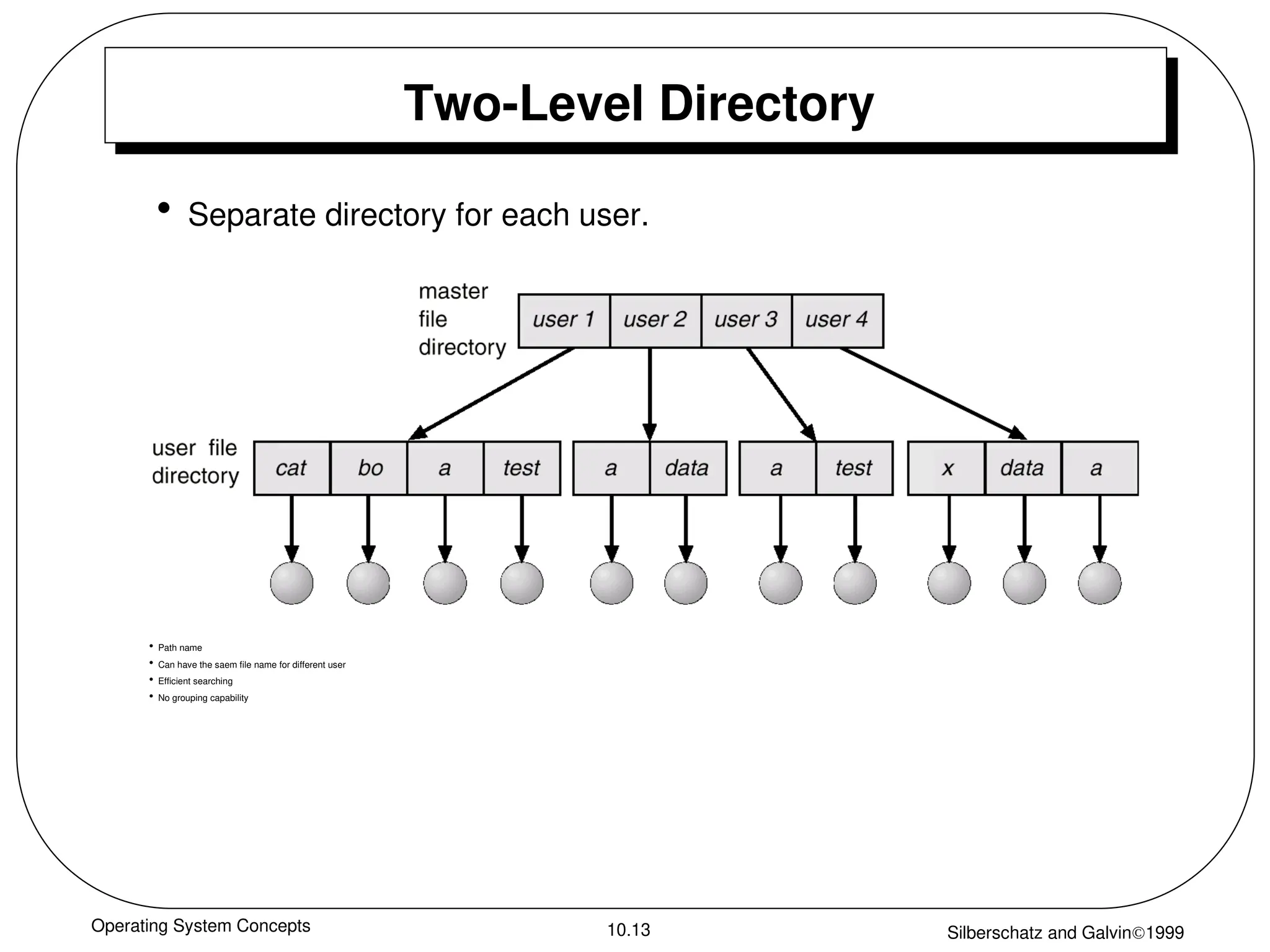
Two-Level Directory
• Separate directory for each user.
• Path name
• Can have the saem file name for different user
• Efficient searching
• No grouping capability
Operating System Concepts Silberschatz and Galvin1999
10.14
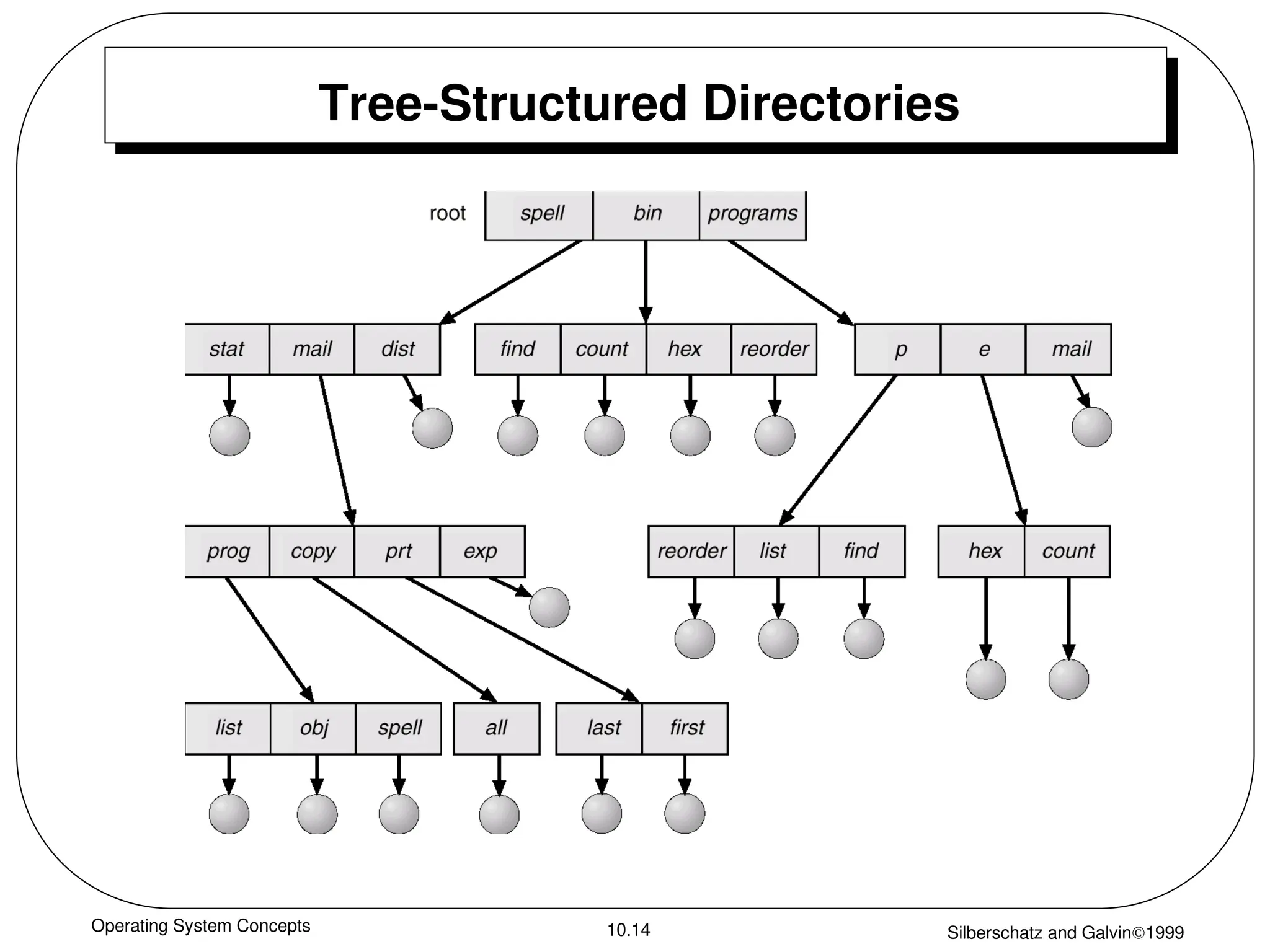
Tree-Structured Directories
Operating System Concepts Silberschatz and Galvin1999
10.15
Tree-Structured Directories (Cont.)
• Efficient searching
• Grouping Capability
• Current directory (working directory)
– cd /spell/mail/prog
– type list
Operating System Concepts Silberschatz and Galvin1999
10.16
Tree-Structured Directories (Cont.)
• Absolute or relative path name
• Creating a new file is done in current directory.
• Delete a file
rm <file-name>
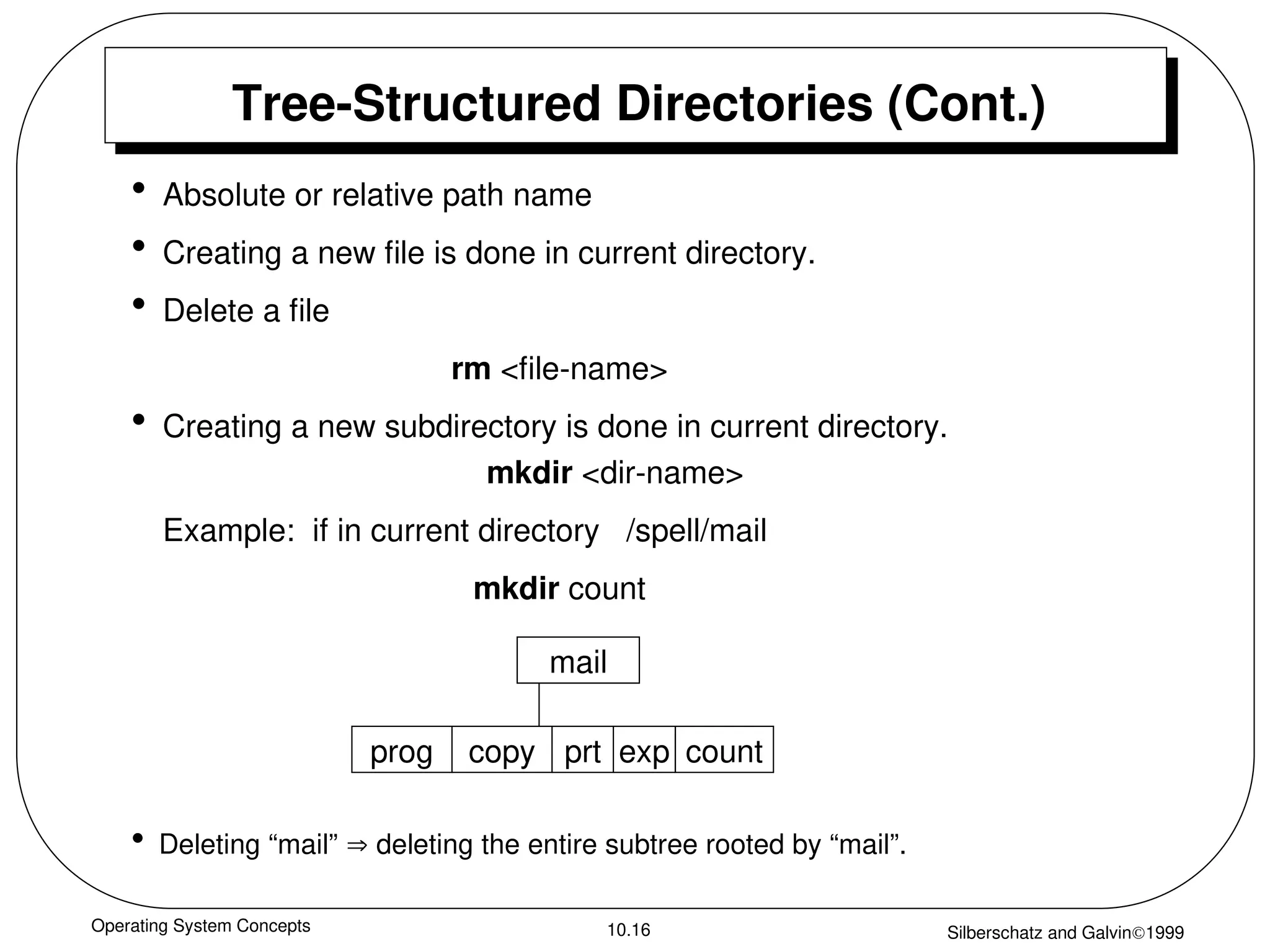
• Creating a new subdirectory is done in current directory.
mkdir <dir-name>
Example: if in current directory /spell/mail
mkdir count
mail
prog copy prt exp count
• Deleting “mail”  deleting the entire subtree rooted by “mail”.
Operating System Concepts Silberschatz and Galvin1999
10.17
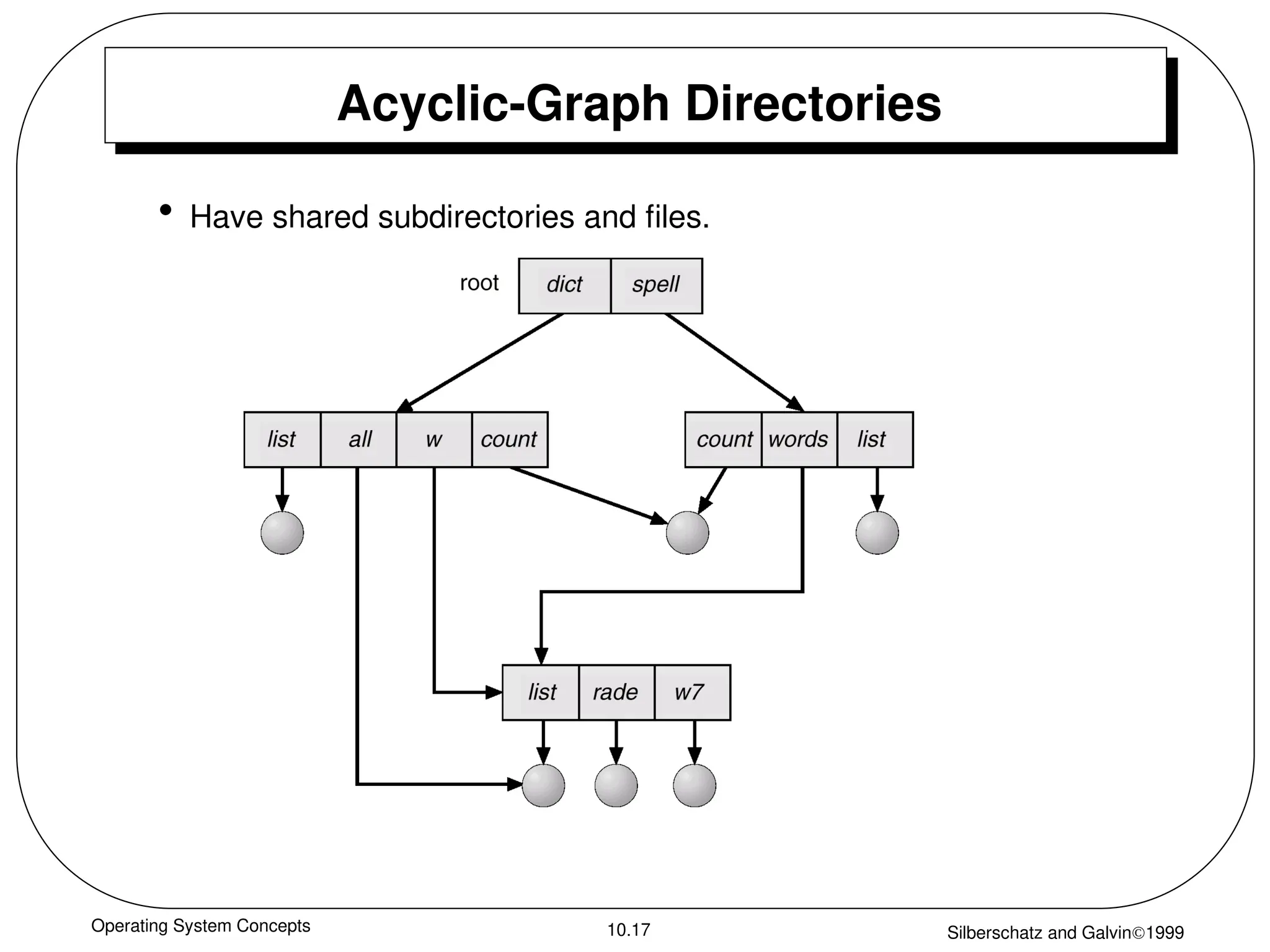
Acyclic-Graph Directories
• Have shared subdirectories and files.
Operating System Concepts Silberschatz and Galvin1999
10.18
Acyclic-Graph Directories (Cont.)
• Two different names (aliasing)
• If dict deletes list  dangling pointer.
Solutions:
– Backpointers, so we can delete all pointers.
Variable size records a problem.
– Backpointers using a daisy chain organization.
– Entry-hold-count solution.
Operating System Concepts Silberschatz and Galvin1999
10.19
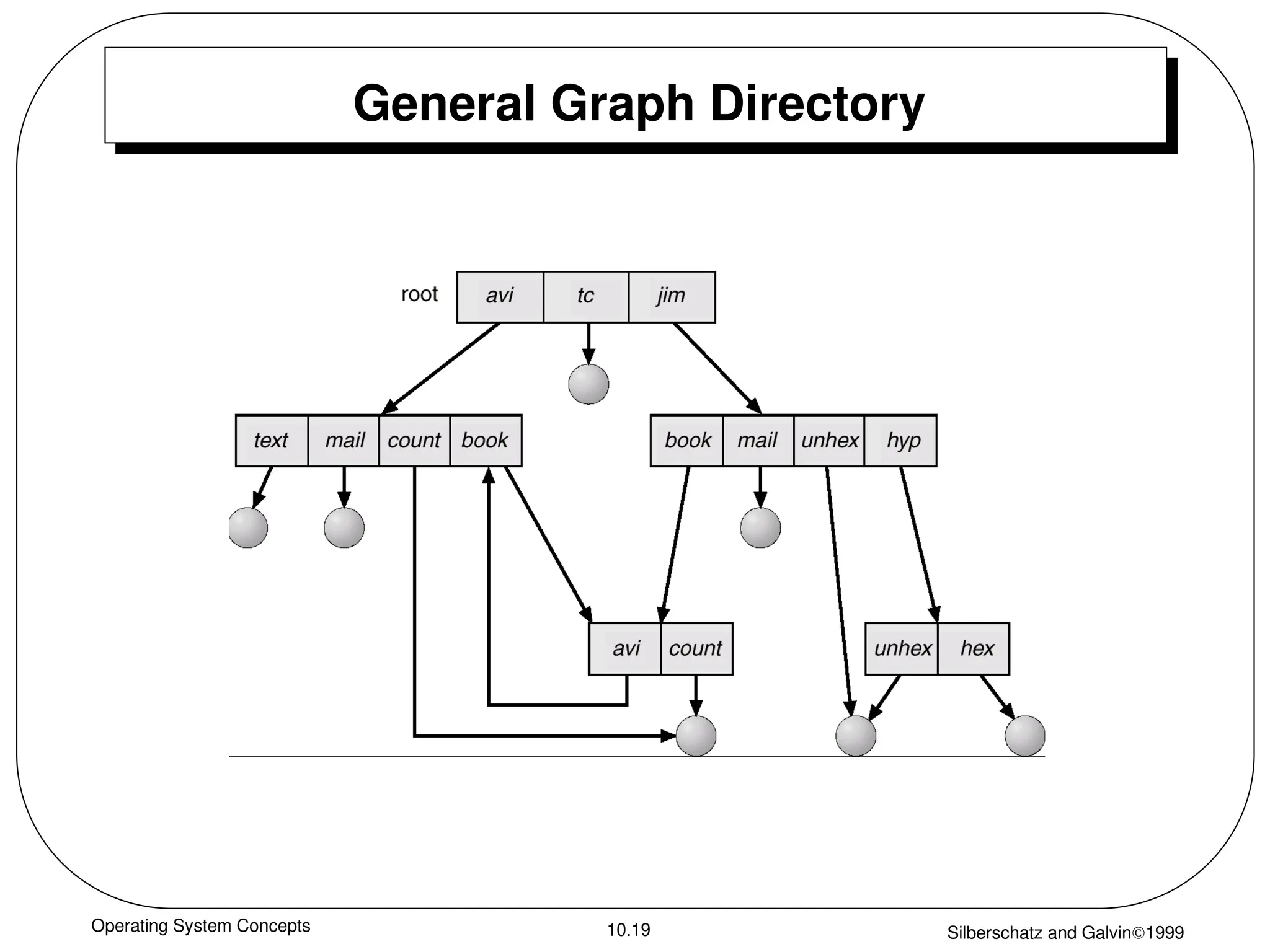
General Graph Directory
Operating System Concepts Silberschatz and Galvin1999
10.20
General Graph Directory (Cont.)
• How do we guarantee no cycles?
– Allow only links to file not subdirectories.
– Garbage collection.
– Every time a new link is added use a cycle detection
algorithm to determine whether it is OK.
Operating System Concepts Silberschatz and Galvin1999
10.21
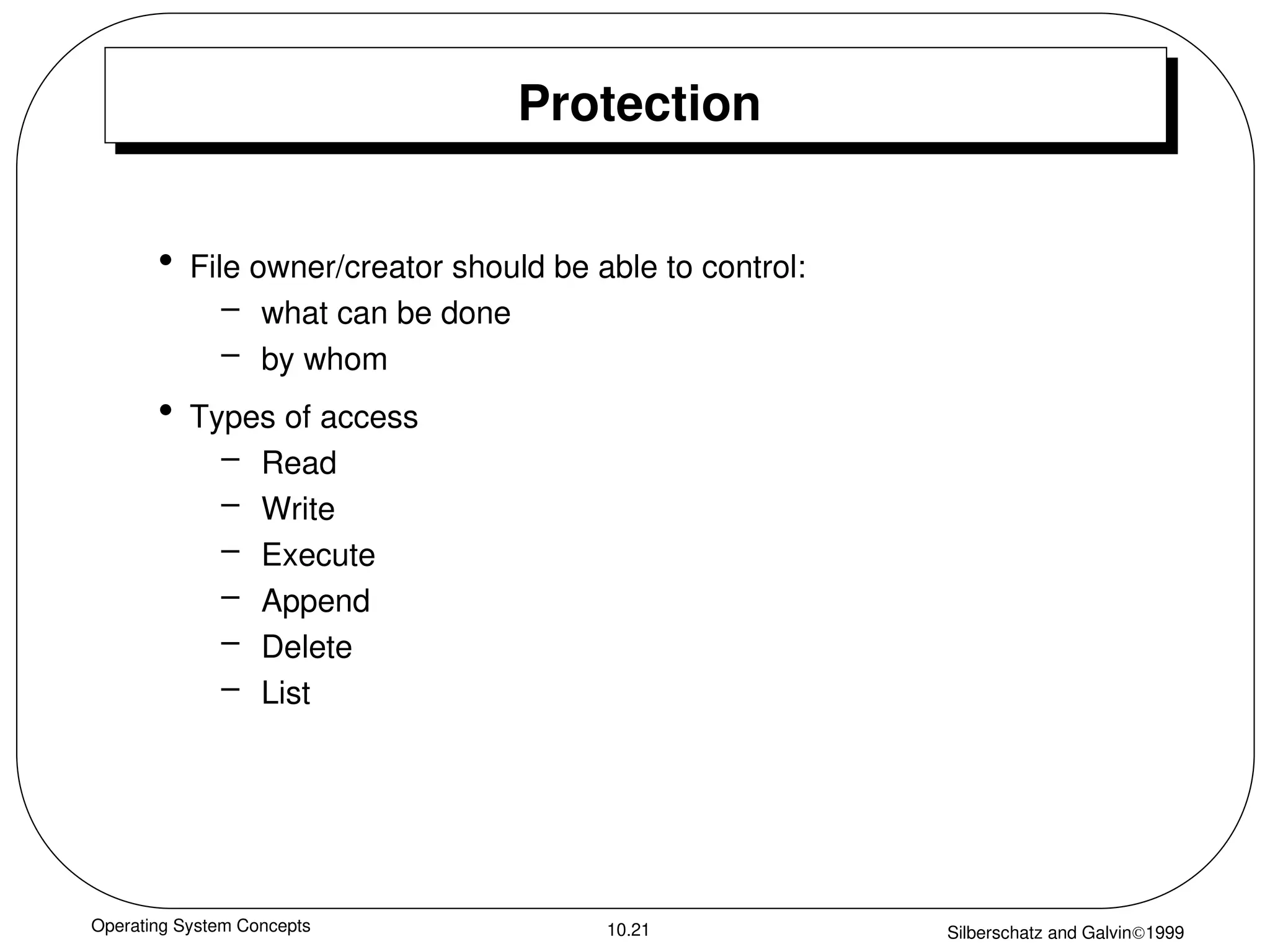
Protection
• File owner/creator should be able to control:
– what can be done
– by whom
• Types of access
– Read
– Write
– Execute
– Append
– Delete
– List
Operating System Concepts Silberschatz and Galvin1999
10.22
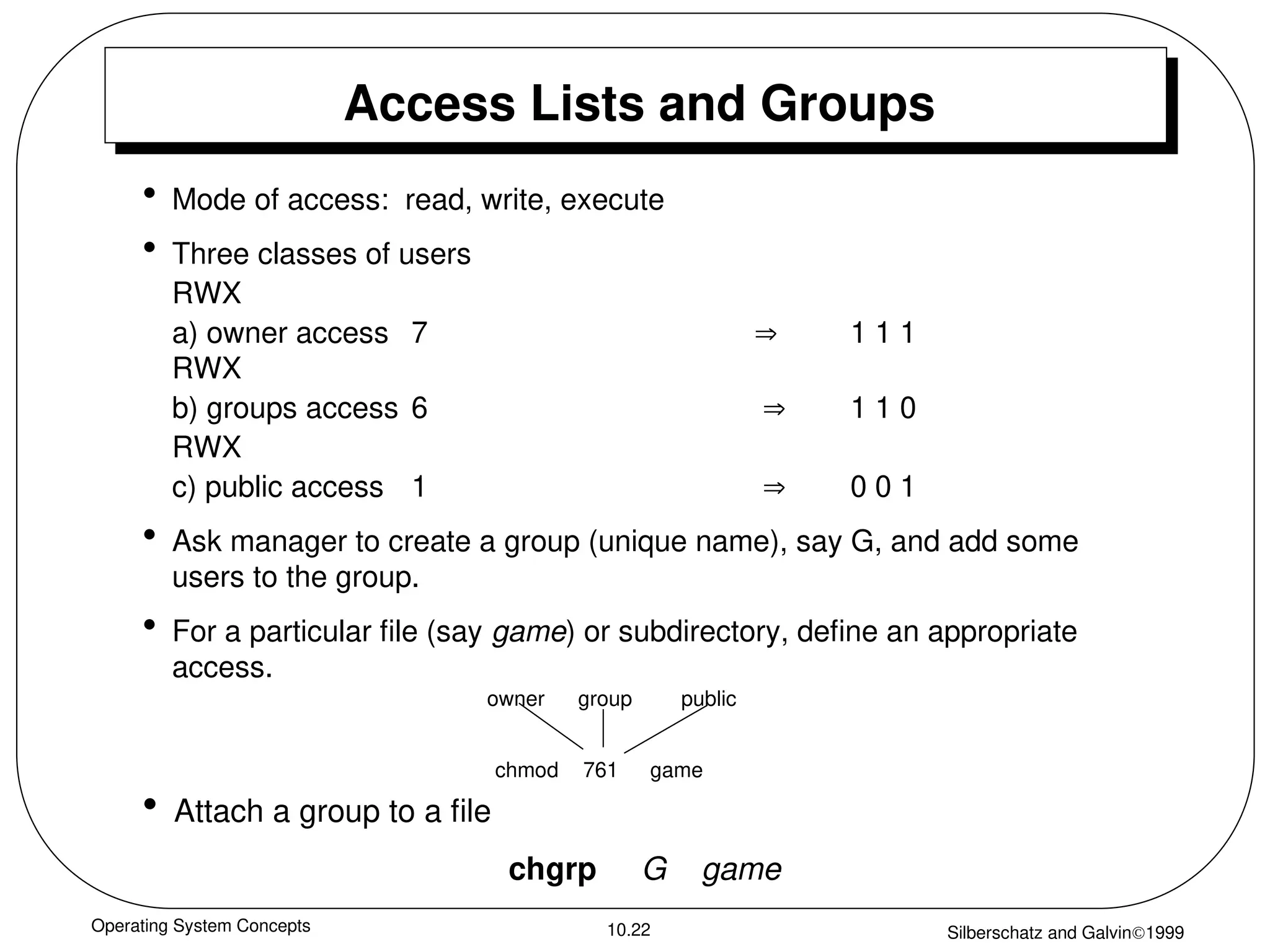
Access Lists and Groups
• Mode of access: read, write, execute
• Three classes of users
RWX
a) owner access 7  1 1 1
RWX
b) groups access 6  1 1 0
RWX
c) public access 1  0 0 1
• Ask manager to create a group (unique name), say G, and add some
users to the group.
• For a particular file (say game) or subdirectory, define an appropriate
access.
owner group public
chmod 761 game
• Attach a group to a file
chgrp G game

ch10.ppt of operating systems of vit bhopal

  • 1.
    Operating System ConceptsSilberschatz and Galvin1999 10.1 Module 10: File-System Interface • File Concept • Access :Methods • Directory Structure • Protection • Consistency Semantics
  • 2.
    Operating System ConceptsSilberschatz and Galvin1999 10.2 File Concept • Contiguous logical address space • Types: – Data  numeric  character  binary – Program
  • 3.
    Operating System ConceptsSilberschatz and Galvin1999 10.3 File Structure • None - sequence of words, bytes • Simple record structure – Lines – Fixed length – Variable length • Complex Structures – Formatted document – Relocatable load file • Can simulate last two with first method by inserting appropriate control characters. • Who decides: – Operating system – Program
  • 4.
    Operating System ConceptsSilberschatz and Galvin1999 10.4 File Attributes • Name – only information kept in human-readable form. • Type – needed for systems that support different types. • Location – pointer to file location on device. • Size – current file size. • Protection – controls who can do reading, writing, executing. • Time, date, and user identification – data for protection, security, and usage monitoring. • Information about files are kept in the directory structure, which is maintained on the disk.
  • 5.
    Operating System ConceptsSilberschatz and Galvin1999 10.5 File Operations • create • write • read • reposition within file – file seek • delete • truncate • open(Fi) – search the directory structure on disk for entry Fi, and move the content of entry to memory. • close (Fi) – move the content of entry Fi in memory to directory structure on disk.
  • 6.
    Operating System ConceptsSilberschatz and Galvin1999 10.6 File Types – name, extension Executable exe, com, bin or none ready-to-run machine- language program Object obj, o complied, machine language, not linked Source code c, p, pas, 177, asm, a source code in various languages Batch bat, sh commands to the command interpreter Text txt, doc textual data documents Word processor wp, tex, rrf, etc. various word-processor formats Library lib, a libraries of routines Print or view ps, dvi, gif ASCII or binary file Archive arc, zip, tar related files grouped into one file, sometimes compressed. File Type Usual extension Function
  • 7.
    Operating System ConceptsSilberschatz and Galvin1999 10.7 Access Methods • Sequential Access read next write next reset no read after last write (rewrite) • Direct Access read n write n position to n read next write next rewrite n n = relative block number
  • 8.
    Operating System ConceptsSilberschatz and Galvin1999 10.8 Directory Structure • A collection of nodes containing information about all files. F 1 F 2 F 3 F 4 F n Directory Files • Both the directory structure and the files reside on disk. • Backups of these two structures are kept on tapes.
  • 9.
    Operating System ConceptsSilberschatz and Galvin1999 10.9 Information in a Device Directory • Name • Type • Address • Current length • Maximum length • Date last accessed (for archival) • Date last updated (for dump) • Owner ID (who pays) • Protection information (discuss later)
  • 10.
    Operating System ConceptsSilberschatz and Galvin1999 10.10 Operations Performed on Directory • Search for a file • Create a file • Delete a file • List a directory • Rename a file • Traverse the file system
  • 11.
    Operating System ConceptsSilberschatz and Galvin1999 10.11 Organize the Directory (Logically) to Obtain • Efficiency – locating a file quickly. • Naming – convenient to users. – Two users can have same name for different files. – The same file can have several different names. • Grouping – logical grouping of files by properties, (e.g., all Pascal programs, all games, …)
  • 12.
    Operating System ConceptsSilberschatz and Galvin1999 10.12 Single-Level Directory • A single directory for all users. • Naming problem • Grouping problem
  • 13.
    Operating System ConceptsSilberschatz and Galvin1999 10.13 Two-Level Directory • Separate directory for each user. • Path name • Can have the saem file name for different user • Efficient searching • No grouping capability
  • 14.
    Operating System ConceptsSilberschatz and Galvin1999 10.14 Tree-Structured Directories
  • 15.
    Operating System ConceptsSilberschatz and Galvin1999 10.15 Tree-Structured Directories (Cont.) • Efficient searching • Grouping Capability • Current directory (working directory) – cd /spell/mail/prog – type list
  • 16.
    Operating System ConceptsSilberschatz and Galvin1999 10.16 Tree-Structured Directories (Cont.) • Absolute or relative path name • Creating a new file is done in current directory. • Delete a file rm <file-name> • Creating a new subdirectory is done in current directory. mkdir <dir-name> Example: if in current directory /spell/mail mkdir count mail prog copy prt exp count • Deleting “mail”  deleting the entire subtree rooted by “mail”.
  • 17.
    Operating System ConceptsSilberschatz and Galvin1999 10.17 Acyclic-Graph Directories • Have shared subdirectories and files.
  • 18.
    Operating System ConceptsSilberschatz and Galvin1999 10.18 Acyclic-Graph Directories (Cont.) • Two different names (aliasing) • If dict deletes list  dangling pointer. Solutions: – Backpointers, so we can delete all pointers. Variable size records a problem. – Backpointers using a daisy chain organization. – Entry-hold-count solution.
  • 19.
    Operating System ConceptsSilberschatz and Galvin1999 10.19 General Graph Directory
  • 20.
    Operating System ConceptsSilberschatz and Galvin1999 10.20 General Graph Directory (Cont.) • How do we guarantee no cycles? – Allow only links to file not subdirectories. – Garbage collection. – Every time a new link is added use a cycle detection algorithm to determine whether it is OK.
  • 21.
    Operating System ConceptsSilberschatz and Galvin1999 10.21 Protection • File owner/creator should be able to control: – what can be done – by whom • Types of access – Read – Write – Execute – Append – Delete – List
  • 22.
    Operating System ConceptsSilberschatz and Galvin1999 10.22 Access Lists and Groups • Mode of access: read, write, execute • Three classes of users RWX a) owner access 7  1 1 1 RWX b) groups access 6  1 1 0 RWX c) public access 1  0 0 1 • Ask manager to create a group (unique name), say G, and add some users to the group. • For a particular file (say game) or subdirectory, define an appropriate access. owner group public chmod 761 game • Attach a group to a file chgrp G game