Prime Distribution
• Prime number theorem states that primes
occur roughly every (ln n) integers
• But can immediately ignore evens
• So in practice need only test 0.5 ln(n)
numbers of size n to locate a prime
• Note this is only the “average”
• Sometimes primes are close together
• Other times are quite far apart
Chinese Remainder Theorem
• Used to speed up modulo computations
• If working modulo a product of numbers
• Eg. mod M = m1m2..mk
• Chinese Remainder theorem lets us work in
each moduli mi separately
• Since computational cost is proportional to
size, this is faster than working in the full
modulus M
Chinese Remainder Theorem
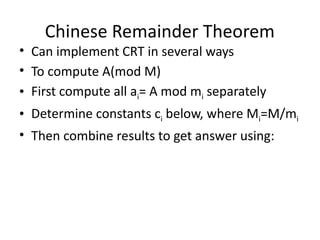
• Can implement CRT in several ways
• To compute A(mod M)
• First compute all ai= A mod mi separately
• Determine constants ci below, where Mi=M/mi
• Then combine results to get answer using:
Primitive Roots
• From Euler’s theorem have a ø(n)
mod n=1
• Consider am
=1 (mod n), GCD(a,n)=1
• Must exist for m = ø(n) but may be smaller
• Once powers reach m, cycle will repeat
• If smallest is m = ø(n) then a is called a primitive
root
• If p is prime, then successive powers of a
"generate" the group mod p
• These are useful but relatively hard to find
Powers mod 19
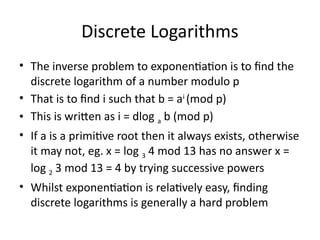
Discrete Logarithms
• The inverse problem to exponentiation is to find the
discrete logarithm of a number modulo p
• That is to find i such that b = ai
(mod p)
• This is written as i = dlog a b (mod p)
• If a is a primitive root then it always exists, otherwise
it may not, eg. x = log 3 4 mod 13 has no answer x =
log 2 3 mod 13 = 4 by trying successive powers
• Whilst exponentiation is relatively easy, finding
discrete logarithms is generally a hard problem
Discrete Logarithms mod 19

module4pptcrypto.pptx, elaborating the basics of encryption

  • 1.
    Prime Distribution • Primenumber theorem states that primes occur roughly every (ln n) integers • But can immediately ignore evens • So in practice need only test 0.5 ln(n) numbers of size n to locate a prime • Note this is only the “average” • Sometimes primes are close together • Other times are quite far apart
  • 2.
    Chinese Remainder Theorem •Used to speed up modulo computations • If working modulo a product of numbers • Eg. mod M = m1m2..mk • Chinese Remainder theorem lets us work in each moduli mi separately • Since computational cost is proportional to size, this is faster than working in the full modulus M
  • 3.
    Chinese Remainder Theorem •Can implement CRT in several ways • To compute A(mod M) • First compute all ai= A mod mi separately • Determine constants ci below, where Mi=M/mi • Then combine results to get answer using:
  • 4.
    Primitive Roots • FromEuler’s theorem have a ø(n) mod n=1 • Consider am =1 (mod n), GCD(a,n)=1 • Must exist for m = ø(n) but may be smaller • Once powers reach m, cycle will repeat • If smallest is m = ø(n) then a is called a primitive root • If p is prime, then successive powers of a "generate" the group mod p • These are useful but relatively hard to find
  • 5.
  • 6.
    Discrete Logarithms • Theinverse problem to exponentiation is to find the discrete logarithm of a number modulo p • That is to find i such that b = ai (mod p) • This is written as i = dlog a b (mod p) • If a is a primitive root then it always exists, otherwise it may not, eg. x = log 3 4 mod 13 has no answer x = log 2 3 mod 13 = 4 by trying successive powers • Whilst exponentiation is relatively easy, finding discrete logarithms is generally a hard problem
  • 7.