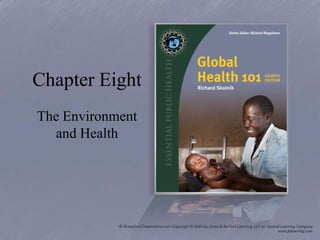
Chapter Eight
The Environment
and Health
Learning Objectives
• Discuss the most important environmental threats to
health, especially for low- and middle-income
countries
• Review the burden of disease related to
environmental risks
• Comment on the costs and consequences of key
environmental health burdens
• Describe some of the most cost-effective ways of
reducing the global burden of environmental health
problems
The Importance of Environmental Health
• Environmental risk factors account for 25–
33% of global burden of disease
• Leading causes of death in low- and middle-
income countries:
– 3rd: Chronic obstructive pulmonary disease
(COPD)
– 5th: Lower respiratory infections
– 7th: Diarrheal diseases
• Central to achieving SDGs
Key Concepts
Environment
“external physical, chemical, and
microbiological exposures and processes that
impinge upon individuals and groups and are
beyond the immediate control of individuals”
-McMichael, A.J. (2001).
Environmental Health.
Key Concepts
Environmental health
efforts that are “concerned with preventing
disease, death, and disability by reducing
exposure to adverse environmental conditions
and promoting behavior change.”
-World Health Organization
Key Concepts
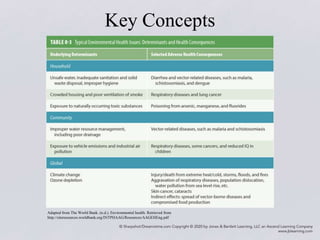
Adapted from The World Bank. (n.d.). Environmental health. Retrieved from
http://siteresources.worldbank.org/INTPHAAG/Resources/AAGEHEng.pdf
Key Environmental Health Burdens
Household Air Pollution
• Three billion people in the world depend on solid
fuel for cooking and heating
• Poorer populations more susceptible
• Short-term problems: conjunctivitis, upper
respiratory infection, acute respiratory infection,
and carbon monoxide poisoning
• Long-term associations: cardiovascular disease,
chronic obstructive pulmonary disease, and
cancer
Key Environmental Health Burdens
Ambient Particulate Matter Pollution
• Common effects are respiratory symptoms,
including cough, irritation of the nose and
throat, and shortness of breath
• Older and younger people tend to be more
susceptible
Key Environmental Health Burdens
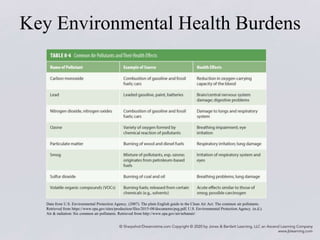
Data from U.S. Environmental Protection Agency. (2007). The plain English guide to the Clean Air Act: The common air pollutants.
Retrieved from https://www.epa.gov/sites/production/files/2015-08/documents/peg.pdf; U.S. Environmental Protection Agency. (n.d.).
Air & radiation: Six common air pollutants. Retrieved from http://www.epa.gov/air/urbanair/
Key Environmental Health Burdens
Water, Sanitation, and Hygiene
• WHO estimated that in 2015 about 71 percent of
the global population or about 5.2 billion people
had access to safe drinking water
• Failure to properly dispose of human waste
associated with increase in transmission of
pathogens through oral-fecal route, spread of
parasitic worms, and trachoma
• Waterborne pathogens are associated with
diarrhea and other gastrointestinal problems
Burden of Environmentally Related
Diseases
Household Air Pollution
• Eighth most important risk factor for deaths
globally in 2016
• Cause of 3.8 million deaths yearly
• Fourth most important risk factor in high
mortality low- and middle-income countries
Burden of Environmentally Related
Diseases
Ambient Particulate Matter Pollution
• Cause of 4.2 million deaths
• 90% of those deaths occur in low- and middle-
income countries
• India and China have major burdens of related
disease, along with other countries in Asia and
Eastern Europe
Burden of Environmentally Related
Diseases
Sanitation, Water, and Hygiene
• Burden falls primarily on children and the poor
in the poorer countries of South Asia and sub-
Saharan Africa
• Unsafe sanitation, unsafe water, poor hygienic
practices, and burden of diarrheal disease are
closely linked
The Costs and Consequences of Key
Environmental Health Problems
• Social and economic consequences are
enormous
• Burden falls disproportionately on relatively
poor people
• Negative consequences on productivity,
particularly for women
• Young children are especially at risk for
consequences of environmental issues
Reducing the Burden of Disease
Ambient Particulate Matter Pollution
• Introduce unleaded gasoline
• Use low-smoke lubricant for, or ban, two-
stroke engines
• Shift to natural gas to fuel public vehicles
• Tighten emissions inspections
• Reduce burning of garbage
Reducing the Burden of Disease
Household Air Pollution
• Improve cooking devices
• Use less polluting fuels
• Reduce need for fuels by using solar cooking
and heating
• Use mechanisms for venting smoke
• Use dried fuels for cooking
• Keep children away from cooking area
Reducing the Burden of Disease
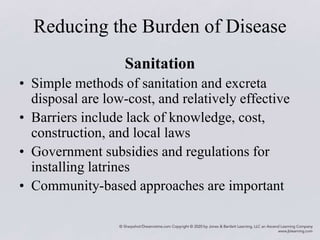
Sanitation
• Simple methods of sanitation and excreta
disposal are low-cost, and relatively effective
• Barriers include lack of knowledge, cost,
construction, and local laws
• Government subsidies and regulations for
installing latrines
• Community-based approaches are important
Reducing the Burden of Disease
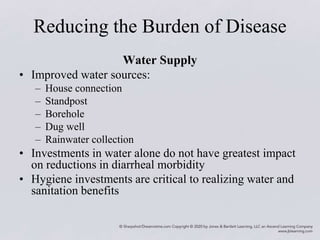
Water Supply
• Improved water sources:
– House connection
– Standpost
– Borehole
– Dug well
– Rainwater collection
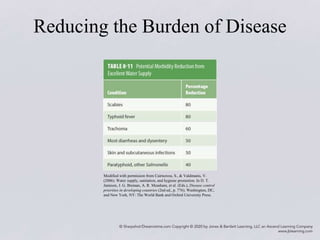
• Investments in water alone do not have greatest impact
on reductions in diarrheal morbidity
• Hygiene investments are critical to realizing water and
sanitation benefits
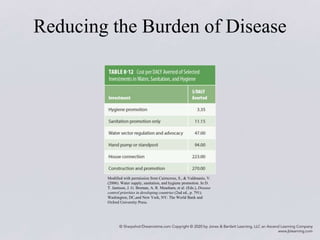
Reducing the Burden of Disease
Modified with permission from Cairncross, S., & Valdmanis, V.
(2006). Water supply, sanitation, and hygiene promotion. In D. T.
Jamison, J. G. Breman, A. R. Measham, et al. (Eds.), Disease control
priorities in developing countries (2nd ed., p. 776). Washington, DC,
and New York, NY: The World Bank and Oxford University Press.
Reducing the Burden of Disease
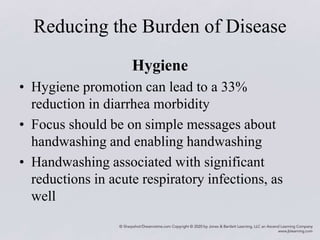
Hygiene
• Hygiene promotion can lead to a 33%
reduction in diarrhea morbidity
• Focus should be on simple messages about
handwashing and enabling handwashing
• Handwashing associated with significant
reductions in acute respiratory infections, as
well
Reducing the Burden of Disease
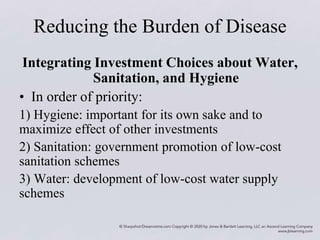
Integrating Investment Choices about Water,
Sanitation, and Hygiene
• In order of priority:
1) Hygiene: important for its own sake and to
maximize effect of other investments
2) Sanitation: government promotion of low-cost
sanitation schemes
3) Water: development of low-cost water supply
schemes
Reducing the Burden of Disease
Modified with permission from Cairncross, S., & Valdmanis, V.
(2006). Water supply, sanitation, and hygiene promotion. In D.
T. Jamison, J. G. Breman, A. R. Measham, et al. (Eds.), Disease
control priorities in developing countries (2nd ed., p. 791).
Washington, DC,and New York, NY: The World Bank and
Oxford University Press.
Future Challenges
• Population growth
• Pollution management
• Community-based approaches to reach rural
populations
• Better information
• Engaging sectors beyond health
Main Messages
• Important environmental health issues include:
the lack of safe water and sanitation, poor
access to hand washing facilities, household
air pollution, and ambient particular matter
• Environmental health issues have a larger
impact on the poor
Main Messages
• When accompanied by improved hygiene,
improved access to water reduces the burden
of diarrheal disease
• There are high-impact, low-cost solutions to
environmental health issues, including: using
improved stoves, building latrines, making
accessible handwashing stations, and taking
intersectoral approaches to reducing ambient
particulate matter pollution

CH08 Environment and Health.pptx

  • 1.
  • 2.
    Learning Objectives • Discussthe most important environmental threats to health, especially for low- and middle-income countries • Review the burden of disease related to environmental risks • Comment on the costs and consequences of key environmental health burdens • Describe some of the most cost-effective ways of reducing the global burden of environmental health problems
  • 3.
    The Importance ofEnvironmental Health • Environmental risk factors account for 25– 33% of global burden of disease • Leading causes of death in low- and middle- income countries: – 3rd: Chronic obstructive pulmonary disease (COPD) – 5th: Lower respiratory infections – 7th: Diarrheal diseases • Central to achieving SDGs
  • 4.
    Key Concepts Environment “external physical,chemical, and microbiological exposures and processes that impinge upon individuals and groups and are beyond the immediate control of individuals” -McMichael, A.J. (2001). Environmental Health.
  • 5.
    Key Concepts Environmental health effortsthat are “concerned with preventing disease, death, and disability by reducing exposure to adverse environmental conditions and promoting behavior change.” -World Health Organization
  • 6.
    Key Concepts Adapted fromThe World Bank. (n.d.). Environmental health. Retrieved from http://siteresources.worldbank.org/INTPHAAG/Resources/AAGEHEng.pdf
  • 7.
    Key Environmental HealthBurdens Household Air Pollution • Three billion people in the world depend on solid fuel for cooking and heating • Poorer populations more susceptible • Short-term problems: conjunctivitis, upper respiratory infection, acute respiratory infection, and carbon monoxide poisoning • Long-term associations: cardiovascular disease, chronic obstructive pulmonary disease, and cancer
  • 8.
    Key Environmental HealthBurdens Ambient Particulate Matter Pollution • Common effects are respiratory symptoms, including cough, irritation of the nose and throat, and shortness of breath • Older and younger people tend to be more susceptible
  • 9.
    Key Environmental HealthBurdens Data from U.S. Environmental Protection Agency. (2007). The plain English guide to the Clean Air Act: The common air pollutants. Retrieved from https://www.epa.gov/sites/production/files/2015-08/documents/peg.pdf; U.S. Environmental Protection Agency. (n.d.). Air & radiation: Six common air pollutants. Retrieved from http://www.epa.gov/air/urbanair/
  • 10.
    Key Environmental HealthBurdens Water, Sanitation, and Hygiene • WHO estimated that in 2015 about 71 percent of the global population or about 5.2 billion people had access to safe drinking water • Failure to properly dispose of human waste associated with increase in transmission of pathogens through oral-fecal route, spread of parasitic worms, and trachoma • Waterborne pathogens are associated with diarrhea and other gastrointestinal problems
  • 11.
    Burden of EnvironmentallyRelated Diseases Household Air Pollution • Eighth most important risk factor for deaths globally in 2016 • Cause of 3.8 million deaths yearly • Fourth most important risk factor in high mortality low- and middle-income countries
  • 12.
    Burden of EnvironmentallyRelated Diseases Ambient Particulate Matter Pollution • Cause of 4.2 million deaths • 90% of those deaths occur in low- and middle- income countries • India and China have major burdens of related disease, along with other countries in Asia and Eastern Europe
  • 13.
    Burden of EnvironmentallyRelated Diseases Sanitation, Water, and Hygiene • Burden falls primarily on children and the poor in the poorer countries of South Asia and sub- Saharan Africa • Unsafe sanitation, unsafe water, poor hygienic practices, and burden of diarrheal disease are closely linked
  • 14.
    The Costs andConsequences of Key Environmental Health Problems • Social and economic consequences are enormous • Burden falls disproportionately on relatively poor people • Negative consequences on productivity, particularly for women • Young children are especially at risk for consequences of environmental issues
  • 15.
    Reducing the Burdenof Disease Ambient Particulate Matter Pollution • Introduce unleaded gasoline • Use low-smoke lubricant for, or ban, two- stroke engines • Shift to natural gas to fuel public vehicles • Tighten emissions inspections • Reduce burning of garbage
  • 16.
    Reducing the Burdenof Disease Household Air Pollution • Improve cooking devices • Use less polluting fuels • Reduce need for fuels by using solar cooking and heating • Use mechanisms for venting smoke • Use dried fuels for cooking • Keep children away from cooking area
  • 17.
    Reducing the Burdenof Disease Sanitation • Simple methods of sanitation and excreta disposal are low-cost, and relatively effective • Barriers include lack of knowledge, cost, construction, and local laws • Government subsidies and regulations for installing latrines • Community-based approaches are important
  • 18.
    Reducing the Burdenof Disease Water Supply • Improved water sources: – House connection – Standpost – Borehole – Dug well – Rainwater collection • Investments in water alone do not have greatest impact on reductions in diarrheal morbidity • Hygiene investments are critical to realizing water and sanitation benefits
  • 19.
    Reducing the Burdenof Disease Modified with permission from Cairncross, S., & Valdmanis, V. (2006). Water supply, sanitation, and hygiene promotion. In D. T. Jamison, J. G. Breman, A. R. Measham, et al. (Eds.), Disease control priorities in developing countries (2nd ed., p. 776). Washington, DC, and New York, NY: The World Bank and Oxford University Press.
  • 20.
    Reducing the Burdenof Disease Hygiene • Hygiene promotion can lead to a 33% reduction in diarrhea morbidity • Focus should be on simple messages about handwashing and enabling handwashing • Handwashing associated with significant reductions in acute respiratory infections, as well
  • 21.
    Reducing the Burdenof Disease Integrating Investment Choices about Water, Sanitation, and Hygiene • In order of priority: 1) Hygiene: important for its own sake and to maximize effect of other investments 2) Sanitation: government promotion of low-cost sanitation schemes 3) Water: development of low-cost water supply schemes
  • 22.
    Reducing the Burdenof Disease Modified with permission from Cairncross, S., & Valdmanis, V. (2006). Water supply, sanitation, and hygiene promotion. In D. T. Jamison, J. G. Breman, A. R. Measham, et al. (Eds.), Disease control priorities in developing countries (2nd ed., p. 791). Washington, DC,and New York, NY: The World Bank and Oxford University Press.
  • 23.
    Future Challenges • Populationgrowth • Pollution management • Community-based approaches to reach rural populations • Better information • Engaging sectors beyond health
  • 24.
    Main Messages • Importantenvironmental health issues include: the lack of safe water and sanitation, poor access to hand washing facilities, household air pollution, and ambient particular matter • Environmental health issues have a larger impact on the poor
  • 25.
    Main Messages • Whenaccompanied by improved hygiene, improved access to water reduces the burden of diarrheal disease • There are high-impact, low-cost solutions to environmental health issues, including: using improved stoves, building latrines, making accessible handwashing stations, and taking intersectoral approaches to reducing ambient particulate matter pollution