Chapter 7
Inventory-Valuation Approaches:
Absorption Costing and Variable Costing
Fundamentals of
COST & MANAGEMENT
ACCOUNTING
© 2025 M.Musov
Designed
by
rawpixel.com
/
Freepik
Overview
1. Introduction
2. Two Conceptual Formats of Income Statements
3. General Approach to Absorption and Variable Costing
4. Comparing Absorption and Variable Costing
5. Advantages and Disadvantages of Absorption and
Variable Costing
1. Introduction
Absorption Costing vs. Variable Costing
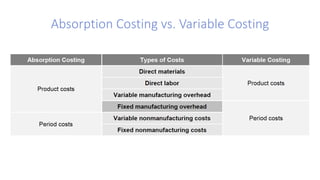
• Absorption costing assigns all (variable and fixed) manufacturing costs to
products. Consequently, under absorption costing, inventories are valued
at all manufacturing costs – direct materials, direct labor, variable
manufacturing overhead and fixed manufacturing overhead.
• Variable costing assigns only the variable manufacturing costs to products.
That is, under variable costing, inventories are valued at variable
manufacturing costs – direct materials, direct labor, and variable
manufacturing overhead. Fixed manufacturing overhead (● e.g., factory
depreciation and insurance, supervisory salaries, and so on) is not included in
the inventory valuation and is treated as a period cost, like all
nonmanufacturing costs.
Absorption Costing vs. Variable Costing
• Absorption costing assigns all (variable and fixed) manufacturing costs to
products. Consequently, under absorption costing, inventories are valued
at all manufacturing costs – direct materials, direct labor, variable
manufacturing overhead and fixed manufacturing overhead.
• Variable costing assigns only the variable manufacturing costs to products.
That is, under variable costing, inventories are valued
at variable manufacturing costs – direct materials, direct labor, and variable
manufacturing overhead. Fixed manufacturing overhead (● e.g., factory
depreciation and insurance, supervisory salaries, and so on) is not included in
the inventory valuation and is treated as a period cost, like all
nonmanufacturing costs.
Absorption Costing vs. Variable Costing
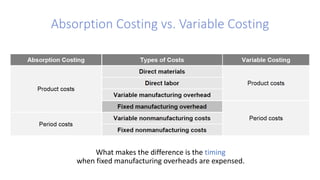
What makes the difference is the timing
when fixed manufacturing overheads are expensed.
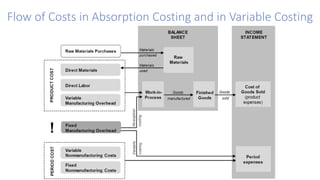
Flow of Costs in Absorption Costing and in Variable Costing
2. Two Conceptual Formats
of Income Statement
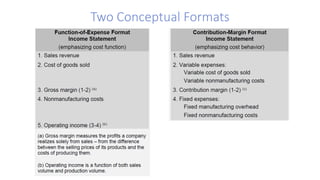
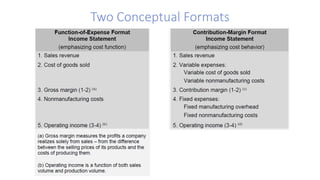
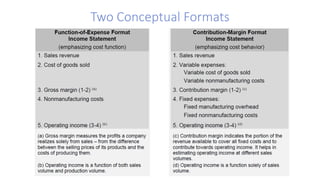
Two Conceptual Formats
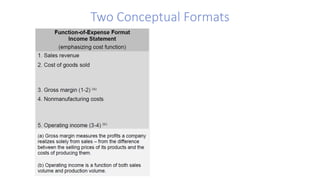
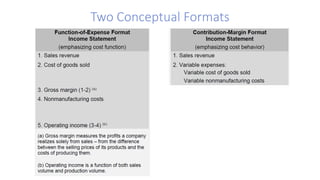
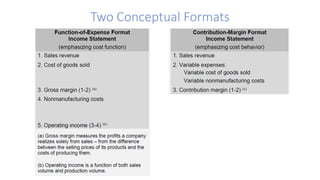
• The function-of-expense format income statement classifies costs only by
business functions of production, sales, and administration – generally, into
manufacturing costs, selling costs, administrative costs.
• It emphasizes the distinction between manufacturing and nonmanufacturing
costs.
The Function-Of-Expense Format
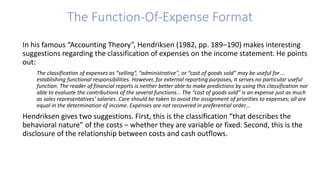
In his famous “Accounting Theory”, Hendriksen (1982, pp. 189–190) makes interesting
suggestions regarding the classification of expenses on the income statement. He points
out:
The classification of expenses as “selling”, “administrative", or “cost of goods sold” may be useful for …
establishing functional responsibilities. However, for external reporting purposes, it serves no particular useful
function. The reader of financial reports is neither better able to make predictions by using this classification nor
able to evaluate the contributions of the several functions… The “cost of goods sold” is an expense just as much
as sales representatives’ salaries. Care should be taken to avoid the assignment of priorities to expenses; all are
equal in the determination of income. Expenses are not recovered in preferential order…
Hendriksen gives two suggestions. First, this is the classification “that describes the
behavioral nature” of the costs – whether they are variable or fixed. Second, this is the
disclosure of the relationship between costs and cash outflows.
The Function-Of-Expense Format
The Contribution-Margin Format
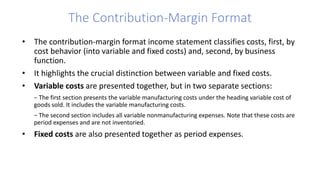
• The contribution-margin format income statement classifies costs, first, by
cost behavior (into variable and fixed costs) and, second, by business
function.
• It highlights the crucial distinction between variable and fixed costs.
• Variable costs are presented together, but in two separate sections:
− The first section presents the variable manufacturing costs under the heading variable cost of
goods sold. It includes the variable manufacturing costs.
− The second section includes all variable nonmanufacturing expenses. Note that these costs are
period expenses and are not inventoried.
• Fixed costs are also presented together as period expenses.
2. General Approach to
Absorption and Variable Costing
(Using Actual Costs)
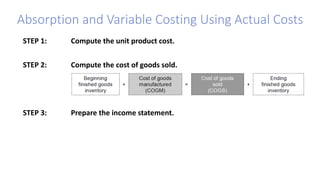
Absorption and Variable Costing Using Actual Costs
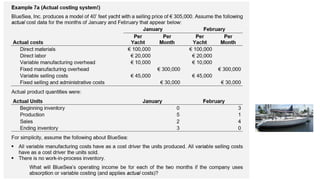
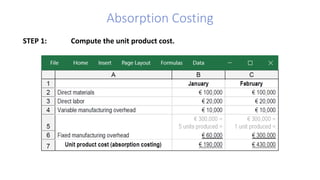
STEP 1: Compute the unit product cost.
STEP 2: Compute the cost of goods sold.
STEP 3: Prepare the income statement.
Absorption Costing
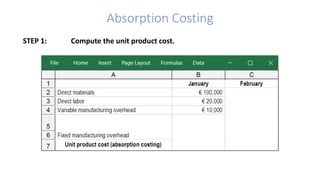
STEP 1: Compute the unit product cost.
Absorption Costing
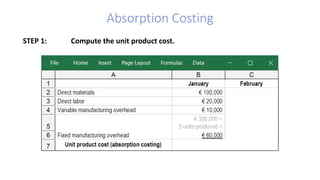
STEP 1: Compute the unit product cost.
Absorption Costing
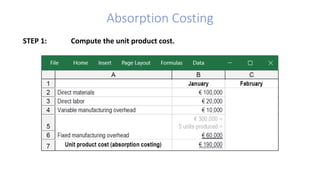
STEP 1: Compute the unit product cost.
Absorption Costing
STEP 1: Compute the unit product cost.
Absorption Costing
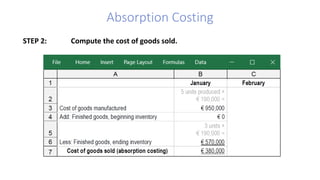
STEP 2: Compute the cost of goods sold.
Absorption Costing
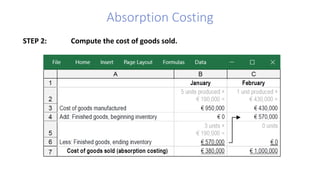
STEP 2: Compute the cost of goods sold.
Absorption Costing
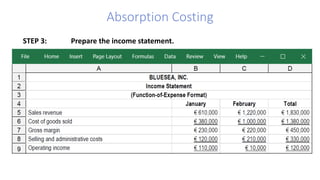
STEP 3: Prepare the income statement.
Absorption Costing
STEP 3: Prepare the income statement.
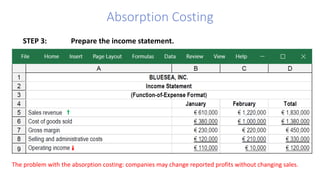
The problem with the absorption costing: companies may change reported profits without changing sales.
Variable Costing
STEP 1: Compute the unit product cost.
Variable Costing
STEP 1: Compute the unit product cost.
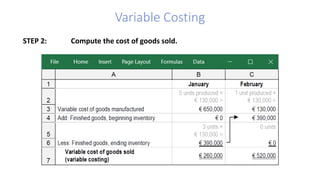
Variable Costing
STEP 2: Compute the cost of goods sold.
Variable Costing
STEP 2: Compute the cost of goods sold.
Variable Costing
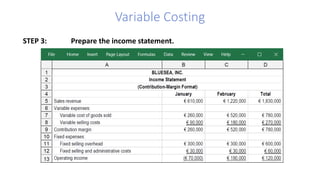
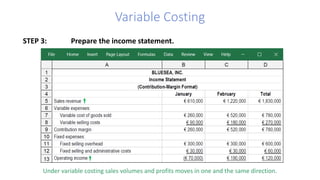
STEP 3: Prepare the income statement.
Variable Costing
STEP 3: Prepare the income statement.
Under variable costing sales volumes and profits moves in one and the same direction.
4. Comparing
Absorption and Variable Costing
Comparing Absorption and Variable Costing
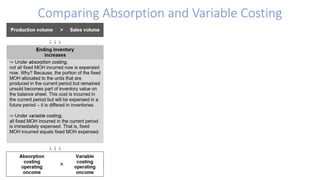
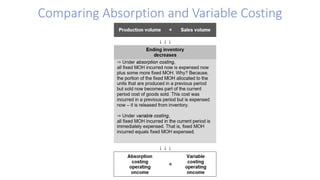
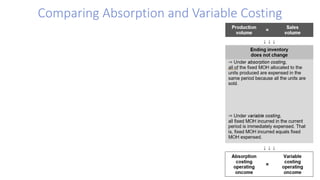
Absorption costing and variable costing may provide different operating incomes
in some periods. In the case of BlueSea, while the income figures are the same
for the two months taken together (€ 120,000), they are different in each
separate month. Why? Simply because fixed manufacturing overhead (MOH) is
accounted for and expensed in a different way under both approaches:
• Under absorption costing, fixed manufacturing overheads are capitalized
(absorbed) in the value of work-in-process and finished goods; they are
expensed not in the period in which they are incurred, but in the period in
which units are sold.
• Under variable costing, fixed manufacturing overheads are expensed in the
period in which incurred.
In general, 3 scenarios are possible in terms of the relationships between
“production/sales volumes” and “absorption/variable costing operating incomes”
Comparing Absorption and Variable Costing
Reconciliation of Absorption and Variable Costing
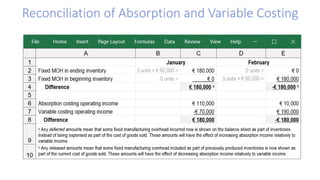
To reconcile the absorption costing and variable costing operating incomes for an
individual period it is needed to determine the amount of fixed manufacturing
overhead that was deferred in, or released from, inventories during this period.
For example, in January, the absorption costing income exceeds the variable
costing income by € 180,000 [= €110,000 – (–€70,000)].
Such kind of differences is referred to as phantom profits. They are caused solely
by building up inventories, i.e., by the fixed manufacturing overhead assigned
under absorption costing to the 3 units produced but not sold in January
[=€ 60,000 × 3 units unsold]. These fictitious profits are temporary. They
disappear in a future period when the inventories will be sold.
Reconciliation of Absorption and Variable Costing
5. Advantages and Disadvantages
Advantages and Disadvantages of Absorption and Variable Costing
In Defense of Absorption Costing. It better matches costs with revenues: the fixed
manufacturing overhead incurred in converting materials into finished goods is as
essential as all variable manufacturing costs.
In Defense of Variable (Marginal)Costing. It better matches costs with revenues: fixed
manufacturing overhead is not incurred for any particular unit produced, but for
ensuring the production capacity for a particular period of time.
• simpler for application and more straightforward for understanding and
interpretation
• unit product cost includes only variable manufacturing costs and thus
it depicts the costs of producing another unit of the product
• emphasizing the distinction between variable and fixed costs – key for decision
making and performance management

Ch07_VariableCosting_LECTUREEEEEEEEE.pdf

  • 1.
    Chapter 7 Inventory-Valuation Approaches: AbsorptionCosting and Variable Costing Fundamentals of COST & MANAGEMENT ACCOUNTING © 2025 M.Musov Designed by rawpixel.com / Freepik
  • 3.
    Overview 1. Introduction 2. TwoConceptual Formats of Income Statements 3. General Approach to Absorption and Variable Costing 4. Comparing Absorption and Variable Costing 5. Advantages and Disadvantages of Absorption and Variable Costing
  • 4.
  • 5.
    Absorption Costing vs.Variable Costing • Absorption costing assigns all (variable and fixed) manufacturing costs to products. Consequently, under absorption costing, inventories are valued at all manufacturing costs – direct materials, direct labor, variable manufacturing overhead and fixed manufacturing overhead. • Variable costing assigns only the variable manufacturing costs to products. That is, under variable costing, inventories are valued at variable manufacturing costs – direct materials, direct labor, and variable manufacturing overhead. Fixed manufacturing overhead (● e.g., factory depreciation and insurance, supervisory salaries, and so on) is not included in the inventory valuation and is treated as a period cost, like all nonmanufacturing costs.
  • 6.
    Absorption Costing vs.Variable Costing • Absorption costing assigns all (variable and fixed) manufacturing costs to products. Consequently, under absorption costing, inventories are valued at all manufacturing costs – direct materials, direct labor, variable manufacturing overhead and fixed manufacturing overhead. • Variable costing assigns only the variable manufacturing costs to products. That is, under variable costing, inventories are valued at variable manufacturing costs – direct materials, direct labor, and variable manufacturing overhead. Fixed manufacturing overhead (● e.g., factory depreciation and insurance, supervisory salaries, and so on) is not included in the inventory valuation and is treated as a period cost, like all nonmanufacturing costs.
  • 7.
    Absorption Costing vs.Variable Costing
  • 8.
    Absorption Costing vs.Variable Costing What makes the difference is the timing when fixed manufacturing overheads are expensed.
  • 9.
    Flow of Costsin Absorption Costing and in Variable Costing
  • 10.
    2. Two ConceptualFormats of Income Statement
  • 11.
  • 12.
  • 13.
  • 14.
  • 15.
  • 16.
  • 17.
    • The function-of-expenseformat income statement classifies costs only by business functions of production, sales, and administration – generally, into manufacturing costs, selling costs, administrative costs. • It emphasizes the distinction between manufacturing and nonmanufacturing costs. The Function-Of-Expense Format
  • 18.
    In his famous“Accounting Theory”, Hendriksen (1982, pp. 189–190) makes interesting suggestions regarding the classification of expenses on the income statement. He points out: The classification of expenses as “selling”, “administrative", or “cost of goods sold” may be useful for … establishing functional responsibilities. However, for external reporting purposes, it serves no particular useful function. The reader of financial reports is neither better able to make predictions by using this classification nor able to evaluate the contributions of the several functions… The “cost of goods sold” is an expense just as much as sales representatives’ salaries. Care should be taken to avoid the assignment of priorities to expenses; all are equal in the determination of income. Expenses are not recovered in preferential order… Hendriksen gives two suggestions. First, this is the classification “that describes the behavioral nature” of the costs – whether they are variable or fixed. Second, this is the disclosure of the relationship between costs and cash outflows. The Function-Of-Expense Format
  • 19.
    The Contribution-Margin Format •The contribution-margin format income statement classifies costs, first, by cost behavior (into variable and fixed costs) and, second, by business function. • It highlights the crucial distinction between variable and fixed costs. • Variable costs are presented together, but in two separate sections: − The first section presents the variable manufacturing costs under the heading variable cost of goods sold. It includes the variable manufacturing costs. − The second section includes all variable nonmanufacturing expenses. Note that these costs are period expenses and are not inventoried. • Fixed costs are also presented together as period expenses.
  • 20.
    2. General Approachto Absorption and Variable Costing (Using Actual Costs)
  • 21.
    Absorption and VariableCosting Using Actual Costs STEP 1: Compute the unit product cost. STEP 2: Compute the cost of goods sold. STEP 3: Prepare the income statement.
  • 23.
    Absorption Costing STEP 1:Compute the unit product cost.
  • 24.
    Absorption Costing STEP 1:Compute the unit product cost.
  • 25.
    Absorption Costing STEP 1:Compute the unit product cost.
  • 26.
    Absorption Costing STEP 1:Compute the unit product cost.
  • 27.
    Absorption Costing STEP 2:Compute the cost of goods sold.
  • 28.
    Absorption Costing STEP 2:Compute the cost of goods sold.
  • 29.
    Absorption Costing STEP 3:Prepare the income statement.
  • 30.
    Absorption Costing STEP 3:Prepare the income statement. The problem with the absorption costing: companies may change reported profits without changing sales.
  • 31.
    Variable Costing STEP 1:Compute the unit product cost.
  • 32.
    Variable Costing STEP 1:Compute the unit product cost.
  • 33.
    Variable Costing STEP 2:Compute the cost of goods sold.
  • 34.
    Variable Costing STEP 2:Compute the cost of goods sold.
  • 35.
    Variable Costing STEP 3:Prepare the income statement.
  • 36.
    Variable Costing STEP 3:Prepare the income statement. Under variable costing sales volumes and profits moves in one and the same direction.
  • 37.
  • 38.
    Comparing Absorption andVariable Costing Absorption costing and variable costing may provide different operating incomes in some periods. In the case of BlueSea, while the income figures are the same for the two months taken together (€ 120,000), they are different in each separate month. Why? Simply because fixed manufacturing overhead (MOH) is accounted for and expensed in a different way under both approaches: • Under absorption costing, fixed manufacturing overheads are capitalized (absorbed) in the value of work-in-process and finished goods; they are expensed not in the period in which they are incurred, but in the period in which units are sold. • Under variable costing, fixed manufacturing overheads are expensed in the period in which incurred. In general, 3 scenarios are possible in terms of the relationships between “production/sales volumes” and “absorption/variable costing operating incomes”
  • 39.
    Comparing Absorption andVariable Costing
  • 40.
    Comparing Absorption andVariable Costing
  • 41.
    Comparing Absorption andVariable Costing
  • 42.
    Reconciliation of Absorptionand Variable Costing To reconcile the absorption costing and variable costing operating incomes for an individual period it is needed to determine the amount of fixed manufacturing overhead that was deferred in, or released from, inventories during this period. For example, in January, the absorption costing income exceeds the variable costing income by € 180,000 [= €110,000 – (–€70,000)]. Such kind of differences is referred to as phantom profits. They are caused solely by building up inventories, i.e., by the fixed manufacturing overhead assigned under absorption costing to the 3 units produced but not sold in January [=€ 60,000 × 3 units unsold]. These fictitious profits are temporary. They disappear in a future period when the inventories will be sold.
  • 43.
    Reconciliation of Absorptionand Variable Costing
  • 44.
    5. Advantages andDisadvantages
  • 45.
    Advantages and Disadvantagesof Absorption and Variable Costing In Defense of Absorption Costing. It better matches costs with revenues: the fixed manufacturing overhead incurred in converting materials into finished goods is as essential as all variable manufacturing costs. In Defense of Variable (Marginal)Costing. It better matches costs with revenues: fixed manufacturing overhead is not incurred for any particular unit produced, but for ensuring the production capacity for a particular period of time. • simpler for application and more straightforward for understanding and interpretation • unit product cost includes only variable manufacturing costs and thus it depicts the costs of producing another unit of the product • emphasizing the distinction between variable and fixed costs – key for decision making and performance management