Copyright © 2019, 2015, 2012 Pearson Education, Inc. All Rights Reserved
Data Structures and Abstractions with Java™
5th
Edition
Chapter 5
Stacks
Copyright © 2019, 2015, 2012 Pearson Education, Inc. All Rights Reserved
• Add item on top of stack
• Remove item that is topmost
▪Last In, First Out … LIFO
Stacks
FIGURE 5-1 Some familiar stacks
Copyright © 2019, 2015, 2012 Pearson Education, Inc. All Rights Reserved
Specifications of the ADT Stack
Pseudocode UML Description
push(newEntry) +push(newEntry: T): void Task: Adds a new entry to the top of the stack.
Input: newEntry is the new entry.
Output: None.
pop() +pop(): T Task: Removes and returns the stack’s top entry.
Input: None.
Output: Returns the stack’s top entry.
Throws an exception if the stack is empty before the operation.
peek() +peek(): T Task: Retrieves the stack’s top entry without changing the stack
in any way.
Input: None.
Output: Returns the stack’s top entry.
Throws an exception if the stack is empty.
isEmpty() +isEmpty(): boolean Task: Detects whether the stack is empty.
Input: None.
Output: Returns true if the stack is empty.
clear() +clear(): void Task: Removes all entries from the stack.
Input: None.
Output: None.
• Data
– A collection of objects in reverse chronological order and having the same data type
Copyright © 2019, 2015, 2012 Pearson Education, Inc. All Rights Reserved
Design Decision
• When stack is empty
– What to do with pop and peek?
• Possible actions
– Assume that the ADT is not empty;
– Return null.
– Throw an exception (which type?).
Copyright © 2019, 2015, 2012 Pearson Education, Inc. All Rights Reserved
Interface for the ADT Stack
LISTING 5-1 An interface for the ADT stack
/** An interface for the ADT stack. */
public interface StackInterface<T>
{
/** Adds a new entry to the top of this stack.
@param newEntry An object to be added to the stack. */
public void push(T newEntry);
/** Removes and returns this stack's top entry.
@return The object at the top of the stack.
@throws EmptyStackException if the stack is empty before the operation. */
public T pop();
/** Retrieves this stack's top entry.
@return The object at the top of the stack.
@throws EmptyStackException if the stack is empty. */
public T peek();
/** Detects whether this stack is empty.
@return True if the stack is empty. */
public boolean isEmpty();
/** Removes all entries from this stack. */
public void clear();
} // end StackInterface
Copyright © 2019, 2015, 2012 Pearson Education, Inc. All Rights Reserved
FIGURE 5-2 A stack of strings
Example of a Stack
StackInterface<String> stringStack = new OurStack<>();
(a) stringStack.push(“Jim”);
(b) stringStack.push("Jess");
(c) stringStack.push("Jill");
(d) stringStack.push("Jane");
(e) stringStack.push("Joe");
(f) stringStack.pop();
(g) stringStack.pop();
Copyright © 2019, 2015, 2012 Pearson Education, Inc. All Rights Reserved
Security Note
• Design guidelines
– Use preconditions and postconditions to document
assumptions.
– Do not trust client to use public methods correctly.
– Avoid ambiguous return values.
– Prefer throwing exceptions instead of returning
values to signal problem.
Copyright © 2019, 2015, 2012 Pearson Education, Inc. All Rights Reserved
Processing Algebraic Expressions
• Infix:
– each binary operator appears between its operands
a + b
• Prefix:
– each binary operator appears before its operands
+ a b
• Postfix:
– each binary operator appears after its operands
a b +
• Balanced expressions: delimiters paired correctly
Copyright © 2019, 2015, 2012 Pearson Education, Inc. All Rights Reserved
FIGURE 5-3 The contents of a stack during the scan of an
expression that contains the balanced delimiters{ [ ( ) ] }
Processing Algebraic Expressions
Copyright © 2019, 2015, 2012 Pearson Education, Inc. All Rights Reserved
FIGURE 5-4 The contents of a stack during the scan of an
expression that contains the unbalanced delimiters { [ ( ] ) }
Processing Algebraic Expressions
Copyright © 2019, 2015, 2012 Pearson Education, Inc. All Rights Reserved
FIGURE 5-5 The contents of a stack during the scan of an
expression that contains the unbalanced delimiters [ ( ) ] }
Processing Algebraic Expressions
Copyright © 2019, 2015, 2012 Pearson Education, Inc. All Rights Reserved
FIGURE 5-6 The contents of a stack during the scan of an
expression that contains the unbalanced delimiters { [ ( ) ]
Processing Algebraic Expressions
Copyright © 2019, 2015, 2012 Pearson Education, Inc. All Rights Reserved
Algorithm to process for balanced expression.
Processing Algebraic Expressions
m checkBalance(expression)
s true if the parentheses, brackets, and braces in an expression are paired correctly.
ced = true // The absence of delimiters is balanced
isBalanced == true) and not at end of expression)
nextCharacter = next character in expression
switch (nextCharacter)
{
case '(': case '[': case '{':
Push nextCharacter onto stack
break
case ')': case ']': case '}':
if (stack is empty)
isBalanced = false
else
{
openDelimiter = top entry of stack
Pop stack
isBalanced = true or false according to whether openDelimiter and
nextCharacter are a pair of delimiters
}
break
}
is not empty)
isBalanced = false
sBalanced
Copyright © 2019, 2015, 2012 Pearson Education, Inc. All Rights Reserved
/** A class that checks whether the parentheses, brackets, and braces
in a string occur in left/right pairs. */
public class BalanceChecker
{
// Returns true if the given characters, open and close, form a pair
// of parentheses, brackets, or braces.
private static boolean isPaired(char open, char close)
{
return (open == '(' && close == ')') ||
(open == '[' && close == ']') ||
(open == '{' && close == '}');
} // end isPaired
/** Decides whether the parentheses, brackets, and braces
in a string occur in left/right pairs.
@param expression A string to be checked.
@return True if the delimiters are paired correctly. */
public static boolean checkBalance(String expression)
{
[ SEE NEXT SLIDE FOR IMPLEMENTATION]
} // end checkBalance
} // end BalanceChecker
LISTING 5-2 The class BalanceChecker
Implementation of Algorithm (Part 1)
Copyright © 2019, 2015, 2012 Pearson Education, Inc. All Rights Reserved
StackInterface<Character> openDelimiterStack = new LinkedStack<>();
int characterCount = expression.length();
boolean isBalanced = true;
int index = 0;
char nextCharacter = ' ';
while (isBalanced && (index < characterCount)) {
nextCharacter = expression.charAt(index);
switch (nextCharacter) {
case '(': case '[': case '{':
openDelimiterStack.push(nextCharacter);
break;
case ')': case ']': case '}':
if (openDelimiterStack.isEmpty())
isBalanced = false;
else {
char openDelimiter = openDelimiterStack.pop();
isBalanced = isPaired(openDelimiter, nextCharacter);
} // end if
break;
default: break; // Ignore unexpected characters
} // end switch
index++;
} // end while
if (!openDelimiterStack.isEmpty())
isBalanced = false;
return isBalanced;
} // end checkBalance
Implementation of Algorithm (Part 2)
Copyright © 2019, 2015, 2012 Pearson Education, Inc. All Rights Reserved
FIGURES 5-7 & 5-8 Converting the infix expressions to postfix form
Converting Infix to Postfix
a + b * c
a - b + c
a ^ b ^ c
Copyright © 2019, 2015, 2012 Pearson Education, Inc. All Rights Reserved
FIGURE 5-9 Steps in converting an infix expression to postfix form
Converting Infix to Postfix
a / b * (c + (d - e))
Copyright © 2019, 2015, 2012 Pearson Education, Inc. All Rights Reserved
To convert an infix expression to postfix form, you take the following
actions, according to the symbols you encounter, as you process the infix
expression from left to right:
Infix-to-postfix Conversion
Operand Append each operand to the end of the output expression.
Operator ^ Push ^ onto the stack.
Operator +, -, *, or /
Pop operators from the stack, appending them to the output expression, until
either the stack is empty or its top entry has a lower precedence than the newly
encountered operator. Then push the new operator onto the stack.
Open parenthesis Push ( onto the stack.
Close parenthesis
Pop operators from the stack and append them to the output expression until an
open parenthesis is popped. Discard both parentheses.
Copyright © 2019, 2015, 2012 Pearson Education, Inc. All Rights Reserved
Infix-to-postfix Algorithm (Part 1)
Algorithm convertToPostfix(infix)
// Converts an infix expression to an equivalent postfix expression.
operatorStack = a new empty stack
postfix = a new empty string
while (infix has characters left to parse)
{
nextCharacter = next nonblank character of infix
switch (nextCharacter)
{
case variable:
Append nextCharacter to postfix
break
case '^' :
operatorStack.push(nextCharacter)
break
case '+' : case '-' : case '*' : case '/' :
while (!operatorStack.isEmpty() and
precedence of nextCharacter <= precedence of operatorStack.peek())
{
Append operatorStack.peek() to postfix
operatorStack.pop()
}
operatorStack.push(nextCharacter)
break
Algorithm for converting infix to postfix expressions.
Copyright © 2019, 2015, 2012 Pearson Education, Inc. All Rights Reserved
Algorithm for converting infix to postfix expressions.
Infix-to-postfix Algorithm (Part 2)
case '( ' :
operatorStack.push(nextCharacter)
break
case ')' : // Stack is not empty if infix expression is valid
topOperator = operatorStack.pop()
while (topOperator != '(')
{
Append topOperator to postfix
topOperator = operatorStack.pop()
}
break
default:
break // Ignore unexpected characters
}
}
while (!operatorStack.isEmpty())
{
topOperator = operatorStack.pop()
Append topOperator to postfix
}
return postfix
Copyright © 2019, 2015, 2012 Pearson Education, Inc. All Rights Reserved
Algorithm for evaluating postfix expressions.
Evaluating Postfix Expressions
Algorithm evaluatePostfix(postfix)
// Evaluates a postfix expression.
valueStack = a new empty stack
while (postfix has characters left to parse)
{
nextCharacter = next nonblank character of postfix
switch (nextCharacter)
{
case variable:
valueStack.push(value of the variable nextCharacter)
break
case '+' : case '-' : case '*' : case '/' : case '^' :
operandTwo = valueStack.pop()
operandOne = valueStack.pop()
result = the result of the operation in nextCharacter and
its operands operandOne and operandTwo
valueStack.push(result)
break
default: break // Ignore unexpected characters
}
}
return valueStack.peek()
Copyright © 2019, 2015, 2012 Pearson Education, Inc. All Rights Reserved
FIGURE 5-10 The stack during the evaluation of the
postfix expression a b / when a is 2 and b is 4
Evaluating Infix Expressions
Copyright © 2019, 2015, 2012 Pearson Education, Inc. All Rights Reserved
FIGURE 5-11 The stack during the evaluation of the postfix
expression a b + c / when a is 2, b is 4, and c is 3
Evaluating Infix Expressions
Copyright © 2019, 2015, 2012 Pearson Education, Inc. All Rights Reserved
Evaluating Infix Expressions
FIGURE 5-12
Two stacks during the evaluation of
a + b * c when a is 2, b is 3, and c is 4
Copyright © 2019, 2015, 2012 Pearson Education, Inc. All Rights Reserved
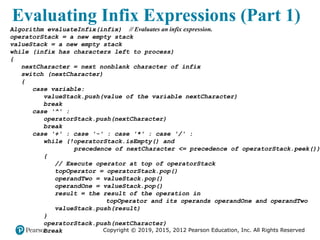
Evaluating Infix Expressions (Part 1)
Algorithm evaluateInfix(infix) // Evaluates an infix expression.
operatorStack = a new empty stack
valueStack = a new empty stack
while (infix has characters left to process)
{
nextCharacter = next nonblank character of infix
switch (nextCharacter)
{
case variable:
valueStack.push(value of the variable nextCharacter)
break
case '^' :
operatorStack.push(nextCharacter)
break
case '+' : case '-' : case '*' : case '/' :
while (!operatorStack.isEmpty() and
precedence of nextCharacter <= precedence of operatorStack.peek())
{
// Execute operator at top of operatorStack
topOperator = operatorStack.pop()
operandTwo = valueStack.pop()
operandOne = valueStack.pop()
result = the result of the operation in
topOperator and its operands operandOne and operandTwo
valueStack.push(result)
}
operatorStack.push(nextCharacter)
break
Copyright © 2019, 2015, 2012 Pearson Education, Inc. All Rights Reserved
Evaluating Infix Expressions (Part 2)
case '(' :
operatorStack.push(nextCharacter)
break
case ')' : // Stack is not empty if infix expression is valid
topOperator = operatorStack.pop()
while (topOperator != ‘(')
{
operandTwo = valueStack.pop()
operandOne = valueStack.pop()
result = the result of the operation in
topOperator and its operands operandOne and operandTwo
valueStack.push(result)
topOperator = operatorStack.pop()
}
break
default: break // Ignore unexpected characters
}
}
while (!operatorStack.isEmpty())
{
topOperator = operatorStack.pop()
operandTwo = valueStack.pop()
operandOne = valueStack.pop()
result = the result of the operation in
topOperator and its operands operandOne and operandTwo
valueStack.push(result)
}
return valueStack.peek()
Copyright © 2019, 2015, 2012 Pearson Education, Inc. All Rights Reserved
FIGURE 5-13 The program stack as a program executes
The Application Program Stack
Copyright © 2019, 2015, 2012 Pearson Education, Inc. All Rights Reserved
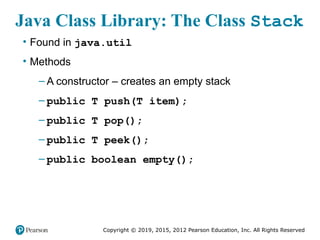
Java Class Library: The Class Stack
• Found in java.util
• Methods
– A constructor – creates an empty stack
– public T push(T item);
– public T pop();
– public T peek();
– public boolean empty();
Copyright © 2019, 2015, 2012 Pearson Education, Inc. All Rights Reserved
End
Chapter 5

Ch05_Stacks implementation in data structures.pptx

  • 1.
    Copyright © 2019,2015, 2012 Pearson Education, Inc. All Rights Reserved Data Structures and Abstractions with Java™ 5th Edition Chapter 5 Stacks
  • 2.
    Copyright © 2019,2015, 2012 Pearson Education, Inc. All Rights Reserved • Add item on top of stack • Remove item that is topmost ▪Last In, First Out … LIFO Stacks FIGURE 5-1 Some familiar stacks
  • 3.
    Copyright © 2019,2015, 2012 Pearson Education, Inc. All Rights Reserved Specifications of the ADT Stack Pseudocode UML Description push(newEntry) +push(newEntry: T): void Task: Adds a new entry to the top of the stack. Input: newEntry is the new entry. Output: None. pop() +pop(): T Task: Removes and returns the stack’s top entry. Input: None. Output: Returns the stack’s top entry. Throws an exception if the stack is empty before the operation. peek() +peek(): T Task: Retrieves the stack’s top entry without changing the stack in any way. Input: None. Output: Returns the stack’s top entry. Throws an exception if the stack is empty. isEmpty() +isEmpty(): boolean Task: Detects whether the stack is empty. Input: None. Output: Returns true if the stack is empty. clear() +clear(): void Task: Removes all entries from the stack. Input: None. Output: None. • Data – A collection of objects in reverse chronological order and having the same data type
  • 4.
    Copyright © 2019,2015, 2012 Pearson Education, Inc. All Rights Reserved Design Decision • When stack is empty – What to do with pop and peek? • Possible actions – Assume that the ADT is not empty; – Return null. – Throw an exception (which type?).
  • 5.
    Copyright © 2019,2015, 2012 Pearson Education, Inc. All Rights Reserved Interface for the ADT Stack LISTING 5-1 An interface for the ADT stack /** An interface for the ADT stack. */ public interface StackInterface<T> { /** Adds a new entry to the top of this stack. @param newEntry An object to be added to the stack. */ public void push(T newEntry); /** Removes and returns this stack's top entry. @return The object at the top of the stack. @throws EmptyStackException if the stack is empty before the operation. */ public T pop(); /** Retrieves this stack's top entry. @return The object at the top of the stack. @throws EmptyStackException if the stack is empty. */ public T peek(); /** Detects whether this stack is empty. @return True if the stack is empty. */ public boolean isEmpty(); /** Removes all entries from this stack. */ public void clear(); } // end StackInterface
  • 6.
    Copyright © 2019,2015, 2012 Pearson Education, Inc. All Rights Reserved FIGURE 5-2 A stack of strings Example of a Stack StackInterface<String> stringStack = new OurStack<>(); (a) stringStack.push(“Jim”); (b) stringStack.push("Jess"); (c) stringStack.push("Jill"); (d) stringStack.push("Jane"); (e) stringStack.push("Joe"); (f) stringStack.pop(); (g) stringStack.pop();
  • 7.
    Copyright © 2019,2015, 2012 Pearson Education, Inc. All Rights Reserved Security Note • Design guidelines – Use preconditions and postconditions to document assumptions. – Do not trust client to use public methods correctly. – Avoid ambiguous return values. – Prefer throwing exceptions instead of returning values to signal problem.
  • 8.
    Copyright © 2019,2015, 2012 Pearson Education, Inc. All Rights Reserved Processing Algebraic Expressions • Infix: – each binary operator appears between its operands a + b • Prefix: – each binary operator appears before its operands + a b • Postfix: – each binary operator appears after its operands a b + • Balanced expressions: delimiters paired correctly
  • 9.
    Copyright © 2019,2015, 2012 Pearson Education, Inc. All Rights Reserved FIGURE 5-3 The contents of a stack during the scan of an expression that contains the balanced delimiters{ [ ( ) ] } Processing Algebraic Expressions
  • 10.
    Copyright © 2019,2015, 2012 Pearson Education, Inc. All Rights Reserved FIGURE 5-4 The contents of a stack during the scan of an expression that contains the unbalanced delimiters { [ ( ] ) } Processing Algebraic Expressions
  • 11.
    Copyright © 2019,2015, 2012 Pearson Education, Inc. All Rights Reserved FIGURE 5-5 The contents of a stack during the scan of an expression that contains the unbalanced delimiters [ ( ) ] } Processing Algebraic Expressions
  • 12.
    Copyright © 2019,2015, 2012 Pearson Education, Inc. All Rights Reserved FIGURE 5-6 The contents of a stack during the scan of an expression that contains the unbalanced delimiters { [ ( ) ] Processing Algebraic Expressions
  • 13.
    Copyright © 2019,2015, 2012 Pearson Education, Inc. All Rights Reserved Algorithm to process for balanced expression. Processing Algebraic Expressions m checkBalance(expression) s true if the parentheses, brackets, and braces in an expression are paired correctly. ced = true // The absence of delimiters is balanced isBalanced == true) and not at end of expression) nextCharacter = next character in expression switch (nextCharacter) { case '(': case '[': case '{': Push nextCharacter onto stack break case ')': case ']': case '}': if (stack is empty) isBalanced = false else { openDelimiter = top entry of stack Pop stack isBalanced = true or false according to whether openDelimiter and nextCharacter are a pair of delimiters } break } is not empty) isBalanced = false sBalanced
  • 14.
    Copyright © 2019,2015, 2012 Pearson Education, Inc. All Rights Reserved /** A class that checks whether the parentheses, brackets, and braces in a string occur in left/right pairs. */ public class BalanceChecker { // Returns true if the given characters, open and close, form a pair // of parentheses, brackets, or braces. private static boolean isPaired(char open, char close) { return (open == '(' && close == ')') || (open == '[' && close == ']') || (open == '{' && close == '}'); } // end isPaired /** Decides whether the parentheses, brackets, and braces in a string occur in left/right pairs. @param expression A string to be checked. @return True if the delimiters are paired correctly. */ public static boolean checkBalance(String expression) { [ SEE NEXT SLIDE FOR IMPLEMENTATION] } // end checkBalance } // end BalanceChecker LISTING 5-2 The class BalanceChecker Implementation of Algorithm (Part 1)
  • 15.
    Copyright © 2019,2015, 2012 Pearson Education, Inc. All Rights Reserved StackInterface<Character> openDelimiterStack = new LinkedStack<>(); int characterCount = expression.length(); boolean isBalanced = true; int index = 0; char nextCharacter = ' '; while (isBalanced && (index < characterCount)) { nextCharacter = expression.charAt(index); switch (nextCharacter) { case '(': case '[': case '{': openDelimiterStack.push(nextCharacter); break; case ')': case ']': case '}': if (openDelimiterStack.isEmpty()) isBalanced = false; else { char openDelimiter = openDelimiterStack.pop(); isBalanced = isPaired(openDelimiter, nextCharacter); } // end if break; default: break; // Ignore unexpected characters } // end switch index++; } // end while if (!openDelimiterStack.isEmpty()) isBalanced = false; return isBalanced; } // end checkBalance Implementation of Algorithm (Part 2)
  • 16.
    Copyright © 2019,2015, 2012 Pearson Education, Inc. All Rights Reserved FIGURES 5-7 & 5-8 Converting the infix expressions to postfix form Converting Infix to Postfix a + b * c a - b + c a ^ b ^ c
  • 17.
    Copyright © 2019,2015, 2012 Pearson Education, Inc. All Rights Reserved FIGURE 5-9 Steps in converting an infix expression to postfix form Converting Infix to Postfix a / b * (c + (d - e))
  • 18.
    Copyright © 2019,2015, 2012 Pearson Education, Inc. All Rights Reserved To convert an infix expression to postfix form, you take the following actions, according to the symbols you encounter, as you process the infix expression from left to right: Infix-to-postfix Conversion Operand Append each operand to the end of the output expression. Operator ^ Push ^ onto the stack. Operator +, -, *, or / Pop operators from the stack, appending them to the output expression, until either the stack is empty or its top entry has a lower precedence than the newly encountered operator. Then push the new operator onto the stack. Open parenthesis Push ( onto the stack. Close parenthesis Pop operators from the stack and append them to the output expression until an open parenthesis is popped. Discard both parentheses.
  • 19.
    Copyright © 2019,2015, 2012 Pearson Education, Inc. All Rights Reserved Infix-to-postfix Algorithm (Part 1) Algorithm convertToPostfix(infix) // Converts an infix expression to an equivalent postfix expression. operatorStack = a new empty stack postfix = a new empty string while (infix has characters left to parse) { nextCharacter = next nonblank character of infix switch (nextCharacter) { case variable: Append nextCharacter to postfix break case '^' : operatorStack.push(nextCharacter) break case '+' : case '-' : case '*' : case '/' : while (!operatorStack.isEmpty() and precedence of nextCharacter <= precedence of operatorStack.peek()) { Append operatorStack.peek() to postfix operatorStack.pop() } operatorStack.push(nextCharacter) break Algorithm for converting infix to postfix expressions.
  • 20.
    Copyright © 2019,2015, 2012 Pearson Education, Inc. All Rights Reserved Algorithm for converting infix to postfix expressions. Infix-to-postfix Algorithm (Part 2) case '( ' : operatorStack.push(nextCharacter) break case ')' : // Stack is not empty if infix expression is valid topOperator = operatorStack.pop() while (topOperator != '(') { Append topOperator to postfix topOperator = operatorStack.pop() } break default: break // Ignore unexpected characters } } while (!operatorStack.isEmpty()) { topOperator = operatorStack.pop() Append topOperator to postfix } return postfix
  • 21.
    Copyright © 2019,2015, 2012 Pearson Education, Inc. All Rights Reserved Algorithm for evaluating postfix expressions. Evaluating Postfix Expressions Algorithm evaluatePostfix(postfix) // Evaluates a postfix expression. valueStack = a new empty stack while (postfix has characters left to parse) { nextCharacter = next nonblank character of postfix switch (nextCharacter) { case variable: valueStack.push(value of the variable nextCharacter) break case '+' : case '-' : case '*' : case '/' : case '^' : operandTwo = valueStack.pop() operandOne = valueStack.pop() result = the result of the operation in nextCharacter and its operands operandOne and operandTwo valueStack.push(result) break default: break // Ignore unexpected characters } } return valueStack.peek()
  • 22.
    Copyright © 2019,2015, 2012 Pearson Education, Inc. All Rights Reserved FIGURE 5-10 The stack during the evaluation of the postfix expression a b / when a is 2 and b is 4 Evaluating Infix Expressions
  • 23.
    Copyright © 2019,2015, 2012 Pearson Education, Inc. All Rights Reserved FIGURE 5-11 The stack during the evaluation of the postfix expression a b + c / when a is 2, b is 4, and c is 3 Evaluating Infix Expressions
  • 24.
    Copyright © 2019,2015, 2012 Pearson Education, Inc. All Rights Reserved Evaluating Infix Expressions FIGURE 5-12 Two stacks during the evaluation of a + b * c when a is 2, b is 3, and c is 4
  • 25.
    Copyright © 2019,2015, 2012 Pearson Education, Inc. All Rights Reserved Evaluating Infix Expressions (Part 1) Algorithm evaluateInfix(infix) // Evaluates an infix expression. operatorStack = a new empty stack valueStack = a new empty stack while (infix has characters left to process) { nextCharacter = next nonblank character of infix switch (nextCharacter) { case variable: valueStack.push(value of the variable nextCharacter) break case '^' : operatorStack.push(nextCharacter) break case '+' : case '-' : case '*' : case '/' : while (!operatorStack.isEmpty() and precedence of nextCharacter <= precedence of operatorStack.peek()) { // Execute operator at top of operatorStack topOperator = operatorStack.pop() operandTwo = valueStack.pop() operandOne = valueStack.pop() result = the result of the operation in topOperator and its operands operandOne and operandTwo valueStack.push(result) } operatorStack.push(nextCharacter) break
  • 26.
    Copyright © 2019,2015, 2012 Pearson Education, Inc. All Rights Reserved Evaluating Infix Expressions (Part 2) case '(' : operatorStack.push(nextCharacter) break case ')' : // Stack is not empty if infix expression is valid topOperator = operatorStack.pop() while (topOperator != ‘(') { operandTwo = valueStack.pop() operandOne = valueStack.pop() result = the result of the operation in topOperator and its operands operandOne and operandTwo valueStack.push(result) topOperator = operatorStack.pop() } break default: break // Ignore unexpected characters } } while (!operatorStack.isEmpty()) { topOperator = operatorStack.pop() operandTwo = valueStack.pop() operandOne = valueStack.pop() result = the result of the operation in topOperator and its operands operandOne and operandTwo valueStack.push(result) } return valueStack.peek()
  • 27.
    Copyright © 2019,2015, 2012 Pearson Education, Inc. All Rights Reserved FIGURE 5-13 The program stack as a program executes The Application Program Stack
  • 28.
    Copyright © 2019,2015, 2012 Pearson Education, Inc. All Rights Reserved Java Class Library: The Class Stack • Found in java.util • Methods – A constructor – creates an empty stack – public T push(T item); – public T pop(); – public T peek(); – public boolean empty();
  • 29.
    Copyright © 2019,2015, 2012 Pearson Education, Inc. All Rights Reserved End Chapter 5

Editor's Notes

  • #6 FIGURE 5-2 A stack of strings after (a) push adds Jim; (b) push adds Jess; (c) push adds Jill; (d) push adds Jane; (e) push adds Joe; (f ) pop retrieves and removes Joe; (g) pop retrieves and removes Jane