Security+ Guide to Network
Security Fundamentals, Third
Edition
Chapter 4
Network Vulnerabilities and Attacks
Objectives
• Explain the types of network vulnerabilities
• List categories of network attacks
• Define different methods of network attacks
Security+ Guide to Network Security Fundamentals, Third Edition 2
Network Vulnerabilities
• There are two broad categories of network
vulnerabilities:
– Those based on the network transport media
– Those found in the network devices themselves
Security+ Guide to Network Security Fundamentals, Third Edition 3
Media-Based Vulnerabilities
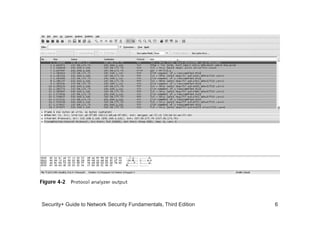
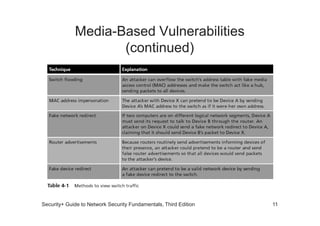
• Monitoring network traffic
– Helps to identify and troubleshoot network problems
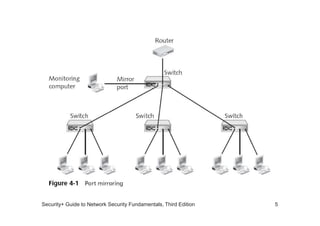
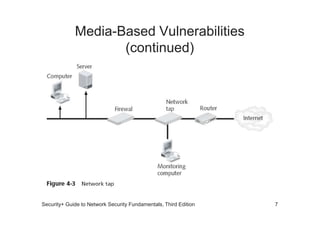
– Monitoring traffic can be done in two ways
 Use a switch with port mirroring
Security+ Guide to Network Security Fundamentals, Third Edition
• To redirect traffic that occurs on some or all ports to a
designated monitoring port on the switch
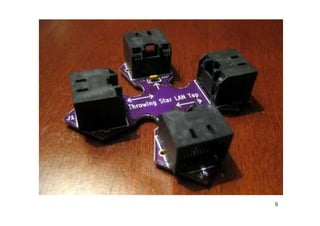
 Install a network tap (test access point)
• A separate device that can be installed between two
network devices, such as a switch, router, or firewall, to
monitor traffic
4
Security+ Guide to Network Security Fundamentals, Third Edition 5
Security+ Guide to Network Security Fundamentals, Third Edition 6
Media-Based Vulnerabilities
(continued)
Security+ Guide to Network Security Fundamentals, Third Edition 7
Media-Based Vulnerabilities
(continued)
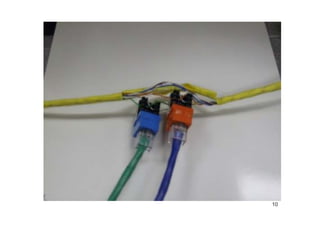
• Just as network taps and protocol analyzers can be
used for legitimate purposes
– They also can be used by attackers to intercept and
view network traffic
• Attackers can access the wired network in the
Security+ Guide to Network Security Fundamentals, Third Edition
• Attackers can access the wired network in the
following ways:
– False ceilings
– Exposed wiring
– Unprotected RJ-45 jacks
8
9
10
Media-Based Vulnerabilities
(continued)
Security+ Guide to Network Security Fundamentals, Third Edition 11
Network Device Vulnerabilities
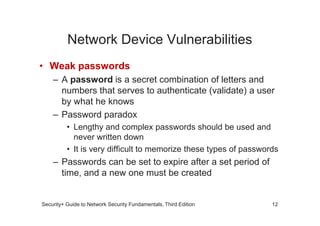
• Weak passwords
– A password is a secret combination of letters and
numbers that serves to authenticate (validate) a user
by what he knows
– Password paradox
Security+ Guide to Network Security Fundamentals, Third Edition
– Password paradox
• Lengthy and complex passwords should be used and
never written down
• It is very difficult to memorize these types of passwords
– Passwords can be set to expire after a set period of
time, and a new one must be created
12
Network Device Vulnerabilities
(continued)
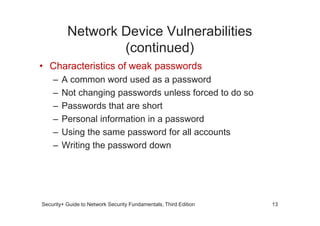
• Characteristics of weak passwords
– A common word used as a password
– Not changing passwords unless forced to do so
– Passwords that are short
Security+ Guide to Network Security Fundamentals, Third Edition
– Personal information in a password
– Using the same password for all accounts
– Writing the password down
13
Network Device Vulnerabilities
(continued)
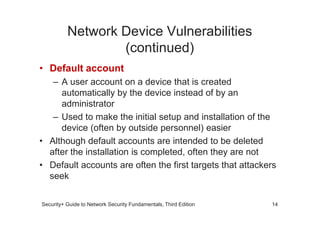
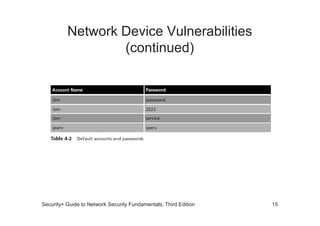
• Default account
– A user account on a device that is created
automatically by the device instead of by an
administrator
– Used to make the initial setup and installation of the
Security+ Guide to Network Security Fundamentals, Third Edition
– Used to make the initial setup and installation of the
device (often by outside personnel) easier
• Although default accounts are intended to be deleted
after the installation is completed, often they are not
• Default accounts are often the first targets that attackers
seek
14
Network Device Vulnerabilities
(continued)
Security+ Guide to Network Security Fundamentals, Third Edition 15
Network Device Vulnerabilities
(continued)
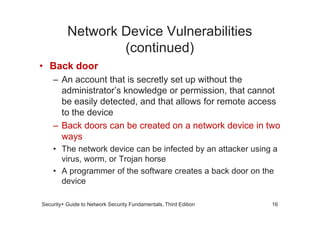
• Back door
– An account that is secretly set up without the
administrator’s knowledge or permission, that cannot
be easily detected, and that allows for remote access
to the device
Security+ Guide to Network Security Fundamentals, Third Edition
to the device
– Back doors can be created on a network device in two
ways
• The network device can be infected by an attacker using a
virus, worm, or Trojan horse
• A programmer of the software creates a back door on the
device
16
Network Device Vulnerabilities
(continued)
• Privilege escalation
– It is possible to exploit a vulnerability in the network
device’s software to gain access to resources that the
user would normally be restricted from obtaining
Security+ Guide to Network Security Fundamentals, Third Edition 17
Categories of Attacks
• Attacks categories
– Denial of service
– Spoofing
– Man-in-the-middle
Security+ Guide to Network Security Fundamentals, Third Edition
– Man-in-the-middle
– Replay attacks
18
Denial of Service (DoS)
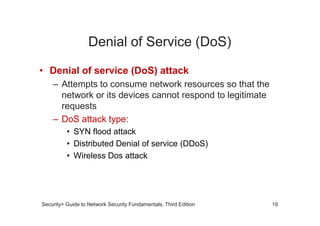
• Denial of service (DoS) attack
– Attempts to consume network resources so that the
network or its devices cannot respond to legitimate
requests
Security+ Guide to Network Security Fundamentals, Third Edition
– DoS attack type:
• SYN flood attack
• Distributed Denial of service (DDoS)
• Wireless Dos attack
19
Denial of Service (DoS) (continued)
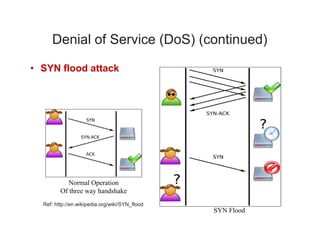
• SYN flood attack
Ref: http://en.wikipedia.org/wiki/SYN_flood 20
20
http://
Normal Operation
Of three way handshake
SYN Flood
Denial of Service (DoS) (continued)
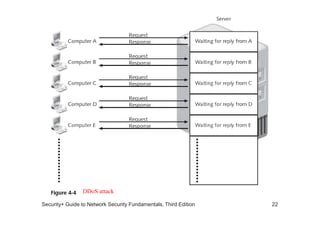
• Distributed denial of service (DDoS) attack
– A variant of the DoS
– May use hundreds or thousands of zombie
computers in a botnet to flood a device with requests
Security+ Guide to Network Security Fundamentals, Third Edition 21
Security+ Guide to Network Security Fundamentals, Third Edition 22
DDoS attack
Denial of Service (DoS) (continued)
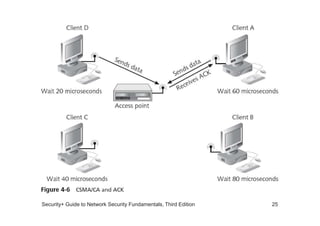
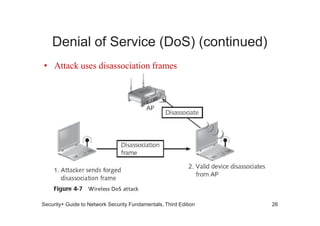
• Wireless Dos attack
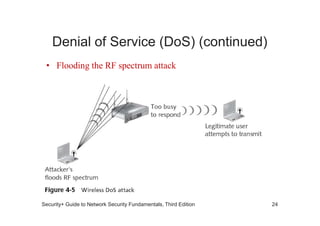
- Flooding the RF spectrum attack
- Attack takes advantage of CSMA/CA procedure
- Attack uses disassociation frames
Security+ Guide to Network Security Fundamentals, Third Edition 23
Denial of Service (DoS) (continued)
• Flooding the RF spectrum attack
Security+ Guide to Network Security Fundamentals, Third Edition 24
Security+ Guide to Network Security Fundamentals, Third Edition 25
Denial of Service (DoS) (continued)
• Attack uses disassociation frames
Security+ Guide to Network Security Fundamentals, Third Edition 26
Spoofing
• Spoofing is impersonation
– Pretends to be someone or something else by
presenting false information
• Variety of different attacks use spoofing
– Attacker may spoof her address so that her malicious actions
Security+ Guide to Network Security Fundamentals, Third Edition
– Attacker may spoof her address so that her malicious actions
would be attributed to a valid user
– Attacker may spoof his network address with an address of a
known and trusted host
– A fictitious login screen may allow an attacker to capture valid
user credentials
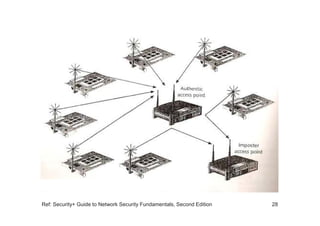
– Attacker can set up his AP device and trick all wireless devices
to communicate with the imposter device
27
Ref: Security+ Guide to Network Security Fundamentals, Second Edition 28
Man-in-the-Middle
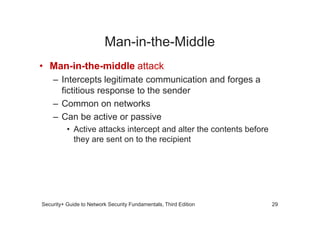
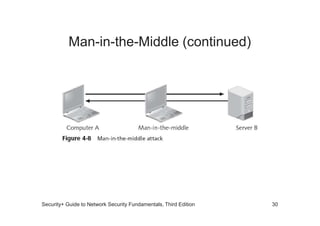
• Man-in-the-middle attack
– Intercepts legitimate communication and forges a
fictitious response to the sender
– Common on networks
– Can be active or passive
Security+ Guide to Network Security Fundamentals, Third Edition
– Can be active or passive
• Active attacks intercept and alter the contents before
they are sent on to the recipient
29
Man-in-the-Middle (continued)
Security+ Guide to Network Security Fundamentals, Third Edition 30
Replay
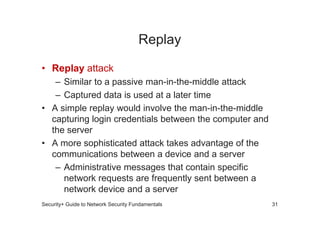
• Replay attack
– Similar to a passive man-in-the-middle attack
– Captured data is used at a later time
• A simple replay would involve the man-in-the-middle
capturing login credentials between the computer and
the server
• A more sophisticated attack takes advantage of the
communications between a device and a server
– Administrative messages that contain specific
network requests are frequently sent between a
network device and a server
Security+ Guide to Network Security Fundamentals 31
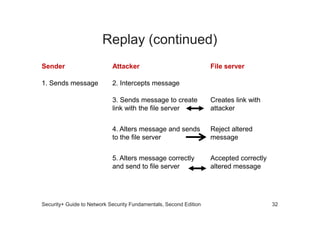
Replay (continued)
Sender Attacker File server
1. Sends message 2. Intercepts message
3. Sends message to create
link with the file server
Creates link with
attacker
4. Alters message and sends
to the file server
Reject altered
message
5. Alters message correctly
and send to file server
Accepted correctly
altered message
Security+ Guide to Network Security Fundamentals, Second Edition 32
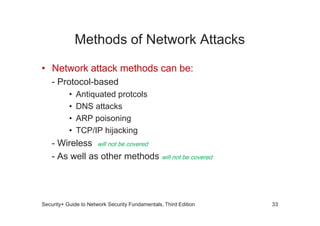
Methods of Network Attacks
• Network attack methods can be:
- Protocol-based
• Antiquated protcols
• DNS attacks
• ARP poisoning
• TCP/IP hijacking
- Wireless will not be covered
- As well as other methods will not be covered
Security+ Guide to Network Security Fundamentals, Third Edition 33
Protocol-Based Attacks
• Antiquated protocols
– TCP/IP protocols have been updated often to
address security vulnerabilities
– SNMP is example of updated protocol
Security+ Guide to Network Security Fundamentals, Third Edition 34
Protocol-Based Attacks (continued)
• SNMP
– Used for exchanging management information between
networked devices
– And enables system admin to remotely monitor, manage
and configure network devices.
– Each SNMP managed device must have an agent that is
protected with the community string.
• The use of community strings in the first two versions
of SNMP, SNMPv1 and SNMPv2, created several
vulnerabilities
• SNMPv3 uses encryption to protect the community
strings
Security+ Guide to Network Security Fundamentals, Third Edition 35
Protocol-Based Attacks (continued)
• DNS attacks
– Domain Name System (DNS) is the basis for name
resolution to IP addresses today
– It includes DNS poisoning and DNS transfers attacks.
Security+ Guide to Network Security Fundamentals, Third Edition
– It includes DNS poisoning and DNS transfers attacks.
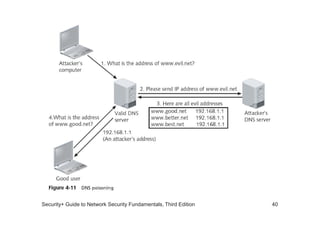
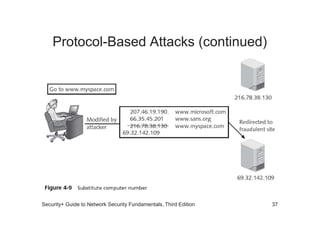
• DNS poisoning
– Substitute a fraudulent IP address so that when a
user enters a symbolic name, she is directed to the
fraudulent computer site
36
Protocol-Based Attacks (continued)
Security+ Guide to Network Security Fundamentals, Third Edition 37
Protocol-Based Attacks (continued)
• DNS poisoning (continued)
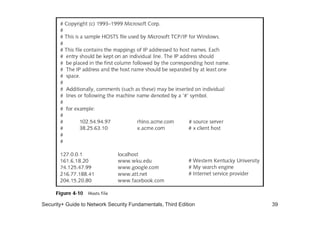
– Substituting a fraudulent IP address can be done in
one of two different locations
• TCP/IP host table name system (See Figure 4-10)
Security+ Guide to Network Security Fundamentals, Third Edition
• TCP/IP host table name system (See Figure 4-10)
• External DNS server
– Attack is called DNS poisoning (also called DNS
spoofing)
– See Figure 4-11
– DNS poisoning can be prevented by using the latest
editions of the DNS software, BIND (Berkeley
Internet Name Domain)
38
Security+ Guide to Network Security Fundamentals, Third Edition 39
Security+ Guide to Network Security Fundamentals, Third Edition 40
Protocol-Based Attacks (continued)
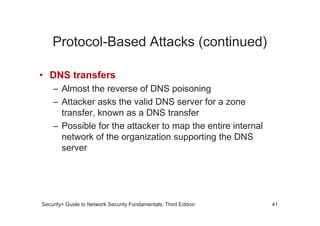
• DNS transfers
– Almost the reverse of DNS poisoning
– Attacker asks the valid DNS server for a zone
transfer, known as a DNS transfer
Security+ Guide to Network Security Fundamentals, Third Edition
transfer, known as a DNS transfer
– Possible for the attacker to map the entire internal
network of the organization supporting the DNS
server
41
Protocol-Based Attacks (continued)
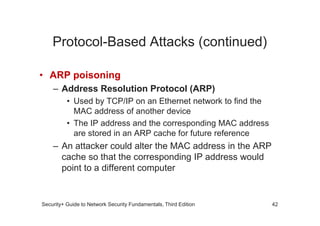
• ARP poisoning
– Address Resolution Protocol (ARP)
• Used by TCP/IP on an Ethernet network to find the
MAC address of another device
Security+ Guide to Network Security Fundamentals, Third Edition
MAC address of another device
• The IP address and the corresponding MAC address
are stored in an ARP cache for future reference
– An attacker could alter the MAC address in the ARP
cache so that the corresponding IP address would
point to a different computer
42
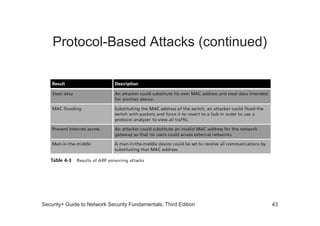
Protocol-Based Attacks (continued)
Security+ Guide to Network Security Fundamentals, Third Edition 43
Protocol-Based Attacks (continued)
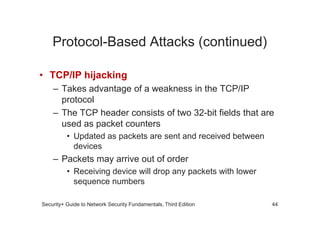
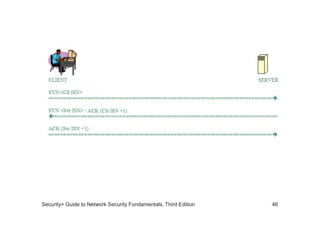
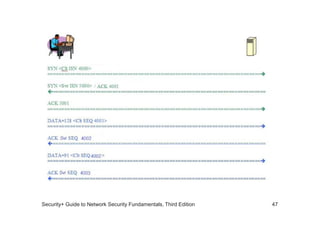
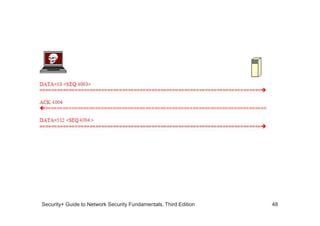
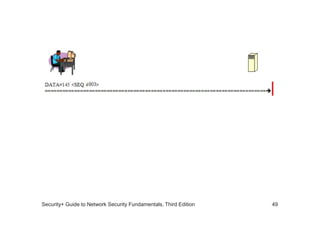
• TCP/IP hijacking
– Takes advantage of a weakness in the TCP/IP
protocol
– The TCP header consists of two 32-bit fields that are
Security+ Guide to Network Security Fundamentals, Third Edition
– The TCP header consists of two 32-bit fields that are
used as packet counters
• Updated as packets are sent and received between
devices
– Packets may arrive out of order
• Receiving device will drop any packets with lower
sequence numbers
44
Protocol-Based Attacks (continued)
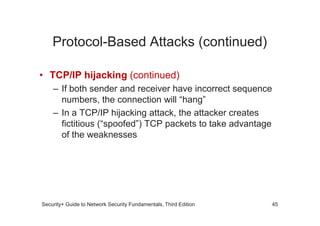
• TCP/IP hijacking (continued)
– If both sender and receiver have incorrect sequence
numbers, the connection will “hang”
– In a TCP/IP hijacking attack, the attacker creates
Security+ Guide to Network Security Fundamentals, Third Edition
– In a TCP/IP hijacking attack, the attacker creates
fictitious (“spoofed”) TCP packets to take advantage
of the weaknesses
45
Security+ Guide to Network Security Fundamentals, Third Edition 46
Security+ Guide to Network Security Fundamentals, Third Edition 47
Security+ Guide to Network Security Fundamentals, Third Edition 48
Security+ Guide to Network Security Fundamentals, Third Edition 49
Summary
• Network vulnerabilities include media-based
vulnerabilities and vulnerabilities in network
devices
• The same tools that network administrators use to
monitor network traffic and troubleshoot network
problems can also be used by attackers
• Network devices often contain weak passwords,
default accounts, back doors, and vulnerabilities
that permit privilege escalation
Security+ Guide to Network Security Fundamentals, Third Edition 50
Summary (continued)
• Network attacks can be grouped into four
categories
• Protocol-based attacks take advantage of
vulnerabilities in network protocols
Security+ Guide to Network Security Fundamentals, Third Edition 51

ch04_network-vulnerabilities-and-attacks.pdf

  • 1.
    Security+ Guide toNetwork Security Fundamentals, Third Edition Chapter 4 Network Vulnerabilities and Attacks
  • 2.
    Objectives • Explain thetypes of network vulnerabilities • List categories of network attacks • Define different methods of network attacks Security+ Guide to Network Security Fundamentals, Third Edition 2
  • 3.
    Network Vulnerabilities • Thereare two broad categories of network vulnerabilities: – Those based on the network transport media – Those found in the network devices themselves Security+ Guide to Network Security Fundamentals, Third Edition 3
  • 4.
    Media-Based Vulnerabilities • Monitoringnetwork traffic – Helps to identify and troubleshoot network problems – Monitoring traffic can be done in two ways Use a switch with port mirroring Security+ Guide to Network Security Fundamentals, Third Edition • To redirect traffic that occurs on some or all ports to a designated monitoring port on the switch Install a network tap (test access point) • A separate device that can be installed between two network devices, such as a switch, router, or firewall, to monitor traffic 4
  • 5.
    Security+ Guide toNetwork Security Fundamentals, Third Edition 5
  • 6.
    Security+ Guide toNetwork Security Fundamentals, Third Edition 6
  • 7.
    Media-Based Vulnerabilities (continued) Security+ Guideto Network Security Fundamentals, Third Edition 7
  • 8.
    Media-Based Vulnerabilities (continued) • Justas network taps and protocol analyzers can be used for legitimate purposes – They also can be used by attackers to intercept and view network traffic • Attackers can access the wired network in the Security+ Guide to Network Security Fundamentals, Third Edition • Attackers can access the wired network in the following ways: – False ceilings – Exposed wiring – Unprotected RJ-45 jacks 8
  • 9.
  • 10.
  • 11.
    Media-Based Vulnerabilities (continued) Security+ Guideto Network Security Fundamentals, Third Edition 11
  • 12.
    Network Device Vulnerabilities •Weak passwords – A password is a secret combination of letters and numbers that serves to authenticate (validate) a user by what he knows – Password paradox Security+ Guide to Network Security Fundamentals, Third Edition – Password paradox • Lengthy and complex passwords should be used and never written down • It is very difficult to memorize these types of passwords – Passwords can be set to expire after a set period of time, and a new one must be created 12
  • 13.
    Network Device Vulnerabilities (continued) •Characteristics of weak passwords – A common word used as a password – Not changing passwords unless forced to do so – Passwords that are short Security+ Guide to Network Security Fundamentals, Third Edition – Personal information in a password – Using the same password for all accounts – Writing the password down 13
  • 14.
    Network Device Vulnerabilities (continued) •Default account – A user account on a device that is created automatically by the device instead of by an administrator – Used to make the initial setup and installation of the Security+ Guide to Network Security Fundamentals, Third Edition – Used to make the initial setup and installation of the device (often by outside personnel) easier • Although default accounts are intended to be deleted after the installation is completed, often they are not • Default accounts are often the first targets that attackers seek 14
  • 15.
    Network Device Vulnerabilities (continued) Security+Guide to Network Security Fundamentals, Third Edition 15
  • 16.
    Network Device Vulnerabilities (continued) •Back door – An account that is secretly set up without the administrator’s knowledge or permission, that cannot be easily detected, and that allows for remote access to the device Security+ Guide to Network Security Fundamentals, Third Edition to the device – Back doors can be created on a network device in two ways • The network device can be infected by an attacker using a virus, worm, or Trojan horse • A programmer of the software creates a back door on the device 16
  • 17.
    Network Device Vulnerabilities (continued) •Privilege escalation – It is possible to exploit a vulnerability in the network device’s software to gain access to resources that the user would normally be restricted from obtaining Security+ Guide to Network Security Fundamentals, Third Edition 17
  • 18.
    Categories of Attacks •Attacks categories – Denial of service – Spoofing – Man-in-the-middle Security+ Guide to Network Security Fundamentals, Third Edition – Man-in-the-middle – Replay attacks 18
  • 19.
    Denial of Service(DoS) • Denial of service (DoS) attack – Attempts to consume network resources so that the network or its devices cannot respond to legitimate requests Security+ Guide to Network Security Fundamentals, Third Edition – DoS attack type: • SYN flood attack • Distributed Denial of service (DDoS) • Wireless Dos attack 19
  • 20.
    Denial of Service(DoS) (continued) • SYN flood attack Ref: http://en.wikipedia.org/wiki/SYN_flood 20 20 http:// Normal Operation Of three way handshake SYN Flood
  • 21.
    Denial of Service(DoS) (continued) • Distributed denial of service (DDoS) attack – A variant of the DoS – May use hundreds or thousands of zombie computers in a botnet to flood a device with requests Security+ Guide to Network Security Fundamentals, Third Edition 21
  • 22.
    Security+ Guide toNetwork Security Fundamentals, Third Edition 22 DDoS attack
  • 23.
    Denial of Service(DoS) (continued) • Wireless Dos attack - Flooding the RF spectrum attack - Attack takes advantage of CSMA/CA procedure - Attack uses disassociation frames Security+ Guide to Network Security Fundamentals, Third Edition 23
  • 24.
    Denial of Service(DoS) (continued) • Flooding the RF spectrum attack Security+ Guide to Network Security Fundamentals, Third Edition 24
  • 25.
    Security+ Guide toNetwork Security Fundamentals, Third Edition 25
  • 26.
    Denial of Service(DoS) (continued) • Attack uses disassociation frames Security+ Guide to Network Security Fundamentals, Third Edition 26
  • 27.
    Spoofing • Spoofing isimpersonation – Pretends to be someone or something else by presenting false information • Variety of different attacks use spoofing – Attacker may spoof her address so that her malicious actions Security+ Guide to Network Security Fundamentals, Third Edition – Attacker may spoof her address so that her malicious actions would be attributed to a valid user – Attacker may spoof his network address with an address of a known and trusted host – A fictitious login screen may allow an attacker to capture valid user credentials – Attacker can set up his AP device and trick all wireless devices to communicate with the imposter device 27
  • 28.
    Ref: Security+ Guideto Network Security Fundamentals, Second Edition 28
  • 29.
    Man-in-the-Middle • Man-in-the-middle attack –Intercepts legitimate communication and forges a fictitious response to the sender – Common on networks – Can be active or passive Security+ Guide to Network Security Fundamentals, Third Edition – Can be active or passive • Active attacks intercept and alter the contents before they are sent on to the recipient 29
  • 30.
    Man-in-the-Middle (continued) Security+ Guideto Network Security Fundamentals, Third Edition 30
  • 31.
    Replay • Replay attack –Similar to a passive man-in-the-middle attack – Captured data is used at a later time • A simple replay would involve the man-in-the-middle • A simple replay would involve the man-in-the-middle capturing login credentials between the computer and the server • A more sophisticated attack takes advantage of the communications between a device and a server – Administrative messages that contain specific network requests are frequently sent between a network device and a server Security+ Guide to Network Security Fundamentals 31
  • 32.
    Replay (continued) Sender AttackerFile server 1. Sends message 2. Intercepts message 3. Sends message to create link with the file server Creates link with attacker 4. Alters message and sends to the file server Reject altered message 5. Alters message correctly and send to file server Accepted correctly altered message Security+ Guide to Network Security Fundamentals, Second Edition 32
  • 33.
    Methods of NetworkAttacks • Network attack methods can be: - Protocol-based • Antiquated protcols • DNS attacks • ARP poisoning • TCP/IP hijacking - Wireless will not be covered - As well as other methods will not be covered Security+ Guide to Network Security Fundamentals, Third Edition 33
  • 34.
    Protocol-Based Attacks • Antiquatedprotocols – TCP/IP protocols have been updated often to address security vulnerabilities – SNMP is example of updated protocol Security+ Guide to Network Security Fundamentals, Third Edition 34
  • 35.
    Protocol-Based Attacks (continued) •SNMP – Used for exchanging management information between networked devices – And enables system admin to remotely monitor, manage and configure network devices. and configure network devices. – Each SNMP managed device must have an agent that is protected with the community string. • The use of community strings in the first two versions of SNMP, SNMPv1 and SNMPv2, created several vulnerabilities • SNMPv3 uses encryption to protect the community strings Security+ Guide to Network Security Fundamentals, Third Edition 35
  • 36.
    Protocol-Based Attacks (continued) •DNS attacks – Domain Name System (DNS) is the basis for name resolution to IP addresses today – It includes DNS poisoning and DNS transfers attacks. Security+ Guide to Network Security Fundamentals, Third Edition – It includes DNS poisoning and DNS transfers attacks. • DNS poisoning – Substitute a fraudulent IP address so that when a user enters a symbolic name, she is directed to the fraudulent computer site 36
  • 37.
    Protocol-Based Attacks (continued) Security+Guide to Network Security Fundamentals, Third Edition 37
  • 38.
    Protocol-Based Attacks (continued) •DNS poisoning (continued) – Substituting a fraudulent IP address can be done in one of two different locations • TCP/IP host table name system (See Figure 4-10) Security+ Guide to Network Security Fundamentals, Third Edition • TCP/IP host table name system (See Figure 4-10) • External DNS server – Attack is called DNS poisoning (also called DNS spoofing) – See Figure 4-11 – DNS poisoning can be prevented by using the latest editions of the DNS software, BIND (Berkeley Internet Name Domain) 38
  • 39.
    Security+ Guide toNetwork Security Fundamentals, Third Edition 39
  • 40.
    Security+ Guide toNetwork Security Fundamentals, Third Edition 40
  • 41.
    Protocol-Based Attacks (continued) •DNS transfers – Almost the reverse of DNS poisoning – Attacker asks the valid DNS server for a zone transfer, known as a DNS transfer Security+ Guide to Network Security Fundamentals, Third Edition transfer, known as a DNS transfer – Possible for the attacker to map the entire internal network of the organization supporting the DNS server 41
  • 42.
    Protocol-Based Attacks (continued) •ARP poisoning – Address Resolution Protocol (ARP) • Used by TCP/IP on an Ethernet network to find the MAC address of another device Security+ Guide to Network Security Fundamentals, Third Edition MAC address of another device • The IP address and the corresponding MAC address are stored in an ARP cache for future reference – An attacker could alter the MAC address in the ARP cache so that the corresponding IP address would point to a different computer 42
  • 43.
    Protocol-Based Attacks (continued) Security+Guide to Network Security Fundamentals, Third Edition 43
  • 44.
    Protocol-Based Attacks (continued) •TCP/IP hijacking – Takes advantage of a weakness in the TCP/IP protocol – The TCP header consists of two 32-bit fields that are Security+ Guide to Network Security Fundamentals, Third Edition – The TCP header consists of two 32-bit fields that are used as packet counters • Updated as packets are sent and received between devices – Packets may arrive out of order • Receiving device will drop any packets with lower sequence numbers 44
  • 45.
    Protocol-Based Attacks (continued) •TCP/IP hijacking (continued) – If both sender and receiver have incorrect sequence numbers, the connection will “hang” – In a TCP/IP hijacking attack, the attacker creates Security+ Guide to Network Security Fundamentals, Third Edition – In a TCP/IP hijacking attack, the attacker creates fictitious (“spoofed”) TCP packets to take advantage of the weaknesses 45
  • 46.
    Security+ Guide toNetwork Security Fundamentals, Third Edition 46
  • 47.
    Security+ Guide toNetwork Security Fundamentals, Third Edition 47
  • 48.
    Security+ Guide toNetwork Security Fundamentals, Third Edition 48
  • 49.
    Security+ Guide toNetwork Security Fundamentals, Third Edition 49
  • 50.
    Summary • Network vulnerabilitiesinclude media-based vulnerabilities and vulnerabilities in network devices • The same tools that network administrators use to monitor network traffic and troubleshoot network monitor network traffic and troubleshoot network problems can also be used by attackers • Network devices often contain weak passwords, default accounts, back doors, and vulnerabilities that permit privilege escalation Security+ Guide to Network Security Fundamentals, Third Edition 50
  • 51.
    Summary (continued) • Networkattacks can be grouped into four categories • Protocol-based attacks take advantage of vulnerabilities in network protocols Security+ Guide to Network Security Fundamentals, Third Edition 51