Copyright ©2016 The Culinary Institute of America. All rights reserved.
3
Equipment
Identification
Copyright ©2016 The Culinary Institute of America. All rights reserved.
• In baking, even more so than in cooking, precise measurement
of ingredients is vital to the success of the product.
• Before using any scale, you must take certain steps to account for
the weight of containers.
– This process is known as setting a scale to tare or setting it to
zero.
• Types of scales include the beam balance scale, spring scales, and
digital scales.
Scales
SCALING AND MEASURING TOOLS
Copyright ©2016 The Culinary Institute of America. All rights reserved.
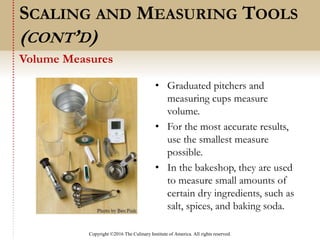
• Graduated pitchers and
measuring cups measure
volume.
• For the most accurate results,
use the smallest measure
possible.
• In the bakeshop, they are used
to measure small amounts of
certain dry ingredients, such as
salt, spices, and baking soda.
Volume Measures
SCALING AND MEASURING TOOLS
(CONT’D)
Copyright ©2016 The Culinary Institute of America. All rights reserved.
• Any bakeshop should have thermometers capable of measuring
accurately over a wide range of temperatures.
• To check a thermometer’s accuracy, let it stand for 10 minutes in
boiling water. It should read 212°F/100°C.
– If there is any discrepancy, subtract or add the correct
number of degrees to make up for the difference when using
the thermometer.
• Types of thermometers include digital thermometers, probe
thermometers, and candy (or sugar or deep-fat) thermometers.
Thermometers
SCALING AND MEASURING TOOLS
(CONT’D)
Copyright ©2016 The Culinary Institute of America. All rights reserved.
• Learn to sharpen knives with a stone and a steel so that you can
maintain them yourself.
• Keeping knives clean helps to extend their lives.
• There are a number of safe, practical ways to store knives,
including knife kits or rolls for one’s personal collection and
slots, racks, and magnetized holders in the kitchen.
• Always use an appropriate cutting surface, like wooden or
composition cutting boards.
• A basic knife collection includes four essential knives—a chef’s
or French knife, a utility knife, a paring knife, and a slicer.
Knives
CUTTING TOOLS
Copyright ©2016 The Culinary Institute of America. All rights reserved.
• Chef’s or French knives are all-
purpose knives used for a variety
of tasks.
• A utility knife is smaller than a
chef’s knife, used for light cutting
chores.
• A paring knife is a short knife
used for peeling and trimming
vegetables and fruits.
• Slicers are used to slice breads,
cakes, and pastries.
Types of Knives
CUTTING TOOLS (CONT’D)
Copyright ©2016 The Culinary Institute of America. All rights reserved.
• Graters are made of metal with openings that shred away pieces
of an ingredient.
• A citrus zester is a small hand tool with a metal head, with a
row of small round holes attached to a handle. As the head is
passed over the citrus fruit, the cutting edges remove the colored
zest.
• A rasp is a long, flat piece of stainless steel with perforations,
well-suited for zesting and finely grating chocolate and hard
cheeses.
Graters, Zesters, and Rasps
OTHER SMALL TOOLS
Copyright ©2016 The Culinary Institute of America. All rights reserved.
• Swivel-bladed peelers remove thin layers of skin (or zest) from
fruits and vegetables.
• A lemon reamer is a conical tool with deep ridges and a handle,
used for extracting the juice from small citrus fruits such as
lemons.
• An apple corer may be a hand tool or a mechanical device.
Peelers, Reamers, and Corers
OTHER SMALL TOOLS (CONT’D)
Copyright ©2016 The Culinary Institute of America. All rights reserved.
• Wood does not conduct or
transfer heat well, so there is no
threat of burning your fingers
when using wooden spoons.
• Tongs act as an extension of
your thumb and forefinger to lift,
turn, and transfer hot food or
other objects.
• Paddles are used in chocolate
and confection work.
Spoons and Tongs
OTHER SMALL TOOLS (CONT’D)
Copyright ©2016 The Culinary Institute of America. All rights reserved.
• Also called whisks.
• Made from a number of thin wires bound together with a
handle.
• Balloon whips are sphere-shaped and have thin wires to
incorporate air for making foams.
• Flat whips often have thicker wires.
Whips
OTHER SMALL TOOLS (CONT’D)
Copyright ©2016 The Culinary Institute of America. All rights reserved.
• Rubber spatulas are used to:
– Scrape mixtures from bowls and into baking pans or other
containers
– Push foods through sieves
– Fold ingredients together
– Spread batters and fillings into even layers
• Metal spatulas look something like knives.
– They have long metal blades and blunt, rounded ends.
Spatulas and Scrapers
OTHER SMALL TOOLS (CONT’D)
Copyright ©2016 The Culinary Institute of America. All rights reserved.
• Some scoops have a spring-operated mechanism that pushes
batters, ice creams, or other preparations cleanly from the bowl.
• Melon ballers, also called Parisian scoops, may be round or
oval, with straight or fluted edges.
• Ladles are used for portioning as well as for measuring pourable
ingredients or mixtures such as sauces.
– The bowl of the ladle holds a specific volume.
– Ladles with a 45-degree angle between the bowl and the
handle work best in most instances.
Scoops and Ladles
OTHER SMALL TOOLS (CONT’D)
Copyright ©2016 The Culinary Institute of America. All rights reserved.
• Sieves and strainers are used to sift and aerate dry ingredients,
as well as to remove any large impurities from them.
– Drum sieves (or tamis), champignons, and conical sieves are
all examples of sieves and strainers.
• A colander is a bowl pierced with holes, used for straining or
draining foods.
• A food mill has a curved blade that is rotated over a disk by a
hand-operated crank.
• Cheesecloth is a light, fine-mesh cotton gauze used to strain
very fine sauces and similar items.
HANDS TOOLS FOR SIFTING,
STRAINING, AND PURÉEING
Copyright ©2016 The Culinary Institute of America. All rights reserved.
• Bakeshops specializing in bread baking will have a unique set of
tools.
• Special tools for fermentation and shaping include couches,
loaf pans, and bannetons—special dough-rising baskets.
• Lames are used to score bread before baking.
• Peels are large wooden paddles that are used to transfer dough
into and out of the oven for baking.
TOOLS FOR BREAD BAKING
Copyright ©2016 The Culinary Institute of America. All rights reserved.
• Tools commonly found in a bakeshop include cookie cutters,
pastry brushes, and dough dockers.
• Rolling pins are used to flatten and thin doughs such as yeasted
bread, pastry, tart, and cookie doughs, puff pastry, and marzipan.
– They may be made of wood, metal, marble, or synthetic
materials.
– Types of pins include the rod-and-bearing rolling pins,
straight rolling pins, and French rolling pins.
TOOLS FOR PASTRIES AND
COOKIES
Copyright ©2016 The Culinary Institute of America. All rights reserved.
• Bakeshops and kitchens use
specialty equipment and
tools for finishing baked
goods.
• Pastry bags, piping tips,
and parchment paper
cones are used for
decorative piping, as well as
for filling and assembling
items.
• Cake combs and turntables
are used for icing and
decorating cakes.
TOOLS FOR DÉCOR WORK
Copyright ©2016 The Culinary Institute of America. All rights reserved.
• Proper equipment is an important aspect of confectionary work,
because the product can be so delicate and challenging to handle.
• Heavy copper pots and fondant funnels make working with
hot sugar safe and efficient.
• Tin molds, chocolate molds, caramel bars, and guitars are used
to create specific shapes and sizes for chocolate, caramel, and
sugar confections.
• Dipping forks, airbrushes, acetate sheets, and gum paste
modeling tools are used to add décor and create garnishes for
confections.
Tools for Confectionary and Décor Work
TOOLS FOR DÉCOR WORK
(CONT’D)
Copyright ©2016 The Culinary Institute of America. All rights reserved.
• Hotel pans, sheet pans, pie pans, and cake pans are
examples of bakeware used in a bakeshop.
• They can come in a variety of shapes, sizes, and materials, such
as aluminum (most typical for pans), glass, and earthenware.
• The ring of a springform pan is joined with a clip closure that
creates tension when closed and holds the removable bottom in
place.
• Tube pans have a center tube, so they conduct heat through the
center of the batter as well as from the sides and bottom.
• Tart pans and tartlet pans are made made of tinned steel with
or without a nonstick coating. They come in various sizes.
Baking Pans
BAKEWARE, RINGS, AND MOLDS
Copyright ©2016 The Culinary Institute of America. All rights reserved.
• Cake rings are stainless-steel rings used for molding cakes and
individual pastries.
• Flan rings are used for molding tarts and European flans.
• A madeleine mold is a tinned steel or aluminum sheet with
scalloped impressions used for molding the small cakes.
• Flexible silicone molds are made of silicone-coated fiberglass
and can be used for molding chocolate or frozen desserts, as well
as for baking pastries and cakes.
• Modular ejection molds are acrylic molds available in different
shapes and sizes; each mold comes with an extractor of
matching shape and size.
Rings and Molds
BAKEWARE, RINGS, AND MOLDS
(CONT’D)
Copyright ©2016 The Culinary Institute of America. All rights reserved.
• Flexible silicone baking mats are able to withstand oven
temperatures up to 500°F/260°C.
– Used for lining sheet pans to give them a nonstick baking
surface
– Provide a nonstick heat-resistant surface in candy making
• Parchment paper is grease-resistant, nonstick, heatproof, quick-
release coated paper.
– Can be reused until it becomes dark and brittle
Silicone Mats and Parchment Paper
BAKEWARE, RINGS, AND MOLDS
(CONT’D)
Copyright ©2016 The Culinary Institute of America. All rights reserved.
• In addition to bakeware, the bakeshop will often find themselves
over a stove, using pots and pans.
• Sauté pans (sometimes referred to as skillets) are shallow pans,
wider than they are tall, sometimes with sloping sides.
– These might be used to sauté fruit or caramelize onions for a
tart.
• Saucepots, which are deeper than they are wide, are frequently
used to make pastry cream, prepare sauces, or to warm
ingredients for a mousse.
STOVETOP POTS AND PANS
Copyright ©2016 The Culinary Institute of America. All rights reserved.
• Mixing, chopping, and puréeing equipment has the potential to
be extremely dangerous.
• An immersion blender is a long, slender one-piece machine
that works like an inverted countertop blender.
• A vertical chopping machine has a motor at the base is
permanently attached to a bowl with integral blades.
• A food chopper (also called a buffalo chopper) is a piece of
equipment in which the food is placed in a bowl that rotates
when the machine is turned.
Mixing, Chopping, and Puréeing Equipment
LARGE EQUIPMENT
Copyright ©2016 The Culinary Institute of America. All rights reserved.
• Planetary mixers have an attachment that revolves inside the
stationary mixing bowl.
• Spiral mixers are stationary mixers, meaning that the bowl,
rather than the mixing attachment, rotates.
• Oblique mixers, also known as fork mixers, are similar in
construction to spiral mixers except that their attachment is a
fork rather than a spiral.
Mixers
LARGE EQUIPMENT (CONT’D)
Copyright ©2016 The Culinary Institute of America. All rights reserved.
• Conventional ovens have a heat source located at the bottom,
and heat is conducted through the floor.
• Deck ovens normally consist of two to four wide, flat decks
stacked one above another.
• Steam-injection ovens vent steam into the oven as breads and
rolls bake.
• In a convection oven, fans force hot air to circulate around the
food, cooking it evenly and quickly.
Ovens
LARGE EQUIPMENT (CONT’D)
Copyright ©2016 The Culinary Institute of America. All rights reserved.
• Proofers maintain the most desirable environment for yeast
growth.
• They help to maintain production schedules and ensure that
items are of uniform quality.
• Proofers with refrigeration capabilities are called
proofer/retarders.
• They are available as stationary walk-ins or as mobile boxes.
Proofers
LARGE EQUIPMENT (CONT’D)
Copyright ©2016 The Culinary Institute of America. All rights reserved.
• Refrigeration equipment is an important piece of equipment and
should be chosen based on the needs of the kitchen.
– A walk-in is the largest type, and usually has shelves arranged
around the walls, and some walk-ins are large enough to
accommodate rolling carts for additional storage.
– Reach-in refrigerators, on-site units, and portable
refrigeration are all well-suited for a small pastry station, as
well as for service, because they are more accessible than a
large walk-in.
Refrigeration Equipment
LARGE EQUIPMENT (CONT’D)
Copyright ©2016 The Culinary Institute of America. All rights reserved.
• Simple hand-cranked or electric ice cream machines have a
motor that either turns the paddle within the cooling chamber or
rotates the chamber around the paddle.
• There are two basic types of commercial ice cream machines:
continuous and batch.
– Continuous: ice cream base is fed continuously into the
machine at a high rate of speed.
– Batch: churns a specific amount of ice cream base at one
time.
Ice Cream Machines
LARGE EQUIPMENT (CONT’D)
Copyright ©2016 The Culinary Institute of America. All rights reserved.
• Good-quality tools are often more expensive, but they last longer
and perform better than poorly made tools.
• Some of the tools and equipment used in professional kitchens
and bakeshops today are the same as those used centuries ago.
• Always be aware of new tools, technologies, and trends.
PROFESSIONALS AND THEIR
TOOLS

ch03: Equipment Identification.pptx

  • 1.
    Copyright ©2016 TheCulinary Institute of America. All rights reserved. 3 Equipment Identification
  • 2.
    Copyright ©2016 TheCulinary Institute of America. All rights reserved. • In baking, even more so than in cooking, precise measurement of ingredients is vital to the success of the product. • Before using any scale, you must take certain steps to account for the weight of containers. – This process is known as setting a scale to tare or setting it to zero. • Types of scales include the beam balance scale, spring scales, and digital scales. Scales SCALING AND MEASURING TOOLS
  • 3.
    Copyright ©2016 TheCulinary Institute of America. All rights reserved. • Graduated pitchers and measuring cups measure volume. • For the most accurate results, use the smallest measure possible. • In the bakeshop, they are used to measure small amounts of certain dry ingredients, such as salt, spices, and baking soda. Volume Measures SCALING AND MEASURING TOOLS (CONT’D)
  • 4.
    Copyright ©2016 TheCulinary Institute of America. All rights reserved. • Any bakeshop should have thermometers capable of measuring accurately over a wide range of temperatures. • To check a thermometer’s accuracy, let it stand for 10 minutes in boiling water. It should read 212°F/100°C. – If there is any discrepancy, subtract or add the correct number of degrees to make up for the difference when using the thermometer. • Types of thermometers include digital thermometers, probe thermometers, and candy (or sugar or deep-fat) thermometers. Thermometers SCALING AND MEASURING TOOLS (CONT’D)
  • 5.
    Copyright ©2016 TheCulinary Institute of America. All rights reserved. • Learn to sharpen knives with a stone and a steel so that you can maintain them yourself. • Keeping knives clean helps to extend their lives. • There are a number of safe, practical ways to store knives, including knife kits or rolls for one’s personal collection and slots, racks, and magnetized holders in the kitchen. • Always use an appropriate cutting surface, like wooden or composition cutting boards. • A basic knife collection includes four essential knives—a chef’s or French knife, a utility knife, a paring knife, and a slicer. Knives CUTTING TOOLS
  • 6.
    Copyright ©2016 TheCulinary Institute of America. All rights reserved. • Chef’s or French knives are all- purpose knives used for a variety of tasks. • A utility knife is smaller than a chef’s knife, used for light cutting chores. • A paring knife is a short knife used for peeling and trimming vegetables and fruits. • Slicers are used to slice breads, cakes, and pastries. Types of Knives CUTTING TOOLS (CONT’D)
  • 7.
    Copyright ©2016 TheCulinary Institute of America. All rights reserved. • Graters are made of metal with openings that shred away pieces of an ingredient. • A citrus zester is a small hand tool with a metal head, with a row of small round holes attached to a handle. As the head is passed over the citrus fruit, the cutting edges remove the colored zest. • A rasp is a long, flat piece of stainless steel with perforations, well-suited for zesting and finely grating chocolate and hard cheeses. Graters, Zesters, and Rasps OTHER SMALL TOOLS
  • 8.
    Copyright ©2016 TheCulinary Institute of America. All rights reserved. • Swivel-bladed peelers remove thin layers of skin (or zest) from fruits and vegetables. • A lemon reamer is a conical tool with deep ridges and a handle, used for extracting the juice from small citrus fruits such as lemons. • An apple corer may be a hand tool or a mechanical device. Peelers, Reamers, and Corers OTHER SMALL TOOLS (CONT’D)
  • 9.
    Copyright ©2016 TheCulinary Institute of America. All rights reserved. • Wood does not conduct or transfer heat well, so there is no threat of burning your fingers when using wooden spoons. • Tongs act as an extension of your thumb and forefinger to lift, turn, and transfer hot food or other objects. • Paddles are used in chocolate and confection work. Spoons and Tongs OTHER SMALL TOOLS (CONT’D)
  • 10.
    Copyright ©2016 TheCulinary Institute of America. All rights reserved. • Also called whisks. • Made from a number of thin wires bound together with a handle. • Balloon whips are sphere-shaped and have thin wires to incorporate air for making foams. • Flat whips often have thicker wires. Whips OTHER SMALL TOOLS (CONT’D)
  • 11.
    Copyright ©2016 TheCulinary Institute of America. All rights reserved. • Rubber spatulas are used to: – Scrape mixtures from bowls and into baking pans or other containers – Push foods through sieves – Fold ingredients together – Spread batters and fillings into even layers • Metal spatulas look something like knives. – They have long metal blades and blunt, rounded ends. Spatulas and Scrapers OTHER SMALL TOOLS (CONT’D)
  • 12.
    Copyright ©2016 TheCulinary Institute of America. All rights reserved. • Some scoops have a spring-operated mechanism that pushes batters, ice creams, or other preparations cleanly from the bowl. • Melon ballers, also called Parisian scoops, may be round or oval, with straight or fluted edges. • Ladles are used for portioning as well as for measuring pourable ingredients or mixtures such as sauces. – The bowl of the ladle holds a specific volume. – Ladles with a 45-degree angle between the bowl and the handle work best in most instances. Scoops and Ladles OTHER SMALL TOOLS (CONT’D)
  • 13.
    Copyright ©2016 TheCulinary Institute of America. All rights reserved. • Sieves and strainers are used to sift and aerate dry ingredients, as well as to remove any large impurities from them. – Drum sieves (or tamis), champignons, and conical sieves are all examples of sieves and strainers. • A colander is a bowl pierced with holes, used for straining or draining foods. • A food mill has a curved blade that is rotated over a disk by a hand-operated crank. • Cheesecloth is a light, fine-mesh cotton gauze used to strain very fine sauces and similar items. HANDS TOOLS FOR SIFTING, STRAINING, AND PURÉEING
  • 14.
    Copyright ©2016 TheCulinary Institute of America. All rights reserved. • Bakeshops specializing in bread baking will have a unique set of tools. • Special tools for fermentation and shaping include couches, loaf pans, and bannetons—special dough-rising baskets. • Lames are used to score bread before baking. • Peels are large wooden paddles that are used to transfer dough into and out of the oven for baking. TOOLS FOR BREAD BAKING
  • 15.
    Copyright ©2016 TheCulinary Institute of America. All rights reserved. • Tools commonly found in a bakeshop include cookie cutters, pastry brushes, and dough dockers. • Rolling pins are used to flatten and thin doughs such as yeasted bread, pastry, tart, and cookie doughs, puff pastry, and marzipan. – They may be made of wood, metal, marble, or synthetic materials. – Types of pins include the rod-and-bearing rolling pins, straight rolling pins, and French rolling pins. TOOLS FOR PASTRIES AND COOKIES
  • 16.
    Copyright ©2016 TheCulinary Institute of America. All rights reserved. • Bakeshops and kitchens use specialty equipment and tools for finishing baked goods. • Pastry bags, piping tips, and parchment paper cones are used for decorative piping, as well as for filling and assembling items. • Cake combs and turntables are used for icing and decorating cakes. TOOLS FOR DÉCOR WORK
  • 17.
    Copyright ©2016 TheCulinary Institute of America. All rights reserved. • Proper equipment is an important aspect of confectionary work, because the product can be so delicate and challenging to handle. • Heavy copper pots and fondant funnels make working with hot sugar safe and efficient. • Tin molds, chocolate molds, caramel bars, and guitars are used to create specific shapes and sizes for chocolate, caramel, and sugar confections. • Dipping forks, airbrushes, acetate sheets, and gum paste modeling tools are used to add décor and create garnishes for confections. Tools for Confectionary and Décor Work TOOLS FOR DÉCOR WORK (CONT’D)
  • 18.
    Copyright ©2016 TheCulinary Institute of America. All rights reserved. • Hotel pans, sheet pans, pie pans, and cake pans are examples of bakeware used in a bakeshop. • They can come in a variety of shapes, sizes, and materials, such as aluminum (most typical for pans), glass, and earthenware. • The ring of a springform pan is joined with a clip closure that creates tension when closed and holds the removable bottom in place. • Tube pans have a center tube, so they conduct heat through the center of the batter as well as from the sides and bottom. • Tart pans and tartlet pans are made made of tinned steel with or without a nonstick coating. They come in various sizes. Baking Pans BAKEWARE, RINGS, AND MOLDS
  • 19.
    Copyright ©2016 TheCulinary Institute of America. All rights reserved. • Cake rings are stainless-steel rings used for molding cakes and individual pastries. • Flan rings are used for molding tarts and European flans. • A madeleine mold is a tinned steel or aluminum sheet with scalloped impressions used for molding the small cakes. • Flexible silicone molds are made of silicone-coated fiberglass and can be used for molding chocolate or frozen desserts, as well as for baking pastries and cakes. • Modular ejection molds are acrylic molds available in different shapes and sizes; each mold comes with an extractor of matching shape and size. Rings and Molds BAKEWARE, RINGS, AND MOLDS (CONT’D)
  • 20.
    Copyright ©2016 TheCulinary Institute of America. All rights reserved. • Flexible silicone baking mats are able to withstand oven temperatures up to 500°F/260°C. – Used for lining sheet pans to give them a nonstick baking surface – Provide a nonstick heat-resistant surface in candy making • Parchment paper is grease-resistant, nonstick, heatproof, quick- release coated paper. – Can be reused until it becomes dark and brittle Silicone Mats and Parchment Paper BAKEWARE, RINGS, AND MOLDS (CONT’D)
  • 21.
    Copyright ©2016 TheCulinary Institute of America. All rights reserved. • In addition to bakeware, the bakeshop will often find themselves over a stove, using pots and pans. • Sauté pans (sometimes referred to as skillets) are shallow pans, wider than they are tall, sometimes with sloping sides. – These might be used to sauté fruit or caramelize onions for a tart. • Saucepots, which are deeper than they are wide, are frequently used to make pastry cream, prepare sauces, or to warm ingredients for a mousse. STOVETOP POTS AND PANS
  • 22.
    Copyright ©2016 TheCulinary Institute of America. All rights reserved. • Mixing, chopping, and puréeing equipment has the potential to be extremely dangerous. • An immersion blender is a long, slender one-piece machine that works like an inverted countertop blender. • A vertical chopping machine has a motor at the base is permanently attached to a bowl with integral blades. • A food chopper (also called a buffalo chopper) is a piece of equipment in which the food is placed in a bowl that rotates when the machine is turned. Mixing, Chopping, and Puréeing Equipment LARGE EQUIPMENT
  • 23.
    Copyright ©2016 TheCulinary Institute of America. All rights reserved. • Planetary mixers have an attachment that revolves inside the stationary mixing bowl. • Spiral mixers are stationary mixers, meaning that the bowl, rather than the mixing attachment, rotates. • Oblique mixers, also known as fork mixers, are similar in construction to spiral mixers except that their attachment is a fork rather than a spiral. Mixers LARGE EQUIPMENT (CONT’D)
  • 24.
    Copyright ©2016 TheCulinary Institute of America. All rights reserved. • Conventional ovens have a heat source located at the bottom, and heat is conducted through the floor. • Deck ovens normally consist of two to four wide, flat decks stacked one above another. • Steam-injection ovens vent steam into the oven as breads and rolls bake. • In a convection oven, fans force hot air to circulate around the food, cooking it evenly and quickly. Ovens LARGE EQUIPMENT (CONT’D)
  • 25.
    Copyright ©2016 TheCulinary Institute of America. All rights reserved. • Proofers maintain the most desirable environment for yeast growth. • They help to maintain production schedules and ensure that items are of uniform quality. • Proofers with refrigeration capabilities are called proofer/retarders. • They are available as stationary walk-ins or as mobile boxes. Proofers LARGE EQUIPMENT (CONT’D)
  • 26.
    Copyright ©2016 TheCulinary Institute of America. All rights reserved. • Refrigeration equipment is an important piece of equipment and should be chosen based on the needs of the kitchen. – A walk-in is the largest type, and usually has shelves arranged around the walls, and some walk-ins are large enough to accommodate rolling carts for additional storage. – Reach-in refrigerators, on-site units, and portable refrigeration are all well-suited for a small pastry station, as well as for service, because they are more accessible than a large walk-in. Refrigeration Equipment LARGE EQUIPMENT (CONT’D)
  • 27.
    Copyright ©2016 TheCulinary Institute of America. All rights reserved. • Simple hand-cranked or electric ice cream machines have a motor that either turns the paddle within the cooling chamber or rotates the chamber around the paddle. • There are two basic types of commercial ice cream machines: continuous and batch. – Continuous: ice cream base is fed continuously into the machine at a high rate of speed. – Batch: churns a specific amount of ice cream base at one time. Ice Cream Machines LARGE EQUIPMENT (CONT’D)
  • 28.
    Copyright ©2016 TheCulinary Institute of America. All rights reserved. • Good-quality tools are often more expensive, but they last longer and perform better than poorly made tools. • Some of the tools and equipment used in professional kitchens and bakeshops today are the same as those used centuries ago. • Always be aware of new tools, technologies, and trends. PROFESSIONALS AND THEIR TOOLS

Editor's Notes

  • #2 Learning Objectives Identify and describe types of scaling and measuring tools. Identify and describe types of cutting tools. Identify and describe other tools used in the kitchen, such as graters, peelers, tongs, and spatulas. Identify and describe hand tools for sifting, straining, and puréeing. Describe tools for bread baking and their uses. Describe tools for pastries and cookies. Identify tools for confectionary and décor work and explain their uses. Identify and describe types of bakeware, rings, and molds. Identify and describe stovetop pots and pans. Describe large kitchen equipment and their uses, such as planetary mixers, ovens, and refrigeration equipment. Discuss the relationship between a chef and his tools.
  • #12 Plastic bowl scrapers are like the head of a rubber spatula without a handle.
  • #14 - Many mixing machines can be used as food mills with attachments that allow them to strain and purée foods
  • #16 - Pins made of porous materials such as wood may absorb the taste of soaps and detergents and transfer them to delicate doughs, so use only warm water and rub with a soft cloth to clean them.
  • #23 - An immersion blender (also known as a hand blender, stick blender, or burr mixer
  • #25 Combi ovens, either gas or electric, combine the advantages of steaming and convection ovens. They can be used in steam mode, hot-air convection mode, or heat/steam (combi) mode. Combi ovens are available in a number of different configurations. - A microwave oven uses electricity to generate microwave radiation, which cooks or reheats foods very quickly. Microwave ovens are available in a variety of sizes and power ratings. Some models can double as convection ovens.
  • #28  - There are two basic types: continuous and batch.