Copyright © 2006 The McGraw-Hill Companies, Inc.
Programming Languages
Tucker and Noonan
Chapter 2
Syntax
A language that is simple to parse for the compiler is also
simple to parse for the human programmer.
N. Wirth
Copyright © 2006 The McGraw-Hill Companies, Inc.
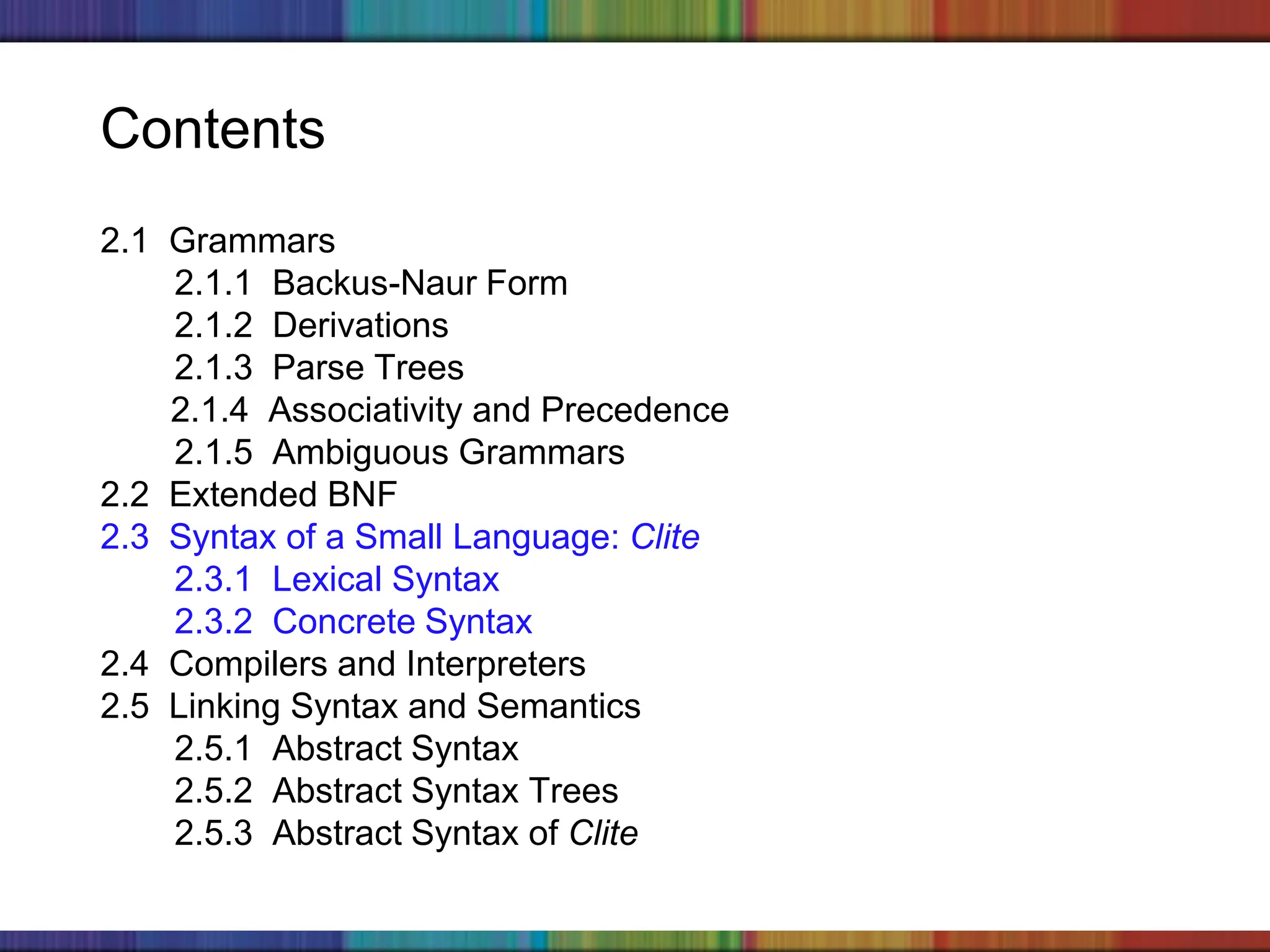
Contents
2.1 Grammars
2.1.1 Backus-Naur Form
2.1.2 Derivations
2.1.3 Parse Trees
2.1.4 Associativity and Precedence
2.1.5 Ambiguous Grammars
2.2 Extended BNF
2.3 Syntax of a Small Language: Clite
2.3.1 Lexical Syntax
2.3.2 Concrete Syntax
2.4 Compilers and Interpreters
2.5 Linking Syntax and Semantics
2.5.1 Abstract Syntax
2.5.2 Abstract Syntax Trees
2.5.3 Abstract Syntax of Clite
Copyright © 2006 The McGraw-Hill Companies, Inc.
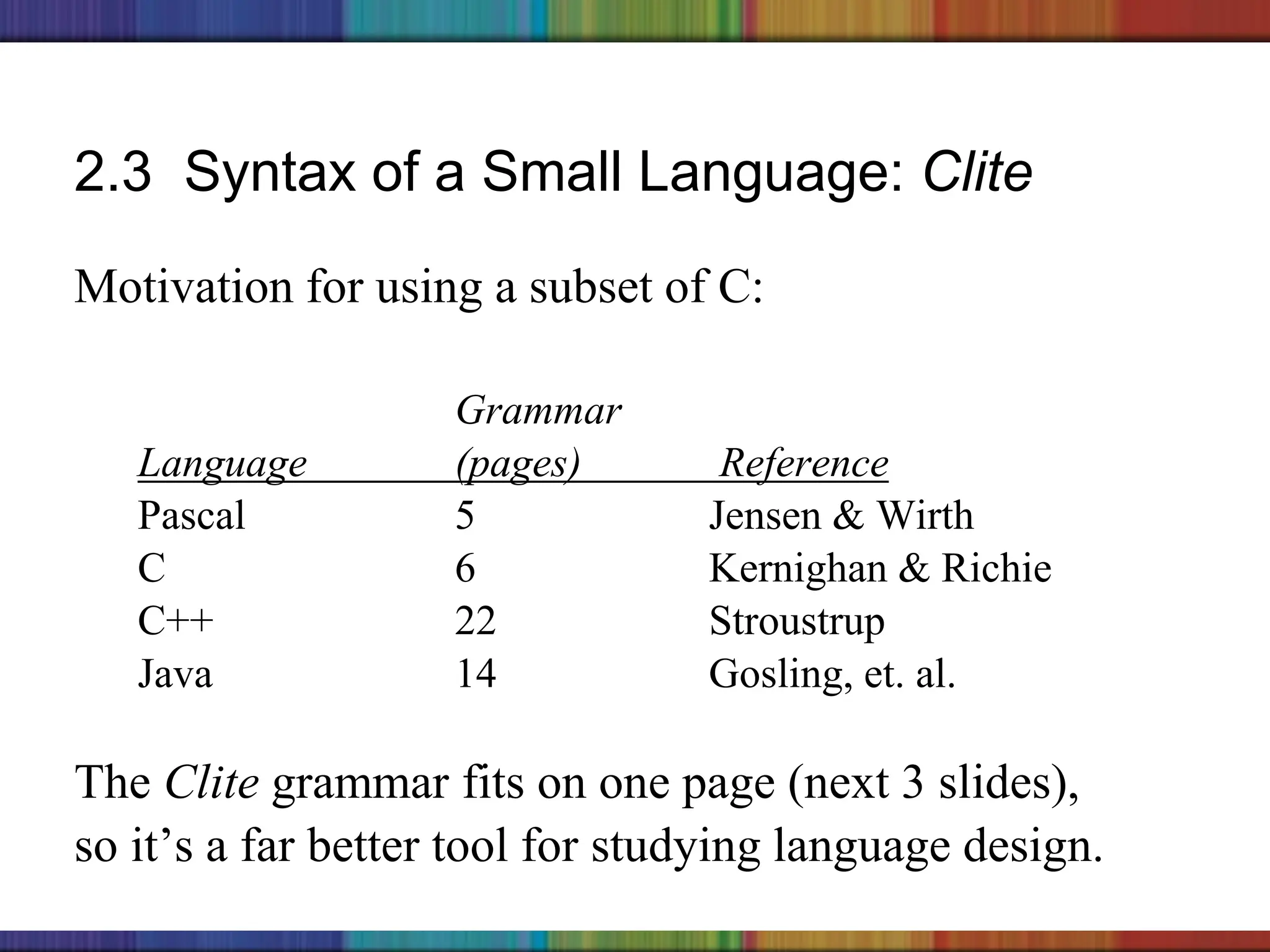
2.3 Syntax of a Small Language: Clite
Motivation for using a subset of C:
Grammar
Language (pages) Reference
Pascal 5 Jensen & Wirth
C 6 Kernighan & Richie
C++ 22 Stroustrup
Java 14 Gosling, et. al.
The Clite grammar fits on one page (next 3 slides),
so it’s a far better tool for studying language design.
Copyright © 2006 The McGraw-Hill Companies, Inc.
Fig. 2.7 Clite Grammar: Statements
Program → int main ( ) { Declarations Statements }
Declarations → { Declaration }
Declaration → Type Identifier [ [ Integer ] ] { , Identifier [ [ Integer ] ] }
Type → int | bool | float | char
Statements → { Statement }
Statement → ; | Block | Assignment | IfStatement | WhileStatement
Block → { Statements }
Assignment → Identifier [ [ Expression ] ] = Expression ;
IfStatement → if ( Expression ) Statement [ else Statement ]
WhileStatement → while ( Expression ) Statement
Copyright © 2006 The McGraw-Hill Companies, Inc.
Fig. 2.7 Clite Grammar: Expressions
Expression → Conjunction { || Conjunction }
Conjunction → Equality { && Equality }
Equality → Relation [ EquOp Relation ]
EquOp → == | !=
Relation → Addition [ RelOp Addition ]
RelOp → < | <= | > | >=
Addition → Term { AddOp Term }
AddOp → + | -
Term → Factor { MulOp Factor }
MulOp → * | / | %
Factor → [ UnaryOp ] Primary
UnaryOp → - | !
Primary → Identifier [ [ Expression ] ] | Literal | ( Expression ) |
Type ( Expression )
Copyright © 2006 The McGraw-Hill Companies, Inc.
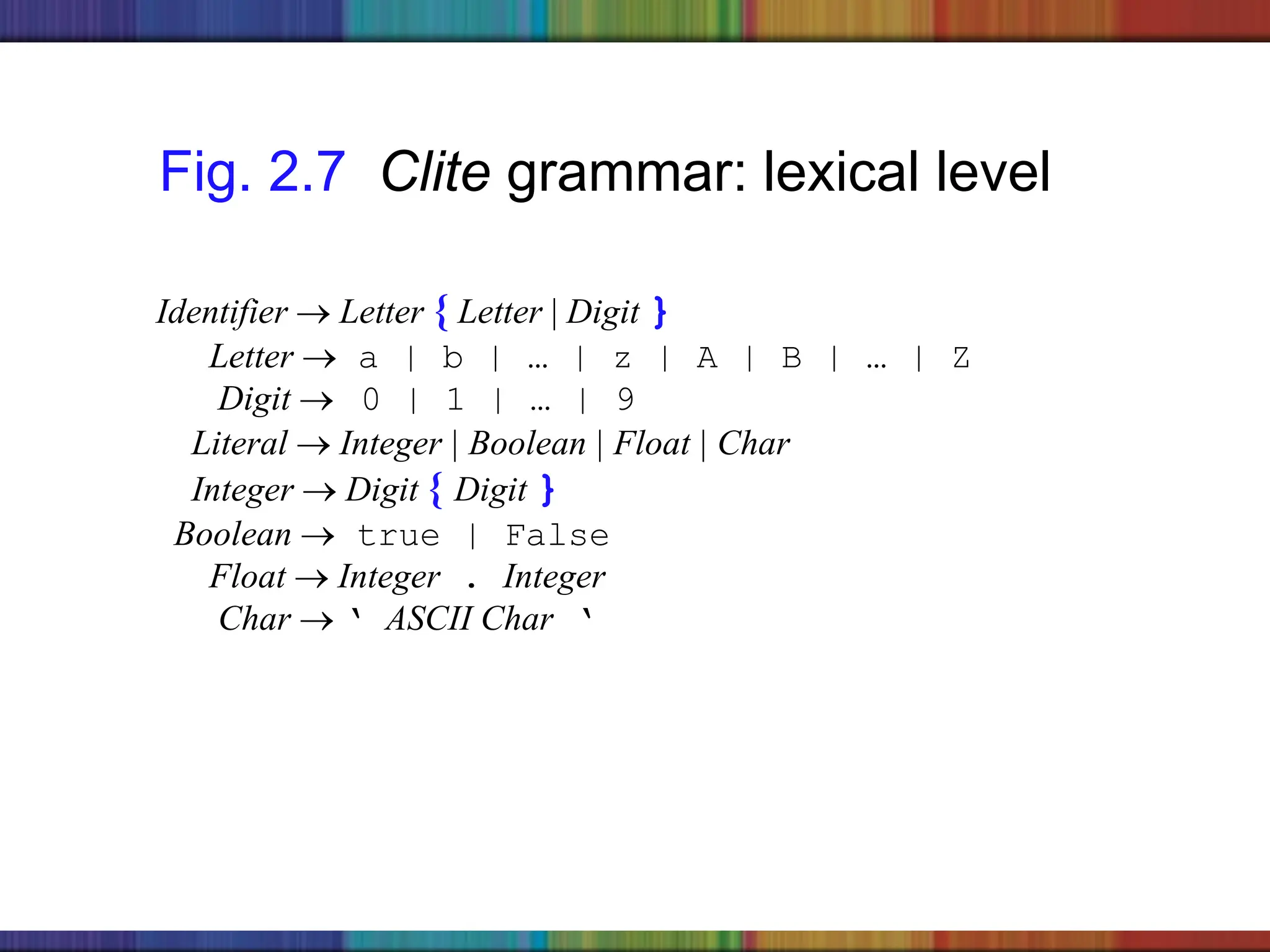
Fig. 2.7 Clite grammar: lexical level
Identifier → Letter { Letter | Digit }
Letter → a | b | … | z | A | B | … | Z
Digit → 0 | 1 | … | 9
Literal → Integer | Boolean | Float | Char
Integer → Digit { Digit }
Boolean → true | False
Float → Integer . Integer
Char → ‘ ASCII Char ‘
Copyright © 2006 The McGraw-Hill Companies, Inc.
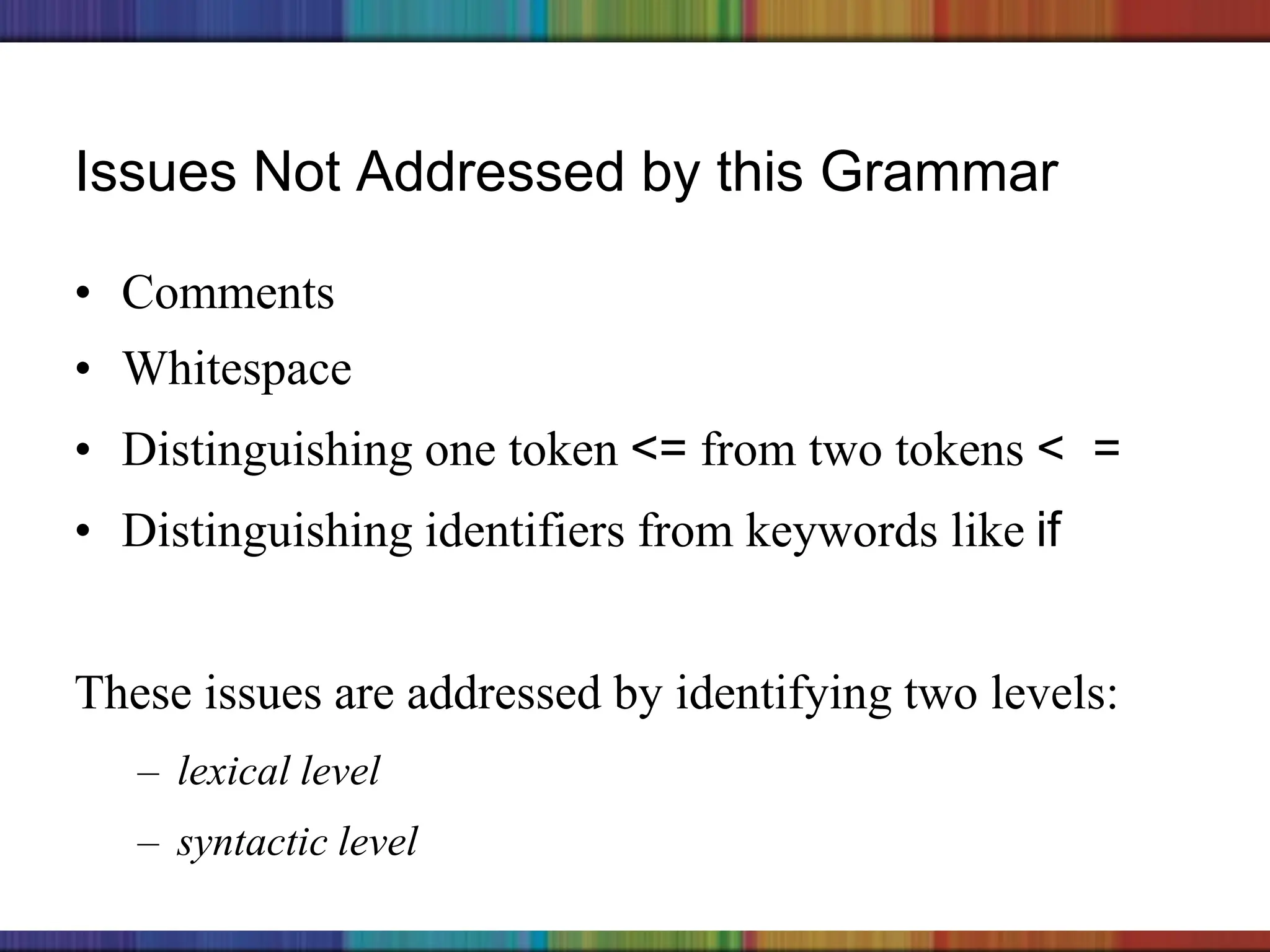
Issues Not Addressed by this Grammar
• Comments
• Whitespace
• Distinguishing one token <= from two tokens < =
• Distinguishing identifiers from keywords like if
These issues are addressed by identifying two levels:
– lexical level
– syntactic level
Copyright © 2006 The McGraw-Hill Companies, Inc.
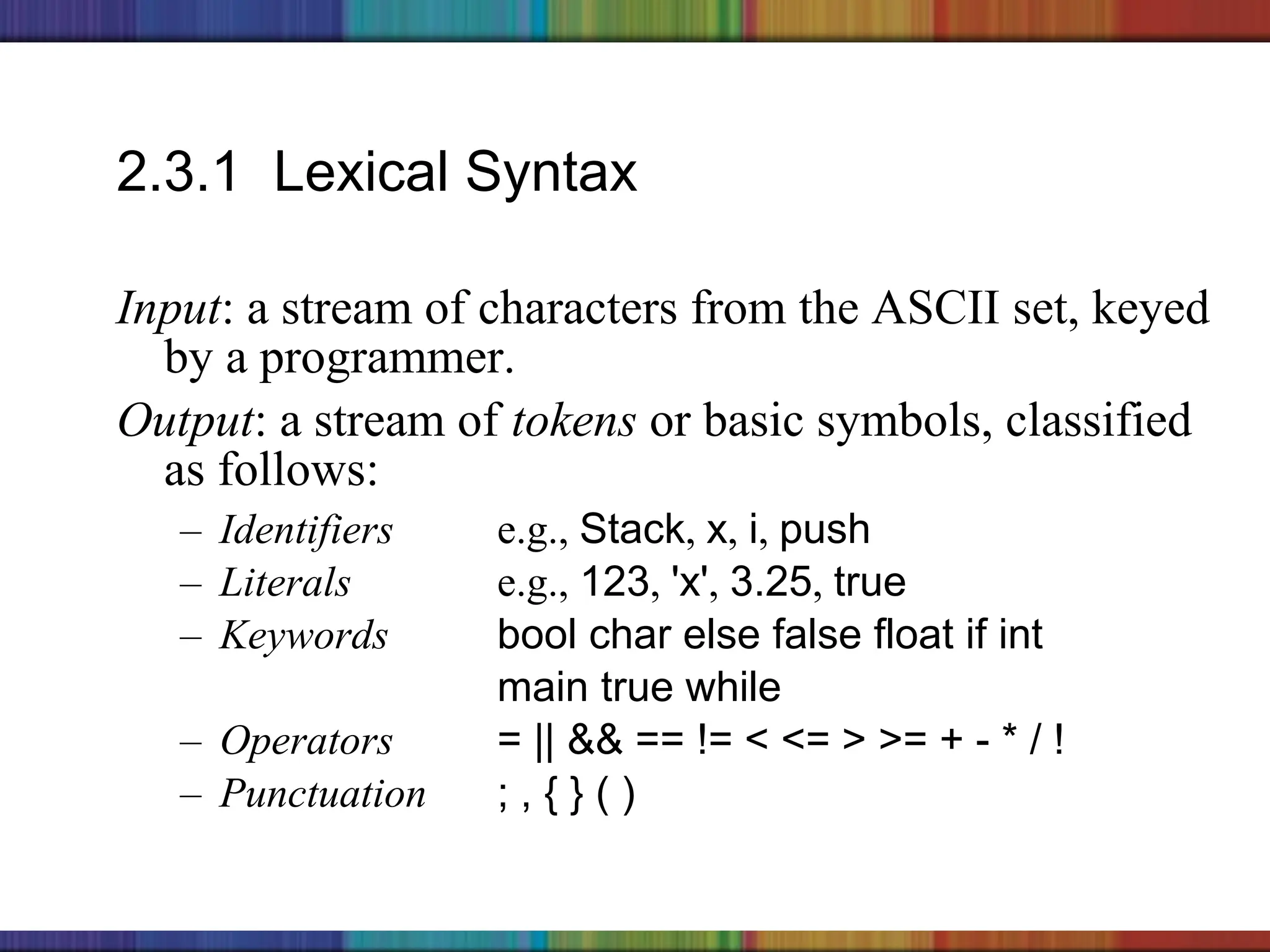
2.3.1 Lexical Syntax
Input: a stream of characters from the ASCII set, keyed
by a programmer.
Output: a stream of tokens or basic symbols, classified
as follows:
– Identifiers e.g., Stack, x, i, push
– Literals e.g., 123, 'x', 3.25, true
– Keywords bool char else false float if int
main true while
– Operators = || && == != < <= > >= + - * / !
– Punctuation ; , { } ( )
Copyright © 2006 The McGraw-Hill Companies, Inc.
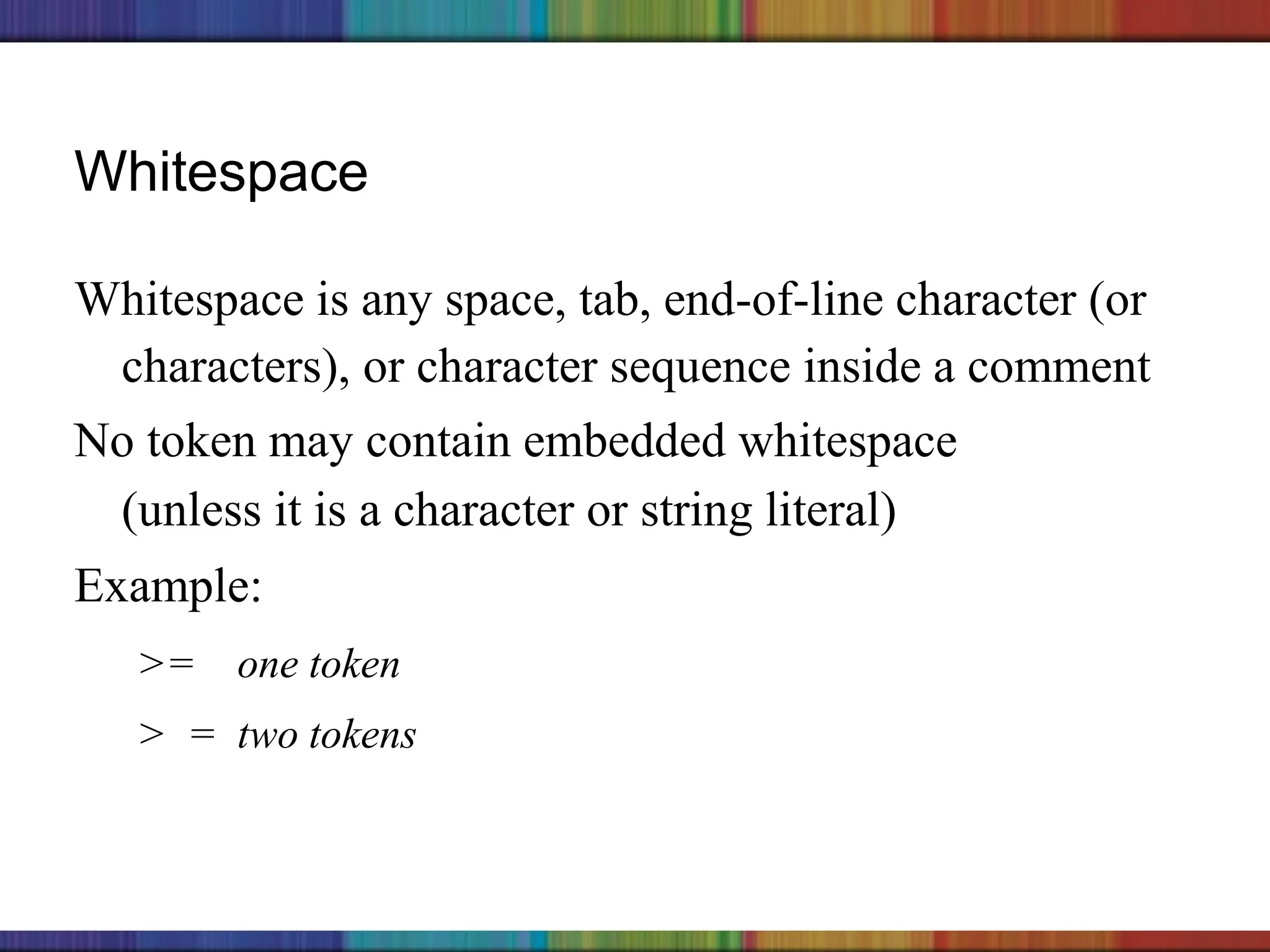
Whitespace
Whitespace is any space, tab, end-of-line character (or
characters), or character sequence inside a comment
No token may contain embedded whitespace
(unless it is a character or string literal)
Example:
>= one token
> = two tokens
Copyright © 2006 The McGraw-Hill Companies, Inc.
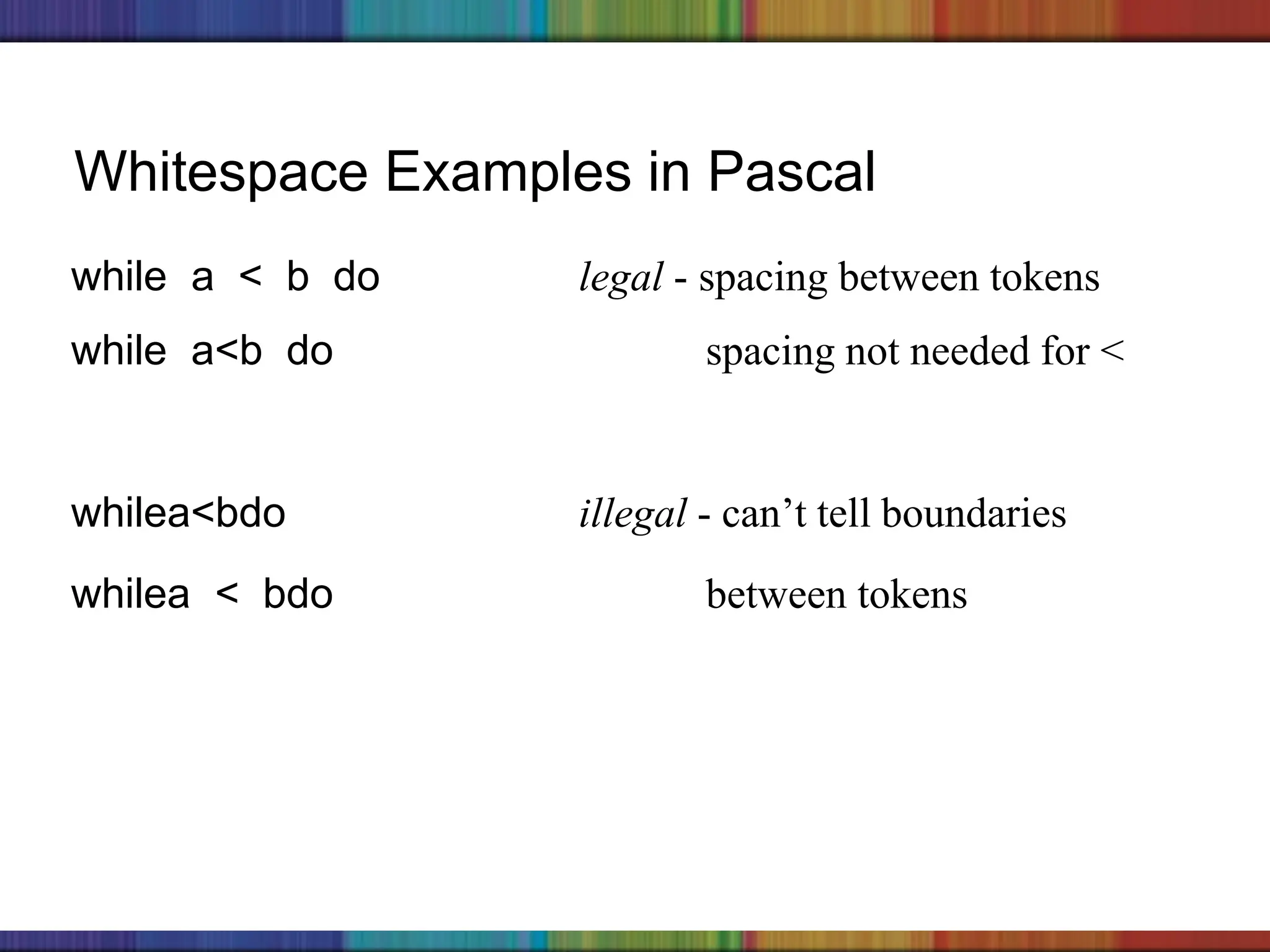
Whitespace Examples in Pascal
while a < b do legal - spacing between tokens
while a<b do spacing not needed for <
whilea<bdo illegal - can’t tell boundaries
whilea < bdo between tokens
Copyright © 2006 The McGraw-Hill Companies, Inc.
Comments
Not defined in grammar
Clite uses // comment style of C++
Copyright © 2006 The McGraw-Hill Companies, Inc.
Identifier
Sequence of letters and digits, starting with a letter
if is both an identifier and a keyword
Most languages require identifiers to be distinct from
keywords
In some languages, identifiers are merely predefined
(and thus can be redefined by the programmer)
Copyright © 2006 The McGraw-Hill Companies, Inc.
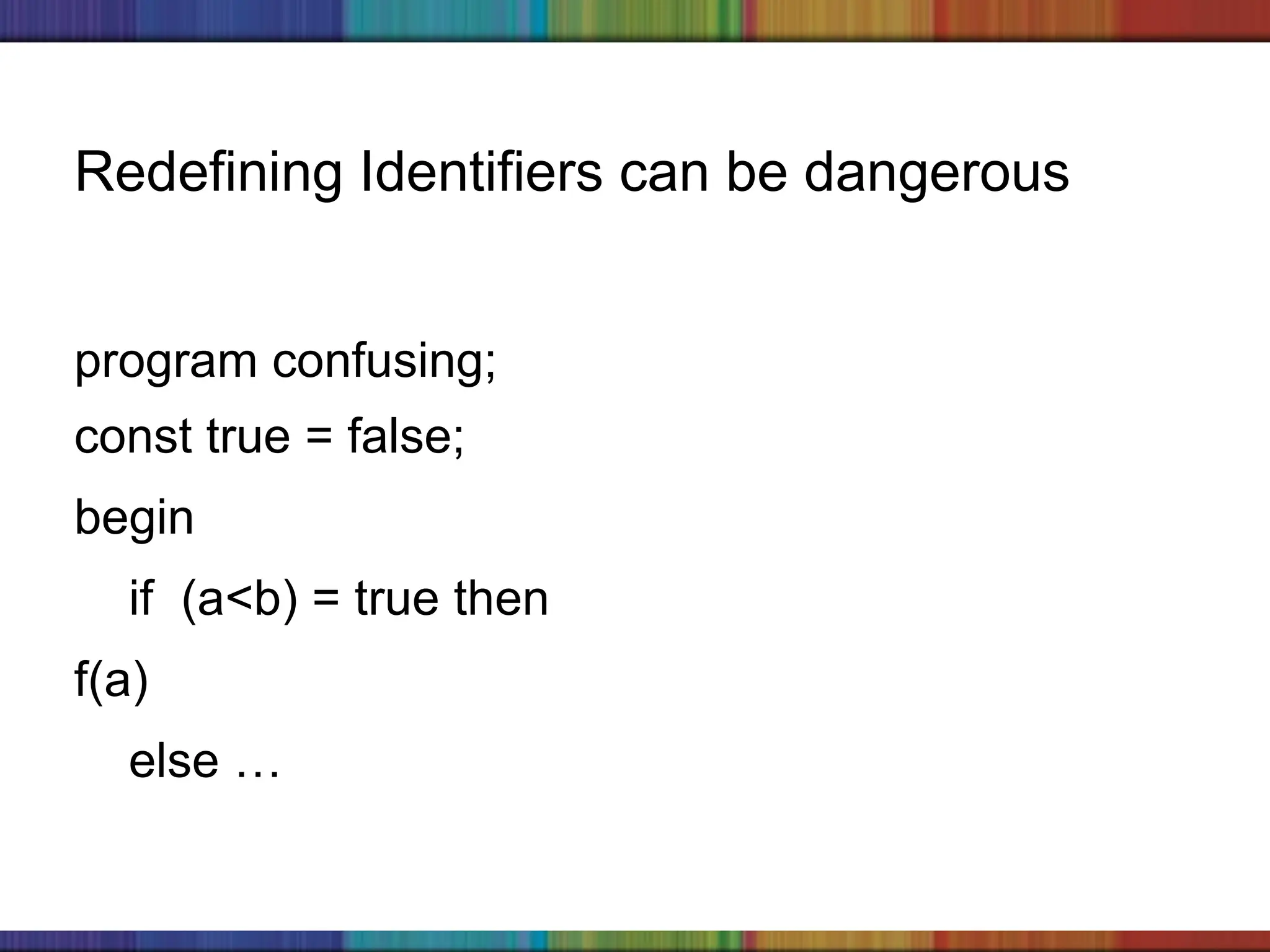
program confusing;
const true = false;
begin
if (a<b) = true then
f(a)
else …
Redefining Identifiers can be dangerous
Copyright © 2006 The McGraw-Hill Companies, Inc.
Should Identifiers be case-sensitive?
Older languages: no. Why?
– Pascal: no.
– Modula: yes
– C, C++: yes
– Java: yes
– PHP: partly yes, partly no. What about
orthogonality?
Copyright © 2006 The McGraw-Hill Companies, Inc.
2.3.2 Concrete Syntax
Based on a parse of its Tokens
; is a statement terminator
(Algol-60, Pascal use ; as a separator)
Rule for IfStatement is ambiguous:
“The else ambiguity is resolved by connecting
an else with the last encountered else-less if.”
[Stroustrup, 1991]
Copyright © 2006 The McGraw-Hill Companies, Inc.
Expressions in Clite
13 grammar rules
Use of meta braces – operators are left associative
C++ expressions require 4 pages of grammar rules
[Stroustrup]
C uses an ambiguous expression grammar
[Kernighan and Ritchie]
Copyright © 2006 The McGraw-Hill Companies, Inc.
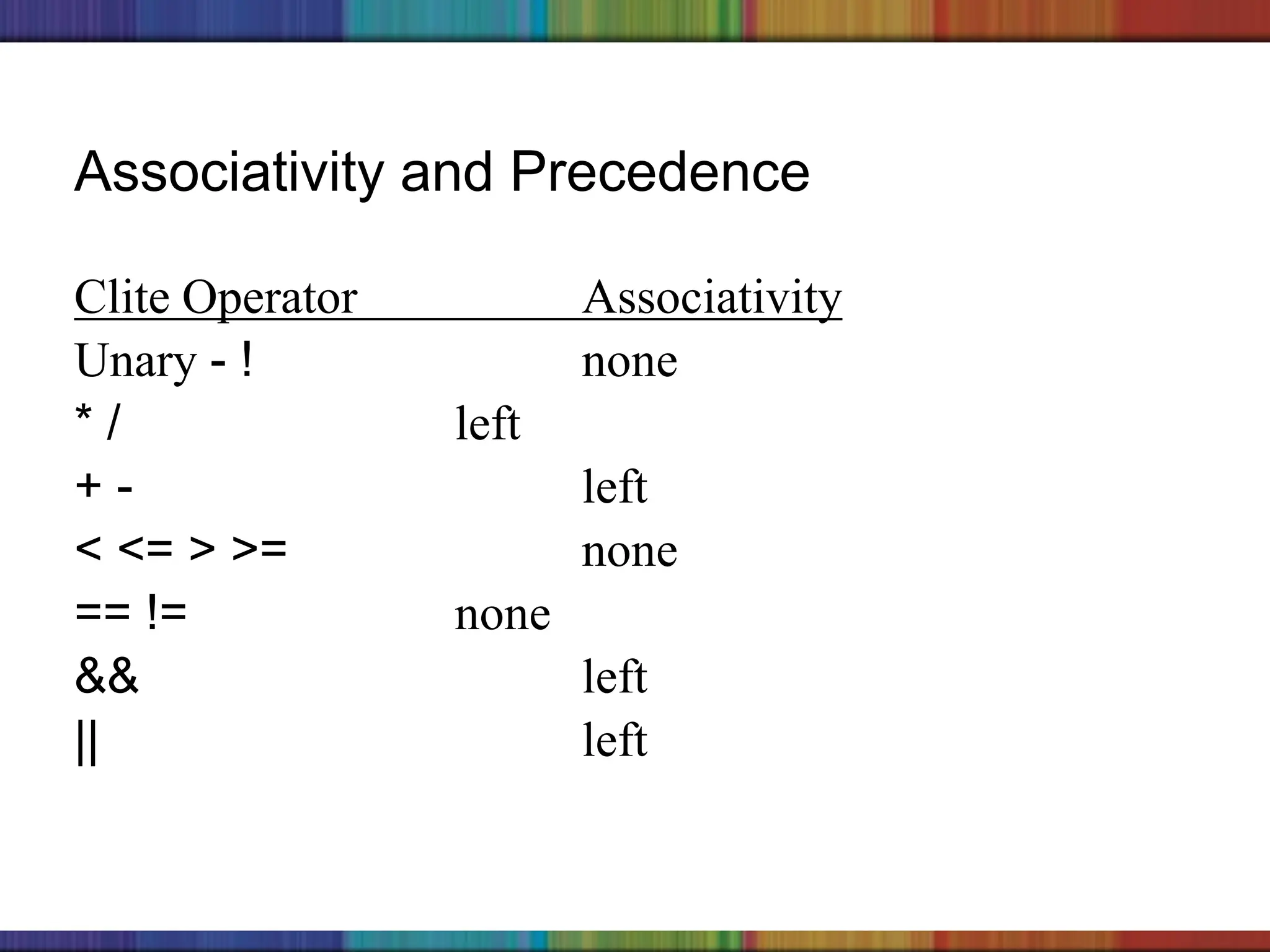
Associativity and Precedence
Clite Operator Associativity
Unary - ! none
* / left
+ - left
< <= > >= none
== != none
&& left
|| left
Copyright © 2006 The McGraw-Hill Companies, Inc.
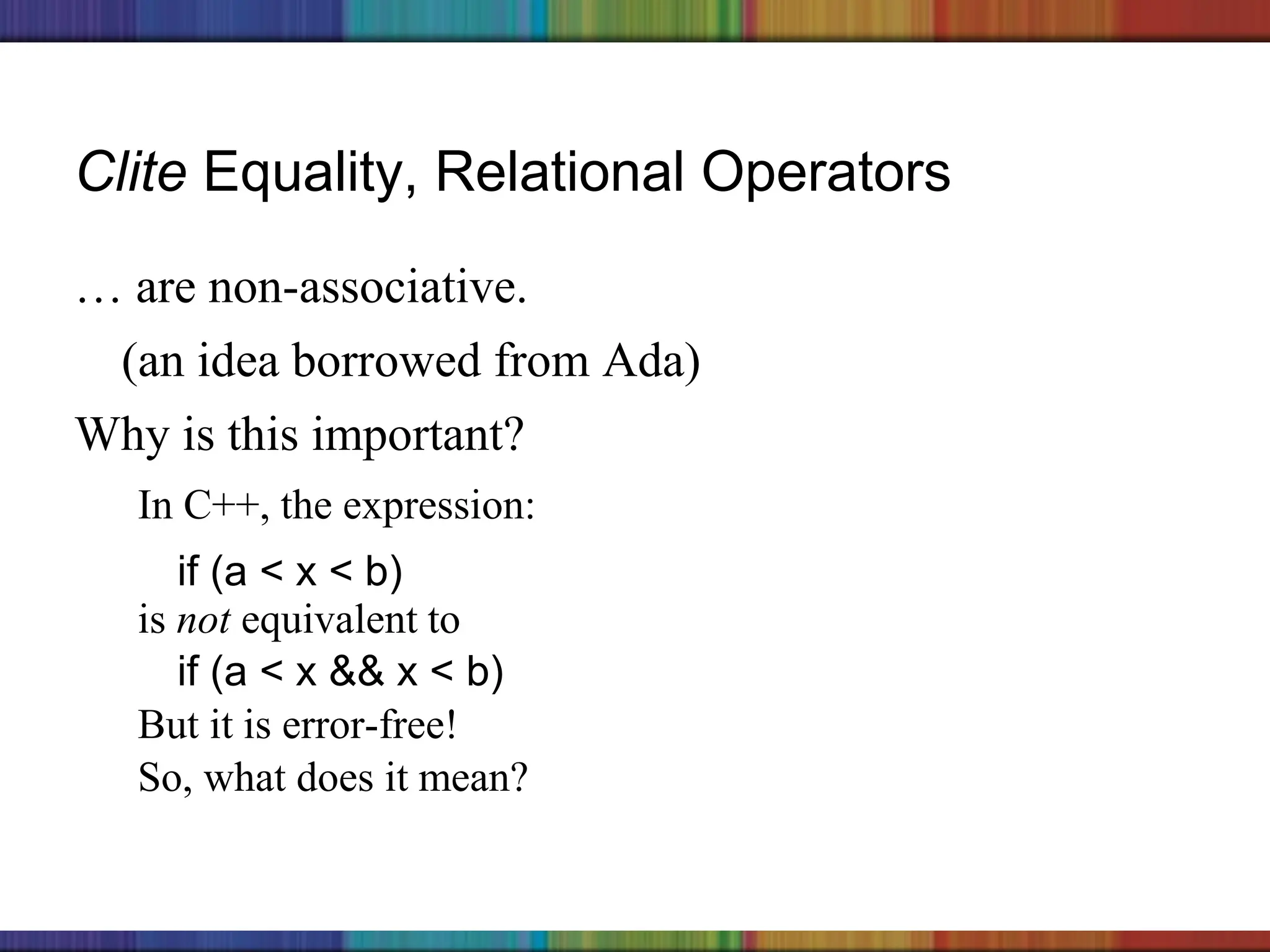
Clite Equality, Relational Operators
… are non-associative.
(an idea borrowed from Ada)
Why is this important?
In C++, the expression:
if (a < x < b)
is not equivalent to
if (a < x && x < b)
But it is error-free!
So, what does it mean?

ch02c.pdf

  • 1.
    Copyright © 2006The McGraw-Hill Companies, Inc. Programming Languages Tucker and Noonan Chapter 2 Syntax A language that is simple to parse for the compiler is also simple to parse for the human programmer. N. Wirth
  • 2.
    Copyright © 2006The McGraw-Hill Companies, Inc. Contents 2.1 Grammars 2.1.1 Backus-Naur Form 2.1.2 Derivations 2.1.3 Parse Trees 2.1.4 Associativity and Precedence 2.1.5 Ambiguous Grammars 2.2 Extended BNF 2.3 Syntax of a Small Language: Clite 2.3.1 Lexical Syntax 2.3.2 Concrete Syntax 2.4 Compilers and Interpreters 2.5 Linking Syntax and Semantics 2.5.1 Abstract Syntax 2.5.2 Abstract Syntax Trees 2.5.3 Abstract Syntax of Clite
  • 3.
    Copyright © 2006The McGraw-Hill Companies, Inc. 2.3 Syntax of a Small Language: Clite Motivation for using a subset of C: Grammar Language (pages) Reference Pascal 5 Jensen & Wirth C 6 Kernighan & Richie C++ 22 Stroustrup Java 14 Gosling, et. al. The Clite grammar fits on one page (next 3 slides), so it’s a far better tool for studying language design.
  • 4.
    Copyright © 2006The McGraw-Hill Companies, Inc. Fig. 2.7 Clite Grammar: Statements Program → int main ( ) { Declarations Statements } Declarations → { Declaration } Declaration → Type Identifier [ [ Integer ] ] { , Identifier [ [ Integer ] ] } Type → int | bool | float | char Statements → { Statement } Statement → ; | Block | Assignment | IfStatement | WhileStatement Block → { Statements } Assignment → Identifier [ [ Expression ] ] = Expression ; IfStatement → if ( Expression ) Statement [ else Statement ] WhileStatement → while ( Expression ) Statement
  • 5.
    Copyright © 2006The McGraw-Hill Companies, Inc. Fig. 2.7 Clite Grammar: Expressions Expression → Conjunction { || Conjunction } Conjunction → Equality { && Equality } Equality → Relation [ EquOp Relation ] EquOp → == | != Relation → Addition [ RelOp Addition ] RelOp → < | <= | > | >= Addition → Term { AddOp Term } AddOp → + | - Term → Factor { MulOp Factor } MulOp → * | / | % Factor → [ UnaryOp ] Primary UnaryOp → - | ! Primary → Identifier [ [ Expression ] ] | Literal | ( Expression ) | Type ( Expression )
  • 6.
    Copyright © 2006The McGraw-Hill Companies, Inc. Fig. 2.7 Clite grammar: lexical level Identifier → Letter { Letter | Digit } Letter → a | b | … | z | A | B | … | Z Digit → 0 | 1 | … | 9 Literal → Integer | Boolean | Float | Char Integer → Digit { Digit } Boolean → true | False Float → Integer . Integer Char → ‘ ASCII Char ‘
  • 7.
    Copyright © 2006The McGraw-Hill Companies, Inc. Issues Not Addressed by this Grammar • Comments • Whitespace • Distinguishing one token <= from two tokens < = • Distinguishing identifiers from keywords like if These issues are addressed by identifying two levels: – lexical level – syntactic level
  • 8.
    Copyright © 2006The McGraw-Hill Companies, Inc. 2.3.1 Lexical Syntax Input: a stream of characters from the ASCII set, keyed by a programmer. Output: a stream of tokens or basic symbols, classified as follows: – Identifiers e.g., Stack, x, i, push – Literals e.g., 123, 'x', 3.25, true – Keywords bool char else false float if int main true while – Operators = || && == != < <= > >= + - * / ! – Punctuation ; , { } ( )
  • 9.
    Copyright © 2006The McGraw-Hill Companies, Inc. Whitespace Whitespace is any space, tab, end-of-line character (or characters), or character sequence inside a comment No token may contain embedded whitespace (unless it is a character or string literal) Example: >= one token > = two tokens
  • 10.
    Copyright © 2006The McGraw-Hill Companies, Inc. Whitespace Examples in Pascal while a < b do legal - spacing between tokens while a<b do spacing not needed for < whilea<bdo illegal - can’t tell boundaries whilea < bdo between tokens
  • 11.
    Copyright © 2006The McGraw-Hill Companies, Inc. Comments Not defined in grammar Clite uses // comment style of C++
  • 12.
    Copyright © 2006The McGraw-Hill Companies, Inc. Identifier Sequence of letters and digits, starting with a letter if is both an identifier and a keyword Most languages require identifiers to be distinct from keywords In some languages, identifiers are merely predefined (and thus can be redefined by the programmer)
  • 13.
    Copyright © 2006The McGraw-Hill Companies, Inc. program confusing; const true = false; begin if (a<b) = true then f(a) else … Redefining Identifiers can be dangerous
  • 14.
    Copyright © 2006The McGraw-Hill Companies, Inc. Should Identifiers be case-sensitive? Older languages: no. Why? – Pascal: no. – Modula: yes – C, C++: yes – Java: yes – PHP: partly yes, partly no. What about orthogonality?
  • 15.
    Copyright © 2006The McGraw-Hill Companies, Inc. 2.3.2 Concrete Syntax Based on a parse of its Tokens ; is a statement terminator (Algol-60, Pascal use ; as a separator) Rule for IfStatement is ambiguous: “The else ambiguity is resolved by connecting an else with the last encountered else-less if.” [Stroustrup, 1991]
  • 16.
    Copyright © 2006The McGraw-Hill Companies, Inc. Expressions in Clite 13 grammar rules Use of meta braces – operators are left associative C++ expressions require 4 pages of grammar rules [Stroustrup] C uses an ambiguous expression grammar [Kernighan and Ritchie]
  • 17.
    Copyright © 2006The McGraw-Hill Companies, Inc. Associativity and Precedence Clite Operator Associativity Unary - ! none * / left + - left < <= > >= none == != none && left || left
  • 18.
    Copyright © 2006The McGraw-Hill Companies, Inc. Clite Equality, Relational Operators … are non-associative. (an idea borrowed from Ada) Why is this important? In C++, the expression: if (a < x < b) is not equivalent to if (a < x && x < b) But it is error-free! So, what does it mean?