   System Approach: Wholistic, anti-piecemeal. Complete look at
    interlocking subsystems. In the light of objective

   Mgmt Oriented: top down approach, overall mgmt needs and
    business plan. System design should be given good time to
    ensure the sys meets specifications of business.

   Need Based: as per info needs of managers at diff levels.
    Should meet the hierarchy.

   Exception Based :abnormal conditions should be met.

   Future Oriented: Not only past needs but also future projection
   Integrated :ex: production scheduling system.
    set up cost, work force, OT rates, production capacity, inventory
    level, capital requirements, customer services.
    Though efficient in dev, but one’s place should be realized and
    properly reflected

•   Common Data Flow : Ex : Customer order documents, key source
    docs. This is source for billing, accts receivables, production, sales
    analysis, sales forecasting Ex: delete operation

•    Long Term Planning: Should Long enough to plan properly and
    should short enough that the mis dev should not be obsolete before
    its launch.

•   Sub sys concepts: To reduce complexity

•   Central Database.
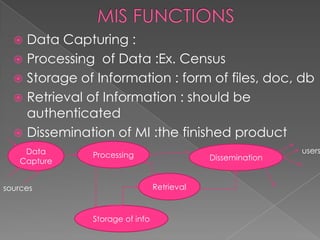
 Data Capturing :
   Processing of Data :Ex. Census
   Storage of Information : form of files, doc, db
   Retrieval of Information : should be
    authenticated
   Dissemination of MI :the finished product
      Data                                                  users
              Processing                    Dissemination
    Capture
  sourses


sources                         Retrieval


              Storage of info
   Structure : Gives shape of an entity. Ex. Political
    system, Ex2.Car in terms of external look, or internal
    structure. Ex3.Marketing Dept in terms of ads, sales,
    market search or in terms of hierarchy of mgmt sys.
    MIS also based on
   Physical Components : H/W, S/W, DB
   Information System Processing functions: master files,
    reports, inquiries
   Decision support: on the basis of its support on
    decision making. Structured(pre planned and
    programmable) and unstructured(not
    programmable)
   Levels of mgmt activities : responsibility allotted
   Organizational functions: as MIS is integration of IS for
    functional subsystems. Structure can be given based
    on Subsys-info needed relation

Ch02 mis-char-func-stru

  • 2.
    System Approach: Wholistic, anti-piecemeal. Complete look at interlocking subsystems. In the light of objective  Mgmt Oriented: top down approach, overall mgmt needs and business plan. System design should be given good time to ensure the sys meets specifications of business.  Need Based: as per info needs of managers at diff levels. Should meet the hierarchy.  Exception Based :abnormal conditions should be met.  Future Oriented: Not only past needs but also future projection
  • 3.
    Integrated :ex: production scheduling system. set up cost, work force, OT rates, production capacity, inventory level, capital requirements, customer services. Though efficient in dev, but one’s place should be realized and properly reflected • Common Data Flow : Ex : Customer order documents, key source docs. This is source for billing, accts receivables, production, sales analysis, sales forecasting Ex: delete operation • Long Term Planning: Should Long enough to plan properly and should short enough that the mis dev should not be obsolete before its launch. • Sub sys concepts: To reduce complexity • Central Database.
  • 4.
     Data Capturing:  Processing of Data :Ex. Census  Storage of Information : form of files, doc, db  Retrieval of Information : should be authenticated  Dissemination of MI :the finished product Data users Processing Dissemination Capture sourses sources Retrieval Storage of info
  • 5.
    Structure : Gives shape of an entity. Ex. Political system, Ex2.Car in terms of external look, or internal structure. Ex3.Marketing Dept in terms of ads, sales, market search or in terms of hierarchy of mgmt sys. MIS also based on  Physical Components : H/W, S/W, DB  Information System Processing functions: master files, reports, inquiries  Decision support: on the basis of its support on decision making. Structured(pre planned and programmable) and unstructured(not programmable)  Levels of mgmt activities : responsibility allotted  Organizational functions: as MIS is integration of IS for functional subsystems. Structure can be given based on Subsys-info needed relation

Editor's Notes

  • #3 A top-down approach (also known as step-wise design) is essentially the breaking down of a system to gain insight into its compositional sub-systems. In a top-down approach an overview of the system is formulated, specifying but not detailing any first-level subsystems. Each subsystem is then refined in yet greater detail, sometimes in many additional subsystem levels, until the entire specification is reduced to base elements.
  • #5 Dissemination