CHAPTER ONE
INTRODUCTION TO MIS
 Data is like raw material, unprocessed facts and figures.
 It can be anything from letters and numbers to symbols and
images.
 It does not interrelate and also it does not help in decision
making
 Data itself has no meaning.
 For example, a customer ID number, a product code, etc.
 Information is data that has been processed and
organized so that it has meaning.
 It can be used to make decisions or take actions.
 For example, a customer ID number combined with a
customer's name and address becomes information that can be
used to send a marketing catalogue.
 A system is a set of interrelated components with a
clearly defined boundary working together to achieve a
common set of objectives.
It refers to a combination of components working together.
It defined as a set of elements which are joined together to
achieve a common objective
These elements are interrelated and interdependent Systems
range from very simple to very complex.
E.g. a computer system includes both hardware and
software.
 Components of a system
Input:- the activity of gathering and capturing data
Processing:- Converting or transforming data into useful
outputs
Output:- Useful information, usually in the form of
documents
 Information system :-
 It can be defined as a set of interrelated components that
work together to manage information.
 It is a set of people, procedures, and resources that
collects, transforms, and disseminates information in an
organization.
 It is a set of interrelated components that collect
(retrieve), process, store, and distribute information to
support decision making and control in an organization.
 An information system contains information about an
organization and its surrounding environment.
 Three basic activities of IS—input, processing, and
output—produce the information organizations need.
 Components of an Information System:
 There are five main components that make up an
information system:
 Hardware: is the physical equipment that you can touch.
 Software: These are the programs and instructions that tell
the hardware what to do. There are two main types:
◦ System Software: This manages the hardware, like the operating
system.
◦ Application Software: This helps users perform specific tasks, like
word processing software or accounting software.
 Data: is the raw, unprocessed information that the system
collects. It can be numbers, text, images, or even
audio/video.
 People: The human element is essential! People design,
operate, use, and maintain the information system.
 Processes: These are the defined procedures and
instructions that guide how people interact with the system
and how data is processed.
 Management information systems:-
 It is a planned system of collecting, storing and disseminating data in the
form of information needed to carry out the functions of management.
 It is attempt to efficiently collect, format, and communicate information to a
wide variety of people.
 It is the system, which makes available the right information to the right
person, at the right place, at the right time, in the right form and at the right
cost.
 It is defined as the system that provides information support for decision
making in the organization.
 It is defined as an integrated system of man and machine for providing the
information to support the operations, the management and the decision
making function in the organization.
 It is defining as the system based on the data base of the organization evolved
for the purpose of providing information to the people in the organization.
 The MIS is defining as a Computer-based Information System.
 Components of a Management Information System:
 An effective MIS relies on five key components working together
includes:
 Hardware: the physical technology infrastructure, including computers,
servers, storage devices, and networking equipment.
 Software: the programs and applications that manage the hardware and
manipulate the data. This includes:
◦ Database Management Systems (DBMS): Organize and store large amounts of
data efficiently.
◦ Analytical Tools: Help analyze data, identify trends, and generate reports.
◦ Presentation Software: Create clear and concise visuals to present information to
managers.
 Data: the raw information that the system collects from various sources
within the organization, such as sales figures, inventory levels, or
customer feedback.
 People: People design, develop, implement, maintain, and use the MIS.
Managers, analysts, and IT professionals all play a role in its success.
 Procedures: Defined processes and guidelines that order how data is
collected, entered, processed, analyzed, and used within the MIS.
 The role of a management information system (MIS) is to allow businesses
with the information they need to make smart decisions.
 Here are some of the key things MIS systems do:
Collect, store and process data: An MIS can gather information from
various sources within a company, like sales figures, inventory levels, or
customer data.
Generate reports: MIS systems can create different reports, both
routine and on-demand, that present data in a clear and concise way.
Support decision-making: By providing insightful information, MIS
systems equip managers to make better-informed decisions.
Improve operational efficiency: With better data and insights,
businesses can streamline their operations. An MIS might help identify
bottlenecks in production or redundancies in administrative tasks.
 The MIS plays the role of information generation, communication,
problem identification and helps in the process of decision making.
 The MIS, therefore, plays a vita role in the management, administration
and operations of an organization.
 Management Information Systems (MIS) can be broken down into subsystems based on two
main approaches:
1. Organizational Function Subsystems: designed to support the specific functions of different
departments within an organization. Here are some common examples:
 Marketing Management Systems (MMS): Tracks customer data, analyzes marketing
campaigns, and supports market research activities.
 Human Resource Management Systems (HRMS): Handles employee data, manages payroll,
and assists with recruitment and training activities.
 Financial Management Systems (FMS): Tracks financial data, generates financial statements,
and helps with budgeting and forecasting.
 Production Management Systems (PMS): Manages production processes, tracks inventory
levels, and optimizes scheduling for manufacturing operations.
 Accounting Systems: Records financial transactions, automates bookkeeping tasks, and
generates accounting reports.
2. Activities Subsystems: focus on supporting specific information processing activities across the
organization, regardless of department. Here are some examples:
 Transaction Processing Systems (TPS): Processes routine transactions like sales orders,
invoices, and payments.
 Management Reporting Systems (MRS): Generates reports summarizing data from various
sources for managerial decision-making.
 Decision Support Systems (DSS): Provides tools and data analysis capabilities to support non-
routine decision making.
 Operational Control Systems: Monitors and controls day-to-day operations, ensuring
adherence to policies and procedures.
 Strategic Planning Systems: Supports long-term planning initiatives by providing data and
analysis for strategic decision-making.
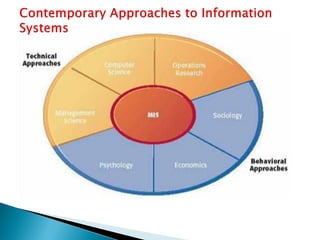
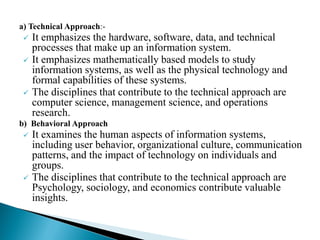
a) Technical Approach:-
 It emphasizes the hardware, software, data, and technical
processes that make up an information system.
 It emphasizes mathematically based models to study
information systems, as well as the physical technology and
formal capabilities of these systems.
 The disciplines that contribute to the technical approach are
computer science, management science, and operations
research.
b) Behavioral Approach
 It examines the human aspects of information systems,
including user behavior, organizational culture, communication
patterns, and the impact of technology on individuals and
groups.
 The disciplines that contribute to the technical approach are
Psychology, sociology, and economics contribute valuable
insights.
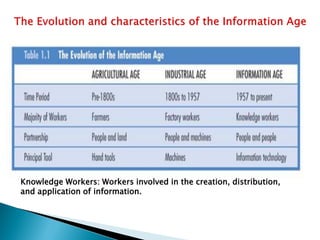
Knowledge Workers: Workers involved in the creation, distribution,
and application of information.
 An information-based society has arisen.
 Information Society: A society in which more people
work at handling information than at agriculture and
manufacturing combined.
 Businesses depend on information technology to get
their work done.
 Work processes are being transformed to increase
productivity.
 Success in business is largely determined by the
effectiveness with which information technology is
used.
 Information technology is embedded in many products
and services.
Ch1-Introduction to  Management Information System .pdf

Ch1-Introduction to Management Information System .pdf

  • 1.
  • 2.
     Data islike raw material, unprocessed facts and figures.  It can be anything from letters and numbers to symbols and images.  It does not interrelate and also it does not help in decision making  Data itself has no meaning.  For example, a customer ID number, a product code, etc.  Information is data that has been processed and organized so that it has meaning.  It can be used to make decisions or take actions.  For example, a customer ID number combined with a customer's name and address becomes information that can be used to send a marketing catalogue.
  • 3.
     A systemis a set of interrelated components with a clearly defined boundary working together to achieve a common set of objectives. It refers to a combination of components working together. It defined as a set of elements which are joined together to achieve a common objective These elements are interrelated and interdependent Systems range from very simple to very complex. E.g. a computer system includes both hardware and software.  Components of a system Input:- the activity of gathering and capturing data Processing:- Converting or transforming data into useful outputs Output:- Useful information, usually in the form of documents
  • 4.
     Information system:-  It can be defined as a set of interrelated components that work together to manage information.  It is a set of people, procedures, and resources that collects, transforms, and disseminates information in an organization.  It is a set of interrelated components that collect (retrieve), process, store, and distribute information to support decision making and control in an organization.  An information system contains information about an organization and its surrounding environment.  Three basic activities of IS—input, processing, and output—produce the information organizations need.
  • 5.
     Components ofan Information System:  There are five main components that make up an information system:  Hardware: is the physical equipment that you can touch.  Software: These are the programs and instructions that tell the hardware what to do. There are two main types: ◦ System Software: This manages the hardware, like the operating system. ◦ Application Software: This helps users perform specific tasks, like word processing software or accounting software.  Data: is the raw, unprocessed information that the system collects. It can be numbers, text, images, or even audio/video.  People: The human element is essential! People design, operate, use, and maintain the information system.  Processes: These are the defined procedures and instructions that guide how people interact with the system and how data is processed.
  • 6.
     Management informationsystems:-  It is a planned system of collecting, storing and disseminating data in the form of information needed to carry out the functions of management.  It is attempt to efficiently collect, format, and communicate information to a wide variety of people.  It is the system, which makes available the right information to the right person, at the right place, at the right time, in the right form and at the right cost.  It is defined as the system that provides information support for decision making in the organization.  It is defined as an integrated system of man and machine for providing the information to support the operations, the management and the decision making function in the organization.  It is defining as the system based on the data base of the organization evolved for the purpose of providing information to the people in the organization.  The MIS is defining as a Computer-based Information System.
  • 7.
     Components ofa Management Information System:  An effective MIS relies on five key components working together includes:  Hardware: the physical technology infrastructure, including computers, servers, storage devices, and networking equipment.  Software: the programs and applications that manage the hardware and manipulate the data. This includes: ◦ Database Management Systems (DBMS): Organize and store large amounts of data efficiently. ◦ Analytical Tools: Help analyze data, identify trends, and generate reports. ◦ Presentation Software: Create clear and concise visuals to present information to managers.  Data: the raw information that the system collects from various sources within the organization, such as sales figures, inventory levels, or customer feedback.  People: People design, develop, implement, maintain, and use the MIS. Managers, analysts, and IT professionals all play a role in its success.  Procedures: Defined processes and guidelines that order how data is collected, entered, processed, analyzed, and used within the MIS.
  • 8.
     The roleof a management information system (MIS) is to allow businesses with the information they need to make smart decisions.  Here are some of the key things MIS systems do: Collect, store and process data: An MIS can gather information from various sources within a company, like sales figures, inventory levels, or customer data. Generate reports: MIS systems can create different reports, both routine and on-demand, that present data in a clear and concise way. Support decision-making: By providing insightful information, MIS systems equip managers to make better-informed decisions. Improve operational efficiency: With better data and insights, businesses can streamline their operations. An MIS might help identify bottlenecks in production or redundancies in administrative tasks.  The MIS plays the role of information generation, communication, problem identification and helps in the process of decision making.  The MIS, therefore, plays a vita role in the management, administration and operations of an organization.
  • 9.
     Management InformationSystems (MIS) can be broken down into subsystems based on two main approaches: 1. Organizational Function Subsystems: designed to support the specific functions of different departments within an organization. Here are some common examples:  Marketing Management Systems (MMS): Tracks customer data, analyzes marketing campaigns, and supports market research activities.  Human Resource Management Systems (HRMS): Handles employee data, manages payroll, and assists with recruitment and training activities.  Financial Management Systems (FMS): Tracks financial data, generates financial statements, and helps with budgeting and forecasting.  Production Management Systems (PMS): Manages production processes, tracks inventory levels, and optimizes scheduling for manufacturing operations.  Accounting Systems: Records financial transactions, automates bookkeeping tasks, and generates accounting reports. 2. Activities Subsystems: focus on supporting specific information processing activities across the organization, regardless of department. Here are some examples:  Transaction Processing Systems (TPS): Processes routine transactions like sales orders, invoices, and payments.  Management Reporting Systems (MRS): Generates reports summarizing data from various sources for managerial decision-making.  Decision Support Systems (DSS): Provides tools and data analysis capabilities to support non- routine decision making.  Operational Control Systems: Monitors and controls day-to-day operations, ensuring adherence to policies and procedures.  Strategic Planning Systems: Supports long-term planning initiatives by providing data and analysis for strategic decision-making.
  • 11.
    a) Technical Approach:- It emphasizes the hardware, software, data, and technical processes that make up an information system.  It emphasizes mathematically based models to study information systems, as well as the physical technology and formal capabilities of these systems.  The disciplines that contribute to the technical approach are computer science, management science, and operations research. b) Behavioral Approach  It examines the human aspects of information systems, including user behavior, organizational culture, communication patterns, and the impact of technology on individuals and groups.  The disciplines that contribute to the technical approach are Psychology, sociology, and economics contribute valuable insights.
  • 12.
    Knowledge Workers: Workersinvolved in the creation, distribution, and application of information.
  • 13.
     An information-basedsociety has arisen.  Information Society: A society in which more people work at handling information than at agriculture and manufacturing combined.  Businesses depend on information technology to get their work done.  Work processes are being transformed to increase productivity.  Success in business is largely determined by the effectiveness with which information technology is used.  Information technology is embedded in many products and services.