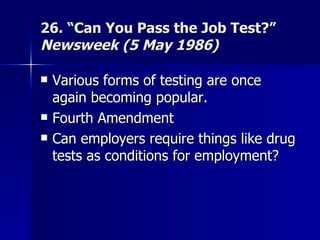
26. “Can You Pass the Job Test?”  Newsweek (5 May 1986) Various forms of testing are once again becoming popular. Fourth Amendment Can employers require things like drug tests as conditions for employment?
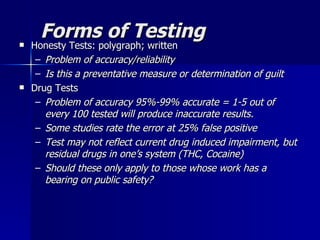
Forms of Testing Honesty Tests: polygraph; written Problem of accuracy/reliability Is this a preventative measure or determination of guilt Drug Tests Problem of accuracy 95%-99% accurate = 1-5 out of every 100 tested will produce inaccurate results. Some studies rate the error at 25% false positive Test may not reflect current drug induced impairment, but residual drugs in one’s system (THC, Cocaine) Should these only apply to those whose work has a bearing on public safety?
Testing (Cont.) Personality Tests Problem with those that don’t do well on tests generally. Genetic Screening Can be useful in protecting the employees and public from health risks. May also result in discrimination against homosexuals, women and those predisposed to disease. Accuracy problems in terms of both false pos. and neg.
27. “Privacy, Morality, and the Law” W. A. Parent Definition of Privacy Why we value Privacy Account of the moral and legal right to privacy
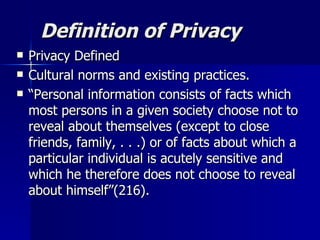
Definition of Privacy Privacy Defined Cultural norms and existing practices. “ Personal information consists of facts which most persons in a given society choose not to reveal about themselves (except to close friends, family, . . .) or of facts about which a particular individual is acutely sensitive and which he therefore does not choose to reveal about himself”(216).
Value of Privacy Privacy prevents others from obtaining personal, sensitive information that could be used to acquire power over us. Privacy prevents the scorn or ridicule due to intolerant views or life styles, habits and ways of thinking. Privacy is part and parcel of ‘the liberal ethic’ i.e., a violation of the respect for persons .
Moral Right to Privacy The value of privacy establishes the moral right to privacy for those that value  freedom  and  individuality. That privacy is a moral right does not entail that it can never be violated.
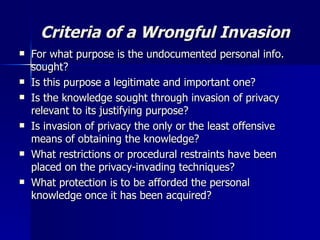
Criteria of a Wrongful Invasion For what purpose is the undocumented personal info. sought? Is this purpose a legitimate and important one? Is the knowledge sought through invasion of privacy relevant to its justifying purpose? Is invasion of privacy the only or the least offensive means of obtaining the knowledge? What restrictions or procedural restraints have been placed on the privacy-invading techniques? What protection is to be afforded the personal knowledge once it has been acquired?
Purpose of the Criteria (pp.220-221) 1-4 deal with the rationale for invading privacy gratuitious invasions: when there is no purpose; when the purpose is less than compelling; when the personal facts have nothing to do with the justifying elements; when the info. could have been obtained by less intrusive measures.
Purpose (Cont.) 5 deals with the actual invasion of privacy Indiscriminate Invasions: occur when insufficient procedural safeguards have been imposed on the techniques employed. 6 deals with how the obtained info. is treated after the invasion.
The Legal Right to Privacy  Contemporary jurisprudence could have benefited from the philosophical analysis of privacy. Griswold v. Connecticut – law recognizes an implicit right to privacy. Eisenstadt v. Baird – equated the right to privacy with the right to make fundamentally important choices free from unwarranted government intrusion. Many cases conflate the right to privacy with the right to liberty.
28. “Invasions of Privacy in Social Science Research” Nature of rights and the nature of the right to privacy. Justifiable invasions of one’s right to privacy. Application to Social Science research.
The Right to Privacy A right to some good “x” is a understood as having a valid claim to do or have “x” assuming: The person who has the claim is permitted to do or have “x”. The claim is another’s obligation to the person.
Rights and Obligations To claim that one has a right entails that someone else has either a positive or negative obligation. Positive Obligation: obligation to provide someone with “x” or the means to do “x”. Negative Obligation: obligation to refrain from interfering with someone’s doing or having “x”.
Privacy and Respect for Persons Individual autonomy    capable of acting and forming conceptions of the good. “ It is surely a truism that control over one’s life entails control (to some degree) over what is known by others about oneself and control over some set of crucial (private) areas of one’s life.”(225)  GMP-respect for persons    abstract right to privacy.
Justifying Invasions of Privacy Specifically – Invasions of privacy in social science research. Some deception is required to perform social science experiments    Milgram studies (Ch.5 study/discussion question 6).
Criteria for Determining Unjust Invasions of Privacy C 1 : Social scientists unjustifiably invade their subjects’ privacy whenever they manipulate subjects into doing something embarrassing or disclosing private embarrassing facts, and thereby place their subjects in a false public light or intrude into their private domain.
Alternate Criteria C 2 : Social scientists unjustifiably invade their subjects’ privacy under certain conditions when they manipulate subjects into doing something embarrassing or disclosing private embarrassing facts, and thereby place their subjects in a false public light of intrude into their private domains.
Problems with C 2 Trades rights for utility Rights can only be sacrificed for the protection of competing rights. Reminder: Both C1 and C2 apply to situations in which there is not consent to the invasions.
“Safe” Areas of Social Life “ It is necessary for social justice and the institution of morality that what may be called “safe” areas of social life be carved out that are almost entirely free from intrusion”(227) Violation of safe areas by lying, deception etc. is almost always wrong. Safe areas can only be overridden to protect other safe areas.
Privacy and Social Science Research Acc. to Pinkard, social science research that invades a safe area is always morally unjustified. Invasions of privacy in tacit, structured and consensual situations is permissible. Agreement of rational persons standard.
Hypothetical Agreement “Our judgments in these cases thus should be set in the context of a model of moral reasoning that focuses on principles that are  shared  between people and to which we can imagine people  contractually  agreeing.”(228) Hypothetical agreement rests on a respect for persons.
Context Counts Is the laboratory setting a “poker game”? Is the subway a poker game? What would hypothetical agents agree to or not agree to? Is there a “right” to do research that overrides one’s right to privacy?

Ch 7 Privacy

  • 1.
    26. “Can YouPass the Job Test?” Newsweek (5 May 1986) Various forms of testing are once again becoming popular. Fourth Amendment Can employers require things like drug tests as conditions for employment?
  • 2.
    Forms of TestingHonesty Tests: polygraph; written Problem of accuracy/reliability Is this a preventative measure or determination of guilt Drug Tests Problem of accuracy 95%-99% accurate = 1-5 out of every 100 tested will produce inaccurate results. Some studies rate the error at 25% false positive Test may not reflect current drug induced impairment, but residual drugs in one’s system (THC, Cocaine) Should these only apply to those whose work has a bearing on public safety?
  • 3.
    Testing (Cont.) PersonalityTests Problem with those that don’t do well on tests generally. Genetic Screening Can be useful in protecting the employees and public from health risks. May also result in discrimination against homosexuals, women and those predisposed to disease. Accuracy problems in terms of both false pos. and neg.
  • 4.
    27. “Privacy, Morality,and the Law” W. A. Parent Definition of Privacy Why we value Privacy Account of the moral and legal right to privacy
  • 5.
    Definition of PrivacyPrivacy Defined Cultural norms and existing practices. “ Personal information consists of facts which most persons in a given society choose not to reveal about themselves (except to close friends, family, . . .) or of facts about which a particular individual is acutely sensitive and which he therefore does not choose to reveal about himself”(216).
  • 6.
    Value of PrivacyPrivacy prevents others from obtaining personal, sensitive information that could be used to acquire power over us. Privacy prevents the scorn or ridicule due to intolerant views or life styles, habits and ways of thinking. Privacy is part and parcel of ‘the liberal ethic’ i.e., a violation of the respect for persons .
  • 7.
    Moral Right toPrivacy The value of privacy establishes the moral right to privacy for those that value freedom and individuality. That privacy is a moral right does not entail that it can never be violated.
  • 8.
    Criteria of aWrongful Invasion For what purpose is the undocumented personal info. sought? Is this purpose a legitimate and important one? Is the knowledge sought through invasion of privacy relevant to its justifying purpose? Is invasion of privacy the only or the least offensive means of obtaining the knowledge? What restrictions or procedural restraints have been placed on the privacy-invading techniques? What protection is to be afforded the personal knowledge once it has been acquired?
  • 9.
    Purpose of theCriteria (pp.220-221) 1-4 deal with the rationale for invading privacy gratuitious invasions: when there is no purpose; when the purpose is less than compelling; when the personal facts have nothing to do with the justifying elements; when the info. could have been obtained by less intrusive measures.
  • 10.
    Purpose (Cont.) 5deals with the actual invasion of privacy Indiscriminate Invasions: occur when insufficient procedural safeguards have been imposed on the techniques employed. 6 deals with how the obtained info. is treated after the invasion.
  • 11.
    The Legal Rightto Privacy Contemporary jurisprudence could have benefited from the philosophical analysis of privacy. Griswold v. Connecticut – law recognizes an implicit right to privacy. Eisenstadt v. Baird – equated the right to privacy with the right to make fundamentally important choices free from unwarranted government intrusion. Many cases conflate the right to privacy with the right to liberty.
  • 12.
    28. “Invasions ofPrivacy in Social Science Research” Nature of rights and the nature of the right to privacy. Justifiable invasions of one’s right to privacy. Application to Social Science research.
  • 13.
    The Right toPrivacy A right to some good “x” is a understood as having a valid claim to do or have “x” assuming: The person who has the claim is permitted to do or have “x”. The claim is another’s obligation to the person.
  • 14.
    Rights and ObligationsTo claim that one has a right entails that someone else has either a positive or negative obligation. Positive Obligation: obligation to provide someone with “x” or the means to do “x”. Negative Obligation: obligation to refrain from interfering with someone’s doing or having “x”.
  • 15.
    Privacy and Respectfor Persons Individual autonomy  capable of acting and forming conceptions of the good. “ It is surely a truism that control over one’s life entails control (to some degree) over what is known by others about oneself and control over some set of crucial (private) areas of one’s life.”(225) GMP-respect for persons  abstract right to privacy.
  • 16.
    Justifying Invasions ofPrivacy Specifically – Invasions of privacy in social science research. Some deception is required to perform social science experiments  Milgram studies (Ch.5 study/discussion question 6).
  • 17.
    Criteria for DeterminingUnjust Invasions of Privacy C 1 : Social scientists unjustifiably invade their subjects’ privacy whenever they manipulate subjects into doing something embarrassing or disclosing private embarrassing facts, and thereby place their subjects in a false public light or intrude into their private domain.
  • 18.
    Alternate Criteria C2 : Social scientists unjustifiably invade their subjects’ privacy under certain conditions when they manipulate subjects into doing something embarrassing or disclosing private embarrassing facts, and thereby place their subjects in a false public light of intrude into their private domains.
  • 19.
    Problems with C2 Trades rights for utility Rights can only be sacrificed for the protection of competing rights. Reminder: Both C1 and C2 apply to situations in which there is not consent to the invasions.
  • 20.
    “Safe” Areas ofSocial Life “ It is necessary for social justice and the institution of morality that what may be called “safe” areas of social life be carved out that are almost entirely free from intrusion”(227) Violation of safe areas by lying, deception etc. is almost always wrong. Safe areas can only be overridden to protect other safe areas.
  • 21.
    Privacy and SocialScience Research Acc. to Pinkard, social science research that invades a safe area is always morally unjustified. Invasions of privacy in tacit, structured and consensual situations is permissible. Agreement of rational persons standard.
  • 22.
    Hypothetical Agreement “Ourjudgments in these cases thus should be set in the context of a model of moral reasoning that focuses on principles that are shared between people and to which we can imagine people contractually agreeing.”(228) Hypothetical agreement rests on a respect for persons.
  • 23.
    Context Counts Isthe laboratory setting a “poker game”? Is the subway a poker game? What would hypothetical agents agree to or not agree to? Is there a “right” to do research that overrides one’s right to privacy?