Social Media Metrics and
Analytics
By: Ummer Ahmed, Noah Guber, Jemimah Colinet
“Social media is not a media.
The key is to listen, engage
and build relationships.”
- David Alston
Social Media Metrics
- Social media offer a unique
opportunity to measure human
nature and communication
behavior.
- How does social media
measurement serve basic business
goals?
1. Raising revenue 2. Lowering Costs
3. Increasing Satisfaction
- Reliability: Social scientific measure of
consistency or reproductivity of results.
- Validity: The determination that
measurement is conceptually what it was
planning to be.
- Transparency: The social media
approach of disclosing all relative
interests and not having a hidden
agenda.
Social Media Measures:
- Buzz based upon number of impressions at a given time, on a specific date, time
of year, channel etc.
- Popularity
- Mainstream media mentions
- Number of fans, followers, friends, etc.
- Likes or favorites
- Sentiment
- Number of interactions or engagement rate
- Conversions to purchases
Google Analytics
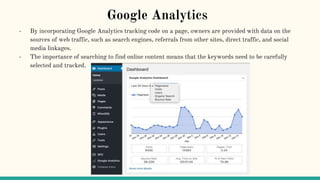
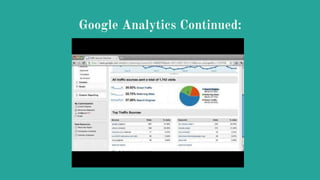
- By incorporating Google Analytics tracking code on a page, owners are provided with data on the
sources of web traffic, such as search engines, referrals from other sites, direct traffic, and social
media linkages.
- The importance of searching to find online content means that the keywords need to be carefully
selected and tracked.
Google Analytics Continued:
Facebook Insights
- One of the most important social media sites this decade with more than
1 billion users worldwide.
- For each Facebook page created, a site manager can download and
analyze real-time data compared each week.
- By creating engaging content, a manager can spark comments, shares,
and post clicks.
Twitter Analytics
- Twitter more open than Facebook and LinkedIn
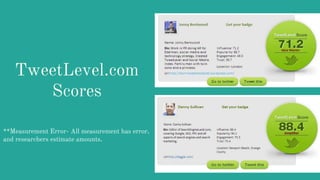
- PR Agency created TweetLevel.com
- Score based on influence, popularity, engagement, and trust
- Score can be used to gauge and improve online behavior
- Popular scores: @GaryVee (88.4) and @LadyGaga (93.3)
- Based on score considered viewer, commentator, curator, idea starter,
amplifier
TweetLevel.com
Scores
**Measurement Error- All measurement has error,
and researchers estimate amounts.
Twitter Analytics (Cont.)
- Jonny Bentwood explains differences in TweetLevel roles: viewer, curator
commentator, idea starter, amplifier
- “Idea starters are creative brains behind talked about thoughts. They
connect with other idea starters, curators and amplifiers - those with very large
followings. The process of curating and commenting may be influential, while
viewers observe but do not leave a footprint on Twitter.”
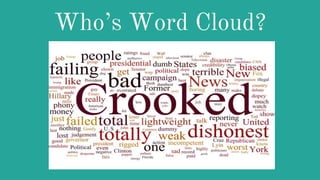
- Once Twitter user type is determined, then examine word clouds
- Word Cloud- A word visualization of frequently used social media language
Who’s Word Cloud?
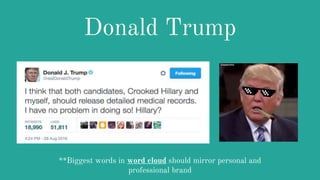
Donald Trump
**Biggest words in word cloud should mirror personal and
professional brand
Other Twitter Analytic Websites
- http://wefollow.com
- http://www.retweetrank.com
- https://tweetreach.com
- http://topsy.com (no longer exists)
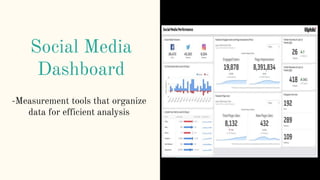
Social Media
Dashboard
-Measurement tools that organize
data for efficient analysis
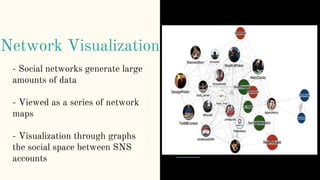
Network Visualization
- Social networks generate large
amounts of data
- Viewed as a series of network
maps
- Visualization through graphs
the social space between SNS
accounts
Network Analyses
Social Network Theory is the systematic study of how individuals interact in social
settings has been the focus of research for more than 50 years.
Information theory and models emphasize flow of messages through channels.
Web is linking and connection.
Web is simultaneously a mass mediated and one to one form of communication.
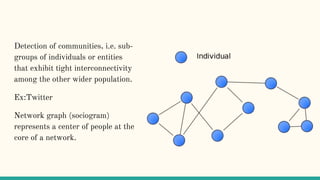
Detection of communities, i.e. sub-
groups of individuals or entities
that exhibit tight interconnectivity
among the other wider population.
Ex:Twitter
Network graph (sociogram)
represents a center of people at the
core of a network.
Other Social Network Measurement
Social Media measurements returns us to central issues of computer mediated
communication. These spaces allow us to develop online relations and explore
interactions with people, and grow communities of interest.
Klout.com attempts to measure influence across social media platforms.
50% of the U.S. and 24% of the world population were projected to have a
smartphone by the end of 2014.
Facebook has the fourth largest overall multiplatform audience behind Google,
Yahoo and Microsoft.
Discussion Questions
1. If you were advising a CEO who had never been on Twitter to
create a profile, which key concepts would you discuss with her or
him? I would mention the four TweetLevel.com dimensions:
influence, popularity, engagement, and trust.
2. Consider ways to use social media to improve trust and influence.
Which Twitter measures would you want to track? I would want to
track followers, and number of tweets retweeted or favorited.
3. Is there ever a time for disengagement from social media? Which
circumstances would provide reasons to lower levels of
engagement? If a business has damaged its brand, it is better to
lower engagement until the conflict passes over. Also too much
posting on social media can draw consumers away.

Ch 6 Presentation

  • 1.
    Social Media Metricsand Analytics By: Ummer Ahmed, Noah Guber, Jemimah Colinet
  • 2.
    “Social media isnot a media. The key is to listen, engage and build relationships.” - David Alston
  • 3.
    Social Media Metrics -Social media offer a unique opportunity to measure human nature and communication behavior. - How does social media measurement serve basic business goals? 1. Raising revenue 2. Lowering Costs 3. Increasing Satisfaction - Reliability: Social scientific measure of consistency or reproductivity of results. - Validity: The determination that measurement is conceptually what it was planning to be. - Transparency: The social media approach of disclosing all relative interests and not having a hidden agenda.
  • 4.
    Social Media Measures: -Buzz based upon number of impressions at a given time, on a specific date, time of year, channel etc. - Popularity - Mainstream media mentions - Number of fans, followers, friends, etc. - Likes or favorites - Sentiment - Number of interactions or engagement rate - Conversions to purchases
  • 5.
    Google Analytics - Byincorporating Google Analytics tracking code on a page, owners are provided with data on the sources of web traffic, such as search engines, referrals from other sites, direct traffic, and social media linkages. - The importance of searching to find online content means that the keywords need to be carefully selected and tracked.
  • 6.
  • 7.
    Facebook Insights - Oneof the most important social media sites this decade with more than 1 billion users worldwide. - For each Facebook page created, a site manager can download and analyze real-time data compared each week. - By creating engaging content, a manager can spark comments, shares, and post clicks.
  • 8.
    Twitter Analytics - Twittermore open than Facebook and LinkedIn - PR Agency created TweetLevel.com - Score based on influence, popularity, engagement, and trust - Score can be used to gauge and improve online behavior - Popular scores: @GaryVee (88.4) and @LadyGaga (93.3) - Based on score considered viewer, commentator, curator, idea starter, amplifier
  • 9.
    TweetLevel.com Scores **Measurement Error- Allmeasurement has error, and researchers estimate amounts.
  • 10.
    Twitter Analytics (Cont.) -Jonny Bentwood explains differences in TweetLevel roles: viewer, curator commentator, idea starter, amplifier - “Idea starters are creative brains behind talked about thoughts. They connect with other idea starters, curators and amplifiers - those with very large followings. The process of curating and commenting may be influential, while viewers observe but do not leave a footprint on Twitter.” - Once Twitter user type is determined, then examine word clouds - Word Cloud- A word visualization of frequently used social media language
  • 11.
  • 12.
    Donald Trump **Biggest wordsin word cloud should mirror personal and professional brand
  • 13.
    Other Twitter AnalyticWebsites - http://wefollow.com - http://www.retweetrank.com - https://tweetreach.com - http://topsy.com (no longer exists)
  • 14.
    Social Media Dashboard -Measurement toolsthat organize data for efficient analysis
  • 15.
    Network Visualization - Socialnetworks generate large amounts of data - Viewed as a series of network maps - Visualization through graphs the social space between SNS accounts
  • 16.
    Network Analyses Social NetworkTheory is the systematic study of how individuals interact in social settings has been the focus of research for more than 50 years. Information theory and models emphasize flow of messages through channels. Web is linking and connection. Web is simultaneously a mass mediated and one to one form of communication.
  • 17.
    Detection of communities,i.e. sub- groups of individuals or entities that exhibit tight interconnectivity among the other wider population. Ex:Twitter Network graph (sociogram) represents a center of people at the core of a network.
  • 18.
    Other Social NetworkMeasurement Social Media measurements returns us to central issues of computer mediated communication. These spaces allow us to develop online relations and explore interactions with people, and grow communities of interest. Klout.com attempts to measure influence across social media platforms. 50% of the U.S. and 24% of the world population were projected to have a smartphone by the end of 2014. Facebook has the fourth largest overall multiplatform audience behind Google, Yahoo and Microsoft.
  • 19.
    Discussion Questions 1. Ifyou were advising a CEO who had never been on Twitter to create a profile, which key concepts would you discuss with her or him? I would mention the four TweetLevel.com dimensions: influence, popularity, engagement, and trust. 2. Consider ways to use social media to improve trust and influence. Which Twitter measures would you want to track? I would want to track followers, and number of tweets retweeted or favorited. 3. Is there ever a time for disengagement from social media? Which circumstances would provide reasons to lower levels of engagement? If a business has damaged its brand, it is better to lower engagement until the conflict passes over. Also too much posting on social media can draw consumers away.

Editor's Notes

  • #7 https://youtu.be/mPgAug15bcQ