Chapter No. 1: Sewage/ Wastewater
Lecture No. 2: Sewers
Engr. Ayesha Asif
CIV-4747 Environmental Engineering-II
2
Sewers
• It is the pipe or conduit for carrying sewage. It is generally closed and
flow takes place under gravity (Atmospheric Pressure).
Classification of sewers
▫ Sanitary Sewers
▫ Storm Sewers
▫ Combined Sewers
▫ House Sewers
▫ Lateral Sewers
▫ Sub-main Sewers
▫ Main/ Trunk Sewers
▫ Outfall Sewers
3
• Sanitary Sewers
Pipes or conduits that carry sanitary sewage i.e., wastewater from municipality
including domestic and industrial wastewaters.
• Storm Sewers
Pipes or conduits carries storm sewage i.e., surface water runoff from rain,
melting snow etc. as well as water from street wash.
• Combined Sewers
Sewers that carry mixture of raw sanitary sewage and runoff from paved
surfaces.
Types of Sewers
4
• House Sewers
It is the sewer conveying sewage from plumbing system of a building or house
to common/municipal/sanitary sewers.
• Lateral Sewers
Sewer that carry discharge from two or more house sewers.
• Sub-main Sewers
Sewer that carry discharge from two or more laterals.
Types of Sewers
5
• Main/ Trunk Sewers
Sewers carrying discharge from two or more sub-mains
• Outfall Sewers
Sewers that receives discharge from all collecting system and conveys it to the
point of final disposal.
Types of Sewers
6
• Asbestos Cement
• Plain or Reinforced Cement Concrete
• Vitrified Clay
• Brick
• Cast Iron
• Steel
• Plastic
Sewer Materials
7
Asbestos Cement Sewers
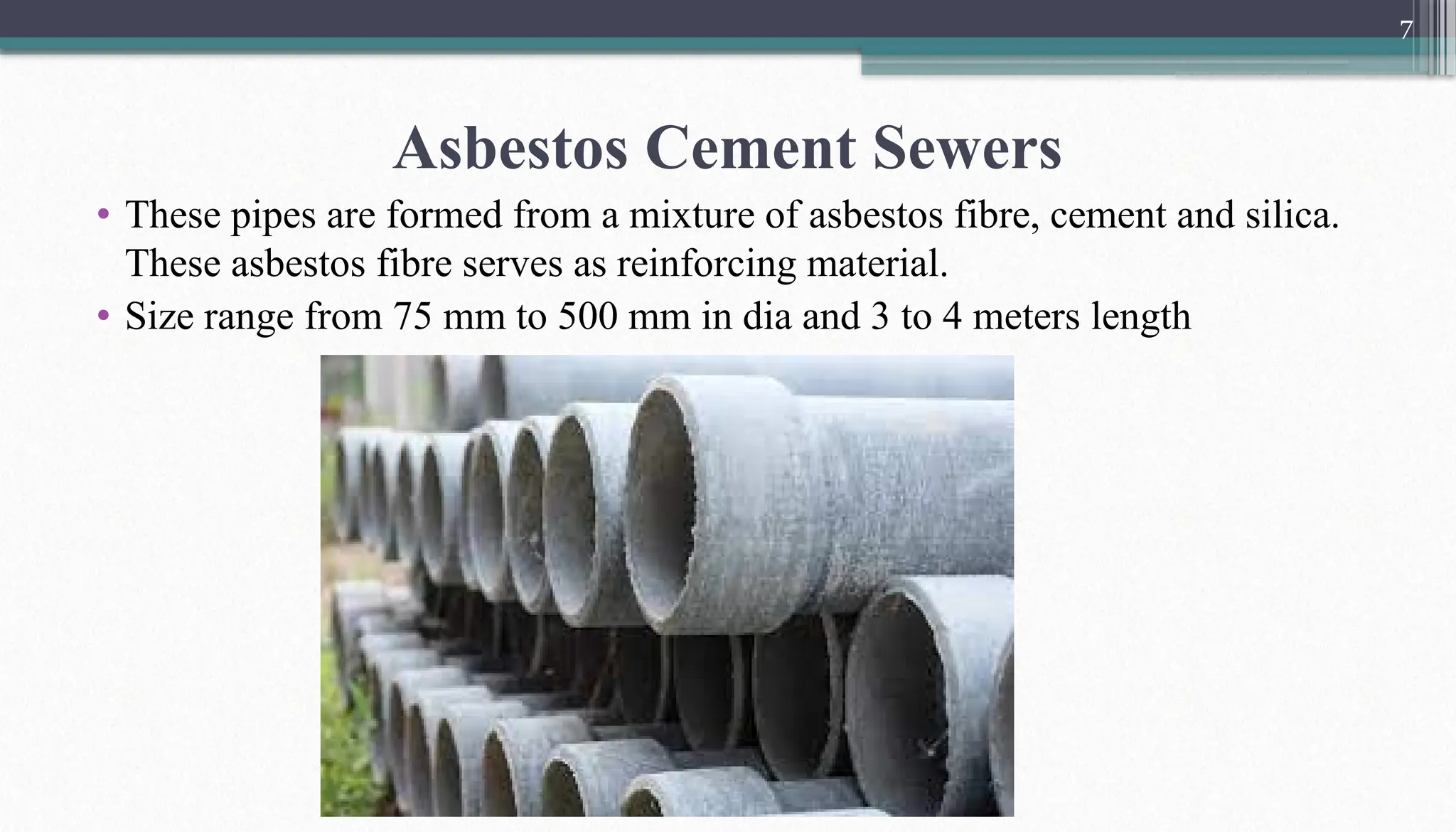
• These pipes are formed from a mixture of asbestos fibre, cement and silica.
These asbestos fibre serves as reinforcing material.
• Size range from 75 mm to 500 mm in dia and 3 to 4 meters length
8
Advantages Disadvantages
• Good strength against internal
pressure
• Light in weight
• Can be cut easily and jointed
• Good resistance to salts and
corrosive materials
• Surface is smooth
• They are brittle
• Less strength against external load
• Susceptible to sulphide corrosion
• They are used as verticals only
Asbestos Cement Sewers
9
Plain or Reinforced Cement Concrete Sewers
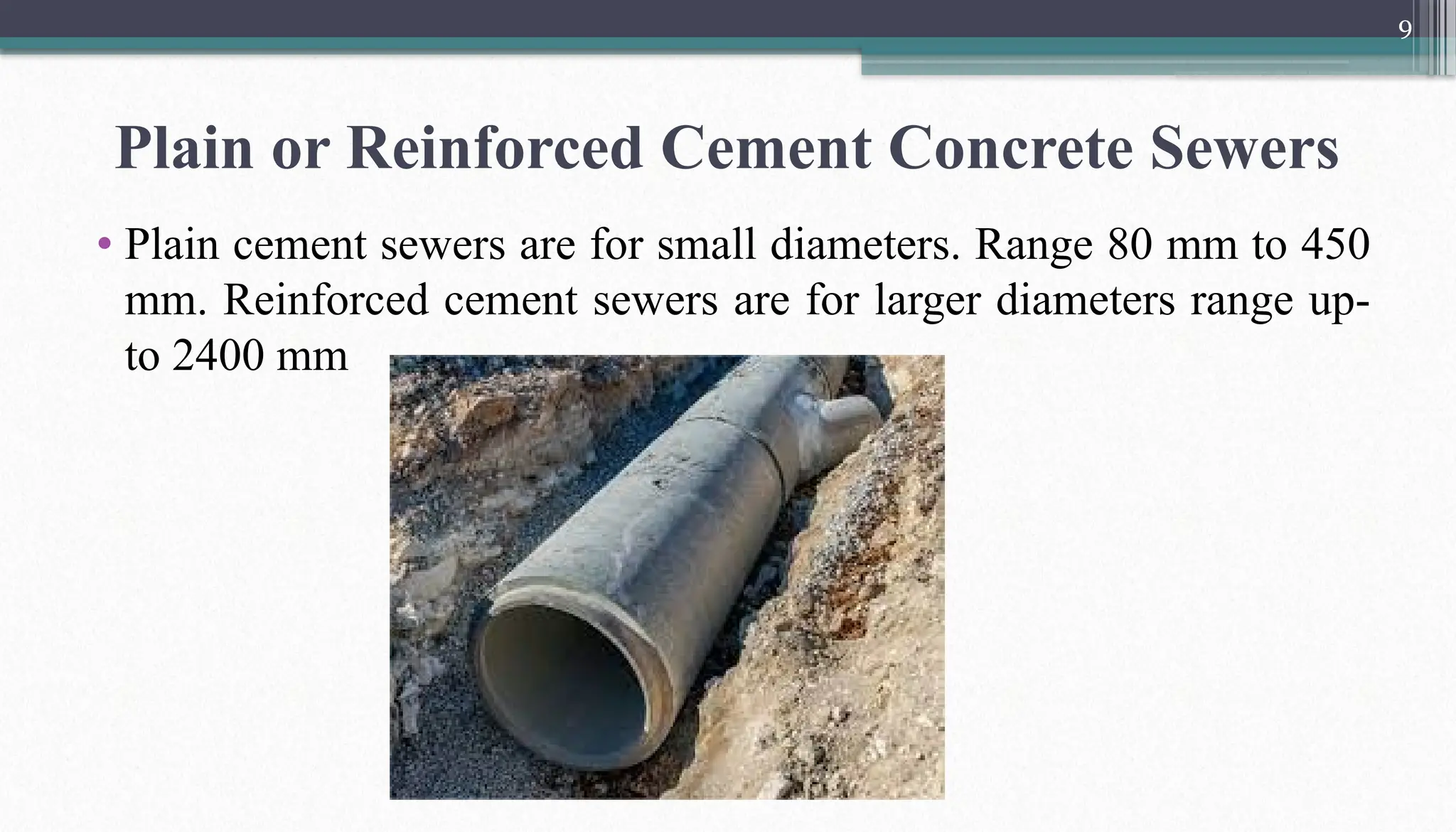
• Plain cement sewers are for small diameters. Range 80 mm to 450
mm. Reinforced cement sewers are for larger diameters range up-
to 2400 mm
10
Advantages Disadvantages
• Stronger externally as well as
internally
• Any desired strength can be
achieved
• Cast insitu
• Economical for medium or large
sewers
• Easily get corroded
• Heavy
Plain or Reinforced Cement Concrete Sewers
11
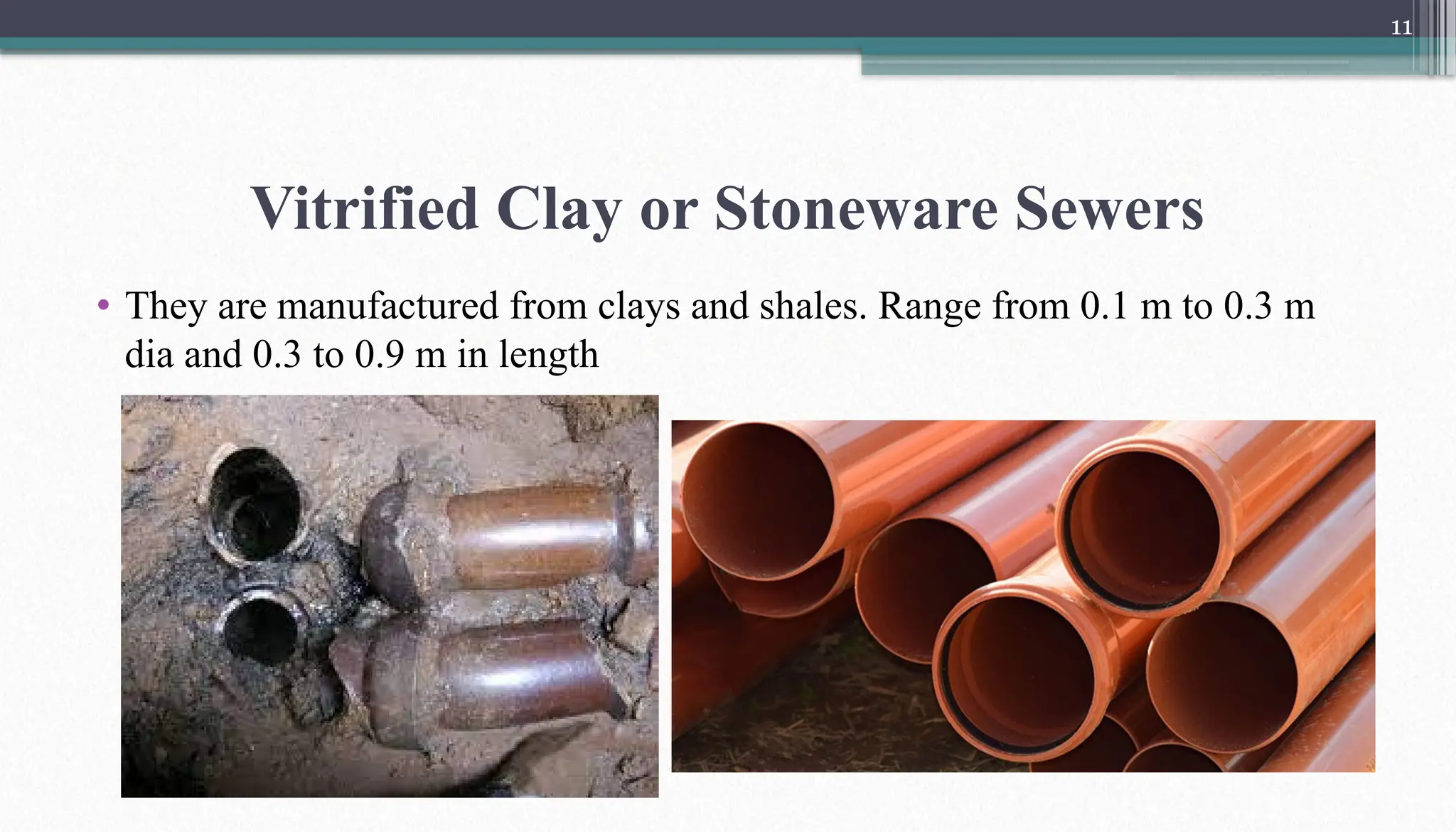
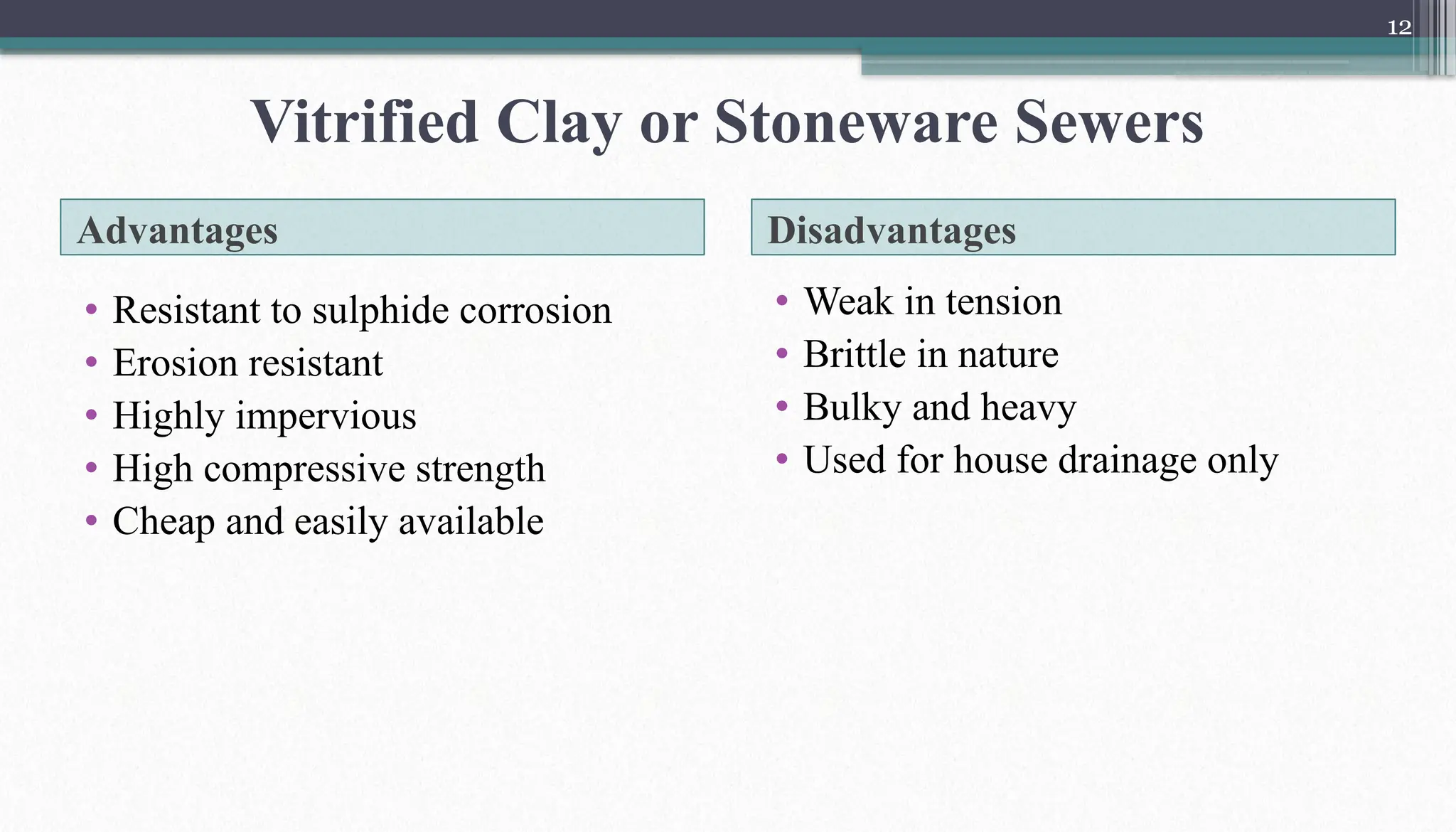
Vitrified Clay or Stoneware Sewers
• They are manufactured from clays and shales. Range from 0.1 m to 0.3 m
dia and 0.3 to 0.9 m in length
12
Advantages Disadvantages
• Resistant to sulphide corrosion
• Erosion resistant
• Highly impervious
• High compressive strength
• Cheap and easily available
• Weak in tension
• Brittle in nature
• Bulky and heavy
• Used for house drainage only
Vitrified Clay or Stoneware Sewers
13
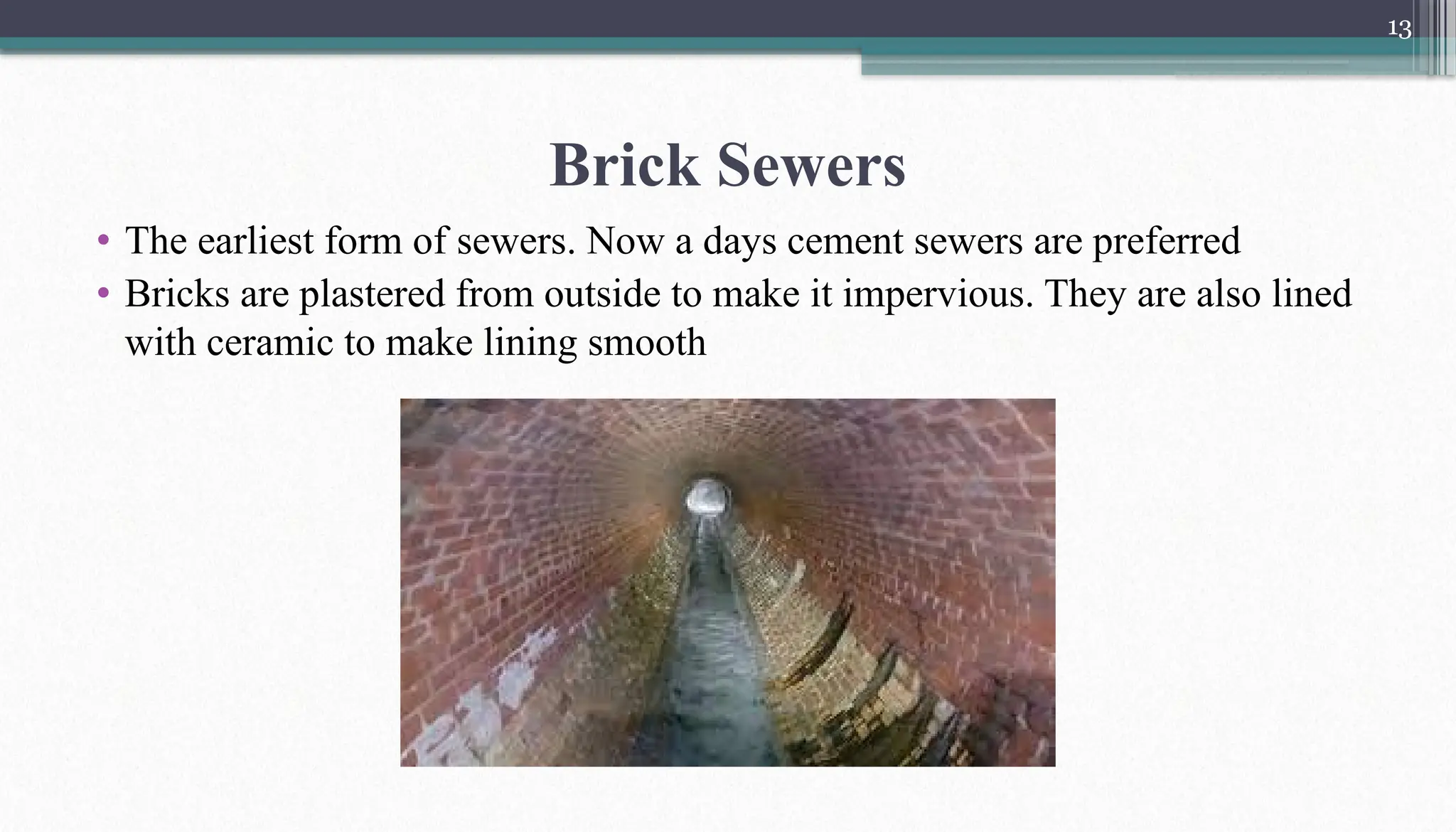
Brick Sewers
• The earliest form of sewers. Now a days cement sewers are preferred
• Bricks are plastered from outside to make it impervious. They are also lined
with ceramic to make lining smooth
14
Cast Iron Sewers
• They possess high strength.
• Size range from 150mm to 750mm in dia and 3 to 3.5m in length
• They can’t resist chemicals hence they are painted to increase their
resistance
• They are costly and must be used under following conditions
Heavy external loads
High internal pressure
Under expensive road surface
Temperature variations
Vibrations
Wet ground conditions
15
Steel Sewers
• They are made of steel
• Impervious in nature
• Light in weight and flexible
• Can absorb vibrations and shocks
• Large diameter
• Corrosion free
• Easily welded
• High initial cost
16
Plastic Sewers
• The use of plastic sewer line is still in the experimental stage
• Made up of PVC
• Available in longer lengths
• Corrosion resistant
17
Steps of Sewer Installation
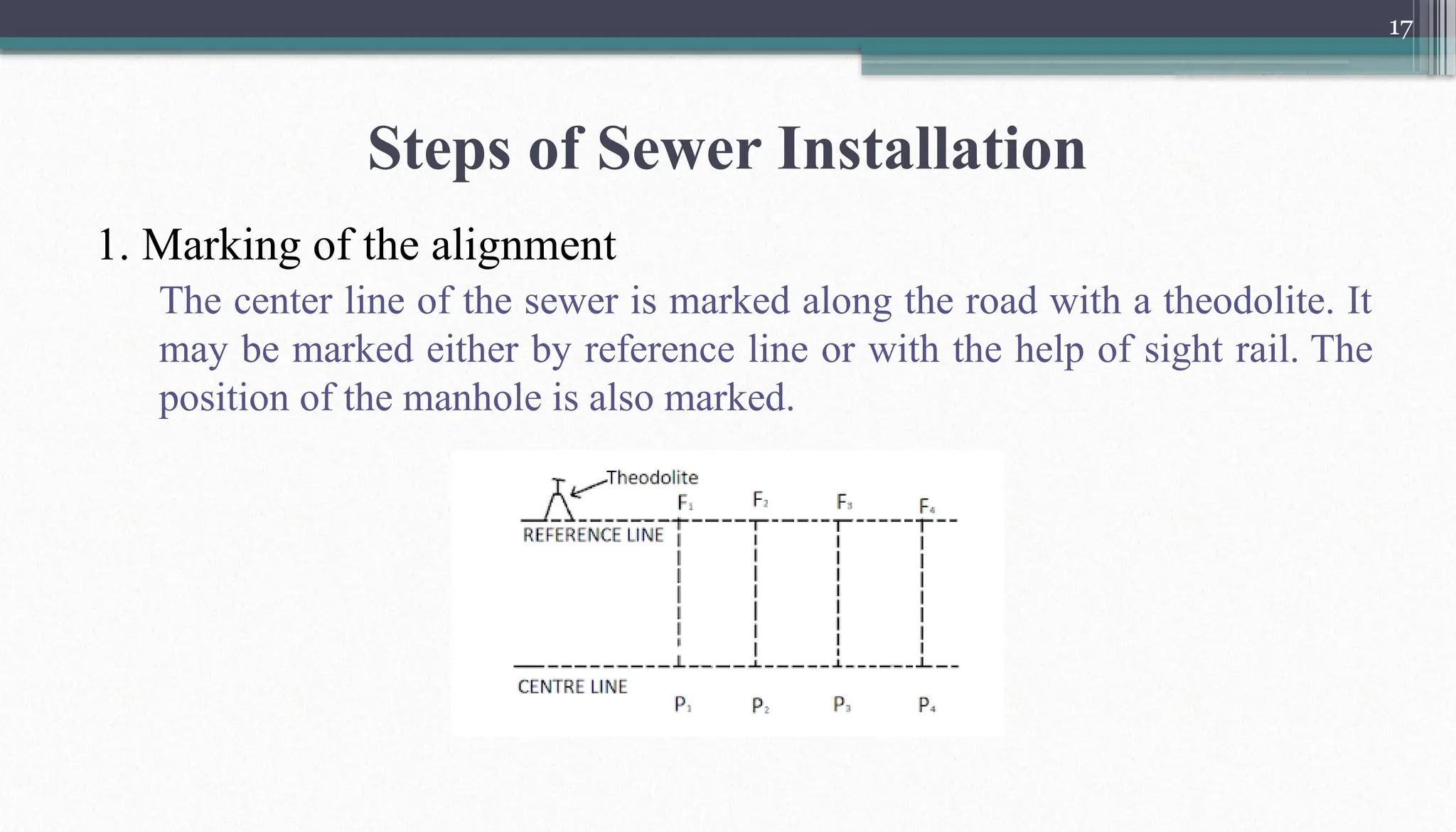
1. Marking of the alignment
The center line of the sewer is marked along the road with a theodolite. It
may be marked either by reference line or with the help of sight rail. The
position of the manhole is also marked.
18
Steps of Sewer Installation
2. Excavation of trench
After marking the center line of the sewer, the excavation of trench is
started. The excavation may be carried out either by manual labour or by
machines like power shovels, track excavators etc.
The width of the trench at the bottom is generally kept 15 cm more than
the dia of sewer pipe. At the point of sewer joint, the width of the trench is
made 60 cm for a length of 60 cm. The invert level is fixed by boning rod.
19
Steps of Sewer Installation
3. Timbering of trench
When, in ordinary soil, the depth of excavation is more than 2 m, timber
bracing or sheet piling is provided on both sides of the trench so that it
may not collapse. The extent of timbering required depends upon the type
of soil and the depth of excavation.
4. Dewatering of trench
If water is met with during excavation, it is removed by pumping or any
other suitable method.
20
Steps of Sewer Installation
5. Preparation of sub-grade
For soft soil, the bed of the sewer is prepared by plain concrete (1:3:6).
The thickness of concrete varies from 15 to 20 cm. The bedding layer is
not required in case of rocky or hard soil.
6. Laying and joining of pipes
The sewers are laid along the trench very carefully. Then the joining of the
sewer is done as per requirements. After joining, both sides of the pipe are
finished with concrete.
7. Testing of leakage
The leakage in the pipe joints or any other points is tested by water test or
air test
21
Steps of Sewer Installation
8. Testing of straightness of alignment and obstructions
The straightness of the sewer pipe and the presence of any obstruction are
tested by placing a mirror at one end of the sewer and a lamp at the other
end. If the pipeline is straight, the full circle of light will be observed.
The presence of an obstruction in the pipe can also be tested by inserting a
smooth ball at the upper end of the sewer. The dia of the ball is 13 mm less
than the internal diameter of the sewer. If there is no obstruction inside the
sewer, the ball shall roll down and reach the lower end of the sewer.
9. Back filling
Lastly, the trenches are filled up with the excavated earth in layers about
15 cm thick. Each layer is properly watered and rammed.
22

Lecture 02.pptx Lecture 02.pptxLecture 02.pptx

  • 1.
    Chapter No. 1:Sewage/ Wastewater Lecture No. 2: Sewers Engr. Ayesha Asif CIV-4747 Environmental Engineering-II
  • 2.
    2 Sewers • It isthe pipe or conduit for carrying sewage. It is generally closed and flow takes place under gravity (Atmospheric Pressure). Classification of sewers ▫ Sanitary Sewers ▫ Storm Sewers ▫ Combined Sewers ▫ House Sewers ▫ Lateral Sewers ▫ Sub-main Sewers ▫ Main/ Trunk Sewers ▫ Outfall Sewers
  • 3.
    3 • Sanitary Sewers Pipesor conduits that carry sanitary sewage i.e., wastewater from municipality including domestic and industrial wastewaters. • Storm Sewers Pipes or conduits carries storm sewage i.e., surface water runoff from rain, melting snow etc. as well as water from street wash. • Combined Sewers Sewers that carry mixture of raw sanitary sewage and runoff from paved surfaces. Types of Sewers
  • 4.
    4 • House Sewers Itis the sewer conveying sewage from plumbing system of a building or house to common/municipal/sanitary sewers. • Lateral Sewers Sewer that carry discharge from two or more house sewers. • Sub-main Sewers Sewer that carry discharge from two or more laterals. Types of Sewers
  • 5.
    5 • Main/ TrunkSewers Sewers carrying discharge from two or more sub-mains • Outfall Sewers Sewers that receives discharge from all collecting system and conveys it to the point of final disposal. Types of Sewers
  • 6.
    6 • Asbestos Cement •Plain or Reinforced Cement Concrete • Vitrified Clay • Brick • Cast Iron • Steel • Plastic Sewer Materials
  • 7.
    7 Asbestos Cement Sewers •These pipes are formed from a mixture of asbestos fibre, cement and silica. These asbestos fibre serves as reinforcing material. • Size range from 75 mm to 500 mm in dia and 3 to 4 meters length
  • 8.
    8 Advantages Disadvantages • Goodstrength against internal pressure • Light in weight • Can be cut easily and jointed • Good resistance to salts and corrosive materials • Surface is smooth • They are brittle • Less strength against external load • Susceptible to sulphide corrosion • They are used as verticals only Asbestos Cement Sewers
  • 9.
    9 Plain or ReinforcedCement Concrete Sewers • Plain cement sewers are for small diameters. Range 80 mm to 450 mm. Reinforced cement sewers are for larger diameters range up- to 2400 mm
  • 10.
    10 Advantages Disadvantages • Strongerexternally as well as internally • Any desired strength can be achieved • Cast insitu • Economical for medium or large sewers • Easily get corroded • Heavy Plain or Reinforced Cement Concrete Sewers
  • 11.
    11 Vitrified Clay orStoneware Sewers • They are manufactured from clays and shales. Range from 0.1 m to 0.3 m dia and 0.3 to 0.9 m in length
  • 12.
    12 Advantages Disadvantages • Resistantto sulphide corrosion • Erosion resistant • Highly impervious • High compressive strength • Cheap and easily available • Weak in tension • Brittle in nature • Bulky and heavy • Used for house drainage only Vitrified Clay or Stoneware Sewers
  • 13.
    13 Brick Sewers • Theearliest form of sewers. Now a days cement sewers are preferred • Bricks are plastered from outside to make it impervious. They are also lined with ceramic to make lining smooth
  • 14.
    14 Cast Iron Sewers •They possess high strength. • Size range from 150mm to 750mm in dia and 3 to 3.5m in length • They can’t resist chemicals hence they are painted to increase their resistance • They are costly and must be used under following conditions Heavy external loads High internal pressure Under expensive road surface Temperature variations Vibrations Wet ground conditions
  • 15.
    15 Steel Sewers • Theyare made of steel • Impervious in nature • Light in weight and flexible • Can absorb vibrations and shocks • Large diameter • Corrosion free • Easily welded • High initial cost
  • 16.
    16 Plastic Sewers • Theuse of plastic sewer line is still in the experimental stage • Made up of PVC • Available in longer lengths • Corrosion resistant
  • 17.
    17 Steps of SewerInstallation 1. Marking of the alignment The center line of the sewer is marked along the road with a theodolite. It may be marked either by reference line or with the help of sight rail. The position of the manhole is also marked.
  • 18.
    18 Steps of SewerInstallation 2. Excavation of trench After marking the center line of the sewer, the excavation of trench is started. The excavation may be carried out either by manual labour or by machines like power shovels, track excavators etc. The width of the trench at the bottom is generally kept 15 cm more than the dia of sewer pipe. At the point of sewer joint, the width of the trench is made 60 cm for a length of 60 cm. The invert level is fixed by boning rod.
  • 19.
    19 Steps of SewerInstallation 3. Timbering of trench When, in ordinary soil, the depth of excavation is more than 2 m, timber bracing or sheet piling is provided on both sides of the trench so that it may not collapse. The extent of timbering required depends upon the type of soil and the depth of excavation. 4. Dewatering of trench If water is met with during excavation, it is removed by pumping or any other suitable method.
  • 20.
    20 Steps of SewerInstallation 5. Preparation of sub-grade For soft soil, the bed of the sewer is prepared by plain concrete (1:3:6). The thickness of concrete varies from 15 to 20 cm. The bedding layer is not required in case of rocky or hard soil. 6. Laying and joining of pipes The sewers are laid along the trench very carefully. Then the joining of the sewer is done as per requirements. After joining, both sides of the pipe are finished with concrete. 7. Testing of leakage The leakage in the pipe joints or any other points is tested by water test or air test
  • 21.
    21 Steps of SewerInstallation 8. Testing of straightness of alignment and obstructions The straightness of the sewer pipe and the presence of any obstruction are tested by placing a mirror at one end of the sewer and a lamp at the other end. If the pipeline is straight, the full circle of light will be observed. The presence of an obstruction in the pipe can also be tested by inserting a smooth ball at the upper end of the sewer. The dia of the ball is 13 mm less than the internal diameter of the sewer. If there is no obstruction inside the sewer, the ball shall roll down and reach the lower end of the sewer. 9. Back filling Lastly, the trenches are filled up with the excavated earth in layers about 15 cm thick. Each layer is properly watered and rammed.
  • 22.