Chapter 1. Introduction to
Management
Management
Definition of Management:
Its Nature and Purpose
• Koontz : “Management is art of getting things
through and with people in formally organized
groups.”
• Management is the force that unifies human as well
as non-human resources in the service of
organizational goals. It is a process of getting results
with and through people.
Definition of Management:
Its Nature and Purpose
• Henry Fayol : “To manage is to forecast, to
plan, to organize, to command, to coordinate, and
to control.”
• Frederick Taylor : “Management is the art of
knowing what you want to do and then seeing that it
is done in the best and cheapest way
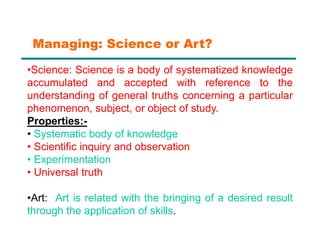
•Science: Science is a body of systematized knowledge
accumulated and accepted with reference to the
understanding of general truths concerning a particular
phenomenon, subject, or object of study.
Properties:-
• Systematic body of knowledge
• Scientific inquiry and observation
• Experimentation
• Universal truth
•Art: Art is related with the bringing of a desired result
through the application of skills.
Managing: Science or Art?
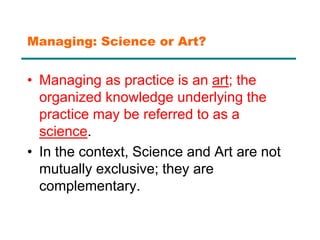
• Managing as practice is an art; the
organized knowledge underlying the
practice may be referred to as a
science.
• In the context, Science and Art are not
mutually exclusive; they are
complementary.
Managing: Science or Art?
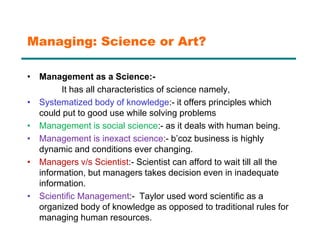
• Management as a Science:-
It has all characteristics of science namely,
• Systematized body of knowledge:- it offers principles which
could put to good use while solving problems
• Management is social science:- as it deals with human being.
• Management is inexact science:- b’coz business is highly
dynamic and conditions ever changing.
• Managers v/s Scientist:- Scientist can afford to wait till all the
information, but managers takes decision even in inadequate
information.
• Scientific Management:- Taylor used word scientific as a
organized body of knowledge as opposed to traditional rules for
managing human resources.
Managing: Science or Art?
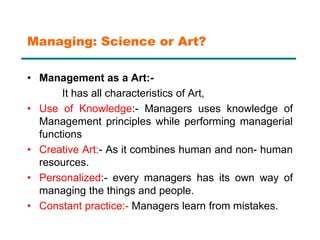
• Management as a Art:-
It has all characteristics of Art,
• Use of Knowledge:- Managers uses knowledge of
Management principles while performing managerial
functions
• Creative Art:- As it combines human and non- human
resources.
• Personalized:- every managers has its own way of
managing the things and people.
• Constant practice:- Managers learn from mistakes.
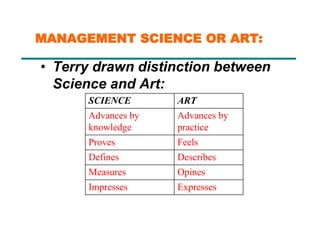
MANAGEMENT SCIENCE OR ART:
• Terry drawn distinction between
Science and Art:
SCIENCE ART
Advances by
knowledge
Advances by
practice
Proves Feels
Defines Describes
Measures Opines
Impresses Expresses
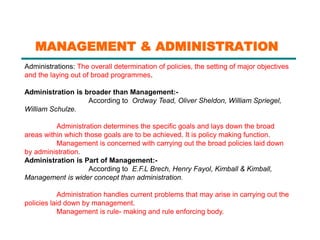
Administrations: The overall determination of policies, the setting of major objectives
and the laying out of broad programmes.
Administration is broader than Management:-
According to Ordway Tead, Oliver Sheldon, William Spriegel,
William Schulze.
Administration determines the specific goals and lays down the broad
areas within which those goals are to be achieved. It is policy making function.
Management is concerned with carrying out the broad policies laid down
by administration.
Administration is Part of Management:-
According to E.F.L Brech, Henry Fayol, Kimball & Kimball,
Management is wider concept than administration.
Administration handles current problems that may arise in carrying out the
policies laid down by management.
Management is rule- making and rule enforcing body.
MANAGEMENT & ADMINISTRATION
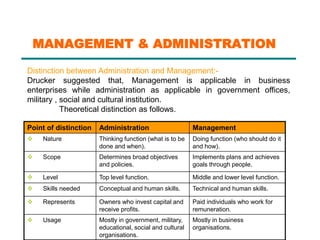
Distinction between Administration and Management:-
Drucker suggested that, Management is applicable in business
enterprises while administration as applicable in government offices,
military , social and cultural institution.
Theoretical distinction as follows.
Point of distinction Administration Management
 Nature Thinking function (what is to be
done and when).
Doing function (who should do it
and how).
 Scope Determines broad objectives
and policies.
Implements plans and achieves
goals through people.
 Level Top level function. Middle and lower level function.
 Skills needed Conceptual and human skills. Technical and human skills.
 Represents Owners who invest capital and
receive profits.
Paid individuals who work for
remuneration.
 Usage Mostly in government, military,
educational, social and cultural
organisations.
Mostly in business
organisations.
MANAGEMENT & ADMINISTRATION
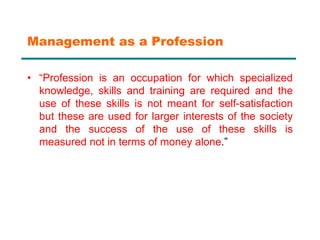
Management as a Profession
• “Profession is an occupation for which specialized
knowledge, skills and training are required and the
use of these skills is not meant for self-satisfaction
but these are used for larger interests of the society
and the success of the use of these skills is
measured not in terms of money alone.”
Characteristics of a profession:
 Well defines body of knowledge
 Formal education and training
 Minimum qualification
 Representative body of professionals exists to
regulate and develop the professional activities.
 Services above self
 Ethical code of conduct
Professionalization of management
 In Conclusion, we can say that management is not a
recognized profession, but it is moving in the direction of
becoming profession.
 Factors such as separation of ownership from management,
government regulations of business activities, growth of trade
unions have lead to increased professionalization of
management.
 Increased professionalization implies licensing, formal
education and degrees, regulatory codes, and so on.
 However, Drucker believe that there should be no statutory
control over manager, he argues that manager known from
their performance rather than by their degrees.
Professionalization of management in
India
• Traditionally managed sector:
“In a family business you have professionals but all decision
making is centralized at the top- family head, who has no
professionalism, but perhaps only experience and intuition, the
decisions are not likely to be as good as that of a modern
professional board.”
 Features: 1. Ownership and control of the organization are in
the hands of family members. 2. Objective is to earn profit only.
 Basic reasons for lack of professional Management are:
• Most of organizations in private sector are generally one man
show and real control lies in the hand of a single person.
• In public enterprises mainly managers are from civil services
and their style of working is different.
• Indian business is not sophisticated in developed countries.
Professionalization of management in
India
• Professionally managed sector:
• HLL, ITC, Infosys, Wipro, Tata Iron, BHEL,
ONGC, IOC.
 Main reasons for professionalization in this
sector are:
–International Impact
–Compulsion
–Availability of trained and educated managers.
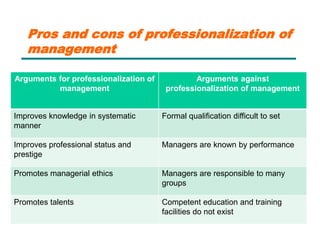
Pros and cons of professionalization of
management
Arguments for professionalization of
management
Arguments against
professionalization of management
Improves knowledge in systematic
manner
Formal qualification difficult to set
Improves professional status and
prestige
Managers are known by performance
Promotes managerial ethics Managers are responsible to many
groups
Promotes talents Competent education and training
facilities do not exist
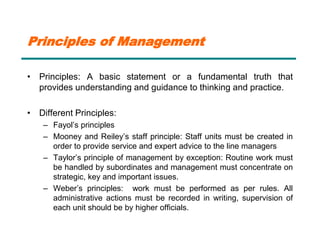
Principles of Management
• Principles: A basic statement or a fundamental truth that
provides understanding and guidance to thinking and practice.
• Different Principles:
– Fayol’s principles
– Mooney and Reiley’s staff principle: Staff units must be created in
order to provide service and expert advice to the line managers
– Taylor’s principle of management by exception: Routine work must
be handled by subordinates and management must concentrate on
strategic, key and important issues.
– Weber’s principles: work must be performed as per rules. All
administrative actions must be recorded in writing, supervision of
each unit should be by higher officials.
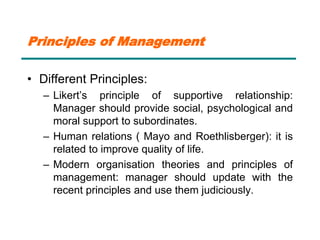
Principles of Management
• Different Principles:
– Likert’s principle of supportive relationship:
Manager should provide social, psychological and
moral support to subordinates.
– Human relations ( Mayo and Roethlisberger): it is
related to improve quality of life.
– Modern organisation theories and principles of
management: manager should update with the
recent principles and use them judiciously.

Ch. 1.1.Introduction to Management.ppt

  • 1.
    Chapter 1. Introductionto Management Management
  • 2.
    Definition of Management: ItsNature and Purpose • Koontz : “Management is art of getting things through and with people in formally organized groups.” • Management is the force that unifies human as well as non-human resources in the service of organizational goals. It is a process of getting results with and through people.
  • 3.
    Definition of Management: ItsNature and Purpose • Henry Fayol : “To manage is to forecast, to plan, to organize, to command, to coordinate, and to control.” • Frederick Taylor : “Management is the art of knowing what you want to do and then seeing that it is done in the best and cheapest way
  • 4.
    •Science: Science isa body of systematized knowledge accumulated and accepted with reference to the understanding of general truths concerning a particular phenomenon, subject, or object of study. Properties:- • Systematic body of knowledge • Scientific inquiry and observation • Experimentation • Universal truth •Art: Art is related with the bringing of a desired result through the application of skills. Managing: Science or Art?
  • 5.
    Managing: Science orArt? • Managing as practice is an art; the organized knowledge underlying the practice may be referred to as a science. • In the context, Science and Art are not mutually exclusive; they are complementary.
  • 6.
    Managing: Science orArt? • Management as a Science:- It has all characteristics of science namely, • Systematized body of knowledge:- it offers principles which could put to good use while solving problems • Management is social science:- as it deals with human being. • Management is inexact science:- b’coz business is highly dynamic and conditions ever changing. • Managers v/s Scientist:- Scientist can afford to wait till all the information, but managers takes decision even in inadequate information. • Scientific Management:- Taylor used word scientific as a organized body of knowledge as opposed to traditional rules for managing human resources.
  • 7.
    Managing: Science orArt? • Management as a Art:- It has all characteristics of Art, • Use of Knowledge:- Managers uses knowledge of Management principles while performing managerial functions • Creative Art:- As it combines human and non- human resources. • Personalized:- every managers has its own way of managing the things and people. • Constant practice:- Managers learn from mistakes.
  • 8.
    MANAGEMENT SCIENCE ORART: • Terry drawn distinction between Science and Art: SCIENCE ART Advances by knowledge Advances by practice Proves Feels Defines Describes Measures Opines Impresses Expresses
  • 9.
    Administrations: The overalldetermination of policies, the setting of major objectives and the laying out of broad programmes. Administration is broader than Management:- According to Ordway Tead, Oliver Sheldon, William Spriegel, William Schulze. Administration determines the specific goals and lays down the broad areas within which those goals are to be achieved. It is policy making function. Management is concerned with carrying out the broad policies laid down by administration. Administration is Part of Management:- According to E.F.L Brech, Henry Fayol, Kimball & Kimball, Management is wider concept than administration. Administration handles current problems that may arise in carrying out the policies laid down by management. Management is rule- making and rule enforcing body. MANAGEMENT & ADMINISTRATION
  • 10.
    Distinction between Administrationand Management:- Drucker suggested that, Management is applicable in business enterprises while administration as applicable in government offices, military , social and cultural institution. Theoretical distinction as follows. Point of distinction Administration Management  Nature Thinking function (what is to be done and when). Doing function (who should do it and how).  Scope Determines broad objectives and policies. Implements plans and achieves goals through people.  Level Top level function. Middle and lower level function.  Skills needed Conceptual and human skills. Technical and human skills.  Represents Owners who invest capital and receive profits. Paid individuals who work for remuneration.  Usage Mostly in government, military, educational, social and cultural organisations. Mostly in business organisations. MANAGEMENT & ADMINISTRATION
  • 11.
    Management as aProfession • “Profession is an occupation for which specialized knowledge, skills and training are required and the use of these skills is not meant for self-satisfaction but these are used for larger interests of the society and the success of the use of these skills is measured not in terms of money alone.”
  • 12.
    Characteristics of aprofession:  Well defines body of knowledge  Formal education and training  Minimum qualification  Representative body of professionals exists to regulate and develop the professional activities.  Services above self  Ethical code of conduct
  • 13.
    Professionalization of management In Conclusion, we can say that management is not a recognized profession, but it is moving in the direction of becoming profession.  Factors such as separation of ownership from management, government regulations of business activities, growth of trade unions have lead to increased professionalization of management.  Increased professionalization implies licensing, formal education and degrees, regulatory codes, and so on.  However, Drucker believe that there should be no statutory control over manager, he argues that manager known from their performance rather than by their degrees.
  • 14.
    Professionalization of managementin India • Traditionally managed sector: “In a family business you have professionals but all decision making is centralized at the top- family head, who has no professionalism, but perhaps only experience and intuition, the decisions are not likely to be as good as that of a modern professional board.”  Features: 1. Ownership and control of the organization are in the hands of family members. 2. Objective is to earn profit only.  Basic reasons for lack of professional Management are: • Most of organizations in private sector are generally one man show and real control lies in the hand of a single person. • In public enterprises mainly managers are from civil services and their style of working is different. • Indian business is not sophisticated in developed countries.
  • 15.
    Professionalization of managementin India • Professionally managed sector: • HLL, ITC, Infosys, Wipro, Tata Iron, BHEL, ONGC, IOC.  Main reasons for professionalization in this sector are: –International Impact –Compulsion –Availability of trained and educated managers.
  • 16.
    Pros and consof professionalization of management Arguments for professionalization of management Arguments against professionalization of management Improves knowledge in systematic manner Formal qualification difficult to set Improves professional status and prestige Managers are known by performance Promotes managerial ethics Managers are responsible to many groups Promotes talents Competent education and training facilities do not exist
  • 17.
    Principles of Management •Principles: A basic statement or a fundamental truth that provides understanding and guidance to thinking and practice. • Different Principles: – Fayol’s principles – Mooney and Reiley’s staff principle: Staff units must be created in order to provide service and expert advice to the line managers – Taylor’s principle of management by exception: Routine work must be handled by subordinates and management must concentrate on strategic, key and important issues. – Weber’s principles: work must be performed as per rules. All administrative actions must be recorded in writing, supervision of each unit should be by higher officials.
  • 18.
    Principles of Management •Different Principles: – Likert’s principle of supportive relationship: Manager should provide social, psychological and moral support to subordinates. – Human relations ( Mayo and Roethlisberger): it is related to improve quality of life. – Modern organisation theories and principles of management: manager should update with the recent principles and use them judiciously.