1
Exercise 1.1
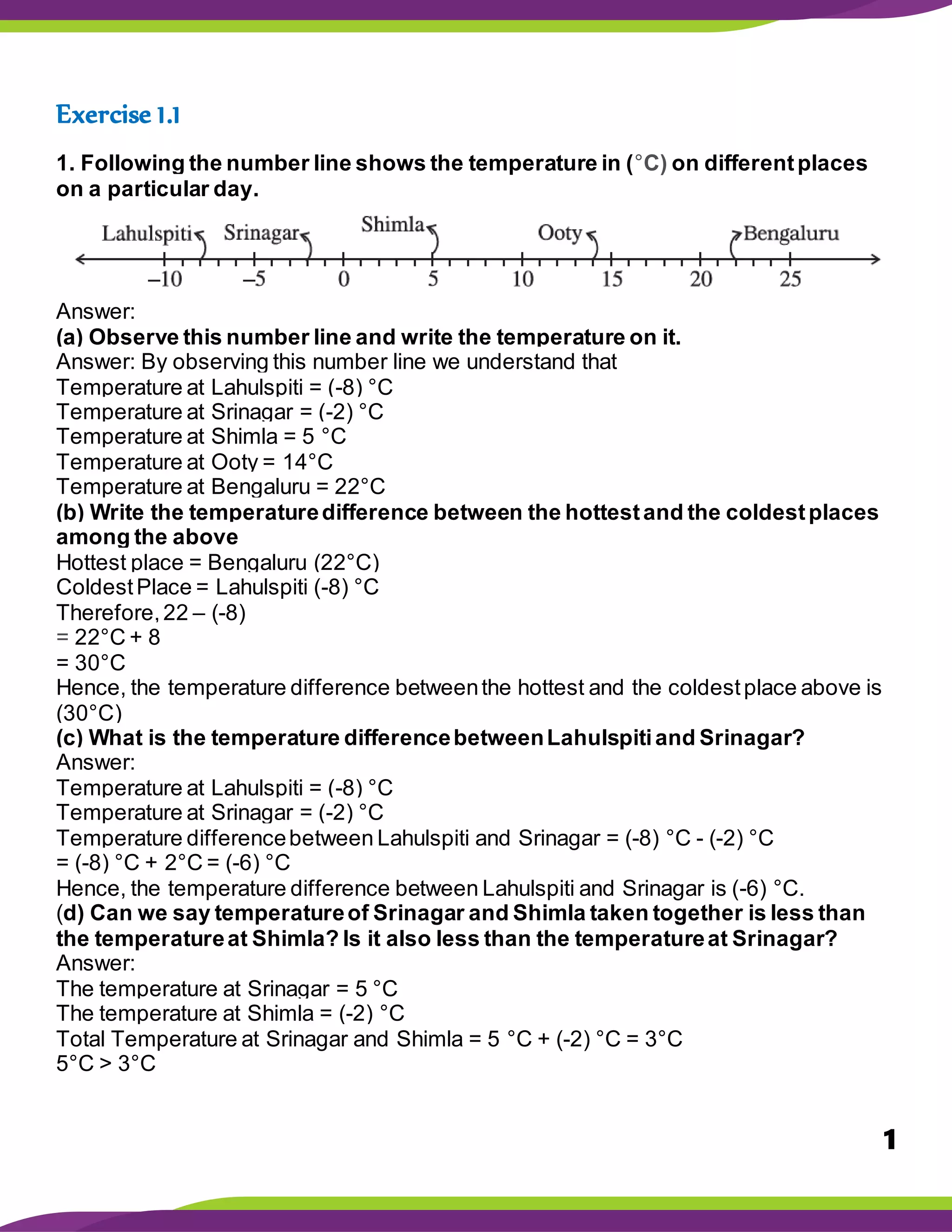
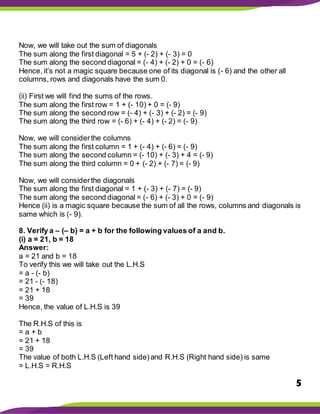
1. Following the number line shows the temperature in (°C) on differentplaces
on a particular day.
Answer:
(a) Observe this number line and write the temperature on it.
Answer: By observing this number line we understand that
Temperature at Lahulspiti = (-8) °C
Temperature at Srinagar = (-2) °C
Temperature at Shimla = 5 °C
Temperature at Ooty = 14°C
Temperature at Bengaluru = 22°C
(b) Write the temperaturedifference between the hottestand the coldestplaces
among the above
Hottest place = Bengaluru (22°C)
ColdestPlace = Lahulspiti (-8) °C
Therefore,22 – (-8)
= 22°C + 8
= 30°C
Hence, the temperature difference betweenthe hottest and the coldestplace above is
(30°C)
(c) What is the temperature differencebetweenLahulspitiand Srinagar?
Answer:
Temperature at Lahulspiti = (-8) °C
Temperature at Srinagar = (-2) °C
Temperature differencebetween Lahulspiti and Srinagar = (-8) °C - (-2) °C
= (-8) °C + 2°C = (-6) °C
Hence, the temperature difference between Lahulspiti and Srinagar is (-6) °C.
(d) Can we say temperatureof Srinagar and Shimla taken together is less than
the temperatureat Shimla? Is it also less than the temperatureat Srinagar?
Answer:
The temperature at Srinagar = 5 °C
The temperature at Shimla = (-2) °C
Total Temperature at Srinagar and Shimla = 5 °C + (-2) °C = 3°C
5°C > 3°C
2
Therefore,temperature of Srinagar and Shimla taken together is less than the
temperature at Srinagar.
Now,
(-2) °C < 3°C
Therefore,temperature of Srinagar and Shimla taken together is not less than the
temperature at Shimla.
2. In a quiz, positive marks are given for correctanswers and negative marksare
given for incorrectanswers.If Jack’s scores in five successive roundswere 25,
– 5, – 10, 15 and 10, whatwas his total at the end?
Answer:
Marks Jack scored in 5 successive rounds = 25, – 5, – 10, 15 and 10
Total score of Jack in that test = 25, – 5, – 10, 15 and 10
= 25, – 5, – 10, 15 and 10
= 35
Hence, Jack scored 35 marks in 5 successive rounds of the test.
3. At Srinagar temperature was – 5°C on Mondayand then it dropped by 2°C on
Tuesday.What was the temperature of Srinagar on Tuesday? On Wednesday,it
rose by 4°C.What was the temperature on this day?
Answer:
Temperature on Monday at Srinagar = (– 5°C)
Temperature that felled on Tuesday = 2°C
Temperature that rose on Wednesday= 4°C
So, temperature at Tuesday will be = (- 5°C) - 2°C
= (- 7°C)
Now,
Temperature at Wednesdaywill be = (- 7°C) + 4°C
= (- 3°C)
Hence the temperature on Tuesday and Wednesday will be (- 7°C) and (- 3°C)
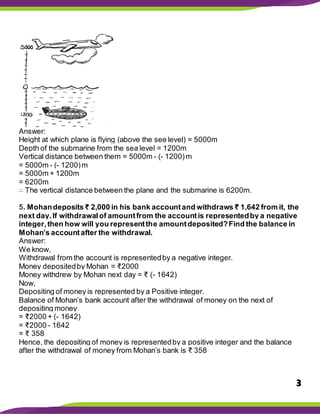
4. A plane is flying at the heightof 5000 m above the sea level. At a particular
point, it is exactly above a submarinefloating 1200 m below the sea level. What
is the verticaldistance betweenthem?
3
Answer:
Height at which plane is flying (above the see level) = 5000m
Depth of the submarine from the sea level = 1200m
Vertical distance between them = 5000m - (- 1200)m
= 5000m - (- 1200)m
= 5000m + 1200m
= 6200m
∴ The vertical distance between the plane and the submarine is 6200m.
5. Mohandeposits ₹ 2,000 in his bank accountand withdraws ₹ 1,642 from it, the
next day.If withdrawalof amountfrom the accountis representedby a negative
integer,then how will you representthe amountdeposited?Find the balance in
Mohan’s accountafter the withdrawal.
Answer:
We know,
Withdrawal from the account is representedby a negative integer.
Money depositedby Mohan = ₹2000
Money withdrew by Mohan next day = ₹ (- 1642)
Now,
Depositing of money is represented by a Positive integer.
Balance of Mohan’s bank account after the withdrawal of money on the next of
depositing money
= ₹2000 + (- 1642)
= ₹2000 - 1642
= ₹ 358
Hence, the depositing of money is representedby a positive integer and the balance
after the withdrawal of money from Mohan’s bank is ₹ 358
4
6. Rita goes 20 km towards eastfrom a point A to the point B. From B, she
moves 30 km towardswestalong the same road.If the distance towards eastis
representedby a positive integer then,how will you representthe distance
travelled towards west? By which integer will you representher final position
from A?
Answer:
We know that the distance towards East is represented by a Positive Integer.
So, the distance travelled towards west is represented bya Negative Integer.
Distance travelled by Rita in east direction = (20 Kilometer)
Distance travelled by Rita in west direction = (- 30 Kilometer)
Distance travelled to east to west
= 20 + (- 30)
= 20 - 30
= (- 10 Kilometer)
Hence, distance travelled towards west is represented bya negative integer. Rita
travels (- 10 Kilometer)towards west.
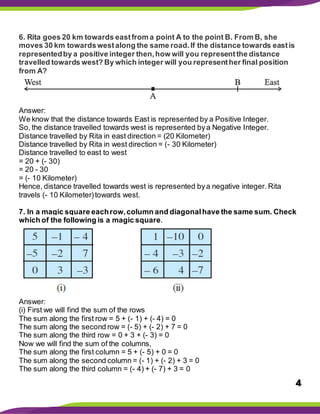
7. In a magic square eachrow,column and diagonalhave the same sum. Check
which of the following is a magic square.
Answer:
(i) First we will find the sum of the rows
The sum along the first row = 5 + (- 1) + (- 4) = 0
The sum along the second row = (- 5) + (- 2) + 7 = 0
The sum along the third row = 0 + 3 + (- 3) = 0
Now we will find the sum of the columns,
The sum along the first column = 5 + (- 5) + 0 = 0
The sum along the second column = (- 1) + (- 2) + 3 = 0
The sum along the third column = (- 4) + (- 7) + 3 = 0
5
Now, we will take out the sum of diagonals
The sum along the first diagonal = 5 + (- 2) + (- 3) = 0
The sum along the second diagonal = (- 4) + (- 2) + 0 = (- 6)
Hence, it’s not a magic square because one of its diagonal is (- 6) and the other all
columns, rows and diagonals have the sum 0.
(ii) First we will find the sums of the rows.
The sum along the first row = 1 + (- 10) + 0 = (- 9)
The sum along the second row = (- 4) + (- 3) + (- 2) = (- 9)
The sum along the third row = (- 6) + (- 4) + (- 2) = (- 9)
Now, we will considerthe columns
The sum along the first column = 1 + (- 4) + (- 6) = (- 9)
The sum along the second column = (- 10) + (- 3) + 4 = (- 9)
The sum along the third column = 0 + (- 2) + (- 7) = (- 9)
Now, we will considerthe diagonals
The sum along the first diagonal = 1 + (- 3) + (- 7) = (- 9)
The sum along the second diagonal = (- 6) + (- 3) + 0 = (- 9)
Hence (ii) is a magic square because the sum of all the rows, columns and diagonals is
same which is (- 9).
8. Verify a – (– b) = a + b for the following values of a and b.
(i) a = 21, b = 18
Answer:
a = 21 and b = 18
To verify this we will take out the L.H.S
= a - (- b)
= 21 - (- 18)
= 21 + 18
= 39
Hence, the value of L.H.S is 39
The R.H.S of this is
= a + b
= 21 + 18
= 39
The value of both L.H.S (Left hand side)and R.H.S (Right hand side) is same
= L.H.S = R.H.S
6
39 = 39
Hence the value of a and b is satisfied.
(ii) a = 118,b = 125
To verify this we will take out the L.H.S
= a - (- b)
= 118 + (- 125)
= 118 + 125
= 243
The R.H.S of it is
= a + b
= 118 + 125
= 243
The value of both L.H.S and R.H.S is same
= L.H.S = R.H.S
243 = 243
Hence, the value of a and b is satisfied
(iii) a = 75, b = 84
To verify we will take out the L.H.S
= a - (- b)
= 75 - (- 84)
= 75 + 84
= 159
The R.H.S of it is
= a + b
= 75 + 84
= 159
The value of both L.H.S and R.H.S is same
= L.H.S = R.H.S
159 = 159
Hence, the value of a and b is satisfied.
(iv) a = 28, b = 11
To verify we will take out the L.H.S
= a - (- b)
= 28 - (- 11)
= 28 + 11
7
= 39
Now,
We will take out the R.H.S of the following.
= a + b
= 28 + 11
= 39
The value of both L.H.S and R.H.S is same
= L.H.S = R.H.S
39 = 39
Hence, the value of a and b is satisfied.
9. Use the sign of >, < or = in the box to make the statements true.
(a) (- 8) + (- 4) (- 8) - (- 4)
Answer:
To find the answer we will take out the L.H.S and the R.H.S
The L.H.S of the following is
= (- 8) + (- 4)
= (- 8) - 4
= (- 12)
The R.H.S of the following is
= (- 8) - (- 4)
= (- 8) + 4
= (- 4)
Therefore, (a) (- 8) + (- 4) < (- 8) - (- 4)
So, (- 8) + 4 > (- 8) - (- 4)
(b) (- 3) + 7 - (19) 15 - 8 + (- 9)
Answer:
To find the answer of the following we will find the L.H.S and the R.H.S of the following
The L.H.S of the following is
= (- 3) + 7 - 19
= (- 15)
The R.H.S of the following is
= 15 - 8 + (- 9)
= (- 2)
Therefore,(- 15) < (- 2)
So, (- 3) + 7 - 19 < 15 - 8 + (- 9)
(c) 23 - 41 + 11 23 - 41 -11
8
Answer:
To find the answer of the following we will find the L.H.S and the R.H.S of the following
The L.H.S of the following is
= {23 - 41} + 11
= {23 - 41}
= (- 18)
= (- 18) + 11
= (- 7)
The R.H.S of the following is
= 23 - 41 - 11
= {23 - 41}
= (- 18) - 11
= (- 29)
Therefore,(- 7) > (- 29)
So, 23 - 41 + 11 > 24 - 41 -11
(d) 39 + (- 24) - (15) 36 + (- 52) - (- 36)
Answer:
Answer:
To find the answer of the following we will find the L.H.S and the R.H.S of the following
The L.H.S of the following is
= 39 + (- 24) - 15
= 39 - 24
= 15
= 15 - 15
= 0
The R.H.S of the following is
= 36 + (- 52) - (- 36)
= 36 - 52 + 36
= 36 - 52
= (- 16) + 36
= 20
Therefore,0 > 20
So, 39 + (- 24) - 15 < 36 + (- 52) - (- 36)
(e) - 231 + 79 + 51 - 399 + 159 + 81
Answer:
To find the answer of the following we will find the L.H.S and the R.H.S of the following
The L.H.S of the following is
= - 231 + 79 + 51
9
= 79 + 51
= 130
= - 231 + 130
= - 101
Now,
The R.H.S of the following is
= - 399 + 159 + 81
= 159 + 81
= 250
= - 399 + 250
= (- 149)
Therefore,(- 101) > (- 149)
So, - 231 + 79 + 51 > - 399 + 159 + 81
10. A water tank has steps inside it. A monkey is sitting on the topmoststep (i.e.,
the first step). The water levelis at the ninth step.
Answer:
(i) He jumps 3 steps down and then jumps back 2 steps up. In how many jumps
will he reach the water level?
Answer:
Let us considersteps moved down are represented by positive integers and then,
steps moved up are represented by negative integers.
As; initially the monkey was sitting at the first step.
In 1st
jump monkey will be at step = 1 + 3 = 4 steps
In 2nd
jump monkey will be at step = 4 + (-2) = 4 – 2 = 2 steps
In 3rd
jump monkey will be at step = 2 + 3 = 5 steps
In 4th
jump monkey will be at step = 5 + (-2) = 5 – 2 = 3 steps
10
In 5th
jump monkey will be at step = 3 + 3 = 6 steps
In 6th
jump monkey will be at step = 6 + (-2) = 6 – 2 = 4 steps
In 7th
jump monkey will be at step = 4 + 3 = 7 steps
In 8th
jump monkey will be at step = 7 + (-2) = 7 – 2 = 5 steps
In 9th
jump monkey will be at step = 5 + 3 = 8 steps
In 10th
jump monkey will be at step = 8 + (-2) = 8 – 2 = 6 steps
In 11th
jump monkey will be at step = 6 + 3 = 9 steps
∴Monkey took 11 jumps or 9th
step to reach the water level.
(ii) After drinking water,he wants to go back.For this, he jumps 4 steps up and
then jumps back 2 steps down in every move.In how many jumps will he reach
back the top step?
Answer:
Let us considersteps moved down are represented by positive integers and then,
steps moved up are represented by negative integers.
Initially monkey is sitting on the ninth step i.e., at the water level
In 1st
jump monkey will be at step = 9 + (-4) = 9 – 4 = 5 steps
In 2nd
jump monkey will be at step = 5 + 2 = 7 steps
In 3rd
jump monkey will be at step = 7 + (-4) = 7 – 4 = 3 steps
In 4th
jump monkey will be at step = 3 + 2 = 5 steps
In 5th
jump monkey will be at step = 5 + (-4) = 5 – 4 = 1 step
∴Monkey took 5 jumps to reach back the top step i.e., first step.
(iii) If the number ofsteps moved down is represented by negative integersand
the number of steps moved up by positive integers,representhis moves in part
(i) and (ii) by completing the following; (a) – 3 + 2 – … = – 8 (b) 4 – 2 + … = 8. In
(a) the sum (– 8) represents going down by eight steps.So, what will the sum 8
in (b) represent?
Answer:
If the number of steps moved down is representedby negative integers and the
number of steps moved up by positive integers.
Monkey moves in part (i)
= – 3 + 2 – ……….. = – 8
Then LHS = – 3 + 2 – 3 + 2 – 3 + 2 – 3 + 2 – 3 + 2 – 3
= – 18 + 10
= – 8
RHS = -8
∴Moves in part (i) represents monkey is going down 8 steps.Because negative integer.
11
Now,
Monkey moves in part (ii)
= 4 – 2 + ……….. = 8
Then LHS = 4 – 2 + 4 – 2 + 4
= 12 – 4
= 8
RHS = 8
∴Moves in part (ii) represents monkey is going up 8 steps.Because positive integer.
Exercise 1.2
1. Write down a pair of integers whose:
(a) Sum is -7
Answer:
(- 5) + (- 2)
= (- 5) - 2
= (- 7)
Therefore,there are many pairs of integers such as given above.
(b) differenceis – 10
Answer:
(- 26) - (- 16)
= (- 26) + 16
= (- 10)
Therefore,there are many pairs of integers such as given above.
(c) sum is 0
(- 116)+ 116
= (- 116)+ 116
= 0
Therefore,there are many pairs of integers such as given above.
2.
(a) Write a pair of negative integers whose differencegives 8
Answer:
= (- 12) - (- 20)
= (- 12) + 20
= (- 12) + 12 = 0
= 20 - 12
12
= 8
Therefore,there are many pairs of integers such as given above.
(b) Write a negative integer and a positive integer whosesum is – 5.
Answer:
= (- 32) + 27
= (- 5)
Therefore,there are many pairs of integers such as given above.
(c) Write a negative integer and a positive integer whosedifference is – 3.
Answer:
= (- 6) - (- 3)
= (- 6) + 3
= (- 3)
Therefore,there are many pairs of integers such as given above.
3. In a quiz, team A scored – 40, 10, 0 and team B scored10, 0, – 40 in three
successive rounds.Which team scored more?Can we say that we can add
integers in any order?
Answer:
From the question we know that
The score of Team A = (- 40), 10, 0
The total score obtained by team A is = (- 40) + 10 + 0
= (- 30)
The score of Team B in 3 successive rounds = 10, 0, (- 40)
The total score obtained by team B is = 10 + 0 + (- 40)
= (- 30)
Thus, the score of both Team A and Team B is same.
Therefore,we can say that we can add the integers in any order.
4. Fill in the blanks to make the following statements true:
(i) (–5) + (– 8) = (– 8) + (…………)
Answer:
Let’s name the missing integer (m)
(–5) + (– 8) = (– 8) + (…………)
(- 5) + (- 8)
= (- 5) - 8
= 13
By sending (- 8) from R.H.S to L.H.S it becomes 8
= (- 13) + 8
13
= (- 5)
Therefore,the missing value (i.e. m) is (- 5)
Now substitute the value of x
(–5) + (– 8) = (– 8) + (- 5) …
[This equation is in the form of Commutative law of Addition]
(ii) –53 + ………… = –53
Let’s name the missing integer (m)
–53 + ………… = –53
It mean’s (- 53) + (m) = (- 53)
By sending (- 53) from R.H.S to L.H.S it becomes53
So,
(- 53) + 53 = 0
Therefore,the missing value (i.e. m) is 0
Now substitute the value of x
(- 53 + 0 = (- 53)
[This equation is in the form of Closure property of Addition]
(iii) 17 + ………… = 0
Let’s name the missing integer (m)
17 + ………… = 0
It means 17 + m = 0
By sending 17 from R.H.S to L.H.S it becomes(- 17)
(m) = 0 - 17
x = (- 17)
Therefore,the missing value (i.e. m) is (- 17)
Now substitute the value of x
17 + (-17) = 0 … [This equation is in the form of Closure property of Addition]
= 17 + (- 17) =
= 17 - 17 = 0
(iv) [13 + (– 12)] + (…………) = 13 + [(–12) + (–7)]
Answer:
Let’s name the missing integer (m)
[13 + (– 12)] + …….. = 13 + [(–12) + (–7)]
It means [13 + (– 12)] + (m) = 13 + [(–12) + (–7)]
= [13 - 12] + (m) = 13 + [- 12 - 7]
= 1 + (m) = 13 + (- 19)
= 1 + (m) = 13 - 19
= 1 + (m) = (- 6)
14
By sending 1 from LHS to RHS it becomes -1
(m) = (- 6) + (- 1)
= (- 6) - 1
= (- 7)
Therefore,the missing value (i.e. m) is (- 7)
Now substitute the value of x
= [13 + (– 12)] + (-7) = 13 + [(–12) + (–7)] …
[This equation is in the form of Associative property of Addition]
(v) (– 4) + [15 + (–3)] = [– 4 + 15] +…………
Answer:
Let’s name the missing integer (m)
(– 4) + [15 + (–3)] = [– 4 + 15] + ………..
= (– 4) + [15 – 3)] = [– 4 + 15] + (m)
= (-4) + [12] = [11] + (m)
= 8 = 11 + x
By sending 11 from RHS to LHS it becomes-11
= 8 – 11 = m
= (m) = -3
Therefore,the missing value (i.e. m) is
Now substitute the value of x
= (– 4) + [15 + (–3)] = [– 4 + 15] + -3 …
[This equation is in the form of Associative property of Addition]
Exercise 1.3 (Page Number - 21)
1. Find each of the following products:
(a) 3 × (–1)
Answer:
We’ll use the rule of Multiplication
= 3 x (- 1)
As there is only 1 negative integer the answer will also be in negative integer.
= 3 x (- 1)
= (- 3)
Therefore,(- 3) is the answer.
(b) (–1) × 225
Answer:
We’ll use the rule of Multiplication
= (- 1) x 225
As there is only 1 negative integer the answer will also be in negative integer.
15
= (- 1) x 225
= (- 225)
Therefore,(- 225) is the answer.
(c) (–21) × (–30)
Answer:
We will use the rule of multiplication
= (– 21) × (– 30)
As there are two negative integers the answer will be in Positive integer.
= (– 21) × (– 30)
= 630
Therefore,630 is the answer.
(d) (–316)× (–1)
Answer:
We will use the rule of multiplication
= (– 316)× (– 1)
As there are two negative integers the answer will be in Positive integer.
= (– 316)× (– 1)
= 316
Therefore,the answer is 316
(e) (–15) × 0 × (–18)
Answer:
We will use the rule of multiplication
= (–15) × 0 × (–18)
= 0
Any integer multiplied by 0 the product is 0 only.
Therefore,the answer is 0
(f) (–12) × (–11) × (10)
Answer:
We will use the rule of multiplication
= (–12) × (–11) × (10)
As there are two negative integers the answer will be in Positive integer.
= (–12) × (–11) × (10)
= (–12) × (–11)
= 132
= 132 × 10
= 1320
16
Therefore,the answer is 1320
(g) 9 × (–3) × (– 6)
Answer:
We will use the rule of multiplication
As there are two negative integers the answer will be in Positive integer.
= 9 × (–3) × (– 6)
= (- 3) × (- 6)
= 18
= 9 × 18
= 162
Therefore,the answer is 162
(h) (–18) × (–5) × (– 4)
Answer:
We will use the rule of multiplication
As there are three negative integers the answer will be in negative integer
= (–18) × (–5) × (– 4)
= (- 18) × (- 5)
= 90
= 90 × (- 4)
= (- 360)
Therefore,the answer is (- 360)
(i) (–1) × (–2) × (–3) × 4
Answer:
We will use the rule of multiplication
As there are three negative integers the answer will be in negative integer
= (–1) × (–2) × (–3)
= (- 6)
= (- 6) × 4
= (- 24)
Therefore,the answer is (- 24)
(j) (–3) × (–6) × (–2) × (–1)
Answer:
We will use the rule of multiplication
As there are four negative integers the answer will be in positive integer.
= [(–3) × (–6)] × [(–2) × (–1)]
= [(–3) × (–6)]
17
= 18
= [(–2) × (–1)]
= 2
= 18 × 2
= 36
Therefore,the answer is 36.
2. Verify the following:
(a) 18 × [7 + (–3)] = [18 × 7] + [18 × (–3)]
Answer:
We will find out the L.H.S and the R.H.S of the following to verify the following.
The L.H.S of the following
First we’ll solve the question in the bracket
= 18 × [7 + (–3)]
= 18 × 7 - 3
= 18 × 4
= 72
Now,
The R.H.S of the following is
= 18 × 7
= 126 + [18 × (–3)]
= [18 × (–3)]
= (- 54)
= 126 + (- 54)
= 126 - 54
72 = 72
Therefore,L.H.S = R.H.S
So, the equation is verified
(b) (–21) × [(– 4) + (– 6)] = [(–21) × (– 4)] + [(–21) × (– 6)]
Answer:
We will find out the L.H.S and the R.H.S of the following to verify the following.
The L.H.S of the following
= (–21) × [(– 4) + (– 6)]
= (–21) × [(- 4) - 6]
= (- 21) × (- 10)
= 210
So the L.H.S is 210
Now,
18
The R.H.S of the following is
= [(–21) × (– 4)] + [(–21) × (– 6)]
= (- 21) × (- 4)
= 84
= (- 21) × (- 6)
= 126
= 126 + 84
= 210
210 = 210
Therefore L.H.S = R.H.S
So, the equation is verified.
3.
(i) For any integer a, whatis (–1) × a equalto?
Answer:
= (-1) × a = -a
Therefore,when we multiplied any integer (a) with -1, then we get additive inverse of
that integer.
(ii) Determinethe integer whose productwith (–1) is
Answer:
(a) –22
Answer:
Now, multiply -22 with (-1), we get
= -22 × (-1)
= 22
Because,when we multiplied integer -22 with -1, then we get additive inverse of that
integer.
(b) 37
Answer:
Now, multiply 37 with (-1), we get
= 37 × (-1)
= -37
Because,when we multiplied integer 37 with -1, then we get additive inverse of that
integer.
(c) 0
Answer:
Now, multiply 0 with (-1), we get
= 0 × (-1)
19
= 0
As, the product of zero give zero only.
4. Starting from (–1) × 5, write various products showing some patternto show
(–1) × (–1) = 1.
Solution:-
The various products are,
= -1 × 5 = -5
= -1 × 4 = -4
= -1 × 3 = -3
= -1 × 2 = -2
= -1 × 1 = -1
= -1 × 0 = 0
= -1 × -1 = 1
We concluded that the product of one negative integer and one positive integer is
negative integer. Then, the product of two negative integers is a positive integer.
5. Find the product,using suitable properties:
(a) 26 × (– 48) + (– 48) × (–36)
Answer:
The given equation can be solved with the Distributive Law
Formulae of Distributive Law
= a × (b + c) = (a × b) + (a × c)
Let say a - 48, b - 26, c - (- 36)
Now,
= 26 × (– 48) + (– 48) × (–36)
= - 48 × (26 + (-36)
= 26 - 36
= (- 10)
= (- 48 × (- 10)
= 480
Therefore,480 is the answer
(b) 8 × 53 × (–125)
Answer:
The given equation can be solved with the Commutative Law.
Formulae of Commutative Law
= a × b = b × a
Let a - 8, b - 53, c - (- 125)
Then,
20
= 8 × 53 × (–125)
= 8 × (- 125)
= (- 1000)
= (- 1000)× 53
= (- 53000)
Therefore,(- 53000)is the answer.
(c) 15 × (–25) × (– 4) × (–10)
Answer:
We will solve this question with commutative law of Multiplication
Formulae of Commutative Law
= a × b = b × a
Then,
= 15 × [(- 25) × (- 4)]
= 15 × 100
= 1500
= 1500 × (- 10)
= (- 15000)
Therefore,(- 15000)is the answer.
(d) (– 41) × 102
Answer:
We will solve this question with Distributive Law of Multiplication.
Formulae of Distributive Law
= a × (b + c) = a × b + a × c
Then,
= (- 41) × 102
= (- 41) × (100 + 2)
= (- 41 × 100)+ (- 41 × 2)
= (- 41 × 100)
= (- 4100)+ (- 41× 2)
= (- 41) × 2
= (- 82)
= (- 4100)+ (- 82)
= (- 4100)- 82
= (- 4,182)
Therefore,(- 4,182)is the answer.
(e) 625 × (–35) + (– 625) × 65
Answer:
21
We will solve this question with Distributive Law of Multiplication.
Formulae of Distributive Law
= a × (b + c) = a × b + a × c
Then,
= 625 × (- 35) + (- 65)
= (- 35) + (- 65)
= (- 100)
= 625 × (- 100)
= (- 62,500)
(f) 7 × (50 – 2)
Answer:
We will solve this question with Distributive Law of Multiplication.
Formulae of Distributive Law
= a × (b + c) = a × b + a × c
Then,
= 7 × 50 - 7 × 2
= 7 × 50
= 350
= 7 × 2
= 14
= 350 - 14
= 336
Therefore,336 is the answer.
(g) (–17) × (–29)
Answer:
We will solve this question with Distributive Law of Multiplication.
Formulae of Distributive Law
= a × (b + c) = a × b + a × c
Then,
= (- 17) × (- 29)
= (- 17) × (30 + 1)
= (- 17) × 30
= (510)
= (-17 × 1)
= (- 17)
= (510 + (- 17)
= (510 - 17)
= (493)
22
Therefore,493 is the answer.
(h) (–57) × (–19) + 57
Answer:
We will solve this question with Distributive Law of Multiplication.
Formulae of Distributive Law
= a × (b + c) = a × b + a × c
Then,
= (- 57) × (- 19) + (- 57) × 1
Simplifying
= (- 57) × [(- 19 + 1)
= (- 57) × (- 20)
= 1140
Therefore,1140 is the answer.
6. A certain freezing processrequiresthat room temperature be lowered from
40°C at the rate of 5°C every hour.What will be the room temperature 10 hours
after the process begins?
Answer:
From the question we know that,
Temperature of the room before the process started = 40°C
Rate of temperature being lowered down = 5°C per hour
Room Temperature after 1st
hour = 5°C × 1 = 5°C
Room Temperature after 2nd
hour = 5°C × 2 = 10°C
Room Temperature after 3rd
hour = 5°C × 3 = 15°C
Room Temperature after 4th
hour = 5°C × 4 = 20°C
Room Temperature after 5th
hour = 5°C × 5 = 25°C
Room Temperature after 6th
hour = 5°C × 6 = 30°C
Room Temperature after 7th
hour = 5°C × 7 = 35°C
Room Temperature after 8th
hour = 5°C × 8 = 40°C
Room Temperature after 9th
hour = 5°C × 9 = 45°C
Room Temperature after 10th
hour = 5°C × 10 = 50°C
∴ the temperature of room after 10 hours is = 40°C - 50°C = (- 10°C)
7. In a class test containing 10 questions,5 marks are awarded for every correct
answer and (–2)marks are awarded for every incorrectanswerand 0 for
questionsnot attempted.
Totalno. questionsthe examination contains = 10 questions
Marksawardedfor each correctanswer= 5 marks
23
Marksawardedfor each incorrectanswer = (- 2) marks
(i) Mohangets four correctand six incorrectanswers.What is his score?
Answer:
Marks awarded for 4 correct answers by Mohan = 4 × 5 = 20 Marks
Marks awarded for 6 incorrect answers = 6 × (- 2) = (- 12)
Score of Mohan
= 20 + (- 12)
= 20 - 12
= 8
∴ 8 marks are the total score of Mohan in the class test.
(ii) Reshma gets five correctanswersand five incorrectanswers,whatis her
score?
Answer:
Marks awarded for 5 correct answers by Mohan = 5 × 5 = 25 Marks
Marks awarded for 5 incorrect answers = 5 × (- 2) = (- 10)
Score of Reshma
= 25 + (- 10)
= 25 - 10
= 15
∴ 15 marks are the total score of Reshma in the class test.
(iii) Heena gets two correctand five incorrectanswers outof seven questions
she attempts. What is her score?
Answer:
Marks awarded for 2 correct answers by Heena = 2 × 5 = 10 Marks
Marks awarded for 5 incorrect answers = 5 × (- 2) = (- 10)
Score of Heena,
= 10 + (- 10)
= 10 - 10
= 0
∴0 marks is the total score of Heena in the class test.
8. A cementcompanyearnsa profit of ₹ 8 per bag of white cementsold and a
loss of ₹ 5 per bag of grey cementsold.
Profit on per bag of white cement = ₹ 8 per bag
Loss on per bag of grey cement= ₹ 5 per bag
24
(a) The company sells 3,000 bags of white cementand 5,000 bags of grey cement
in a month. What is its profit or loss?
Answer:
We,denote profitby a positive integer and loss by a negative integer
Profit on selling 3000 bags of white cement= ₹ 8 × 3000 = ₹ (24000)
Loss on selling 5000 bags of grey cement = ₹ 5 × 5000 = ₹ (- 25000)
So,
24,000 + (- 25,000)
= 24,000 - 25,000
= (- 1000)
Therefore there is a loss of ₹1000 in total.
(b) What is the number of white cementbags it mustsell to have neither profit
nor loss, if the numberof grey bags sold is 6,400 bags.
Answer:
We,denote profitin Positive Integerand loss in Negative Integer.
As,
Cement Company earns a profit of ₹ 8 on per bag of white cement.
Let the number of cementbag (y)
Then,
Cement company earns a profit on selling y bags of white cement= (y) × ₹ 8
= ₹ 8x
Loss on selling 1 bag of grey cement= – ₹ 5 per bag
Then,
Loss on selling 6400 bags of grey cement = 6400 × – ₹ 5
= (– ₹ 32000)
Now let’s come to the question,
Company must sell to have neither profitnor loss.
= Profit + loss = 0
= 8x + (-32000)=0
By sending (- 32000)from L.H.S to R.H.S it becomes32000
= 8y = 32000
= y = 32000 ÷ 8
= 4000
Hence, 4000 bags of white cement have to be sold to have neither profit nor loss for
the Cement Company.
9. Replace the blank with an integer to make it a true statement.
(a) (–3) × _____ = 27
Answer:
25
Let’s name the missing place (m)
So,
= (- 3) × m = 27
= (m) = 27÷ (- 3)
= 27 ÷ (- 3)
= (- 9)
= (- 3) × (- 9) = 27
Let’s substitute the value of (m)
(- 3) × (- 9) = 27
Therefore,(- 9) is the answer.
(b) 5 × _____ = –35
Answer:
Let’s name the missing place (m)
So,
= 5 × m = (- 35)
= m = (- 35) ÷ 5
= (- 35) ÷ 5
= (- 7)
= 5 × (- 7) = (- 35)
Let’s substitute the value of (m)
5 × (- 7) = (- 35)
Therefore, (-7) is the answer.
(c) _____ × (– 8) = –56
Answer:
Let’s name the missing place (m)
So,
= (m) × (- 8) = (- 56)
= (m) = (- 56) ÷ (- 8)
= (- 56) ÷ (- 8)
= 7
Let’s substitute the value of (m)
7 × (- 8) = (- 56)
(d) _____ × (–12) = 132
Answer:
Let’s name the missing place (m)
So,
= (m) × (- 12) = 132
26
= (m) = 132 ÷ (- 12)
= (- 11)
Let’s substitute the value of (m)
(- 11) × (- 12) = 132
Exercise 1.4 (Page no. 26)
1. Evaluate each ofthe following:
(a) (–30) ÷ 10
Answer:
10 - 30 3
30 Therefore,(- 3) is the answer.
00
Rule of division of Integers:Whenwe divide a negative integer by a positive integer,
we first divide them as whole numbers and then put minus sign (-) before the quotient.
(b) 50 ÷ (- 5)
Answer:
-5 50 - 10
- 5
00
00
00
Rule of division of Integers:Whenwe divide a negative integer by a positive integer,
we first divide them as whole numbers and then put minus sign (-) before the quotient.
(c) (- 36) ÷ (- 9)
Answer:
-9 - 36 4
36
00
Rule of division of Integers:Whenwe divide a negative integer by a positive integer,
we first divide them as whole numbers and then put minus sign (-) before the quotient.
(c) (- 36) ÷ (- 9)
Answer:
= (- 36) ÷ (- 9)
= 4 Therefore 4 is the answer
27
Rule of division of integers:When we divide a Negative integer by a Negative integer
we will first divide them as whole numbers and the put Plus sign (+) before the
quotient.
(d) (– 49) ÷ (49)
Answer:
= (- 49) ÷ 49
= 1 Therefore 1 is the answer.
Rule of division of integers:When we divide a Negative integer by a Positive integer
we will first divide them as whole numbers and the put Plus sign (+) before the
quotient.
(e) 13 ÷ [(–2) + 1]
Answer:
= 13 ÷ [(–2) + 1]
First we will solve the numbers in bracket.
= (- 2) + 1
= (- 1)
= 13 ÷ (- 1)
= (- 13) Therefore,the answer is (- 13)
Rule of division of Integers:Whenwe divide a negative integer by a positive integer,
we first divide them as whole numbers and then put minus sign (-) before the quotient.
(f) 0 ÷ (–12)
Answer:
= 0 ÷ 12
= 0 Therefore,the answer is 0
Rule of division of Integers: When we divide zero by a negative integer gives zero.
(g) (–31) ÷ [(–30) + (–1)]
Answer:
= (–31) ÷ [(–30) + (–1)]
First we will solve the numbers in the bracket
= (- 30) + (- 1)
= (- 30) - 1
= (- 31)
Now,
= (- 31) ÷ (- 31)
= 1 Therefore,the answer is 1
28
Rule of division of integers:Whenwe divide a Negative integer by a Negative integer
we will first divide them as whole numbers and the put Plus sign (+) before the
quotient.
(h) [(–36) ÷ 12] ÷ 3
Answer:
First we will solve the numbers in the brackets
= [(–36) ÷ 12]
= (- 3)
Rule of Division of Integers:Whenwe divide a negative integer by a positive integer,
we first divide them as whole numbers and then put minus sign (-) before the quotient.
Now,
= (- 3) ÷ 3
= (- 1) Therefore the answer is (- 1)
Rule of Division of Integers:Whenwe divide a negative integer by a positive integer,
we first divide them as whole numbers and then put minus sign (-) before the quotient.
(i) [(– 6) + 5)] ÷ [(–2) + 1]
Answer:
= [(– 6) + 5)] ÷ [(–2) + 1]
= (- 6) + 5
= (- 1)
Now,
= (- 2) + 1
= (- 1)
= (- 1) ÷ (- 1)
= 1 Therefore the answer is (- 1)
Rule of division of integers:Whenwe divide a Negative integer by a Negative integer
we will first divide them as whole numbers and the put Plus sign (+) before the
quotient.
2. Verify that a ÷ (b + c) ≠ (a ÷ b) + (a ÷ c) for each of the following values of a, b
and c.
(a) a = 12, b = – 4, c = 2
Answer:
From the question we understand that, a ÷ (b + c) ≠ (a ÷ b) + (a ÷ c)
We know that,
A = 12, b = (- 4), c = 2
We will considerthe L.H.S (Left hand side) = a ÷ (b + c)
= 12 ÷ [(- 4) + 2]
29
First we will solve the numbers in the brackets.
= [(- 4) + 2]
= (- 4) + 2
= (- 2)
= 12 ÷ (- 2)
= (- 6)
Rule of Division of Integers:Whenwe divide a negative integer by a positive integer,
we first divide them as whole numbers and then put minus sign (-) before the quotient.
We will now considerthe R.H.S (a ÷ b) + (a ÷ c)
= [(12 ÷ (- 4)] + (12 ÷ 2)
= 12 ÷ (- 4)
= (- 3)
Rule of Division of Integers:Whenwe divide a negative integer by a positive integer,
we first divide them as whole numbers and then put minus sign (-) before the quotient.
Now,
= 12 ÷ 2
= 6 + (- 3)
= 6 - 3
= 3
By comparing L.H.S and R.H.S
Therefore,L.H.S ≠ R.H.S
a ÷ (b + c) ≠ (a ÷ b) + (a ÷ c)
Therefore the equation is verified.
(b) a = (–10), b = 1, c = 1
Answer:
From the question we understand that, a ÷ (b + c) ≠ (a ÷ b) + (a ÷ c)
a = (–10), b = 1, c = 1
We will considerthe L.H.S
= a ÷ (b + c)
= (- 10) ÷ [1 + 1]
= (- 10) ÷ 2
= (- 5)
Rule of Division of Integers:Whenwe divide a negative integer by a positive integer,
we first divide them as whole numbers and then put minus sign (-) before the quotient.
Now,
We will considerthe R.H.S
= (- 10) ÷ 1
= (- 10)
= (- 10) ÷ 1
30
= (- 10) ÷ (- 10)
= 1
Rule of division of integers:Whenwe divide a Negative integer by a Negative integer
we will first divide them as whole numbers and the put Plus sign (+) before the
quotient.
By comparing L.H.S and R.H.S
Therefore,L.H.S ≠ R.H.S
a ÷ (b + c) ≠ (a ÷ b) + (a ÷ c)
Therefore the equation is verified.
3. Fill in the blanks:
(a) 369 ÷ _____ = 369
Answer:
Let’s name the missing place (m)
Then,
= 369 ÷ (m) = 369
= (m) = (369 ÷ 369)
= 1
Therefore the value of (m) is 1
That means 369 ÷ 1 = 369
(b) (–75) ÷ _____ = –1
Answer:
Let’s name the missing place (m)
Then,
= (- 75) ÷ m = (- 1)
= m = [(- 75) ÷ (- 1)
= 75
Therefore the value of (m) is 75
That means (–75) ÷ 75 = –1
(c) (–206)÷ _____ = 1
Answer:
Let’s name the missing place (m)
Then,
= (–206)÷ m = 1
= (m) = [(- 206) ÷ 1)]
= (- 206)
Therefore the value of (m) is (- 206)
That means (–206)÷ (- 206) = 1
31
(d) – 87 ÷ _____ = 87
Answer:
Let’s name the missing place (m)
Then,
= (- 87) ÷ m = 87
= (m) = [(- 87) ÷ 87]
= (- 1)
Therefore the value of (m) is (- 1)
That means (- 87) ÷ (- 1) = 87
(e) _____ ÷ 1 = – 87
Answer:
Let’s name the missing place (m)
Then,
= m ÷ 1 = – 87
= m = [(- 87) ÷ 1]
= (- 87)
Therefore the value of (m) is (- 87)
That means (- 87) ÷ 1 = (- 87)
(f) _____ ÷ 48 = –1
Answer:
Let’s name the missing place (m)
Then,
= (m) ÷ 48 = –1
= (m) = [48 ÷ (- 1)]
= (- 48)
Therefore the value of (m) is (- 48)
That means (- 48) ÷ 48 = (- 1)
(g) 20 ÷ _____ = –2
Answer:
Let’s name the missing place (m)
Then,
= 20 ÷ (m) = (- 2)
= (m) = [20 ÷ (- 2)]
= (- 10)
Therefore the value of (m) is (- 10)
That means 20 ÷ (- 10) = –2
32
(h) _____ ÷ (4) = –3
Answer:
Let’s name the missing place (m)
Then,
= (m) ÷ (4) = (- 3)
= (m) = (4) x (- 3)
= (- 12)
Therefore the value of (m) is (- 12)
That means (- 12) ÷ (4) = (- 3)
4. Write five pairs of integers(a, b) such that a ÷ b = –3. One such pair is (6, –2)
because 6 ÷ (–2) = (–3).
Answer:
There are many such pairs some of them are given below
1. 15 ÷ (- 5)
As => 15 ÷ (- 5) = (- 3)
2. (- 15) ÷ 5
As => (- 15) ÷ 5 = (- 3)
3. (- 21) ÷ 7
As => (- 21) ÷ 7 = (- 3)
4. 12 ÷ (- 4)
As => 12 ÷ (- 4) = (- 3)
5. 33 ÷ (- 11)
As => 33 ÷ (- 11) = (- 3)
5. The temperatureat 12 noon was 10o
C above zero.If it decreases at the rate of
2o
C per hour until midnight,at what time would the temperature be 8°C below
zero? What would be the temperatureat mid-night?
Answer:
The Temperature at 12 noon = 10o
C above zero (10o
C)
The rate of decreasing perhour = 2o
C per hour
So,
Temperature at 12 noon = 10o
C
Temperature at 1 pm = 10 + (- 2)
= 10o
C + (- 2o
C)
= 10o
C - (- 2o
C)
= 8o
C
Temperature at 2 pm = 8o
C + (- 2o
C)
= 8o
C + (- 2o
C)
33
= 8o
C - 2o
C
= 6o
C
Temperature at 3 pm = 6o
C + (- 2o
C)
= 6o
C + (- 2o
C)
= 6o
C - 2o
C
= 4o
C
Temperature at 4 pm = 4o
C + (- 2o
C)
= 4o
C + (- 2o
C)
= 4o
C - 2o
C
= 2o
C
Temperature at 5 pm = 2o
C + (-2o
C)
= 2o
C + (-2o
C)
= 2o
C -2o
C
= 0o
C
Temperature at 6 pm = 0o
C + (-2o
C)
= 0o
C + (-2o
C)
= 0o
C -2o
C
= (-2o
C)
Temperature at 7 pm = (- 2o
C) + (- 2o
C)
= (- 2o
C) + (- 2o
C)
= (- 2o
C) - 2o
C
= (- 4o
C)
Temperature at 8 pm = (- 4o
C) + (- 2o
C)
= (- 4o
C) + (- 2o
C)
= (- 4o
C) - 2o
C
= (- 6o
C)
Temperature at 9 pm = (- 6o
C) + (- 2o
C)
= (- 6o
C) + (- 2o
C)
= (- 6o
C) - 2o
C
= (- 8o
C)
Temperature at 10 pm = (- 8o
C) + (- 2o
C)
= (- 8o
C) + (- 2o
C)
= (- 8o
C) - 2o
C
= (- 10o
C)
Temperature at 11 pm = (- 10o
C)+ (- 2o
C)
= (- 10o
C)+ (- 2o
C)
= (- 10o
C)- 2o
C
= (- 12o
C)
Temperature at 12 pm = (- 12o
C) + (- 2o
C)
= (- 12o
C)+ (- 2o
C)
34
= (- 12o
C)- 2o
C
= (- 14o
C)
8o
C below 0 means (- 8o
C)
Therefore at 9 pm the temperature would be 8o
C below 0 (i.e. (- 8o
C)
The temperature at midnight is (- 14o
C).
6. In a class test (+ 3) marks are given for every correctanswerand (–2) marks
are given for every incorrectanswer and no marks for not attempting any
question.
(i) Radhika scored 20 marks.If she has got 12 correctanswers,how many
questionshas she attempted incorrectly?
Answer:
Marks given for every correctanswer = (+ 3) marks
Marks given or every incorrectanswer = (- 2) marks
(i)
Score of Radhika = 20 marks
Marks awarded for 12 correctanswers = 12 x 3 = 36 marks
No. of questions attempted incorrectly = Total score - Marks awarded for correct
answers
= 20 - 36
= (- 16)
So,
Incorrectanswers answered by Radhika = (- 16) ÷ (- 2)
= 8
Therefore Radhika answered 8 incorrectanswers.
(ii) Mohiniscores –5 marks in this test, though she has got 7 correctanswers.
How many questions has she attempted incorrectly?
Answer:
Marks given for every correctanswer = (+ 3) marks
Marks given or every incorrectanswer = (- 2) marks
(ii) Answer
Score of Mohan = (- 5) marks
Marks awarded for 7 correct answers = 7 x 3 = 21 marks
No. of questions attempted incorrectly = Total score - Marks awarded for correct
answers
= (- 5) - 21
= (- 26)
So,
Incorrectanswers answered by Mohini = (- 26) ÷ (- 2)
35
= 13
Therefore Mohini answered 13 incorrect answers.
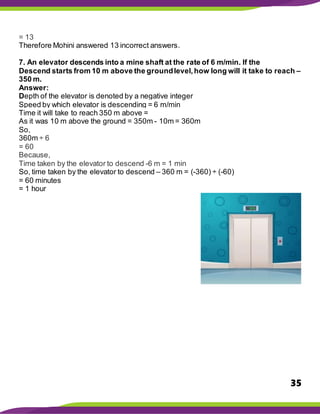
7. An elevator descends into a mine shaft at the rate of 6 m/min. If the
Descend starts from 10 m above the groundlevel,how long will it take to reach –
350 m.
Answer:
Depth of the elevator is denoted by a negative integer
Speed by which elevator is descending = 6 m/min
Time it will take to reach 350 m above =
As it was 10 m above the ground = 350m - 10m = 360m
So,
360m ÷ 6
= 60
Because,
Time taken by the elevator to descend -6 m = 1 min
So, time taken by the elevator to descend – 360 m = (-360) ÷ (-60)
= 60 minutes
= 1 hour
36
37
38
39

Class 7 Integers

  • 1.
    1 Exercise 1.1 1. Followingthe number line shows the temperature in (°C) on differentplaces on a particular day. Answer: (a) Observe this number line and write the temperature on it. Answer: By observing this number line we understand that Temperature at Lahulspiti = (-8) °C Temperature at Srinagar = (-2) °C Temperature at Shimla = 5 °C Temperature at Ooty = 14°C Temperature at Bengaluru = 22°C (b) Write the temperaturedifference between the hottestand the coldestplaces among the above Hottest place = Bengaluru (22°C) ColdestPlace = Lahulspiti (-8) °C Therefore,22 – (-8) = 22°C + 8 = 30°C Hence, the temperature difference betweenthe hottest and the coldestplace above is (30°C) (c) What is the temperature differencebetweenLahulspitiand Srinagar? Answer: Temperature at Lahulspiti = (-8) °C Temperature at Srinagar = (-2) °C Temperature differencebetween Lahulspiti and Srinagar = (-8) °C - (-2) °C = (-8) °C + 2°C = (-6) °C Hence, the temperature difference between Lahulspiti and Srinagar is (-6) °C. (d) Can we say temperatureof Srinagar and Shimla taken together is less than the temperatureat Shimla? Is it also less than the temperatureat Srinagar? Answer: The temperature at Srinagar = 5 °C The temperature at Shimla = (-2) °C Total Temperature at Srinagar and Shimla = 5 °C + (-2) °C = 3°C 5°C > 3°C
  • 2.
    2 Therefore,temperature of Srinagarand Shimla taken together is less than the temperature at Srinagar. Now, (-2) °C < 3°C Therefore,temperature of Srinagar and Shimla taken together is not less than the temperature at Shimla. 2. In a quiz, positive marks are given for correctanswers and negative marksare given for incorrectanswers.If Jack’s scores in five successive roundswere 25, – 5, – 10, 15 and 10, whatwas his total at the end? Answer: Marks Jack scored in 5 successive rounds = 25, – 5, – 10, 15 and 10 Total score of Jack in that test = 25, – 5, – 10, 15 and 10 = 25, – 5, – 10, 15 and 10 = 35 Hence, Jack scored 35 marks in 5 successive rounds of the test. 3. At Srinagar temperature was – 5°C on Mondayand then it dropped by 2°C on Tuesday.What was the temperature of Srinagar on Tuesday? On Wednesday,it rose by 4°C.What was the temperature on this day? Answer: Temperature on Monday at Srinagar = (– 5°C) Temperature that felled on Tuesday = 2°C Temperature that rose on Wednesday= 4°C So, temperature at Tuesday will be = (- 5°C) - 2°C = (- 7°C) Now, Temperature at Wednesdaywill be = (- 7°C) + 4°C = (- 3°C) Hence the temperature on Tuesday and Wednesday will be (- 7°C) and (- 3°C) 4. A plane is flying at the heightof 5000 m above the sea level. At a particular point, it is exactly above a submarinefloating 1200 m below the sea level. What is the verticaldistance betweenthem?
  • 3.
    3 Answer: Height at whichplane is flying (above the see level) = 5000m Depth of the submarine from the sea level = 1200m Vertical distance between them = 5000m - (- 1200)m = 5000m - (- 1200)m = 5000m + 1200m = 6200m ∴ The vertical distance between the plane and the submarine is 6200m. 5. Mohandeposits ₹ 2,000 in his bank accountand withdraws ₹ 1,642 from it, the next day.If withdrawalof amountfrom the accountis representedby a negative integer,then how will you representthe amountdeposited?Find the balance in Mohan’s accountafter the withdrawal. Answer: We know, Withdrawal from the account is representedby a negative integer. Money depositedby Mohan = ₹2000 Money withdrew by Mohan next day = ₹ (- 1642) Now, Depositing of money is represented by a Positive integer. Balance of Mohan’s bank account after the withdrawal of money on the next of depositing money = ₹2000 + (- 1642) = ₹2000 - 1642 = ₹ 358 Hence, the depositing of money is representedby a positive integer and the balance after the withdrawal of money from Mohan’s bank is ₹ 358
  • 4.
    4 6. Rita goes20 km towards eastfrom a point A to the point B. From B, she moves 30 km towardswestalong the same road.If the distance towards eastis representedby a positive integer then,how will you representthe distance travelled towards west? By which integer will you representher final position from A? Answer: We know that the distance towards East is represented by a Positive Integer. So, the distance travelled towards west is represented bya Negative Integer. Distance travelled by Rita in east direction = (20 Kilometer) Distance travelled by Rita in west direction = (- 30 Kilometer) Distance travelled to east to west = 20 + (- 30) = 20 - 30 = (- 10 Kilometer) Hence, distance travelled towards west is represented bya negative integer. Rita travels (- 10 Kilometer)towards west. 7. In a magic square eachrow,column and diagonalhave the same sum. Check which of the following is a magic square. Answer: (i) First we will find the sum of the rows The sum along the first row = 5 + (- 1) + (- 4) = 0 The sum along the second row = (- 5) + (- 2) + 7 = 0 The sum along the third row = 0 + 3 + (- 3) = 0 Now we will find the sum of the columns, The sum along the first column = 5 + (- 5) + 0 = 0 The sum along the second column = (- 1) + (- 2) + 3 = 0 The sum along the third column = (- 4) + (- 7) + 3 = 0
  • 5.
    5 Now, we willtake out the sum of diagonals The sum along the first diagonal = 5 + (- 2) + (- 3) = 0 The sum along the second diagonal = (- 4) + (- 2) + 0 = (- 6) Hence, it’s not a magic square because one of its diagonal is (- 6) and the other all columns, rows and diagonals have the sum 0. (ii) First we will find the sums of the rows. The sum along the first row = 1 + (- 10) + 0 = (- 9) The sum along the second row = (- 4) + (- 3) + (- 2) = (- 9) The sum along the third row = (- 6) + (- 4) + (- 2) = (- 9) Now, we will considerthe columns The sum along the first column = 1 + (- 4) + (- 6) = (- 9) The sum along the second column = (- 10) + (- 3) + 4 = (- 9) The sum along the third column = 0 + (- 2) + (- 7) = (- 9) Now, we will considerthe diagonals The sum along the first diagonal = 1 + (- 3) + (- 7) = (- 9) The sum along the second diagonal = (- 6) + (- 3) + 0 = (- 9) Hence (ii) is a magic square because the sum of all the rows, columns and diagonals is same which is (- 9). 8. Verify a – (– b) = a + b for the following values of a and b. (i) a = 21, b = 18 Answer: a = 21 and b = 18 To verify this we will take out the L.H.S = a - (- b) = 21 - (- 18) = 21 + 18 = 39 Hence, the value of L.H.S is 39 The R.H.S of this is = a + b = 21 + 18 = 39 The value of both L.H.S (Left hand side)and R.H.S (Right hand side) is same = L.H.S = R.H.S
  • 6.
    6 39 = 39 Hencethe value of a and b is satisfied. (ii) a = 118,b = 125 To verify this we will take out the L.H.S = a - (- b) = 118 + (- 125) = 118 + 125 = 243 The R.H.S of it is = a + b = 118 + 125 = 243 The value of both L.H.S and R.H.S is same = L.H.S = R.H.S 243 = 243 Hence, the value of a and b is satisfied (iii) a = 75, b = 84 To verify we will take out the L.H.S = a - (- b) = 75 - (- 84) = 75 + 84 = 159 The R.H.S of it is = a + b = 75 + 84 = 159 The value of both L.H.S and R.H.S is same = L.H.S = R.H.S 159 = 159 Hence, the value of a and b is satisfied. (iv) a = 28, b = 11 To verify we will take out the L.H.S = a - (- b) = 28 - (- 11) = 28 + 11
  • 7.
    7 = 39 Now, We willtake out the R.H.S of the following. = a + b = 28 + 11 = 39 The value of both L.H.S and R.H.S is same = L.H.S = R.H.S 39 = 39 Hence, the value of a and b is satisfied. 9. Use the sign of >, < or = in the box to make the statements true. (a) (- 8) + (- 4) (- 8) - (- 4) Answer: To find the answer we will take out the L.H.S and the R.H.S The L.H.S of the following is = (- 8) + (- 4) = (- 8) - 4 = (- 12) The R.H.S of the following is = (- 8) - (- 4) = (- 8) + 4 = (- 4) Therefore, (a) (- 8) + (- 4) < (- 8) - (- 4) So, (- 8) + 4 > (- 8) - (- 4) (b) (- 3) + 7 - (19) 15 - 8 + (- 9) Answer: To find the answer of the following we will find the L.H.S and the R.H.S of the following The L.H.S of the following is = (- 3) + 7 - 19 = (- 15) The R.H.S of the following is = 15 - 8 + (- 9) = (- 2) Therefore,(- 15) < (- 2) So, (- 3) + 7 - 19 < 15 - 8 + (- 9) (c) 23 - 41 + 11 23 - 41 -11
  • 8.
    8 Answer: To find theanswer of the following we will find the L.H.S and the R.H.S of the following The L.H.S of the following is = {23 - 41} + 11 = {23 - 41} = (- 18) = (- 18) + 11 = (- 7) The R.H.S of the following is = 23 - 41 - 11 = {23 - 41} = (- 18) - 11 = (- 29) Therefore,(- 7) > (- 29) So, 23 - 41 + 11 > 24 - 41 -11 (d) 39 + (- 24) - (15) 36 + (- 52) - (- 36) Answer: Answer: To find the answer of the following we will find the L.H.S and the R.H.S of the following The L.H.S of the following is = 39 + (- 24) - 15 = 39 - 24 = 15 = 15 - 15 = 0 The R.H.S of the following is = 36 + (- 52) - (- 36) = 36 - 52 + 36 = 36 - 52 = (- 16) + 36 = 20 Therefore,0 > 20 So, 39 + (- 24) - 15 < 36 + (- 52) - (- 36) (e) - 231 + 79 + 51 - 399 + 159 + 81 Answer: To find the answer of the following we will find the L.H.S and the R.H.S of the following The L.H.S of the following is = - 231 + 79 + 51
  • 9.
    9 = 79 +51 = 130 = - 231 + 130 = - 101 Now, The R.H.S of the following is = - 399 + 159 + 81 = 159 + 81 = 250 = - 399 + 250 = (- 149) Therefore,(- 101) > (- 149) So, - 231 + 79 + 51 > - 399 + 159 + 81 10. A water tank has steps inside it. A monkey is sitting on the topmoststep (i.e., the first step). The water levelis at the ninth step. Answer: (i) He jumps 3 steps down and then jumps back 2 steps up. In how many jumps will he reach the water level? Answer: Let us considersteps moved down are represented by positive integers and then, steps moved up are represented by negative integers. As; initially the monkey was sitting at the first step. In 1st jump monkey will be at step = 1 + 3 = 4 steps In 2nd jump monkey will be at step = 4 + (-2) = 4 – 2 = 2 steps In 3rd jump monkey will be at step = 2 + 3 = 5 steps In 4th jump monkey will be at step = 5 + (-2) = 5 – 2 = 3 steps
  • 10.
    10 In 5th jump monkeywill be at step = 3 + 3 = 6 steps In 6th jump monkey will be at step = 6 + (-2) = 6 – 2 = 4 steps In 7th jump monkey will be at step = 4 + 3 = 7 steps In 8th jump monkey will be at step = 7 + (-2) = 7 – 2 = 5 steps In 9th jump monkey will be at step = 5 + 3 = 8 steps In 10th jump monkey will be at step = 8 + (-2) = 8 – 2 = 6 steps In 11th jump monkey will be at step = 6 + 3 = 9 steps ∴Monkey took 11 jumps or 9th step to reach the water level. (ii) After drinking water,he wants to go back.For this, he jumps 4 steps up and then jumps back 2 steps down in every move.In how many jumps will he reach back the top step? Answer: Let us considersteps moved down are represented by positive integers and then, steps moved up are represented by negative integers. Initially monkey is sitting on the ninth step i.e., at the water level In 1st jump monkey will be at step = 9 + (-4) = 9 – 4 = 5 steps In 2nd jump monkey will be at step = 5 + 2 = 7 steps In 3rd jump monkey will be at step = 7 + (-4) = 7 – 4 = 3 steps In 4th jump monkey will be at step = 3 + 2 = 5 steps In 5th jump monkey will be at step = 5 + (-4) = 5 – 4 = 1 step ∴Monkey took 5 jumps to reach back the top step i.e., first step. (iii) If the number ofsteps moved down is represented by negative integersand the number of steps moved up by positive integers,representhis moves in part (i) and (ii) by completing the following; (a) – 3 + 2 – … = – 8 (b) 4 – 2 + … = 8. In (a) the sum (– 8) represents going down by eight steps.So, what will the sum 8 in (b) represent? Answer: If the number of steps moved down is representedby negative integers and the number of steps moved up by positive integers. Monkey moves in part (i) = – 3 + 2 – ……….. = – 8 Then LHS = – 3 + 2 – 3 + 2 – 3 + 2 – 3 + 2 – 3 + 2 – 3 = – 18 + 10 = – 8 RHS = -8 ∴Moves in part (i) represents monkey is going down 8 steps.Because negative integer.
  • 11.
    11 Now, Monkey moves inpart (ii) = 4 – 2 + ……….. = 8 Then LHS = 4 – 2 + 4 – 2 + 4 = 12 – 4 = 8 RHS = 8 ∴Moves in part (ii) represents monkey is going up 8 steps.Because positive integer. Exercise 1.2 1. Write down a pair of integers whose: (a) Sum is -7 Answer: (- 5) + (- 2) = (- 5) - 2 = (- 7) Therefore,there are many pairs of integers such as given above. (b) differenceis – 10 Answer: (- 26) - (- 16) = (- 26) + 16 = (- 10) Therefore,there are many pairs of integers such as given above. (c) sum is 0 (- 116)+ 116 = (- 116)+ 116 = 0 Therefore,there are many pairs of integers such as given above. 2. (a) Write a pair of negative integers whose differencegives 8 Answer: = (- 12) - (- 20) = (- 12) + 20 = (- 12) + 12 = 0 = 20 - 12
  • 12.
    12 = 8 Therefore,there aremany pairs of integers such as given above. (b) Write a negative integer and a positive integer whosesum is – 5. Answer: = (- 32) + 27 = (- 5) Therefore,there are many pairs of integers such as given above. (c) Write a negative integer and a positive integer whosedifference is – 3. Answer: = (- 6) - (- 3) = (- 6) + 3 = (- 3) Therefore,there are many pairs of integers such as given above. 3. In a quiz, team A scored – 40, 10, 0 and team B scored10, 0, – 40 in three successive rounds.Which team scored more?Can we say that we can add integers in any order? Answer: From the question we know that The score of Team A = (- 40), 10, 0 The total score obtained by team A is = (- 40) + 10 + 0 = (- 30) The score of Team B in 3 successive rounds = 10, 0, (- 40) The total score obtained by team B is = 10 + 0 + (- 40) = (- 30) Thus, the score of both Team A and Team B is same. Therefore,we can say that we can add the integers in any order. 4. Fill in the blanks to make the following statements true: (i) (–5) + (– 8) = (– 8) + (…………) Answer: Let’s name the missing integer (m) (–5) + (– 8) = (– 8) + (…………) (- 5) + (- 8) = (- 5) - 8 = 13 By sending (- 8) from R.H.S to L.H.S it becomes 8 = (- 13) + 8
  • 13.
    13 = (- 5) Therefore,themissing value (i.e. m) is (- 5) Now substitute the value of x (–5) + (– 8) = (– 8) + (- 5) … [This equation is in the form of Commutative law of Addition] (ii) –53 + ………… = –53 Let’s name the missing integer (m) –53 + ………… = –53 It mean’s (- 53) + (m) = (- 53) By sending (- 53) from R.H.S to L.H.S it becomes53 So, (- 53) + 53 = 0 Therefore,the missing value (i.e. m) is 0 Now substitute the value of x (- 53 + 0 = (- 53) [This equation is in the form of Closure property of Addition] (iii) 17 + ………… = 0 Let’s name the missing integer (m) 17 + ………… = 0 It means 17 + m = 0 By sending 17 from R.H.S to L.H.S it becomes(- 17) (m) = 0 - 17 x = (- 17) Therefore,the missing value (i.e. m) is (- 17) Now substitute the value of x 17 + (-17) = 0 … [This equation is in the form of Closure property of Addition] = 17 + (- 17) = = 17 - 17 = 0 (iv) [13 + (– 12)] + (…………) = 13 + [(–12) + (–7)] Answer: Let’s name the missing integer (m) [13 + (– 12)] + …….. = 13 + [(–12) + (–7)] It means [13 + (– 12)] + (m) = 13 + [(–12) + (–7)] = [13 - 12] + (m) = 13 + [- 12 - 7] = 1 + (m) = 13 + (- 19) = 1 + (m) = 13 - 19 = 1 + (m) = (- 6)
  • 14.
    14 By sending 1from LHS to RHS it becomes -1 (m) = (- 6) + (- 1) = (- 6) - 1 = (- 7) Therefore,the missing value (i.e. m) is (- 7) Now substitute the value of x = [13 + (– 12)] + (-7) = 13 + [(–12) + (–7)] … [This equation is in the form of Associative property of Addition] (v) (– 4) + [15 + (–3)] = [– 4 + 15] +………… Answer: Let’s name the missing integer (m) (– 4) + [15 + (–3)] = [– 4 + 15] + ……….. = (– 4) + [15 – 3)] = [– 4 + 15] + (m) = (-4) + [12] = [11] + (m) = 8 = 11 + x By sending 11 from RHS to LHS it becomes-11 = 8 – 11 = m = (m) = -3 Therefore,the missing value (i.e. m) is Now substitute the value of x = (– 4) + [15 + (–3)] = [– 4 + 15] + -3 … [This equation is in the form of Associative property of Addition] Exercise 1.3 (Page Number - 21) 1. Find each of the following products: (a) 3 × (–1) Answer: We’ll use the rule of Multiplication = 3 x (- 1) As there is only 1 negative integer the answer will also be in negative integer. = 3 x (- 1) = (- 3) Therefore,(- 3) is the answer. (b) (–1) × 225 Answer: We’ll use the rule of Multiplication = (- 1) x 225 As there is only 1 negative integer the answer will also be in negative integer.
  • 15.
    15 = (- 1)x 225 = (- 225) Therefore,(- 225) is the answer. (c) (–21) × (–30) Answer: We will use the rule of multiplication = (– 21) × (– 30) As there are two negative integers the answer will be in Positive integer. = (– 21) × (– 30) = 630 Therefore,630 is the answer. (d) (–316)× (–1) Answer: We will use the rule of multiplication = (– 316)× (– 1) As there are two negative integers the answer will be in Positive integer. = (– 316)× (– 1) = 316 Therefore,the answer is 316 (e) (–15) × 0 × (–18) Answer: We will use the rule of multiplication = (–15) × 0 × (–18) = 0 Any integer multiplied by 0 the product is 0 only. Therefore,the answer is 0 (f) (–12) × (–11) × (10) Answer: We will use the rule of multiplication = (–12) × (–11) × (10) As there are two negative integers the answer will be in Positive integer. = (–12) × (–11) × (10) = (–12) × (–11) = 132 = 132 × 10 = 1320
  • 16.
    16 Therefore,the answer is1320 (g) 9 × (–3) × (– 6) Answer: We will use the rule of multiplication As there are two negative integers the answer will be in Positive integer. = 9 × (–3) × (– 6) = (- 3) × (- 6) = 18 = 9 × 18 = 162 Therefore,the answer is 162 (h) (–18) × (–5) × (– 4) Answer: We will use the rule of multiplication As there are three negative integers the answer will be in negative integer = (–18) × (–5) × (– 4) = (- 18) × (- 5) = 90 = 90 × (- 4) = (- 360) Therefore,the answer is (- 360) (i) (–1) × (–2) × (–3) × 4 Answer: We will use the rule of multiplication As there are three negative integers the answer will be in negative integer = (–1) × (–2) × (–3) = (- 6) = (- 6) × 4 = (- 24) Therefore,the answer is (- 24) (j) (–3) × (–6) × (–2) × (–1) Answer: We will use the rule of multiplication As there are four negative integers the answer will be in positive integer. = [(–3) × (–6)] × [(–2) × (–1)] = [(–3) × (–6)]
  • 17.
    17 = 18 = [(–2)× (–1)] = 2 = 18 × 2 = 36 Therefore,the answer is 36. 2. Verify the following: (a) 18 × [7 + (–3)] = [18 × 7] + [18 × (–3)] Answer: We will find out the L.H.S and the R.H.S of the following to verify the following. The L.H.S of the following First we’ll solve the question in the bracket = 18 × [7 + (–3)] = 18 × 7 - 3 = 18 × 4 = 72 Now, The R.H.S of the following is = 18 × 7 = 126 + [18 × (–3)] = [18 × (–3)] = (- 54) = 126 + (- 54) = 126 - 54 72 = 72 Therefore,L.H.S = R.H.S So, the equation is verified (b) (–21) × [(– 4) + (– 6)] = [(–21) × (– 4)] + [(–21) × (– 6)] Answer: We will find out the L.H.S and the R.H.S of the following to verify the following. The L.H.S of the following = (–21) × [(– 4) + (– 6)] = (–21) × [(- 4) - 6] = (- 21) × (- 10) = 210 So the L.H.S is 210 Now,
  • 18.
    18 The R.H.S ofthe following is = [(–21) × (– 4)] + [(–21) × (– 6)] = (- 21) × (- 4) = 84 = (- 21) × (- 6) = 126 = 126 + 84 = 210 210 = 210 Therefore L.H.S = R.H.S So, the equation is verified. 3. (i) For any integer a, whatis (–1) × a equalto? Answer: = (-1) × a = -a Therefore,when we multiplied any integer (a) with -1, then we get additive inverse of that integer. (ii) Determinethe integer whose productwith (–1) is Answer: (a) –22 Answer: Now, multiply -22 with (-1), we get = -22 × (-1) = 22 Because,when we multiplied integer -22 with -1, then we get additive inverse of that integer. (b) 37 Answer: Now, multiply 37 with (-1), we get = 37 × (-1) = -37 Because,when we multiplied integer 37 with -1, then we get additive inverse of that integer. (c) 0 Answer: Now, multiply 0 with (-1), we get = 0 × (-1)
  • 19.
    19 = 0 As, theproduct of zero give zero only. 4. Starting from (–1) × 5, write various products showing some patternto show (–1) × (–1) = 1. Solution:- The various products are, = -1 × 5 = -5 = -1 × 4 = -4 = -1 × 3 = -3 = -1 × 2 = -2 = -1 × 1 = -1 = -1 × 0 = 0 = -1 × -1 = 1 We concluded that the product of one negative integer and one positive integer is negative integer. Then, the product of two negative integers is a positive integer. 5. Find the product,using suitable properties: (a) 26 × (– 48) + (– 48) × (–36) Answer: The given equation can be solved with the Distributive Law Formulae of Distributive Law = a × (b + c) = (a × b) + (a × c) Let say a - 48, b - 26, c - (- 36) Now, = 26 × (– 48) + (– 48) × (–36) = - 48 × (26 + (-36) = 26 - 36 = (- 10) = (- 48 × (- 10) = 480 Therefore,480 is the answer (b) 8 × 53 × (–125) Answer: The given equation can be solved with the Commutative Law. Formulae of Commutative Law = a × b = b × a Let a - 8, b - 53, c - (- 125) Then,
  • 20.
    20 = 8 ×53 × (–125) = 8 × (- 125) = (- 1000) = (- 1000)× 53 = (- 53000) Therefore,(- 53000)is the answer. (c) 15 × (–25) × (– 4) × (–10) Answer: We will solve this question with commutative law of Multiplication Formulae of Commutative Law = a × b = b × a Then, = 15 × [(- 25) × (- 4)] = 15 × 100 = 1500 = 1500 × (- 10) = (- 15000) Therefore,(- 15000)is the answer. (d) (– 41) × 102 Answer: We will solve this question with Distributive Law of Multiplication. Formulae of Distributive Law = a × (b + c) = a × b + a × c Then, = (- 41) × 102 = (- 41) × (100 + 2) = (- 41 × 100)+ (- 41 × 2) = (- 41 × 100) = (- 4100)+ (- 41× 2) = (- 41) × 2 = (- 82) = (- 4100)+ (- 82) = (- 4100)- 82 = (- 4,182) Therefore,(- 4,182)is the answer. (e) 625 × (–35) + (– 625) × 65 Answer:
  • 21.
    21 We will solvethis question with Distributive Law of Multiplication. Formulae of Distributive Law = a × (b + c) = a × b + a × c Then, = 625 × (- 35) + (- 65) = (- 35) + (- 65) = (- 100) = 625 × (- 100) = (- 62,500) (f) 7 × (50 – 2) Answer: We will solve this question with Distributive Law of Multiplication. Formulae of Distributive Law = a × (b + c) = a × b + a × c Then, = 7 × 50 - 7 × 2 = 7 × 50 = 350 = 7 × 2 = 14 = 350 - 14 = 336 Therefore,336 is the answer. (g) (–17) × (–29) Answer: We will solve this question with Distributive Law of Multiplication. Formulae of Distributive Law = a × (b + c) = a × b + a × c Then, = (- 17) × (- 29) = (- 17) × (30 + 1) = (- 17) × 30 = (510) = (-17 × 1) = (- 17) = (510 + (- 17) = (510 - 17) = (493)
  • 22.
    22 Therefore,493 is theanswer. (h) (–57) × (–19) + 57 Answer: We will solve this question with Distributive Law of Multiplication. Formulae of Distributive Law = a × (b + c) = a × b + a × c Then, = (- 57) × (- 19) + (- 57) × 1 Simplifying = (- 57) × [(- 19 + 1) = (- 57) × (- 20) = 1140 Therefore,1140 is the answer. 6. A certain freezing processrequiresthat room temperature be lowered from 40°C at the rate of 5°C every hour.What will be the room temperature 10 hours after the process begins? Answer: From the question we know that, Temperature of the room before the process started = 40°C Rate of temperature being lowered down = 5°C per hour Room Temperature after 1st hour = 5°C × 1 = 5°C Room Temperature after 2nd hour = 5°C × 2 = 10°C Room Temperature after 3rd hour = 5°C × 3 = 15°C Room Temperature after 4th hour = 5°C × 4 = 20°C Room Temperature after 5th hour = 5°C × 5 = 25°C Room Temperature after 6th hour = 5°C × 6 = 30°C Room Temperature after 7th hour = 5°C × 7 = 35°C Room Temperature after 8th hour = 5°C × 8 = 40°C Room Temperature after 9th hour = 5°C × 9 = 45°C Room Temperature after 10th hour = 5°C × 10 = 50°C ∴ the temperature of room after 10 hours is = 40°C - 50°C = (- 10°C) 7. In a class test containing 10 questions,5 marks are awarded for every correct answer and (–2)marks are awarded for every incorrectanswerand 0 for questionsnot attempted. Totalno. questionsthe examination contains = 10 questions Marksawardedfor each correctanswer= 5 marks
  • 23.
    23 Marksawardedfor each incorrectanswer= (- 2) marks (i) Mohangets four correctand six incorrectanswers.What is his score? Answer: Marks awarded for 4 correct answers by Mohan = 4 × 5 = 20 Marks Marks awarded for 6 incorrect answers = 6 × (- 2) = (- 12) Score of Mohan = 20 + (- 12) = 20 - 12 = 8 ∴ 8 marks are the total score of Mohan in the class test. (ii) Reshma gets five correctanswersand five incorrectanswers,whatis her score? Answer: Marks awarded for 5 correct answers by Mohan = 5 × 5 = 25 Marks Marks awarded for 5 incorrect answers = 5 × (- 2) = (- 10) Score of Reshma = 25 + (- 10) = 25 - 10 = 15 ∴ 15 marks are the total score of Reshma in the class test. (iii) Heena gets two correctand five incorrectanswers outof seven questions she attempts. What is her score? Answer: Marks awarded for 2 correct answers by Heena = 2 × 5 = 10 Marks Marks awarded for 5 incorrect answers = 5 × (- 2) = (- 10) Score of Heena, = 10 + (- 10) = 10 - 10 = 0 ∴0 marks is the total score of Heena in the class test. 8. A cementcompanyearnsa profit of ₹ 8 per bag of white cementsold and a loss of ₹ 5 per bag of grey cementsold. Profit on per bag of white cement = ₹ 8 per bag Loss on per bag of grey cement= ₹ 5 per bag
  • 24.
    24 (a) The companysells 3,000 bags of white cementand 5,000 bags of grey cement in a month. What is its profit or loss? Answer: We,denote profitby a positive integer and loss by a negative integer Profit on selling 3000 bags of white cement= ₹ 8 × 3000 = ₹ (24000) Loss on selling 5000 bags of grey cement = ₹ 5 × 5000 = ₹ (- 25000) So, 24,000 + (- 25,000) = 24,000 - 25,000 = (- 1000) Therefore there is a loss of ₹1000 in total. (b) What is the number of white cementbags it mustsell to have neither profit nor loss, if the numberof grey bags sold is 6,400 bags. Answer: We,denote profitin Positive Integerand loss in Negative Integer. As, Cement Company earns a profit of ₹ 8 on per bag of white cement. Let the number of cementbag (y) Then, Cement company earns a profit on selling y bags of white cement= (y) × ₹ 8 = ₹ 8x Loss on selling 1 bag of grey cement= – ₹ 5 per bag Then, Loss on selling 6400 bags of grey cement = 6400 × – ₹ 5 = (– ₹ 32000) Now let’s come to the question, Company must sell to have neither profitnor loss. = Profit + loss = 0 = 8x + (-32000)=0 By sending (- 32000)from L.H.S to R.H.S it becomes32000 = 8y = 32000 = y = 32000 ÷ 8 = 4000 Hence, 4000 bags of white cement have to be sold to have neither profit nor loss for the Cement Company. 9. Replace the blank with an integer to make it a true statement. (a) (–3) × _____ = 27 Answer:
  • 25.
    25 Let’s name themissing place (m) So, = (- 3) × m = 27 = (m) = 27÷ (- 3) = 27 ÷ (- 3) = (- 9) = (- 3) × (- 9) = 27 Let’s substitute the value of (m) (- 3) × (- 9) = 27 Therefore,(- 9) is the answer. (b) 5 × _____ = –35 Answer: Let’s name the missing place (m) So, = 5 × m = (- 35) = m = (- 35) ÷ 5 = (- 35) ÷ 5 = (- 7) = 5 × (- 7) = (- 35) Let’s substitute the value of (m) 5 × (- 7) = (- 35) Therefore, (-7) is the answer. (c) _____ × (– 8) = –56 Answer: Let’s name the missing place (m) So, = (m) × (- 8) = (- 56) = (m) = (- 56) ÷ (- 8) = (- 56) ÷ (- 8) = 7 Let’s substitute the value of (m) 7 × (- 8) = (- 56) (d) _____ × (–12) = 132 Answer: Let’s name the missing place (m) So, = (m) × (- 12) = 132
  • 26.
    26 = (m) =132 ÷ (- 12) = (- 11) Let’s substitute the value of (m) (- 11) × (- 12) = 132 Exercise 1.4 (Page no. 26) 1. Evaluate each ofthe following: (a) (–30) ÷ 10 Answer: 10 - 30 3 30 Therefore,(- 3) is the answer. 00 Rule of division of Integers:Whenwe divide a negative integer by a positive integer, we first divide them as whole numbers and then put minus sign (-) before the quotient. (b) 50 ÷ (- 5) Answer: -5 50 - 10 - 5 00 00 00 Rule of division of Integers:Whenwe divide a negative integer by a positive integer, we first divide them as whole numbers and then put minus sign (-) before the quotient. (c) (- 36) ÷ (- 9) Answer: -9 - 36 4 36 00 Rule of division of Integers:Whenwe divide a negative integer by a positive integer, we first divide them as whole numbers and then put minus sign (-) before the quotient. (c) (- 36) ÷ (- 9) Answer: = (- 36) ÷ (- 9) = 4 Therefore 4 is the answer
  • 27.
    27 Rule of divisionof integers:When we divide a Negative integer by a Negative integer we will first divide them as whole numbers and the put Plus sign (+) before the quotient. (d) (– 49) ÷ (49) Answer: = (- 49) ÷ 49 = 1 Therefore 1 is the answer. Rule of division of integers:When we divide a Negative integer by a Positive integer we will first divide them as whole numbers and the put Plus sign (+) before the quotient. (e) 13 ÷ [(–2) + 1] Answer: = 13 ÷ [(–2) + 1] First we will solve the numbers in bracket. = (- 2) + 1 = (- 1) = 13 ÷ (- 1) = (- 13) Therefore,the answer is (- 13) Rule of division of Integers:Whenwe divide a negative integer by a positive integer, we first divide them as whole numbers and then put minus sign (-) before the quotient. (f) 0 ÷ (–12) Answer: = 0 ÷ 12 = 0 Therefore,the answer is 0 Rule of division of Integers: When we divide zero by a negative integer gives zero. (g) (–31) ÷ [(–30) + (–1)] Answer: = (–31) ÷ [(–30) + (–1)] First we will solve the numbers in the bracket = (- 30) + (- 1) = (- 30) - 1 = (- 31) Now, = (- 31) ÷ (- 31) = 1 Therefore,the answer is 1
  • 28.
    28 Rule of divisionof integers:Whenwe divide a Negative integer by a Negative integer we will first divide them as whole numbers and the put Plus sign (+) before the quotient. (h) [(–36) ÷ 12] ÷ 3 Answer: First we will solve the numbers in the brackets = [(–36) ÷ 12] = (- 3) Rule of Division of Integers:Whenwe divide a negative integer by a positive integer, we first divide them as whole numbers and then put minus sign (-) before the quotient. Now, = (- 3) ÷ 3 = (- 1) Therefore the answer is (- 1) Rule of Division of Integers:Whenwe divide a negative integer by a positive integer, we first divide them as whole numbers and then put minus sign (-) before the quotient. (i) [(– 6) + 5)] ÷ [(–2) + 1] Answer: = [(– 6) + 5)] ÷ [(–2) + 1] = (- 6) + 5 = (- 1) Now, = (- 2) + 1 = (- 1) = (- 1) ÷ (- 1) = 1 Therefore the answer is (- 1) Rule of division of integers:Whenwe divide a Negative integer by a Negative integer we will first divide them as whole numbers and the put Plus sign (+) before the quotient. 2. Verify that a ÷ (b + c) ≠ (a ÷ b) + (a ÷ c) for each of the following values of a, b and c. (a) a = 12, b = – 4, c = 2 Answer: From the question we understand that, a ÷ (b + c) ≠ (a ÷ b) + (a ÷ c) We know that, A = 12, b = (- 4), c = 2 We will considerthe L.H.S (Left hand side) = a ÷ (b + c) = 12 ÷ [(- 4) + 2]
  • 29.
    29 First we willsolve the numbers in the brackets. = [(- 4) + 2] = (- 4) + 2 = (- 2) = 12 ÷ (- 2) = (- 6) Rule of Division of Integers:Whenwe divide a negative integer by a positive integer, we first divide them as whole numbers and then put minus sign (-) before the quotient. We will now considerthe R.H.S (a ÷ b) + (a ÷ c) = [(12 ÷ (- 4)] + (12 ÷ 2) = 12 ÷ (- 4) = (- 3) Rule of Division of Integers:Whenwe divide a negative integer by a positive integer, we first divide them as whole numbers and then put minus sign (-) before the quotient. Now, = 12 ÷ 2 = 6 + (- 3) = 6 - 3 = 3 By comparing L.H.S and R.H.S Therefore,L.H.S ≠ R.H.S a ÷ (b + c) ≠ (a ÷ b) + (a ÷ c) Therefore the equation is verified. (b) a = (–10), b = 1, c = 1 Answer: From the question we understand that, a ÷ (b + c) ≠ (a ÷ b) + (a ÷ c) a = (–10), b = 1, c = 1 We will considerthe L.H.S = a ÷ (b + c) = (- 10) ÷ [1 + 1] = (- 10) ÷ 2 = (- 5) Rule of Division of Integers:Whenwe divide a negative integer by a positive integer, we first divide them as whole numbers and then put minus sign (-) before the quotient. Now, We will considerthe R.H.S = (- 10) ÷ 1 = (- 10) = (- 10) ÷ 1
  • 30.
    30 = (- 10)÷ (- 10) = 1 Rule of division of integers:Whenwe divide a Negative integer by a Negative integer we will first divide them as whole numbers and the put Plus sign (+) before the quotient. By comparing L.H.S and R.H.S Therefore,L.H.S ≠ R.H.S a ÷ (b + c) ≠ (a ÷ b) + (a ÷ c) Therefore the equation is verified. 3. Fill in the blanks: (a) 369 ÷ _____ = 369 Answer: Let’s name the missing place (m) Then, = 369 ÷ (m) = 369 = (m) = (369 ÷ 369) = 1 Therefore the value of (m) is 1 That means 369 ÷ 1 = 369 (b) (–75) ÷ _____ = –1 Answer: Let’s name the missing place (m) Then, = (- 75) ÷ m = (- 1) = m = [(- 75) ÷ (- 1) = 75 Therefore the value of (m) is 75 That means (–75) ÷ 75 = –1 (c) (–206)÷ _____ = 1 Answer: Let’s name the missing place (m) Then, = (–206)÷ m = 1 = (m) = [(- 206) ÷ 1)] = (- 206) Therefore the value of (m) is (- 206) That means (–206)÷ (- 206) = 1
  • 31.
    31 (d) – 87÷ _____ = 87 Answer: Let’s name the missing place (m) Then, = (- 87) ÷ m = 87 = (m) = [(- 87) ÷ 87] = (- 1) Therefore the value of (m) is (- 1) That means (- 87) ÷ (- 1) = 87 (e) _____ ÷ 1 = – 87 Answer: Let’s name the missing place (m) Then, = m ÷ 1 = – 87 = m = [(- 87) ÷ 1] = (- 87) Therefore the value of (m) is (- 87) That means (- 87) ÷ 1 = (- 87) (f) _____ ÷ 48 = –1 Answer: Let’s name the missing place (m) Then, = (m) ÷ 48 = –1 = (m) = [48 ÷ (- 1)] = (- 48) Therefore the value of (m) is (- 48) That means (- 48) ÷ 48 = (- 1) (g) 20 ÷ _____ = –2 Answer: Let’s name the missing place (m) Then, = 20 ÷ (m) = (- 2) = (m) = [20 ÷ (- 2)] = (- 10) Therefore the value of (m) is (- 10) That means 20 ÷ (- 10) = –2
  • 32.
    32 (h) _____ ÷(4) = –3 Answer: Let’s name the missing place (m) Then, = (m) ÷ (4) = (- 3) = (m) = (4) x (- 3) = (- 12) Therefore the value of (m) is (- 12) That means (- 12) ÷ (4) = (- 3) 4. Write five pairs of integers(a, b) such that a ÷ b = –3. One such pair is (6, –2) because 6 ÷ (–2) = (–3). Answer: There are many such pairs some of them are given below 1. 15 ÷ (- 5) As => 15 ÷ (- 5) = (- 3) 2. (- 15) ÷ 5 As => (- 15) ÷ 5 = (- 3) 3. (- 21) ÷ 7 As => (- 21) ÷ 7 = (- 3) 4. 12 ÷ (- 4) As => 12 ÷ (- 4) = (- 3) 5. 33 ÷ (- 11) As => 33 ÷ (- 11) = (- 3) 5. The temperatureat 12 noon was 10o C above zero.If it decreases at the rate of 2o C per hour until midnight,at what time would the temperature be 8°C below zero? What would be the temperatureat mid-night? Answer: The Temperature at 12 noon = 10o C above zero (10o C) The rate of decreasing perhour = 2o C per hour So, Temperature at 12 noon = 10o C Temperature at 1 pm = 10 + (- 2) = 10o C + (- 2o C) = 10o C - (- 2o C) = 8o C Temperature at 2 pm = 8o C + (- 2o C) = 8o C + (- 2o C)
  • 33.
    33 = 8o C -2o C = 6o C Temperature at 3 pm = 6o C + (- 2o C) = 6o C + (- 2o C) = 6o C - 2o C = 4o C Temperature at 4 pm = 4o C + (- 2o C) = 4o C + (- 2o C) = 4o C - 2o C = 2o C Temperature at 5 pm = 2o C + (-2o C) = 2o C + (-2o C) = 2o C -2o C = 0o C Temperature at 6 pm = 0o C + (-2o C) = 0o C + (-2o C) = 0o C -2o C = (-2o C) Temperature at 7 pm = (- 2o C) + (- 2o C) = (- 2o C) + (- 2o C) = (- 2o C) - 2o C = (- 4o C) Temperature at 8 pm = (- 4o C) + (- 2o C) = (- 4o C) + (- 2o C) = (- 4o C) - 2o C = (- 6o C) Temperature at 9 pm = (- 6o C) + (- 2o C) = (- 6o C) + (- 2o C) = (- 6o C) - 2o C = (- 8o C) Temperature at 10 pm = (- 8o C) + (- 2o C) = (- 8o C) + (- 2o C) = (- 8o C) - 2o C = (- 10o C) Temperature at 11 pm = (- 10o C)+ (- 2o C) = (- 10o C)+ (- 2o C) = (- 10o C)- 2o C = (- 12o C) Temperature at 12 pm = (- 12o C) + (- 2o C) = (- 12o C)+ (- 2o C)
  • 34.
    34 = (- 12o C)-2o C = (- 14o C) 8o C below 0 means (- 8o C) Therefore at 9 pm the temperature would be 8o C below 0 (i.e. (- 8o C) The temperature at midnight is (- 14o C). 6. In a class test (+ 3) marks are given for every correctanswerand (–2) marks are given for every incorrectanswer and no marks for not attempting any question. (i) Radhika scored 20 marks.If she has got 12 correctanswers,how many questionshas she attempted incorrectly? Answer: Marks given for every correctanswer = (+ 3) marks Marks given or every incorrectanswer = (- 2) marks (i) Score of Radhika = 20 marks Marks awarded for 12 correctanswers = 12 x 3 = 36 marks No. of questions attempted incorrectly = Total score - Marks awarded for correct answers = 20 - 36 = (- 16) So, Incorrectanswers answered by Radhika = (- 16) ÷ (- 2) = 8 Therefore Radhika answered 8 incorrectanswers. (ii) Mohiniscores –5 marks in this test, though she has got 7 correctanswers. How many questions has she attempted incorrectly? Answer: Marks given for every correctanswer = (+ 3) marks Marks given or every incorrectanswer = (- 2) marks (ii) Answer Score of Mohan = (- 5) marks Marks awarded for 7 correct answers = 7 x 3 = 21 marks No. of questions attempted incorrectly = Total score - Marks awarded for correct answers = (- 5) - 21 = (- 26) So, Incorrectanswers answered by Mohini = (- 26) ÷ (- 2)
  • 35.
    35 = 13 Therefore Mohinianswered 13 incorrect answers. 7. An elevator descends into a mine shaft at the rate of 6 m/min. If the Descend starts from 10 m above the groundlevel,how long will it take to reach – 350 m. Answer: Depth of the elevator is denoted by a negative integer Speed by which elevator is descending = 6 m/min Time it will take to reach 350 m above = As it was 10 m above the ground = 350m - 10m = 360m So, 360m ÷ 6 = 60 Because, Time taken by the elevator to descend -6 m = 1 min So, time taken by the elevator to descend – 360 m = (-360) ÷ (-60) = 60 minutes = 1 hour
  • 36.
  • 37.
  • 38.
  • 39.