HISTORY
Approaches to merging medical school education with residency training have evolved over the past 25
years. In 1992, the Department of Family Medicine at the University of Missouri (MU) created MU’s first
Integrated Residency Program (IRP). Other residency programs soon followed.
Initially residency program participation centered around the primary care specialties- Family Medicine,
Internal Medicine, Med/Peds and Child Health with each offering two positions. As the program gained
recognition for recruiting outstanding MU students who tend to remain as faculty and/or practice in
Missouri, additional departments petitioned for inclusion. Career outcomes data was utilized to
support the increase of integrated residency positions from 12 to 15, in 2015.
The integration of graduate training, in combination with the final year of medical school, offers those
confident in their specialty choices, and who wish to stay at MU, the opportunity to better use the
fourth year of medical school to prepare for residency training.
The program offers the opportunity for students to apply to the residency of their choice outside the
Electronic Residency Application Service. Students and programs are required to participate in the
National Medical Residency Matching program. The MU residency program provides financial support
to each student approximating the cost of the fourth year of medical school tuition in the form of a
scholarship, paid after Match Day. The financial support is roughly split between University Healthcare
and each department. Since 1993, 250 students have participated in the MU Integrated Residency
program.
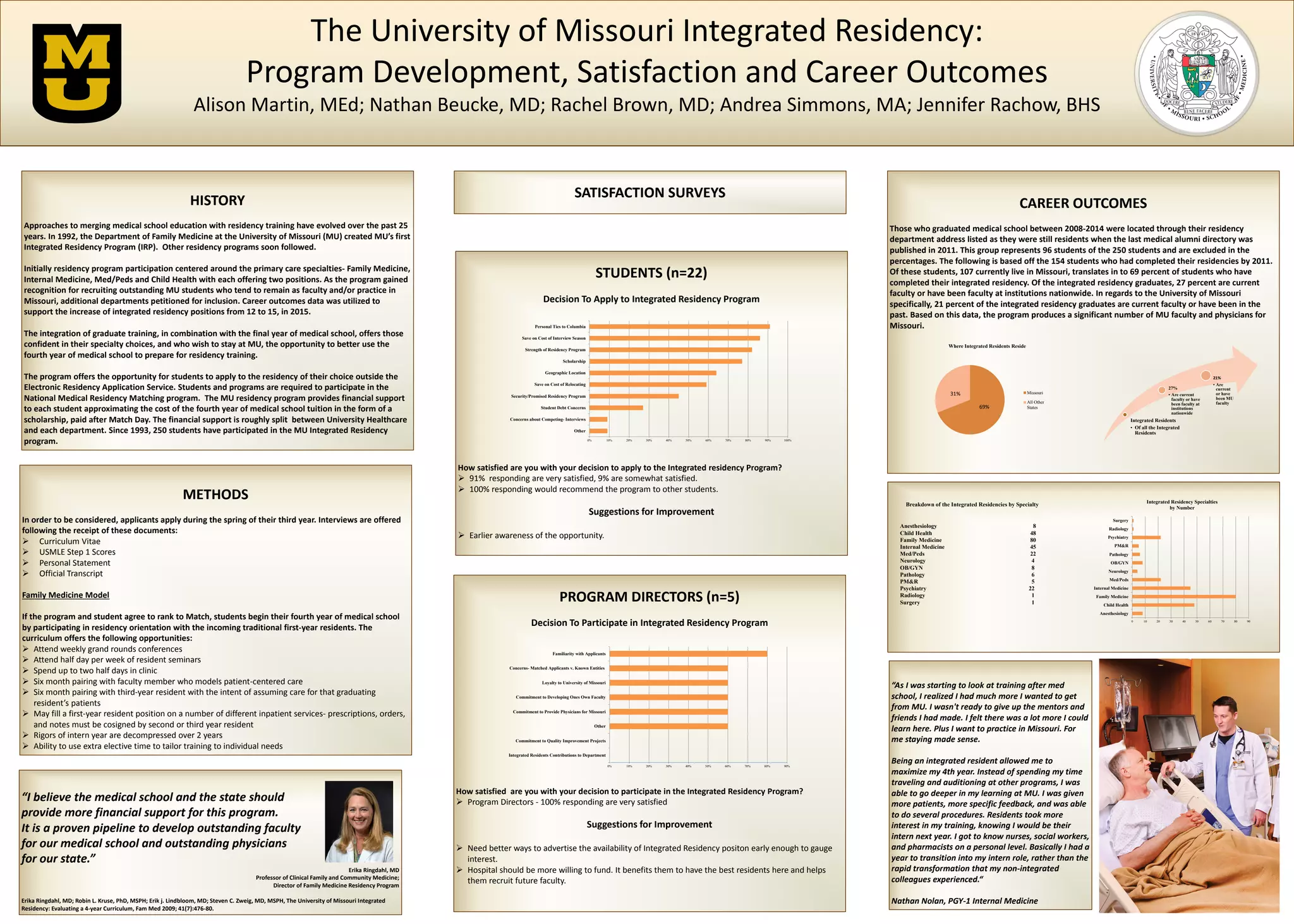
CAREER OUTCOMES
Those who graduated medical school between 2008-2014 were located through their residency
department address listed as they were still residents when the last medical alumni directory was
published in 2011. This group represents 96 students of the 250 students and are excluded in the
percentages. The following is based off the 154 students who had completed their residencies by 2011.
Of these students, 107 currently live in Missouri, translates in to 69 percent of students who have
completed their integrated residency. Of the integrated residency graduates, 27 percent are current
faculty or have been faculty at institutions nationwide. In regards to the University of Missouri
specifically, 21 percent of the integrated residency graduates are current faculty or have been in the
past. Based on this data, the program produces a significant number of MU faculty and physicians for
Missouri.
STUDENTS (n=22)
Decision To Apply to Integrated Residency Program
How satisfied are you with your decision to apply to the Integrated residency Program?
 91% responding are very satisfied, 9% are somewhat satisfied.
 100% responding would recommend the program to other students.
Suggestions for Improvement
 Earlier awareness of the opportunity.
The University of Missouri Integrated Residency:
Program Development, Satisfaction and Career Outcomes
Alison Martin, MEd; Nathan Beucke, MD; Rachel Brown, MD; Andrea Simmons, MA; Jennifer Rachow, BHS
Breakdown of the Integrated Residencies by Specialty
Anesthesiology 8
Child Health 48
Family Medicine 80
Internal Medicine 45
Med/Peds 22
Neurology 4
OB/GYN 8
Pathology 6
PM&R 5
Psychiatry 22
Radiology 1
Surgery 1
METHODS
In order to be considered, applicants apply during the spring of their third year. Interviews are offered
following the receipt of these documents:
 Curriculum Vitae
 USMLE Step 1 Scores
 Personal Statement
 Official Transcript
Family Medicine Model
If the program and student agree to rank to Match, students begin their fourth year of medical school
by participating in residency orientation with the incoming traditional first-year residents. The
curriculum offers the following opportunities:
 Attend weekly grand rounds conferences
 Attend half day per week of resident seminars
 Spend up to two half days in clinic
 Six month pairing with faculty member who models patient-centered care
 Six month pairing with third-year resident with the intent of assuming care for that graduating
resident’s patients
 May fill a first-year resident position on a number of different inpatient services- prescriptions, orders,
and notes must be cosigned by second or third year resident
 Rigors of intern year are decompressed over 2 years
 Ability to use extra elective time to tailor training to individual needs
Integrated Residents
• Of all the Integrated
Residents
27%
• Are current
faculty or have
been faculty at
institutions
nationwide
21%
• Are
current
or have
been MU
faculty
69%
31%
Where Integrated Residents Reside
Missouri
All Other
States
0 10 20 30 40 50 60 70 80 90
Anesthesiology
Child Health
Family Medicine
Internal Medicine
Med/Peds
Neurology
OB/GYN
Pathology
PM&R
Psychiatry
Radiology
Surgery
Integrated Residency Specialties
by Number
0% 10% 20% 30% 40% 50% 60% 70% 80% 90% 100%
Other
Concerns about Competing- Interviews
Student Debt Concerns
Security/Promised Residency Program
Save on Cost of Relocating
Geographic Location
Scholarship
Strength of Residency Program
Save on Cost of Interview Season
Personal Ties to Columbia
SATISFACTION SURVEYS
PROGRAM DIRECTORS (n=5)
Decision To Participate in Integrated Residency Program
How satisfied are you with your decision to participate in the Integrated Residency Program?
 Program Directors - 100% responding are very satisfied
Suggestions for Improvement
 Need better ways to advertise the availability of Integrated Residency positon early enough to gauge
interest.
 Hospital should be more willing to fund. It benefits them to have the best residents here and helps
them recruit future faculty.
0% 10% 20% 30% 40% 50% 60% 70% 80% 90%
Integrated Residents Contributions to Department
Commitment to Quality Improvement Projects
Other
Commitment to Provide Physicians for Missouri
Commitment to Developing Ones Own Faculty
Loyalty to University of Missouri
Concerns- Matched Applicants v. Known Entities
Familiarity with Applicants
“As I was starting to look at training after med
school, I realized I had much more I wanted to get
from MU. I wasn't ready to give up the mentors and
friends I had made. I felt there was a lot more I could
learn here. Plus I want to practice in Missouri. For
me staying made sense.
Being an integrated resident allowed me to
maximize my 4th year. Instead of spending my time
traveling and auditioning at other programs, I was
able to go deeper in my learning at MU. I was given
more patients, more specific feedback, and was able
to do several procedures. Residents took more
interest in my training, knowing I would be their
intern next year. I got to know nurses, social workers,
and pharmacists on a personal level. Basically I had a
year to transition into my intern role, rather than the
rapid transformation that my non-integrated
colleagues experienced.“
Nathan Nolan, PGY-1 Internal Medicine
“I believe the medical school and the state should
provide more financial support for this program.
It is a proven pipeline to develop outstanding faculty
for our medical school and outstanding physicians
for our state.”
Erika Ringdahl, MD
Professor of Clinical Family and Community Medicine;
Director of Family Medicine Residency Program
Erika Ringdahl, MD; Robin L. Kruse, PhD, MSPH; Erik j. Lindbloom, MD; Steven C. Zweig, MD, MSPH, The University of Missouri Integrated
Residency: Evaluating a 4-year Curriculum, Fam Med 2009; 41(7):476-80.

CGSA Integrated Residency Poster 06-16

  • 1.
    HISTORY Approaches to mergingmedical school education with residency training have evolved over the past 25 years. In 1992, the Department of Family Medicine at the University of Missouri (MU) created MU’s first Integrated Residency Program (IRP). Other residency programs soon followed. Initially residency program participation centered around the primary care specialties- Family Medicine, Internal Medicine, Med/Peds and Child Health with each offering two positions. As the program gained recognition for recruiting outstanding MU students who tend to remain as faculty and/or practice in Missouri, additional departments petitioned for inclusion. Career outcomes data was utilized to support the increase of integrated residency positions from 12 to 15, in 2015. The integration of graduate training, in combination with the final year of medical school, offers those confident in their specialty choices, and who wish to stay at MU, the opportunity to better use the fourth year of medical school to prepare for residency training. The program offers the opportunity for students to apply to the residency of their choice outside the Electronic Residency Application Service. Students and programs are required to participate in the National Medical Residency Matching program. The MU residency program provides financial support to each student approximating the cost of the fourth year of medical school tuition in the form of a scholarship, paid after Match Day. The financial support is roughly split between University Healthcare and each department. Since 1993, 250 students have participated in the MU Integrated Residency program. CAREER OUTCOMES Those who graduated medical school between 2008-2014 were located through their residency department address listed as they were still residents when the last medical alumni directory was published in 2011. This group represents 96 students of the 250 students and are excluded in the percentages. The following is based off the 154 students who had completed their residencies by 2011. Of these students, 107 currently live in Missouri, translates in to 69 percent of students who have completed their integrated residency. Of the integrated residency graduates, 27 percent are current faculty or have been faculty at institutions nationwide. In regards to the University of Missouri specifically, 21 percent of the integrated residency graduates are current faculty or have been in the past. Based on this data, the program produces a significant number of MU faculty and physicians for Missouri. STUDENTS (n=22) Decision To Apply to Integrated Residency Program How satisfied are you with your decision to apply to the Integrated residency Program?  91% responding are very satisfied, 9% are somewhat satisfied.  100% responding would recommend the program to other students. Suggestions for Improvement  Earlier awareness of the opportunity. The University of Missouri Integrated Residency: Program Development, Satisfaction and Career Outcomes Alison Martin, MEd; Nathan Beucke, MD; Rachel Brown, MD; Andrea Simmons, MA; Jennifer Rachow, BHS Breakdown of the Integrated Residencies by Specialty Anesthesiology 8 Child Health 48 Family Medicine 80 Internal Medicine 45 Med/Peds 22 Neurology 4 OB/GYN 8 Pathology 6 PM&R 5 Psychiatry 22 Radiology 1 Surgery 1 METHODS In order to be considered, applicants apply during the spring of their third year. Interviews are offered following the receipt of these documents:  Curriculum Vitae  USMLE Step 1 Scores  Personal Statement  Official Transcript Family Medicine Model If the program and student agree to rank to Match, students begin their fourth year of medical school by participating in residency orientation with the incoming traditional first-year residents. The curriculum offers the following opportunities:  Attend weekly grand rounds conferences  Attend half day per week of resident seminars  Spend up to two half days in clinic  Six month pairing with faculty member who models patient-centered care  Six month pairing with third-year resident with the intent of assuming care for that graduating resident’s patients  May fill a first-year resident position on a number of different inpatient services- prescriptions, orders, and notes must be cosigned by second or third year resident  Rigors of intern year are decompressed over 2 years  Ability to use extra elective time to tailor training to individual needs Integrated Residents • Of all the Integrated Residents 27% • Are current faculty or have been faculty at institutions nationwide 21% • Are current or have been MU faculty 69% 31% Where Integrated Residents Reside Missouri All Other States 0 10 20 30 40 50 60 70 80 90 Anesthesiology Child Health Family Medicine Internal Medicine Med/Peds Neurology OB/GYN Pathology PM&R Psychiatry Radiology Surgery Integrated Residency Specialties by Number 0% 10% 20% 30% 40% 50% 60% 70% 80% 90% 100% Other Concerns about Competing- Interviews Student Debt Concerns Security/Promised Residency Program Save on Cost of Relocating Geographic Location Scholarship Strength of Residency Program Save on Cost of Interview Season Personal Ties to Columbia SATISFACTION SURVEYS PROGRAM DIRECTORS (n=5) Decision To Participate in Integrated Residency Program How satisfied are you with your decision to participate in the Integrated Residency Program?  Program Directors - 100% responding are very satisfied Suggestions for Improvement  Need better ways to advertise the availability of Integrated Residency positon early enough to gauge interest.  Hospital should be more willing to fund. It benefits them to have the best residents here and helps them recruit future faculty. 0% 10% 20% 30% 40% 50% 60% 70% 80% 90% Integrated Residents Contributions to Department Commitment to Quality Improvement Projects Other Commitment to Provide Physicians for Missouri Commitment to Developing Ones Own Faculty Loyalty to University of Missouri Concerns- Matched Applicants v. Known Entities Familiarity with Applicants “As I was starting to look at training after med school, I realized I had much more I wanted to get from MU. I wasn't ready to give up the mentors and friends I had made. I felt there was a lot more I could learn here. Plus I want to practice in Missouri. For me staying made sense. Being an integrated resident allowed me to maximize my 4th year. Instead of spending my time traveling and auditioning at other programs, I was able to go deeper in my learning at MU. I was given more patients, more specific feedback, and was able to do several procedures. Residents took more interest in my training, knowing I would be their intern next year. I got to know nurses, social workers, and pharmacists on a personal level. Basically I had a year to transition into my intern role, rather than the rapid transformation that my non-integrated colleagues experienced.“ Nathan Nolan, PGY-1 Internal Medicine “I believe the medical school and the state should provide more financial support for this program. It is a proven pipeline to develop outstanding faculty for our medical school and outstanding physicians for our state.” Erika Ringdahl, MD Professor of Clinical Family and Community Medicine; Director of Family Medicine Residency Program Erika Ringdahl, MD; Robin L. Kruse, PhD, MSPH; Erik j. Lindbloom, MD; Steven C. Zweig, MD, MSPH, The University of Missouri Integrated Residency: Evaluating a 4-year Curriculum, Fam Med 2009; 41(7):476-80.