1. BIOCHEMISTRY- HARPER, 24 TH EDITION
2. ANATOMY -MOORE AND DALLY, LATEST EDITION
3. GROSS HUMAN ANATOMY ATLAS BY NETTER
4. GRAY’S ANATOMY
5. HISTOLOGY BY LESSON AND PAPARO
6. CELL BIOLOGY BY LESLIE GARTNER, 2ND
EDITION
7. WHEATER FUNCTIONAL HISTOLOGY, BY FREYE AND BURKITT,3RD
EDITION
8. ATLAS OF HISTOLOGY BY DE FIORE
9. NEUROANATOMY: CLINICAL NEUROANATOMY FOR MEDICAL STUDENTS, 4TH
EDITION
10. PHYSIOLOGY: REVIEW OF MEDICAL PHYSIOLOGY BY WILLIAM GANONG
11. MEDICAL PARASITOLOGY BY BELISARIO DE LEON
12. MEDICAL PARASITOLOGY BY VOGUE, MICHAEL JOHN
13. PREVENTIVE AND COMMUNITY MEDICINE BY MENDOZA ET AL
14. FOUNDATION OF EPIDEMIOLOGY BY LILLENTHEL AND LILLENTHEL
15. EPIDEMIOLOGY RESEARCH BY HENEKIN
16. CUNNINGHAM MANUAL OF DISSECTION( THREE VOLUMES)
Resectfully requesting approval from the good President, issuance of a memorandum to all
the following concerned administrative, academic personnel, with medical concerns, to submit:
to the Medical Officer this university the following data:to wit:
I. For those afflicted with medical illness:
1. Current medical status,, issued and certified by their respective attending
physicians,including progress report
2. Results of recent medical tests, clinical laboratory tests
II. For those with surgical cases:
a. Current surgical/post surgical status issued and certified by their respective
attending physicians
b. If on chemotherapy: post- chemotherapy evaluations,
c. Results of recent medical tests,
III. For those on Rehabilitation or undergoing any physical therapy:
a.functional independence measures scores, and progress reports, to be issued and
certified by their respective attending physicians
The purpose is for monitoring and evaluation of their current health status and for the
Medical Officer be guided on accurate information regarding their prevailing health condtions
and provide baseline data for return to work evalutions,.
For consideration and approval.
HEALTH SERVICES, QUALITY OF LIFE AND CLIENT SATISFACTION AMONG
STUDENTS, ADMINISTRATIVE AND ACADEMIC PERSONNEL OF STATE UNIVERSITIES AND
COLLEGES(SUC’S) IN ZAMBOANGA CITY: AN ASSESSMENT
Statement of the Problem
This study examined the extent to which Health Services and the perceived health-related
quality of life, relates to clientelle satisfaction among stakeholders in SUC’s in Zamboanga City.
Specifically, it endeavored to answer the following queries:
2. To what extent are the health services provided to the students, teaching and non-
teaching personnel of SUCs in Region IX in terms of:
a. Health promotion
b. Consultations and treatment
c. Immunizations
d. Outreach programs
e. Referral of complicated cases
3. Is there a significant difference in the extent of provision of health services provided to
the students, teaching and non-teaching personnel of SUC’s in Region IX when the data
are classified according to the respondent groups?
3. What is the degree of client satisfaction of the students, teaching and non-teaching
personnel of SUC’s in Region IX?
Significance of the Study
Health services research is the multidisciplinary field of scientific investigation that study how
social factors, financing systems, organizational structures and processes, health technologies, and
personal behaviors affect access to health care, the quality and cost of health care, and ultimately our
health and well-being. Its research domains are individuals, families, organizations, institutions,
communities, and populations. It is noteworthy that the literature is replete of research articles on
health services, specifically in the our country, the Phillippines, where majority of researches are
limited to health services delivery and health conditions, among local government units,
unfortunately, few, if ever none, in the academic institution.
The findings of this study will be beneficial to the following:
CLIENTS( students,faculty, administrative personnel) . This study provides data that brings
awareness on the extent of health services the academic stakeholders of the HEI’s experienced
and their level of satisfaction. Knowledge generated on this research can be a substantial factor
in improving their expectations as revealed by the variables.
Researchers. This study would be an additional and updated reference on delivery of health
services and provides baseline information on client satisfaction among students , faculty and
administrative personnel in SUC’s in region IX.
Top level management.(presidents,vice pres.,middle management(deans,directors,heads of units,)
Information on extent of health services and clientelle satisfaction experienced and availed by the
respective stakeholders of SUC’s in Region IX, such that specific gaps in health service delivery
will be properly addressed.
Scope and delimitation of the study.
The study was bounded by the following:
1. The study involved public heis in region IX, based on their respective year of
establishment and number of campuses.
2. The respondents of the study were regular second-year students, faculty members
whose major assignment is teaching –teaching personnel as of the first semester
of school year 2013-2014.
3. The concepts of client satisfaction using the modified CSQ-8 questionnaire.
4. The study was conducted during the first semester of SY 2013-14..
5. While literature defines client satisfaction assessment tool as complex, this study used
the modified CSQ- 8 assessment tool as a model..
HEALTH-RELATED QUALITY OF LIFE AND SCHOOL PERFORMANCE AMONG HEPATITIS-B
VIRUSPOSITIVE STUDENTS OF WMSU: A RETROSPECTIVE STUDY
CHAPTER I
INTRODUCTION
BACKGROUND OF THE STUDY
Hepatitis-B virus(HBV) is a major cause of chronic liver diseases, cirrhosis and
hepatocellular carcinoma worldwide.The prevalence of Hepatitis-B virus infection varies
geographically, with the highly endemic areas being Asia, most of Africa, and some parts of
South America.The clinical presentation of Hepatitis B infection can range from assymptomatic
infection to acute liver failure as well as chronic hepatitis and liver cirrhosis.
The Philippines is considered by the World Health Organization as highly endemic area
for Hepatitis B virus infection, with more than 8% of the population HBV positive.Detection of
HBV in the country is commonly carried out using Hepatitis B surface antigen (HbsAg) as
marker.In an effort to determine the current status of HBV infection in the country, a report on
the HbsAg prevalence in an urban area was published in 2005; however, new information on
the prevalence of HBV infection in the rural setting is still wanting. Much more so, in the
academic setting.
Despite a great deal of clinical data on the natural historyof HBV infection, little is
known about its impact on the patient’s quality of life.
Statement of the Problem.
This study examined retrospectively the health-related quality of life and the academic
performance of enrolled wmsu students afflicted with HBV infection.
Specifically, it endeavored to answer the following queries:
1. What is the demographic profile of students with HBV infection at wmsu?
2. What is the health-related quality of life among students with HBV infection?
3. Is there a significant relationship between health-related quality of life and academic
performance of students with HBV infection?
4. Is there a significant difference between health-related quality of life and academic
performance of students with HBV infection?
Significance of the Study
Hepatitis B virus positive persons still have to cope with the stigma, life uncertainties,
and their health-related quality of life. Several literatures will only establish treatment regimens,
treatment outcomes, but little, if none, as regards to its relationship to acdemic performance
and perceived quality of life for college students. This study is significant since students, after
graduating from college , will soon face career and family life.
Specifically, the study will be of benefit to the following:
1. The clients who are HBV positive- their academic performance vis a vis quality of life
determination will be a great help in terms of coming up with intervention mechanisms.
2. The school hierarchy- appropriate measures can be adopted to safeguard certain issues
against discrimination at school.
3. Medical service providers- healthcare services to monitor disease progression, mitigating
treatments, coordination, linkage to other health agencies.
Scope and delimitation of the Study
1. The study involved wmsu students who are HBV positive from SY 2010,2011,2012.
LIFESTYLE DISEASE PREVALENCE, AND ACADEMIC PERFORMANCE OF
FACULTY OF ,EXTERNAL STUDIES UNITS OF WMSU, SY 2013-2014: AN
ASSESSMENT
CHAPTER I
INTRODUCTION
Background of the Study
LIFESTYLE diseases belong to a group of medical conditions categorized under non-
communicable diseases. These are coronary artery disease, cerebrovascular disease,obesity,
hypertension,diabetes, cancers, and osteoporosis. From among these, cardivascular disease
account for most common cause of death. It kills more people in developed countries than the next
leading 6 causes (including cancer).
These medical conditions are worse in low and middle-income countries. About 4/5 of all
CVD events occur in these parts of the world. Philippines is no exception.
With increasing workplace stress, environmental health issues, sedentary lifestyles, dietary
and nutritional imbalance, a study must be conducted to explore the academe, particularly in
this part of western mindanao , on a rural setting, to determine lifestyle disease prevalence
and teacher performance appraisal.
Academic performance or evaluation of teacher performance is usually done with the use of
ratings made by students, peers, and principals or supervisors, and at times, selfratings made by the
teachers themselves. The trouble with this practice is that it is obviously subjective, and vulnerable to
what Glass and Martinez call the “politics of teacher evaluation,” as well as to professional incapacities
of the rater.There is an obvious need for objective teacher evaluation.
Statement of the Problem.
This study examined the prevalence of lifestyle disease and teacher performance among
faculty of wmsu external studies units; and specifically endeavored to answer the following
queries:
1. What is the demographic profile, health status of wmsu external studies units faculty?
2. What is the prevalence of lifestyle diseases among faculty of wmsu external units?
3. What heathcare services are available for the faculty of wmsu external studies units?
4. Is there a significant relationship with lifestyle disease prevalence and teacher
performance among faculty of wmsu external unit?
Significance of the Study
The study provided empirical information about lifestyle disease prevalence among faculty
of wmsu external studies units. Studies reveal that lifestyle disease prevalence abound in highly
urbanized areas; thus, with this research, a comparable study will establish the extent of lifestyle
diseases in less urban, provincial setting.
Further, teacher performance would also be correlated on its impact and outcome of student
learning of students of the external studies units.
The findings of this study will be beneficial to the following:
University management: information gathered from the study would provide data as to
demography, teacher performance among esu faculty of wmsu.
Faculty of WMSU ESU: Healthcare services would be designed appropriate to the needs of
faculty of WMSU ESU.
Medical personnel; results of the study would ne a baseline data as to status, profile of wmsu
esu faculty, and prevalence of lifestyle dseases among WMSU ESU faculty.
Scope and delimitation of the Study
The study is limited to the faculty of WMSU External Studies Units, SY 2013-2014.
WESTERN MINDANAO STATE UNIVERSITY
COLLEGE OF EDUCATION
GRADUATE SCHOOL
PRESENTED BY:
DR. MARIO J. GAPOY
09203846937
TITLE
HEALTH SERVICES , HEALTH-RELATED QUALITY OF LIFE, AND CLIENT
SATISFACTION AMONG STUDENTS, ADMINISTRATIVE AND ACADEMIC PERSONNEL
OF STATE UNIVERSITIES (SUC’S) IN ZAMBOANGA CITY: AN ASSESSMENT.
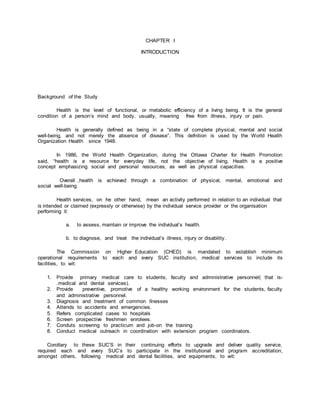
CHAPTER I
INTRODUCTION
Background of the Study
Health is the level of functional, or metabolic efficiency of a living being. It is the general
condition of a person’s mind and body, usually, meaning free from illness, injury or pain.
Health is generally defined as being in a “state of complete physical, mental and social
well-being, and not merely the absence of disease”. This defnition is used by the World Health
Organization Health since 1948.
In 1986, the World Health Organization, during the Ottawa Charter for Health Promotion
said, “health is a resource for everyday life, not the objective of living, Health is a positive
concept emphasizing social and personal resources, as well as physical capacities.
Overall ,health is achieved through a combination of physical, mental, emotional and
social well-being.
Health services, on he other hand, mean an activity performed in relation to an individual that
is intended or claimed (expressly or otherwise) by the individual service provider or the organisation
performing it:
a. to assess, maintain or improve the individual’s health.
b. to diagnose, and treat the individual’s illness, injury or disability.
The Commission on Higher Education (CHED) is mandated to establish minimum
operational requirements to each and every SUC institution, medical services to include its
facilities, to wit:
1. Provide primary medical care to students, faculty and administrative personnel( that is-
.medical and dental services).
2. Provide preventive, promotive of a healthy working environment for the students, faculty
and administrative personnel.
3. Diagnosis and treatment of common llnesses
4. Attends to accidents and emergencies.
5. Refers complicated cases to hospitals
6. Screen prospective freshmen enrolees.
7. Conduts screenng to practicum and job-on the training
8. Conduct medical outreach in coordination with extension program coordinators.
Corollary to these SUC’S in their continuing efforts to upgrade and deliver quality service,
required each and every SUC’s to participate in the institutional and program accreditation,
amongst others, following medical and dental facilities, and equipments, to wit:
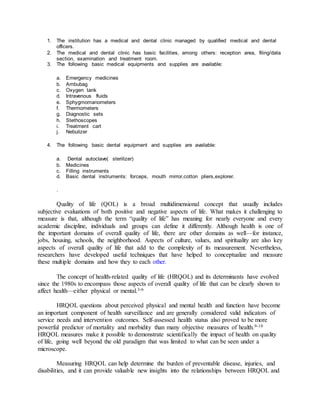
1. The institution has a medical and dental clinic managed by qualified medical and dental
officers.
2. The medical and dental clinic has basic facilities, among others: reception area, filing/data
section, examination and treatment room.
3. The following basic medical equipments and supplies are available:
a. Emergency medicines
b. Ambubag
c. Oxygen tank
d. Intravenous fluids
e. Sphygmomanometers
f. Thermometers
g. Diagnostic sets
h. Stethoscopes
i. Treatment cart
j. Nebulizer
4. The following basic dental equipment and supplies are available:
a. Dental autoclave( sterilizer)
b. Medicines
c. Filling instruments
d. Basic dental instruments: forceps, mouth mirror,cotton pliers,explorer.
.
Quality of life (QOL) is a broad multidimensional concept that usually includes
subjective evaluations of both positive and negative aspects of life. What makes it challenging to
measure is that, although the term “quality of life” has meaning for nearly everyone and every
academic discipline, individuals and groups can define it differently. Although health is one of
the important domains of overall quality of life, there are other domains as well—for instance,
jobs, housing, schools, the neighborhood. Aspects of culture, values, and spirituality are also key
aspects of overall quality of life that add to the complexity of its measurement. Nevertheless,
researchers have developed useful techniques that have helped to conceptualize and measure
these multiple domains and how they to each other.
The concept of health-related quality of life (HRQOL) and its determinants have evolved
since the 1980s to encompass those aspects of overall quality of life that can be clearly shown to
affect health—either physical or mental.3-6
HRQOL questions about perceived physical and mental health and function have become
an important component of health surveillance and are generally considered valid indicators of
service needs and intervention outcomes. Self-assessed health status also proved to be more
powerful predictor of mortality and morbidity than many objective measures of health.9-10
HRQOL measures make it possible to demonstrate scientifically the impact of health on quality
of life, going well beyond the old paradigm that was limited to what can be seen under a
microscope.
Measuring HRQOL can help determine the burden of preventable disease, injuries, and
disabilities, and it can provide valuable new insights into the relationships between HRQOL and
risk factors. Measuring HRQOL will help monitor progress in achieving the nation’s health
objectives. Analysis of HRQOL surveillance data can identify subgroups with relatively poor
perceived health and help to guide interventions to improve their situations and avert more
serious consequences. Interpretation and publication of these data can help identify needs for
health policies and legislation, help to allocate resources based on unmet needs, guide the
development of strategic plans, and monitor the effectiveness of broad community interventions.
HRQOL assessment is a particularly important public health tool for the elderly in an era when
life expectancy is increasing, with the goal of improving the additional years in spite of the
cumulative health effects associated with normal aging and pathological disease process.
Several measures have been used to assess HRQOL and related concepts of functional
status. Among them are the Medical Outcomes Study Short Forms (SF-12 and SF-36), the
Sickness Impact Profile, and the Quality of Well-Being Scale. The SF-36 measures are now used
by the Health Care Financing Administration (HCFA) and the National Committee for Quality
Assurance’s Health Plan Employer Data and Information Set (HEDIS 3.0) to help evaluate the
quality of care in managed care plans and other health care applications. While these measures
have been widely used and extensively validated in clinical settings and special population
studies, their length often makes them impractical to use in population surveillance.
To meet the need for a standard set of valid HRQOL measures that could be used in our
national health surveillance system, a collaborative program was initiated in 1989 by the
Division of Adult and Community Health (DACH) in the CDC’s National Center for Chronic
Disease Prevention and Health Promotion (NCCDPHP). This HRQOL surveillance program
received its initial direction and guidance from several planning meetings that included represen-
tatives of state and local chronic disease and health promotion programs, relevant academic
disciplines, and survey researchers.
CLIENT SATISFACTION
Client satisfaction may be considered to be one of the desired outcomes of care, even an
element in health status itself…It is futile to argue about the validity of patient satisfaction as a measure of
quality. Whatever its strengths and limitations as an indicator of quality, information about patient
satisfaction should be as indispensable to assessments of quality as to the design and management of
health care systems.
Clinicians' and clients' views about quality of care can differ vastly. While clinicians are
known to define quality primarily by their technical skill, clients are inclined to define quality by
a clinician's interpersonal skills. An illustration of these divergent perceptions of quality care is
found in a recent article and subsequent letter-to-theeditor in Asha. Dorothea Wender (1990), an
individual with aphasia who underwent a course of language treatment, wrote an article titled:
"Quality: A Personal Perspective." She describes a "good therapist" and a "bad therapist." The
good therapist was perceived as a person who respected her, treated her as an intelligent adult,
smiled often, and talked with her daughters. The bad therapist was perceived as business-like,
didactic, insensitive to the use of childlike clinical materials, and rigid in treatment style. Not
surprisingly, her article prompted letters to the editor from the "bad therapist's" peers. Says one
colleague:
The person described as a "bad therapist" was actually an outstanding aphasiologist…If the reader
only knew that the speech-language pathologist is so highly regarded, the article would have been so
much more useful (Asha, May 1990, p. 3).
Although the importance of technical over interpersonal care can be convincingly argued by
clinicians, client perceptions about quality cannot be ignored. Superior technical care may not be
effective in the absence of a good interpersonal relationship. Poor interpersonal skills often
involve poor communication with the client, which can lead to client dissatisfaction. For
example, the client may not understand the rationale for a particular procedure, or may be
unaware of potential consequences. Such dissatisfaction can be prevented through appropriate
client education. Interpersonal aspects of care that include clear communications and informed
consent for specific procedures is therefore recommended to not only educate the client, but to
protect both the client and practitioner in cases of litigation.
According to Harper Petersen (1989), the following aspects of care are found in the
professional literature as significant components of client expectations:
 Being comfortable;
 Being treated as a mature individual;
 Getting information about what will happen;
 Learning how to participate in care;
 Feeling safe;
 Needing reassurance;
 Feeling more in control;
 Decreasing stress; and
 Having staff available to listen.
In summary, both interpersonal and technical aspects of care must be considered when
measuring quality. Anecdotal evidence affirms that acceptable care contributes to client
cooperation and, thus, to successful outcomes (Palmer & Reilly, 1979). However, little is known
empirically about what specific interpersonal qualities positively affect clinical outcomes.
Reliable and valid client satisfaction measures can be used to effectively explore this
relationship.
CHAPTER II
THEORETICAL AND CONCEPTUAL FRAMEWORK
This section contains the study’s theoretical and conceptual frameworks that were based
on the related literature and studies on health services’ health-related quality of life and client
satisfaction.,The related literature is a summary of established facts, concepts and information on
the public SUC’s in Zamboanga City. The related studies are a collection of selected researches
on the relationship of health related quality of life and client satisfaction outcomes and
expectations. This chapter also include the study’s hypotheses and definition of variables..
Review of related literature and related studies.
a. Related literature
BODY MASS INDEX -WMSU COMMUNITY
Name College/dept age height Weight BP BMI INTERPRETATION
BARJOSE,N CN 51 5’2” 81 KG 100/70 30 OBESE
NOLLEDO,S CN 42 5’2” 65 KG 120/70 26 OVERWEIGHT
ADDAGUPAN, A CN 58 5’2” 70 KG 100/70 27 OVERWEIGHT
DE LA CRUZ, S CN 58 5’7” 78 KG 120/70 27 OVERWEIGHT
JULKARNAIN, M CN 46 5’1” 60 KG 130/90 25 OVERWEIGHT
RENDON, E CN 57 5’6” 110/70
MUYARGAS, E CN 53 5’4” 56 KG 110/80 21 NORMAL
MANGA, P CN 44 5’2” 52 KG 100/70 20 NORMAL
SANTIAGO, R CN 54 5’3” 57 KG 110/70 23 NORMAL
FLORIANO, G CN 47 5’3” 63 KG 110/70 25 OVERWEIGHT
MARUMAS, DG CN 40 5’ 45 KG 90/60 20 NORMAL
GAAN, V CN 58 5’4” 63 KG 120/70 23 NORMAL
DEMAYO, SJ CN 40 5’ 45 KG 90/60 20 NORMAL
SERGAS, EF CN 25 5’2” 57 KG 100/70 22 NORMAL
RAMOS, I CN 44 4’7” 54 KG 110/70 20 NORMAL
LARA, A L CN 35 5’2” 67 KG 90/70 27 OVERWEIGHT
SANTIAGO, MC CN 26 4’10” 47 KG 100/70 22 NORMAL
MIGRINO, M CN 30 5’4” 54 KG 110/80 21 NORMAL
MARIANO, A CN 51 5’2” 59 KG 110/80 23 NORMAL
CALUSCUSAN, A CN 60 5’2” 65 KG 120/80 27 OVERWEIGHT
RUBIO, RM CN 43 5’2” 59 KG 90/70 22 NORMAL
PATINO, S CN 53 1.6 M 95 KG 30 OBESE
ENRIQUEZ, M CN 1.6 M 81 KG 120/80 30 OBESE
DEMONI, F CN 59 5’ 64 KG 100/70 26 OVERWEIGHT
SAN LUIS, C CN 58 5’1” 58 KG 130/80 24 NORMAL
GAAN, M CN 57 4’10” 72 KG 100/70 30 OBESE
TAUPAN, S CN 48 5’ 62 KG 100/70 25 OVERWEIGHT
DOMINGO, MS CN 53 4’10” 52 KG 100/80 24 NORMAL
GURREA, MC CN 38 5’2” 54 KG 100/80 21 NORMAL
APOSTOL, MF CN 57 5’1” 65 KG 110/80 27 OVERWEIGHT
ONG, T CN 56 5’ 57 KG 130/80 24 NORMAL
MARQUEZ, MD CN 60 5’1” 65 KG 27 OVERWEIGHT
FERNANDO, MA CN 43 120/80
ESCOBAR, V CN 51 5’5” 90 KG 90/70 30 OBESE
KANTI, M CN 52 5’7” 97 KG 130/70 30 OBESE
PIZARRO,JA CN 55 5’1” 54 KG 90/70 21 NORMAL
BENITO, L CN 54
CABURNAY, A CN 45 5’1 73 KG 120/70 28 OVERWEIGHT
ALAWI, H CN 44 5’6” 77 KG 120/80 28 OVERWEIGHT
FLORENDO, G CN 60 5’3” 65 KG 120/80 27 OVERWEIGHT
PATINO, A CN 56 5’2” 56 KG 120/80 22 NORMAL
OMAR, F CN 46 5’3” 68 KG 100/70 26 OVERWEIGHT
ROSALDO, R CN 41 5’7” 85 KG 120/80 28 OVERWEIGHT
LEGEND: B M I VALUES
BELOW 18.= UNDERWEIGHT
18.5 - 24.9 = NORMAL
25.0 - 29.9 = OVERWEIGHT
30.0 & > = OBESE
Few clinicians would debate that clients are the central focus of both service delivery and quality
measurement. In recent years, client satisfaction with clinical services has gained recognition as an
outcome of quality care. Donabedian (1988), a noted authority in quality measurement, states
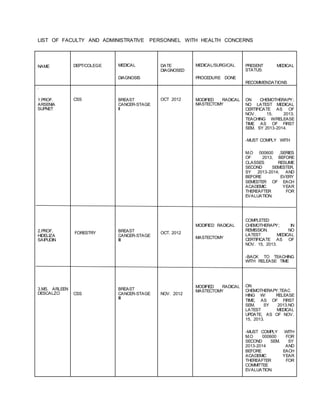
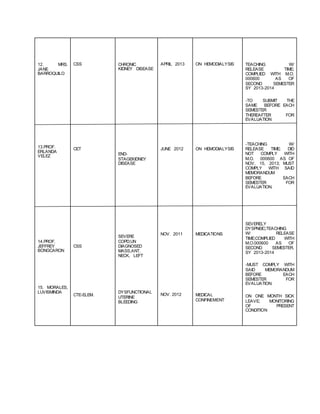
LIST OF FACULTY AND ADMINISTRATIVE PERSONNEL WITH HEALTH CONCERNS
NAME DEPT/COLEGE MEDICAL
DIAGNOSIS
DATE
DIAGNOSED
MEDICAL/SURGICAL
PROCEDURE DONE
PRESENT MEDICAL
STATUS:
RECOMMENDATIONS
.
1.PROF.
ARSENIA
SUPNET
2.PROF.
HIDELIZA
SAIPUDIN
3.MS. ARLEEN
DESCALZO
CSS
FORESTRY
CSS
BREAST
CANCER-STAGE
II
BREAST
CANCER-STAGE
III
BREAST
CANCER-STAGE
III
OCT 2012
OCT. 2012
NOV. 2012
MODIFIED RADICAL
MASTECTOMY
MODIFIED RADICAL
MASTECTOMY
MODIFIED RADICAL
MASTECTOMY
ON CHEMOTHERAPY;
NO LATEST MEDICAL
CERTIFICATE AS OF
NOV. 15, 2013;
TEACHING W/RELEASE
TIME AS OF FIRST
SEM. SY 2013-2014.
-MUST COMPLY WITH
M.O 000600 ,SERIES
OF 2013, BEFORE
CLASSES RESUME
SECOND SEMESTER,
SY 2013-2014; AND
BEFORE EVERY
SEMESTER OF EACH
ACADEMIC YEAR
THEREAFTER FOR
EVALUATION.
COMPLETED
CHEMOTHERAPY; IN
REMISSION. NO
LATEST MEDICAL
CERTIFICATE AS OF
NOV. 15, 2013.
-BACK TO TEACHING
WITH RELEASE TIME
ON
CHEMOTHERAPY;TEAC
HING W/ RELEASE
TIME, AS OF FIRST
SEM. SY 2013.NO
LATEST MEDICAL
UPDATE, AS OF NOV.
15, 2013.
-MUST COMPLY WITH
M.O 000600 FOR
SECOND SEM. SY
2013-2014 AND
BEFORE EACH
ACADEMIC YEAR
THEREAFTER FOR
COMMITTEE
EVALUATION.
4.PROF
ROMMEL
RACHO
5.PROF.
JAMES SALI
6.PROF.
EDGAR
UNDAG
7.PROF.
PERFECTA
COSADIO
CSS
COLLEGE OF
AGRICULTURE
COLLEGE OF
NURSING
CPERS
CHRONIC
LYMPHOCYTIC
LEUKEMIA
HYPERTENSIVE
CARDIOVASC-
ULAR DISEASE;
CEREBROVASCU
LAR ACCIDENT
CEREBROVASCU
LAR ACCIDENT
BREAST
CANCER,STAGE
IV
OCT. 2012
SEPT. 2011
MAY,2013
MARCH 2013
POST-
CHEMOTHERAPY;IN
REMISSION
RELAPSED;ONGOING
REHABILITATION-
PHYSICAL THERAPY
PARTIALLY
RECOVERED;
ONGOING PHYSICAL
THERAPY
ON CYCLICAL
CHEMOTHERAPY;S/P
PLEURODESIS
TEACHING; W/
RELEASE TIME AS OF
FIRST SEMESTER, AY
2013-2014. COMPLIED
WITH M.O. 000600
FOR THE SECOND
SEMESTER, AY 2013-
2014.
-TO COMPLY WITH
M.O. 000600 BEFORE
EVRY SEMESTER
THEREAFTER FOR
EVALUATION.
FULL RELEASE TIME-
CSW; DID NOT
COMPLY WITH M.O.
000600 AS OF NOV.
15, 2013.
-LACKED REHAB
PROGRESS REPORT
CERTIFICATE
-ON LEAVE; STILL
WITH NEUROLOGIC
DEFICIT ON HIS
RIGHTUPPER
EXTREMITY; USES
QUAD CANE FOR
AMBULATION;LACKED
REHAB PROGRESS
REPORT CERTIFICATE
-MUST COMPLY WITH
M.O 000600 BEFORE
EACH SEMESTER FOR
EVALUATION
IN CANCER
REMISSION;COMPLIED
WITH M.O 000600 FOR
SECOND SEMESTER,
SY 2013-2014;
RETURNED TO WORK,
WITH RELEASE TIME
-TO COMPLY WITH
M.O. 000600 EVERY
EACH SEMESTER FOR
EVALUATION
8.PROF.
ALAMJAVIER
INDANAN
9.JOFRE
RASUL
10.ENGR.
FELICIANO
PUNZALAN
11.MR
ARMAND DIN
ARQUIZA
CPERS
CSS
CET
ACADEMC NON-
TEACHING; UHSC
END-STAGE
KIDNEY DISEASE
CEREBROVASCU
LAR ACCIDENT
CEREBROVASCU
LAR ACCIDENT;
MOOD DISORDER
COLONIC
MALIGNANCY
AUGUST 2012
JAN,2013
OCT. 2006
NOV. 2012
ON HEMODIALYSIS
RECOVERED; ON
REHAB-PT
RECOVERED
TUMOR-RESECTION-
COLOSTOMY;ON
CHEMOTHERAPY
TEACHES WITH
RELEASE TIME;DID
NOT COMPLY WITH
M.O. 000600 AS OF
NOV. 15, 2013.
-MUST COMPLY WITH
M.O000600 FOR
EVALUATION BEFORE
EVERY SEMESTER
THEREAFTER.
TEACHING; RELEASE
TIME. DID NOT
COMPLY WITH
M.O.000600 AS NOV.
15, 2013.MUST
COMPLY WITH SAID
M.O. EVERY BEFORE
EACH SEMESTER FOR
EVALUATION.
-WITH MILD
NEUROLOGIC DEFICIT;
AMBULATES WITHOUT
SUPPORT;FULL TIME
TEACHING; COMPLIED
WITH M.O. 000600 AS
OF NOV. 15, 2013
ON LEAVE
12. MRS.
JANE
BARROQUILO
13.PROF.
ERLANDA
VELEZ
14.PROF.
JEFFREY
BONGCARON
15. MORALES,
LUVISMINDA
CSS
CET
CSS
CTE-ELEM.
CHRONIC
KIDNEY DISEASE
END-
STAGEKIDNEY
DISEASE
SEVERE
COPD;UN
DIAGNOSED
MASS,ANT.
NECK, LEFT
DYSFUNCTIONAL
UTERINE
BLEEDING
APRIL 2013
JUNE 2012
NOV. 2011
NOV. 2012
ON HEMODIALYSIS
ON HEMODIALYSIS
MEDICATIONS
MEDICAL
CONFINEMENT
TEACHING W/
RELEASE TIME;
COMPLIED WITH M.O.
000600 AS OF
SECOND SEMESTER
SY 2013-2014
-TO SUBMIT THE
SAME BEFORE EACH
SEMESTER
THEREAFTER FOR
EVALUATION
-TEACHING W/
RELEASE TIME; DID
NOT COMPLY WITH
M.O. 000600 AS OF
NOV, 15, 2013; MUST
COMPLY WITH SAID
MEMORANDUM
BEFORE EACH
SEMESTER FOR
EVALUATION.
SEVERELY
DYSPNEIC;TEACHING
W/ RELEASE
TIME;COMPLIED WITH
M.O.000600 AS OF
SECOND SEMESTER,
SY 2013-2014
-MUST COMPLY WITH
SAID MEMORANDUM
BEFORE EACH
SEMESTER FOR
EVALUATION.
ON ONE MONTH SICK
LEAVE; MONITORING
OF PRESENT
CONDITION
1. Estrellas, richie c .= 56
2. Estoque, jann limuel m.= 57
3. Fernandez, ian c. = 58
4. balasabas, flora mae c. = 52
5. dagalea, rey lorenz a. = 54
6. magno, angel b. = 63
7. cabalero, genilene a. = 61
8. silagan, shiela jane b. = 61
9. catbagan, jesthel k. = 59
10. del rosario, alelie b. = 53
11. almero jr., danilo = 57
12. madalipay, jessa danica l.= 53
13. castillo, roselle mae s. = 57
14. atilano, judy anne d.r. = 62
15. amban, cresnand s. = 60
16. suganob, sally b. = 52
17. fernando, kristel o. = 57
18. sagibu, ar-rafi s. = 59
19. canillo, jeziel ann m. = 65
20. eramis, jenn bert h. = 65
21. landiao, johnny s. = 48
22. jangas, john aladdin m.= 66
23. tuazon, christian jose s.= 61
24. molas, michael a. = 59
25. ramos, jenelyn a. = 66
26. navarro, joseph p. = 50
27. borres, angelo d. = 58
28. belgira, danny mark o. = 56
29. aldohisa, john kelvin m.= 63
30. lumahan, al c. = 51
31. saddalani, shellamae a. = 59
32. helar, dave lester v. = 61
33. hassan, ismael s . = 54
34. cardenas, kelly o. = 61
35. saavedra, rolito l. = 53
36. suarez, randy g. = 55
37. corpus, nariel s. = 58
38. delano, maverick franklin= 62
39. barredo, jonalaine a. = 57
40. pantaleon, arjorie elexis d.= 62
41. baginda, brenda c. = 53
42. enriquez, robin a. = 47
43. ecalner, anna wendeline g.= 59
44. vargas, daryl p. = 51
45. tang, johnny v. = 60
46. asbi, omarwin s. =59
47. teves, steve a. =60
48. belarmino, mark jayson a. =59
49. gregorio, dexter d. =61
50. montecillo, jescil s. =52
51. leonin, harvey g. =56
52. balucan, reena mae j. = 58
53. suganob, archie lourd a. = 61
54. dellatan, kristina-abigail m = 59
55. puno, sittie nasifah g. = 62
56. ramos, jenelyn s. =54
57. galvez, mary imy l. =60
58. enriquez, cheezel joy s. =60
59. gayla, hilbert l. =55
1. sebastian, mark gerald s.j. = 45
2. Abdulgafor, azfar-azre a. = 43
3. Asali, abdurasid a. = 46
4. Cuaresma, leonardo t. = 45
5. Otod, winfred m. =45
6. Fernandez, erick angelo p .= 44
7. Gresos, arnold d. =43
8. Pucot, edwin f. =44
9. De los reyes, kinberly gay b. =35
10. Faustino, maybelyn j. = 38
11. Bejerano, jason a. =47
12. Abdul, adrei issacarl d. =39
13. Natividad, xyrus c. =46
14. Hatang, fadzlorrasyd a. =45
15. Laygo, rizza liz a. =35
16. Joven, gladice p. = 28
17. Abubakar, al-samir b. =43
18. Rebollos, ronan m. =43
19. Lim, cherry cris a. =28
20. Evangelista, roseAnn = 36
21. Perez, may ann f. =31
22. Tamayo, kevin s. =38
23. Partosa, leo g. =48
24. Malaluan, jayson e. =41
25. Cardoza, mariel q. =41
26. Taji, moh. Faujee j =46
27. Zamora, precious m. =39
28. Laison, al-shadin n. =44
29. Friales, greymart u. =44
30. Bayona, joel a. =48
31. Sarador, marjorie o. =47
32. Infante, marjon l. =48
33. Gonzaga, brilliant b. =41
34. Ponce, gerald a. =40
35. Bautista, marie rose b. =39
36. Andico, christian bryan r. =47
37. Carabot, maria fe d. =43
38. Tormon, fredner v. =42
39. Loyloy, christian b. =47
40. Chia, abdurahman d. =48
41. Lorete, doris gay r. =44
42. Nunez, jennevie j. =44
43. jawad, julhasbi k. =45
44. abbas, shaiman c. =42
45. bermas, irish kimberly d. =33
46. otchia, melvielyn s. = 35
47. cahulogan, novo angelo d. = 47
48. suhaili, lancivan j =46
49. dollente, mayshell a. =46
50. caro, hazel b. =41
51. tuban, joseph carl l. =39
52. cuanan, windel m. =43
53. enopia, shehani l. =47
54. joseph, jennifer d. = 44
55. custodio, joyce b. =47
56. elman, karen mae b. =40
57. isnani, al-rasheed n. = 45
Executive Board
Dean'sMessage
Dean'sList
Honor Roll
Vision/Mission/Goals
Faculty
Scholarships
Newsletter
On-goingProjects
Login| Reg
APPLICATION FORM
Please use the form below to submit your application. Also, let us know how you would like us to
reach you and how you came upon our site.
* RequiredEntry
I. Personal Info
1. FirstName *
2. Last Name *
3. Middle Name *
4. Civil Status*
5. Age *
6. Sex *
7. Nationality *
8. Religion *
9. Email Address *
Alumni Directory
PhotoGallery
Contact Us
Online Application
MESSAGE
Southern
Philippine’s
firstmedical
school,the
Southwestern
University-
Matias H. Aznar
Memorial
College of
Medicine
(SWU-
MHAMCM) is
home of the
thousandsof
medical
professionals
practicing
read more...
10. Home Address *
11. Country*
12. RegionforPhilippinesonly*
II. Family Background
1. A. Aggregate Average MonthlyIncomeof Parentsof Applicant (Php=Philippine Currency)
o Lessthan Php20,000
o Php20,000 to Php30,000
o Php31,000 to Php50,000
o Greaterthan Php50,000
2. B. ParentsOccupation
o Father *
o Mother *
3. C. ParentsEducational Attainment
o Father *
o Mother *
4. D. Numberof Childreninthe family *
III. Admission Test
1. A. Have youtakenthe National Medical AdmissionTest(NMAT)?
o Yes
o No
2. B. If Yes, howmuch isyour NMAT score?
3. C. What isyour preparatorycourse forMedical School?
o College
o Masteral
IV. Views on the MedicalProfession
A. Reasonsforchoosing
the medical profession
B. Expectationsof Applicant
fromthe medical school
C. Expectationsof Applicant
fromhis/herchosen
medical career
D. Contributions(intermsof
talent,etc.) thatapplicant
can give tothe College of
Medicine

Biochemistr1

  • 1.
    1. BIOCHEMISTRY- HARPER,24 TH EDITION 2. ANATOMY -MOORE AND DALLY, LATEST EDITION 3. GROSS HUMAN ANATOMY ATLAS BY NETTER 4. GRAY’S ANATOMY 5. HISTOLOGY BY LESSON AND PAPARO 6. CELL BIOLOGY BY LESLIE GARTNER, 2ND EDITION 7. WHEATER FUNCTIONAL HISTOLOGY, BY FREYE AND BURKITT,3RD EDITION 8. ATLAS OF HISTOLOGY BY DE FIORE 9. NEUROANATOMY: CLINICAL NEUROANATOMY FOR MEDICAL STUDENTS, 4TH EDITION 10. PHYSIOLOGY: REVIEW OF MEDICAL PHYSIOLOGY BY WILLIAM GANONG 11. MEDICAL PARASITOLOGY BY BELISARIO DE LEON 12. MEDICAL PARASITOLOGY BY VOGUE, MICHAEL JOHN 13. PREVENTIVE AND COMMUNITY MEDICINE BY MENDOZA ET AL 14. FOUNDATION OF EPIDEMIOLOGY BY LILLENTHEL AND LILLENTHEL 15. EPIDEMIOLOGY RESEARCH BY HENEKIN 16. CUNNINGHAM MANUAL OF DISSECTION( THREE VOLUMES) Resectfully requesting approval from the good President, issuance of a memorandum to all the following concerned administrative, academic personnel, with medical concerns, to submit: to the Medical Officer this university the following data:to wit: I. For those afflicted with medical illness: 1. Current medical status,, issued and certified by their respective attending physicians,including progress report 2. Results of recent medical tests, clinical laboratory tests II. For those with surgical cases: a. Current surgical/post surgical status issued and certified by their respective attending physicians b. If on chemotherapy: post- chemotherapy evaluations, c. Results of recent medical tests, III. For those on Rehabilitation or undergoing any physical therapy: a.functional independence measures scores, and progress reports, to be issued and certified by their respective attending physicians
  • 2.
    The purpose isfor monitoring and evaluation of their current health status and for the Medical Officer be guided on accurate information regarding their prevailing health condtions and provide baseline data for return to work evalutions,. For consideration and approval. HEALTH SERVICES, QUALITY OF LIFE AND CLIENT SATISFACTION AMONG STUDENTS, ADMINISTRATIVE AND ACADEMIC PERSONNEL OF STATE UNIVERSITIES AND COLLEGES(SUC’S) IN ZAMBOANGA CITY: AN ASSESSMENT Statement of the Problem This study examined the extent to which Health Services and the perceived health-related quality of life, relates to clientelle satisfaction among stakeholders in SUC’s in Zamboanga City.
  • 3.
    Specifically, it endeavoredto answer the following queries: 2. To what extent are the health services provided to the students, teaching and non- teaching personnel of SUCs in Region IX in terms of: a. Health promotion b. Consultations and treatment c. Immunizations d. Outreach programs e. Referral of complicated cases 3. Is there a significant difference in the extent of provision of health services provided to the students, teaching and non-teaching personnel of SUC’s in Region IX when the data are classified according to the respondent groups? 3. What is the degree of client satisfaction of the students, teaching and non-teaching personnel of SUC’s in Region IX? Significance of the Study Health services research is the multidisciplinary field of scientific investigation that study how social factors, financing systems, organizational structures and processes, health technologies, and personal behaviors affect access to health care, the quality and cost of health care, and ultimately our health and well-being. Its research domains are individuals, families, organizations, institutions, communities, and populations. It is noteworthy that the literature is replete of research articles on health services, specifically in the our country, the Phillippines, where majority of researches are limited to health services delivery and health conditions, among local government units, unfortunately, few, if ever none, in the academic institution. The findings of this study will be beneficial to the following: CLIENTS( students,faculty, administrative personnel) . This study provides data that brings awareness on the extent of health services the academic stakeholders of the HEI’s experienced and their level of satisfaction. Knowledge generated on this research can be a substantial factor in improving their expectations as revealed by the variables. Researchers. This study would be an additional and updated reference on delivery of health services and provides baseline information on client satisfaction among students , faculty and administrative personnel in SUC’s in region IX. Top level management.(presidents,vice pres.,middle management(deans,directors,heads of units,) Information on extent of health services and clientelle satisfaction experienced and availed by the respective stakeholders of SUC’s in Region IX, such that specific gaps in health service delivery will be properly addressed.
  • 4.
    Scope and delimitationof the study. The study was bounded by the following: 1. The study involved public heis in region IX, based on their respective year of establishment and number of campuses. 2. The respondents of the study were regular second-year students, faculty members whose major assignment is teaching –teaching personnel as of the first semester of school year 2013-2014. 3. The concepts of client satisfaction using the modified CSQ-8 questionnaire. 4. The study was conducted during the first semester of SY 2013-14.. 5. While literature defines client satisfaction assessment tool as complex, this study used the modified CSQ- 8 assessment tool as a model..
  • 5.
    HEALTH-RELATED QUALITY OFLIFE AND SCHOOL PERFORMANCE AMONG HEPATITIS-B VIRUSPOSITIVE STUDENTS OF WMSU: A RETROSPECTIVE STUDY CHAPTER I INTRODUCTION BACKGROUND OF THE STUDY Hepatitis-B virus(HBV) is a major cause of chronic liver diseases, cirrhosis and hepatocellular carcinoma worldwide.The prevalence of Hepatitis-B virus infection varies geographically, with the highly endemic areas being Asia, most of Africa, and some parts of South America.The clinical presentation of Hepatitis B infection can range from assymptomatic infection to acute liver failure as well as chronic hepatitis and liver cirrhosis. The Philippines is considered by the World Health Organization as highly endemic area for Hepatitis B virus infection, with more than 8% of the population HBV positive.Detection of HBV in the country is commonly carried out using Hepatitis B surface antigen (HbsAg) as marker.In an effort to determine the current status of HBV infection in the country, a report on the HbsAg prevalence in an urban area was published in 2005; however, new information on the prevalence of HBV infection in the rural setting is still wanting. Much more so, in the academic setting. Despite a great deal of clinical data on the natural historyof HBV infection, little is known about its impact on the patient’s quality of life. Statement of the Problem. This study examined retrospectively the health-related quality of life and the academic performance of enrolled wmsu students afflicted with HBV infection. Specifically, it endeavored to answer the following queries: 1. What is the demographic profile of students with HBV infection at wmsu? 2. What is the health-related quality of life among students with HBV infection? 3. Is there a significant relationship between health-related quality of life and academic performance of students with HBV infection? 4. Is there a significant difference between health-related quality of life and academic performance of students with HBV infection?
  • 6.
    Significance of theStudy Hepatitis B virus positive persons still have to cope with the stigma, life uncertainties, and their health-related quality of life. Several literatures will only establish treatment regimens, treatment outcomes, but little, if none, as regards to its relationship to acdemic performance and perceived quality of life for college students. This study is significant since students, after graduating from college , will soon face career and family life. Specifically, the study will be of benefit to the following: 1. The clients who are HBV positive- their academic performance vis a vis quality of life determination will be a great help in terms of coming up with intervention mechanisms. 2. The school hierarchy- appropriate measures can be adopted to safeguard certain issues against discrimination at school. 3. Medical service providers- healthcare services to monitor disease progression, mitigating treatments, coordination, linkage to other health agencies. Scope and delimitation of the Study 1. The study involved wmsu students who are HBV positive from SY 2010,2011,2012.
  • 7.
    LIFESTYLE DISEASE PREVALENCE,AND ACADEMIC PERFORMANCE OF FACULTY OF ,EXTERNAL STUDIES UNITS OF WMSU, SY 2013-2014: AN ASSESSMENT CHAPTER I INTRODUCTION Background of the Study LIFESTYLE diseases belong to a group of medical conditions categorized under non- communicable diseases. These are coronary artery disease, cerebrovascular disease,obesity, hypertension,diabetes, cancers, and osteoporosis. From among these, cardivascular disease account for most common cause of death. It kills more people in developed countries than the next leading 6 causes (including cancer). These medical conditions are worse in low and middle-income countries. About 4/5 of all CVD events occur in these parts of the world. Philippines is no exception. With increasing workplace stress, environmental health issues, sedentary lifestyles, dietary and nutritional imbalance, a study must be conducted to explore the academe, particularly in this part of western mindanao , on a rural setting, to determine lifestyle disease prevalence and teacher performance appraisal. Academic performance or evaluation of teacher performance is usually done with the use of ratings made by students, peers, and principals or supervisors, and at times, selfratings made by the teachers themselves. The trouble with this practice is that it is obviously subjective, and vulnerable to what Glass and Martinez call the “politics of teacher evaluation,” as well as to professional incapacities of the rater.There is an obvious need for objective teacher evaluation. Statement of the Problem. This study examined the prevalence of lifestyle disease and teacher performance among faculty of wmsu external studies units; and specifically endeavored to answer the following queries: 1. What is the demographic profile, health status of wmsu external studies units faculty? 2. What is the prevalence of lifestyle diseases among faculty of wmsu external units? 3. What heathcare services are available for the faculty of wmsu external studies units? 4. Is there a significant relationship with lifestyle disease prevalence and teacher performance among faculty of wmsu external unit? Significance of the Study The study provided empirical information about lifestyle disease prevalence among faculty of wmsu external studies units. Studies reveal that lifestyle disease prevalence abound in highly urbanized areas; thus, with this research, a comparable study will establish the extent of lifestyle diseases in less urban, provincial setting.
  • 8.
    Further, teacher performancewould also be correlated on its impact and outcome of student learning of students of the external studies units. The findings of this study will be beneficial to the following: University management: information gathered from the study would provide data as to demography, teacher performance among esu faculty of wmsu. Faculty of WMSU ESU: Healthcare services would be designed appropriate to the needs of faculty of WMSU ESU. Medical personnel; results of the study would ne a baseline data as to status, profile of wmsu esu faculty, and prevalence of lifestyle dseases among WMSU ESU faculty. Scope and delimitation of the Study The study is limited to the faculty of WMSU External Studies Units, SY 2013-2014.
  • 9.
    WESTERN MINDANAO STATEUNIVERSITY COLLEGE OF EDUCATION GRADUATE SCHOOL PRESENTED BY: DR. MARIO J. GAPOY 09203846937 TITLE HEALTH SERVICES , HEALTH-RELATED QUALITY OF LIFE, AND CLIENT SATISFACTION AMONG STUDENTS, ADMINISTRATIVE AND ACADEMIC PERSONNEL OF STATE UNIVERSITIES (SUC’S) IN ZAMBOANGA CITY: AN ASSESSMENT.
  • 10.
    CHAPTER I INTRODUCTION Background ofthe Study Health is the level of functional, or metabolic efficiency of a living being. It is the general condition of a person’s mind and body, usually, meaning free from illness, injury or pain. Health is generally defined as being in a “state of complete physical, mental and social well-being, and not merely the absence of disease”. This defnition is used by the World Health Organization Health since 1948. In 1986, the World Health Organization, during the Ottawa Charter for Health Promotion said, “health is a resource for everyday life, not the objective of living, Health is a positive concept emphasizing social and personal resources, as well as physical capacities. Overall ,health is achieved through a combination of physical, mental, emotional and social well-being. Health services, on he other hand, mean an activity performed in relation to an individual that is intended or claimed (expressly or otherwise) by the individual service provider or the organisation performing it: a. to assess, maintain or improve the individual’s health. b. to diagnose, and treat the individual’s illness, injury or disability. The Commission on Higher Education (CHED) is mandated to establish minimum operational requirements to each and every SUC institution, medical services to include its facilities, to wit: 1. Provide primary medical care to students, faculty and administrative personnel( that is- .medical and dental services). 2. Provide preventive, promotive of a healthy working environment for the students, faculty and administrative personnel. 3. Diagnosis and treatment of common llnesses 4. Attends to accidents and emergencies. 5. Refers complicated cases to hospitals 6. Screen prospective freshmen enrolees. 7. Conduts screenng to practicum and job-on the training 8. Conduct medical outreach in coordination with extension program coordinators. Corollary to these SUC’S in their continuing efforts to upgrade and deliver quality service, required each and every SUC’s to participate in the institutional and program accreditation, amongst others, following medical and dental facilities, and equipments, to wit:
  • 11.
    1. The institutionhas a medical and dental clinic managed by qualified medical and dental officers. 2. The medical and dental clinic has basic facilities, among others: reception area, filing/data section, examination and treatment room. 3. The following basic medical equipments and supplies are available: a. Emergency medicines b. Ambubag c. Oxygen tank d. Intravenous fluids e. Sphygmomanometers f. Thermometers g. Diagnostic sets h. Stethoscopes i. Treatment cart j. Nebulizer 4. The following basic dental equipment and supplies are available: a. Dental autoclave( sterilizer) b. Medicines c. Filling instruments d. Basic dental instruments: forceps, mouth mirror,cotton pliers,explorer. . Quality of life (QOL) is a broad multidimensional concept that usually includes subjective evaluations of both positive and negative aspects of life. What makes it challenging to measure is that, although the term “quality of life” has meaning for nearly everyone and every academic discipline, individuals and groups can define it differently. Although health is one of the important domains of overall quality of life, there are other domains as well—for instance, jobs, housing, schools, the neighborhood. Aspects of culture, values, and spirituality are also key aspects of overall quality of life that add to the complexity of its measurement. Nevertheless, researchers have developed useful techniques that have helped to conceptualize and measure these multiple domains and how they to each other. The concept of health-related quality of life (HRQOL) and its determinants have evolved since the 1980s to encompass those aspects of overall quality of life that can be clearly shown to affect health—either physical or mental.3-6 HRQOL questions about perceived physical and mental health and function have become an important component of health surveillance and are generally considered valid indicators of service needs and intervention outcomes. Self-assessed health status also proved to be more powerful predictor of mortality and morbidity than many objective measures of health.9-10 HRQOL measures make it possible to demonstrate scientifically the impact of health on quality of life, going well beyond the old paradigm that was limited to what can be seen under a microscope. Measuring HRQOL can help determine the burden of preventable disease, injuries, and disabilities, and it can provide valuable new insights into the relationships between HRQOL and
  • 12.
    risk factors. MeasuringHRQOL will help monitor progress in achieving the nation’s health objectives. Analysis of HRQOL surveillance data can identify subgroups with relatively poor perceived health and help to guide interventions to improve their situations and avert more serious consequences. Interpretation and publication of these data can help identify needs for health policies and legislation, help to allocate resources based on unmet needs, guide the development of strategic plans, and monitor the effectiveness of broad community interventions. HRQOL assessment is a particularly important public health tool for the elderly in an era when life expectancy is increasing, with the goal of improving the additional years in spite of the cumulative health effects associated with normal aging and pathological disease process. Several measures have been used to assess HRQOL and related concepts of functional status. Among them are the Medical Outcomes Study Short Forms (SF-12 and SF-36), the Sickness Impact Profile, and the Quality of Well-Being Scale. The SF-36 measures are now used by the Health Care Financing Administration (HCFA) and the National Committee for Quality Assurance’s Health Plan Employer Data and Information Set (HEDIS 3.0) to help evaluate the quality of care in managed care plans and other health care applications. While these measures have been widely used and extensively validated in clinical settings and special population studies, their length often makes them impractical to use in population surveillance. To meet the need for a standard set of valid HRQOL measures that could be used in our national health surveillance system, a collaborative program was initiated in 1989 by the Division of Adult and Community Health (DACH) in the CDC’s National Center for Chronic Disease Prevention and Health Promotion (NCCDPHP). This HRQOL surveillance program received its initial direction and guidance from several planning meetings that included represen- tatives of state and local chronic disease and health promotion programs, relevant academic disciplines, and survey researchers. CLIENT SATISFACTION Client satisfaction may be considered to be one of the desired outcomes of care, even an element in health status itself…It is futile to argue about the validity of patient satisfaction as a measure of quality. Whatever its strengths and limitations as an indicator of quality, information about patient satisfaction should be as indispensable to assessments of quality as to the design and management of health care systems. Clinicians' and clients' views about quality of care can differ vastly. While clinicians are known to define quality primarily by their technical skill, clients are inclined to define quality by a clinician's interpersonal skills. An illustration of these divergent perceptions of quality care is found in a recent article and subsequent letter-to-theeditor in Asha. Dorothea Wender (1990), an individual with aphasia who underwent a course of language treatment, wrote an article titled: "Quality: A Personal Perspective." She describes a "good therapist" and a "bad therapist." The good therapist was perceived as a person who respected her, treated her as an intelligent adult, smiled often, and talked with her daughters. The bad therapist was perceived as business-like,
  • 13.
    didactic, insensitive tothe use of childlike clinical materials, and rigid in treatment style. Not surprisingly, her article prompted letters to the editor from the "bad therapist's" peers. Says one colleague: The person described as a "bad therapist" was actually an outstanding aphasiologist…If the reader only knew that the speech-language pathologist is so highly regarded, the article would have been so much more useful (Asha, May 1990, p. 3). Although the importance of technical over interpersonal care can be convincingly argued by clinicians, client perceptions about quality cannot be ignored. Superior technical care may not be effective in the absence of a good interpersonal relationship. Poor interpersonal skills often involve poor communication with the client, which can lead to client dissatisfaction. For example, the client may not understand the rationale for a particular procedure, or may be unaware of potential consequences. Such dissatisfaction can be prevented through appropriate client education. Interpersonal aspects of care that include clear communications and informed consent for specific procedures is therefore recommended to not only educate the client, but to protect both the client and practitioner in cases of litigation. According to Harper Petersen (1989), the following aspects of care are found in the professional literature as significant components of client expectations:  Being comfortable;  Being treated as a mature individual;  Getting information about what will happen;  Learning how to participate in care;  Feeling safe;  Needing reassurance;  Feeling more in control;  Decreasing stress; and  Having staff available to listen. In summary, both interpersonal and technical aspects of care must be considered when measuring quality. Anecdotal evidence affirms that acceptable care contributes to client cooperation and, thus, to successful outcomes (Palmer & Reilly, 1979). However, little is known empirically about what specific interpersonal qualities positively affect clinical outcomes. Reliable and valid client satisfaction measures can be used to effectively explore this relationship.
  • 14.
    CHAPTER II THEORETICAL ANDCONCEPTUAL FRAMEWORK This section contains the study’s theoretical and conceptual frameworks that were based on the related literature and studies on health services’ health-related quality of life and client satisfaction.,The related literature is a summary of established facts, concepts and information on the public SUC’s in Zamboanga City. The related studies are a collection of selected researches on the relationship of health related quality of life and client satisfaction outcomes and expectations. This chapter also include the study’s hypotheses and definition of variables.. Review of related literature and related studies. a. Related literature
  • 15.
    BODY MASS INDEX-WMSU COMMUNITY Name College/dept age height Weight BP BMI INTERPRETATION BARJOSE,N CN 51 5’2” 81 KG 100/70 30 OBESE NOLLEDO,S CN 42 5’2” 65 KG 120/70 26 OVERWEIGHT ADDAGUPAN, A CN 58 5’2” 70 KG 100/70 27 OVERWEIGHT DE LA CRUZ, S CN 58 5’7” 78 KG 120/70 27 OVERWEIGHT JULKARNAIN, M CN 46 5’1” 60 KG 130/90 25 OVERWEIGHT RENDON, E CN 57 5’6” 110/70 MUYARGAS, E CN 53 5’4” 56 KG 110/80 21 NORMAL MANGA, P CN 44 5’2” 52 KG 100/70 20 NORMAL SANTIAGO, R CN 54 5’3” 57 KG 110/70 23 NORMAL FLORIANO, G CN 47 5’3” 63 KG 110/70 25 OVERWEIGHT MARUMAS, DG CN 40 5’ 45 KG 90/60 20 NORMAL GAAN, V CN 58 5’4” 63 KG 120/70 23 NORMAL DEMAYO, SJ CN 40 5’ 45 KG 90/60 20 NORMAL SERGAS, EF CN 25 5’2” 57 KG 100/70 22 NORMAL RAMOS, I CN 44 4’7” 54 KG 110/70 20 NORMAL LARA, A L CN 35 5’2” 67 KG 90/70 27 OVERWEIGHT SANTIAGO, MC CN 26 4’10” 47 KG 100/70 22 NORMAL MIGRINO, M CN 30 5’4” 54 KG 110/80 21 NORMAL MARIANO, A CN 51 5’2” 59 KG 110/80 23 NORMAL CALUSCUSAN, A CN 60 5’2” 65 KG 120/80 27 OVERWEIGHT RUBIO, RM CN 43 5’2” 59 KG 90/70 22 NORMAL PATINO, S CN 53 1.6 M 95 KG 30 OBESE ENRIQUEZ, M CN 1.6 M 81 KG 120/80 30 OBESE DEMONI, F CN 59 5’ 64 KG 100/70 26 OVERWEIGHT SAN LUIS, C CN 58 5’1” 58 KG 130/80 24 NORMAL GAAN, M CN 57 4’10” 72 KG 100/70 30 OBESE TAUPAN, S CN 48 5’ 62 KG 100/70 25 OVERWEIGHT DOMINGO, MS CN 53 4’10” 52 KG 100/80 24 NORMAL GURREA, MC CN 38 5’2” 54 KG 100/80 21 NORMAL APOSTOL, MF CN 57 5’1” 65 KG 110/80 27 OVERWEIGHT ONG, T CN 56 5’ 57 KG 130/80 24 NORMAL MARQUEZ, MD CN 60 5’1” 65 KG 27 OVERWEIGHT FERNANDO, MA CN 43 120/80 ESCOBAR, V CN 51 5’5” 90 KG 90/70 30 OBESE
  • 16.
    KANTI, M CN52 5’7” 97 KG 130/70 30 OBESE PIZARRO,JA CN 55 5’1” 54 KG 90/70 21 NORMAL BENITO, L CN 54 CABURNAY, A CN 45 5’1 73 KG 120/70 28 OVERWEIGHT ALAWI, H CN 44 5’6” 77 KG 120/80 28 OVERWEIGHT FLORENDO, G CN 60 5’3” 65 KG 120/80 27 OVERWEIGHT PATINO, A CN 56 5’2” 56 KG 120/80 22 NORMAL OMAR, F CN 46 5’3” 68 KG 100/70 26 OVERWEIGHT ROSALDO, R CN 41 5’7” 85 KG 120/80 28 OVERWEIGHT LEGEND: B M I VALUES BELOW 18.= UNDERWEIGHT 18.5 - 24.9 = NORMAL 25.0 - 29.9 = OVERWEIGHT 30.0 & > = OBESE
  • 17.
    Few clinicians woulddebate that clients are the central focus of both service delivery and quality measurement. In recent years, client satisfaction with clinical services has gained recognition as an outcome of quality care. Donabedian (1988), a noted authority in quality measurement, states
  • 18.
    LIST OF FACULTYAND ADMINISTRATIVE PERSONNEL WITH HEALTH CONCERNS NAME DEPT/COLEGE MEDICAL DIAGNOSIS DATE DIAGNOSED MEDICAL/SURGICAL PROCEDURE DONE PRESENT MEDICAL STATUS: RECOMMENDATIONS . 1.PROF. ARSENIA SUPNET 2.PROF. HIDELIZA SAIPUDIN 3.MS. ARLEEN DESCALZO CSS FORESTRY CSS BREAST CANCER-STAGE II BREAST CANCER-STAGE III BREAST CANCER-STAGE III OCT 2012 OCT. 2012 NOV. 2012 MODIFIED RADICAL MASTECTOMY MODIFIED RADICAL MASTECTOMY MODIFIED RADICAL MASTECTOMY ON CHEMOTHERAPY; NO LATEST MEDICAL CERTIFICATE AS OF NOV. 15, 2013; TEACHING W/RELEASE TIME AS OF FIRST SEM. SY 2013-2014. -MUST COMPLY WITH M.O 000600 ,SERIES OF 2013, BEFORE CLASSES RESUME SECOND SEMESTER, SY 2013-2014; AND BEFORE EVERY SEMESTER OF EACH ACADEMIC YEAR THEREAFTER FOR EVALUATION. COMPLETED CHEMOTHERAPY; IN REMISSION. NO LATEST MEDICAL CERTIFICATE AS OF NOV. 15, 2013. -BACK TO TEACHING WITH RELEASE TIME ON CHEMOTHERAPY;TEAC HING W/ RELEASE TIME, AS OF FIRST SEM. SY 2013.NO LATEST MEDICAL UPDATE, AS OF NOV. 15, 2013. -MUST COMPLY WITH M.O 000600 FOR SECOND SEM. SY 2013-2014 AND BEFORE EACH ACADEMIC YEAR THEREAFTER FOR COMMITTEE EVALUATION.
  • 19.
    4.PROF ROMMEL RACHO 5.PROF. JAMES SALI 6.PROF. EDGAR UNDAG 7.PROF. PERFECTA COSADIO CSS COLLEGE OF AGRICULTURE COLLEGEOF NURSING CPERS CHRONIC LYMPHOCYTIC LEUKEMIA HYPERTENSIVE CARDIOVASC- ULAR DISEASE; CEREBROVASCU LAR ACCIDENT CEREBROVASCU LAR ACCIDENT BREAST CANCER,STAGE IV OCT. 2012 SEPT. 2011 MAY,2013 MARCH 2013 POST- CHEMOTHERAPY;IN REMISSION RELAPSED;ONGOING REHABILITATION- PHYSICAL THERAPY PARTIALLY RECOVERED; ONGOING PHYSICAL THERAPY ON CYCLICAL CHEMOTHERAPY;S/P PLEURODESIS TEACHING; W/ RELEASE TIME AS OF FIRST SEMESTER, AY 2013-2014. COMPLIED WITH M.O. 000600 FOR THE SECOND SEMESTER, AY 2013- 2014. -TO COMPLY WITH M.O. 000600 BEFORE EVRY SEMESTER THEREAFTER FOR EVALUATION. FULL RELEASE TIME- CSW; DID NOT COMPLY WITH M.O. 000600 AS OF NOV. 15, 2013. -LACKED REHAB PROGRESS REPORT CERTIFICATE -ON LEAVE; STILL WITH NEUROLOGIC DEFICIT ON HIS RIGHTUPPER EXTREMITY; USES QUAD CANE FOR AMBULATION;LACKED REHAB PROGRESS REPORT CERTIFICATE -MUST COMPLY WITH M.O 000600 BEFORE EACH SEMESTER FOR EVALUATION IN CANCER REMISSION;COMPLIED WITH M.O 000600 FOR SECOND SEMESTER, SY 2013-2014; RETURNED TO WORK, WITH RELEASE TIME -TO COMPLY WITH M.O. 000600 EVERY EACH SEMESTER FOR EVALUATION
  • 20.
    8.PROF. ALAMJAVIER INDANAN 9.JOFRE RASUL 10.ENGR. FELICIANO PUNZALAN 11.MR ARMAND DIN ARQUIZA CPERS CSS CET ACADEMC NON- TEACHING;UHSC END-STAGE KIDNEY DISEASE CEREBROVASCU LAR ACCIDENT CEREBROVASCU LAR ACCIDENT; MOOD DISORDER COLONIC MALIGNANCY AUGUST 2012 JAN,2013 OCT. 2006 NOV. 2012 ON HEMODIALYSIS RECOVERED; ON REHAB-PT RECOVERED TUMOR-RESECTION- COLOSTOMY;ON CHEMOTHERAPY TEACHES WITH RELEASE TIME;DID NOT COMPLY WITH M.O. 000600 AS OF NOV. 15, 2013. -MUST COMPLY WITH M.O000600 FOR EVALUATION BEFORE EVERY SEMESTER THEREAFTER. TEACHING; RELEASE TIME. DID NOT COMPLY WITH M.O.000600 AS NOV. 15, 2013.MUST COMPLY WITH SAID M.O. EVERY BEFORE EACH SEMESTER FOR EVALUATION. -WITH MILD NEUROLOGIC DEFICIT; AMBULATES WITHOUT SUPPORT;FULL TIME TEACHING; COMPLIED WITH M.O. 000600 AS OF NOV. 15, 2013 ON LEAVE
  • 21.
    12. MRS. JANE BARROQUILO 13.PROF. ERLANDA VELEZ 14.PROF. JEFFREY BONGCARON 15. MORALES, LUVISMINDA CSS CET CSS CTE-ELEM. CHRONIC KIDNEYDISEASE END- STAGEKIDNEY DISEASE SEVERE COPD;UN DIAGNOSED MASS,ANT. NECK, LEFT DYSFUNCTIONAL UTERINE BLEEDING APRIL 2013 JUNE 2012 NOV. 2011 NOV. 2012 ON HEMODIALYSIS ON HEMODIALYSIS MEDICATIONS MEDICAL CONFINEMENT TEACHING W/ RELEASE TIME; COMPLIED WITH M.O. 000600 AS OF SECOND SEMESTER SY 2013-2014 -TO SUBMIT THE SAME BEFORE EACH SEMESTER THEREAFTER FOR EVALUATION -TEACHING W/ RELEASE TIME; DID NOT COMPLY WITH M.O. 000600 AS OF NOV, 15, 2013; MUST COMPLY WITH SAID MEMORANDUM BEFORE EACH SEMESTER FOR EVALUATION. SEVERELY DYSPNEIC;TEACHING W/ RELEASE TIME;COMPLIED WITH M.O.000600 AS OF SECOND SEMESTER, SY 2013-2014 -MUST COMPLY WITH SAID MEMORANDUM BEFORE EACH SEMESTER FOR EVALUATION. ON ONE MONTH SICK LEAVE; MONITORING OF PRESENT CONDITION
  • 22.
    1. Estrellas, richiec .= 56 2. Estoque, jann limuel m.= 57 3. Fernandez, ian c. = 58 4. balasabas, flora mae c. = 52 5. dagalea, rey lorenz a. = 54 6. magno, angel b. = 63 7. cabalero, genilene a. = 61 8. silagan, shiela jane b. = 61 9. catbagan, jesthel k. = 59 10. del rosario, alelie b. = 53 11. almero jr., danilo = 57 12. madalipay, jessa danica l.= 53 13. castillo, roselle mae s. = 57 14. atilano, judy anne d.r. = 62 15. amban, cresnand s. = 60 16. suganob, sally b. = 52 17. fernando, kristel o. = 57 18. sagibu, ar-rafi s. = 59 19. canillo, jeziel ann m. = 65 20. eramis, jenn bert h. = 65 21. landiao, johnny s. = 48 22. jangas, john aladdin m.= 66 23. tuazon, christian jose s.= 61 24. molas, michael a. = 59 25. ramos, jenelyn a. = 66 26. navarro, joseph p. = 50 27. borres, angelo d. = 58 28. belgira, danny mark o. = 56 29. aldohisa, john kelvin m.= 63 30. lumahan, al c. = 51 31. saddalani, shellamae a. = 59 32. helar, dave lester v. = 61 33. hassan, ismael s . = 54 34. cardenas, kelly o. = 61 35. saavedra, rolito l. = 53 36. suarez, randy g. = 55 37. corpus, nariel s. = 58 38. delano, maverick franklin= 62 39. barredo, jonalaine a. = 57 40. pantaleon, arjorie elexis d.= 62 41. baginda, brenda c. = 53 42. enriquez, robin a. = 47 43. ecalner, anna wendeline g.= 59 44. vargas, daryl p. = 51 45. tang, johnny v. = 60 46. asbi, omarwin s. =59 47. teves, steve a. =60 48. belarmino, mark jayson a. =59 49. gregorio, dexter d. =61 50. montecillo, jescil s. =52 51. leonin, harvey g. =56 52. balucan, reena mae j. = 58 53. suganob, archie lourd a. = 61 54. dellatan, kristina-abigail m = 59 55. puno, sittie nasifah g. = 62 56. ramos, jenelyn s. =54
  • 23.
    57. galvez, maryimy l. =60 58. enriquez, cheezel joy s. =60 59. gayla, hilbert l. =55 1. sebastian, mark gerald s.j. = 45 2. Abdulgafor, azfar-azre a. = 43 3. Asali, abdurasid a. = 46 4. Cuaresma, leonardo t. = 45 5. Otod, winfred m. =45 6. Fernandez, erick angelo p .= 44 7. Gresos, arnold d. =43 8. Pucot, edwin f. =44 9. De los reyes, kinberly gay b. =35 10. Faustino, maybelyn j. = 38 11. Bejerano, jason a. =47 12. Abdul, adrei issacarl d. =39 13. Natividad, xyrus c. =46 14. Hatang, fadzlorrasyd a. =45 15. Laygo, rizza liz a. =35 16. Joven, gladice p. = 28 17. Abubakar, al-samir b. =43 18. Rebollos, ronan m. =43 19. Lim, cherry cris a. =28 20. Evangelista, roseAnn = 36 21. Perez, may ann f. =31 22. Tamayo, kevin s. =38 23. Partosa, leo g. =48 24. Malaluan, jayson e. =41 25. Cardoza, mariel q. =41 26. Taji, moh. Faujee j =46 27. Zamora, precious m. =39 28. Laison, al-shadin n. =44 29. Friales, greymart u. =44 30. Bayona, joel a. =48 31. Sarador, marjorie o. =47 32. Infante, marjon l. =48 33. Gonzaga, brilliant b. =41 34. Ponce, gerald a. =40 35. Bautista, marie rose b. =39 36. Andico, christian bryan r. =47 37. Carabot, maria fe d. =43 38. Tormon, fredner v. =42 39. Loyloy, christian b. =47 40. Chia, abdurahman d. =48 41. Lorete, doris gay r. =44 42. Nunez, jennevie j. =44 43. jawad, julhasbi k. =45 44. abbas, shaiman c. =42
  • 24.
    45. bermas, irishkimberly d. =33 46. otchia, melvielyn s. = 35 47. cahulogan, novo angelo d. = 47 48. suhaili, lancivan j =46 49. dollente, mayshell a. =46 50. caro, hazel b. =41 51. tuban, joseph carl l. =39 52. cuanan, windel m. =43 53. enopia, shehani l. =47 54. joseph, jennifer d. = 44 55. custodio, joyce b. =47 56. elman, karen mae b. =40 57. isnani, al-rasheed n. = 45
  • 25.
    Executive Board Dean'sMessage Dean'sList Honor Roll Vision/Mission/Goals Faculty Scholarships Newsletter On-goingProjects Login|Reg APPLICATION FORM Please use the form below to submit your application. Also, let us know how you would like us to reach you and how you came upon our site. * RequiredEntry I. Personal Info 1. FirstName * 2. Last Name * 3. Middle Name * 4. Civil Status* 5. Age * 6. Sex * 7. Nationality * 8. Religion * 9. Email Address *
  • 26.
    Alumni Directory PhotoGallery Contact Us OnlineApplication MESSAGE Southern Philippine’s firstmedical school,the Southwestern University- Matias H. Aznar Memorial College of Medicine (SWU- MHAMCM) is home of the thousandsof medical professionals practicing read more... 10. Home Address * 11. Country* 12. RegionforPhilippinesonly* II. Family Background 1. A. Aggregate Average MonthlyIncomeof Parentsof Applicant (Php=Philippine Currency) o Lessthan Php20,000 o Php20,000 to Php30,000 o Php31,000 to Php50,000 o Greaterthan Php50,000 2. B. ParentsOccupation o Father * o Mother * 3. C. ParentsEducational Attainment o Father * o Mother * 4. D. Numberof Childreninthe family * III. Admission Test 1. A. Have youtakenthe National Medical AdmissionTest(NMAT)? o Yes o No 2. B. If Yes, howmuch isyour NMAT score? 3. C. What isyour preparatorycourse forMedical School? o College o Masteral IV. Views on the MedicalProfession
  • 27.
    A. Reasonsforchoosing the medicalprofession B. Expectationsof Applicant fromthe medical school C. Expectationsof Applicant fromhis/herchosen medical career D. Contributions(intermsof talent,etc.) thatapplicant can give tothe College of Medicine