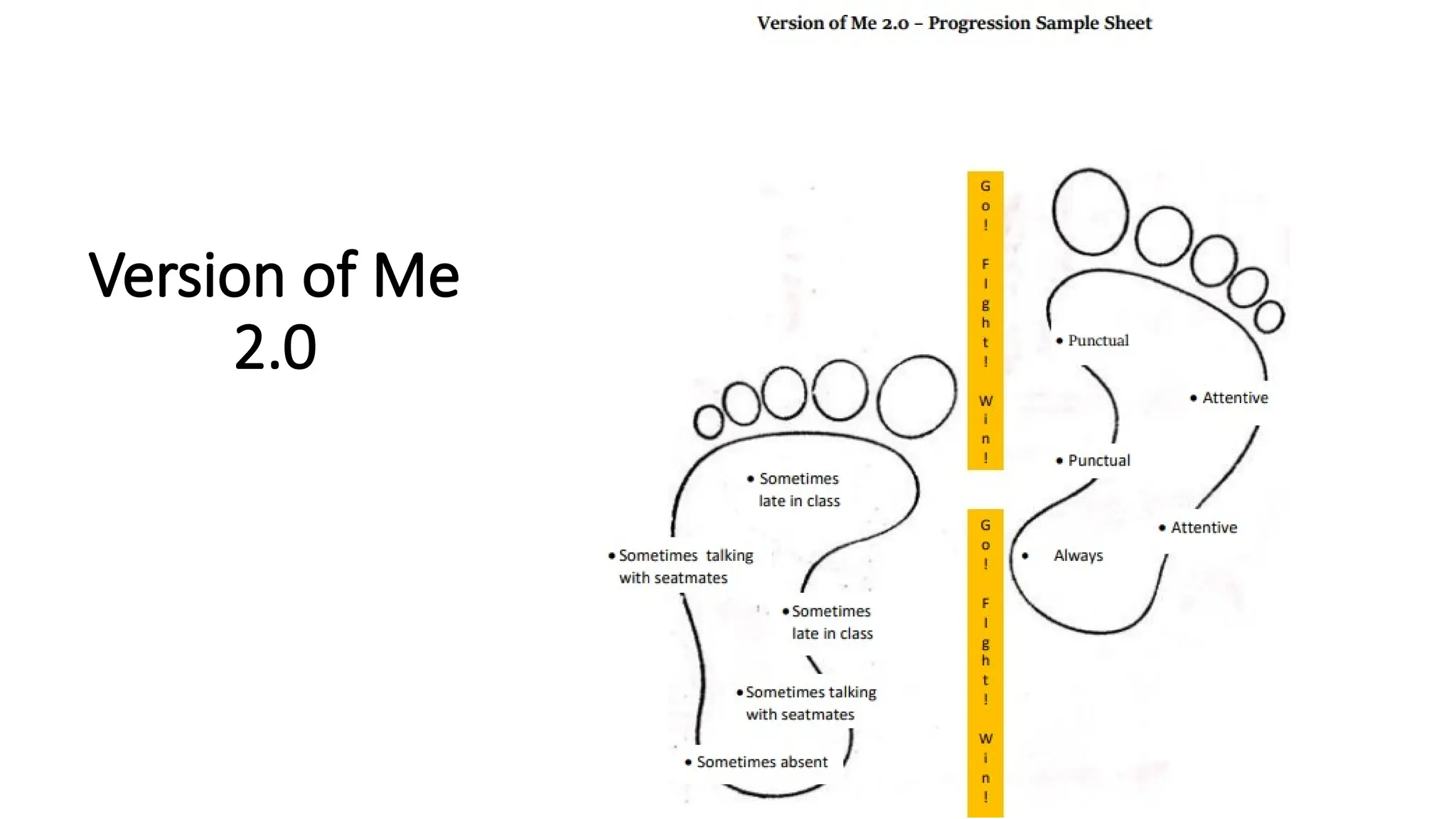
Version of Me 2.0
Introduction
•This module entitled “Version of Me 2.0” refers to the
individual who is discovering the real Version of Me
2.0, that can be awesome in his/her own way and able
to manifest greatness in pursuing a lifelong career. It is
a transition from school to the curriculum exits that
the learner will plan for the future job, that he/she
will be productive and persistently sustain in the real
world of work―that’s the real version of me 2.0.
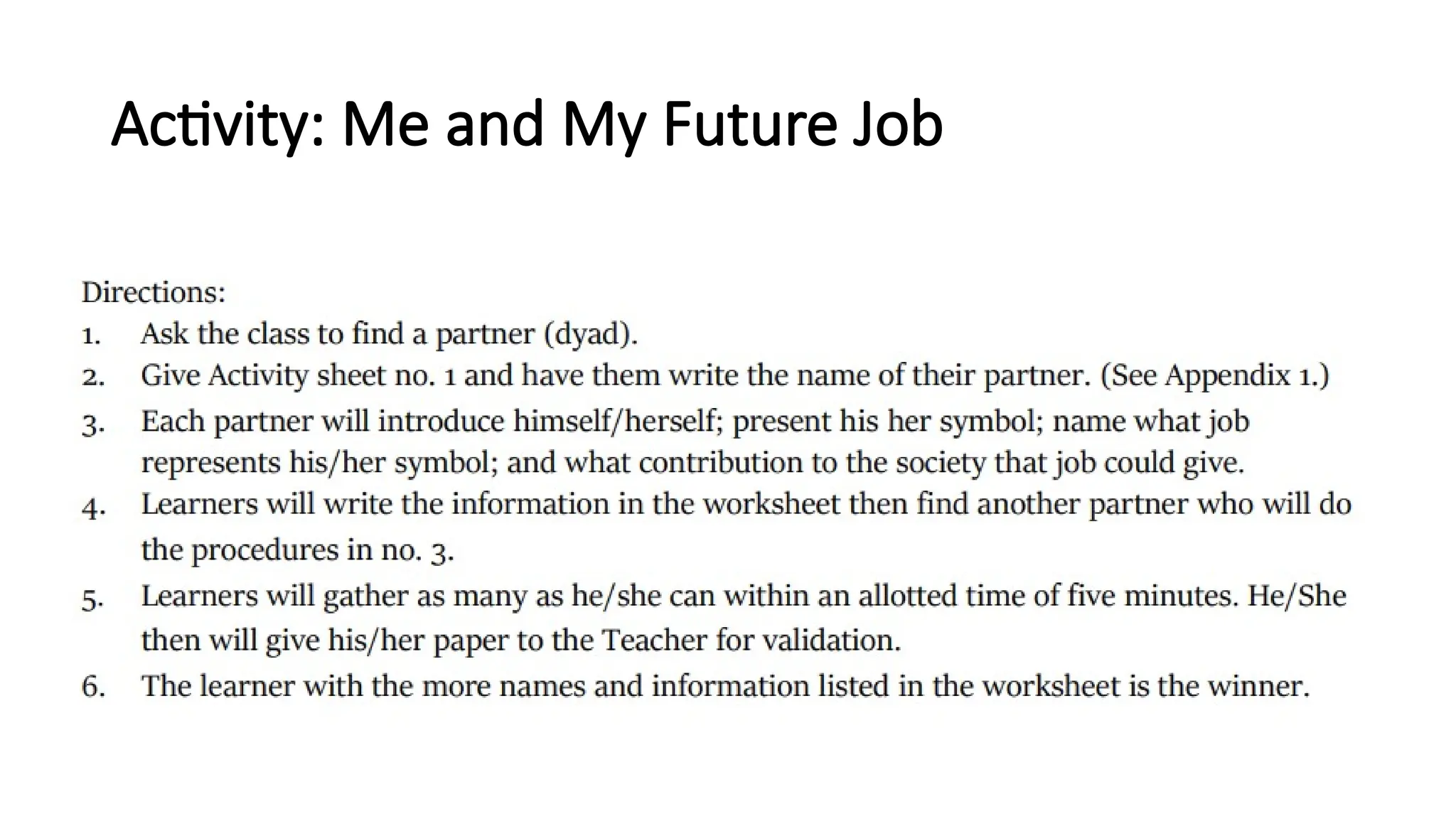
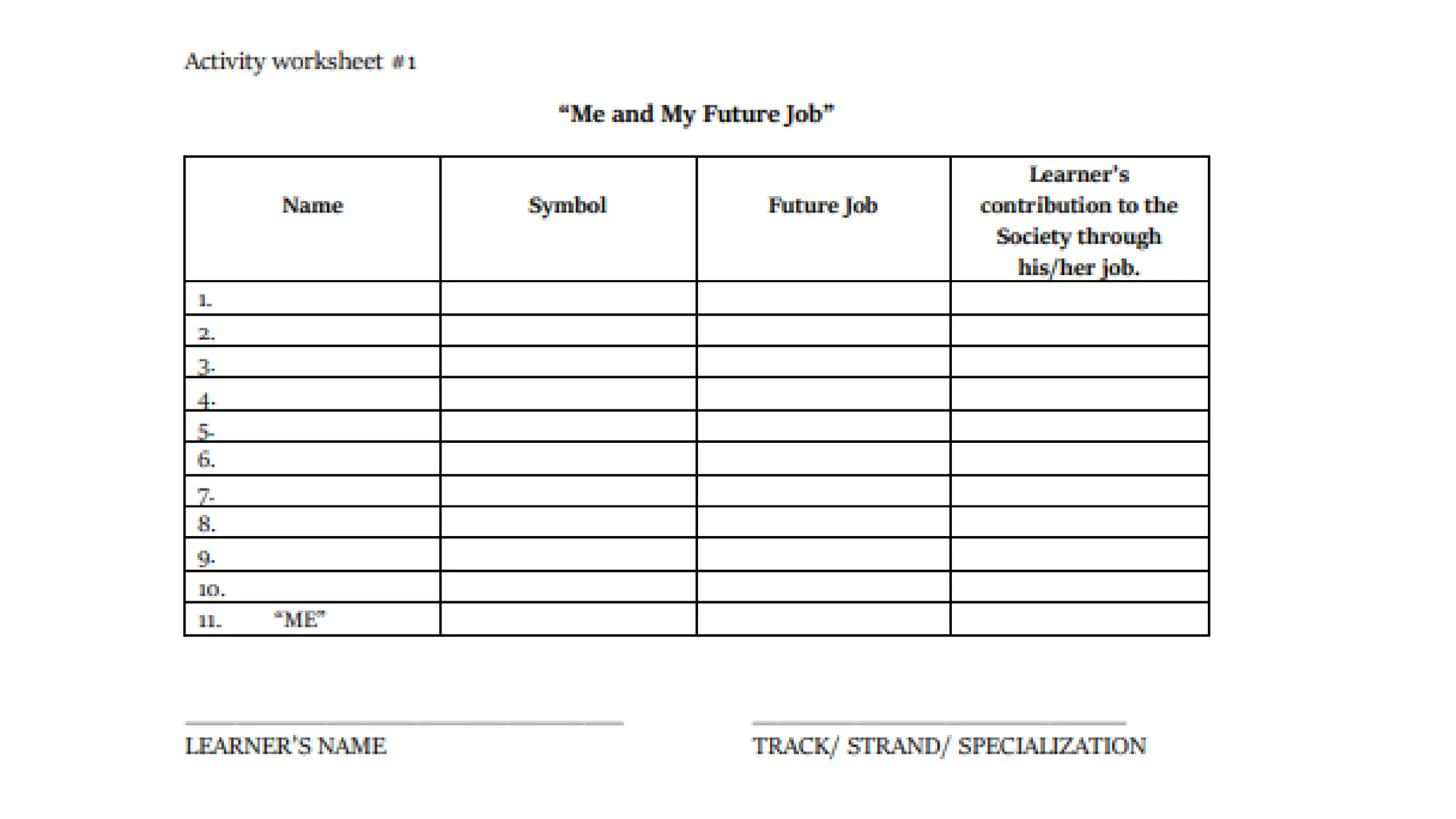
Activity: Me and My Future Job
Main Activity
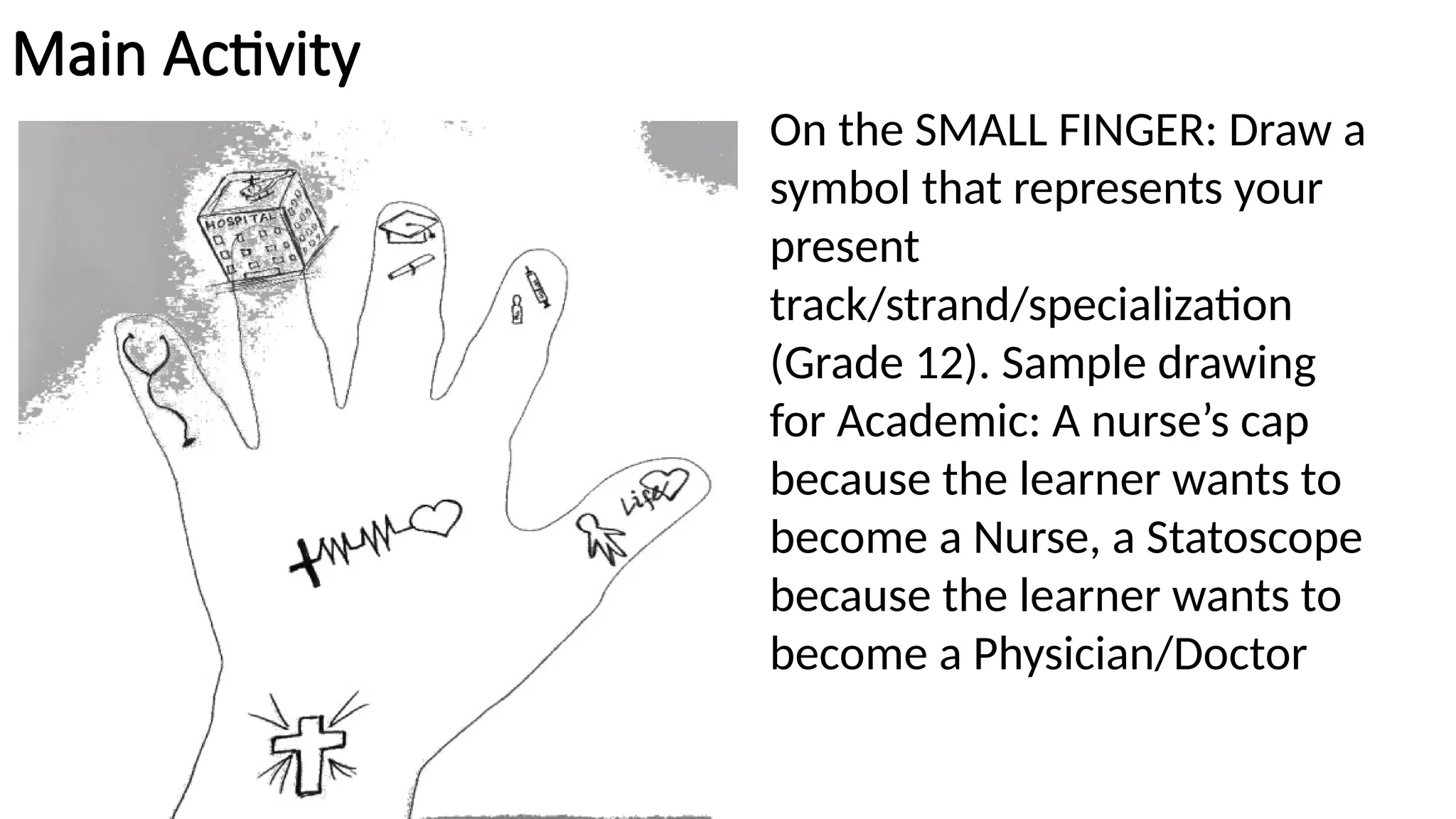
On the SMALL FINGER: Draw a
symbol that represents your
present
track/strand/specialization
(Grade 12). Sample drawing
for Academic: A nurse’s cap
because the learner wants to
become a Nurse, a Statoscope
because the learner wants to
become a Physician/Doctor
Main Activity
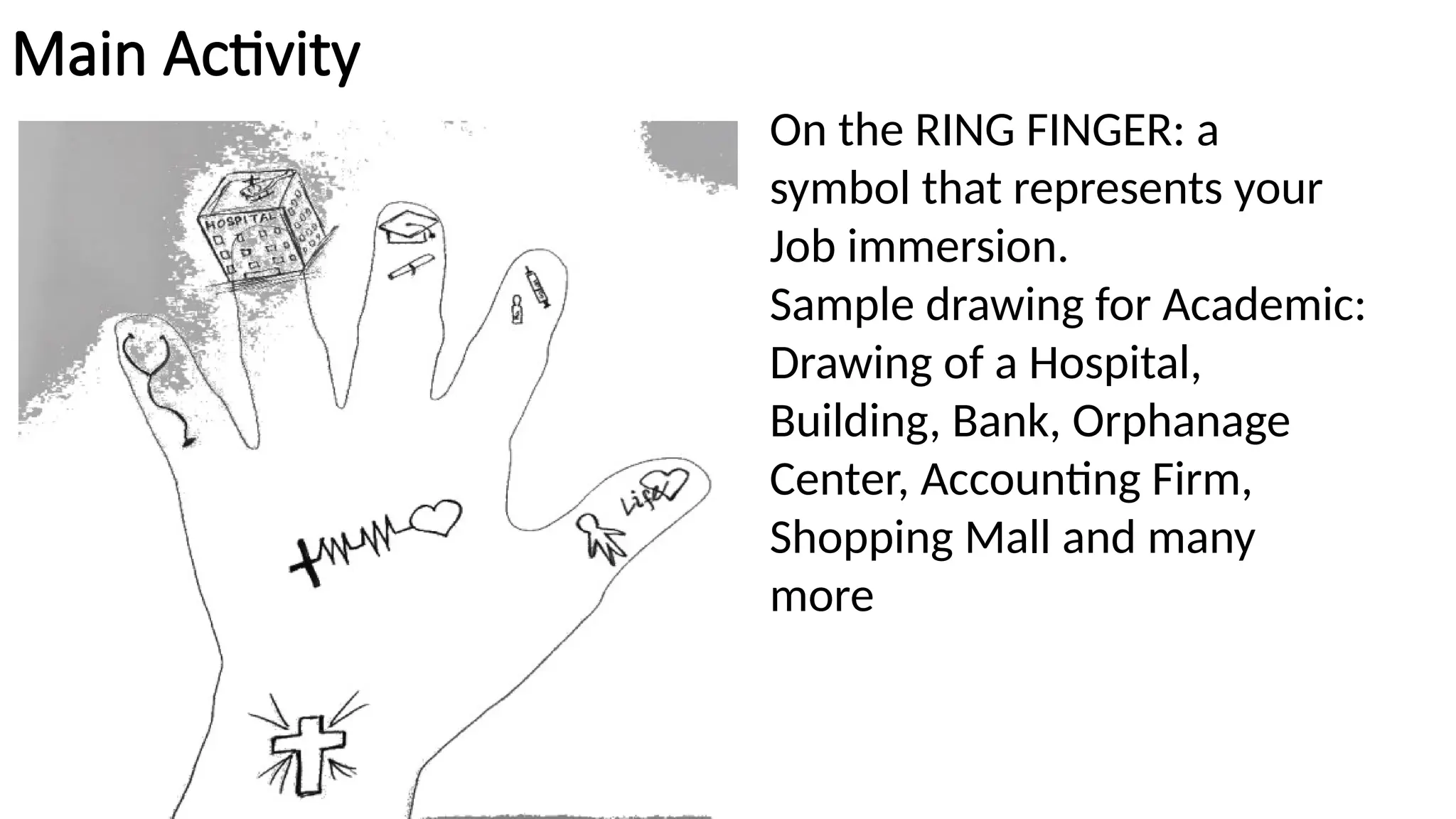
On the RING FINGER: a
symbol that represents your
Job immersion.
Sample drawing for Academic:
Drawing of a Hospital,
Building, Bank, Orphanage
Center, Accounting Firm,
Shopping Mall and many
more
Main Activity
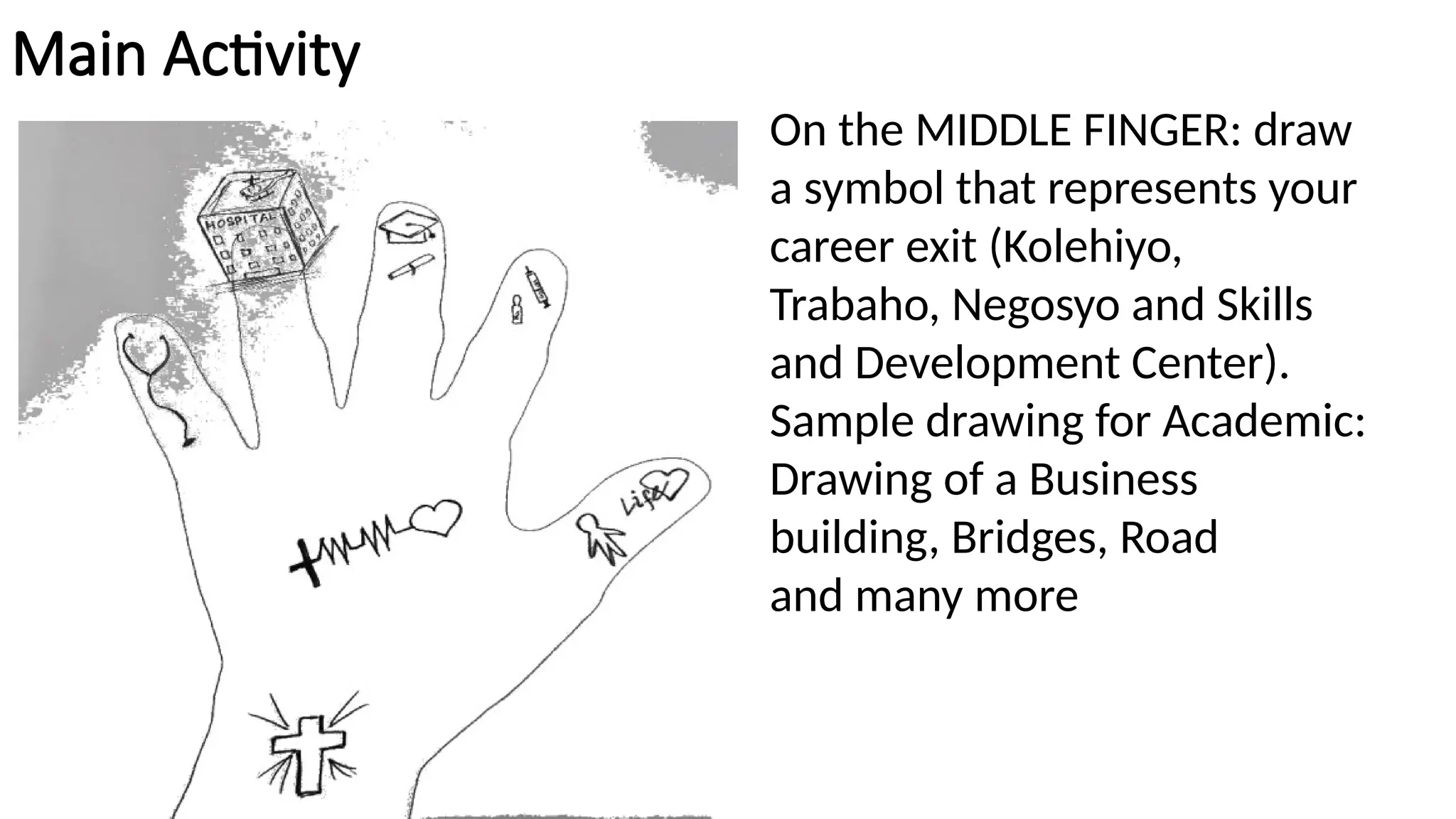
On the MIDDLE FINGER: draw
a symbol that represents your
career exit (Kolehiyo,
Trabaho, Negosyo and Skills
and Development Center).
Sample drawing for Academic:
Drawing of a Business
building, Bridges, Road
and many more
Main Activity
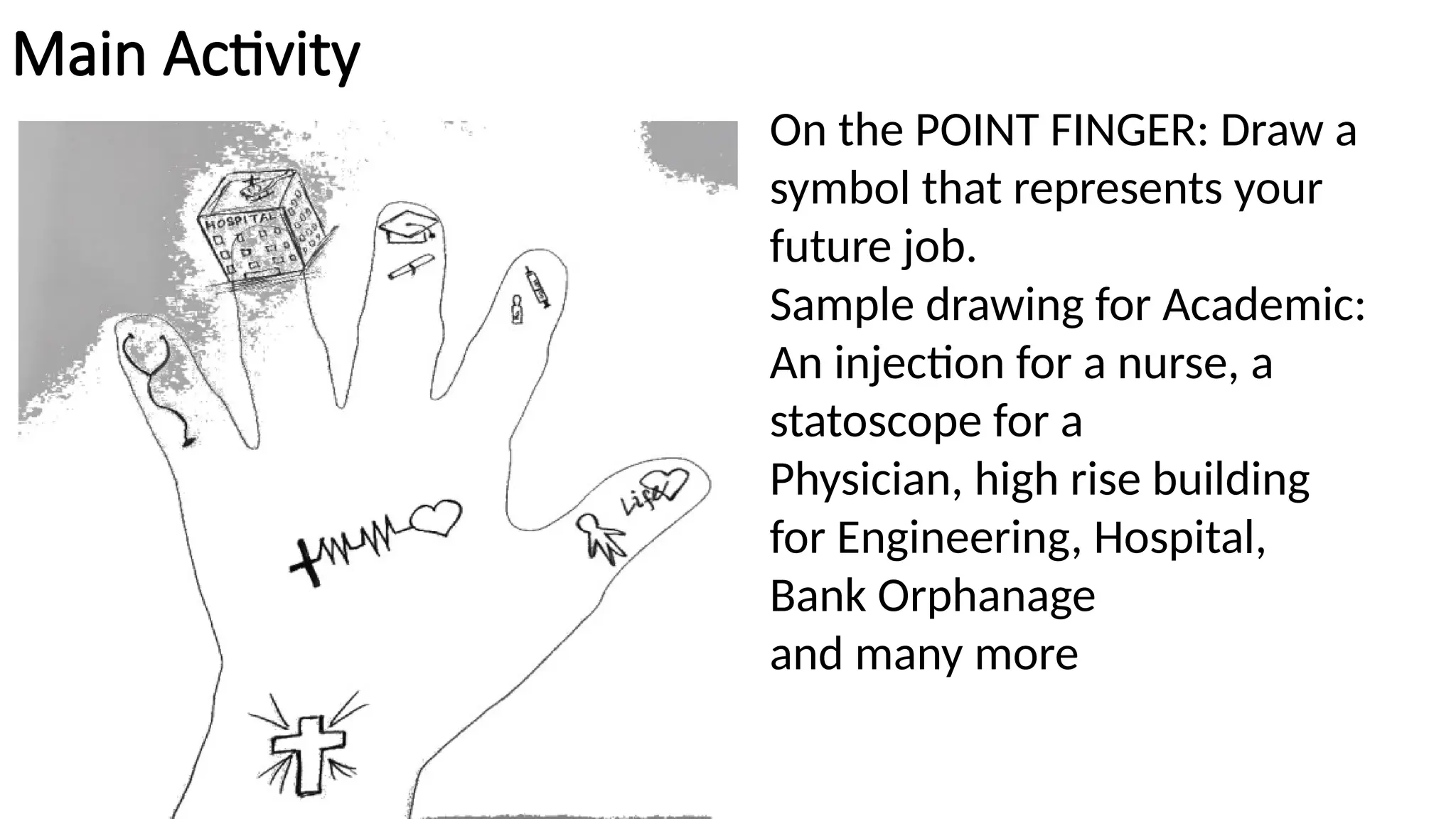
On the POINT FINGER: Draw a
symbol that represents your
future job.
Sample drawing for Academic:
An injection for a nurse, a
statoscope for a
Physician, high rise building
for Engineering, Hospital,
Bank Orphanage
and many more
Main Activity
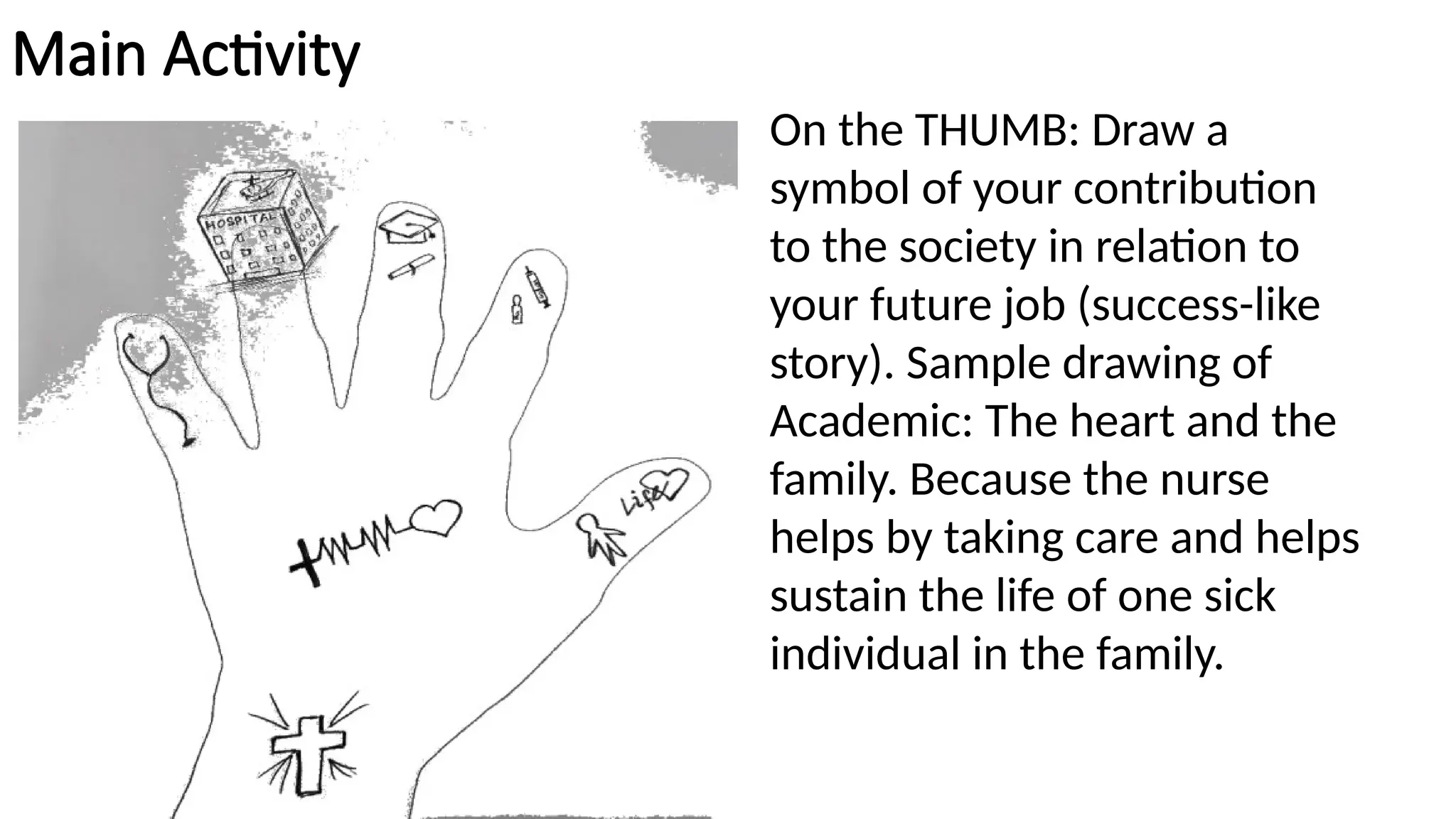
On the THUMB: Draw a
symbol of your contribution
to the society in relation to
your future job (success-like
story). Sample drawing of
Academic: The heart and the
family. Because the nurse
helps by taking care and helps
sustain the life of one sick
individual in the family.
Main Activity
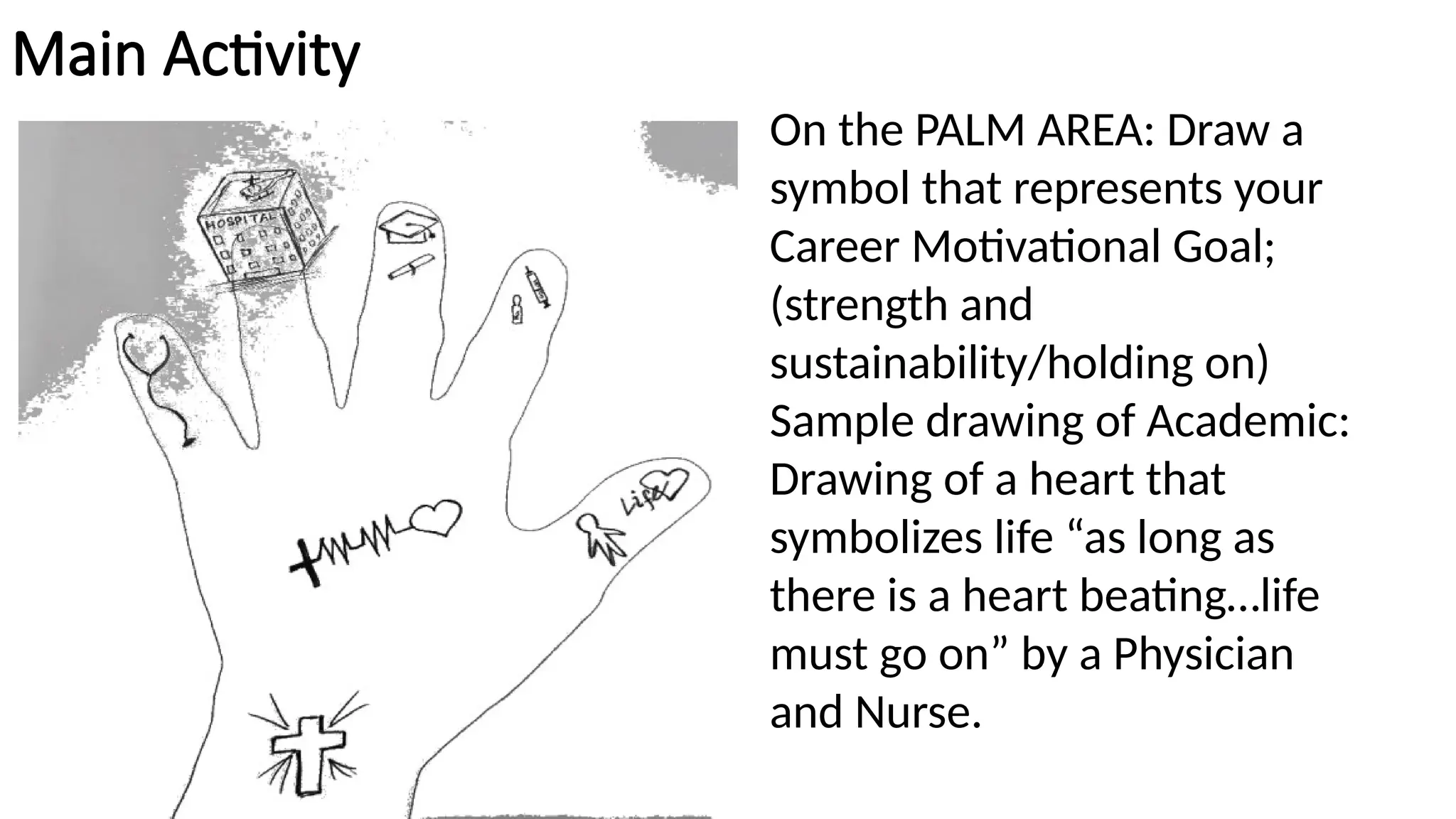
On the PALM AREA: Draw a
symbol that represents your
Career Motivational Goal;
(strength and
sustainability/holding on)
Sample drawing of Academic:
Drawing of a heart that
symbolizes life “as long as
there is a heart beating…life
must go on” by a Physician
and Nurse.
Main Activity
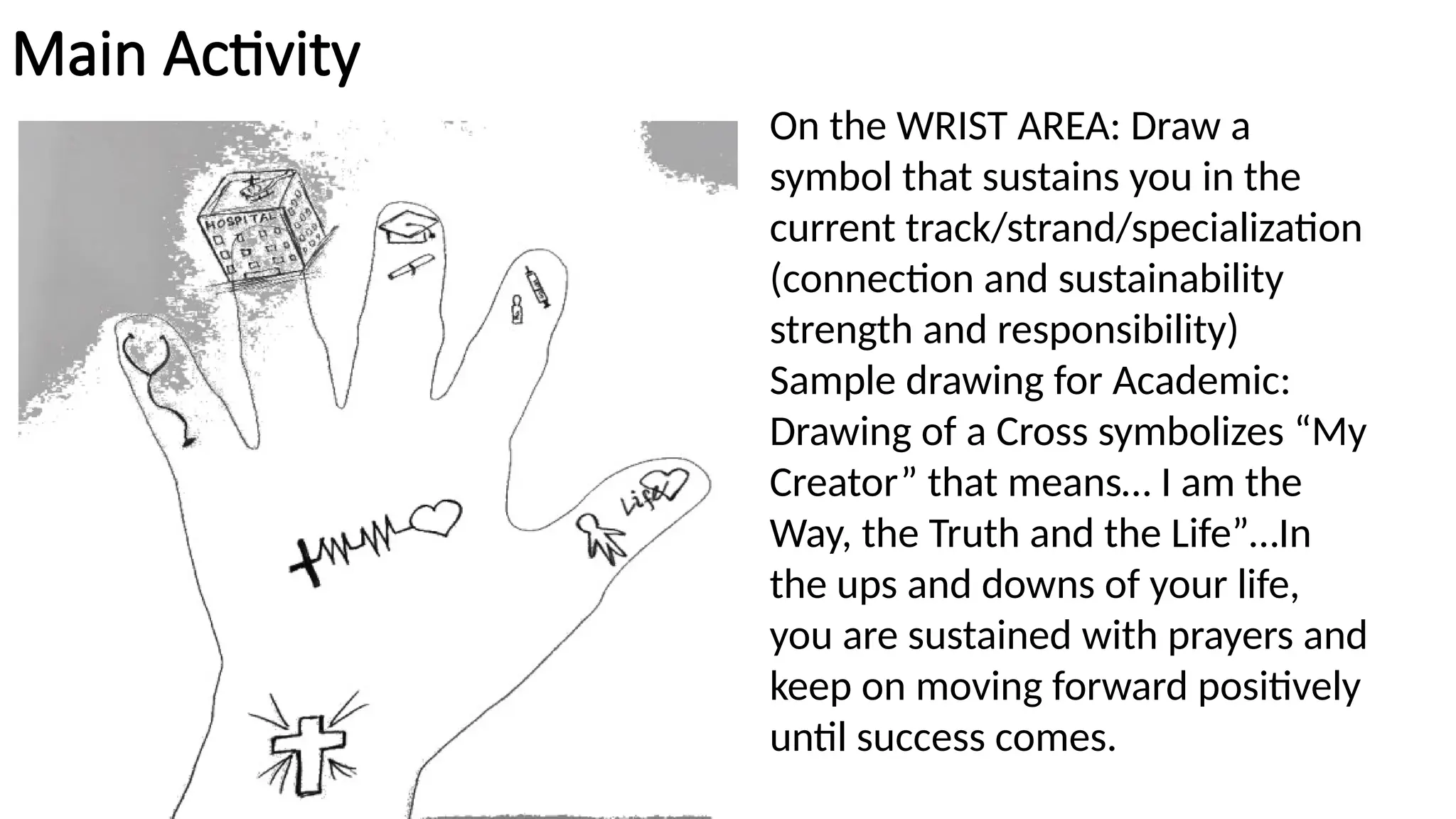
On the WRIST AREA: Draw a
symbol that sustains you in the
current track/strand/specialization
(connection and sustainability
strength and responsibility)
Sample drawing for Academic:
Drawing of a Cross symbolizes “My
Creator” that means… I am the
Way, the Truth and the Life”…In
the ups and downs of your life,
you are sustained with prayers and
keep on moving forward positively
until success comes.
Version of Me
2.0
Situational Analysis
Situation No.
Mr. Blank is a policeman who witnessed a killing incident to a
teenager who allegedly was involved about illegal drugs. In
the court scenario, Mr. Blank labelled the child as illegal drug
user without strong evidence.
1. Identify the work ethics and values of the policeman.
2. What could have been done by the policeman?
Situational Analysis
Situation No.
A bridge was built with substandard materials. The civil
engineer gave an estimated budget of 1.5 million to build the
bridge but only P750,00.00 was spent for the materials. The
other P750,000.00 was shared by the rest of the construction
workers.
1. Identify the ethical issue in this situation.
2. What should be done?
Situational Analysis
Situation No.
You are a friend of a newly hired accountant in a company XYZ
who was offered with a bonus of 1 million and a trip to
London for a vacation. But he could not present to the Board
of Directors his findings on the discrepancy of the financial
report at the company treasurer.
1. Identify the ethical issue in this situation.
2. What could have been done by the accountant?
Situational Analysis
Situation No.
A good chief cook was known in your community. Because of
his monetary needs, he closed a number of catering booking
in just a week. He was successful and gained triple income
better than when he was working in the hotel. But
unfortunately, he got sick with tuberculosis. He got so
depressed.
1. What work values can you identify in this situation?
2. How will you help/advise your good neighbor?
Situational Analysis
Situation No.
In a restaurant, a costumer ordered a hot noodle soup. As the
costumer was about to take the noodle soup, he found a hair
together with the noodles. The costumer then called the
waiter and told him about the hair. The waiter right away
apologized about the incident and gave him another serve of
hot noodle soup.
Identify the lesson learned in the situation.
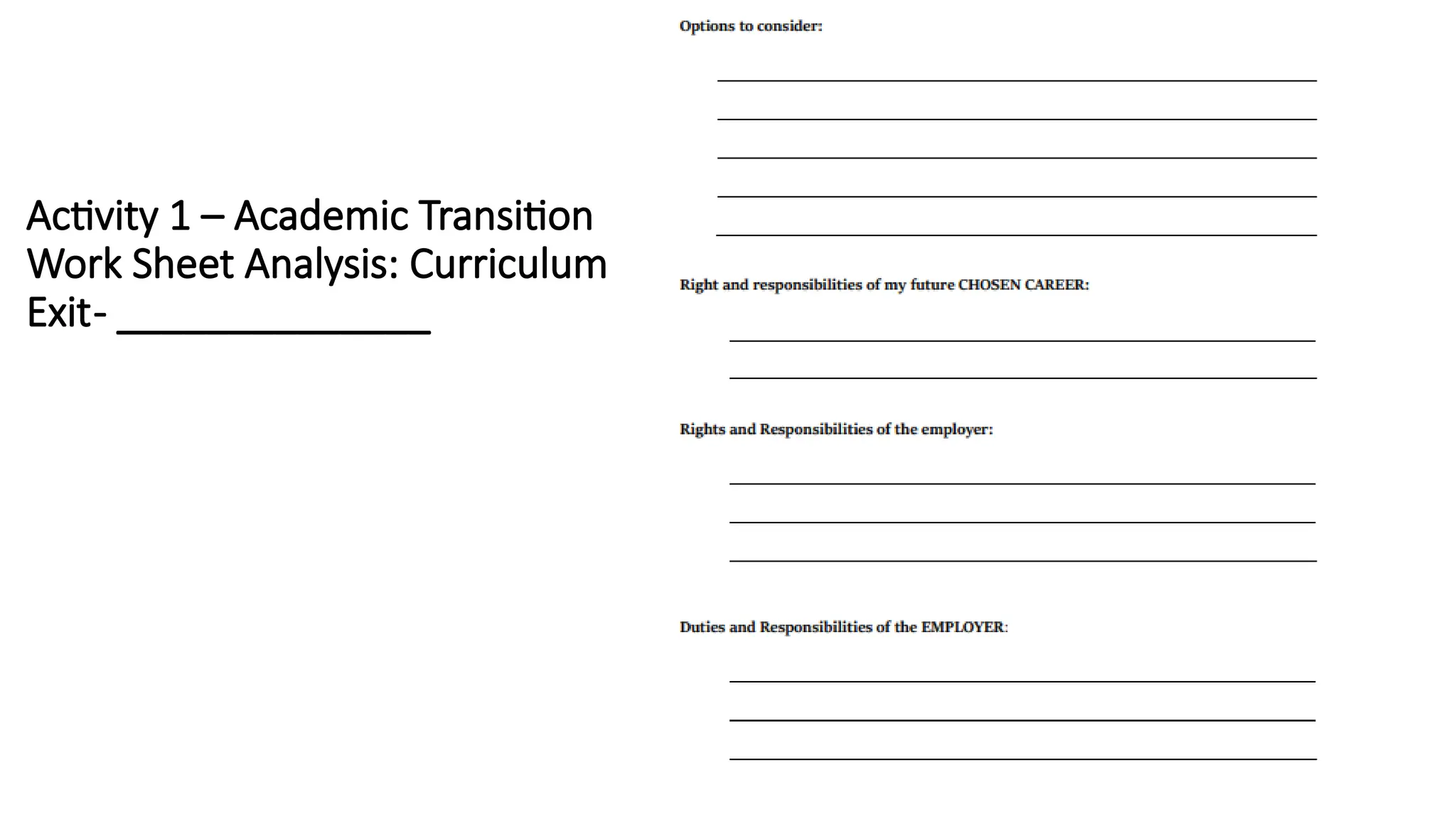
Activity 1 – Academic Transition
Work Sheet Analysis: Curriculum
Exit- ______________
Activity 1 – Academic Transition
Work Sheet Analysis: Curriculum
Exit- ______________
List of Work Ethics
1. Reliability
2. Positive and helpful character
3. Good communicator
4. Altruistic and Goal Oriented
Positive Work Ethics
Work ethics can be defined as a set of values, which involves
the right approach, attitude, precise behavior, respect for
others and lively communication. Basically, work ethics
normalize what an employee would do in different situations
in office premises.
The habit of following good work ethics is inherent - it comes
from within. It involves our morality and other values, apart
from what our parents have taught us. Workers revealing
good work ethics are considered suitable for better positions
and more responsibilities. Hence, it becomes important to be
honest, responsible and dependable.
Positive Work Beliefs
•Honesty: The old adage, "honesty is the best policy" is
true today more than ever. Any job assigned to a
person should be done with utmost honesty, without
double-dealing, untruthful or larceny. Employee
business ethics manuals from most scandalized
corporations are likely to contain slogans touting its
commitment to honesty and integrity at work.
Positive Work Beliefs
•Integrity at Work: Integrity implies strength and
stability. It means taking the high road by practicing
the highest business ethics standards. Representing
integrity in the workplace shows wholeness and
reliability in a person's character and in an
organization. It shows that person have solid
workplace behavior ethics that matter in the real
world that promote positive work ethics.
Positive Work Beliefs
•Dependability: Those who are dependable are
considered reliable as well. Hence, it is necessary to
develop the quality of being a responsible person.
This will, in turn, nurture brilliant results and set you
as a good example for those around you.
Positive Work Beliefs
•Responsibility: Accusing others, claiming victimhood, or
passing the buck mays solve shortterm crises, but
refusal to take responsibility corrodes respect and unity
in an organization. Ethical people take responsibility for
their actions. Workplace stress issues are no excuse.
Likewise, actions show the ability to be responsible
both in the little and big things. Good work ethics show
a deeper promise to personal responsibility.
Positive Work Beliefs
•Trust: There's no free drive to good work ethics. Trust
is hard to earn and even harder to get back after
you've lost it. Everyone who comes in contact with
you or your company must have trust and confidence
in how you do business ethics. Conflicts of interest in
the workplace must not be on your detector display.
Positive Work Beliefs
•Respect: Respect is more than a feeling, but a demo of
honor, value, and admiration for something or
someone. We respect the laws, the people we work
with, the company and its assets, and ourselves.
Positive Work Beliefs
•Teamwork: Always remember that you are a part of
the team, no matter what role you play in it. Do what
is not only good for you, but also, beneficial for the
team as a whole. It is a business necessity to work
openly and supportively in teams whether formal or
informal. You need each other for effective problem
solving in the work place.
Positive Work Beliefs
•Efficiency: Efficiency is vital for a person's own growth
as well as the improvement of the company he is
working with. It is very easy to spot inefficient
employees, who waste a lot of time and resources.
However, efficiency is still a hallmark of good workers.
Positive Work Beliefs
• Quality: Quality should be more than making the best
product, but should extend to every aspect of your work.
A person who recognizes quality and strives for it daily
has a profound sense of self-respect, pride in
accomplishment, and attentiveness that affects
everything. From your memos to your presentations,
everything you touch should communicate
professionalism and quality. Don't let workplace stress
issues rob you of striving for quality in everything you do
Positive Work Beliefs
•Modesty: Humbleness and modesty are amongst the
essential elements of good work ethics. Only a dupe is
arrogant, while a wise person always shows behaviors
of humility.
Positive Work Beliefs
•Leadership: A leader is out front providing an example
that others will follow. Problem solving in the work
place must be your first response. The real test of
these values comes from the resulting action. It takes
a concerted, company-wide effort, beyond inserting
these words in an employee manual, to make it
happen.
Positive Work Beliefs
•Positive Work Habits: Inculcate good working habits
that will impress the people you are working with and
your superiors as well. Coming to work late, dressing
inappropriately and shuffling jobs are considered as
signs of not following good work ethics.
Positive Work Beliefs
•Initiative: To be successful in whatever you do, it is
vital to take initiatives on your part. Don't wait to be
told what to do. If you are doing the right thing in an
acceptable manner, do not hesitate to take initiatives.
Positive Work Beliefs
•Positive Attitude: Maintaining a positive attitude at
work is very important to complete your tasks
successfully. This is because your coworkers get
affected by your trait and respond accordingly.

CGP MODULE 7 POWERPOINT PRESENTATION FOR

  • 1.
  • 2.
    Introduction •This module entitled“Version of Me 2.0” refers to the individual who is discovering the real Version of Me 2.0, that can be awesome in his/her own way and able to manifest greatness in pursuing a lifelong career. It is a transition from school to the curriculum exits that the learner will plan for the future job, that he/she will be productive and persistently sustain in the real world of work―that’s the real version of me 2.0.
  • 3.
    Activity: Me andMy Future Job
  • 5.
    Main Activity On theSMALL FINGER: Draw a symbol that represents your present track/strand/specialization (Grade 12). Sample drawing for Academic: A nurse’s cap because the learner wants to become a Nurse, a Statoscope because the learner wants to become a Physician/Doctor
  • 6.
    Main Activity On theRING FINGER: a symbol that represents your Job immersion. Sample drawing for Academic: Drawing of a Hospital, Building, Bank, Orphanage Center, Accounting Firm, Shopping Mall and many more
  • 7.
    Main Activity On theMIDDLE FINGER: draw a symbol that represents your career exit (Kolehiyo, Trabaho, Negosyo and Skills and Development Center). Sample drawing for Academic: Drawing of a Business building, Bridges, Road and many more
  • 8.
    Main Activity On thePOINT FINGER: Draw a symbol that represents your future job. Sample drawing for Academic: An injection for a nurse, a statoscope for a Physician, high rise building for Engineering, Hospital, Bank Orphanage and many more
  • 9.
    Main Activity On theTHUMB: Draw a symbol of your contribution to the society in relation to your future job (success-like story). Sample drawing of Academic: The heart and the family. Because the nurse helps by taking care and helps sustain the life of one sick individual in the family.
  • 10.
    Main Activity On thePALM AREA: Draw a symbol that represents your Career Motivational Goal; (strength and sustainability/holding on) Sample drawing of Academic: Drawing of a heart that symbolizes life “as long as there is a heart beating…life must go on” by a Physician and Nurse.
  • 11.
    Main Activity On theWRIST AREA: Draw a symbol that sustains you in the current track/strand/specialization (connection and sustainability strength and responsibility) Sample drawing for Academic: Drawing of a Cross symbolizes “My Creator” that means… I am the Way, the Truth and the Life”…In the ups and downs of your life, you are sustained with prayers and keep on moving forward positively until success comes.
  • 12.
  • 13.
    Situational Analysis Situation No. Mr.Blank is a policeman who witnessed a killing incident to a teenager who allegedly was involved about illegal drugs. In the court scenario, Mr. Blank labelled the child as illegal drug user without strong evidence. 1. Identify the work ethics and values of the policeman. 2. What could have been done by the policeman?
  • 14.
    Situational Analysis Situation No. Abridge was built with substandard materials. The civil engineer gave an estimated budget of 1.5 million to build the bridge but only P750,00.00 was spent for the materials. The other P750,000.00 was shared by the rest of the construction workers. 1. Identify the ethical issue in this situation. 2. What should be done?
  • 15.
    Situational Analysis Situation No. Youare a friend of a newly hired accountant in a company XYZ who was offered with a bonus of 1 million and a trip to London for a vacation. But he could not present to the Board of Directors his findings on the discrepancy of the financial report at the company treasurer. 1. Identify the ethical issue in this situation. 2. What could have been done by the accountant?
  • 16.
    Situational Analysis Situation No. Agood chief cook was known in your community. Because of his monetary needs, he closed a number of catering booking in just a week. He was successful and gained triple income better than when he was working in the hotel. But unfortunately, he got sick with tuberculosis. He got so depressed. 1. What work values can you identify in this situation? 2. How will you help/advise your good neighbor?
  • 17.
    Situational Analysis Situation No. Ina restaurant, a costumer ordered a hot noodle soup. As the costumer was about to take the noodle soup, he found a hair together with the noodles. The costumer then called the waiter and told him about the hair. The waiter right away apologized about the incident and gave him another serve of hot noodle soup. Identify the lesson learned in the situation.
  • 18.
    Activity 1 –Academic Transition Work Sheet Analysis: Curriculum Exit- ______________
  • 19.
    Activity 1 –Academic Transition Work Sheet Analysis: Curriculum Exit- ______________
  • 20.
    List of WorkEthics 1. Reliability 2. Positive and helpful character 3. Good communicator 4. Altruistic and Goal Oriented
  • 21.
    Positive Work Ethics Workethics can be defined as a set of values, which involves the right approach, attitude, precise behavior, respect for others and lively communication. Basically, work ethics normalize what an employee would do in different situations in office premises. The habit of following good work ethics is inherent - it comes from within. It involves our morality and other values, apart from what our parents have taught us. Workers revealing good work ethics are considered suitable for better positions and more responsibilities. Hence, it becomes important to be honest, responsible and dependable.
  • 22.
    Positive Work Beliefs •Honesty:The old adage, "honesty is the best policy" is true today more than ever. Any job assigned to a person should be done with utmost honesty, without double-dealing, untruthful or larceny. Employee business ethics manuals from most scandalized corporations are likely to contain slogans touting its commitment to honesty and integrity at work.
  • 23.
    Positive Work Beliefs •Integrityat Work: Integrity implies strength and stability. It means taking the high road by practicing the highest business ethics standards. Representing integrity in the workplace shows wholeness and reliability in a person's character and in an organization. It shows that person have solid workplace behavior ethics that matter in the real world that promote positive work ethics.
  • 24.
    Positive Work Beliefs •Dependability:Those who are dependable are considered reliable as well. Hence, it is necessary to develop the quality of being a responsible person. This will, in turn, nurture brilliant results and set you as a good example for those around you.
  • 25.
    Positive Work Beliefs •Responsibility:Accusing others, claiming victimhood, or passing the buck mays solve shortterm crises, but refusal to take responsibility corrodes respect and unity in an organization. Ethical people take responsibility for their actions. Workplace stress issues are no excuse. Likewise, actions show the ability to be responsible both in the little and big things. Good work ethics show a deeper promise to personal responsibility.
  • 26.
    Positive Work Beliefs •Trust:There's no free drive to good work ethics. Trust is hard to earn and even harder to get back after you've lost it. Everyone who comes in contact with you or your company must have trust and confidence in how you do business ethics. Conflicts of interest in the workplace must not be on your detector display.
  • 27.
    Positive Work Beliefs •Respect:Respect is more than a feeling, but a demo of honor, value, and admiration for something or someone. We respect the laws, the people we work with, the company and its assets, and ourselves.
  • 28.
    Positive Work Beliefs •Teamwork:Always remember that you are a part of the team, no matter what role you play in it. Do what is not only good for you, but also, beneficial for the team as a whole. It is a business necessity to work openly and supportively in teams whether formal or informal. You need each other for effective problem solving in the work place.
  • 29.
    Positive Work Beliefs •Efficiency:Efficiency is vital for a person's own growth as well as the improvement of the company he is working with. It is very easy to spot inefficient employees, who waste a lot of time and resources. However, efficiency is still a hallmark of good workers.
  • 30.
    Positive Work Beliefs •Quality: Quality should be more than making the best product, but should extend to every aspect of your work. A person who recognizes quality and strives for it daily has a profound sense of self-respect, pride in accomplishment, and attentiveness that affects everything. From your memos to your presentations, everything you touch should communicate professionalism and quality. Don't let workplace stress issues rob you of striving for quality in everything you do
  • 31.
    Positive Work Beliefs •Modesty:Humbleness and modesty are amongst the essential elements of good work ethics. Only a dupe is arrogant, while a wise person always shows behaviors of humility.
  • 32.
    Positive Work Beliefs •Leadership:A leader is out front providing an example that others will follow. Problem solving in the work place must be your first response. The real test of these values comes from the resulting action. It takes a concerted, company-wide effort, beyond inserting these words in an employee manual, to make it happen.
  • 33.
    Positive Work Beliefs •PositiveWork Habits: Inculcate good working habits that will impress the people you are working with and your superiors as well. Coming to work late, dressing inappropriately and shuffling jobs are considered as signs of not following good work ethics.
  • 34.
    Positive Work Beliefs •Initiative:To be successful in whatever you do, it is vital to take initiatives on your part. Don't wait to be told what to do. If you are doing the right thing in an acceptable manner, do not hesitate to take initiatives.
  • 35.
    Positive Work Beliefs •PositiveAttitude: Maintaining a positive attitude at work is very important to complete your tasks successfully. This is because your coworkers get affected by your trait and respond accordingly.

Editor's Notes

  • #22 Values that are influenced by other people’s value systems may not truly represent the individual’s true values.
  • #23 Values that are influenced by other people’s value systems may not truly represent the individual’s true values.
  • #24 Values that are influenced by other people’s value systems may not truly represent the individual’s true values.
  • #25 Values that are influenced by other people’s value systems may not truly represent the individual’s true values.
  • #26 Values that are influenced by other people’s value systems may not truly represent the individual’s true values.
  • #27 Values that are influenced by other people’s value systems may not truly represent the individual’s true values.
  • #28 Values that are influenced by other people’s value systems may not truly represent the individual’s true values.
  • #29 Values that are influenced by other people’s value systems may not truly represent the individual’s true values.
  • #30 Values that are influenced by other people’s value systems may not truly represent the individual’s true values.
  • #31 Values that are influenced by other people’s value systems may not truly represent the individual’s true values.
  • #32 Values that are influenced by other people’s value systems may not truly represent the individual’s true values.
  • #33 Values that are influenced by other people’s value systems may not truly represent the individual’s true values.
  • #34 Values that are influenced by other people’s value systems may not truly represent the individual’s true values.
  • #35 Values that are influenced by other people’s value systems may not truly represent the individual’s true values.