ERIK DE MEULEMEESTER, PT, DSCPT, OMPT
Oakland University
 Translatoric Spinal Manipulation¹ or ‘TSM’ was
developed by Olaf Evjenth, PT, OMT and Freddy
Kaltenborn, PT, OMT
 TSM² can be performed at low velocity (LV) or a high
velocity (HV)
 LV: long amplitude; end of grade 2
 HV: amplitude of impulse is short as possible; end of
grade 2, across the final stop
2
 Mechanical:
 Enhance fluid movement through the joint⁴
 Stretch joint capsule and muscles crossing the joint
 Increase ROM
 Neurophysiological⁴ :
 Muscle relaxation and pain reduction may be
facilitated at both the spinal and supraspinal levels
3
 The effect of spinal manipulation on cervical mobility
 Kondratek et al⁷ in 2006, Creighton et al⁸ in 2005
described pre-positioned C0 & C1 traction for
improvement of neck pain and mobility
 Krauss et al⁹ in 2008 has described the effect of
thoracic manipulation on the relief of cervical
symptoms.
 Puentedura et al¹º in 2011 demonstrated the
effectiveness of cervical manipulation on pain
4
 Use of TSM techniques to improve cervical mobility and
pain
 No adverse events were are recorded when
practicing TSM techniques
 Limited cervical mobility may be treated safely with
TSM techniques ⁷,⁸,⁹
 The VA is not compromised with non-thrust TSM
techniques¹¹
5
 No studies were found that describe cervical traction
manipulation (TSM), as a single-modal treatment in a
study with randomized group assignment.
 This information suggests a significant gap in the current
literature in the research of cervical manual therapy.
 The need to support the effects of cervical manual
traction is indicated to establish the use of cervical
traction manipulation as an efficacious intervention
option.
6
1. To demonstrate the effectiveness of Translatoric Spinal
Manipulation (TSM) to reduce cervical pain and
stiffness.
2. To compare the effectiveness of a high velocity (HV)
and low velocity (LV) versions of the same cervical
traction technique.
7
 Approval was obtained from the respective ethics
committees
 Participants were recruited through a sample of
convenience, 3 subjects for each group
 Informed consent and screening forms were completed
by each participant
 Participants were randomly assigned to either ‘HV’ or
‘LV’
8
 Inclusion criteria:
 18 through 80 years of age
 primary complaint of neck pain and/or stiffness.
 Exclusion criteria:
 current infection, tumor,
 spinal fracture
 concurrently receiving manipulative treatment from
another practitioner,
 involvement in litigation, and/or currently involved in
workers compensation cases.
9
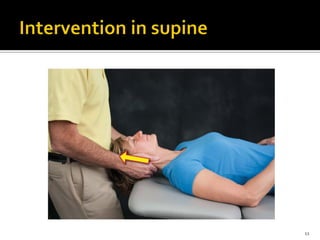
 TSM was performed in sitting, side lying, or supine, as
selected by the RA.
 After data collection:
 The therapist completed the intervention using other
interventions as selected by the treating therapist.
 The only limitation:
 participants from the HV group only received HV
interventions
 participants from the LV group only received LV
interventions
10
11
 Data collection performed at the beginning of each of 6 PT
visits
 CROM measurements: flexion, extension, right /left side
bending, right / left rotation
 3 warm-up repetitions - stop at the onset of pain.
 Measure and record 4th, 5th, and 6th repetitions.
 Record the NPRS at the onset of pain
 Post intervention: CROM was used to guide the participant
to return the neck to the point where pain was produced
prior to intervention.
 NPRS value is reported at this point in the range 12
 Actively move the neck further, if possible; record CROM
 Record the NPRS at the end range of motion
 Each participant was followed for a total of six visits
within their rehabilitation period.
 NDI was completed before the first / after the sixth visit
13
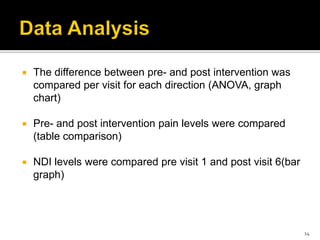
 The difference between pre- and post intervention was
compared per visit for each direction (ANOVA, graph
chart)
 Pre- and post intervention pain levels were compared
(table comparison)
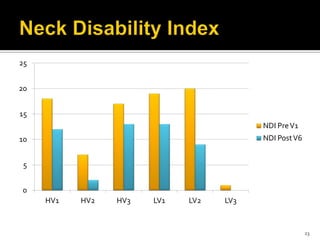
 NDI levels were compared pre visit 1 and post visit 6(bar
graph)
14
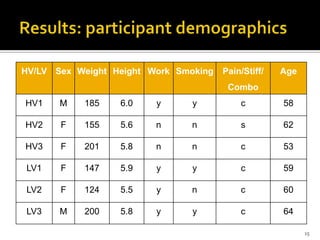
HV/LV Sex Weight Height Work Smoking Pain/Stiff/
Combo
Age
HV1 M 185 6.0 y y c 58
HV2 F 155 5.6 n n s 62
HV3 F 201 5.8 n n c 53
LV1 F 147 5.9 y y c 59
LV2 F 124 5.5 y n c 60
LV3 M 200 5.8 y y c 64
15
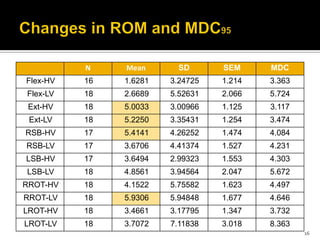
N Mean SD SEM MDC
Flex-HV 16 1.6281 3.24725 1.214 3.363
Flex-LV 18 2.6689 5.52631 2.066 5.724
Ext-HV 18 5.0033 3.00966 1.125 3.117
Ext-LV 18 5.2250 3.35431 1.254 3.474
RSB-HV 17 5.4141 4.26252 1.474 4.084
RSB-LV 17 3.6706 4.41374 1.527 4.231
LSB-HV 17 3.6494 2.99323 1.553 4.303
LSB-LV 18 4.8561 3.94564 2.047 5.672
RROT-HV 18 4.1522 5.75582 1.623 4.497
RROT-LV 18 5.9306 5.94848 1.677 4.646
LROT-HV 18 3.4661 3.17795 1.347 3.732
LROT-LV 18 3.7072 7.11838 3.018 8.363
16
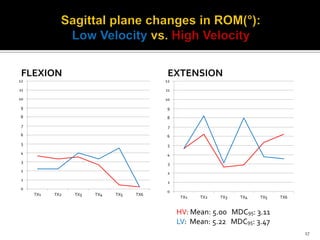
FLEXION
0
1
2
3
4
5
6
7
8
9
10
11
12
TX1 TX2 TX3 TX4 TX5 TX6
EXTENSION
0
1
2
3
4
5
6
7
8
9
10
11
12
TX1 TX2 TX3 TX4 TX5 TX6
17
HV: Mean: 5.00 MDC95: 3.11
LV: Mean: 5.22 MDC95: 3.47
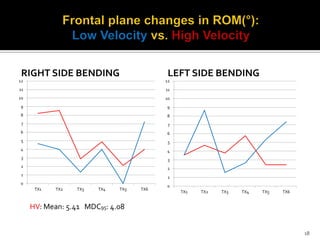
RIGHT SIDE BENDING
0
1
2
3
4
5
6
7
8
9
10
11
12
TX1 TX2 TX3 TX4 TX5 TX6
LEFT SIDE BENDING
0
1
2
3
4
5
6
7
8
9
10
11
12
TX1 TX2 TX3 TX4 TX5 TX6
18
HV: Mean: 5.41 MDC95: 4.08
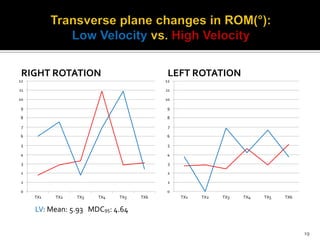
RIGHT ROTATION
0
1
2
3
4
5
6
7
8
9
10
11
12
TX1 TX2 TX3 TX4 TX5 TX6
LEFT ROTATION
0
1
2
3
4
5
6
7
8
9
10
11
12
TX1 TX2 TX3 TX4 TX5 TX6
19
LV: Mean: 5.93 MDC95: 4.64
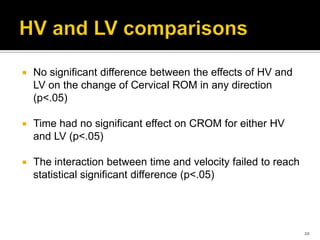
 No significant difference between the effects of HV and
LV on the change of Cervical ROM in any direction
(p<.05)
 Time had no significant effect on CROM for either HV
and LV (p<.05)
 The interaction between time and velocity failed to reach
statistical significant difference (p<.05)
20
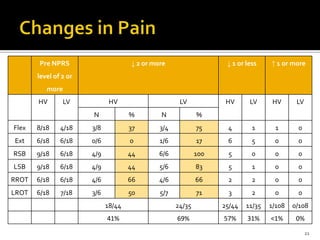
Pre NPRS
level of 2 or
more
↓ 2 or more ↓ 1 or less ↑ 1 or more
HV LV HV LV HV LV HV LV
N % N %
Flex 8/18 4/18 3/8 37 3/4 75 4 1 1 0
Ext 6/18 6/18 0/6 0 1/6 17 6 5 0 0
RSB 9/18 6/18 4/9 44 6/6 100 5 0 0 0
LSB 9/18 6/18 4/9 44 5/6 83 5 1 0 0
RROT 6/18 6/18 4/6 66 4/6 66 2 2 0 0
LROT 6/18 7/18 3/6 50 5/7 71 3 2 0 0
18/44 24/35 25/44 11/35 1/108 0/108
41% 69% 57% 31% <1% 0%
21
22
0
10
20
30
40
50
60
70
80
90
100
FLEX EXT RSB LSB RROT LROT
HV
LV
Percent
0
5
10
15
20
25
HV1 HV2 HV3 LV1 LV2 LV3
NDI PreV1
NDI PostV6
23
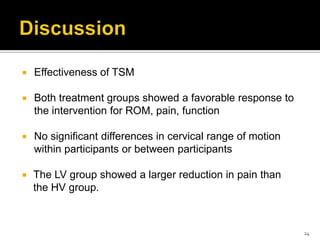
 Effectiveness of TSM
 Both treatment groups showed a favorable response to
the intervention for ROM, pain, function
 No significant differences in cervical range of motion
within participants or between participants
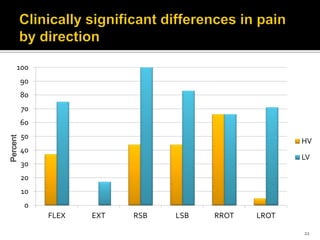
 The LV group showed a larger reduction in pain than
the HV group.
24
 To the best of my knowledge this is the first randomized
study to use the CROM-device as an outcome measure
for manipulative cervical traction techniques.
 Other studies have used the CROM device as an
outcome measurement tool, to investigate either a
thoracic manipulation or contra-lateral gapping in the
lower cervical spine.
 The studies that have investigated the effect of cervical
traction and traction manipulation, used functional
outcome measures (Neck Disability Index) and self-
report of pain (VAS and NPRS).
25
 In the preliminary study we have a small sample size
which will make it difficult to detect any significant
changes with an ANCOVA analysis
 We did not ask the RA to report the position of the
intervention. It is possible the position of the intervention
may have an effect upon the outcome.
26
 Orthopedic manual therapists use several manipulative
techniques for the treatment of pain and movement
impairments of the cervical spine.
 This preliminary study demonstrates that cervical
traction manipulation has a favorable response on
cervical range of motion, pain and function.
 No participant reported a significant increase in level of
pain or any adverse events during the interventions.
27
 1) Kaltenborn F. The Spine Basic Evaluation and Mobilization
Techniques. 5th ed. Olso, Norway: . OPTP Minneapolis, Minnesota.
2009.
 2) Krauss J., Evjenth O., Creighton D. TSM Translatoric spinal
manipulation for physical therapists Lakeview Media. 2006
 3) Evans DW. Review of the literature. Mechanisms and effects of
spinal high-velocity, low-amplitude thrust manipulation: previous
theories. Journal of Manipulative & Physiological Therapeutics.
2002;25(4):251-262.
 4) Bialosky JE, Bishop MD, Price DD, Robinson ME, George SZ. The
mechanisms of manual therapy in the treatment of musculoskeletal
pain: A comprehensive model. Manual Therapy. 2009;14(5):531-538.
28
 5) Constantoyannis C, Konstantinou D, Kourtopoulos H, Papadakis
N. Intermittent cervical traction for cervical radiculopathy caused by
large-volume herniated disks. Journal of Manipulative and
Physiological Therapeutics. 2002;25(3):188-192.
 6) Cleland JA, Childs MJD, McRae M, Palmer JA, Stowell T.
Immediate effects of thoracic manipulation in patients with neck
pain: a randomized clinical trial. Manual Therapy. 2005;10(2):127-
135.
 7) Kondratek M., Creighton D., Krauss J. Use of translatoric
mobilization in a patient with cervicogenic dizziness and motion
restriction: A case report. Journal of manual and manipulative
therapy 2006;13:140-51. Journal of Manual & Manipulative Therapy
(Journal of Manual & Manipulative Therapy). 2006.
29
 8) Creighton D, Viti J, Krauss J. Use of translatoric mobilization in a
patient with cervical spondylotic degeneration: a case report.
Journal of Manual & Manipulative Therapy. 2005;13(1):12-26.
 9) Krauss J, Creighton D, Ely JD, Podlewska-Ely J. The immediate
effects of upper thoracic translatoric spinal manipulation on cervical
pain and range of motion: a randomized clinical trial. Journal of
Manual & Manipulative Therapy (Journal of Manual & Manipulative
Therapy). 2008;16(2):93-99.
 10) Puentedura EJ, Landers MR, Cleland JA, Mintken P, Huijbregts
P, Fernandez-De-Las-Penas C. Thoracic Spine Thrust Manipulation
Versus Cervical Spine Thrust Manipulation in Patients With Acute
Neck Pain: A Randomized Clinical Trial. Journal of Orthopaedic &
Sports Physical Therapy. 2011;41(4):208-220.
30
 11) Creighton D, Kondratek M, Krauss J, Huijbregts P, Qu H.
Ultrasound analysis of the vertebral artery during non-thrust cervical
translatoric spinal manipulation. Journal of Manual & Manipulative
Therapy (Maney Publishing). 2011;19(2):84-90.
31

Cervical Manipulation - EDM - Research Day - OU-5-13-2012

  • 1.
    ERIK DE MEULEMEESTER,PT, DSCPT, OMPT Oakland University
  • 2.
     Translatoric SpinalManipulation¹ or ‘TSM’ was developed by Olaf Evjenth, PT, OMT and Freddy Kaltenborn, PT, OMT  TSM² can be performed at low velocity (LV) or a high velocity (HV)  LV: long amplitude; end of grade 2  HV: amplitude of impulse is short as possible; end of grade 2, across the final stop 2
  • 3.
     Mechanical:  Enhancefluid movement through the joint⁴  Stretch joint capsule and muscles crossing the joint  Increase ROM  Neurophysiological⁴ :  Muscle relaxation and pain reduction may be facilitated at both the spinal and supraspinal levels 3
  • 4.
     The effectof spinal manipulation on cervical mobility  Kondratek et al⁷ in 2006, Creighton et al⁸ in 2005 described pre-positioned C0 & C1 traction for improvement of neck pain and mobility  Krauss et al⁹ in 2008 has described the effect of thoracic manipulation on the relief of cervical symptoms.  Puentedura et al¹º in 2011 demonstrated the effectiveness of cervical manipulation on pain 4
  • 5.
     Use ofTSM techniques to improve cervical mobility and pain  No adverse events were are recorded when practicing TSM techniques  Limited cervical mobility may be treated safely with TSM techniques ⁷,⁸,⁹  The VA is not compromised with non-thrust TSM techniques¹¹ 5
  • 6.
     No studieswere found that describe cervical traction manipulation (TSM), as a single-modal treatment in a study with randomized group assignment.  This information suggests a significant gap in the current literature in the research of cervical manual therapy.  The need to support the effects of cervical manual traction is indicated to establish the use of cervical traction manipulation as an efficacious intervention option. 6
  • 7.
    1. To demonstratethe effectiveness of Translatoric Spinal Manipulation (TSM) to reduce cervical pain and stiffness. 2. To compare the effectiveness of a high velocity (HV) and low velocity (LV) versions of the same cervical traction technique. 7
  • 8.
     Approval wasobtained from the respective ethics committees  Participants were recruited through a sample of convenience, 3 subjects for each group  Informed consent and screening forms were completed by each participant  Participants were randomly assigned to either ‘HV’ or ‘LV’ 8
  • 9.
     Inclusion criteria: 18 through 80 years of age  primary complaint of neck pain and/or stiffness.  Exclusion criteria:  current infection, tumor,  spinal fracture  concurrently receiving manipulative treatment from another practitioner,  involvement in litigation, and/or currently involved in workers compensation cases. 9
  • 10.
     TSM wasperformed in sitting, side lying, or supine, as selected by the RA.  After data collection:  The therapist completed the intervention using other interventions as selected by the treating therapist.  The only limitation:  participants from the HV group only received HV interventions  participants from the LV group only received LV interventions 10
  • 11.
  • 12.
     Data collectionperformed at the beginning of each of 6 PT visits  CROM measurements: flexion, extension, right /left side bending, right / left rotation  3 warm-up repetitions - stop at the onset of pain.  Measure and record 4th, 5th, and 6th repetitions.  Record the NPRS at the onset of pain  Post intervention: CROM was used to guide the participant to return the neck to the point where pain was produced prior to intervention.  NPRS value is reported at this point in the range 12
  • 13.
     Actively movethe neck further, if possible; record CROM  Record the NPRS at the end range of motion  Each participant was followed for a total of six visits within their rehabilitation period.  NDI was completed before the first / after the sixth visit 13
  • 14.
     The differencebetween pre- and post intervention was compared per visit for each direction (ANOVA, graph chart)  Pre- and post intervention pain levels were compared (table comparison)  NDI levels were compared pre visit 1 and post visit 6(bar graph) 14
  • 15.
    HV/LV Sex WeightHeight Work Smoking Pain/Stiff/ Combo Age HV1 M 185 6.0 y y c 58 HV2 F 155 5.6 n n s 62 HV3 F 201 5.8 n n c 53 LV1 F 147 5.9 y y c 59 LV2 F 124 5.5 y n c 60 LV3 M 200 5.8 y y c 64 15
  • 16.
    N Mean SDSEM MDC Flex-HV 16 1.6281 3.24725 1.214 3.363 Flex-LV 18 2.6689 5.52631 2.066 5.724 Ext-HV 18 5.0033 3.00966 1.125 3.117 Ext-LV 18 5.2250 3.35431 1.254 3.474 RSB-HV 17 5.4141 4.26252 1.474 4.084 RSB-LV 17 3.6706 4.41374 1.527 4.231 LSB-HV 17 3.6494 2.99323 1.553 4.303 LSB-LV 18 4.8561 3.94564 2.047 5.672 RROT-HV 18 4.1522 5.75582 1.623 4.497 RROT-LV 18 5.9306 5.94848 1.677 4.646 LROT-HV 18 3.4661 3.17795 1.347 3.732 LROT-LV 18 3.7072 7.11838 3.018 8.363 16
  • 17.
    FLEXION 0 1 2 3 4 5 6 7 8 9 10 11 12 TX1 TX2 TX3TX4 TX5 TX6 EXTENSION 0 1 2 3 4 5 6 7 8 9 10 11 12 TX1 TX2 TX3 TX4 TX5 TX6 17 HV: Mean: 5.00 MDC95: 3.11 LV: Mean: 5.22 MDC95: 3.47
  • 18.
    RIGHT SIDE BENDING 0 1 2 3 4 5 6 7 8 9 10 11 12 TX1TX2 TX3 TX4 TX5 TX6 LEFT SIDE BENDING 0 1 2 3 4 5 6 7 8 9 10 11 12 TX1 TX2 TX3 TX4 TX5 TX6 18 HV: Mean: 5.41 MDC95: 4.08
  • 19.
    RIGHT ROTATION 0 1 2 3 4 5 6 7 8 9 10 11 12 TX1 TX2TX3 TX4 TX5 TX6 LEFT ROTATION 0 1 2 3 4 5 6 7 8 9 10 11 12 TX1 TX2 TX3 TX4 TX5 TX6 19 LV: Mean: 5.93 MDC95: 4.64
  • 20.
     No significantdifference between the effects of HV and LV on the change of Cervical ROM in any direction (p<.05)  Time had no significant effect on CROM for either HV and LV (p<.05)  The interaction between time and velocity failed to reach statistical significant difference (p<.05) 20
  • 21.
    Pre NPRS level of2 or more ↓ 2 or more ↓ 1 or less ↑ 1 or more HV LV HV LV HV LV HV LV N % N % Flex 8/18 4/18 3/8 37 3/4 75 4 1 1 0 Ext 6/18 6/18 0/6 0 1/6 17 6 5 0 0 RSB 9/18 6/18 4/9 44 6/6 100 5 0 0 0 LSB 9/18 6/18 4/9 44 5/6 83 5 1 0 0 RROT 6/18 6/18 4/6 66 4/6 66 2 2 0 0 LROT 6/18 7/18 3/6 50 5/7 71 3 2 0 0 18/44 24/35 25/44 11/35 1/108 0/108 41% 69% 57% 31% <1% 0% 21
  • 22.
  • 23.
    0 5 10 15 20 25 HV1 HV2 HV3LV1 LV2 LV3 NDI PreV1 NDI PostV6 23
  • 24.
     Effectiveness ofTSM  Both treatment groups showed a favorable response to the intervention for ROM, pain, function  No significant differences in cervical range of motion within participants or between participants  The LV group showed a larger reduction in pain than the HV group. 24
  • 25.
     To thebest of my knowledge this is the first randomized study to use the CROM-device as an outcome measure for manipulative cervical traction techniques.  Other studies have used the CROM device as an outcome measurement tool, to investigate either a thoracic manipulation or contra-lateral gapping in the lower cervical spine.  The studies that have investigated the effect of cervical traction and traction manipulation, used functional outcome measures (Neck Disability Index) and self- report of pain (VAS and NPRS). 25
  • 26.
     In thepreliminary study we have a small sample size which will make it difficult to detect any significant changes with an ANCOVA analysis  We did not ask the RA to report the position of the intervention. It is possible the position of the intervention may have an effect upon the outcome. 26
  • 27.
     Orthopedic manualtherapists use several manipulative techniques for the treatment of pain and movement impairments of the cervical spine.  This preliminary study demonstrates that cervical traction manipulation has a favorable response on cervical range of motion, pain and function.  No participant reported a significant increase in level of pain or any adverse events during the interventions. 27
  • 28.
     1) KaltenbornF. The Spine Basic Evaluation and Mobilization Techniques. 5th ed. Olso, Norway: . OPTP Minneapolis, Minnesota. 2009.  2) Krauss J., Evjenth O., Creighton D. TSM Translatoric spinal manipulation for physical therapists Lakeview Media. 2006  3) Evans DW. Review of the literature. Mechanisms and effects of spinal high-velocity, low-amplitude thrust manipulation: previous theories. Journal of Manipulative & Physiological Therapeutics. 2002;25(4):251-262.  4) Bialosky JE, Bishop MD, Price DD, Robinson ME, George SZ. The mechanisms of manual therapy in the treatment of musculoskeletal pain: A comprehensive model. Manual Therapy. 2009;14(5):531-538. 28
  • 29.
     5) ConstantoyannisC, Konstantinou D, Kourtopoulos H, Papadakis N. Intermittent cervical traction for cervical radiculopathy caused by large-volume herniated disks. Journal of Manipulative and Physiological Therapeutics. 2002;25(3):188-192.  6) Cleland JA, Childs MJD, McRae M, Palmer JA, Stowell T. Immediate effects of thoracic manipulation in patients with neck pain: a randomized clinical trial. Manual Therapy. 2005;10(2):127- 135.  7) Kondratek M., Creighton D., Krauss J. Use of translatoric mobilization in a patient with cervicogenic dizziness and motion restriction: A case report. Journal of manual and manipulative therapy 2006;13:140-51. Journal of Manual & Manipulative Therapy (Journal of Manual & Manipulative Therapy). 2006. 29
  • 30.
     8) CreightonD, Viti J, Krauss J. Use of translatoric mobilization in a patient with cervical spondylotic degeneration: a case report. Journal of Manual & Manipulative Therapy. 2005;13(1):12-26.  9) Krauss J, Creighton D, Ely JD, Podlewska-Ely J. The immediate effects of upper thoracic translatoric spinal manipulation on cervical pain and range of motion: a randomized clinical trial. Journal of Manual & Manipulative Therapy (Journal of Manual & Manipulative Therapy). 2008;16(2):93-99.  10) Puentedura EJ, Landers MR, Cleland JA, Mintken P, Huijbregts P, Fernandez-De-Las-Penas C. Thoracic Spine Thrust Manipulation Versus Cervical Spine Thrust Manipulation in Patients With Acute Neck Pain: A Randomized Clinical Trial. Journal of Orthopaedic & Sports Physical Therapy. 2011;41(4):208-220. 30
  • 31.
     11) CreightonD, Kondratek M, Krauss J, Huijbregts P, Qu H. Ultrasound analysis of the vertebral artery during non-thrust cervical translatoric spinal manipulation. Journal of Manual & Manipulative Therapy (Maney Publishing). 2011;19(2):84-90. 31