IMPORTANT NOTICE
Feedback
We havedeveloped quality product and state-of-art service to ensure our customers interest. If you have any
suggestions, please feel free to contact us at feedback@certsout.com
Support
If you have any questions about our product, please provide the following items:
exam code
screenshot of the question
login id/email
please contact us at and our technical experts will provide support within 24 hours.
support@certsout.com
Copyright
The product of each order has its own encryption code, so you should use it independently. Any unauthorized
changes will inflict legal punishment. We reserve the right of final explanation for this statement.
3.
Microsoft - AZ-700
CertsExam
1 of 20
Pass with Valid Exam Questions Pool
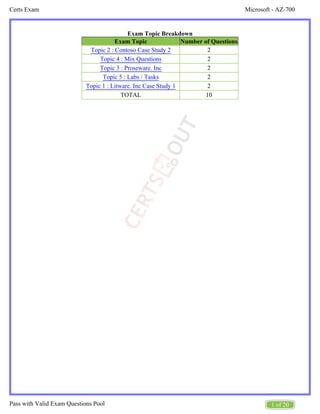
Exam Topic Breakdown
Exam Topic Number of Questions
Topic 2 : Contoso Case Study 2 2
Topic 4 : Mix Questions 2
Topic 3 : Proseware. Inc 2
Topic 5 : Labs / Tasks 2
Topic 1 : Litware. Inc Case Study 1 2
TOTAL 10
4.
Microsoft - AZ-700
CertsExam
2 of 20
Pass with Valid Exam Questions Pool
Topic 2, Contoso Case Study 2
Overview
This is a case study. Case studies are not timed separately. You can use as much exam time as you would like
to complete each case. However, there may be additional case studies and sections on this exam. You must
manage your time to ensure that you are able to complete all questions included on this exam in the time
provided.
To answer the questions included in a case study, you will need to reference information that is provided in
the case study. Case studies might contain exhibits and other resources that provide more information about
the scenario that is described in the case study. Each question is independent of the other questions in this case
study.
At the end of this case study, a review screen will appear. This screen allows you to review your answers and
to make changes before you move to the next section of the exam. After you begin a new section, you cannot
return to this section.
To start the case study
To display the first question in this case study, click the Next button. Use the buttons in the left pane to
explore the content of the case study before you answer the questions. Clicking these buttons displays
information such as business requirements, existing environment, and problem statements. If the case study
has an All Information tab. note that the information displayed is identical to the information displayed on the
subsequent tabs. When you are ready to answer a question, click the Question button to return to the question.
Existing Environment:
Azure Network Infrastructure
Contoso has an Azure Active Directory (Azure AD) tenant named contoso.com.
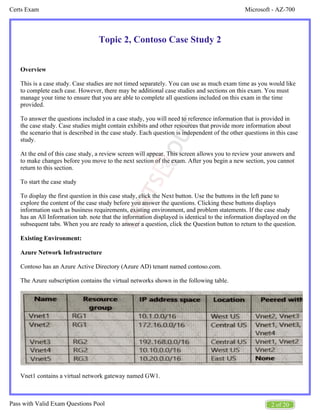
The Azure subscription contains the virtual networks shown in the following table.
Vnet1 contains a virtual network gateway named GW1.
5.
Microsoft - AZ-700
CertsExam
3 of 20
Pass with Valid Exam Questions Pool
Azure Virtual Machines
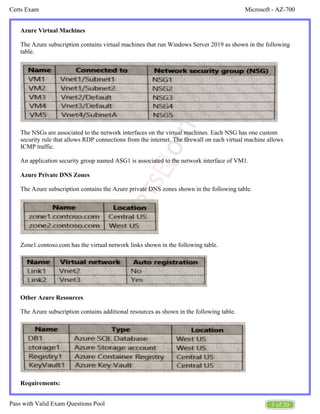
The Azure subscription contains virtual machines that run Windows Server 2019 as shown in the following
table.
The NSGs are associated to the network interfaces on the virtual machines. Each NSG has one custom
security rule that allows RDP connections from the internet. The firewall on each virtual machine allows
ICMP traffic.
An application security group named ASG1 is associated to the network interface of VM1.
Azure Private DNS Zones
The Azure subscription contains the Azure private DNS zones shown in the following table.
Zone1.contoso.com has the virtual network links shown in the following table.
Other Azure Resources
The Azure subscription contains additional resources as shown in the following table.
Requirements:
6.
Microsoft - AZ-700
CertsExam
4 of 20
Pass with Valid Exam Questions Pool
A.
Virtual Network Requirements
Contoso has the following virtual networks requirements:
* Create a virtual network named Vnet6 in West US that will contain the following resources and
configurations:
Two container groups that connect to Vnet6
Three virtual machines that connect to Vnet6
Allow VPN connections to be established to Vnet6
Allow the resources in Vnet6 to access KeyVault1, DB1, and Vnet1 over the Microsoft backbone network
* The virtual machines in Vnet4 and Vnet5 must be able to communicate over the Microsoft backbone
network.
* A virtual machine named VM-Analyze will be deployed to Subnet1. VM-Analyze must inspect the
outbound network traffic from Subnet2 to the internet.
Network Security Requirements
Contoso has the following network security requirements:
* Configure Azure Active Directory (Azure AD) authentication for Point-to-Site (P2S) VPN users.
* Enable NSG flow logs for NSG3 and NSG4.
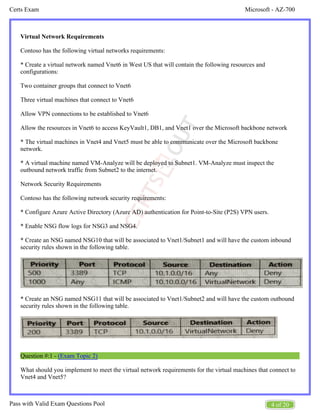
* Create an NSG named NSG10 that will be associated to Vnet1/Subnet1 and will have the custom inbound
security rules shown in the following table.
* Create an NSG named NSG11 that will be associated to Vnet1/Subnet2 and will have the custom outbound
security rules shown in the following table.
Question #:1 - (Exam Topic 2)
What should you implement to meet the virtual network requirements for the virtual machines that connect to
Vnet4 and Vnet5?
7.
Microsoft - AZ-700
CertsExam
5 of 20
Pass with Valid Exam Questions Pool
A.
B.
C.
D.
E.
a private endpoint
a virtual network peering
a private link service
a routing table
a service endpoint
Answer: B
Explanation
There is no virtual network peering between VM4’s VNet (VNet3) and VM5’s VNet (VNet4). To enable the
VMs to communicate over the Microsoft backbone network a VNet peering is required between VNet3 and
VNet4.
Question #:2 - (Exam Topic 2)
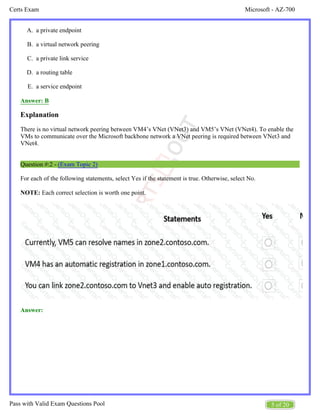
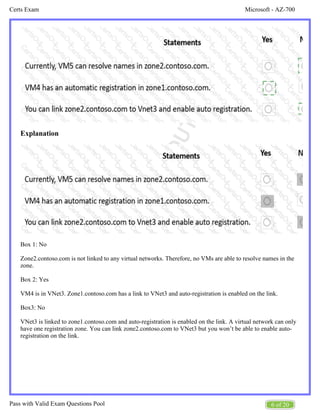
For each of the following statements, select Yes if the statement is true. Otherwise, select No.
NOTE: Each correct selection is worth one point.
Answer:
8.
Microsoft - AZ-700
CertsExam
6 of 20
Pass with Valid Exam Questions Pool
Explanation
Box 1: No
Zone2.contoso.com is not linked to any virtual networks. Therefore, no VMs are able to resolve names in the
zone.
Box 2: Yes
VM4 is in VNet3. Zone1.contoso.com has a link to VNet3 and auto-registration is enabled on the link.
Box3: No
VNet3 is linked to zone1.contoso.com and auto-registration is enabled on the link. A virtual network can only
have one registration zone. You can link zone2.contoso.com to VNet3 but you won’t be able to enable auto-
registration on the link.
9.
Microsoft - AZ-700
CertsExam
7 of 20
Pass with Valid Exam Questions Pool
Topic 4, Mix Questions
Question #:3 - (Exam Topic 4)
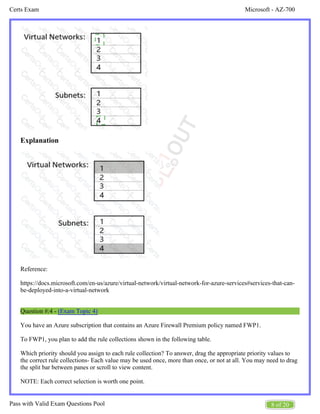
You are planning an Azure solution that will contain the following types of resources in a single Azure region:
Virtual machine
Azure App Service
Virtual Network gateway
Azure SQL Managed Instance
App Service and SQL Managed Instance will be delegated to create resources in virtual networks.
You need to identify how many virtual networks and subnets are required for the solution. The solution must
minimize costs to transfer data between virtual networks.
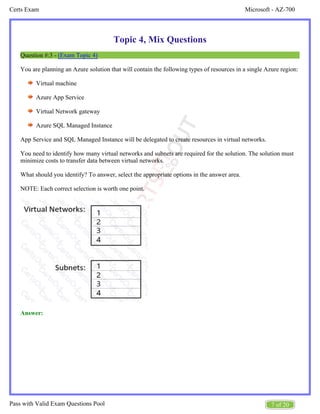
What should you identify? To answer, select the appropriate options in the answer area.
NOTE: Each correct selection is worth one point.
Answer:
10.
Microsoft - AZ-700
CertsExam
8 of 20
Pass with Valid Exam Questions Pool
Explanation
Reference:
https://docs.microsoft.com/en-us/azure/virtual-network/virtual-network-for-azure-services#services-that-can-
be-deployed-into-a-virtual-network
Question #:4 - (Exam Topic 4)
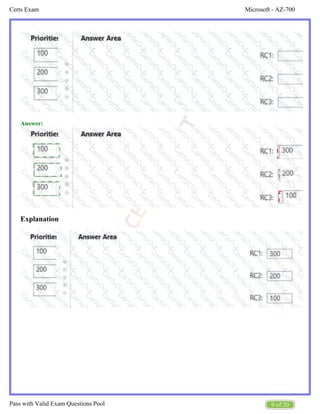
You have an Azure subscription that contains an Azure Firewall Premium policy named FWP1.
To FWP1, you plan to add the rule collections shown in the following table.
Which priority should you assign to each rule collection? To answer, drag the appropriate priority values to
the correct rule collections- Each value may be used once, more than once, or not at all. You may need to drag
the split bar between panes or scroll to view content.
NOTE: Each correct selection is worth one point.
Microsoft - AZ-700
CertsExam
10 of 20
Pass with Valid Exam Questions Pool
Topic 3, Proseware. Inc
Overview
Existing Environment
Proseware. Inc. is a financial services company that has a main office in New York City and a branch office in
San Francisco.
Hybrid Environment
Proseware has an on-premises Active Directory Domain Services (AD DS) forest named corp.proseware.com
that syncs with a Microsoft Entra tenant named proseware.com.
Proseware has an Azure subscription that is linked to proseware.com.
Proseware has an internal certification authority (CA).
Network infrashtructure
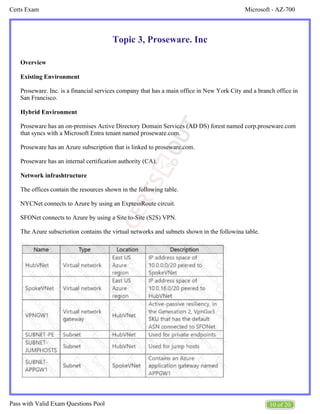
The offices contain the resources shown in the following table.
NYCNet connects to Azure by using an ExptessRoute circuit.
SFONet connects to Azure by using a Site to-Site (S2S) VPN.
The Azure subscriotion contains the virtual networks and subnets shown in the followina table.
13.
Microsoft - AZ-700
CertsExam
11 of 20
Pass with Valid Exam Questions Pool
The subscription contains four virtual machines named VM1, VM2, VM3, and VM4. VM1 and VM2 host an
app named App1.
VM3 and VM4 host a web app named App2 that is accessed by using a FQDN of app2.proseware.com. Users
access app2.proseware.com by using HTTP or HTTPS.
VM1, VM2, and VM4 are connected to SpokeVNet
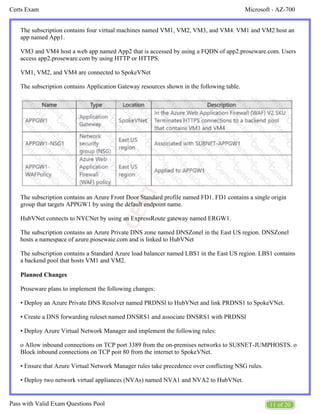
The subscription contains Application Gateway resources shown in the following table.
The subscription contains an Azure Front Door Standard profile named FD1. FD1 contains a single origin
group that targets APPGW1 by using the default endpoint name.
HubVNet connects to NYCNet by using an ExpressRoute gateway named ERGW1.
The subscription contains an Azure Private DNS zone named DNSZonel in the East US region. DNSZonel
hosts a namespace of azure.piosewaie.com and is linked to HubVNet
The subscription contains a Standard Azure load balancer named LBS1 in the East US region. LBS1 contains
a backend pool that hosts VM1 and VM2.
Planned Changes
Proseware plans to implement the following changes:
• Deploy an Azure Private DNS Resolver named PRDNSl to HubVNet and link PRDNS1 to SpokeVNet.
• Create a DNS forwarding ruleset named DNSRS1 and associate DNSRS1 with PRDNSl
• Deploy Azure Virtual Network Manager and implement the following rules:
o Allow inbound connections on TCP port 3389 from the on-premises networks to SU8NET-JUMPHOSTS. o
Block inbound connections on TCP poit 80 from the internet to SpokeVNet.
• Ensure that Azure Virtual Network Manager rules take precedence over conflicting NSG rules.
• Deploy two network virtual appliances (NVAs) named NVA1 and NVA2 to HubVNet.
14.
Microsoft - AZ-700
CertsExam
12 of 20
Pass with Valid Exam Questions Pool
• Deploy a gateway load balancer named L8GW1 to HubVNet.
• Configure LBGW1 to inspect traffic on TCP ports 443, 1433, and 1434 from LBS1 by using NVA1 and
NVA2.
• Ensure that all the traffic to App2 is processed by using FD1.
Connectivity Requirements
Proseware identifies the following connectivity requirements:
• Minimize the complexity of the Azure Virtual Network Manager deployment.
• Route traffic between NYCNet and SFONet via the ExpressRoute circuit and the S2S VPN
• Ensure that remote users on Windows 11 devices can connect to HubVNet by using a Point-to-Site (P2S)
VP and their proseware.com credentials.
Security Requirements
Proseware identifies the following general requirements:
• Minimize the IP address space required to deploy platform-managed resources to the virtual networks.
• From SpokeVNet, resolve name resolution requests for the azure.proseware.com namespace and the corp.
proseware.com namespace by using PRDNS1.
• Whenever possible, minimize administrative effort.
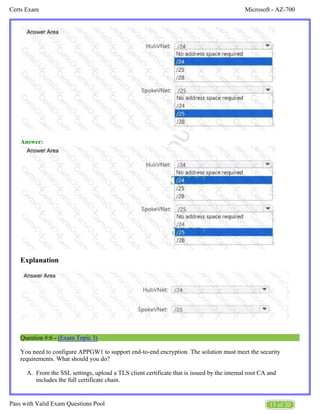
Question #:5 - (Exam Topic 3)
You need to identify which IP address space to allocate for the planned deployment of PRDNS1 to HubVNet
and SpokeVNet. The solution must meet the general requirements
What should you identify for each virtual network? To answer, select the appropriate options in the answer
area. NOTE: Each correct selection is worth one point.
15.
Microsoft - AZ-700
CertsExam
13 of 20
Pass with Valid Exam Questions Pool
A.
Answer:
Explanation
Question #:6 - (Exam Topic 3)
You need to configure APPGW1 to support end-to-end encryption. The solution must meet the security
requirements. What should you do?
From the SSL settings, upload a TLS client certificate that is issued by the internal root CA and
includes the full certificate chain.
16.
Microsoft - AZ-700
CertsExam
14 of 20
Pass with Valid Exam Questions Pool
B.
C.
D.
From the Backend settings, upload a wildcard TLS certificate that has a private key issued by the
internal root CA
From the Backend settings, upload the internal root CA certificate.
From the SSL settings, upload a TLS client certificate that is issued by the internal root CA.
Answer: A
17.
Microsoft - AZ-700
CertsExam
15 of 20
Pass with Valid Exam Questions Pool
Topic 5, Labs / Tasks
Question #:7 - (Exam Topic 5)
Task 9
You need to ensure that subnet4-3 can accommodate 507 hosts.
See the Explanation below for step by step instructions.
Explanation
Here are the steps and explanations for ensuring that subnet4-3 can accommodate 507 hosts:
To determine the subnet size that can accommodate 507 hosts, you need to use the formula: number of
hosts = 2^(32 - n) - 2, where n is the number of bits in the subnet mask1. You need to find the value
of n that satisfies this equation for 507 hosts.
To solve this equation, you can use trial and error or a binary search method. For example, you can start
with n = 24, which is the default subnet mask for Class C networks. Then, plug in the value of n into the
formula and see if it is too big or too small for 507 hosts.
If you try n = 24, you get number of hosts = 2^(32 - 24) - 2 = 254, which is too small. You need to
increase the value of n to get a larger number of hosts.
If you try n = 25, you get number of hosts = 2^(32 - 25) - 2 = 510, which is just enough to
accommodate 507 hosts. You can stop here or try a smaller value of n to see if it still works.
If you try n = 26, you get number of hosts = 2^(32 - 26) - 2 = 254, which is too small again. You need
to decrease the value of n to get a larger number of hosts.
Therefore, the smallest value of n that can accommodate 507 hosts is n = 25. This means that the subnet
mask for subnet4-3 should be /25 or 255.255.255.128 in dot-decimal notation1.
To change the subnet mask for subnet4-3, you need to go to the Azure portal and select your virtual
network. Then select Subnets under Settings and select subnet4-3 from the list2.
On the Edit subnet page, under Address range (CIDR block), change the value from /24 to /25. Then
select Save2.
Question #:8 - (Exam Topic 5)
Task 8
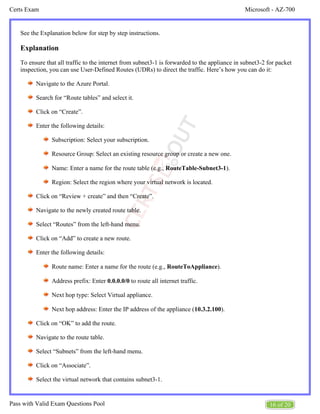
You plan to deploy an appliance to subnet3-2- The appliance will perform packet inspection and will have an
IP address of 10.3.2.100.
You need to ensure that all traffic to the internet from subnet3-1 is forwarded to the appliance for inspection.
18.
Microsoft - AZ-700
CertsExam
16 of 20
Pass with Valid Exam Questions Pool
See the Explanation below for step by step instructions.
Explanation
To ensure that all traffic to the internet from subnet3-1 is forwarded to the appliance in subnet3-2 for packet
inspection, you can use User-Defined Routes (UDRs) to direct the traffic. Here’s how you can do it:
Navigate to the Azure Portal.
Search for “Route tables” and select it.
Click on “Create”.
Enter the following details:
Subscription: Select your subscription.
Resource Group: Select an existing resource group or create a new one.
Name: Enter a name for the route table (e.g., ).
RouteTable-Subnet3-1
Region: Select the region where your virtual network is located.
Click on “Review + create” and then “Create”.
Navigate to the newly created route table.
Select “Routes” from the left-hand menu.
Click on “Add” to create a new route.
Enter the following details:
Route name: Enter a name for the route (e.g., ).
RouteToAppliance
Address prefix: Enter to route all internet traffic.
0.0.0.0/0
Next hop type: Select Virtual appliance.
Next hop address: Enter the IP address of the appliance ( ).
10.3.2.100
Click on “OK” to add the route.
Navigate to the route table.
Select “Subnets” from the left-hand menu.
Click on “Associate”.
Select the virtual network that contains subnet3-1.
19.
Microsoft - AZ-700
CertsExam
17 of 20
Pass with Valid Exam Questions Pool
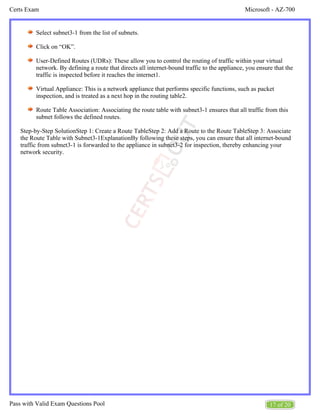
Select subnet3-1 from the list of subnets.
Click on “OK”.
User-Defined Routes (UDRs): These allow you to control the routing of traffic within your virtual
network. By defining a route that directs all internet-bound traffic to the appliance, you ensure that the
traffic is inspected before it reaches the internet1.
Virtual Appliance: This is a network appliance that performs specific functions, such as packet
inspection, and is treated as a next hop in the routing table2.
Route Table Association: Associating the route table with subnet3-1 ensures that all traffic from this
subnet follows the defined routes.
Step-by-Step SolutionStep 1: Create a Route TableStep 2: Add a Route to the Route TableStep 3: Associate
the Route Table with Subnet3-1ExplanationBy following these steps, you can ensure that all internet-bound
traffic from subnet3-1 is forwarded to the appliance in subnet3-2 for inspection, thereby enhancing your
network security.
20.
Microsoft - AZ-700
CertsExam
18 of 20
Pass with Valid Exam Questions Pool
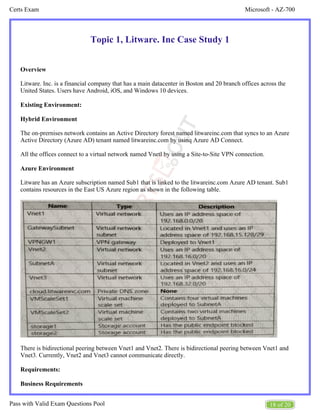
Topic 1, Litware. Inc Case Study 1
Overview
Litware. Inc. is a financial company that has a main datacenter in Boston and 20 branch offices across the
United States. Users have Android, iOS, and Windows 10 devices.
Existing Environment:
Hybrid Environment
The on-prernises network contains an Active Directory forest named litwareinc.com that syncs to an Azure
Active Directory (Azure AD) tenant named litwareinc.com by usinq Azure AD Connect.
All the offices connect to a virtual network named Vnetl by using a Site-to-Site VPN connection.
Azure Environment
Litware has an Azure subscription named Sub1 that is linked to the litwareinc.com Azure AD tenant. Sub1
contains resources in the East US Azure region as shown in the following table.
There is bidirectional peering between Vnet1 and Vnet2. There is bidirectional peering between Vnet1 and
Vnet3. Currently, Vnet2 and Vnet3 cannot communicate directly.
Requirements:
Business Requirements
21.
Microsoft - AZ-700
CertsExam
19 of 20
Pass with Valid Exam Questions Pool
A.
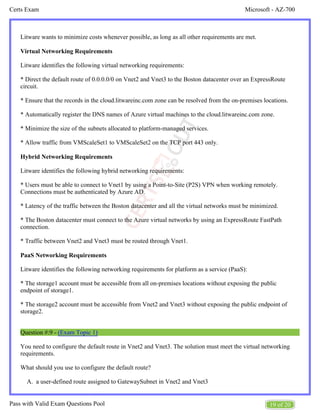
Litware wants to minimize costs whenever possible, as long as all other requirements are met.
Virtual Networking Requirements
Litware identifies the following virtual networking requirements:
* Direct the default route of 0.0.0.0/0 on Vnet2 and Vnet3 to the Boston datacenter over an ExpressRoute
circuit.
* Ensure that the records in the cloud.litwareinc.com zone can be resolved from the on-premises locations.
* Automatically register the DNS names of Azure virtual machines to the cloud.litwareinc.com zone.
* Minimize the size of the subnets allocated to platform-managed services.
* Allow traffic from VMScaleSet1 to VMScaleSet2 on the TCP port 443 only.
Hybrid Networking Requirements
Litware identifies the following hybrid networking requirements:
* Users must be able to connect to Vnet1 by using a Point-to-Site (P2S) VPN when working remotely.
Connections must be authenticated by Azure AD.
* Latency of the traffic between the Boston datacenter and all the virtual networks must be minimized.
* The Boston datacenter must connect to the Azure virtual networks by using an ExpressRoute FastPath
connection.
* Traffic between Vnet2 and Vnet3 must be routed through Vnet1.
PaaS Networking Requirements
Litware identifies the following networking requirements for platform as a service (PaaS):
* The storage1 account must be accessible from all on-premises locations without exposing the public
endpoint of storage1.
* The storage2 account must be accessible from Vnet2 and Vnet3 without exposing the public endpoint of
storage2.
Question #:9 - (Exam Topic 1)
You need to configure the default route in Vnet2 and Vnet3. The solution must meet the virtual networking
requirements.
What should you use to configure the default route?
a user-defined route assigned to GatewaySubnet in Vnet2 and Vnet3
22.
Microsoft - AZ-700
CertsExam
20 of 20
Pass with Valid Exam Questions Pool
B.
C.
D.
A.
B.
C.
D.
a user-defined route assigned to GatewaySubnet in Vnet1
BGP route exchange
route filters
Answer: C
Explanation
VNet 1 will get the default from BGP and propagate it to VNET 2 and 3
Question #:10 - (Exam Topic 1)
You need to provide connectivity to storage1. The solution must meet the PaaS networking requirements and
the business requirements.
What should you include in the solution?
a service endpoint
Azure Front Door
a private endpoint
Azure Traffic Manager
Answer: A
Reference:
https://docs.microsoft.com/en-us/azure/virtual-network/virtual-network-service-endpoints-overview
23.
About certsout.com
certsout.com wasfounded in 2007. We provide latest & high quality IT / Business Certification Training Exam
Questions, Study Guides, Practice Tests.
We help you pass any IT / Business Certification Exams with 100% Pass Guaranteed or Full Refund. Especially
Cisco, CompTIA, Citrix, EMC, HP, Oracle, VMware, Juniper, Check Point, LPI, Nortel, EXIN and so on.
View list of all certification exams: All vendors
We prepare state-of-the art practice tests for certification exams. You can reach us at any of the email addresses
listed below.
Sales: sales@certsout.com
Feedback: feedback@certsout.com
Support: support@certsout.com
Any problems about IT certification or our products, You can write us back and we will get back to you within 24
hours.
![Designing and
Implementing
Microsoft Azure
Networking Solutions
Version: Demo
[ Total Questions: 10]
Web: www.certsout.com
Email: support@certsout.com
Microsoft
AZ-700](https://image.slidesharecdn.com/certsoutmicrosoft-az-700-250512074810-3a8dfaba/85/CertsOut-Microsoft-AZ-700-exam-dumps-pdf-1-320.jpg)
![Designing and
Implementing
Microsoft Azure
Networking Solutions
Version: Demo
[ Total Questions: 10]
Web: www.certsout.com
Email: support@certsout.com
Microsoft
AZ-700](https://image.slidesharecdn.com/certsoutmicrosoft-az-700-250512074810-3a8dfaba/75/CertsOut-Microsoft-AZ-700-exam-dumps-pdf-1-2048.jpg)