HOW TO START A PROJECT?
120 pages
COPYRIGHT © 2020 ZULK SHAMSUDDIN, PHD / GAFM ACADEMY
Introduction
Chapter 1 : Project Management
Chapter 2 : Initiating The Project
Chapter 3 : Defining The Project Scope
Chapter 4 : Developing The Project Schedule
Chapter 5 : Define Quality Requirements
Chapter 6 : Developing The Project Budget
Chapter 7 : Identify Project Risk
Chapter 8 : Develop Project Plan
Chapter 9 : Leadership Management
Chapter 10 : Business Communication
Glossary
Author Biography
COPYRIGHT © 2020 ZULK SHAMSUDDIN, PHD / GAFM ACADEMY
All rights reserved.
ISBN: 978-1-365-46519-2
INTRODUCTION
You have been assigned to manage a project but have no clue how and where to
begin. It sounds like an opportunity but it can also turn out to be a disaster if you do
not possess the knowledge and skills.
You must have come across a book called The Project Management Body of
Knowledge which is most commonly called PMBOK. PMBOK is about processes,
tools, and techniques to manage a project. It does not talk about the art and science
of executing a project from the initial phase to the end of the project life cycle.
PMBOK introduces you to a bunch of processes that you may use in managing a
project, initiation processes for the project initiation phase, planning group of
processes that you may apply during the planning phase, and the list goes on. After
reading the PMBOK guide, you still have no idea where to begin. If you do not have
the time then what you need is a book that will provide a birds-eye view and content
that is sufficient enough to assist you in kicking off a project. Get this book now and
begin to kick off a project like a pro.
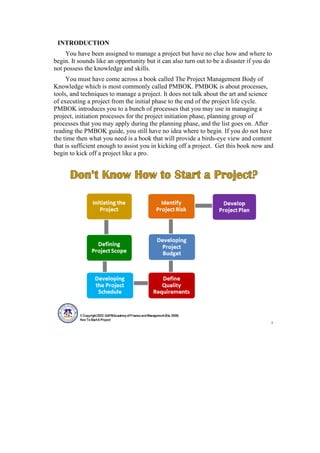
Starting a project involves a 7-step process.
Step #1: Initiating the Project
Step #2: Defining Project Scope
Step #3: Developing the Project Schedule
Step #4: Define Quality Requirements
Step #5: Developing the Project Budget
Step #6: Identify Project Risk
Step #7: Develop Project Plan
The above steps in starting a project are available in a slides’ presentation
format that provides the best learning experience.
Chapter 1 : PROJECT MANAGEMENT
This chapter provides an overview of project management, its characteristics, the
organization and the people behind a project, the project management life cycle and a
summary of the five phases of initiation, planning, execution, control, and closing. We will
also examine the project management competency areas that will be applied during the
various stages of the life cycle processes. The information you will learn in this chapter
not only will help you to succeed in passing the examination but also guide you in
managing a project regardless of your project experience. This reference guide has been
prepared from the perspective of professional industry experts in the field of project
management.
A project involves a group of interrelated activities that are planned and then
executed in a certain sequence to create a unique product or service within a specific
timeframe, to achieve benefits. Projects are often critical components of an organization’s
business strategy. Projects vary in size and complexity.
For example, they may:
• Involve changes to existing systems, policies, legislation and/or procedures
• Entail organizational change
• Involve a single person or many people
• Involve a single unit of one organization, or may span across organizational
boundaries
• Involve engagement and management of external resources
• Require less than 100 hours or take several years
PROJECTS VERSUS OPERATIONS
In some organizations, everything is a project. In other organizations, projects are
rare exercises in change. There's a fine line between projects and operations, and often
these entities overlap in function. Consider the following points shared by projects and
operations:
• Both involve employees
• Both typically have limited resources: people, money, or both
• Both are hopefully designed, executed, and managed by someone in charge
So, what is a project and how do you know if you are managing one?
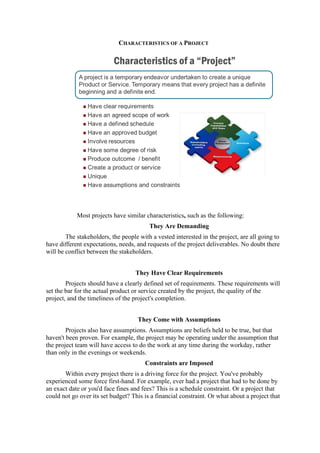
A project is a temporary endeavour undertaken to create a unique product or
service.'
Temporary means that the project has an end date.
Unique means that the project's end result is different from the results of other
functions of the organization.
Often projects are confused with general business duties: marketing, sales,
manufacturing, and so on. The tell-tale sign of a project is that it has an end date and that
it's unique from other activities within the organization.
Some examples of projects include:
• Designing a new product or service
• Converting from one computer application to another
• Building a new warehouse
• Moving from one building to another
• Organizing a political campaign
• Designing and building a new aircraft
The output of projects can result in operations. For example, imagine a company
creating a new aircraft. This new aircraft will be a small personal plane that would allow
people to fly to different destinations with the same freedom they use in driving their car.
The project team will have to design an aircraft from scratch that may be similar to a car.
This project, to create a personal plane, is temporary, but not necessarily short-term. It
may take years to go from concept to completion but the project does have an end date. A
project of this magnitude may require hundreds of prototypes before a working model are
ready for the marketplace. In addition, there are countless regulations, safety issues, and
quality control issues that must be pacified before completion.
Once the initial plane is designed, built, and approved, the end result of the project
is business operations. As the company creates a new vehicle, it would follow through
with its design by manufacturing, marketing, selling, supporting, and improving its
product. The initial design of the aircraft is the project-the business of manufacturing it,
supporting sold units, and marketing the product constitutes the ongoing operations part of
the business.
Operations are the day-to-day work that goes on in the organization. A
manufacturer manufactures things, scientists complete research and development, and
businesses provide goods and services. Operations are the heart of organizations. Projects,
on the other hand, are short-term endeavor that fall outside of the normal day-to-day
operations an organization offers.
Once the project is completed, the project team moves along to other projects and
activities. The people who are actually building the aircraft on the assembly line however
have no end date in sight, and will continue to create aircraft as long as there is a demand
for the product.
PROJECT MANAGEMENT BODY OF KNOWLEDGE
Project management is the supervision and control of the work required to
complete the project vision. The project team carries out the work needed to complete the
project, while the project manager schedules, monitors, and controls the various project
tasks. Projects, being the temporary and unique things that they are, require the project
manager to be actively involved with the project implementation. They are not self-
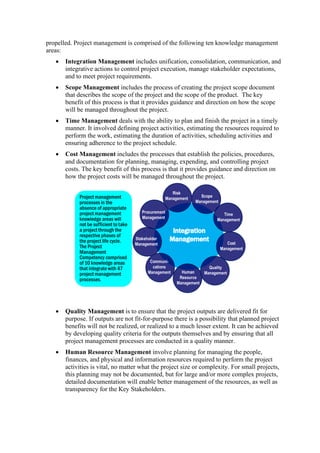
propelled. Project management is comprised of the following ten knowledge management
areas:
• Integration Management includes unification, consolidation, communication, and
integrative actions to control project execution, manage stakeholder expectations,
and to meet project requirements.
• Scope Management includes the process of creating the project scope document
that describes the scope of the project and the scope of the product. The key
benefit of this process is that it provides guidance and direction on how the scope
will be managed throughout the project.
• Time Management deals with the ability to plan and finish the project in a timely
manner. It involved defining project activities, estimating the resources required to
perform the work, estimating the duration of activities, scheduling activities and
ensuring adherence to the project schedule.
• Cost Management includes the processes that establish the policies, procedures,
and documentation for planning, managing, expending, and controlling project
costs. The key benefit of this process is that it provides guidance and direction on
how the project costs will be managed throughout the project.
• Quality Management is to ensure that the project outputs are delivered fit for
purpose. If outputs are not fit-for-purpose there is a possibility that planned project
benefits will not be realized, or realized to a much lesser extent. It can be achieved
by developing quality criteria for the outputs themselves and by ensuring that all
project management processes are conducted in a quality manner.
• Human Resource Management involve planning for managing the people,
finances, and physical and information resources required to perform the project
activities is vital, no matter what the project size or complexity. For small projects,
this planning may not be documented, but for large and/or more complex projects,
detailed documentation will enable better management of the resources, as well as
transparency for the Key Stakeholders.
• Communications Management includes the processes involved in developing an
appropriate approach and plan for project communications based on stakeholders’
information needs, requirements and available organizational assets.
• Stakeholder Management involves the identification of people or organizations
that have an interest in the project processes, outputs, outcomes or benefits, and
planning for how their involvement will be managed on an ongoing basis. It may
be done very quickly for a small project, whereas a large and/or more complex
project will require a formal stakeholder analysis, a Stakeholder Management Plan
as part of the Project Business Plan and ongoing monitoring and review of
progress. Stakeholder Management is closely related to communication strategy
and planning.
• Risk Management describes the processes concerned with identifying, analyzing
and responding to project risk. It consists of risk identification, risk analysis, risk
evaluation and risk treatment. The processes are iterative throughout the life of the
project and should be built into the project management planning and activities. For
small projects, a brief scan and ongoing monitoring may be all that is required. For
large and/or more complex projects, a formalized system for analyzing, managing
and reporting should be established, including the use of a Risk Register.
• Procurement Management includes the processes associated with contract
management and change control processes required to develop and administer
contracts or purchase orders issued by authorized project team members;
administer any contract issued by an outside organization (the buyer) that is
acquiring deliverables from the project.
PROJECT MANAGEMENT LIFE CYCLE AND PROCESSES
One common attribute of all projects is that they eventually end. Think back to one
of your favourite projects. The project started with a desire to change something within an
organization. The idea to change this 'something' was mulled around, kicked around, and
researched until someone with power deemed it a good idea to move forward and
implement the project. As the project progressed towards completion there were some very
visible phases within the project life. Each phase within the life of the project created a
deliverable. For example, consider a project to build a new warehouse. The construction
company has some pretty clear phases within this project: research, blueprints, approvals
and permits, breaking ground, laying the foundation, and so on. Each phase, big or small,
results in some accomplishment that everyone can look to and say, 'Hey! We're making
progress!' Eventually, the project is completed and the warehouse is put into production.
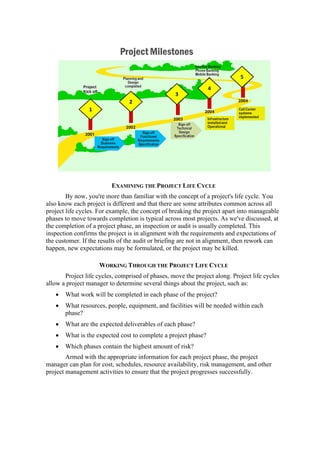
At the beginning of the project, through planning, research, experience, and expert
judgment, the project manager and the project team will plot out when each phase should
begin, when it should end, and the related deliverable that will come from each phase.
Often, the deliverable of each phase is called a milestone. The milestone is a significant
point in the schedule that allows the stakeholders to see how far the project has progressed
and how far the project has to go to reach completion.
EXAMINING THE PROJECT LIFE CYCLE
By now, you're more than familiar with the concept of a project's life cycle. You
also know each project is different and that there are some attributes common across all
project life cycles. For example, the concept of breaking the project apart into manageable
phases to move towards completion is typical across most projects. As we've discussed, at
the completion of a project phase, an inspection or audit is usually completed. This
inspection confirms the project is in alignment with the requirements and expectations of
the customer. If the results of the audit or briefing are not in alignment, then rework can
happen, new expectations may be formulated, or the project may be killed.
WORKING THROUGH THE PROJECT LIFE CYCLE
Project life cycles, comprised of phases, move the project along. Project life cycles
allow a project manager to determine several things about the project, such as:
• What work will be completed in each phase of the project?
• What resources, people, equipment, and facilities will be needed within each
phase?
• What are the expected deliverables of each phase?
• What is the expected cost to complete a project phase?
• Which phases contain the highest amount of risk?
Armed with the appropriate information for each project phase, the project
manager can plan for cost, schedules, resource availability, risk management, and other
project management activities to ensure that the project progresses successfully.
CHARACTERISTICS OF A PROJECT
Most projects have similar characteristics, such as the following:
They Are Demanding
The stakeholders, the people with a vested interested in the project, are all going to
have different expectations, needs, and requests of the project deliverables. No doubt there
will be conflict between the stakeholders.
They Have Clear Requirements
Projects should have a clearly defined set of requirements. These requirements will
set the bar for the actual product or service created by the project, the quality of the
project, and the timeliness of the project's completion.
They Come with Assumptions
Projects also have assumptions. Assumptions are beliefs held to be true, but that
haven't been proven. For example, the project may be operating under the assumption that
the project team will have access to do the work at any time during the workday, rather
than only in the evenings or weekends.
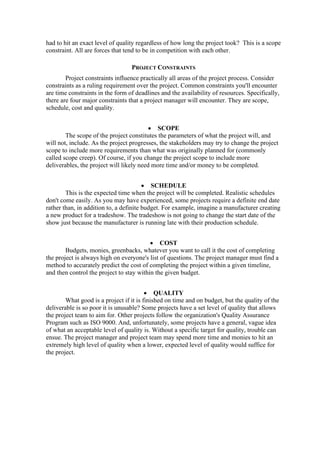
Constraints are Imposed
Within every project there is a driving force for the project. You've probably
experienced some force first-hand. For example, ever had a project that had to be done by
an exact date or you'd face fines and fees? This is a schedule constraint. Or a project that
could not go over its set budget? This is a financial constraint. Or what about a project that
had to hit an exact level of quality regardless of how long the project took? This is a scope
constraint. All are forces that tend to be in competition with each other.
PROJECT CONSTRAINTS
Project constraints influence practically all areas of the project process. Consider
constraints as a ruling requirement over the project. Common constraints you'll encounter
are time constraints in the form of deadlines and the availability of resources. Specifically,
there are four major constraints that a project manager will encounter. They are scope,
schedule, cost and quality.
• SCOPE
The scope of the project constitutes the parameters of what the project will, and
will not, include. As the project progresses, the stakeholders may try to change the project
scope to include more requirements than what was originally planned for (commonly
called scope creep). Of course, if you change the project scope to include more
deliverables, the project will likely need more time and/or money to be completed.
• SCHEDULE
This is the expected time when the project will be completed. Realistic schedules
don't come easily. As you may have experienced, some projects require a definite end date
rather than, in addition to, a definite budget. For example, imagine a manufacturer creating
a new product for a tradeshow. The tradeshow is not going to change the start date of the
show just because the manufacturer is running late with their production schedule.
• COST
Budgets, monies, greenbacks, whatever you want to call it the cost of completing
the project is always high on everyone's list of questions. The project manager must find a
method to accurately predict the cost of completing the project within a given timeline,
and then control the project to stay within the given budget.
• QUALITY
What good is a project if it is finished on time and on budget, but the quality of the
deliverable is so poor it is unusable? Some projects have a set level of quality that allows
the project team to aim for. Other projects follow the organization's Quality Assurance
Program such as ISO 9000. And, unfortunately, some projects have a general, vague idea
of what an acceptable level of quality is. Without a specific target for quality, trouble can
ensue. The project manager and project team may spend more time and monies to hit an
extremely high level of quality when a lower, expected level of quality would suffice for
the project.
PROJECT MANAGEMENT PROCESSES
On a project, any project, there are fundamental activities that must happen before
the work begins. The rules, management principles, planning, and general guidelines for a
project are the project management framework. The project management framework is the
skeleton of projects. And, just like a house, even though every project has a general
framing, the end results are typically different. The management of a project, the day-to-
day activities, is the bones of successful project management. A project manager must
monitor, maintain, and control the work of the project to ensure timeliness, accountability,
quality, and success. Just as you wouldn't randomly build a home without plans and a level
of control, a project requires a level of detail and management to guarantee completion and
acceptability.
The five processes of a project are initiation, planning, execution, control, and
closure. The five processes interact with one another and allow the project manager, the
project sponsor, the project team, and even the stakeholders to witness the progress,
success, and, sometimes, failure of a project. These processes are cyclic, iterative,
progressively elaborated, documentation, and project manager participation.
WHAT IS PROJECT MANAGEMENT PROCESS?
A process is a set of interrelated actions and activities performed to create a
specific product, service, or result. Each process is characterized by its inputs, the tools
and techniques that can be applied, and the resulting outputs. Each process has several
Tasks or Activities. Resources will be assigned to each Task.
• Initiating processes are processes used to initiate a project or phase once
commitment is obtained.
• Planning processes are processes used to develop and maintain a workable plan
to support the project's overall goal.
• Executing processes are processes used to coordinate people and other resources
to execute the work described in the project plan.
• Controlling processes are processes used to ensure proper control and reporting
mechanisms are in place so that progress can be monitored, problems identified,
and appropriate actions taken when necessary.
• Closing processes are processes used to provide closure in terms of a formal
acceptance that the project or a project's phase has been completed
satisfactorily.
PROCESSES ASSOCIATED WITH INITIATION PHASE
• Initiating the Project
• Define Scope
• Define Schedule
• Define Quality
• Define Cost
• Perform Risk Identification
• Develop Initial Project Plan
• Review Initiation phase
PROCESSES ASSOCIATED WITH PLANNING PHASE
• Initiating Planning phase
• Verify Scope
• Verify Schedule
• Plan Quality Assurance
• Refine Budget
• Perform Risk Assessment
• Refine Project Plan
• Review Planning phase
PROCESSES ASSOCIATED WITH EXECUTION PHASE
• Manage Change Control
• Manage Acceptance
• Manage Risks
• Manage Issues
• Manage Communications
• Manage Organizational Change
• Manage Project Team
• Manage Project Transition
PROCESSES ASSOCIATED WITH CONTROLLING PHASE
• Control Scope
• Control Schedule
• Control Quality
• Control Costs
• Control Risks
• Control Communications
• Acquire Acceptance
PROCESSES ASSOCIATED WITH CLOSING PHASE
• Conduct Post-Implementation Review
• Perform Administrative Closeout
INPUT-PROCESS-OUTPUT MODEL
It is imperative initially to define a project in terms of the outputs and benefits the
project should achieve. It helps to link directly the actual outputs of the project and project
activities with the organizational goals and directions of an organization.
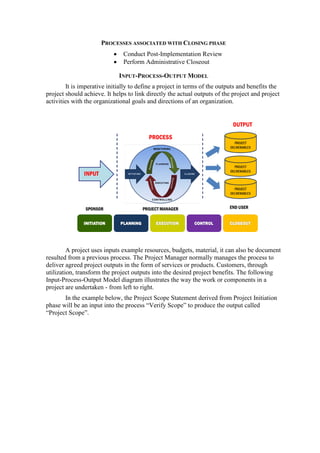
A project uses inputs example resources, budgets, material, it can also be document
resulted from a previous process. The Project Manager normally manages the process to
deliver agreed project outputs in the form of services or products. Customers, through
utilization, transform the project outputs into the desired project benefits. The following
Input-Process-Output Model diagram illustrates the way the work or components in a
project are undertaken - from left to right.
In the example below, the Project Scope Statement derived from Project Initiation
phase will be an input into the process “Verify Scope” to produce the output called
“Project Scope”.

How to Start a Project? PREVIEW

  • 2.
    HOW TO STARTA PROJECT?
  • 3.
    120 pages COPYRIGHT ©2020 ZULK SHAMSUDDIN, PHD / GAFM ACADEMY Introduction Chapter 1 : Project Management Chapter 2 : Initiating The Project Chapter 3 : Defining The Project Scope Chapter 4 : Developing The Project Schedule Chapter 5 : Define Quality Requirements Chapter 6 : Developing The Project Budget Chapter 7 : Identify Project Risk Chapter 8 : Develop Project Plan Chapter 9 : Leadership Management Chapter 10 : Business Communication Glossary Author Biography
  • 4.
    COPYRIGHT © 2020ZULK SHAMSUDDIN, PHD / GAFM ACADEMY All rights reserved. ISBN: 978-1-365-46519-2
  • 5.
    INTRODUCTION You have beenassigned to manage a project but have no clue how and where to begin. It sounds like an opportunity but it can also turn out to be a disaster if you do not possess the knowledge and skills. You must have come across a book called The Project Management Body of Knowledge which is most commonly called PMBOK. PMBOK is about processes, tools, and techniques to manage a project. It does not talk about the art and science of executing a project from the initial phase to the end of the project life cycle. PMBOK introduces you to a bunch of processes that you may use in managing a project, initiation processes for the project initiation phase, planning group of processes that you may apply during the planning phase, and the list goes on. After reading the PMBOK guide, you still have no idea where to begin. If you do not have the time then what you need is a book that will provide a birds-eye view and content that is sufficient enough to assist you in kicking off a project. Get this book now and begin to kick off a project like a pro.
  • 6.
    Starting a projectinvolves a 7-step process. Step #1: Initiating the Project Step #2: Defining Project Scope Step #3: Developing the Project Schedule Step #4: Define Quality Requirements Step #5: Developing the Project Budget Step #6: Identify Project Risk Step #7: Develop Project Plan The above steps in starting a project are available in a slides’ presentation format that provides the best learning experience.
  • 7.
    Chapter 1 :PROJECT MANAGEMENT This chapter provides an overview of project management, its characteristics, the organization and the people behind a project, the project management life cycle and a summary of the five phases of initiation, planning, execution, control, and closing. We will also examine the project management competency areas that will be applied during the various stages of the life cycle processes. The information you will learn in this chapter not only will help you to succeed in passing the examination but also guide you in managing a project regardless of your project experience. This reference guide has been prepared from the perspective of professional industry experts in the field of project management. A project involves a group of interrelated activities that are planned and then executed in a certain sequence to create a unique product or service within a specific timeframe, to achieve benefits. Projects are often critical components of an organization’s business strategy. Projects vary in size and complexity. For example, they may: • Involve changes to existing systems, policies, legislation and/or procedures • Entail organizational change • Involve a single person or many people • Involve a single unit of one organization, or may span across organizational boundaries • Involve engagement and management of external resources • Require less than 100 hours or take several years PROJECTS VERSUS OPERATIONS In some organizations, everything is a project. In other organizations, projects are rare exercises in change. There's a fine line between projects and operations, and often these entities overlap in function. Consider the following points shared by projects and operations: • Both involve employees • Both typically have limited resources: people, money, or both • Both are hopefully designed, executed, and managed by someone in charge So, what is a project and how do you know if you are managing one? A project is a temporary endeavour undertaken to create a unique product or service.' Temporary means that the project has an end date. Unique means that the project's end result is different from the results of other functions of the organization.
  • 8.
    Often projects areconfused with general business duties: marketing, sales, manufacturing, and so on. The tell-tale sign of a project is that it has an end date and that it's unique from other activities within the organization. Some examples of projects include: • Designing a new product or service • Converting from one computer application to another • Building a new warehouse • Moving from one building to another • Organizing a political campaign • Designing and building a new aircraft The output of projects can result in operations. For example, imagine a company creating a new aircraft. This new aircraft will be a small personal plane that would allow people to fly to different destinations with the same freedom they use in driving their car. The project team will have to design an aircraft from scratch that may be similar to a car. This project, to create a personal plane, is temporary, but not necessarily short-term. It may take years to go from concept to completion but the project does have an end date. A project of this magnitude may require hundreds of prototypes before a working model are ready for the marketplace. In addition, there are countless regulations, safety issues, and quality control issues that must be pacified before completion. Once the initial plane is designed, built, and approved, the end result of the project is business operations. As the company creates a new vehicle, it would follow through with its design by manufacturing, marketing, selling, supporting, and improving its product. The initial design of the aircraft is the project-the business of manufacturing it, supporting sold units, and marketing the product constitutes the ongoing operations part of the business. Operations are the day-to-day work that goes on in the organization. A manufacturer manufactures things, scientists complete research and development, and businesses provide goods and services. Operations are the heart of organizations. Projects, on the other hand, are short-term endeavor that fall outside of the normal day-to-day operations an organization offers. Once the project is completed, the project team moves along to other projects and activities. The people who are actually building the aircraft on the assembly line however have no end date in sight, and will continue to create aircraft as long as there is a demand for the product. PROJECT MANAGEMENT BODY OF KNOWLEDGE Project management is the supervision and control of the work required to complete the project vision. The project team carries out the work needed to complete the project, while the project manager schedules, monitors, and controls the various project tasks. Projects, being the temporary and unique things that they are, require the project manager to be actively involved with the project implementation. They are not self-
  • 9.
    propelled. Project managementis comprised of the following ten knowledge management areas: • Integration Management includes unification, consolidation, communication, and integrative actions to control project execution, manage stakeholder expectations, and to meet project requirements. • Scope Management includes the process of creating the project scope document that describes the scope of the project and the scope of the product. The key benefit of this process is that it provides guidance and direction on how the scope will be managed throughout the project. • Time Management deals with the ability to plan and finish the project in a timely manner. It involved defining project activities, estimating the resources required to perform the work, estimating the duration of activities, scheduling activities and ensuring adherence to the project schedule. • Cost Management includes the processes that establish the policies, procedures, and documentation for planning, managing, expending, and controlling project costs. The key benefit of this process is that it provides guidance and direction on how the project costs will be managed throughout the project. • Quality Management is to ensure that the project outputs are delivered fit for purpose. If outputs are not fit-for-purpose there is a possibility that planned project benefits will not be realized, or realized to a much lesser extent. It can be achieved by developing quality criteria for the outputs themselves and by ensuring that all project management processes are conducted in a quality manner. • Human Resource Management involve planning for managing the people, finances, and physical and information resources required to perform the project activities is vital, no matter what the project size or complexity. For small projects, this planning may not be documented, but for large and/or more complex projects, detailed documentation will enable better management of the resources, as well as transparency for the Key Stakeholders.
  • 10.
    • Communications Managementincludes the processes involved in developing an appropriate approach and plan for project communications based on stakeholders’ information needs, requirements and available organizational assets. • Stakeholder Management involves the identification of people or organizations that have an interest in the project processes, outputs, outcomes or benefits, and planning for how their involvement will be managed on an ongoing basis. It may be done very quickly for a small project, whereas a large and/or more complex project will require a formal stakeholder analysis, a Stakeholder Management Plan as part of the Project Business Plan and ongoing monitoring and review of progress. Stakeholder Management is closely related to communication strategy and planning. • Risk Management describes the processes concerned with identifying, analyzing and responding to project risk. It consists of risk identification, risk analysis, risk evaluation and risk treatment. The processes are iterative throughout the life of the project and should be built into the project management planning and activities. For small projects, a brief scan and ongoing monitoring may be all that is required. For large and/or more complex projects, a formalized system for analyzing, managing and reporting should be established, including the use of a Risk Register. • Procurement Management includes the processes associated with contract management and change control processes required to develop and administer contracts or purchase orders issued by authorized project team members; administer any contract issued by an outside organization (the buyer) that is acquiring deliverables from the project. PROJECT MANAGEMENT LIFE CYCLE AND PROCESSES One common attribute of all projects is that they eventually end. Think back to one of your favourite projects. The project started with a desire to change something within an organization. The idea to change this 'something' was mulled around, kicked around, and researched until someone with power deemed it a good idea to move forward and implement the project. As the project progressed towards completion there were some very visible phases within the project life. Each phase within the life of the project created a deliverable. For example, consider a project to build a new warehouse. The construction company has some pretty clear phases within this project: research, blueprints, approvals and permits, breaking ground, laying the foundation, and so on. Each phase, big or small, results in some accomplishment that everyone can look to and say, 'Hey! We're making progress!' Eventually, the project is completed and the warehouse is put into production. At the beginning of the project, through planning, research, experience, and expert judgment, the project manager and the project team will plot out when each phase should begin, when it should end, and the related deliverable that will come from each phase. Often, the deliverable of each phase is called a milestone. The milestone is a significant point in the schedule that allows the stakeholders to see how far the project has progressed and how far the project has to go to reach completion.
  • 11.
    EXAMINING THE PROJECTLIFE CYCLE By now, you're more than familiar with the concept of a project's life cycle. You also know each project is different and that there are some attributes common across all project life cycles. For example, the concept of breaking the project apart into manageable phases to move towards completion is typical across most projects. As we've discussed, at the completion of a project phase, an inspection or audit is usually completed. This inspection confirms the project is in alignment with the requirements and expectations of the customer. If the results of the audit or briefing are not in alignment, then rework can happen, new expectations may be formulated, or the project may be killed. WORKING THROUGH THE PROJECT LIFE CYCLE Project life cycles, comprised of phases, move the project along. Project life cycles allow a project manager to determine several things about the project, such as: • What work will be completed in each phase of the project? • What resources, people, equipment, and facilities will be needed within each phase? • What are the expected deliverables of each phase? • What is the expected cost to complete a project phase? • Which phases contain the highest amount of risk? Armed with the appropriate information for each project phase, the project manager can plan for cost, schedules, resource availability, risk management, and other project management activities to ensure that the project progresses successfully.
  • 12.
    CHARACTERISTICS OF APROJECT Most projects have similar characteristics, such as the following: They Are Demanding The stakeholders, the people with a vested interested in the project, are all going to have different expectations, needs, and requests of the project deliverables. No doubt there will be conflict between the stakeholders. They Have Clear Requirements Projects should have a clearly defined set of requirements. These requirements will set the bar for the actual product or service created by the project, the quality of the project, and the timeliness of the project's completion. They Come with Assumptions Projects also have assumptions. Assumptions are beliefs held to be true, but that haven't been proven. For example, the project may be operating under the assumption that the project team will have access to do the work at any time during the workday, rather than only in the evenings or weekends. Constraints are Imposed Within every project there is a driving force for the project. You've probably experienced some force first-hand. For example, ever had a project that had to be done by an exact date or you'd face fines and fees? This is a schedule constraint. Or a project that could not go over its set budget? This is a financial constraint. Or what about a project that
  • 13.
    had to hitan exact level of quality regardless of how long the project took? This is a scope constraint. All are forces that tend to be in competition with each other. PROJECT CONSTRAINTS Project constraints influence practically all areas of the project process. Consider constraints as a ruling requirement over the project. Common constraints you'll encounter are time constraints in the form of deadlines and the availability of resources. Specifically, there are four major constraints that a project manager will encounter. They are scope, schedule, cost and quality. • SCOPE The scope of the project constitutes the parameters of what the project will, and will not, include. As the project progresses, the stakeholders may try to change the project scope to include more requirements than what was originally planned for (commonly called scope creep). Of course, if you change the project scope to include more deliverables, the project will likely need more time and/or money to be completed. • SCHEDULE This is the expected time when the project will be completed. Realistic schedules don't come easily. As you may have experienced, some projects require a definite end date rather than, in addition to, a definite budget. For example, imagine a manufacturer creating a new product for a tradeshow. The tradeshow is not going to change the start date of the show just because the manufacturer is running late with their production schedule. • COST Budgets, monies, greenbacks, whatever you want to call it the cost of completing the project is always high on everyone's list of questions. The project manager must find a method to accurately predict the cost of completing the project within a given timeline, and then control the project to stay within the given budget. • QUALITY What good is a project if it is finished on time and on budget, but the quality of the deliverable is so poor it is unusable? Some projects have a set level of quality that allows the project team to aim for. Other projects follow the organization's Quality Assurance Program such as ISO 9000. And, unfortunately, some projects have a general, vague idea of what an acceptable level of quality is. Without a specific target for quality, trouble can ensue. The project manager and project team may spend more time and monies to hit an extremely high level of quality when a lower, expected level of quality would suffice for the project.
  • 14.
    PROJECT MANAGEMENT PROCESSES Ona project, any project, there are fundamental activities that must happen before the work begins. The rules, management principles, planning, and general guidelines for a project are the project management framework. The project management framework is the skeleton of projects. And, just like a house, even though every project has a general framing, the end results are typically different. The management of a project, the day-to- day activities, is the bones of successful project management. A project manager must monitor, maintain, and control the work of the project to ensure timeliness, accountability, quality, and success. Just as you wouldn't randomly build a home without plans and a level of control, a project requires a level of detail and management to guarantee completion and acceptability. The five processes of a project are initiation, planning, execution, control, and closure. The five processes interact with one another and allow the project manager, the project sponsor, the project team, and even the stakeholders to witness the progress, success, and, sometimes, failure of a project. These processes are cyclic, iterative, progressively elaborated, documentation, and project manager participation. WHAT IS PROJECT MANAGEMENT PROCESS? A process is a set of interrelated actions and activities performed to create a specific product, service, or result. Each process is characterized by its inputs, the tools and techniques that can be applied, and the resulting outputs. Each process has several Tasks or Activities. Resources will be assigned to each Task. • Initiating processes are processes used to initiate a project or phase once commitment is obtained. • Planning processes are processes used to develop and maintain a workable plan to support the project's overall goal. • Executing processes are processes used to coordinate people and other resources to execute the work described in the project plan.
  • 15.
    • Controlling processesare processes used to ensure proper control and reporting mechanisms are in place so that progress can be monitored, problems identified, and appropriate actions taken when necessary. • Closing processes are processes used to provide closure in terms of a formal acceptance that the project or a project's phase has been completed satisfactorily. PROCESSES ASSOCIATED WITH INITIATION PHASE • Initiating the Project • Define Scope • Define Schedule • Define Quality • Define Cost • Perform Risk Identification • Develop Initial Project Plan • Review Initiation phase PROCESSES ASSOCIATED WITH PLANNING PHASE • Initiating Planning phase • Verify Scope • Verify Schedule • Plan Quality Assurance • Refine Budget • Perform Risk Assessment • Refine Project Plan • Review Planning phase PROCESSES ASSOCIATED WITH EXECUTION PHASE • Manage Change Control • Manage Acceptance • Manage Risks • Manage Issues • Manage Communications • Manage Organizational Change • Manage Project Team • Manage Project Transition PROCESSES ASSOCIATED WITH CONTROLLING PHASE • Control Scope • Control Schedule • Control Quality • Control Costs • Control Risks • Control Communications • Acquire Acceptance
  • 16.
    PROCESSES ASSOCIATED WITHCLOSING PHASE • Conduct Post-Implementation Review • Perform Administrative Closeout INPUT-PROCESS-OUTPUT MODEL It is imperative initially to define a project in terms of the outputs and benefits the project should achieve. It helps to link directly the actual outputs of the project and project activities with the organizational goals and directions of an organization. A project uses inputs example resources, budgets, material, it can also be document resulted from a previous process. The Project Manager normally manages the process to deliver agreed project outputs in the form of services or products. Customers, through utilization, transform the project outputs into the desired project benefits. The following Input-Process-Output Model diagram illustrates the way the work or components in a project are undertaken - from left to right. In the example below, the Project Scope Statement derived from Project Initiation phase will be an input into the process “Verify Scope” to produce the output called “Project Scope”.