University of the Aegean

De Facto Joint Research Group

Certificate Revocation:
What Is It and What
Should It Be
John Iliadis1,2, Stefanos Gritzalis1
Department of Information and Communication Systems Engineering
University of the Aegean
E-mail: {jiliad,sgritz}@aegean.gr

1

2

Department of Informatics
Technological Educational Institute of Athens
E-mail: jiliad@cs.teiath.gr
Overview
➢
➢
➢

➢
➢
➢
➢

Introduction
What is Certificate Revocation ?
Proposed mechanisms for Certificate Status
Information
Evaluation criteria for CSI mechanisms
The need for an alternative mechanism
Alternative Dissemination of CSI (ADoCSI)
Problems to be solved in ADoCSI

John Iliadis, Stefanos Gritzalis
University of the Aegean, IPICS 2002
Copyright © 2002

Slide 2 out of 21
Introduction
1.

2.

3.

4.

Is PKI a new era for Network
Security?
Certificate Revocation? What
Certificate Revocation?
Certificate Status Information
Mechanisms
EU Directive: “secure and prompt
revocation service”

John Iliadis, Stefanos Gritzalis
University of the Aegean, IPICS 2002
Copyright © 2002

Slide 3 out of 21
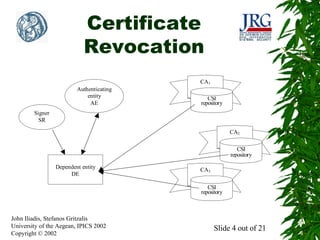
Certificate
Revocation
CA1
Authenticating
entity
AE

CSI
repository

Signer
SR
CA2
CSI
repository
Dependent entity
DE

CA3
CSI
repository

John Iliadis, Stefanos Gritzalis
University of the Aegean, IPICS 2002
Copyright © 2002

Slide 4 out of 21
CSI Mechanisms:
CRLs
➢
➢

➢

Certificate Revocation Lists
Compare to Black lists: Banks, Cell phone
Operators. Dependent entities: merchants
(online POS), Banks, other Cell phone
operators
CRL: Signed list containing serial numbers
of revoked (/suspended?) certificates, the
revocation dates and (optional) reasons

John Iliadis, Stefanos Gritzalis
University of the Aegean, IPICS 2002
Copyright © 2002

Slide 5 out of 21
CSI Mechanisms:
CRLs (cont.)
➢
➢
➢

➢

Delta-Certificate Revocation Lists
Distribution Points
Fresh Revocation Information
(DeltaCRLs on top of DP CRLs)
Redirect CRL (dynamic re-partitioning
of large DP CRLs)

John Iliadis, Stefanos Gritzalis
University of the Aegean, IPICS 2002
Copyright © 2002

Slide 6 out of 21
CSI Mechanisms:
(cont.)
➢

Enhanced CRL Distribution Options
➢

➢

Separate location and validation
functions.

Positive CSI
➢

CRLs are all wrong… CSI should contain
positive, not negative info. Dependent
entity should set ad hoc freshness
requirements and certificate holder should
provide ad hoc CSI.

John Iliadis, Stefanos Gritzalis
University of the Aegean, IPICS 2002
Copyright © 2002

Slide 7 out of 21
CSI Mechanisms:
(cont.)
Online Certificate Status Protocol
–

Server returning signed CSI corresponding to
CSI requests by dependent entities. Possible
OCSP Responses:
1.
2.

3.

“Good”, meaning certificate has not been revoked,
“Revoked”, meaning certificate has been revoked or
suspended,
“Unknown”, OCSP is not aware of that certificate

John Iliadis, Stefanos Gritzalis
University of the Aegean, IPICS 2002
Copyright © 2002

Slide 8 out of 21
CSI: Freshnessconstrained
Revocation Authority
➢

➢

➢

Repositories of CSI need not be
trusted
Separation of Certification Authority
and Authority that issues CSI
(Revocation Authority, RevA)
Dependent entity requires fresh
enough CSI from certificate holder

John Iliadis, Stefanos Gritzalis
University of the Aegean, IPICS 2002
Copyright © 2002

Slide 9 out of 21
Evaluation Criteria:
Type of Mechanism
➢
➢
➢
➢
➢
➢
➢

M1: Transparency,
M2: Offline revocation,
M3: Delegation of revocation,
M4: Delegation of CSI dissemination,
M5: Delegation of certificate path validation,
M6: Referral capability,
M7: Revocation reasons.

John Iliadis, Stefanos Gritzalis
University of the Aegean, IPICS 2002
Copyright © 2002

Slide 10 out of 21
Evaluation Criteria:
Efficiency
➢
➢
➢
➢
➢
➢
➢

E1: Timeliness of CSI,
E2: Freshness of CSI,
E3: Bounded revocation,
E4: Emergency CSI capability,
E5: Economy,
E6: Scalability,
E7: Adjustability.

John Iliadis, Stefanos Gritzalis
University of the Aegean, IPICS 2002
Copyright © 2002

Slide 11 out of 21
Evaluation Criteria:
Security
➢
➢
➢
➢
➢
➢

S1: CSI disseminator authentication,
S2: CSI integrity,
S3: CA compromise
S4: RevA compromise,
S5: Contained functionality,
S6: Availability.

John Iliadis, Stefanos Gritzalis
University of the Aegean, IPICS 2002
Copyright © 2002

Slide 12 out of 21
The need for an
alternative CSI
mechanism
➢

➢

Dependent entities and certificate
holders are not necessarily
experienced computer-users, nor are
they security aware,
PKI security-related procedures have
to be made more transparent, as in
the credit card system.

John Iliadis, Stefanos Gritzalis
University of the Aegean, IPICS 2002
Copyright © 2002

Slide 13 out of 21
An Agent-based
mechanism
➢

➢

The transparency criterion has to be met:
location, retrieval and validation of CSI has
to be made transparent to the dependent
entity.
An Agent-based mechanism could do that,
using the aforementioned CSI mechanisms
and providing an indirection layer between
dependent entity and CSI mechanisms

John Iliadis, Stefanos Gritzalis
University of the Aegean, IPICS 2002
Copyright © 2002

Slide 14 out of 21
ADoCSI:

Alternative
Dissemination of Certificate
Status Information

The agents ADoCSI needs must be able
to:
1. Suspend execution and resume it at another execution
environment,
2. Retain their state, when transporting themselves to other
execution environments,
3. Create child agents and deploy them,
4. Select a network location, out of a list of locations, with
the least network congestion,
5. Communicate the retrieved information back to their
owner or to their owner’s application that spawned the
agent.
John Iliadis, Stefanos Gritzalis
University of the Aegean, IPICS 2002
Copyright © 2002

Slide 15 out of 21
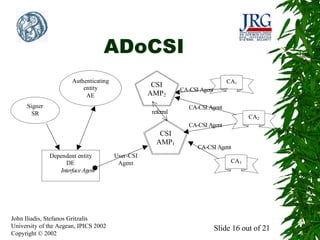
ADoCSI
Authenticating
entity
AE

CSI
AMP2

Signer
SR

referral

CA1
CA-CSI Agent
CA-CSI Agent
CA2
CA-CSI Agent

CSI
AMP1
Dependent entity
DE
Interface Agent

John Iliadis, Stefanos Gritzalis
University of the Aegean, IPICS 2002
Copyright © 2002

User-CSI
Agent

CA-CSI Agent
CA3

Slide 16 out of 21
ADoCSI (2)
1.

2.
3.
4.

5.

6.

Agent Meeting Places (AMP) (also called
Agent Platforms)
Dependent entity,
Authenticating Entity or Signer,
Certification Authority Certificate Status
Information (CA-CSI) Agent,
User Certificate Status Information (UserCSI) Agent,
Interface Agent.

John Iliadis, Stefanos Gritzalis
University of the Aegean, IPICS 2002
Copyright © 2002

Slide 17 out of 21
ADoCSI: Problems
seeking solutions
ADOCSI researchers must find solutions to a series of problems that
emerge from using Agents in CSI, namely :
2.
3.

4.
5.

6.

7.
8.

How can the location function be implemented transparently ?
How can dependent entities retrieve and validate CSI
transparently ?
How is a certificate path validated ?
What is the way this mechanism interacts with dependent
entities ?
How are Agents protected from unauthorised modification or
replacement ?
How can CSI carried by Agents be protected ?
How can an Agent tell a fraudulent Agent Meeting Place ?

John Iliadis, Stefanos Gritzalis
University of the Aegean, IPICS 2002
Copyright © 2002

Slide 18 out of 21
ADoCSI: Problems
seeking solutions (2)
1.
2.

3.

4.

How can AMPs be protected from DoS attacks ?
How can dependent entities be protected against
User-CSI Agent replay attacks ?
How are the Agent Meeting Places protected from
malicious Agents ?
How can an Agent retrieve CSI for a dependent
entity, without letting the AMP know which
certificate did it retrieve CSI for ?

A first paper commenting on these issues will soon
appear.
John Iliadis, Stefanos Gritzalis
University of the Aegean, IPICS 2002
Copyright © 2002

Slide 19 out of 21
References
➢

➢

➢

References of general interest (PKI
mostly)
References to certificate revocation
resources
References to papers on securing
Software Agents

John Iliadis, Stefanos Gritzalis
University of the Aegean, IPICS 2002
Copyright © 2002

Slide 20 out of 21
References (2)
➢

➢

➢

References of general interest (PKI
mostly)
References to certificate revocation
resources
References to papers on securing
Software Agents

John Iliadis, Stefanos Gritzalis
University of the Aegean, IPICS 2002
Copyright © 2002

Slide 21 out of 21

Certificate Revocation: What Is It And What Should It Be

  • 1.
    University of theAegean De Facto Joint Research Group Certificate Revocation: What Is It and What Should It Be John Iliadis1,2, Stefanos Gritzalis1 Department of Information and Communication Systems Engineering University of the Aegean E-mail: {jiliad,sgritz}@aegean.gr 1 2 Department of Informatics Technological Educational Institute of Athens E-mail: jiliad@cs.teiath.gr
  • 2.
    Overview ➢ ➢ ➢ ➢ ➢ ➢ ➢ Introduction What is CertificateRevocation ? Proposed mechanisms for Certificate Status Information Evaluation criteria for CSI mechanisms The need for an alternative mechanism Alternative Dissemination of CSI (ADoCSI) Problems to be solved in ADoCSI John Iliadis, Stefanos Gritzalis University of the Aegean, IPICS 2002 Copyright © 2002 Slide 2 out of 21
  • 3.
    Introduction 1. 2. 3. 4. Is PKI anew era for Network Security? Certificate Revocation? What Certificate Revocation? Certificate Status Information Mechanisms EU Directive: “secure and prompt revocation service” John Iliadis, Stefanos Gritzalis University of the Aegean, IPICS 2002 Copyright © 2002 Slide 3 out of 21
  • 4.
  • 5.
    CSI Mechanisms: CRLs ➢ ➢ ➢ Certificate RevocationLists Compare to Black lists: Banks, Cell phone Operators. Dependent entities: merchants (online POS), Banks, other Cell phone operators CRL: Signed list containing serial numbers of revoked (/suspended?) certificates, the revocation dates and (optional) reasons John Iliadis, Stefanos Gritzalis University of the Aegean, IPICS 2002 Copyright © 2002 Slide 5 out of 21
  • 6.
    CSI Mechanisms: CRLs (cont.) ➢ ➢ ➢ ➢ Delta-CertificateRevocation Lists Distribution Points Fresh Revocation Information (DeltaCRLs on top of DP CRLs) Redirect CRL (dynamic re-partitioning of large DP CRLs) John Iliadis, Stefanos Gritzalis University of the Aegean, IPICS 2002 Copyright © 2002 Slide 6 out of 21
  • 7.
    CSI Mechanisms: (cont.) ➢ Enhanced CRLDistribution Options ➢ ➢ Separate location and validation functions. Positive CSI ➢ CRLs are all wrong… CSI should contain positive, not negative info. Dependent entity should set ad hoc freshness requirements and certificate holder should provide ad hoc CSI. John Iliadis, Stefanos Gritzalis University of the Aegean, IPICS 2002 Copyright © 2002 Slide 7 out of 21
  • 8.
    CSI Mechanisms: (cont.) Online CertificateStatus Protocol – Server returning signed CSI corresponding to CSI requests by dependent entities. Possible OCSP Responses: 1. 2. 3. “Good”, meaning certificate has not been revoked, “Revoked”, meaning certificate has been revoked or suspended, “Unknown”, OCSP is not aware of that certificate John Iliadis, Stefanos Gritzalis University of the Aegean, IPICS 2002 Copyright © 2002 Slide 8 out of 21
  • 9.
    CSI: Freshnessconstrained Revocation Authority ➢ ➢ ➢ Repositoriesof CSI need not be trusted Separation of Certification Authority and Authority that issues CSI (Revocation Authority, RevA) Dependent entity requires fresh enough CSI from certificate holder John Iliadis, Stefanos Gritzalis University of the Aegean, IPICS 2002 Copyright © 2002 Slide 9 out of 21
  • 10.
    Evaluation Criteria: Type ofMechanism ➢ ➢ ➢ ➢ ➢ ➢ ➢ M1: Transparency, M2: Offline revocation, M3: Delegation of revocation, M4: Delegation of CSI dissemination, M5: Delegation of certificate path validation, M6: Referral capability, M7: Revocation reasons. John Iliadis, Stefanos Gritzalis University of the Aegean, IPICS 2002 Copyright © 2002 Slide 10 out of 21
  • 11.
    Evaluation Criteria: Efficiency ➢ ➢ ➢ ➢ ➢ ➢ ➢ E1: Timelinessof CSI, E2: Freshness of CSI, E3: Bounded revocation, E4: Emergency CSI capability, E5: Economy, E6: Scalability, E7: Adjustability. John Iliadis, Stefanos Gritzalis University of the Aegean, IPICS 2002 Copyright © 2002 Slide 11 out of 21
  • 12.
    Evaluation Criteria: Security ➢ ➢ ➢ ➢ ➢ ➢ S1: CSIdisseminator authentication, S2: CSI integrity, S3: CA compromise S4: RevA compromise, S5: Contained functionality, S6: Availability. John Iliadis, Stefanos Gritzalis University of the Aegean, IPICS 2002 Copyright © 2002 Slide 12 out of 21
  • 13.
    The need foran alternative CSI mechanism ➢ ➢ Dependent entities and certificate holders are not necessarily experienced computer-users, nor are they security aware, PKI security-related procedures have to be made more transparent, as in the credit card system. John Iliadis, Stefanos Gritzalis University of the Aegean, IPICS 2002 Copyright © 2002 Slide 13 out of 21
  • 14.
    An Agent-based mechanism ➢ ➢ The transparencycriterion has to be met: location, retrieval and validation of CSI has to be made transparent to the dependent entity. An Agent-based mechanism could do that, using the aforementioned CSI mechanisms and providing an indirection layer between dependent entity and CSI mechanisms John Iliadis, Stefanos Gritzalis University of the Aegean, IPICS 2002 Copyright © 2002 Slide 14 out of 21
  • 15.
    ADoCSI: Alternative Dissemination of Certificate StatusInformation The agents ADoCSI needs must be able to: 1. Suspend execution and resume it at another execution environment, 2. Retain their state, when transporting themselves to other execution environments, 3. Create child agents and deploy them, 4. Select a network location, out of a list of locations, with the least network congestion, 5. Communicate the retrieved information back to their owner or to their owner’s application that spawned the agent. John Iliadis, Stefanos Gritzalis University of the Aegean, IPICS 2002 Copyright © 2002 Slide 15 out of 21
  • 16.
    ADoCSI Authenticating entity AE CSI AMP2 Signer SR referral CA1 CA-CSI Agent CA-CSI Agent CA2 CA-CSIAgent CSI AMP1 Dependent entity DE Interface Agent John Iliadis, Stefanos Gritzalis University of the Aegean, IPICS 2002 Copyright © 2002 User-CSI Agent CA-CSI Agent CA3 Slide 16 out of 21
  • 17.
    ADoCSI (2) 1. 2. 3. 4. 5. 6. Agent MeetingPlaces (AMP) (also called Agent Platforms) Dependent entity, Authenticating Entity or Signer, Certification Authority Certificate Status Information (CA-CSI) Agent, User Certificate Status Information (UserCSI) Agent, Interface Agent. John Iliadis, Stefanos Gritzalis University of the Aegean, IPICS 2002 Copyright © 2002 Slide 17 out of 21
  • 18.
    ADoCSI: Problems seeking solutions ADOCSIresearchers must find solutions to a series of problems that emerge from using Agents in CSI, namely : 2. 3. 4. 5. 6. 7. 8. How can the location function be implemented transparently ? How can dependent entities retrieve and validate CSI transparently ? How is a certificate path validated ? What is the way this mechanism interacts with dependent entities ? How are Agents protected from unauthorised modification or replacement ? How can CSI carried by Agents be protected ? How can an Agent tell a fraudulent Agent Meeting Place ? John Iliadis, Stefanos Gritzalis University of the Aegean, IPICS 2002 Copyright © 2002 Slide 18 out of 21
  • 19.
    ADoCSI: Problems seeking solutions(2) 1. 2. 3. 4. How can AMPs be protected from DoS attacks ? How can dependent entities be protected against User-CSI Agent replay attacks ? How are the Agent Meeting Places protected from malicious Agents ? How can an Agent retrieve CSI for a dependent entity, without letting the AMP know which certificate did it retrieve CSI for ? A first paper commenting on these issues will soon appear. John Iliadis, Stefanos Gritzalis University of the Aegean, IPICS 2002 Copyright © 2002 Slide 19 out of 21
  • 20.
    References ➢ ➢ ➢ References of generalinterest (PKI mostly) References to certificate revocation resources References to papers on securing Software Agents John Iliadis, Stefanos Gritzalis University of the Aegean, IPICS 2002 Copyright © 2002 Slide 20 out of 21
  • 21.
    References (2) ➢ ➢ ➢ References ofgeneral interest (PKI mostly) References to certificate revocation resources References to papers on securing Software Agents John Iliadis, Stefanos Gritzalis University of the Aegean, IPICS 2002 Copyright © 2002 Slide 21 out of 21